Signal House is a cloud communications platform that helps businesses add SMS, MMS and programmable voice to their software and customer workflows. It provides APIs, a management dashboard and integrations with tools such as GoHighLevel, Shopify, Medusa and Make. Businesses use it for permitted messaging, notifications and configured voice applications.
In practical terms, Signal House supplies part of the connection between business software and a customer's phone. A store can trigger an order update, an agency can manage client SMS messaging through a supported integration, and a developer can build a voice workflow. The exact setup, operating interface and charges depend on the service and account you choose.
This guide explains the platform in plain language before moving into features, integrations, pricing and setup. It also separates communication infrastructure from a complete employee phone subscription. Understanding that difference helps you buy the right service and avoid assuming that an API, integration or promotional credit includes every application your team needs.
 4.8/5
 Rating uses the named product profile on G2. It summarizes customer feedback rather than independently measuring every service, integration or network route.
What Is Signal House In Simple Terms?
Signal House is a communications platform as a service, often shortened to CPaaS. That means it offers building blocks for communication inside another application or workflow. A business can use a supported integration instead of developing everything itself, or connect the APIs to its own software when it needs more control.
An API is an interface that lets software request an action. For example, an SMS-enabled appointment application can ask Signal House to send a permitted SMS reminder after a booking is confirmed. A webhook works in the other direction: it tells your application that an event happened, such as an incoming reply or a change in delivery status.
| Topic | Plain-Language Answer | Buying Consideration |
|---|---|---|
| Product category | Cloud communications platform / CPaaS | Choose a supported integration or developer implementation |
| Main communication channels | SMS, MMS and programmable voice | Actual number capabilities and account access matter |
| Typical users | Eligible businesses, agencies, merchants and developers | Verify the actual traffic and operating workflow |
| How software connects | APIs, webhooks and named integrations | Identify who maintains the application and connection |
| Numbers | Purchase or evaluate transfer of an eligible number | Messaging-only transfer differs from moving calls |
| Pricing approach | Usage and resources; integration offers can differ | Include carrier, registration and software costs |
| Evaluation | New-account credit advertised | Confirm eligible resources; credit is not unlimited service |
Signal House Is A Platform, Not A Single Messaging Campaign
The account can contain numbers, registration records, SMS activity and configured services. A campaign describes the intended SMS use; it is not the whole platform. This matters because buying a number, creating an account and getting an approved sender ready are separate steps. Completing 1 does not necessarily complete the others.
Think of the platform as the communication layer and the business application as the operating workspace. They can work together, but each has responsibilities. The workspace may hold appointments and customer records, while Signal House handles the requested communication and returns information about its progress. Staff still need a clear process for responding and resolving issues.
Is Signal House A Business Phone System?
Signal House supports programmable voice and documented SIP and browser options, but that does not make every account equivalent to a complete employee phone subscription. The business needs to identify the intended interface, endpoints and routing. A company seeking a turnkey phone app should ask which employee functions are supplied directly and which require a connected application.
This distinction is useful for small teams. A developer may be comfortable assembling the communication workflow, while an office manager may expect a finished application with familiar staff controls. Both needs are reasonable, but they lead to different purchases. Ask for the actual employee experience before comparing a usage rate with a per-user phone plan.
How Does Signal House Work?
Signal House connects an authorized account, an eligible number and a permitted communication request. The request can originate in a dashboard, supported integration or custom application. The platform processes it through the relevant network path and makes activity information available. Your business then uses that information to manage replies, failures and follow-up.
1. A Business Event Starts The Workflow
An event might be a confirmed appointment, shipping update or staff decision to contact a customer. The application should check that the communication is appropriate before requesting it. A useful workflow also checks whether the customer has already received the same notification, changed the booking or opted out of messages.
For example, a service company could send an SMS reminder when tomorrow's appointments are finalized. If an appointment is canceled, the pending SMS reminder should stop. Signal House can provide the SMS connection, but the scheduling application still needs accurate booking information. Connecting a service does not automatically correct the business data that triggers it.
2. The Account Uses An Eligible Sending Number
A sending number needs the capabilities and configuration for the intended channel. The number guide describes purchasing or porting a number, configuring it and connecting it with the relevant brand and campaign. A number appearing in the account is therefore different from a fully configured production sender.
Keep customer recognition and technical capability separate. A local number can be useful for an area-based business, but it does not establish international coverage. A number enabled for messaging does not by itself establish every voice capability. Confirm the actual sender, country and service rather than treating all phone numbers as interchangeable resources.
3. Signal House Processes The Communication
The company describes connections with carriers and carrier partners for SMS delivery. That is its network proposition, rather than independent proof that every SMS will arrive or every route has the same performance. Carrier filtering, account configuration, recipient availability and content can still affect the result.
For a voice application, the selected configuration determines where a voice call goes and what happens next. It might ring a registered endpoint, connect to an existing system or request instructions from an application. The business should map those branches before launch so an unanswered employee does not leave the caller without a useful next step.
4. Status Events And Replies Return To The Business
The platform's logs distinguish SMS activity and delivery stages. Your application can also use callbacks to receive updates. An accepted request, a sent SMS and a delivered SMS are different events. None automatically proves that the recipient read the content or completed the requested action.
Decide what staff should do with an unresolved result. A failed appointment reminder may need a review task, while an ordinary customer SMS reply needs to reach the correct conversation. The value of the communication service depends partly on this operating process. A dashboard full of events is useful only when the business can act on them.
What Services Does Signal House Offer?
The main documented services include business SMS, multimedia messaging, programmable voice and phone-number management. Signal House also provides integration and developer paths around those services. Availability, registration and commercial terms depend on the actual product, so evaluate each required function rather than assuming a single account includes every possible channel.
| Service | Practical Use | What To Confirm |
|---|---|---|
| SMS messaging | Permitted reminders, updates and customer texts | Configured sender, consent, segment units and replies |
| MMS messaging | Images or other supported multimedia content | Account access, media retrieval, carrier and usage charges |
| Programmable voice | Configured call handling and supported endpoints | Actual call architecture, employee interface and complete fees |
| Phone-number management | Buy, configure or transfer eligible resources | Country, capabilities, registration and transfer scope |
| APIs and webhooks | Connect business software and receive events | Authentication, event processing and operational ownership |
| Logs and reporting | Investigate status, activity and billable units | Retention, staff access and export requirements |
Signal House SMS For Business Texting
SMS is ordinary SMS messaging delivered to a phone number. Signal House supports business SMS messaging through its APIs, portal and named integrations. Typical eligible uses include appointment reminders, customer SMS updates and permission-based outreach. The exact campaign should describe what your business sends and how recipients agree to receive it.
For cost planning, count billable segments rather than only drafted messages. Message length, encoding and personalization can change the number of units. A template that looks short before inserting a full name and address may become longer for some customers. Check realistic rendered examples before forecasting campaign spend.
Signal House MMS For Images And Attachments
MMS adds multimedia content to a phone-number message. The sending guide describes media URLs and uploaded attachments. This can be relevant to permitted product images or other visual information, but the media workflow needs its own evaluation. A working plain-text notification does not prove that every recipient can open a particular attachment.
Check the actual file, hosting requirements and number access. If the media is referenced through a URL, the platform must be able to retrieve it. Staff should know how a failed attachment appears and what alternative information they can provide. Treat multimedia pricing and carrier charges separately from an ordinary SMS-segment estimate.
Signal House Voice For Configured Calling Applications
The documented voice platform includes programmable profiles, SIP trunks, individual SIP endpoints and WebRTC softphones. These are different connection methods for business voice. An existing PBX may use a trunk, while an individual compatible device can register as an endpoint. A browser application has its own configuration and staff-access requirements.
The platform also documents SHML, its call-instruction language, for actions such as speaking text, collecting digits and forwarding. Those actions are building blocks. They do not establish that a complete conversational receptionist, booking system or external AI service is included. Ask for the exact required voice call flow and any additional software involved.
Signal House Phone Numbers And Porting
Businesses can evaluate new numbers or transfers of eligible existing numbers. Signal House distinguishes messaging-only soft ports from full transfers. A soft port moves the messaging service while the existing provider continues handling calls. This can be useful when the phone arrangement works and the business only wants a different messaging connection.
Portability depends on the number, authorization and provider process. Confirm what will move, what will remain and how charges change. Do not cancel the existing service simply because a transfer request has been submitted. The business needs confirmed continuity and a tested replacement before ending a customer-facing resource.
Signal House Logs And Reporting
The SMS logs include direction, sender, recipient, segment information and delivery status, with additional details for investigation. These records help explain what happened to a communication and why an invoice contains a particular amount. They are operational evidence, not a guarantee that every customer interaction produced a sale or resolved a support issue.
Use consistent names and account organization so staff can find the relevant activity. A location, customer group or campaign label should make sense to the people doing follow-up. When volume increases, clear organization can matter as much as the ability to submit another request. Otherwise, employees spend time searching instead of helping the customer.
Signal House Integrations: Which Tools Can Connect?
The current integration catalog names GoHighLevel, Shopify, Medusa, Make and AI-assistant tools. Each connection has its own purpose and requirements. A store plugin is different from an agency CRM integration, and neither should be assumed to expose every API operation or voice feature.
Signal House For GoHighLevel Agencies
The HighLevel offering is positioned around native client SMS messaging and agency pricing control. It can be relevant to an agency that wants customer SMS conversations inside its existing CRM. Ask to see ordinary sending, incoming replies, client separation and usage attribution in the actual account. A feature name is less useful than a working employee process.
Commercial terms deserve a separate check. The dedicated integration guide presents monthly options and a different pay-as-you-go SMS segment figure from the general API starting rate. The agency should obtain a worked invoice for the offer it will purchase. Do not assume that a public transport rate automatically becomes the price inside every integration.
Signal House For Shopify Stores
The Shopify product page describes abandoned-checkout texting, customer replies and AI-assisted conversations with human takeover. It advertises a free-to-install app with 100 included segments. That is a specific store offer, rather than proof that every Signal House product is free or that usage remains unlimited after the allowance.
A store should evaluate the customer journey before enabling automation broadly. Check which carts qualify, what information the reply assistant can use and how staff intervene. Test a customer asking a question the system cannot answer. The workflow should provide a clear handoff rather than invent stock, shipping or refund information.
Signal House For Medusa Commerce
The Medusa integration is a free, open-source plugin for the documented supported version of that commerce platform. It describes order and shipping texts, cart reminders, consent handling, broadcasts and phone sign-in. Communication usage still bills through the account; free plugin code is different from free network activity.
For a merchant, the practical benefit is bringing the communication workflow into the commerce administration environment. A developer still needs to install and maintain the connection. Verify compatibility with the actual store version, test order changes and review how consent records are retained. A new integration announcement should not be treated as a guarantee for every customized storefront.
Signal House With Make Automation
The Make connector provides a lower-code way to connect business events with SMS actions. The connector's current page describes a Group ID and API-token connection, SMS creation, group SMS and raw API access. This can suit a company that already coordinates its applications through Make rather than maintaining a custom service.
Automation still needs an owner. Decide what happens when a trigger runs twice, an account lacks funds or an appointment changes. A drag-and-drop connection reduces some development work, but it does not eliminate data quality, consent or monitoring responsibilities. Include the automation platform's own subscription and operation limits in the budget.
Signal House MCP And AI-Assistant Access
The provider's dedicated MCP page describes connecting an AI assistant to account functions, such as checking numbers, balances and campaign status. Authorized actions can also change account resources or submit messages. This is an interface to the communication service, rather than evidence that an assistant automatically understands every business policy or should operate without review.
Separate reading information from spending money or changing resources. Signal House describes permission-aware access and write actions that request approval by default in the documented client experience. Confirm the behavior in the particular assistant and account you use. Start with a narrow task and review the selected sender, recipient and content before approving a chargeable action.
What Can You Manage In The Signal House Dashboard?
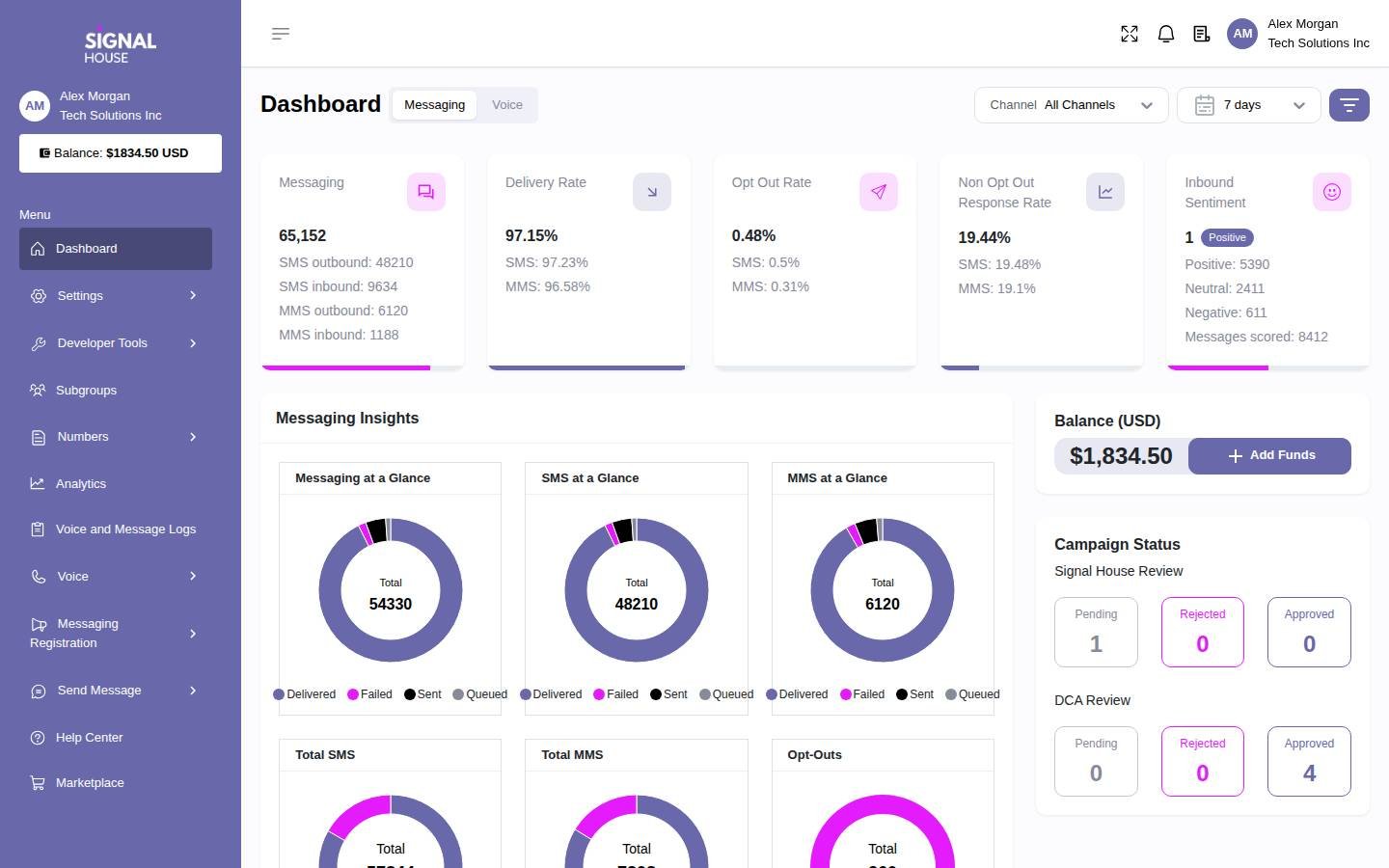
The portal brings account resources and communication activity into a management interface. Signal House's help center describes number configuration, testing tools, SMS logs, developer keys and related account functions. The exact screens and permissions should be demonstrated for your account. A supplied screenshot shows the interface, rather than proving every feature is included in a particular offer.
Numbers, Brands And Campaigns
A brand identifies the business responsible for an SMS program, while a campaign describes the intended use. A number then needs the appropriate assignment and configuration. The platform's setup guides treat these as separate resources. That structure matters when an agency manages several clients or a business runs more than 1 communication workflow.
Use account organization to keep responsibilities understandable. Employees should know which number belongs to which location or client, and who can change it. Before reassigning a resource, check its active automations and customer-facing use. An ordinary administrative change can affect incoming replies or sending if another application depends on the old configuration.
Sending Tests And Reviewing Results
The portal's sending tool can help evaluate an active, configured number and relevant campaign. Signal House's guide describes SMS and multimedia tests plus optional status callbacks. This is useful for checking the complete connection before placing it inside an application. Testing still uses the applicable account and sender requirements.
Choose a controlled recipient who has agreed to the test. Then examine the resulting log, reply behavior and billable units. If the expected update is missing, investigate the saved record before repeating the request. A successful first test is encouraging, but a useful pilot also covers an error or unavailable destination and documents how staff should respond.
How Much Does Signal House Cost?
Signal House generally prices communication usage and related resources separately. Its published pricing page distinguishes sender types, SMS units, phone-number rental and voice charges. The table below uses selected US starting components in USD; it is not an all-in subscription or a price promise for every integration.
| Resource | Published Component | Important Qualification |
|---|---|---|
| Outgoing local SMS | $0.0065/segment | General API starting component; integration terms can differ |
| Outgoing toll-free SMS | $0.0079/segment | Match the actual sender and destination |
| Outgoing local/toll-free MMS | $0.0200/billable unit | Confirm account access and complete media charges |
| Outgoing voice | $0.012/minute initial band | Answered-call minimum and whole-minute rounding apply |
| Incoming US voice | $0.005/minute | Number, surcharges and configured resources can be extra |
| Local messaging number | $1/month starting rental | A voice-enabled number needs its own capability and price confirmation |
| Voice-enabled local number | Request a quote | Do not substitute messaging-only rental as the complete price |
| New-account promotion | $25 credit | Confirm eligible resources and ongoing funding terms |
Signal House Pricing Depends On What You Use
Local and toll-free sending have different starting components. Outgoing messages, incoming traffic, rented numbers and optional resources can create separate charges. The public incoming carrier schedule does not by itself establish the complete platform receiving base, so request that missing amount instead of assuming all replies are free.
Connected tools also belong in the budget. An agency may need a CRM subscription, a store may depend on an app configuration, and a custom application may require hosting and development. A low communication rate can be useful, but it should be compared with the cost of the complete workflow the business will operate.
A Simple Signal House SMS Budget Example
Consider 2,000 outgoing local SMS segments at the selected $0.0065 starting component. That produces $13 in platform SMS charges. Add 1 eligible local messaging number at the selected $1 monthly rental and the subtotal becomes $14 before carrier fees, registration, incoming usage and other charges.
Now assume 1,000 of those segments reach AT&T subscribers and 1,000 reach T-Mobile subscribers, using the published local outgoing carrier components of $0.0035 and $0.0045. The carrier charges add $3.50 and $4.50, bringing the selected subtotal to $22. This is a specified recipient-mix model, not a universal monthly invoice.
If every visible SMS instead contains 2 segments, the same 2,000 customer SMS messages create 4,000 units. Under the same proportional recipient mix, the selected SMS sending component becomes $26, the carrier component becomes $16 and the number adds $1: a $43 subtotal before the remaining exclusions. Content length can therefore matter as much as the advertised unit rate.
Calling Costs Need Billable Minutes
Signal House's published voice terms use a 1-minute minimum for answered calls and round later fractions up to a whole minute. Voicemail counts as answered. For 100 outgoing answered calls lasting 65 seconds each, the calculation becomes 200 billable minutes, not the raw elapsed total. At the selected starting component, that is $2.40 before other resources and surcharges.
Higher outgoing usage uses graduated bands in the published schedule. For example, 250,000 billable minutes are modeled as $1,200 for the first 100,000 plus $1,350 for the next 150,000, totaling $2,550. The lower band is not applied retroactively to every minute. Confirm the actual configuration and agreement before using this as a budget.
General API Pricing And Integration Plans Can Differ
Signal House's dedicated HighLevel plan guide describes monthly options from $20 and a separate $0.02-per-segment pay-as-you-go offer. These should not be silently replaced with the general API starting figure. Ask for an invoice example for the actual product and account you intend to buy.
The guide displays monthly price, message limit and a per-SMS column. Do not invent an included allowance or an effective bundle rate by interpreting those columns without clarification. Confirm subscriptions, usage, overages, carrier charges and cancellation separately. A clear worked example is more useful than comparing 2 numbers that belong to different offers.
Is Signal House Free To Use?
Signal House advertises a $25 new-account credit, which is a promotional allowance rather than unlimited free service. Its Shopify and Medusa offerings also have their own installation or plugin terms. A free app or included evaluation units do not make all communication, numbers and connected resources permanently free.
Ask which resources an allowance covers, any eligibility restrictions and how ongoing funding works. Do not assume a fixed trial duration when none has been verified for the offer. Before using the service for a live customer SMS workflow, confirm SMS sender approval and the cost after the credit is consumed.
Check Signal House Pricing And Account Credit
Who Is Signal House For?
Signal House can suit businesses that need a supported communication workflow around their software. The strongest fit depends on the intended channel, integration, traffic eligibility and available technical ownership. The following examples describe buying scenarios, rather than a guarantee that every account includes the same functions or that every industry is permitted.
| Intended User | Useful Scenario | Evaluation Priority |
|---|---|---|
| Small service team | Customer updates with staff follow-up | Demonstrate a reply, changed booking and unresolved task |
| Eligible agency | Client messaging through a supported CRM | Client separation, exact plan, consent and usage attribution |
| Ecommerce merchant | Order updates or eligible cart recovery | Actual store platform, customer controls and staff takeover |
| Application developer | Communication inside existing software | Supported operations, events, retries and maintenance |
| Business retaining a PBX | SIP connection or defined endpoint arrangement | Device fit, routing, unavailable staff and complete call cost |
Small Businesses Sending Customer Updates
A service business may want booking confirmations and replies without staff using personal numbers. Signal House can be relevant when the chosen application provides the required scheduling and conversation interface. Evaluate a complete example: create a booking, notify the customer, receive a changed-time request and assign someone to respond.
For a small team, simplicity is an operating requirement. Staff should be able to identify an unresolved reply and know what to do next. If the proposed setup depends on a developer for every routine task, include that dependency in the decision. The right solution is the one the business can maintain after the initial demonstration.
Marketing Agencies Managing Eligible Client Messaging
Signal House's HighLevel proposition can be relevant to an agency already using that CRM. Evaluate client separation, pricing control, consent records and the handling of departing clients. An agency needs more than an outgoing send button: it needs accurate attribution of usage and a repeatable support process across accounts.
Establish traffic eligibility before onboarding clients. The provider's terms restrict specified categories, including certain third-party lead-generation and marketing activities. A technical connection does not approve every business model. Explain the intended client work and obtain the relevant authorization rather than assuming a general agency label establishes permission.
Ecommerce Stores With Recognized Communication Events
For a store, useful events include an order confirmation, shipping change or eligible abandoned checkout. Signal House's Shopify and Medusa paths are different ways to connect those events with customer SMS messaging. Choose the integration that matches the commerce platform, and verify what information it can access and how employees intervene.
Judge the result against the customer's experience. The notification should contain accurate information, a working destination and a clear route for help. Review automation when an order is canceled or a customer opts out. An increased message count is not by itself a useful outcome if the content arrives at the wrong time or creates confusion.
Developers Building Communication Into An Application
A developer can evaluate Signal House for a product that already owns customer records and business logic. The API and webhook path can keep communication events inside that application. Start by defining the minimum operations required, then check the actual authentication, event formats and error behavior in the current documentation.
Assign maintenance responsibility from the beginning. Credentials, callback endpoints, balance monitoring and changes to account resources need ongoing ownership. A successful request in a prototype is only 1 stage. Production also needs careful retries, status reconciliation and a way for support staff to investigate a customer issue without exposing unnecessary personal information.
How To Get Started With Signal House
Start by defining a single useful workflow and checking that it is supported and eligible. Then create the appropriate account, choose an integration or developer route, prepare the required sender and run a controlled test. The outline below explains the purchasing and setup decisions; current account instructions should control the exact screens and fields.
1. Define The Communication Task
Write down who sends, who receives, what starts the communication and what staff must do afterward. A reminder with a customer SMS reply needs different handling from an outgoing-only alert. If voice is required, identify the employee destination and the behavior when nobody answers. Clear requirements make the demonstration and quote more useful.
Choose success measures that match the task. For example, an employee should find the correct customer reply and complete a requested change. Do not treat an accepted API request as the whole outcome. The operating procedure should explain how the business identifies unresolved work and which person owns it.
2. Choose The Right Account And Connection
Tell Signal House whether you will use a supported integration, the portal or a custom application. Ask which account offer applies and what software is needed alongside it. A store integration, an agency arrangement and a general API account can have different commercial and operational details.
If the business wants voice, demonstrate the chosen endpoint and interface. If it only wants messaging, do not add an unnecessary phone migration to the project. A narrow initial setup can make it easier to identify actual requirements before increasing the number of workflows, employees or customer accounts involved.
3. Prepare The Business And Sender Information
Signal House's 10DLC guidance describes registering the brand, submitting the messaging use and assigning numbers. Prepare accurate business details, sample SMS content and the recipient opt-in process. The registered description should reflect the SMS messages the business will actually send, rather than wording copied from an unrelated campaign.
SMS sender registration and recipient consent answer different questions. Completing a registration does not grant permission to contact every imported number. Preserve the company's consent and opt-out records, and establish which system controls those preferences when several connected applications can submit messages.
4. Connect, Test And Reconcile
Use the selected Signal House instructions to connect the application and configure events. Keep credentials private and grant only the access required. Test an ordinary send and reply, then inspect the relevant SMS logs and charges. If the workflow uses multimedia or calls, include those in the pilot instead of assuming the SMS test validates every channel.
Record unresolved requirements before going live. These might include a missing permission, sender approval or unclear billing component. Assign an owner to each item and retest the affected branch after it is resolved. A controlled rollout is more informative than launching everything and trying to infer what went wrong from a large collection of failures.
Signal House Benefits, Limitations And Buying Considerations
Signal House's potential benefits include communication APIs, supported integrations, account management tools and human implementation assistance. Their value depends on the workflow the business actually needs. Evaluate the finished operating arrangement rather than assuming that more features on a product page necessarily produce a simpler employee experience.
Where Signal House May Add Value
A named connection can reduce the amount of application work required for a supported use case. Central logs can make a communication easier to investigate. Configured voice options can connect an existing environment rather than force a complete redesign. These are practical reasons to evaluate the platform, not guarantees that every company will save the same amount of time or money.
Implementation help is especially useful when it resolves a real dependency, such as getting replies into the right workspace or identifying an account configuration problem. Ask what assistance is included, who maintains the connection afterward and how issues are escalated. A clear support arrangement should survive the handoff from sales to everyday use.
What You Still Need To Confirm
Ask Signal House for the exact employee interface, supported functions, account terms and complete charge schedule. Confirm incoming usage, number capabilities, integration subscriptions and any required development. Do not describe planned channels as available services merely because a broad page or older announcement mentions them.
The same caution applies to performance and compliance. This guide does not independently verify delivery percentages, uninterrupted availability or automatic approval. For sensitive data or a regulated use, obtain the appropriate product-specific contractual confirmation. A business communication platform does not make every message or connected workflow suitable by default.
Signal House Security And Operating Ownership
Review available account permissions, credential handling and retention requirements with the provider. The provider's privacy policy and terms explain how it handles customer information and the customer's responsibilities. The business should also review connected platforms, because a CRM or store application may hold the same communication content and customer details.
Keep access keys out of public pages and customer-facing code, and establish who can change numbers or funding settings. Confirm the account's supported safeguards instead of assuming an alert is a guaranteed spending cap. Useful security and cost control depend on the application and staff process as well as the communications account.
How Does Signal House Compare With Other Options?
Signal House is an alternative to consider when a business needs the supported communication functions and integration model. Other providers may have different rates, channels or application features. A useful comparison keeps the same sender, destination mix, incoming workload and operating requirements on both sides.
For broader research, our guides to Twilio alternatives and competitors and Telnyx alternatives provide related starting points. These are different purchasing questions from this introductory guide. Choose an alternative because it resolves a specific need, rather than assuming any communications API replaces every product in a competitor's catalog.
A business that needs a finished phone application should compare the supplied employee software as well as the network connection. A developer building a product should compare supported operations and maintenance work. An agency should compare client administration and commercial terms. Those distinctions make the shortlist more useful than a universal cheapest label.
Frequently Asked Questions About Signal House
What Is Signal House Used For?
Signal House is used to add business SMS messaging and configured voice to applications and workflows. Examples include eligible customer SMS reminders, order updates, agency messaging and developer-built communication services. The required integration, sender approval and staff interface depend on the actual use case and account.
How Does Signal House Send SMS?
Signal House accepts an authorized request through a supported interface, processes the message using the configured sender and network path, and makes status information available. The business needs an eligible account and sender plus permission for the communication. Its application or staff process must handle replies and unresolved results.
Do You Need Coding Skills To Use Signal House?
Not for every supported workflow. Signal House lists prebuilt integrations and portal tools, while custom applications use its APIs and webhooks. The exact technical work depends on the chosen connection. Even a lower-code setup needs someone responsible for configuration, consent, monitoring and routine changes.
Can Signal House Work With GoHighLevel?
Yes. Signal House markets a HighLevel integration for client SMS messaging and agency pricing control. Confirm the exact functions, client-access model and integration plan. Dedicated HighLevel terms can differ from the general API starting rate, so request a worked invoice for the account you will use.
Does Signal House Support Calls As Well As Texts?
Yes. Signal House documents programmable voice, SIP trunks, individual endpoints and browser voice options alongside messaging. The business still needs the intended configuration, compatible endpoints and any connected application. These capabilities do not automatically include every feature of a complete employee phone system.
Can I Keep My Existing Number With Signal House?
Potentially, subject to eligibility and the transfer process. Signal House documents messaging-only soft ports and full transfers. A soft port keeps calls with the existing provider while moving messaging. Confirm the scope, authorization, fees and continuity plan before changing or canceling an active service.
Is Signal House Free?
No, ongoing communication and resources are chargeable under the applicable offer. Signal House advertises $25 in new-account credit, while certain integrations have separate free-installation or plugin terms. Confirm eligible usage and ongoing costs rather than treating an allowance as permanently unlimited service.
How Much Is Signal House SMS?
The selected published US starting outgoing components are $0.0065 per local SMS segment and $0.0079 per toll-free SMS segment, before carrier and other charges. Volume and integration offers can differ. Obtain the rate for your actual sender, account and workload, including incoming traffic and rented resources.
Is Signal House An AI Receptionist?
Signal House supplies communication and integration capabilities, including documented AI-assistant access and specific commerce conversation features. That does not establish a complete general-purpose AI receptionist subscription. If you need callers screened, appointments booked and staff transfers handled, verify the exact conversational application and full configured price.
Does Signal House Guarantee Delivery Or Approval?
No universal delivery or approval guarantee is established by this guide. Provider marketing figures do not prove the result for every sender or recipient. Registration, content, carrier conditions and account configuration can affect outcomes. Run a representative permitted pilot and obtain the relevant service terms before depending on the workflow.
Who Should Evaluate Signal House?
Eligible businesses, agencies, merchants and developers needing a supported communication workflow can evaluate Signal House. Start with the required channel, employee experience and complete budget. A demonstration should show the actual customer journey and identify any extra application or development work.
Is Signal House Right For Your Business?
Signal House is worth evaluating when its messaging, voice or supported integration path fits a defined business need. The platform can provide a communication layer around software the company already uses. Its usefulness depends on a working customer journey, clear staff ownership and account terms that match the intended traffic.
Start with 1 real scenario, obtain a complete quote and test the necessary functions. Pay particular attention to integration-specific prices, receiving charges, number capabilities and follow-up. That approach turns a general question about Signal House into a practical decision about the workflow your business can operate.
What Do Customers Say About Signal House?
Signal House's named G2 profile shows 4.8/5. Reviewed feedback includes Ismail A.'s positive account of onboarding help and The T.'s praise for setup assistance alongside a request for clearer voice guidance. These are individual customer opinions, rather than proof of a universal support or performance result.
Older comments should be checked against current documentation. For example, a historical request for clearer voice pricing does not override the provider's published rates today. Use customer feedback to form evaluation questions, then verify the proposed service directly. No independent hands-on performance test was conducted for this guide.
Affiliate Disclosure: VoIPCalling may earn a commission when you use selected recommendation links, at no additional cost to you. Recommendations reflect the stated use cases and documented information; offers, eligibility and account terms may change.