Signal House pricing combines messaging usage, carrier charges, number rental and applicable registration or campaign fees. Its main rate card lists US local outbound SMS from $0.0065 per segment. GoHighLevel plans use a separate offer, and some help-center figures differ from the main pricing page. Confirm your account rates before treating a headline price as your total bill.
For a business sending reminders, sales follow-ups or customer updates, the important question is how much a complete month will cost. A short message, a long personalized message and a customer reply can produce different charges. This guide explains the components, shows conditional budgeting examples and identifies the questions to take to Signal House before buying.
The examples are calculations, not customer invoices or results from hands-on testing. They use stated assumptions so you can replace each input with the amount on your own quote. All dollar amounts are USD, and the selected public messaging rates concern US sender types rather than a worldwide tariff.
 4.8/5
Best suited to evaluating usage-based messaging infrastructure and supported integrations. Match the account offer to your application and sending requirements.
Check Signal House PricingSignal House Pricing: Messaging Rates At A Glance
Start with the sender type and usage unit. Signal House publishes different messaging offers for local numbers, toll-free numbers and short codes. Number availability, campaign approval and the intended application belong in the same decision. A rate from the wrong sender category is not a useful estimate.
| Sender Type | Outbound Usage | Number Cost | Budget Boundary |
|---|---|---|---|
| US Local / 10DLC | SMS: $0.0065/segment MMS: $0.0200/segment | $1/number/month at the no-minimum messaging tier | Carrier and applicable registration fees additional. |
| US Toll-Free | SMS: $0.0079/segment MMS: $0.0200/segment | $1/number/month | Separate verification; confirm the complete offer. |
| US Short Code | SMS: $0.0065/message MMS: $0.0200/message | Random code: $1,000/month; $1,000 setup | MMS enablement: $500; confirm billing units and commitment. |
This is a starting-rate snapshot, not a complete tariff. Volume, sender selection and negotiated terms can change pricing. For a short code, confirm how a long message is counted because the public card uses different unit wording. Do not automatically apply the local-number segmentation model to every service.
Choose A Signal House Sender For The Actual Workflow
A small service business and a large marketing operation can need different sending arrangements. Write down the intended message purpose, approximate volume and whether customers must reply. Ask Signal House to identify the suitable sender and campaign configuration before selecting a rate from a marketing page.
Keep the number decision separate from message copy and consent. An available number does not establish permission to contact every customer. Likewise, a campaign accepted for a particular use should not be treated as approval for an unrelated program. These decisions affect the implementation as well as the budget.
Why Signal House Pricing Figures Differ Across Pages
The main rate card lists local-number MMS at $0.0200, while the pricing-structure help guide lists $0.04. Number rental also differs: the main messaging card shows $1 at its starting tier, while the guide shows $1.15 renewal. Neither page explains a universal rule that reconciles those figures for every account.
There are also differences between the main carrier card and the carrier-fee help article. Some amounts differ, and the help article's note about inbound applicability conflicts with rows in its own table. A reliable estimate should flag that uncertainty instead of selecting whichever value makes the bill look smallest.
Use Signal House Account Pricing To Resolve Your Quote
Signal House directs existing users to Settings → Account Pricing for account-level platform, brand, campaign and carrier information. It also says negotiated arrangements appear there. Obtain that breakdown and ask for a written explanation of any difference from the public pages. A prospective buyer can request an equivalent itemized proposal.
Save the agreed pricing with the account name and service scope. If the team changes plans or sender types later, repeat the comparison. Keeping the inputs beside the estimate makes it easier to identify a genuine billing discrepancy rather than assuming every change in monthly spend is an incorrect charge.
Budget For Signal House Pricing Uncertainty
For 1,000 qualifying MMS units, the 2 published figures imply base charges of $20 or $40 before other fees. That is a $20 unresolved difference, not an automatic discount. Ask which amount applies before approving a media-heavy campaign or promising a fixed client price.
The rental difference is smaller for 1 number but scales with inventory. Across 100 numbers, the 2 listed amounts differ by $15 per month. Record the correct account rate rather than ignoring the issue because it looks minor on an individual line. Small recurring differences become more important across an agency portfolio.
Signal House Setup Fees, Renewals And Conditional Charges
The help-center pricing-structure guide lists the following components. Treat them as published items to confirm, particularly because that guide conflicts with the main card elsewhere. Separate the initial purchase from recurring service fees and from events that occur only when a review or appeal is needed.
| Item | Listed Amount | Charging Basis | Question To Resolve |
|---|---|---|---|
| Brand Registration | $4.50 | One-time | What is included for this brand? |
| Campaign Registration | $15 | Per campaign, initial | Are resubmissions separate? |
| Number Purchase | $1 | Initial acquisition | How does rental begin? |
| Campaign Renewal | $1.50 low-volume / $10 standard | Monthly | Which classification applies? |
| Number Renewal | $1.15 | Recurring | Reconcile with the main card's $1. |
| Brand Vetting | $40 | Conditional review | Is it required for this brand? |
| Brand Appeal | $11 | Conditional appeal | What event triggers it? |
Do Not Add Every Conditional Charge Automatically
A list of possible fees is not a statement that every new customer pays every item. Ask Signal House which reviews are required, which are optional and what happens after a rejection. Keep the answer specific to the brand, campaign and requested sending arrangement.
Also distinguish a brand appeal from a campaign resubmission. They concern different steps and should not be combined into a single generic compliance fee. Ask Signal House what action triggers each of the fees and whether a correction can be reviewed before it reaches an upstream party.
Check The Difference Between Review Stages
Signal House's campaign-review guidance distinguishes its internal review from upstream carrier review. The guide describes free internal corrections and a possible $15 upstream resubmission fee. That is another reason to resolve the campaign description and permission flow before assuming the initial registration payment covers every eventuality.
Good preparation can reduce avoidable rework, but it does not guarantee approval or eliminate all future costs. Keep the business identity, intended use and sample content consistent. Ask the Signal House reviewer to explain an unresolved requirement rather than repeatedly paying to submit unchanged information.
Signal House Carrier Fees: The Extra Usage Component
The platform's base price and the recipient carrier's charge are separate components. Sender type, direction and carrier can affect the applicable amount. Signal House describes these fees as pass-through costs. The important budgeting task is to identify the actual rate schedule on your account, including incoming activity where applicable.
Use A Carrier Mix For Signal House Estimates
Suppose a forecast assumes 40% of outbound segments incur $0.0035, 35% incur $0.005 and 25% incur $0.0045. The weighted carrier component is $0.004275 per segment. For 10,000 segments, that component totals $42.75. This is an illustrative mix, not a finding about your customers or the provider's actual invoice.
Replace those inputs with your confirmed pricing and observed destination mix. If no reliable mix is available, calculate more than 1 scenario and label the uncertainty. An estimate built on an unexplained average can appear precise while hiding the largest variable in the forecast.
Keep Incoming Traffic In The Model
A business asking customers to reply should forecast those replies. Signal House's main card separates inbound carrier charges from outbound charges, but it does not provide a sufficiently clear universal inbound platform base in the selected messaging view. Request both components. Do not infer that an unlisted amount is zero.
For a reminder campaign, count confirmations, reschedule requests and ordinary questions separately from the original send. The purpose is not to discourage useful conversations. It is to avoid approving a budget for outgoing notifications and then discovering that the real workflow includes substantial incoming activity.
What To Ask About Taxes And Other Fees
Ask Signal House whether the quote excludes taxes, regulatory fees or optional services. Request a sample invoice with those categories separated from usage. Do not assume a marketing statement about transparent pricing means every charge has already been included in the headline amount.
If a fee cannot be explained, keep it unresolved in the forecast and request clarification. A finance team needs a description, billing basis and trigger, not just a total. This also helps an agency explain charges honestly when a client asks why its invoice differs from a public rate.
Signal House SMS Pricing: How Segments Change The Cost
Signal House bills local outbound SMS by segment rather than by the number of message drafts in a campaign. Its guide describes 160 GSM-7 characters for a single segment and 153 per segment once concatenated. For UCS-2, the corresponding basic limits are 70 and 67. Actual encoding and character units matter.
Some characters use extra encoding units, and an emoji can occupy more than 1 unit. Use the final content's measured segment count rather than assuming that every visible character counts identically. The estimate should include personalization, links and any appended opt-out text.
A Long Message Can Become 3 Billable Segments
Using the guide's basic GSM example, a 310-character message needs 3 concatenated segments. Sending it to 1,000 recipients creates 3,000 outbound segments. At the selected starting base, that is $19.50 rather than the $6.50 implied by counting each recipient as 1 unit. Carrier and other fees are additional.
The difference comes from the usage quantity, not a hidden change to the unit price. For Signal House pricing estimates, show both the recipient count and the expected segments per recipient. This makes a longer message's effect visible before the campaign is approved.
Preview The Final Signal House Template
Test a short name, a long name, a realistic appointment address and the actual URL. Then inspect the final message rather than only the editor's unpersonalized draft. A template that works economically for the shortest record may cross a boundary for other customers.
Keep the copy useful. Removing context can create more replies, confusion or missed appointments, which may outweigh a small usage saving. Compare the complete customer interaction. An effective confirmation should tell the recipient what is happening and how to take the intended next step.
Price Media Messages Separately
Images and other media require their own estimate. Confirm the enabled sending capability, the billable unit and how failed media retrieval is handled. Do not multiply a plain-text recipient count by a media rate without understanding the platform's applicable rules.
Because the published MMS figures conflict, request a small account-specific test and reconcile the charge. The test should validate pricing and workflow behavior, not be presented as a prediction of every future campaign. Keep the approved quote beside the resulting usage record.
Signal House Monthly Cost Examples
The table below models local outbound messaging only. It assumes the starting base from the main card, an illustrative $0.0045 carrier component per segment, 1 number at $1 and a confirmed $10 monthly campaign renewal. These inputs deliberately combine separately identified components; they are not a packaged plan or a universal invoice.
| Outbound Segments | Base Usage | Assumed Carrier Component | Selected Recurring Subtotal |
|---|---|---|---|
| 1,000 | $6.50 | $4.50 | $22.00, including $11 number/campaign assumptions |
| 10,000 | $65.00 | $45.00 | $121.00, including $11 number/campaign assumptions |
| 50,000 | $325.00 | $225.00 | $561.00, including $11 number/campaign assumptions |
Excluded: incoming traffic, media messages, taxes, optional features, application costs and initial registration. Actual carrier mix and campaign classification can change the result. If the account uses the help guide's higher number renewal instead, add $0.15 to each selected subtotal. Confirm whether acquisition and rental both apply during the first billing period.
First-Month Signal House Pricing Versus Ongoing Pricing
Under the conditional 10,000-segment model, adding the guide's brand, campaign and number-acquisition items adds $20.50. The resulting selected first-month amount is $141.50 before excluded charges or credit. If the quoted configuration also requires $40 vetting, the selected amount becomes $181.50.
These examples show why Signal House pricing should be separated into initial and recurring fees. Do not carry an initial item forward every month, and do not remove recurring campaign fees after the launch. Record conditional reviews separately so a normal operating forecast is not confused with a special event.
How A Different Carrier Mix Changes The Estimate
Replacing the flat carrier assumption with the weighted example above changes the 10,000-segment carrier component from $45.00 to $42.75. Keeping the other selected inputs unchanged produces $118.75. The $2.25 difference illustrates how destination assumptions affect the estimate without changing the platform's base rate.
For a small operation, administrative work may exceed that difference. For a large portfolio, accurate assumptions still matter because they repeat across clients. Use the level of detail needed for the decision, and avoid implying that a forecast is an exact future invoice.
Signal House Volume Pricing And Commitments
The main rate card publishes volume bands and invites negotiated agreements. Before applying a discounted rate to a forecast, ask how qualifying volume is measured, which traffic counts and whether the calculation applies to an entire quantity or only part of it. Do not infer those rules from a table label alone.
Signal House voice pricing explicitly describes graduated bands, but that does not establish the same treatment for every messaging offer. Ask Signal House for a worked example around the relevant threshold. An account-specific response is more useful than assuming that all product categories share identical billing mechanics.
Compare The Minimum Commitment With Real Demand
A lower Signal House unit price can become less attractive when the business must pay for capacity it does not use. Request the minimum payment, contract period and treatment of unused allowance. Model a normal month and a quieter month rather than using only the most optimistic campaign forecast.
For Signal House pricing discussions, separate the commitment from predicted traffic. Ask whether several subaccounts can contribute to qualification and what happens if a client leaves. An agency should understand the obligation it retains, even when the original volume estimate came from a customer's proposed campaign.
Price The Whole Agreement
Ask whether the negotiation changes usage, number rental, assistance or another component. Keep the comparison itemized. A concession on a small line should not distract from an important recurring commitment elsewhere in the agreement.
Also include the time needed to implement and maintain the Signal House application. A lower usage price does not automatically remove hosting, monitoring or workflow maintenance. For a business without technical staff, a supported integration may be more practical than an attractive API rate that requires a separate build.
Signal House GoHighLevel Pricing Is A Separate Offer
Signal House's dedicated integration guide lists $20, $50, $100 and $1,000 monthly options. The associated message limits are 2,000, 7,500, 15,000 and 175,000; its per-message column lists $0.015, $0.010, $0.0075 and $0.0065 respectively. It separately describes PAYG at $0.02 per segment.
The relationship between a monthly payment, a stated limit and the usage column needs clarification. Do not assume the guide describes included credits, an access fee plus usage or a complete invoice. Request a worked example for the exact tier. A message limit is not automatically the same thing as prepaid allowance.
Questions That Make Agency Pricing Reviewable
- Does the monthly amount include usage, or is usage charged separately?
- Are limits counted as messages, segments or another unit?
- Which carrier, registration and number fees remain additional?
- Does the subscription apply to the agency or each location?
- What happens above the stated limit and during a plan change?
- How do incoming replies appear in usage and billing?
Compare the answers with your agency's actual workflow. A location sending occasional reminders and a client running a large campaign may need different arrangements. Keep client expectations aligned with the underlying quote rather than promising a single unlimited service from incomplete pricing information.
Agency Markup Changes The Signal House Client Price
Signal House's SaaS-plan guide describes feature charges and billing multipliers for client-facing arrangements. An agency's resale price can therefore differ from the underlying provider cost. When reviewing a bill, identify who set each amount and whether the invoice includes the agency's application or management service.
For example, a hypothetical $100 cost increased by a 20% markup becomes $120. The $20 difference is 16.7% of revenue, not a 20% gross margin. This arithmetic matters when an agency promises a profit target while also paying for onboarding, account management and customer support.
Verify The Account Offer Before Moving Traffic
Use the dedicated GoHighLevel plan guide to frame questions, then obtain the confirmed account terms. A general Signal House pricing page is useful background, but it should not replace the integration proposal.
Test manual sending, workflow automation, a customer reply and a suppressed follow-up. Reconcile their usage records before migrating essential activity. The cheapest arrangement on paper is not useful if its permissions or workflow do not match the agency's application.
Signal House Credit: What The New-Account Offer Means
Signal House advertises $25 new-account credit for initial brand, campaign, number and messaging activity. That is a credit offer, not a verified unlimited free plan or a fixed-duration free trial. Confirm eligibility, applicable services and any restrictions before relying on it.
Do not subtract the credit from every future month of a recurring forecast. Show the normal quoted cost first, then identify any eligible initial credit separately. This gives a business owner a clearer picture of the amount required after the introductory balance has been used.
Use Credit For A Defined Evaluation
A useful Signal House evaluation checks 1 representative customer journey from sending to reply handling and billing. Prepare the expected result, a small group of consenting test recipients and a person responsible for reviewing the records. Avoid spending the available balance on an uncontrolled campaign before the configuration is understood.
If registration consumes part of the credit, confirm how much remains before testing. Also ask Signal House what happens when the balance is exhausted. A successful evaluation should explain the next paid step and the ongoing pricing, rather than leaving the buyer to infer the cost from a temporary offer.
How To Check Signal House Billing And Wallet Charges
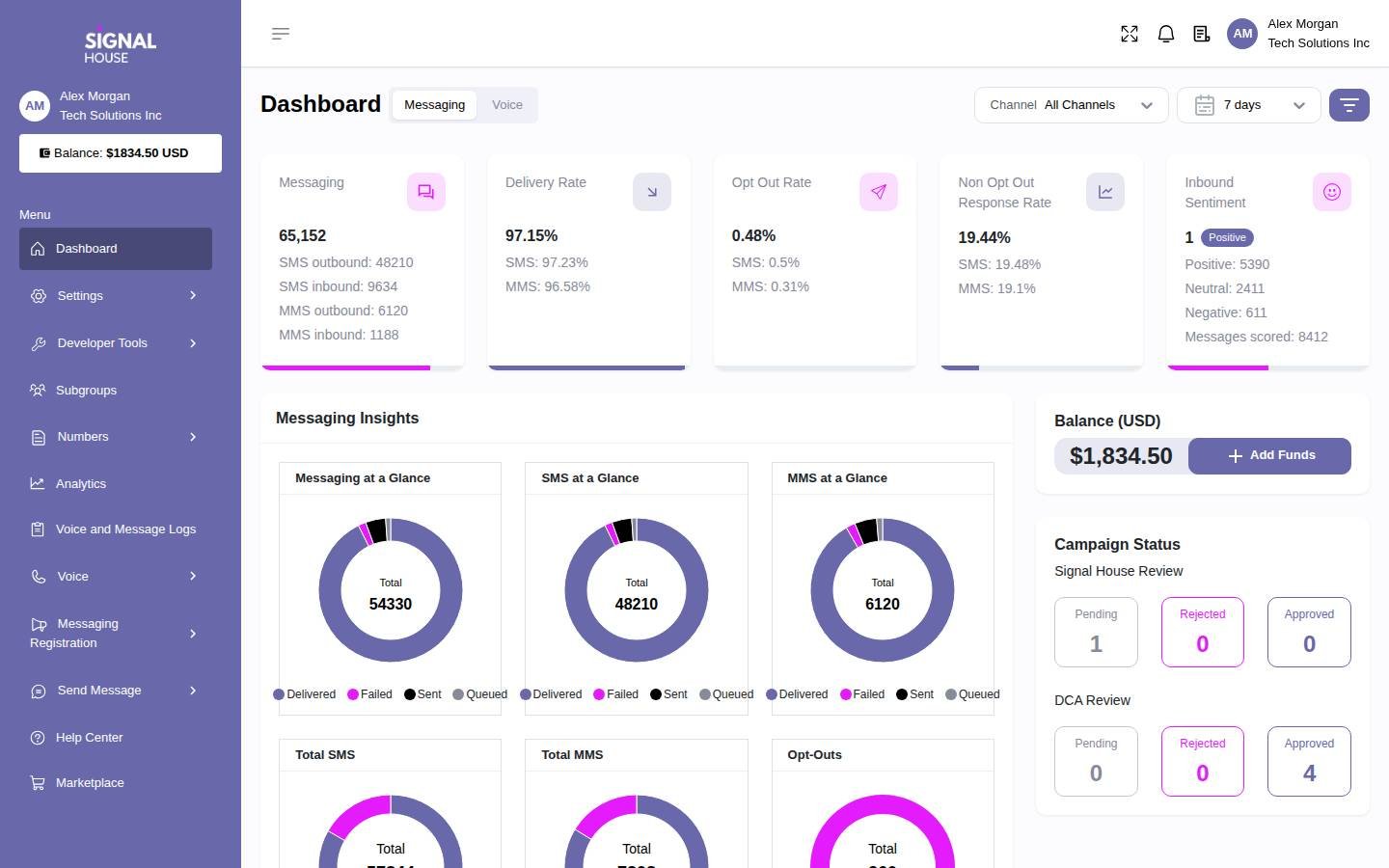
Signal House's billing guide directs users to Settings → Billing for invoices, payment history, account funding and usage summaries. Its agency guide describes a Wallet area within the GoHighLevel app. Use the instructions that match the account you actually operate.
A Wallet Deposit Is Different From Usage Expense
Putting $100 into an account does not establish that the business consumed $100 of messaging. Reconcile the opening balance, added funds, deducted charges, adjustments and closing balance. Keep the payment receipt and usage breakdown together so a top-up is not mistaken for a monthly subscription price.
For Signal House pricing reviews, choose a consistent reporting period. A card payment near month-end and usage charged across a different period can otherwise look like duplicate expenditure. Ask the billing team to explain any adjustment before treating it as new traffic.
Signal House Auto-Recharge And Balance Thresholds
The general billing guide describes recharge settings and a $30 minimum threshold field. The agency wallet guide illustrates a different threshold. Confirm the actual configuration available on your account; a threshold setting is not automatically a universal minimum purchase or monthly charge.
Assign someone to monitor funding and payment failures. Signal House's billing guidance warns that insufficient funds can affect campaigns. Auto-recharge can help maintain funding, but it does not guarantee delivery, approval or uninterrupted application operation. Check payment limits and keep the escalation owner identifiable.
Review Signal House Usage By Client Or Business Unit
The billing documentation describes breakdowns by subaccount or subgroup. Use the relevant view to identify which client or application produced a change in spending. Keep the business explanation alongside the export: a new appointment workflow can explain higher traffic without indicating a change in pricing.
For an agency, agree whether the customer sees raw usage, a marked-up rate or a bundled management service. A transparent client invoice should make that pricing arrangement understandable. Do not describe the agency's entire service fee as a carrier charge.
How To Reduce Signal House Messaging Costs
Improve Templates Without Losing Useful Information
Begin with the highest-volume templates. Check their measured encoding and length, remove redundant wording and retain the details customers need. A clearer reminder can be more economical than sending a vague message that generates several avoidable follow-ups.
Keep a small approved Signal House template library and review changes before launch. For Signal House pricing forecasts, record the typical segment count beside each template. This makes it easier to understand why a copy change affected usage and helps an agency explain the result to a client.
Remove Duplicate And Unnecessary Sends
Check whether multiple workflows respond to the same event. A booking confirmation, a generic welcome and a sales sequence may overlap without anyone intending to contact the customer 3 times. Review the complete experience before optimizing individual unit costs.
Investigate uncertain message results before retrying. A missing event in your application does not by itself establish that the first request failed. Save the relevant identifier and determine the correct state. This protects the customer experience as well as the budget.
Review Numbers And Campaign Renewals
Maintain an inventory of active Signal House numbers, their purpose and the employee or client who owns them. Investigate unused resources before renewal, but preserve anything needed for incoming conversations or a planned transfer. A small rental saving is not worthwhile if a business loses an important contact route.
Signal House's campaign guide distinguishes turning off renewal from permanent deactivation. Confirm the consequences before changing either setting. Export required records and establish the replacement workflow first. Reducing recurring expenditure should follow an ownership review rather than an unplanned cleanup.
Compare Pricing On A Complete Workload
If you assess an alternative or competitor, send the same workload description to each vendor. Compare billable segments, carrier mix, number types, registration and the application layer. Our communications API alternatives guide can help build a wider shortlist.
Include switching and maintenance effort. A hypothetical $300 migration that saves $15 per month has a simple 20-month payback before other changes. A price reduction is useful when the implementation fits and the saving survives the work required to obtain it.
When Signal House Pricing Represents Good Value
Signal House can be worth evaluating when the required integration is available, the quoted rates are clear and the team can operate the service. Value depends on the whole workflow. A lower transport expense is helpful, but it should be considered alongside administrative time and the consequences of missed customer conversations.
A small business should identify who maintains the application and answers replies. An agency should also model client onboarding, billing questions and offboarding. A developer should inventory API dependencies. Those responsibilities help determine whether usage-based infrastructure is an appropriate purchase.
Compare Cost With The Business Outcome
For an internal value check, divide the relevant communication expense by a useful outcome, such as confirmed appointments. If a hypothetical program costs $120 and produces 40 confirmed bookings, the communication cost is $3 per booking. This does not prove that messaging caused every booking or include the whole acquisition budget. Use consistent attribution, include applicable fees and compare Signal House pricing alongside administrative effort when reviewing the program.
Request A Worked Quote Before Committing
Give Signal House the number of senders, outbound segments, expected replies, media activity and integration details. Ask for initial, recurring and conditional charges separately. Include a normal month and a peak month, and resolve conflicting public figures on the written proposal.
Then run a small pilot and compare the recorded units with the estimate. This does not prove every future outcome, but it can reveal misunderstood billing units before essential traffic moves. Keep the confirmed pricing, configuration owner and escalation process together.
Frequently Asked Questions About Signal House Pricing
How Much Does Signal House Cost Per Message?
The main local-number card starts at $0.0065 per outbound segment. That is not a complete per-conversation cost: length, carrier charges, incoming replies and account terms can change the total. Confirm the billing unit and the final template's segment count.
Why Is My Bill Higher Than The Base Rate Suggests?
The base covers only a selected usage component. Number rental, campaign fees, carrier activity and initial or conditional fees may also apply. Reconcile the invoice by category and compare actual segments with the quantity used in your forecast.
Does Signal House Have Setup Fees?
Its help guide lists initial brand, campaign and number-acquisition items. Conditional reviews or resubmissions can be separate. Ask which items apply to your account and distinguish them from recurring renewal fees before approving the first payment.
Are Incoming Messages Free?
Do not assume so. Ask for the applicable inbound platform pricing and carrier fees. An absent or unclear base price does not establish zero cost, and the published carrier documents contain differences that need account-level confirmation.
Is Signal House GoHighLevel Pricing The Same As API Pricing?
No identical offer is established. The integration guide publishes its own plans and PAYG arrangement. Request a worked invoice showing how its monthly amount, limits, usage and additional fees combine before applying the general API headline.
Can I Get A Custom Signal House Pricing Quote?
The provider invites volume discussions. Ask Signal House to quote your actual sender types, expected traffic and integration. Confirm commitments and quiet-month costs alongside any lower usage rate.
Does Adding Voice Change The Messaging Budget?
It can. Calling introduces directional usage, billing increments and potentially different number or feature fees. Request a separate voice estimate rather than assuming a messaging-enabled number or credit allocation covers the complete calling setup.
How Do I Confirm The Correct Published Rate?
Compare the main rate card with your account's pricing and agreement. Ask the provider to resolve discrepancies in writing. Preserve that explanation with the quote so later billing reviews use the same assumptions.
Signal House Customer Reviews About Pricing And Billing
Signal House's exact G2 product profile shows 4.8/5. Ismail A. praised onboarding assistance, while The T. described clear, low pricing and helpful support. Those comments reflect individual experiences rather than verified savings for every customer. The T. also wanted clearer voice guidance.
Denise B. said setup and configuration instructions could be clearer. For a pricing decision, use that feedback to ask who explains account settings and billing categories. This is a buying question, not proof of a billing defect. Customer reviews complement the confirmed quote; they do not replace it.
Affiliate Disclosure: We may earn a commission through recommendation links, at no additional cost to you. Prices are published examples subject to account confirmation. Calculations are illustrative; no hands-on billing or performance testing is claimed.