When reaching out to support teams, customers expect immediate help and easy communication. As telecom infrastructures evolve, interactive voice response (IVR) technology is a key enabler in meeting those expectations. The choice of trustworthy ivr solution providers has become more of a strategic decision than a mere upgrade. With the right telephony architecture, organizations can realize fast, personalized, customer-centric service experiences. Better platforms guarantee that callers are directed to the appropriate department in a timely fashion, without delay. This detailed guide covers the top software tools, key features, pricing models, and recommendations to optimize your corporate communication network.
What Is IVR Software?
Interactive voice response (IVR) software is an automated telephony solution that can interact with callers, gather information, and route calls to the appropriate representative without any human interaction. Modern hosted IVR systems are based on pre-recorded audio and touch-tone keypad signals to accurately understand customer needs. This technology directs people based on their intent, urgency, or specific account details, instead of sending everyone to a generic waiting line, and provides seamless escalation to live agents.
The modern-day ivr softwares are much more than a simple phone tree and a fixed menu. These dynamic tools integrate with customer relationship management databases and artificial intelligence analytics, to enable intelligent conversations. They easily recognize their customers, personalize audio greetings, verify identities, process transactions and pass on full context history to staff. When you find an ivr solution provider that is capable, you are ensured seamless integration with the existing corporate software system.
How IVR Works in a Cloud Phone System
A cloud-based IVR system works completely over internet protocols, with no physical hardware involved in any interactions. The best ivr solution providers handle configurable workflows via web interfaces that can be accessed anywhere in the world, without the need to perform complex maintenance tasks.
-
Caller input and menu navigation
Once a connection is made, the interface provides audio feedback and waits for a response (either via dual-tone multi-frequency or natural language processing). Advanced speech recognition allows users to speak their needs rather than pressing digits, greatly speeding up the resolution process.
Clear and timeout settings are crucial to navigation logic, which helps to avoid dead ends in the consumer journey. The telecom framework can automatically recognize people who return and avoid unnecessary authentication steps by using caller recognition.
-
Call routing, queues, and self-service
When the system detects user intent, it starts intelligent distribution using real-time data streams that legacy on-premise hardware can’t access. Call routing takes into account the menu option and agent availability and priority rules to determine the most efficient call routing path.
The best ivr solution providers generally divide distribution into separate channels:
-
Dynamic assignment of the most qualified representative with intelligent tracking that reviews the CRM history.
-
Queue management systems with estimated wait times or automatic call back in periods of high volume.
-
Securely process payments or verify profiles with complete self-service resolution through database syncing.
5 Best IVR System Providers in 2026
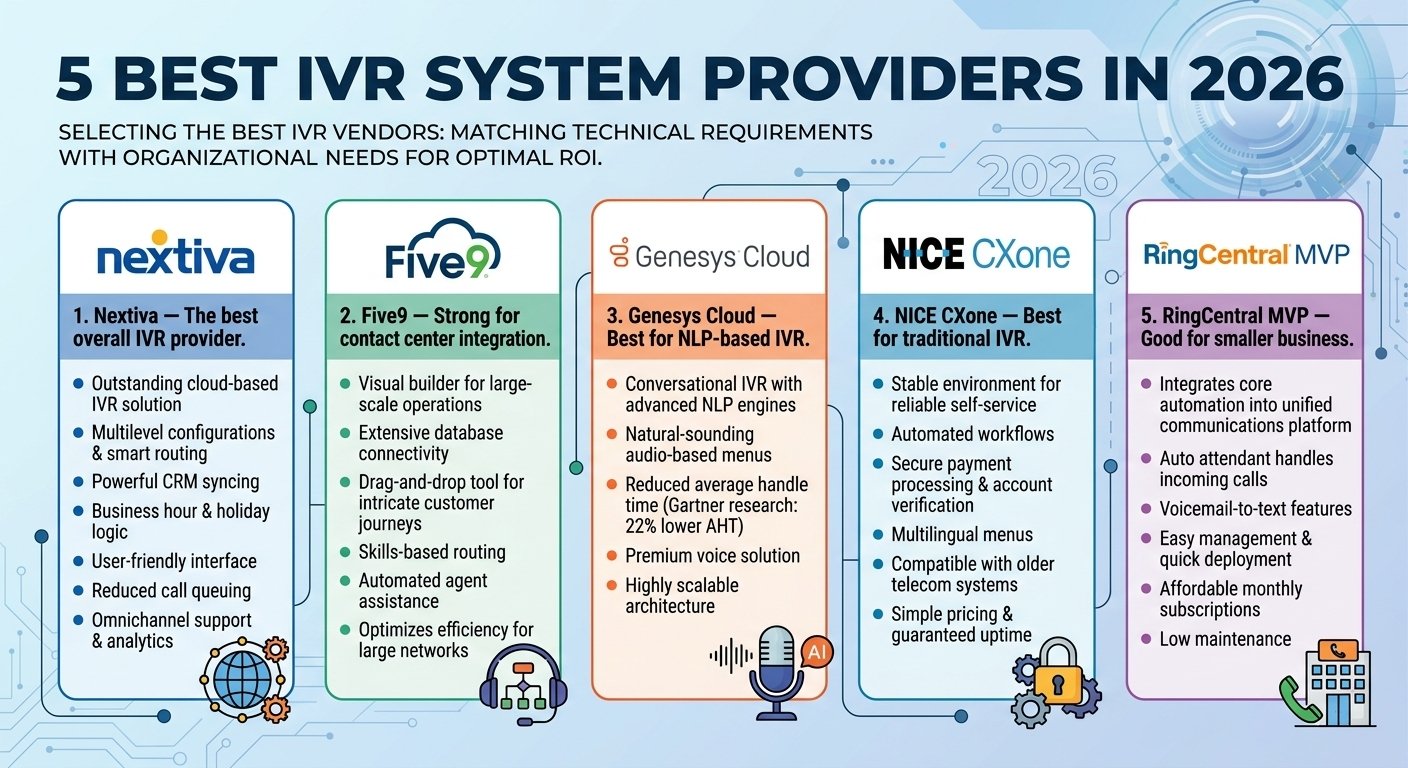
1. Nextiva: The best overall IVR provider
Nextiva offers an outstanding cloud based ivr solution with multilevel configurations, smart routing, and powerful CRM syncing. Business hour logic and holiday rules can be deployed easily by teams and with minimal IT involvement.
Its user-friendly interface and ability to reduce call queuing on platforms like SMS, email, and voice messaging are always highlighted by users. Starting at a very competitive monthly rate, Nextiva provides omnichannel support, extensive analytics and smooth integrations, making it one of the best ivr solution providers.
2. Five9: Strong for contact center integration
Five9 offers a visual builder designed for large-scale operations with extensive database connectivity. The drag-and-drop tool enables non-technical users to create intricate customer journeys using live data.
This enterprise ivr solution is particularly good at skills-based routing and automated agent assistance mechanisms. These tools are used by administrators to optimize the efficiency of large consumer networks without a problem.
3. Genesys Cloud: Best for NLP-based IVR
Genesys Cloud is the leader of the conversational world, with the help of advanced NLP engines. This method uses flexible, audio-based menus instead of hard-coded numbers, and is very natural-sounding and conversational.
Recent Gartner research on NLP-powered telephony shows that the average handle time is 22 percent lower in large enterprises. For multinational corporations looking for a premium voice solution provider with highly scalable voice architectures, Genesys is the ideal solution.
4. NICE CXone: Best for traditional IVR
NICE CXone offers a very stable environment with a focus on reliable and dependable self-service and automated workflows. Its robust infrastructure is a huge advantage for organizations that depend on typical features such as payment processing and account verification.
The software can be used to create multilingual menus and is compatible with older telecom systems. It is also one of the best ivr solution providers for established companies that are making a steady upgrade to their systems, thanks to its simple pricing and guaranteed uptime.
5. RingCentral MVP: Good for smaller business
RingCentral MVP integrates the core automation features right into the RingCentral unified communications platform, making it a great start-up solution. The auto attendant seamlessly handles incoming calls and voicemail-to-text features improve everyday use.
It’s an established ivr service provider that offers significant value with its easy management and quick deployment cycles. These easy-to-use Ivr solution providers provide affordable monthly subscriptions and easy maintenance, which is a great benefit for small businesses.
Key Features to Look for in an IVR System
The right features lead to quicker and more intelligent operations on a larger scale. The best cloud-based IVR (interactive voice response) services include certain features that make them more than just a voice channel.
-
Multilevel IVR menus
Dynamic conditional menus adapt to service outages or changing hours are necessary for structuring incoming traffic. In a multilevel map, the caller can avoid frustration by being able to bypass options that are not relevant to their call once they are connected.
This structural adaptability crafts a tailored journey from the initial greeting. When relevant choices are heard immediately, callers navigate through the architecture with confidence.
-
Speech recognition
Verbal comprehension enhances ordinary conversations into conversations without compromising structure. Voice-first navigation significantly minimizes keypad mistakes, and text-to-speech modules provide dynamic information on account balances or delivery statuses.
With AI support for transcription, the entire telecom workflow is streamlined. This feature significantly reduces misroute percentages in high volume environments with modern ivr solution providers.
-
CRM integration
For personalized customer journeys, continuity is essential in today’s crm-integrated ivr solutions. By integrating telephony data with previous interactions, live representatives never ask redundant questions when transferring calls.
Seamless integration with external databases allows for capturing consumer intent at an early stage. This integration provides employees with full visibility of previous support tickets and purchase history on the spot.
-
Omnichannel support
When consumers move from one medium to another (voice, email, chat), context carryover is the difference between good and great frameworks. The infrastructure needs to identify the user and understand the user’s current problem, no matter what channel is used.
Despite the rise of chatbots, there is still a significant reliance on voice interactions for handling complex issues among different demographics. A unified history ensures seamless issue resolution for clients using top-tier ivr solution providers.
-
Real-time call analytics
If the performance is not visible, administrators may end up missing out on important operational issues until it starts to cost them money. Full dashboards include real-time volumes, drop-off locations, and menu efficiency to help with quick iteration.
Advanced systems provide proactive alerts for unexpected increases in hang-ups. Keeping track of these metrics gives managers the power to address friction points quickly and before they hurt their brand.
-
Queue callback functionality
Allowing individuals to retain their position without staying on hold signals immense respect for their time. Premium architectures permit users to select preferred callback windows aligning with anticipated agent availability.
Benefits of Hosted IVR
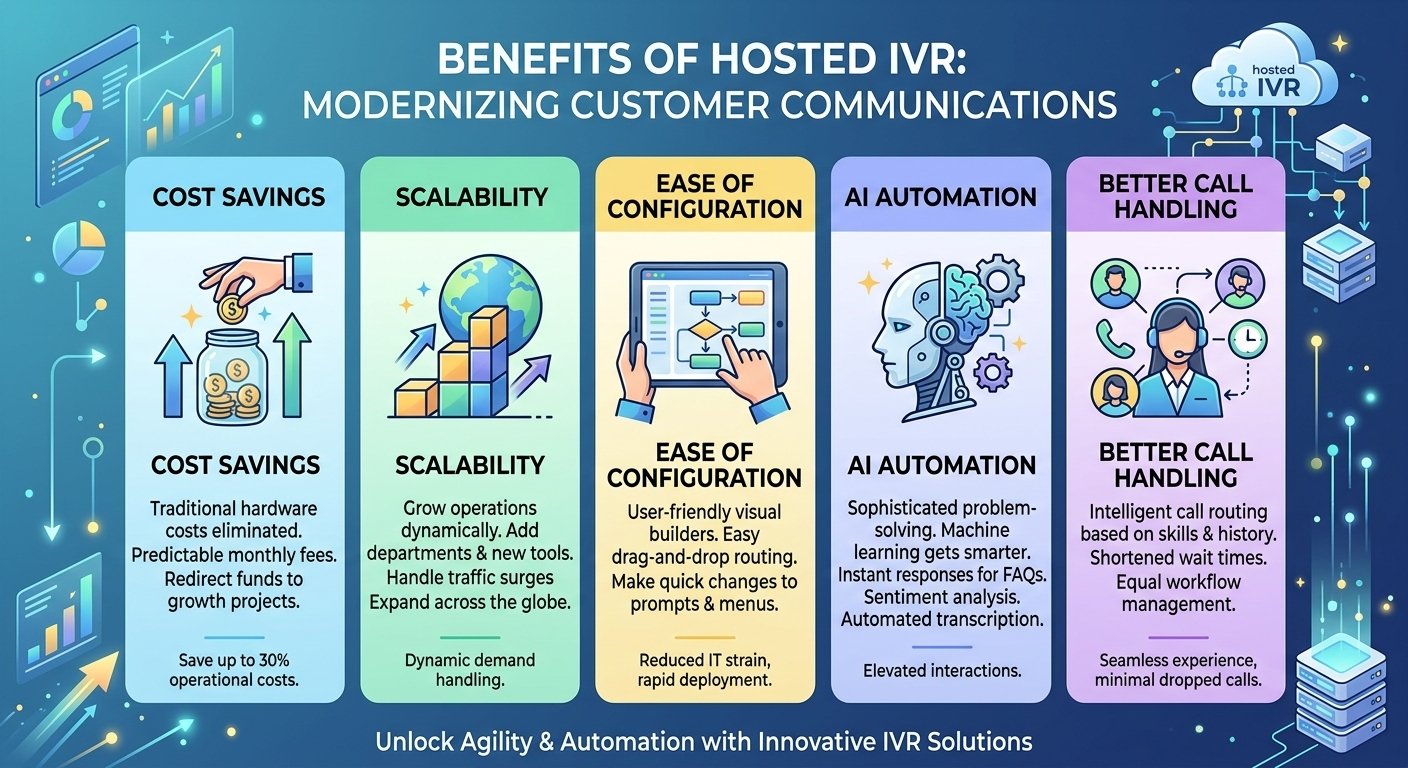
1. Cost savings
The traditional approach requires costly equipment and a team of dedicated engineers to maintain it. These capital expenses are completely eliminated with a hosted ivr system, instead opting for predictable monthly subscription fees.
A recent Forrester economic impact study showed that moving to virtual telephony can save up to 30 percent in telecom operational costs per year. Financial predictability gives organisations the freedom to invest in growth projects instead of server maintenance.
2. Scalability
Virtual platforms enable managers to grow their operations without having to undergo a full overhaul of their infrastructure. Departments can be added, new tools can be integrated, and traffic surges are dealt with without impacting the system.
This flexibility allows for dynamic demand without any hassle. As businesses grow and expand across the globe, business leaders have full control over the capacity limits.
3. Ease of configuration
Modern platforms include user-friendly visual builders that allow supervisors to make routing adjustments with easy drag-and-drop actions. This autonomy takes the strain on the IT department when it comes to making minor changes to audio prompts or menus.
Operational agility means the communication strategy is always in sync with the evolving consumer expectations. The enterprise is extremely responsive with rapid deployment.
4. AI automation
The direct integration of AI into the communication stack elevates the level of interaction from simple to sophisticated problem-solving. Smart, innovative solution providers like ivr offer a solution that allows the machine learning algorithms to continuously improve over time.
Advanced automation offers several distinct operational upgrades directly out of the box:
-
Instant response generation for frequently asked inquiries and basic account troubleshooting.
-
Emotional sentiment analysis to prioritize frustrated callers and route them immediately.
-
Automated transcription services for accurate auditing and strict compliance purposes.
5. Better call handling
Conversations are distributed according to caller history and exact staff skills, guaranteeing equal and effective workflow management. The key to optimal connection rates is dedicated ivr calling software.
When handled properly, dropped connections are minimized and average wait times are shortened. Customers have a more seamless experience from automated greetings to live interactions.
How to Choose the Right IVR Provider
Selecting an appropriate partner depends entirely on your specific operational gaps and projected expansion goals. Assessing these criteria ensures a successful deployment alongside top-tier ivr solution providers.
1. Assess your call volume and support complexity
Start by studying the inbound traffic patterns of the day and being able to identify the seasonal patterns accurately. A small team dealing with small issues has very different needs for infrastructure compared to a large enterprise with thousands of active conversations.
Know the subtlety of your usual questions and decide on the level of routing required. Predicting the volume of your operations accurately can avoid premature outgrowths of your system and unnecessary digital migrations.
2. Evaluate core features and self-service capabilities
Structural menu mapping, comprehensive recording and robust analytics are essential to baseline functionality. In addition to those basics, look for platforms that provide extensive database integration and secure identity verification via the dial pad.
Figure out whether your audience would like to use a rigid numeric menu or a conversational voice command. The underlying intelligence engine determines how natural the response of the system is to open-ended requests.
3. Check integrations with your existing tech stack
An isolated telecom setup only provides a small part of its strategic value. Before signing deals with any ivr solution providers, lay out all the connections you need to make with your existing sales and marketing software.
Ensure that proprietary internal software that doesn’t natively support API is accessible. Historical data is vital for providing customised client experiences and real-time sync is essential.
4. Compare pricing models and total cost
Financial structures can differ significantly between various telecom vendors, and must be analyzed carefully before deployment. A per-minute model may appear cheap at the time of the order, but soon becomes very costly when inbound traffic grows.
When calculating overall expenditures with ivr solution providers, strictly factor in these primary expenses:
-
Initial setup fees and professional onboarding services required for deployment.
-
Premium feature add-ons like advanced speech recognition or custom routing rules.
-
Potential overage charges incurred for exceeding monthly minute allocations unexpectedly.
5. Consider ease of setup and ongoing management
Some platforms require a high level of coding expertise, while others focus on ease of use for day-to-day managers. Determine who is going to be responsible for day to day administration after the launch and make sure they have the necessary technical skills.
Assess the speed of changing audio prompts or pulling performance metrics. Eventually, delayed mod capabilities extend your consumer base’s sub-optimal experience.
Read More: Sip Trunking vs Pri: Know the Difference
Final Words
A strong communications infrastructure is a game-changer for how companies handle inbound traffic and customer interactions. The top ivr solution providers offer unparalleled automation, sound quality, and analytical capabilities. Knowing how to compare your specific volume requirements with the software’s capabilities ensures a long-term growth strategy. These cutting-edge telecom solutions will give your employees the freedom to concentrate on the important things, while the machines take care of the mundane.
Faqs
-
Who are the top ivr solution providers for businesses?
Top platforms include Nextiva, Five9, Genesys Cloud, NICE CXone, and RingCentral MVP. These telecom providers are equipped with powerful capabilities, automated routing, and remarkable scalability for contemporary businesses seeking to enhance their infrastructure.
-
What is the cost of an IVR system?
The pricing varies significantly based on the type of deployment and number of concurrent users. The cost of cloud based subscriptions generally begin at about fifteen dollars per month per user and increase in accordance with the advanced features and premium integrations.
-
How does an IVR work?
The technology is pre-recorded prompts and speech recognition, which automatically engages with inbound callers. It collects intent data and directs the person to the relevant department without any human intervention, providing optimal efficiency.
-
What are some IVR business use cases?
Typical use cases include safe payments, automated booking, and simple account queries. It’s also used by contact centers to easily distinguish urgent technical support requests from informational requests.
-
Are there certain industries that should use IVR?
Healthcare networks, financial institutions, retail chains, and logistics companies benefit massively from automated telephony. Any sector experiencing high inbound caller volume requires these digital receptionists to maintain efficiency and customer satisfaction.
-
What is an AI-powered IVR for cloud contact centers?
This advanced implementation utilizes natural language processing to comprehend conversational speech rather than keypad presses. It accurately determines consumer sentiment and handles complex open-ended requests dynamically without requiring physical input.
-
How does conversational IVR improve contact center routing?
By understanding complete sentences, the architecture precisely identifies the core issue before initiating a transfer. This accuracy drastically reduces misroutes and ensures callers reach the most qualified representative instantly.
-
Can small companies benefit from IVR hosting?
Absolutely, as virtual subscriptions eliminate the need for expensive physical telecom hardware. Startups project a highly professional image while efficiently managing their growing inbound traffic on remarkably tight budgets.