
Primary Rate Interface uses standard copper technology to connect a private branch exchange with the public switched telephone network, giving a maximum number of channels which can be selected. By contrast, Session Initiation Protocol (SIP) provides virtual phone lines that become immediate while allowing for seamless (and instant) multimedia routing and scalability within a broadband, active Internet connection.
To cut down on operating expenses and boost flexibility, organizations upgrading their telecommunications infrastructure are always going for virtual solutions. Switching from legacy physical networks results in state-of-the-art features such as an interactive voice response system software and an automated digital routing system.
What is the main difference between SIP and PRI?
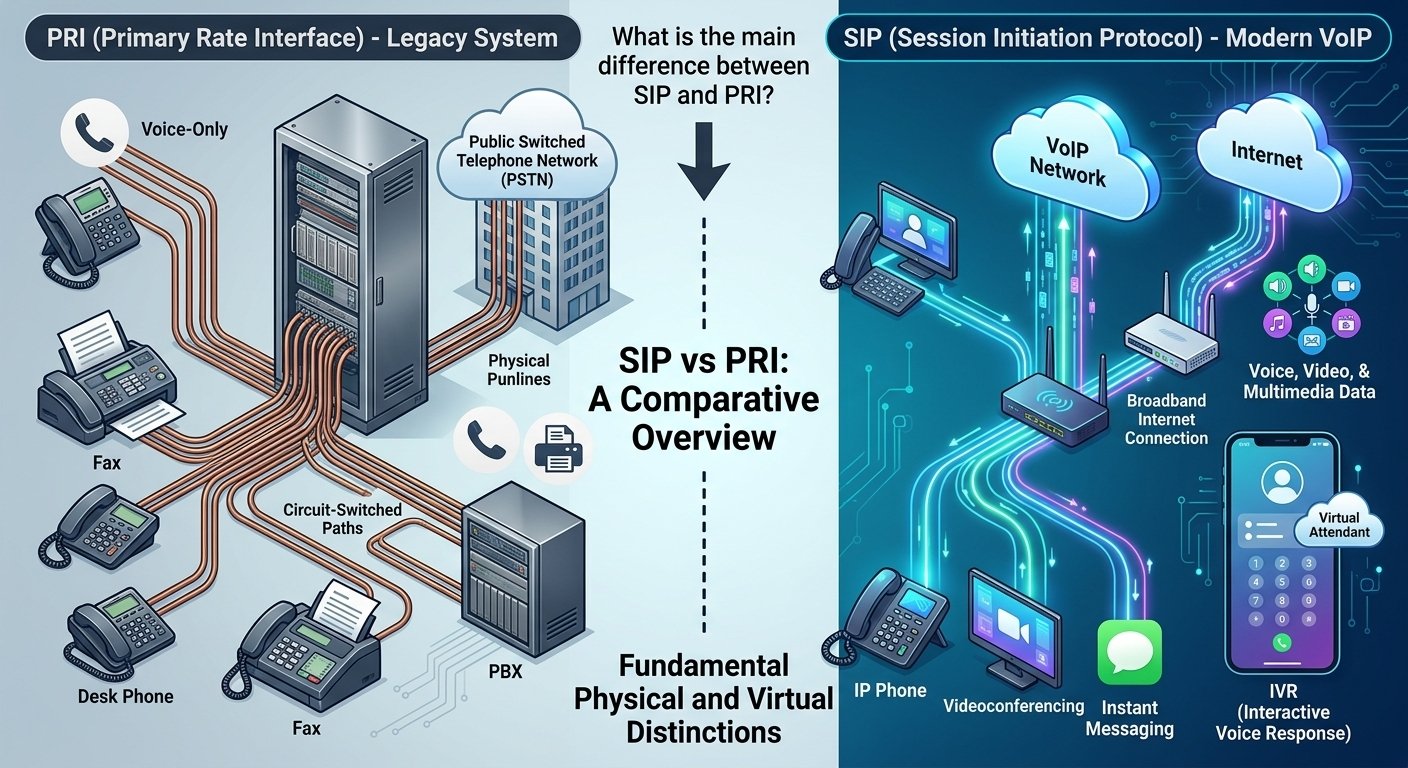
The main difference in sip trunking vs pri is the way in which these frameworks are physically and virtually linked to the external networks. Legacy configurations require large copper installations, requiring a lot of physical space and maintenance staff with specializations to maintain. Eliminating all these physical requirements, virtual configurations send all voice data packets securely across existing internet broadband connections. The change is a basic one that revolutionizes the way organizations handle their worldwide interactions.
When considering sip trunking vs pri, there are significant differences in how bandwidth is allocated, and overall system flexibility. Legacy systems only allow basic voice transmission over pre-defined physical paths, which is limiting organisations in terms of integration possibilities. New Internet-based protocols enable administrators to send voice, high-definition video and Instant Messaging all in one connection. This flexibility is a natural fit for implementing a full-featured voip ivr system to improve customer interactions effortlessly.
What Is PRI?
It is a legacy telecommunication standard that uses physical copper wires to send voice and digital data between enterprise networks and users. It digitally integrates commercial facilities directly with the large-scale public switched telephone network, bringing together national and regional telephone operators into a single loop for communication. When external customers call, the call is directed to a centralized on-premises PBX, which then routes the call to the party to whom it is intended.
These circuits have traditionally been used by large enterprise organisations to handle the volume of communications they needed on a daily basis in a secure manner. These investments in infrastructure and long-term carrier agreements were important to ensure reliable uptime. The technology still proved to be the lifeline of business telephony for many years, despite these challenging requirements. Until the arrival of digital IVRs, businesses relied on a standard telephone IVR to route their callers with efficiency.
-
PRI features
| Feature | Description |
| Fixed number of voice channels | A PRI phone supports 23 bearer voice or data transmission channels, which means 23 communications can happen at the same time. These channels allow multiple calls to be made simultaneously and transmit voice, data, and video on the same line. The data transmission occurs at 64 Kbps per channel. It uplifts speed, makes communication reliable, and increases the security of a business voice communication system. |
| Dedicated lines for voice and data | A trunk offers a consistent level of service, and voice and data connection lines don’t traverse over the Internet but rely on the PSTN for connectivity. |
-
PRI requirements
This legacy architecture has to be deployed with exactly compatible equipment and would have to be a specialized gateway or a branch exchange server with dedicated circuit cards. The technician has to physically put these components into place inside a climate controlled server room and set them up so they communicate with other digital lines. This environment requires ongoing monitoring and hardware replacements every so often to avoid catastrophic system failure.
The standard system will allow for up to twenty-three concurrent conversations, but more than that will cause a lot of logistical problems for growing companies. When the call volume is above the threshold, administrators need to purchase and install new physical circuits. This rigid structure does not allow agility and it is hard to easily and seamlessly adopt modern solutions such as an intelligent call queuing system or dynamic routing protocols.
What Is SIP?
It is a modern protocol that will enable you to link your internal communication server straight to the web, letting you have seamless inbound and outbound digital communications. The trunking is used to merge several separate communications channels into one virtual channel that requires far less resources throughout the corporation. The difference between sip trunking vs pri emphasizes the limitations of conventional telephone telephone technology infrastructure are completely overcome with virtualization.
According to a Gartner study, by 2025 more than 75% of all enterprise organizations across the globe will have completely replaced legacy physical network connections with virtualized IP-based technologies. This transition make voice communication just as easily accessible as standard email or web browsing activities. An advanced interactive voice response application and automatic menu systems are easily integrated with modernizing your infrastructure.
-
Key features of SIP
-
-
Doesn’t need separate phone lines: Direct inward dialing numbers route incoming traffic specifically to designated users rather than funneling everyone through a generic auto-attendant queue.
-
Integrates with other IP-based services: Administrators effortlessly integrate virtual trunks with customer relationship management platforms, collaborative messaging applications, and advanced conferencing solutions.
-
Built on dependable network reliability: Top-tier providers maintain redundant global data centers to guarantee exceptional uptime and superior call clarity during peak traffic hours.
-
Offers more flexibility in virtual connections: Virtual routing mechanisms empower organizations to manage phone numbers, user extensions, and diverse endpoints without worrying about physical geographic limitations.
-
-
SIP trunking requirements
Moving to a virtual communication infrastructure involves a fast and stable internet connection, as well as a compatible IP-based branch exchange server. It should be remembered that organizations that are switching from an older configuration will need to purchase special digital adapters to connect the analog desktop phones to the new digital network. Having enough bandwidth is an important factor to guarantee clean audio when conducting high volume outbound campaigns at the same time.
A strong digital platform enables the teams to use more robust additional tools that help streamline daily operations. When the virtual network architecture is fully in place, it is extremely simple to use an IVR system in the call center. These digital tools take into account incoming caller information as soon as it is received and direct it to the most suitable person in the department to handle it immediately.
Pros and Cons of PRI
The traditional telecoms frameworks offer distinct operational benefits but also growing technical drawbacks. Facility managers can make informed decisions in the long run based on these different parameters. When you do know both sides, you understand why some industries are reluctant to get rid of their legacy systems right now.
Traditionally, physical circuits were a choice for organizations in out-of-the-way geographical locations that have unreliable, or no, broadband service. Stability and isolation guaranteed communications during localized widespread internet outages, prioritizing over modern digital feature sets. Those facilities that were heavily dependent on a simple standalone ivr system typically favored the consistent service of dedicated copper pathways.
-
PRI advantages
-
-
Dedicated bandwidth guarantees: Because the system utilizes hardwired physical connections, voice traffic never competes with internal office internet usage, guaranteeing pristine transmission clarity.
-
Security through network isolation: Operating exclusively within closed public networks inherently isolates internal communications from prevalent internet-based cyber threats and malicious digital spoofing attempts.
-
Direct inward dialing capabilities: A single circuit allows administrators to assign dozens of direct extension lines to individual employees without physically installing separate desktop wiring.
-
-
PRI disadvantages
-
-
Lack of disaster recovery: Experiencing a physical wire cut outside the facility instantly deadens all internal communications without any automatic failover rerouting capabilities.
-
Rising operational expenses: As major telecommunications carriers actively retire aging copper infrastructure, securing experienced legacy technicians and replacement components becomes prohibitively expensive.
-
Extremely rigid scalability: Expanding capacity requires purchasing expensive supplementary channel blocks, forcing businesses to pay continuously for unused network capacity.
-
Pros and cons of SIP trunking
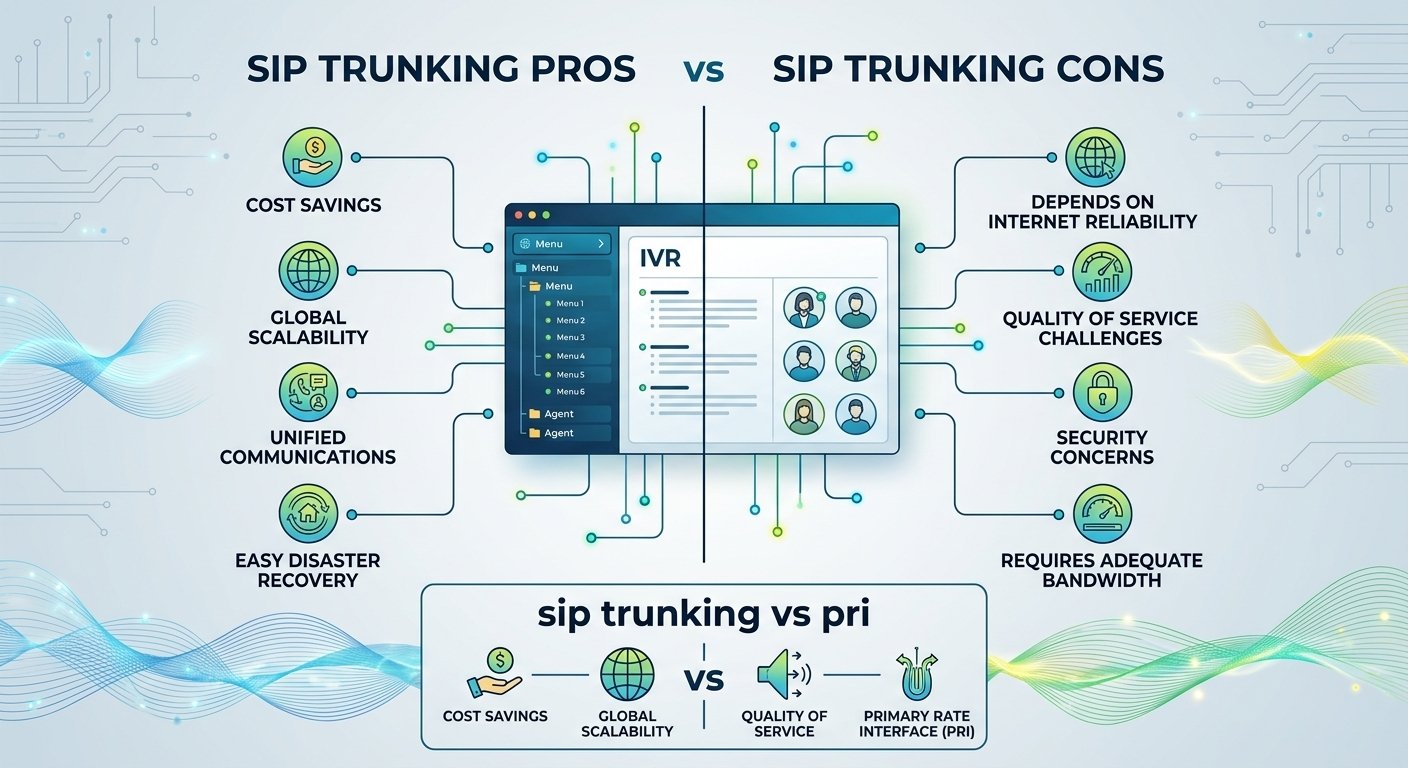
The choice of a highly scalable and low cost digital communications framework must be made with great care, taking into account all the specific benefits and technical risks. By examining the details of sip trunking vs pri, you’ll see why modern enterprises pretty much universally prefer internet-based communications to legacy, landline services. Virtual platforms systematically break down geographic boundaries which have traditionally hindered global expansion by corporations.
Digital telephony signifies a new level of operational efficiency as it brings together the disparate connectivity worldwide under one management window. This huge architectural change helps to quickly deploy a completely autonomous (ivr) system for the routing of complex customer logic. Looking at the good and the bad helps technology leaders make sure they put in place sufficient network protection before completing their move.
-
SIP advantages
-
-
Instant network scalability: Virtual architectures allow administrators to provision new channels instantly through a centralized software dashboard without scheduling disruptive physical hardware installations.
-
Built-in disaster recovery: Advanced virtual trunks automatically detect localized power failures and instantly reroute essential traffic to secondary branch offices or designated mobile devices.
-
Comprehensive multimedia support: Moving beyond basic voice transmissions enables teams to conduct high-definition video conferencing and secure instant messaging across the exact same unified connection.
-
-
SIP disadvantages
-
-
Strict internet dependency: Experiencing unstable or degraded broadband bandwidth directly impacts transmission clarity and overall system reliability during critical business hours.
-
Complex security configurations: Connecting internal servers to the open internet mandates rigorous firewall configurations and robust data encryption protocols to prevent unauthorized access.
-
Hardware compatibility challenges: Utilizing exceptionally old analog desktop hardware requires purchasing secondary conversion adapters to function correctly across a modern digital network.
-
PRI vs. SIP Head-to-Head Comparison
| Feature | PRI | SIP trunking |
| Connection Type | Physical copper wires (T1/E1) | Virtual or internet connection |
| Scalability | Low: Must add lines in blocks of 23. | High: Add 1 channel at a time instantly. |
| Media Type | Voice only | Multimedia (voice, video, messaging) |
| Hardware | Requires on-premise cards/gateways. | Minimal (uses existing internet router). |
| Reliability | High (dedicated line), but no failover | High (with Fiber/SD-WAN) + auto-failover |
| Setup Time | Weeks (physical installation required). | Minutes (software configuration). |
| Cost Trend | Rising (legacy maintenance fees). | Dropping (competitive market). |
Thinking of Migrating From PRI to SIP?
To successfully make the switch from the legacy PRI telecommunications system to SIP, there is a need for careful planning. In today’s digital age, where large-scale telecom companies are actively retiring from their physical copper network and transitioning to a virtual network and embracing latest technologies such as mobile IVR, it is an imperative logistical step to remain competitive.
1. Assess and plan
First, analyze past usage data, upgrade edge routers, and deploy quality of service technologies to prioritize internal voice traffic. You should make sure to test bandwidth at peak hours, inventory your hardware, review existing carrier contracts, and make sure your primary branch exchange server is digitally compatible to avoid unexpected obstacles.
2. Choose a SIP service provider
When choosing a vendor, consider costs, reliability, scalability, and technical support. Make sure that the service provider guarantees high uptime in their SLA, provides crucial security updates, and provides compatibility with user-friendly IVR software to assist your staff in handling customers.
3. Implement
In order to get this right, it’s essential to have a well-trained internal tech team, good internal communication, and a strategy to number port without losing client connections. When using temporary call forwarding and automated IVR status messages during the switchover will help control customer expectations and guarantee 100% uptime when the traffic is redirected.
4. Decide on post-migration support
Have an external support contract agreed and signed to ensure instant technical support if any unforeseen configuration problems should occur immediately after deployment. You should always look for a vendor that has a large collection of training materials for your staff as well as ongoing analytical monitoring which will detect and correct minor network glitches before they become big network failures.
Final Words
In the end, virtual SIP solutions deliver unparalleled operational agility, enabling businesses to quickly expand their communications, reduce recurring maintenance expenses, and add powerful DR capabilities. Implementing these digital protocols and leveraging tools such as an IVR free trial during the migration process will help organizations future-proof their enterprise connectivity and keep their customers happy for years to come.
Frequently Asked Questions
-
How does SIP trunking vs PRI impact growing businesses?
Transitioning to virtual trunks provides growing companies with instant scalability and significantly lower costs compared to legacy physical circuits. Virtual infrastructure allows administrators to add single channels dynamically, completely avoiding the rigid twenty-three channel blocks required by traditional copper networks.
-
How much does SIP trunking cost?
Virtual communication setups dramatically reduce monthly telecommunications expenses by eliminating physical hardware maintenance fees and standardizing long-distance transmission rates. Most modern providers offer predictable per-channel flat-rate pricing structures that scale seamlessly alongside your actual operational consumption.
-
Is SIP trunking reliable?
Digital trunks deliver exceptional reliability when paired with high-speed broadband connections and enterprise-grade network routing hardware. Built-in automatic failover protocols instantly reroute critical incoming calls to designated mobile devices if the primary office experiences a sudden internet outage.
-
What is the difference between SIP trunking and VoIP?
Voice over Internet Protocol represents the broad overarching technology enabling digital voice transmissions across the internet. Session Initiation Protocol functions as the highly specific underlying technical ruleset used to establish, manage, and seamlessly terminate those digital multimedia connections.
-
How can I convert SIP to PRI?
Converting digital signals back to physical circuits requires installing a specialized premise-based media gateway appliance within your server room. This hardware actively translates incoming virtual data packets into traditional digital signals that older legacy branch exchange servers can successfully process.
-
Can I use an enterprise ivr testing system with virtual lines?
Modern digital networks integrate flawlessly with enterprise-grade testing software to simulate high-volume caller traffic and evaluate menu routing efficiency. These robust testing frameworks identify hidden logical bottlenecks before they negatively impact actual external customer experiences.
-
Does this technology support advanced ivr phones?
Virtual networks natively support modern IP-based desktop handsets equipped with expansive digital displays and programmable routing directories. Users navigate complex automated menus effortlessly using intuitive touchscreen interfaces rather than relying exclusively on traditional numerical keypads.
-
What is the best practice for configuring a voip ivr system?
Administrators should strictly limit automated menu options to five distinct choices per tier to prevent overwhelming callers with unnecessary information. Implementing advanced speech recognition capabilities further streamlines the navigation process by allowing users to bypass traditional keypad inputs entirely.
-
Do I need a completely new phone ivr system after migrating?
If your current internal server supports native digital integrations, you can seamlessly retain your existing automated routing configurations without purchasing new software. Facilities utilizing exceptionally outdated analog infrastructure must invest in compatible digital gateways to maintain their automated greeting functionalities.