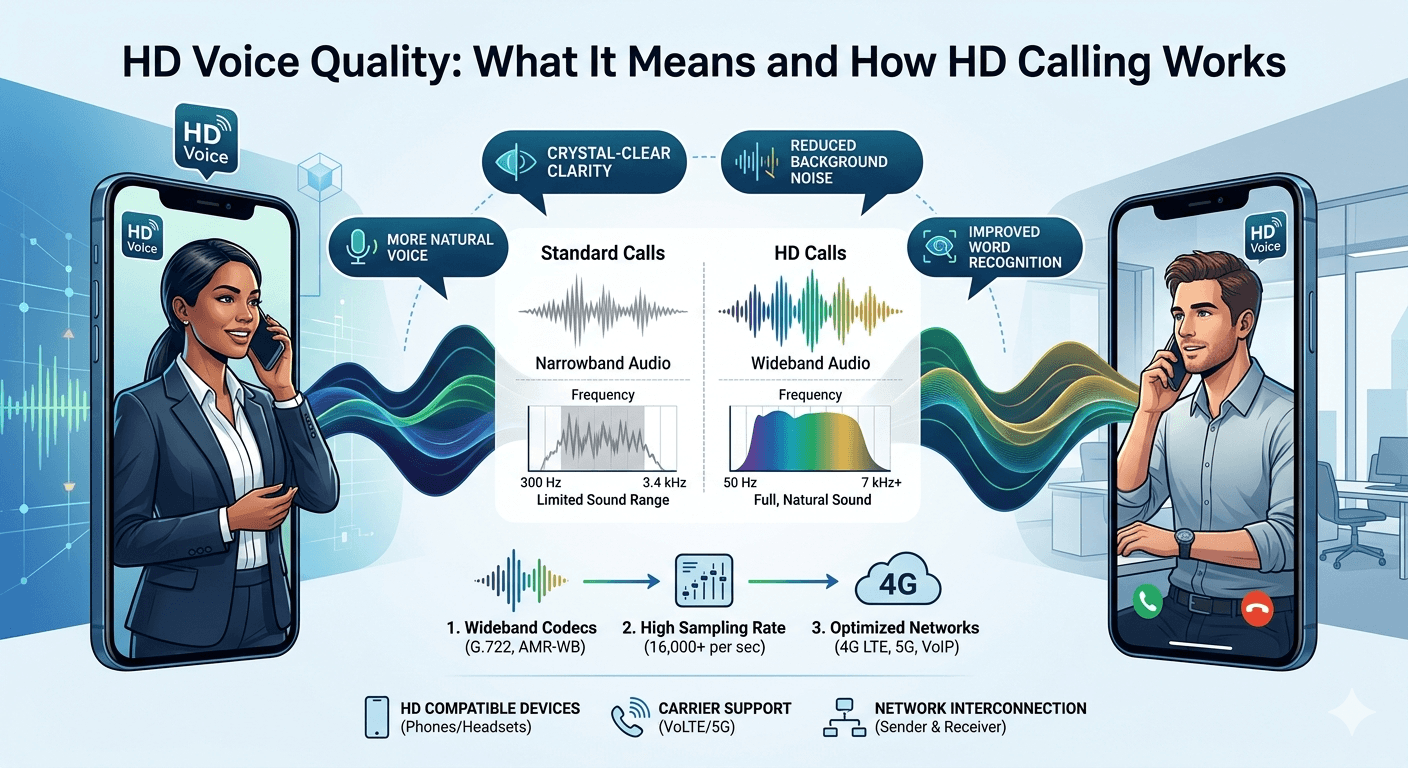
HD voice quality refers to high-definition audio technology that significantly improves the clarity and richness of phone conversations compared to traditional narrowband telephony. While standard phone calls typically operate within a limited frequency range of 300 Hz to 3.4 kHz, high definition voice extends this range to between 50 Hz and 7 kHz or higher. This expansion allows the technology to capture more nuances of the human voice, making callers sound more natural and easier to understand. By doubling the frequency range and increasing the sampling rate, HD calling reduces background noise and minimizes the listener fatigue often associated with muffled or distorted audio over digital networks.
Understanding High Definition Voice and HD Calling Technology
The transition from traditional landlines to modern digital communication has introduced several advancements in audio fidelity. When people discuss what is hd calling, they are essentially referring to wideband audio technology. Unlike the older public switched telephone network that compressed audio to fit into narrow bandwidths, modern voip virtual receptionist systems and mobile networks utilize wider bands to transmit data. This results in a fuller sound that captures both the lower and higher pitches of a person’s voice. High definition voice is not just about volume; it is about the precision of the audio signal being transmitted across a network.
The underlying technology behind an hd call relies on specific audio codecs, most notably the G.722 codec. This codec is designed to handle the increased data required for high fidelity sound without placing an excessive burden on the network. When you initiate an hdcall, the system samples the audio at a much higher frequency than standard calls. Standard calls usually sample at 8,000 times per second, while high definition calling samples at 16,000 times per second or more. This higher sampling rate ensures that the digital representation of the voice is much closer to the original analog sound produced by the speaker.
For a business environment, utilizing vonage branded calling or similar high-quality services ensures that every interaction with a client is professional. If a customer cannot hear a representative clearly, it leads to frustration and potential misunderstandings. By implementing hdvoice across a corporate network, companies can ensure that their communication is as clear as an in-person meeting. This is especially important for industries that rely heavily on phone-based consultations, where every detail discussed over the phone carries significant weight and requires absolute clarity.
Technical Requirements for Experiencing HD Calling on Your Devices
To successfully place an hd call, certain infrastructure requirements must be met by both the sender and the receiver. It is not enough for just one person to have a compatible phone; the entire path of the call must support high definition voice protocols. This means that both the service providers and the hardware on both ends must be capable of processing wideband audio. If you are using a legacy device that does not support hd voice phones, the call will automatically drop back to standard narrowband quality to ensure the connection remains stable, even if the other party has the latest technology.
Network compatibility is perhaps the most critical factor in determining what are hd calls in a practical sense. Most modern LTE and 5G networks are designed to support Voice over LTE (VoLTE), which is the standard carrier technology used to deliver high definition calling. When a smartphone displays an hd icon during a conversation, it indicates that the network has successfully negotiated a wideband connection. For those using office systems, a high definition conference call requires a robust internet connection with sufficient bandwidth to handle the increased data packets without jitter or latency.
- Compatible Hardware: Users must possess hd voice devices such as modern smartphones, IP phones, or certified headsets that contain speakers and microphones capable of handling a wider frequency range. Older handsets often have hardware limitations that prevent them from reproducing the high-frequency sounds associated with high definition audio.
- Carrier Support: Both the originating and receiving mobile carriers must have an interconnection agreement that supports wideband audio. In many cases, if you call someone on a different network, the call might revert to standard quality unless both carriers have integrated their HD services.
- Software Settings: On many devices, particularly in the case of android hd calling, users may need to ensure that VoLTE or HD settings are enabled in the cellular network menu. While most modern phones have this turned on by default, some older or specialized enterprise devices might require manual activation.
Benefits of Utilizing High Definition Voice for Business Communications
The advantages of adopting high definition voice extend far beyond simply hearing someone more clearly. In a professional setting, the quality of a call can directly influence a client’s perception of a company’s competence and attention to detail. When a business uses a voip virtual receptionist that supports HD audio, the initial greeting sounds crisp and welcoming. This reduces the cognitive load on the listener, as they do not have to strain to understand what is being said through static or muffled audio. High definition voice helps in building a more personal connection between parties who may never meet in person.
Research conducted by Fraunhofer IIS, the creators of many audio codecs, demonstrates that high definition voice significantly reduces “listener fatigue.” Their studies show that wideband audio (HD Voice) improves word recognition by approximately 20% compared to traditional narrowband calls. This is because the brain has to work less hard to “fill in the gaps” of missing frequencies, leading to clearer communication and less mental strain during long conversations.
Another significant benefit is the reduction of background noise interference. The codecs used in hd calling are often paired with advanced noise-cancellation algorithms that can distinguish between the human voice and ambient sounds like traffic, office chatter, or wind. This makes what is an hd call particularly valuable for remote workers or field technicians who may be calling from less-than-ideal environments. By isolating the voice and suppressing unwanted noise, the communication remains focused and productive, preventing the need for repetitive questions or clarifications during the conversation.
- Enhanced Clarity: The primary benefit is the dramatic improvement in sound quality, making it easier to distinguish between similar-sounding consonants like S and F or M and N. This is vital for accurately recording names, addresses, and technical specifications over the phone.
- Better Conference Calls: In a high definition conference call, it is much easier to identify who is speaking, even when multiple people are in the same room. The spatial quality of the audio helps the brain process the conversation more naturally, which leads to more effective collaboration.
- Professional Image: Providing a high-quality audio experience signals that a business invests in its infrastructure and values the time of its clients. It removes the amateur feel of scratchy, low-bitrate calls that often plague older or cheaper communication systems.
Exploring HD Voice Devices and Hardware Compatibility
The market for hd voice devices has expanded significantly, moving from high-end executive tools to standard consumer electronics. Most smartphones released in the last several years are inherently hd voice phones, equipped with the necessary hardware and software to support wideband audio. However, the quality of the internal microphone and speaker still plays a role in the final output. For instance, a budget phone might support the hd voice protocol but lack the high-quality acoustic components to truly deliver the full range of sound, leading to a less impressive experience than a flagship device.
In an office setting, IP phones have become the standard for businesses seeking the best audio quality. These devices are specifically designed for voip environments where high definition voice is a native feature. Many of these phones come with a dedicated hdvoice logo, indicating they meet specific industry standards for audio fidelity. Furthermore, using a high-quality headset can further enhance the experience. Professional-grade headsets are built with wideband speakers and noise-canceling microphones that complement the capabilities of the phone system, ensuring that both the user and the caller enjoy maximum clarity.
According to research by the audio experts at Poly, better audio quality can lead to a 20 percent increase in word recognition and a significant reduction in the listener’s heart rate during long calls. This suggests that high definition audio reduces the physical and mental stress associated with communication. Another study by Frost & Sullivan noted that businesses using high-quality communication tools saw a 15 percent improvement in meeting efficiency because participants spent less time asking for information to be repeated. These findings underscore the tangible business value of investing in high-quality audio solutions.
How High Definition Audio Works for Better HD Voice Quality
To grasp the full scope of what is hd voice, it is helpful to look at how the audio signal is processed during a transmission. Standard telephony uses a method called Pulse Code Modulation (PCM) which severely limits the amount of data transmitted. When you engage in hd calling, the system uses more advanced compression techniques that preserve more of the original signal. The audio is divided into more frequent and detailed segments during the digital conversion process. This prevents the “tinny” sound that many people associate with traditional phone calls, instead providing a depth of sound that mimics a face-to-face conversation.
The concept of what does hd mean on a phone call is similar to the difference between a standard definition television and a 4K display. Just as the 4K display has more pixels to create a sharper image, an HD call has more data points to create a sharper sound. This extra detail is particularly noticeable in the higher frequencies, where the subtle “air” around a voice is captured. For companies utilizing vonage virtual receptionist services, this means that even automated messages sound more human and less like a computer-generated recording.
According to an analysis by Frost & Sullivan, businesses that implement high-quality audio solutions, such as HD voice phones and high definition conference calls, see a 15% increase in meeting efficiency. The study found that clear audio reduces the need for participants to repeat information and minimizes misunderstandings, directly impacting the speed of decision-making and overall workplace productivity.
The implementation of what is hd calling on android and other platforms often involves the use of Wideband Adaptive Multi-Rate (AMR-WB) technology. This technology allows the network to adjust the bit rate of the call in real-time based on the available signal strength. If the network is congested, the system can slightly reduce the quality to maintain the connection, but when the signal is strong, it pushes the full high definition voice data through. This adaptability ensures that the user gets the best possible audio quality under their current network conditions without risking a dropped call.
Comparing Standard Audio and HD Voice Quality Performance
When comparing a standard call to an hd call, the difference is most apparent in the frequency response graph. A standard call has a very narrow “hump” where only the middle frequencies of the human voice are transmitted. This is why voices on old phones often sound flat and lacking in character. In contrast, high definition voice covers a much wider spectrum, allowing the rich bass tones and the crisp treble tones to come through. This makes what is a hd call sound “closer” to the listener, as if the person is standing in the same room rather than speaking through a long-distance wire.
The shift toward high definition calling has also been driven by the rise of Voice over IP (VoIP) and 5G technology. Older copper-based phone lines were physically limited in the amount of data they could carry, but modern fiber-optic and wireless networks have virtually unlimited capacity for audio data. This has allowed service providers to offer what does hd mean on phone call features as a standard part of their service rather than a premium add-on. As more people move away from traditional landlines, the expectation for crystal-clear audio has become the new industry standard.
- Frequency Range: Standard calls are limited to 3.4 kHz, whereas HD calls reach up to 7 kHz or 14 kHz in some advanced systems. This extra range captures the sibilance and harmonics that make voices recognizable.
- Sampling Rate: Standard telephony samples at 8 kHz, while HD systems sample at 16 kHz or higher. This creates a more accurate digital “map” of the sound wave.
- Noise Suppression: High definition systems are better at filtering out non-voice sounds, which helps in maintaining focus during important business discussions or personal conversations.
How to Enable and Use High Definition Calling on Modern Smartphones
For many users, the transition to high definition calling happens automatically without any intervention. However, there are times when you might need to check your settings to ensure you are getting the best possible audio. On an iPhone, this is usually managed under the Cellular Data Options menu, where you can enable VoLTE. For those looking for what is hd calling on android, the process is similar. You typically navigate to the Mobile Networks section of your settings and look for a toggle labeled HD Voice, Enhanced Calling, or VoLTE. Ensuring this is active is the first step toward enjoying superior sound quality.
If you are using a voip virtual receptionist or a business phone system, the settings are often managed by your IT department or the service provider. In these cases, the system is usually configured to prioritize high definition voice whenever the bandwidth allows. If you find that your calls lack clarity, it could be due to a limitation in your internet connection or a router that is not optimized for VoIP traffic. Many modern routers have a Quality of Service (QoS) setting that allows you to prioritize voice data over other types of internet traffic, ensuring that your hdvoice quality remains consistent even when the network is busy.
Another factor to consider is the use of accessories. Even with a perfect network and a high-end phone, using cheap, low-quality headphones can ruin the experience of what is hd voice. To truly appreciate high definition audio, you should use hardware that is specifically rated for wideband frequency response. This includes many Bluetooth headsets that support the HFP 1.6 (Hands-Free Profile) or higher, which is the standard required to transmit HD audio wirelessly between your phone and your ears. Without this compatibility, the audio will be compressed back down to standard quality before it reaches your headset.
Common Obstacles to Maintaining HD Voice Quality
Despite the widespread availability of this technology, there are still several obstacles that can prevent a user from experiencing high definition voice consistently. The most common issue is the lack of cross-carrier compatibility. If you are on Carrier A and you call someone on Carrier B, the two networks must have a direct HD interconnection to maintain the quality. If they do not, the call will be transcoded into a standard format as it passes between the two networks. While these interconnections are becoming more common, they are still not universal, which explains why some calls sound great while others seem stuck in the past.
Signal strength also plays a vital role in what is an hd call experience. High-definition audio requires a stable and relatively strong data connection. If you are in an area with poor LTE or 5G coverage, your phone may switch back to a 3G or older connection, which does not support wideband audio. This results in a noticeable drop in sound quality mid-conversation. Similarly, if your Wi-Fi connection is unstable while using Wi-Fi Calling, the audio may stutter or revert to a lower bitrate to keep the call from dropping entirely.
- Network Congestion: During peak hours, carriers might limit the bandwidth available for individual calls to ensure that the network remains functional for everyone, which can occasionally impact the richness of the audio.
- Legacy Equipment: Calling a business that still uses an old analog PBX system will always result in a standard definition call, regardless of how modern your own phone might be.
- Geographical Limitations: In some rural areas or developing countries, the local infrastructure may not yet support the high-speed data transmission required for reliable high definition calling.
Read More: Guide to Advantages and Disadvantages of Whatsapp for business
Final Thought
High definition voice represents a fundamental shift in how we perceive and conduct voice communication. By breaking free from the narrow frequency limits of the past, hd voice quality brings a level of clarity and emotion to conversations that was previously impossible. For businesses, this technology is a vital tool for improving customer service, increasing productivity, and maintaining a professional image. As 5G networks continue to expand and more devices become compatible, the standard for every phone call will eventually be high definition, making the days of muffled and static-filled conversations a thing of the past. Understanding what is hd voice and ensuring your hardware is ready will help you stay connected in the clearest way possible.
FAQs
-
What phones are compatible with HD voice?
Most smartphones produced after 2014 are compatible with high definition audio technology. This includes almost all models of the iPhone from the 6 onwards, as well as the majority of Samsung Galaxy, Google Pixel, and other major Android devices. To use this feature, the device must support Voice over LTE (VoLTE) or be used with a compatible VoIP service that provides wideband audio.
-
How do I know if my phone supports HD voice?
The easiest way to check is to look for an “HD” icon or logo in the top status bar of your phone during an active call. Additionally, you can check your phone’s cellular settings for options like “VoLTE,” “Enhanced 4G LTE Mode,” or “HD Voice.” If these options are present and can be toggled on, your device supports high definition calling. You can also consult your manufacturer’s specifications for wideband audio support.
-
What is HD Voice?
High definition voice is a wideband audio technology that offers at least double the frequency range of a standard phone call. While traditional calls are limited to a frequency of 3.4 kHz, HD voice extends this to 7 kHz or higher. This results in a much clearer, more natural-sounding voice that captures higher and lower pitches, making it easier to understand the caller and reducing background noise.
-
How Does it Work?
HD voice works by using advanced audio codecs like G.722 or AMR-WB to sample the human voice more frequently than standard telephony. By increasing the sampling rate from 8,000 to 16,000 times per second, the technology creates a more detailed digital representation of the sound. This extra data allows the speaker’s voice to sound fuller and more lifelike when it is reconstructed on the receiving end.
-
What are the requirements for an HD call?
For a call to be in high definition, three things must happen simultaneously: both the caller and the receiver must have HD-compatible devices, both must be on a network that supports wideband audio (like VoLTE or high-speed VoIP), and the service providers must have an agreement that allows HD data to pass between their networks without being downgraded.