WhatsApp for Business offers advantages such as free messaging, direct customer communication, quick replies, product catalogs, and global reach. However, it also has disadvantages, including limited advanced automation in the free app, dependence on internet connectivity, privacy and compliance considerations, and the need for the WhatsApp Business Platform for large-scale customer support and integrations.
Organizations that adopt whatsapp business messaging often find that they can resolve customer queries much faster than through traditional channels. The immediacy of the platform matches the expectations of the modern consumer who values quick resolutions and personalized service. By utilizing this specialized tool, companies can manage high volumes of inquiries without losing the personal touch that defines successful customer relationships. This balance of automation and human interaction is one of the defining characteristics of the platform, making it a versatile choice for startups and established enterprises alike.
What is a WhatsApp Business Account?
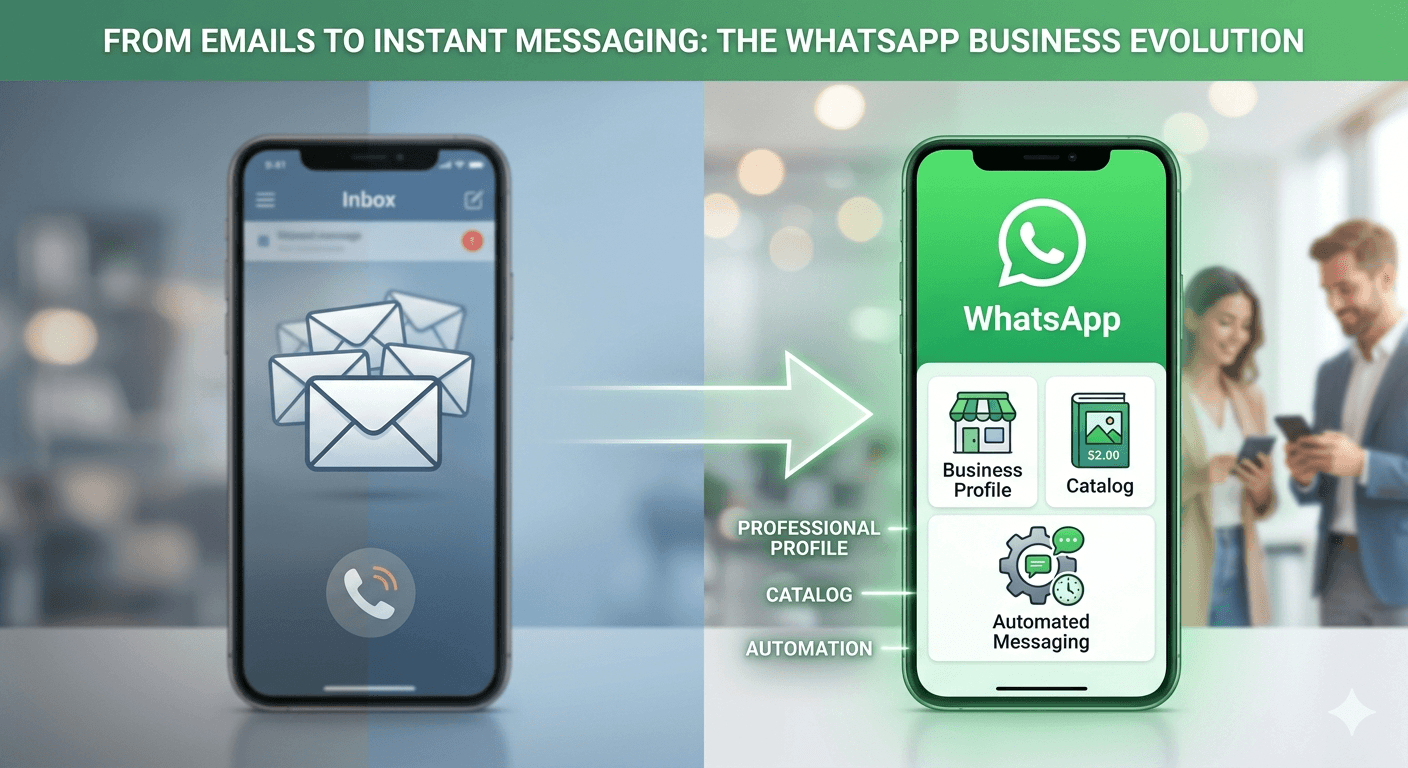
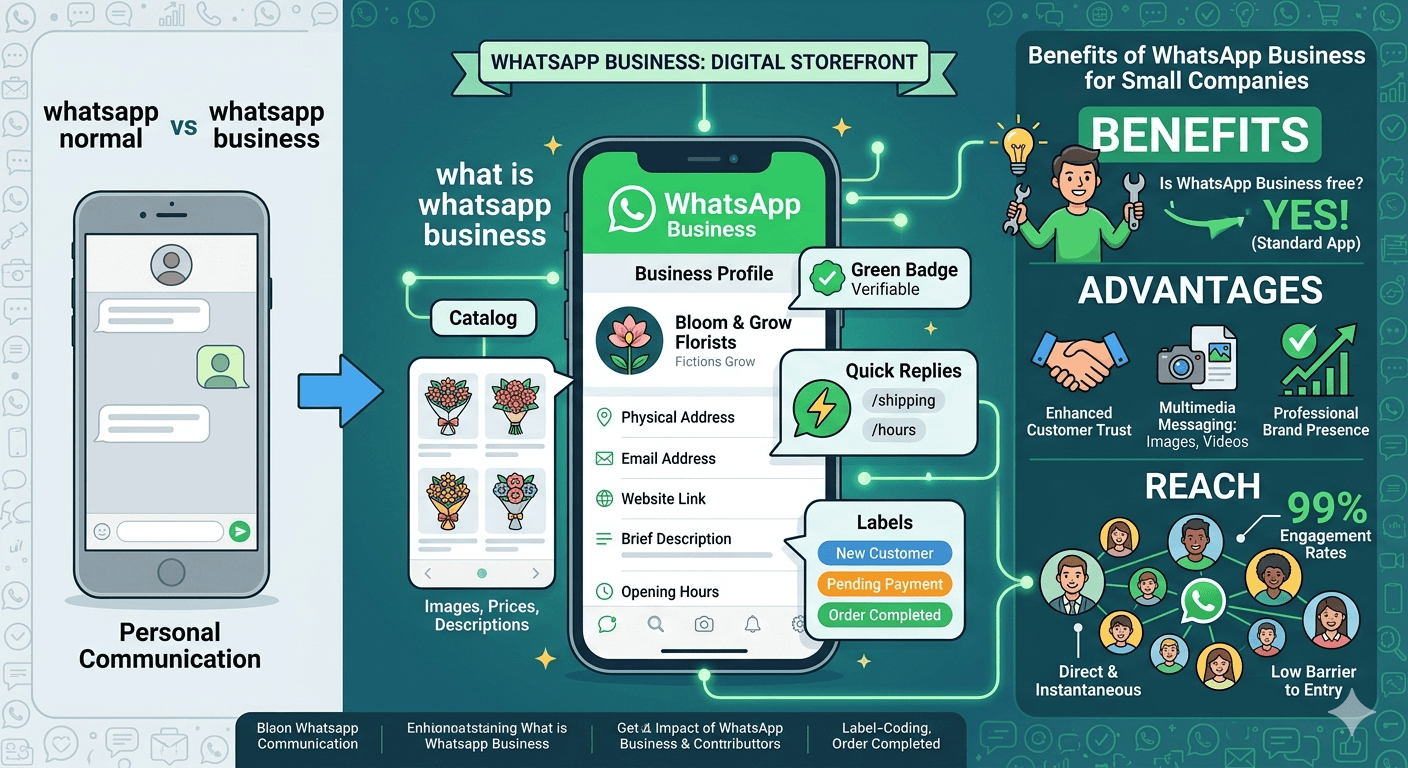
To fully grasp the utility of this tool, one must first understand what is a whatsapp business account and how it functions as a digital storefront. Essentially, it is a professional profile that allows a company to display essential information such as their physical address, email, website link, and a brief description of their services. This profile serves as the first point of contact for many customers, providing them with the necessary context before they even initiate a conversation. The transparency offered by a complete profile helps in establishing credibility, which is a significant factor in converting a lead into a loyal customer.
One of the most prominent whatsapp for business account features is the ability to create a digital catalog. This feature acts as a mobile showroom where businesses can list their products or services, complete with images, prices, and descriptions. This significantly reduces the friction in the buying process, as customers can browse offerings directly within the chat interface without having to navigate away to a separate website. The convenience of seeing a product and being able to ask a question about it in the same window is a powerful driver for higher conversion rates and improved customer satisfaction.
Benefits of WhatsApp Business for Small Companies
- Free to use: The standard WhatsApp Business app is free, making it an affordable solution for small and medium-sized businesses.
- Low setup costs: Requires minimal technical expertise and no significant upfront investment.
- Professional business profile: Helps build credibility and customer trust with branded business information.
- Rich multimedia support: Share images, videos, documents, and product catalogs to showcase products and services effectively.
- Improved customer engagement: Direct messaging typically achieves higher open and response rates than email.
- Familiar user experience: Customers can communicate through an app they already use, eliminating the learning curve.
- Stronger customer relationships: Enables personalized, real-time conversations that boost satisfaction and loyalty.
- Wider reach: Connect with billions of WhatsApp users worldwide, making it easier to engage local and international customers.
- Better brand visibility: Regular interactions keep your business top-of-mind and encourage repeat engagement.
- Ideal for growing businesses: Offers a scalable communication channel, with the option to upgrade to the WhatsApp Business Platform as customer demand increases.
Detailed Analysis of WhatsApp Business Cost and Implementation
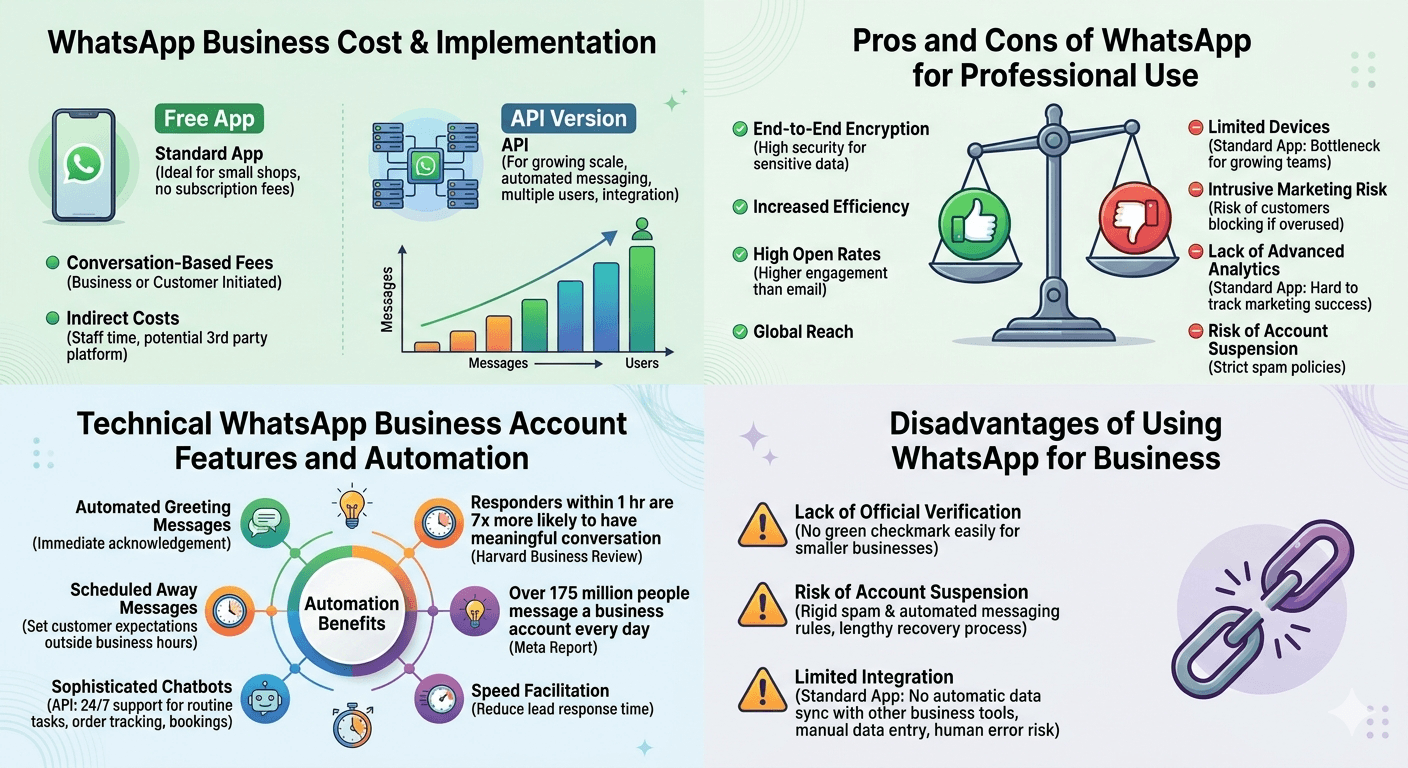
While the basic app is accessible to many, understanding the whatsapp business cost structure is vital for growing companies. For the standard app available on smartphones, there are generally no subscription fees, making it an ideal choice for local shops and individual consultants. However, as a business scales and requires more advanced features like multi-user access or integration with third-party software, they may need to transition to the API version. The API version involves a different pricing model, which is often based on the number of conversations initiated within a 24-hour window.
The financial planning for using business whatsapp requires looking at both direct and indirect costs. Direct costs involve the conversation-based fees associated with the API, which vary depending on whether the business or the customer initiates the chat. Indirect costs might include the time spent by staff managing the messages or the potential investment in a third-party platform to manage the API. Despite these costs, the return on investment is often very high due to the increased efficiency and the higher open rates of messages compared to other communication channels.
When considering if the platform is right for a specific budget, companies should weigh the advantages of whatsapp business account tools against the potential expenses. For a small business, the free app provides enough functionality to manage a moderate number of clients effectively. For larger organizations, the cost of the API is justified by the ability to automate thousands of interactions and integrate the data into their existing sales funnels. This scalability ensures that the platform remains a viable solution regardless of the size or growth stage of the organization.
Pros and Cons of WhatsApp for Professional Use
When deciding whether to adopt this tool, a thorough review of the pros and cons of whatsapp is necessary. On the positive side, the platform offers unparalleled security through end-to-end encryption. This means that sensitive information, such as order details or personal data, remains private between the business and the customer. This level of security is a major selling point for industries that handle confidential information, as it provides peace of mind to both parties involved in the transaction.
However, there are certain disadvantages of whatsapp that users must be aware of. One major drawback for the standard business app is the limitation on the number of devices that can be linked to a single account. This can create a bottleneck for growing teams where multiple agents need to respond to messages simultaneously. Without moving to the API, a business may find it difficult to maintain rapid response times as their customer base expands. Additionally, the lack of advanced analytics in the basic app makes it hard to track the long-term success of marketing campaigns.
Another point in the pros and cons of whatsapp for business discussion involves the potential for intrusive marketing. While the direct line to a customer is a benefit, overusing it can lead to customers blocking the business. Unlike email, where a person might ignore a message, a notification on a chat app is much more personal and can be seen as an annoyance if sent too frequently or at inappropriate times. Balancing the frequency and relevance of messages is a critical skill that businesses must master to avoid the negative aspects of the platform.
Additionally, reports from Meta indicate that over 175 million people message a business account every day, showing a massive and active user base that is already conditioned to interact with brands in this manner.
This data underscores the importance of the speed that the platform facilitates.
Major Disadvantages of Using WhatsApp for Business
Despite the many strengths, there are clear disadvantages of using whatsapp for business that can impact operational efficiency. One of the primary issues is the lack of a green checkmark or verification for everyone. Obtaining the official business verification is a rigorous process and is usually reserved for large, well-known brands. For smaller businesses, the absence of this badge might make it slightly harder to prove authenticity to a skeptical new customer. While a complete profile helps, the official “verified” status remains an elusive goal for many.
The disadvantages of whatsapp business account management also include the risk of account suspension. The platform has very strict policies regarding spam and automated messaging. If a business sends too many unsolicited messages or if several users report the account, the account can be banned without much warning. Recovering a banned account can be a long and tedious process, during which the business loses its primary communication channel with its customers. This high stakes environment requires a disciplined approach to messaging and a deep understanding of the platform’s terms of service.
Furthermore, the limited integration with other business tools in the standard app version can be a hindrance. Most modern businesses rely on a variety of software for accounting, inventory, and lead management. The inability of the free app to automatically sync data with these tools means that staff often have to manually enter information, which increases the likelihood of human error. This lack of a unified ecosystem is one of the main reasons why growing companies eventually find themselves needing to upgrade to more robust enterprise solutions.
Transitioning to WhatsApp Business API for Large Scale Operations
For enterprises that have outgrown the basic app, the transition to the API represents a significant step forward. The API removes many of the limitations found in the standard version, such as the single-user restriction and the lack of deep integrations. By using the API, a company can connect their messaging flow directly into their existing Customer Relationship Management (CRM) software. This allows for a 360-degree view of the customer, where every interaction on the messaging app is recorded alongside their purchase history and previous support tickets.
The shift also allows for unlimited message sending to customers who have opted-in to receive updates. This is particularly useful for sending shipping notifications, flight updates, or appointment reminders. Unlike the broadcast lists in the standard app, which have a limit on the number of recipients, the API is built for high-volume communication. This makes it an essential tool for logistics companies, travel agencies, and large e-commerce platforms that need to send thousands of time-sensitive alerts every day.
Moreover, the API supports more complex message templates that can include interactive buttons. These buttons allow customers to make choices or confirm actions with a single tap, further simplifying the user experience. For example, a customer could receive an appointment reminder with “Confirm” or “Reschedule” buttons directly in the chat. This interactive element significantly increases engagement and makes the communication feel more like a modern application and less like a static text message.
Key Considerations for Global Reach and Accessibility
When an organization asks what is a whatsapp and why it matters for global trade, the answer lies in its international ubiquity. In many parts of the world, including Latin America, India, and parts of Europe, the app is the primary method of communication, often surpassing traditional SMS and even email. For a business looking to expand internationally, having a presence on this platform is not just an advantage; it is a necessity. It allows a company to provide local-style support to a global audience without needing a physical office in every country.
The benefits of whatsapp business account tools in an international context include the ability to handle multiple languages and time zones through automated routing. Large organizations can set up their API to route messages to different teams based on the language of the incoming query. This ensures that the customer always talks to someone who understands their needs, improving the overall brand perception. The global nature of the platform also means that the cost of reaching an international customer is the same as reaching a local one, which is a major benefit for export-oriented businesses.
Furthermore, the platform’s ability to work on low-bandwidth connections is a vital feature for reaching customers in regions with inconsistent internet. The app is optimized to send and receive messages even when the signal is weak, ensuring that the business remains reachable at all times. This reliability is a key factor in its dominance in emerging markets, providing a stable foundation for commerce where other digital tools might fail.
Comparison of WhatsApp Normal vs Business Features
| Feature | WhatsApp Normal | WhatsApp Business App | WhatsApp Business API |
| Target Audience | Personal Use | Small Businesses | Large Enterprises |
| Cost | Free | Free | Conversation-based pricing |
| Profile Type | Personal | Business Profile | Business Profile |
| Automation | None | Basic (Greetings, Away) | Advanced (AI Chatbots) |
| Multi-user access | Limited (4 devices) | Limited (4 devices) | Unlimited via CRM |
| Integrations | None | Limited | Full CRM & Third-party |
| Verification | No | Possible but rare | High chance of Green Tick |
| Catalog | No | Yes | Yes (via API) |
This comparison highlights that while all versions share the core messaging DNA, the tools layered on top are drastically different. The standard version is purely for social interaction, whereas the business app introduces identity and basic efficiency. The API, however, is a professional infrastructure designed for scale, data integrity, and high-level automation. Choosing the right version depends entirely on the current size of the business and its future growth projections.
Read More: What is Cloud Calling? A Complete Guide to Cloud Telephony
Final Thought:
The decision to integrate this platform into a company’s strategy involves a careful weighing of the advantages and disadvantages of whatsapp for business. It is clear that the platform offers an unparalleled opportunity to connect with a global audience in a personal and secure manner. The ability to automate routine tasks, showcase products in a catalog, and provide instant support are benefits that can lead to significant growth. However, businesses must also be mindful of the limitations, such as the single-user constraints of the app and the strict policies regarding message frequency.
Ultimately, the digital economy is moving toward a conversational model where relationships are built through dialogue rather than one-way broadcasting. By understanding the nuances of the various account types and features, an organization can position itself at the forefront of this trend. Whether a small local shop or a multinational corporation, the tools provided by this platform offer a path toward more efficient, trustworthy, and profitable customer interactions. The journey from a standard account to a fully integrated API might be complex, but the potential rewards in customer loyalty and operational speed make it a journey worth taking.
Frequently Asked Questions
-
What is the advantage of Whatsapp business for a small company?
The primary advantage lies in its ability to create a professional presence for free. Small companies can use the business profile to share their location and website, while features like quick replies and labels help manage customer inquiries more efficiently than a standard personal account. It also allows for the creation of a product catalog, which serves as a mobile-friendly storefront.
-
Is Whatsapp or Whatsapp for business better for professional use?
For professional use, the business-specific version is significantly better. It provides essential tools that the personal version lacks, such as automated greetings, away messages, and detailed business profiles. These features help in maintaining a professional image and ensuring that customer inquiries are handled systematically rather than being mixed with personal messages.
-
Do I have to pay for Whatsapp business as my company grows?
The basic app version is free to download and use. However, as your company grows and requires the WhatsApp Business API for handling large volumes of messages or integrating with a CRM, you will encounter costs. These costs are typically based on a per-conversation pricing model, meaning you pay for the interactions you have with customers.
-
Can I use the same number for Whatsapp and Whatsapp business simultaneously?
No, a single phone number cannot be linked to both a personal and a business account at the same time. If you wish to use both on the same phone, you must have two separate phone numbers (such as a dual-SIM phone). You can, however, migrate your chat history from a personal account to a business account if you decide to switch.
-
What are the limitations of WhatsApp Business for large enterprises?
The main limitation for large enterprises using the standard app is the restriction on the number of users who can access the account. The app only allows one primary phone and four linked devices, which is insufficient for large support teams. To overcome this, large enterprises must use the API, which allows for unlimited agents and advanced automation.