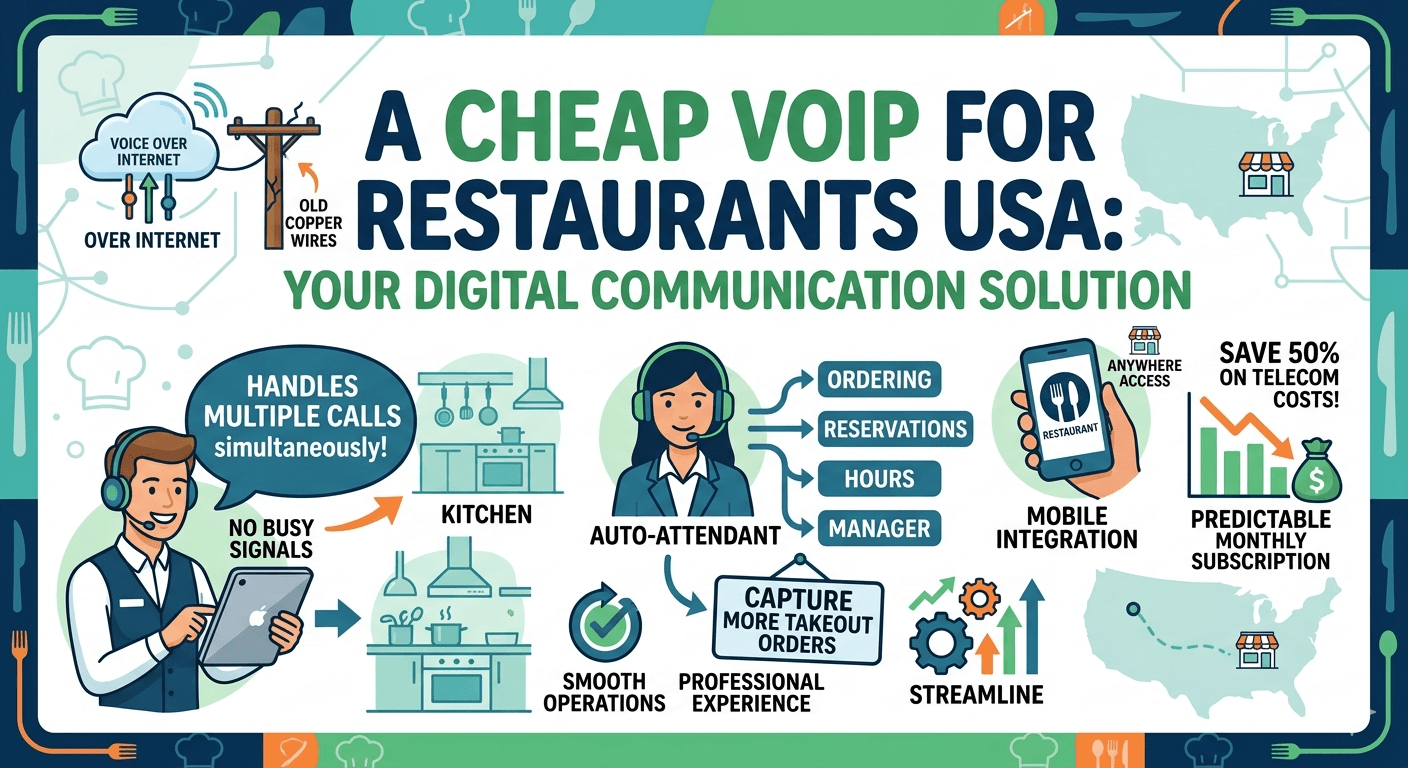
A cheap VoIP for restaurants USA is a digital communication solution that allows dining establishments to manage their phone calls over the internet rather than through traditional copper wires. By using an internet-based restaurant phone system, owners can handle multiple incoming orders simultaneously, ensuring that no customer ever receives a busy signal during the peak dinner rush. These systems offer essential features like automated attendants, call routing, and mobile integration at a fraction of the cost of legacy landlines. Implementing cheap VoIP for restaurants USA helps businesses streamline their operations, capture more takeout orders, and provide a professional experience for every caller.
Why Traditional Phone Lines Fail Food Service Operators
Legacy telephone infrastructure relies on physical copper wires running into your building, which naturally restricts your incoming call capacity to the exact number of physical lines you pay for monthly. When a front-of-house team member is processing a reservation on a legacy landline, the next customer who calls immediately hears a frustrating busy signal, prompting them to contact a nearby competitor instead. Relying on outdated hardware introduces an immediate operational bottleneck that limits your weekly sales pipeline during critical dinner rushes when order volume spikes.
A structured investigation published by Fortune Business Insights indicates that modern organizations migrating away from classic telephone networks achieve an immediate 50% to 60% reduction in their ongoing telecommunication operational expenditures.
This financial relief occurs because internet-based communication routes traffic through the cloud, allowing a single softphone application to manage dozens of simultaneous incoming calls. Instead of paying local telecom providers for individual physical lines, a restaurant can run an entire multi-line host desk configuration through a unified internet router setup. Furthermore, cloud-hosted options avoid vulnerability by allowing managers to instantly redirect incoming customer traffic to backup devices.
The Best Cheap Restaurant VoIP Systems

1. Zoom Phone
Zoom Phone offers an ultra-affordable, pay-as-you-go solution designed specifically for budget-conscious food trucks and small, single-location cafes.
-
- Starting Price: $10 per user/month
- Best For: Ultra-low-budget cafes, food trucks, and single-location diners.
- Key Features: Auto-attendant, visual voicemail, mobile and desktop apps, SMS messaging, and call logs.
- Pro: Cheapest pay-as-you-go outbound calling plan on the market.
- Con: Toll-free numbers and unlimited outbound minutes cost extra.
2. Nextiva
High-volume pizzerias and full-service restaurants often turn to Nextiva for its industry-leading customer support and exceptional call clarity.
-
- Starting Price: $18 – $20 per user/month
- Best For: High-volume pizzerias and full-service restaurants needing strong customer service tools.
- Key Features: Multi-level auto-attendant, unlimited calling across North America, voicemail-to-email, and mobile management.
- Pro: Industry-leading 24/7 customer support and exceptional call clarity.
- Con: Cheapest pricing requires an annual contract and a higher user count.
3. Dialpad
Fast-casual spots can leverage the advanced AI features and automated transcriptions built natively into the Dialpad platform to streamline their operations.
-
- Starting Price: $15 per user/month
- Best For: Fast-casual spots looking to leverage automated AI features.
- Key Features: Built-in AI call transcriptions, automated text replies for missed calls, and custom call routing.
- Pro: Outstanding AI features included natively in the base tier.
- Con: Multi-location call routing requires an upgrade to higher tiers.
4. RingCentral
For growing restaurant franchises that require deep software connectivity and scalability, RingCentral provides an extensive marketplace of app integrations and real-time analytics.
-
- Starting Price: $20 per user/month
- Best For: Growing restaurant groups and franchises requiring deep software integrations.
- Key Features: Interactive Voice Response (IVR), real-time analytics, SMS capabilities, and integrations with CRM platforms.
- Pro: Highly scalable platform with an extensive app marketplace.
- Con: Interface can feel complex for small operations with basic needs.
5. Ooma Office
Ooma Office provides a straightforward, plug-and-play experience for traditional restaurants that prefer using their existing analog hardware without a long-term contract.
-
- Starting Price: $19.95 per user/month
- Best For: Traditional restaurants wanting a straightforward, plug-and-play setup.
- Key Features: Virtual receptionist, hold music, ring groups, and call blocking for spam.
- Pro: No contract required and works flawlessly with standard analog phones via an adapter.
- Con: Lacks advanced integration options with modern Point of Sale (POS) systems.
6. Phone.com
Budget-conscious diners that primarily receive inbound calls will find Phone.com to be an extremely cost-effective choice for handling basic communication needs.
-
- Starting Price: $15.00 per user/month
- Best For: Low-volume diners or cafes that do not need unlimited calling minutes.
- Key Features: 500 pooled minutes, 1,000 text messages, call forwarding, and an auto-attendant.
- Pro: Extremely cost-effective for locations that mostly receive inbound calls.
- Con: Exceeding the 500-minute threshold requires a plan upgrade.
- Learn more on the Phone.com Official Website.
7. Vonage Business Communications
Restaurants seeking a fully tailored communication system can use Vonage Business Communications to build a custom suite of features through its flexible a la carte model.
-
- Starting Price: $19.99 per line/month
- Best For: Restaurants wanting a fully customized a la carte system.
- Key Features: Mobile and desktop apps, text messaging, and a virtual receptionist menu.
- Pro: Add-on features allow you to buy exactly what your restaurant needs.
- Con: Advanced features like on-demand call recording require expensive add-on subscriptions.
- Learn more on the Vonage Business Website.
8. Grasshopper
Grasshopper is the ideal hardware-free solution for mobile catering businesses and food trucks that want to manage professional calls directly through their existing smartphones.
-
- Starting Price: $14.00 – $15.00 per user/month
- Best For: Small setups, food trucks, or mobile catering businesses.
- Key Features: Call forwarding to personal mobile phones, voicemail transcription, and automated text responses.
- Pro: Requires zero upfront hardware purchases since staff use their existing mobile devices.
- Con: Completely reliant on your cell phone carrier network for voice quality.
- Learn more on the Grasshopper Home Page.
Core Features of VOIP Phone Systems for Restaurants
Modern communication tools are designed to handle the fast-paced environment of a professional kitchen and busy front-of-house. A cheap VoIP for restaurants USA provides a suite of advanced features that were previously only available to large corporations with massive budgets. These tools help maintain order during chaotic shifts and ensure that every staff member can stay focused on providing excellent food and service.
By utilizing these digital features, you can automate routine tasks that usually take up a host’s time. Instead of answering the phone just to state your operating hours or address, the system can do it for you. This allows your team to focus on the guests sitting in front of them while still providing excellent service to those calling from home.
1. IVR / Auto-Attendant
The Interactive Voice Response (IVR) or Auto-Attendant acts as a virtual receptionist for your business. When a customer calls your restaurant, they are greeted by a professional recording that directs them to the right place. For example, the message might say, “Press 1 for hours and location, Press 2 for takeout orders, or Press 3 to speak with a manager.”
This feature is essential for a voip phone service for restaurants because it filters out simple questions that don’t require human interaction. By letting the system handle basic inquiries, your staff can spend more time packing orders or seating guests. It also ensures that callers get the information they need immediately without being placed on hold.
2. Ring Groups / Call Hunt
In a busy environment, a single phone ringing at the host stand might not be heard over the noise of the crowd. Ring groups allow the system to ring all front-of-house phones simultaneously or in a specific sequence. This ensures that if the host is busy, the phone in the back office or at the bar will ring next, so no carryout order gets missed.
-
Simultaneous Ring: All designated phones ring at the same time.
-
Sequential Ring: The system tries the host stand first, then the bar, then the office.
-
Time-Based Routing: Phones ring differently during lunch versus dinner shifts.
-
No-Answer Failover: Calls automatically move to a backup line if no one picks up.
-
Priority Queuing: VIP customers or regular callers can be moved to the front of the line.
3. Mobile App Integration
Restaurant managers are rarely sitting at a desk; they are usually on the floor or in the kitchen. Mobile app integration allows managers to adjust operations or check voicemails on their phones right from the kitchen or even while away from the building. This flexibility is a key benefit of voip for restaurants.
Using a mobile app, you can change your outgoing greeting if you have an unexpected closure or update your menu options on the fly. It also allows you to make outbound calls using the restaurant’s phone number, keeping your personal number private while staying connected to vendors and staff.
4. Crystal-Clear HD Voice
Communication in a loud kitchen or a bustling dining room can be difficult if the audio quality is poor. High-definition (HD) voice technology ensures that every conversation is crisp and clear, reducing the chance of order errors caused by miscommunication. This superior sound quality is a standard feature in the best phone system for restaurants.
HD voice uses a wider frequency range than traditional landlines, which helps eliminate background noise and static. When your staff can clearly hear a customer’s specific dietary requests or complex order details, the overall efficiency of your kitchen increases and customer satisfaction improves.
5. Multi-Line Call Handling
With a traditional phone system, you are limited by the number of physical lines you have installed. Cheap VoIP for restaurants USA removes this limitation by allowing virtually unlimited simultaneous calls. This means you can have three people on hold, two people talking to the host, and another person leaving a voicemail, all at once.
This multi-line capacity is vital during peak hours when everyone wants to place an order at the same time. Instead of the “busy” signal that drives customers away, callers are placed in a professional queue where they can listen to specials or music while they wait for the next available staff member.
6. Custom Call Routing & Auto Attendants
Custom call routing allows you to define exactly where calls go based on the time of day or the day of the week. For example, during closed hours, calls can be routed to a recording that states your opening times or redirected to a manager’s mobile phone for emergency inquiries. This level of control is a major advantage of modern restaurant telephone systems.
-
Holiday Routing: Automatically play special messages on Thanksgiving or Christmas.
-
Lunch vs. Dinner: Route calls to different stations depending on the shift.
-
Overflow Routing: Send calls to a secondary location if the primary line is too busy.
-
Direct Dial: Give specific vendors a direct line to the kitchen manager.
-
Language Options: Offer menus in different languages for diverse communities.
7. Wireless Failover
Internet outages can happen, but they shouldn’t stop your restaurant from taking orders. Wireless failover is a safety feature where the system automatically switches to a cellular data connection if your main internet line goes down. This keeps your cheap VoIP for restaurants USA active and ensures you never lose revenue due to technical issues.
This feature provides peace of mind for operators who worry about the reliability of cloud-based systems. By having a secondary connection ready to go, you maintain a 100% uptime environment that keeps your digital ordering system and phone lines running smoothly at all times.
8. AI Ordering Ready
As technology evolves, many restaurants are looking toward artificial intelligence to handle routine phone orders. While this is often an optional add-on, many voip for restaurants platforms are built to be “AI-ready.” This means you can eventually integrate automated voice bots that can take orders and input them directly into your POS system.
AI ordering can significantly reduce labor costs and eliminate human error in the ordering process. Even if you aren’t ready for AI today, choosing a system that supports this future technology ensures that your restaurant remains competitive as the industry shifts toward more automation.
9. Built-In Call Recording
Call recording is an invaluable tool for training and resolving disputes. If there is a misunderstanding about a large catering order or a complaint about a staff member’s phone etiquette, you can review the recorded call to see exactly what happened. Most affordable voip service providers include this feature as part of their standard package.
Reviewing calls periodically can also help you identify areas where your staff might need more training. You can listen for how effectively they upsell appetizers or how they handle difficult customers, allowing you to provide constructive feedback that improves the overall guest experience.
10. Cloud-Based Management
Managing a restaurant phone system shouldn’t require a degree in IT. Cloud-based management allows you to log into a simple website and make changes to your system from anywhere. Whether you need to add a new extension for a seasonal patio or change your voicemail password, it can be done in seconds.
This centralized control is especially helpful for owners of multiple locations. You can manage the phone settings for all your restaurants from one dashboard, ensuring consistency in how calls are handled across your entire brand. It simplifies administrative tasks and reduces the need for expensive on-site technicians.
11. Mobile App Calling
Staff members often need to call customers back to clarify an order or notify them that their table is ready. Mobile app calling allows them to use their own smartphones to make these calls while displaying the restaurant’s business number on the caller ID. This is a crucial feature for the best restaurant phone system.
This protects the privacy of your employees and maintains a professional image for your business. It also means you don’t have to invest in expensive cordless handsets that often get dropped or lost in a busy kitchen environment. Staff can simply use the devices they already have in their pockets.
How a cheap VoIP service can help your business
Switching to an affordable VoIP service can provide small businesses and startups especially with significant advantages—both in cost savings and operational efficiency. Many restaurant owners find that the monthly savings alone are enough to justify the switch, but the operational benefits are equally impactful. When you use cheap VoIP for restaurants USA, you are investing in a tool that grows with your business.
The flexibility of cloud communication means you are no longer tethered to a physical location. If you open a food truck or a pop-up shop, your phone system can follow you there. This adaptability is essential in the modern food service industry where agility can be the difference between success and failure.
-
Lower costs by replacing expensive PBX hardware and maintenance with a predictable subscription.
-
Consolidates all calls, messages, and video meetings into a single app.
-
Reduces the need for multiple tools and complex IT overhead.
-
Provides remote-friendly flexibility for managers on the move.
-
Includes advanced productivity tools like real-time transcription and call summaries.
-
Offers native integrations with CRMs and helpdesk business apps.
Beyond the technical benefits, these systems improve the quality of life for your staff. By reducing the number of repetitive phone calls they have to answer, you reduce their stress levels during busy shifts. A more relaxed and focused team leads to better food quality and a more pleasant atmosphere for your guests.
How to Choose & Set Up Your System
Choosing the right cheap VoIP for restaurants USA requires a quick look at your current technology and your future needs. You don’t need to be a tech expert to get started, but a little bit of preparation goes a long way. The setup process is generally much faster than installing traditional landlines, often taking only a few minutes once your hardware arrives.
The goal is to create a seamless transition that doesn’t interrupt your daily operations. Most providers offer guided setup tools and customer support to help you through the process. By following a few simple steps, you can move your restaurant into the digital age with minimal hassle.
-
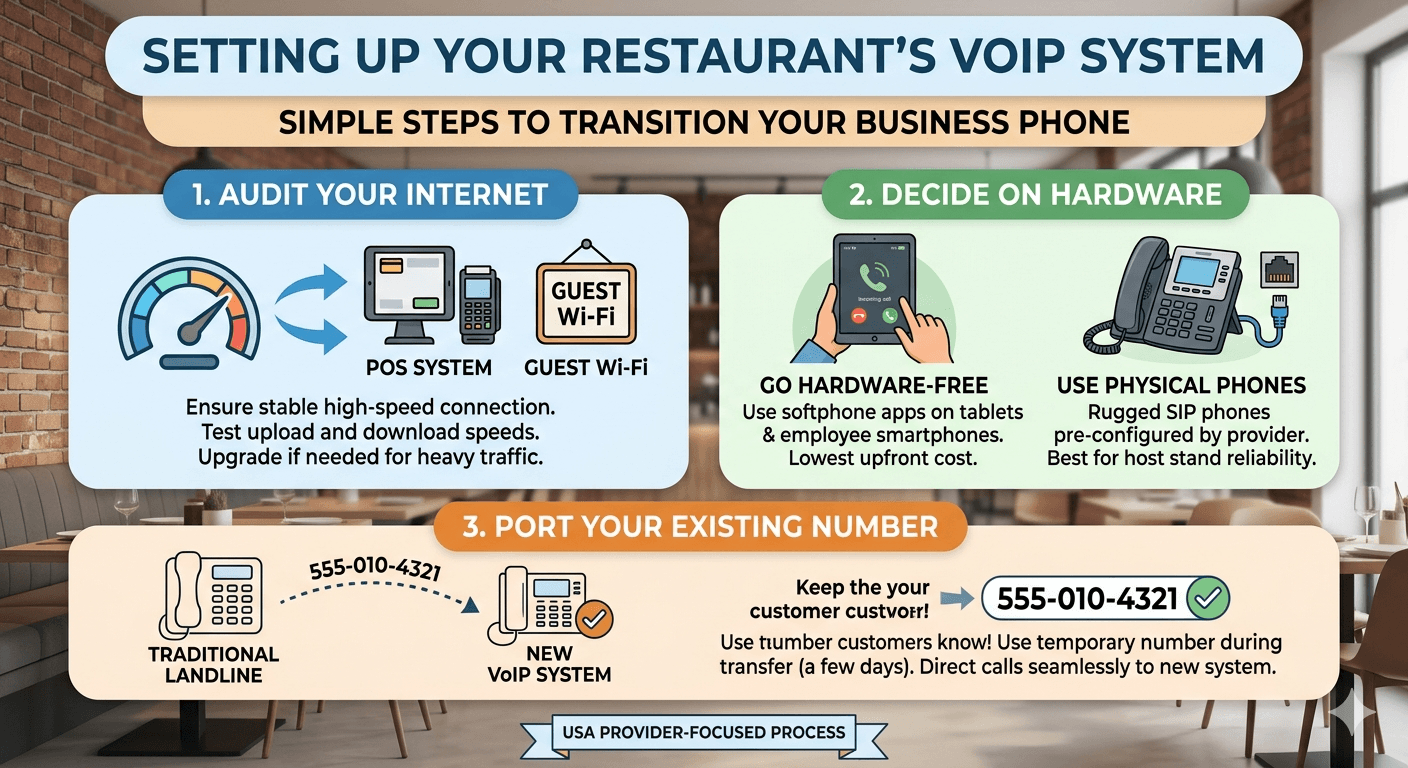
Audit Your Internet
VoIP relies completely on a stable, high-speed internet connection. Before making the switch, ensure your network can handle voice packets alongside your POS system and guest Wi-Fi. A slow connection can lead to dropped calls or poor audio quality, which can frustrate both your staff and your customers.
According to research by BroadbandNow, most business-grade internet connections in the USA are more than capable of handling VoIP traffic.
However, it is always a good idea to check your upload and download speeds. If your internet is struggling, you may need to upgrade your plan or install a separate router specifically for your phone system to ensure consistent performance.
-
Decide on Hardware
You can save money by avoiding physical desk phones entirely. Simply run softphone apps on a tablet at the host stand or on the smartphones your staff already use. This is often the cheapest voip business phone service strategy because it eliminates the need for any upfront hardware investment.
If you prefer physical phones, look for providers that support standard pre-configured SIP phones. These are rugged devices designed for high-volume use. Many restaurant owners choose a mix of hardware: a physical phone for the host stand and softphones for the managers and kitchen staff. This hybrid approach provides the best of both worlds in terms of reliability and flexibility.
-
Port Your Existing Number
Do not change your phone number. Your customers likely have your current number saved in their phones or have seen it on your menus and signage for years. Make sure the provider offers free local number porting so regulars can continue using the exact same number they already know.
Porting is a standard industry practice, but it can take a few days to complete. Most cheap VoIP for restaurants USA providers will give you a temporary number to use while the transfer happens. Once the port is successful, all calls to your old number will automatically ring on your new VoIP system, ensuring a seamless transition for your loyal customer base.
Implementation Checklist
A smooth rollout is key to getting the most out of your new system. Before you go live, take the time to test everything and train your staff on the new features. A little bit of preparation ensures that your first “VoIP-powered” shift goes off without a hitch and that you start seeing the benefits of your cheap VoIP for restaurants USA immediately.
Use this checklist to ensure you haven’t missed any critical steps. It is better to find and fix a small issue during a slow Tuesday morning than to deal with it during a crowded Friday night.
-
Test your internet: Run a speed test to ensure your network can handle voice traffic without jitter.
-
Choose hardware: Use standard analog telephone adapters (ATAs) to keep legacy kitchen/bar phones or purchase dedicated IP desk phones.
-
Set up failover routing: Configure your system to instantly forward calls to a manager’s mobile number if your physical internet router goes offline.
-
Record your greetings: Ensure your IVR and voicemail messages are professional and up-to-date.
-
Train the team: Show the host and managers how to transfer calls, check voicemails, and use the mobile app.
By following these steps, you create a robust communication environment that is ready for anything. The ability to failover to mobile devices is particularly important for maintaining service during unexpected local events or utility issues.
The Human Bottleneck Warning
While VoIP keeps monthly bills incredibly low, remember that standard VoIP does not take orders automatically. If your host is tied up seating a table during rush hour, calls will still get sent to a hold queue or voicemail. The technology provides the “pipes” for the calls, but someone—or something—still needs to handle the interaction.
If you are looking to fully automate phone orders, you may eventually want to budget for specialized AI-ordering add-ons. However, even without AI, a cheap VoIP for restaurants USA significantly reduces the human workload by using the Auto-Attendant to answer common questions. This ensures that the only calls your staff has to answer are the ones that actually result in a sale or a high-value reservation.
Read More: Does VoIP Work Without Internet: 10 Crucial Facts
Final Thoughts: Is Your Restaurant Ready for the Cloud?
Adopting a cheap VoIP for restaurants USA is one of the smartest investments a modern food service operator can make. It solves the age-old problem of missed calls and busy signals while significantly lowering your monthly overhead. In an industry where margins are notoriously thin, saving 50% on your phone bill while simultaneously improving your order capacity is a win-win scenario. The transition from legacy landlines to cloud-based systems is not just a trend; it is a necessary evolution for any restaurant that wants to thrive in a competitive market.
By focusing on features like IVR, ring groups, and mobile integration, you empower your staff to work more efficiently and provide a better experience for your guests. Whether you are running a small local diner or a busy urban bistro, the right phone system ensures that you are always open for business. The future of restaurant communication is digital, flexible, and affordable. Don’t let an outdated copper wire be the bottleneck that holds your business back.
Frequently Asked Questions
-
How Much Do VoIP Phone Services Cost?
VoIP phone services are significantly cheaper than traditional landlines, typically starting as low as $15 to $25 per user per month. Most providers offer flat-rate pricing that includes unlimited local and long-distance calling within the USA. This predictable monthly cost helps restaurant owners budget more effectively without worrying about hidden fees or per-minute charges.
-
What Makes VoIP More Cost-Effective Than Traditional Telephony?
VoIP is more cost-effective because it uses your existing internet connection rather than requiring a separate physical phone network. This eliminates the need for expensive hardware installations, on-site maintenance, and the high monthly taxes associated with legacy telecom. Additionally, features like Auto-Attendant reduce the labor hours needed to answer routine questions.
-
What’s the Difference Between VoIP and UCaaS?
VoIP stands for Voice over Internet Protocol and primarily focuses on phone calls. UCaaS, or Unified Communications as a Service, is a broader platform that includes VoIP plus video conferencing, team messaging, and advanced integrations. For most restaurants, a standard VoIP plan with basic features is sufficient, though larger groups may prefer the expanded tools of UCaaS.
-
What’s Best if You Have a Remote or Hybrid Team, a VoIP Phone Service or a UCaaS platform?
If you have a remote management team or multiple locations that need to coordinate closely, a UCaaS platform is often the better choice. It allows for video meetings and internal messaging which can help in training and management. However, for a single-location restaurant primarily focused on taking orders, a cheap VoIP service is usually the most efficient and affordable option.
-
How Easy is it to Switch From a Legacy System to VoIP?
Switching is remarkably easy and can often be done in less than an hour of actual setup time. Once you choose a provider, you simply plug your new IP phones into your internet router or install the app on your mobile devices. The most time-consuming part is usually waiting for your old phone number to port over, but your provider handles most of that work for you.
-
What makes your VOIP phone service for restaurants different from a regular business phone system?
A restaurant-specific setup focuses on high-volume call handling, rugged hardware that can withstand kitchen environments, and features like “Call Hunt” to ensure orders are picked up by the first available staff member. Regular business systems might focus more on conference calling or internal extensions that aren’t as vital for a food service environment.
-
Are your phone systems for restaurants scalable enough for smaller restaurants?
Yes, one of the best things about cloud-based VoIP is its perfect scalability. A small café can start with just one line and a mobile app, while a large restaurant can have ten different extensions across the bar, kitchen, and host stand. You only pay for the “seats” you need, and you can add or remove them instantly as your business grows.
-
What should I look for when choosing the best VOIP for restaurants?
Look for a provider that offers high reliability (99.9% uptime), 24/7 customer support, and essential features like IVR and mobile app integration. It is also important to ensure they offer free number porting and have experience working with the unique needs of the hospitality industry.
-
What’s the best phone system for restaurants that also supports AI ordering?
The best systems are those with open APIs or built-in integrations for AI voice bots. When evaluating providers, ask specifically about their ability to integrate with third-party ordering platforms or if they have their own proprietary AI tools. This ensures your system is future-proof as you move toward more automation.