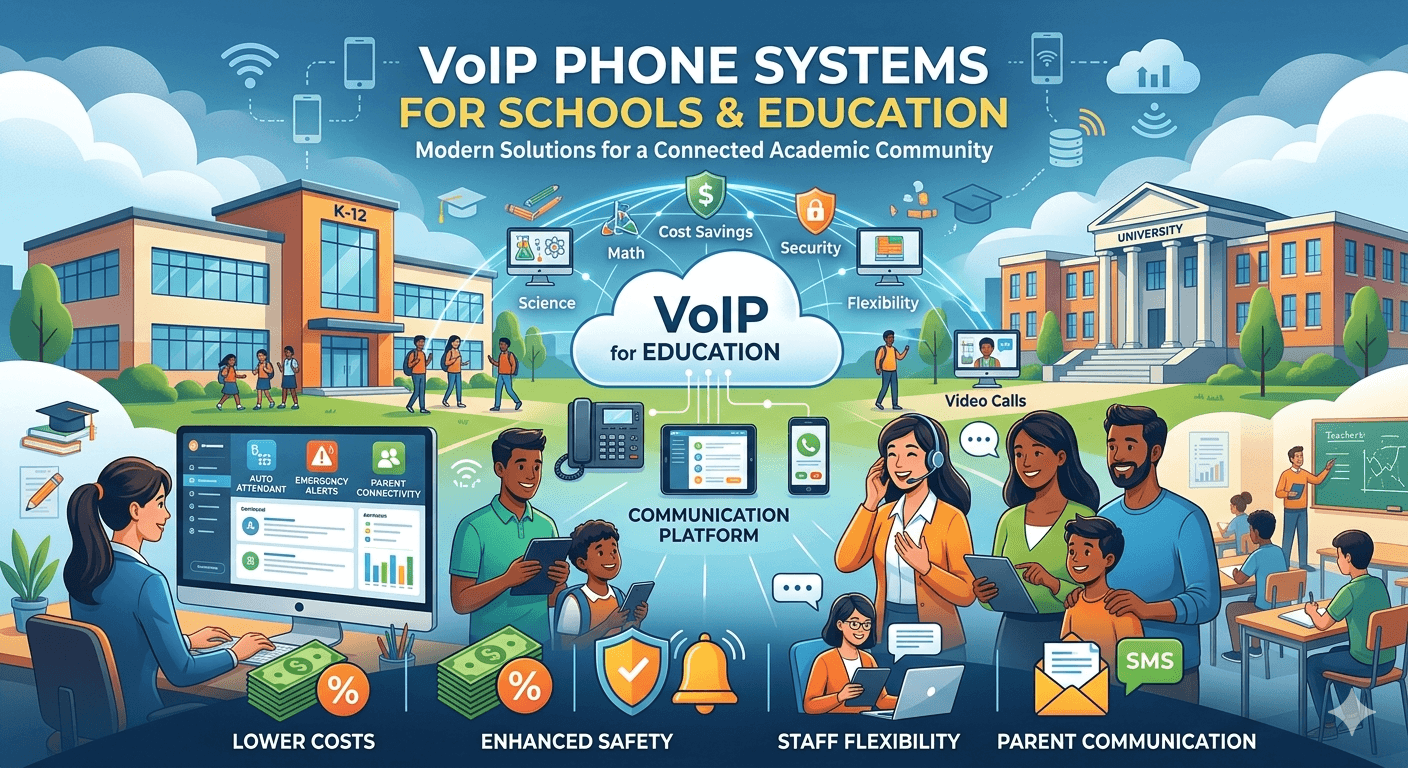
A VoIP phone system for Schools and Education is a modern communication solution that replaces traditional landlines with internet-based calling. These systems allow K-12 schools and higher education institutions to manage voice calls, video conferencing, and messaging through a single digital platform. By leveraging cloud technology, educational facilities can reduce operational costs, enhance campus security, and improve collaboration between teachers, parents, and administrators. This technology offers advanced features like automated attendants, mobile app integration, and emergency broadcasting, ensuring that school districts remain connected and responsive while simplifying the management of their entire telecommunications infrastructure.
What Is VoIP for Education?
Voice over Internet Protocol, commonly known as VoIP, is a technology that allows users to make voice calls using a broadband internet connection instead of a regular phone line. For educational environments, this means that the school phone system no longer relies on heavy copper wiring or expensive hardware on-site. Instead, all communication data is transmitted digitally via the cloud, allowing staff to access their phone extensions from desk phones, computers, or mobile devices. This transition to telecom for educational institutions represents a significant shift toward digital transformation in the classroom and administrative offices.
Implementing a private school cloud phone system provides a unified communication platform that supports the diverse needs of modern learning environments. Whether it is a small preschool or a large university campus, this technology bridges the gap between different departments and remote locations. It allows for seamless data sharing and voice communication, ensuring that every member of the academic community has access to reliable tools. As schools continue to adopt more digital tools, integrated voice solutions become the backbone of their daily operations and long-term strategic planning.
Why Schools Are Replacing Traditional Phone Systems
Traditional analog phone systems are becoming increasingly obsolete due to high maintenance costs and limited functionality. Many school districts find that their legacy hardware is difficult to repair because parts are no longer manufactured, leading to frequent downtime. By switching to voip for schools, administrators can eliminate the need for expensive service contracts and specialized technicians required for on-premise PBX systems. This modernization ensures that the school stays current with technological standards while providing a more robust platform for daily communication.
Furthermore, traditional systems lack the flexibility required for modern education models, such as remote learning or hybrid administrative work. Old-fashioned telephone systems for schools do not easily support call forwarding to mobile devices or remote voicemail access, which can hinder productivity. Cloud-based solutions solve these issues by providing a centralized management portal where updates can be deployed instantly across multiple campuses. The shift is driven by the need for better reliability, lower overhead, and the ability to integrate voice services with other digital educational tools.
Key Benefits of VoIP for Schools and Educational Institutions
Modernizing your infrastructure with a dedicated VoIP phone system for Schools and Education offers numerous advantages that extend beyond simple voice calls. These systems are designed to handle the high-volume traffic typical of school offices, especially during registration periods or emergency situations. By centralizing communication, schools can ensure that no call goes unanswered and that every parent or staff member receives the information they need promptly.
Educational institutions also benefit from the professional image that advanced telephony provides. Features such as customized greetings and professional hold music enhance the experience for callers. Additionally, the ability to manage the entire system from a single web-based dashboard allows IT staff to focus on more critical tasks rather than troubleshooting individual phone lines. This streamlined approach to school phone systems makes it easier to maintain high standards of communication across the entire district.
1. Lower Communication Costs
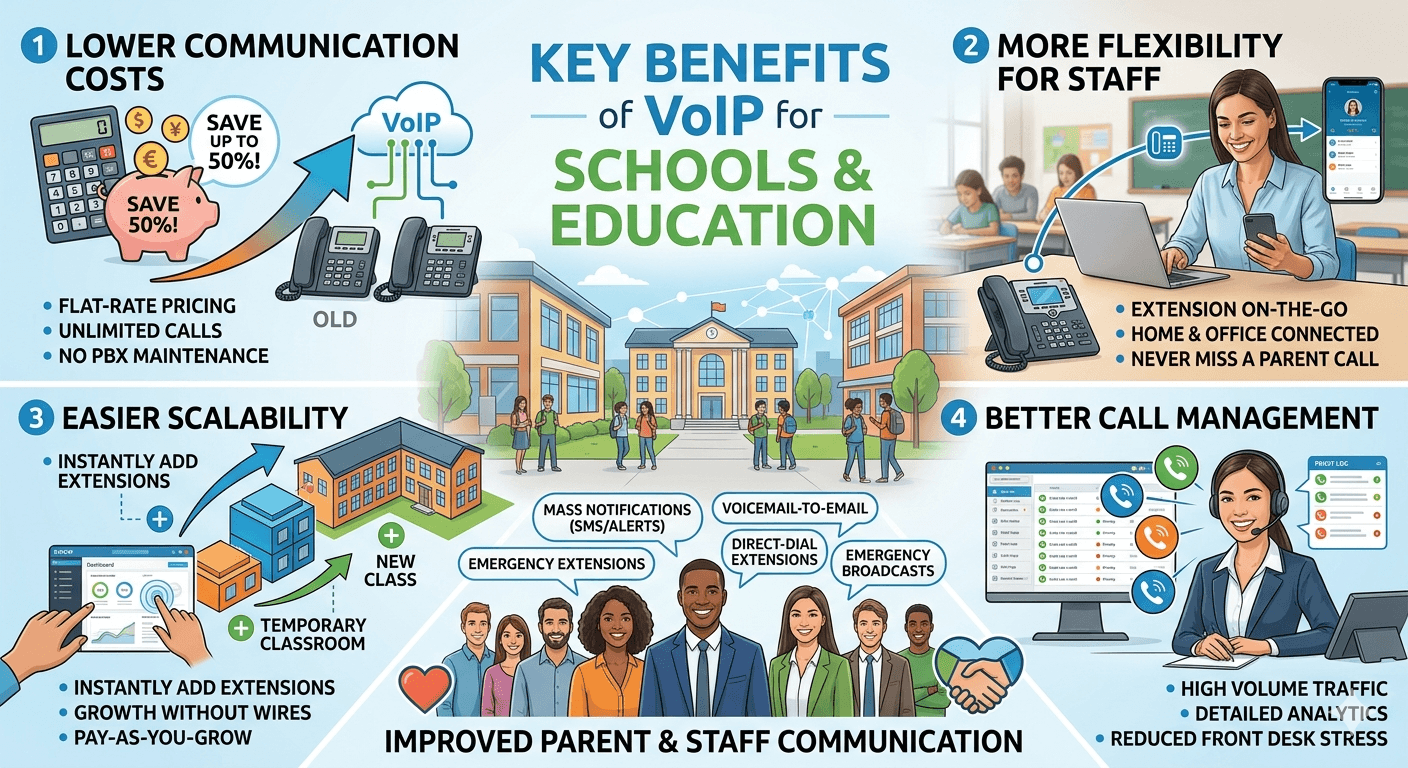
One of the most significant advantages of adopting voip for educational institutions is the immediate reduction in monthly expenses. Traditional phone companies charge per line and often include high fees for long-distance calls and system maintenance. In contrast, cloud-based providers typically offer flat-rate monthly pricing per user, which includes unlimited local and long-distance calling. Research indicates that educational organizations can save up to 50% on their telecommunications bills by moving to a hosted VoIP solution.
-
Reduction in initial hardware investment and installation fees.
-
Lower monthly subscription costs compared to analog service providers.
-
Elimination of maintenance contracts for on-site PBX hardware.
-
Free calling between different campus locations or district offices.
-
Minimal costs for adding new features or software updates.
Beyond the direct savings on bills, schools also save money through reduced power consumption and less physical space required for equipment. Since the service is hosted in the cloud, there is no need for a dedicated, climate-controlled server room for phone lines. These reclaimed funds can be redirected toward classroom resources, technology upgrades for students, or extracurricular programs. The financial sustainability of voip for private schools makes it an attractive option for boards looking to maximize their budgets.
2. More Flexibility for Staff
Staff members in educational settings are rarely tied to a single desk throughout the day. Teachers move between classrooms, and administrators often travel between different buildings or attend off-site meetings. A VoIP phone system for Schools and Education allows staff to take their extensions with them wherever they go via mobile apps or laptop software. This ensures that important calls from parents or colleagues are never missed, regardless of the physical location of the staff member.
This flexibility is particularly beneficial for schools that have adopted hybrid work models for administrative staff. With a private school cloud phone system, an employee working from home can answer calls exactly as if they were sitting in the main office. This level of connectivity supports a better work-life balance and ensures that the school remains operational during inclement weather or other disruptions. The ability to switch between devices during an active call also adds a layer of convenience that traditional systems cannot match.
3. Easier Scalability
As a school grows or as new departments are created, the communication system must be able to expand without significant delays or costs. Best phone systems for schools offer instant scalability, allowing administrators to add or remove users with just a few clicks in the management portal. There is no need to wait for a technician to come on-site and run new wires or install additional hardware cards. This agility is crucial for institutions that experience seasonal fluctuations in staff or student enrollment.
-
Add new extensions for temporary staff during peak enrollment periods.
-
Easily integrate new satellite campuses into the main network.
-
Remove unused lines instantly to save on monthly subscription costs.
-
Upgrade feature sets for specific departments without affecting the whole school.
-
Deploy softphones to new employees without purchasing physical hardware.
The cloud-based nature of these systems means that the infrastructure grows with the institution. Whether the school is adding a single classroom or an entire new wing, the phone system remains a constant and reliable resource. This “pay-as-you-grow” model ensures that schools only pay for the capacity they actually need, preventing the waste of resources on unused technology.
4. Better Call Management
Managing a high volume of incoming calls is a daily challenge for school secretaries and front-office staff. Advanced phone systems for education institutions provide sophisticated call management tools that streamline this process. Features such as visual voicemail, call waiting, and detailed call logs help staff prioritize urgent matters and ensure that every inquiry is documented. This level of organization reduces the stress on administrative personnel and improves the overall efficiency of the office.
With these tools, administrators can also gain insights into call patterns through detailed analytics. For instance, they can see when call volumes are highest and adjust staffing levels accordingly. This data-driven approach to management helps in optimizing the performance of the front desk and improving the service provided to the school community. Better call management directly correlates to a more organized and professional educational environment.
5. Improved Parent and Staff Communication
Clear and consistent communication is the foundation of a strong school community. A VoIP phone system for Schools and Education facilitates better interaction between parents and teachers by providing direct lines of contact that are easy to manage. Teachers can set specific hours for receiving calls or use the “do not disturb” feature during instruction time, while still allowing parents to leave messages that are delivered directly to their email. This respectful balance between accessibility and privacy fosters a more collaborative relationship.
-
Quickly broadcast announcements to all staff members simultaneously.
-
Send automated SMS alerts to parents for school closures or events.
-
Enable direct-dial extensions to bypass the main office for specific queries.
-
Facilitate conference calls for IEP meetings or parent-teacher associations.
-
Improve response times with voicemail-to-text features for busy administrators.
In times of crisis or emergency, the ability to communicate instantly across multiple channels is vital. Modern voip solutions for schools often include mass notification features that can send alerts to every phone in the building or to parent mobile devices at once. This capability ensures that safety protocols are followed and that everyone remains informed during critical events, significantly enhancing the security posture of the institution.
Essential VoIP Features for Education
When selecting a VoIP phone system for Schools and Education, it is important to look for specific features that cater to the unique needs of an academic setting. Unlike standard corporate environments, schools require tools that support both high-volume administrative tasks and specialized classroom needs. The right combination of features can transform how a school functions on a day-to-day basis, making it more responsive to its students and stakeholders.
These features are not just about making calls; they are about creating an integrated communication ecosystem. By utilizing digital tools, schools can automate repetitive tasks, such as directing callers to the right department or providing recorded information about school hours. This automation frees up staff to focus on more complex student-facing responsibilities, ultimately improving the quality of service provided by the institution.
1. Auto Attendant and IVR
The Auto Attendant serves as a virtual receptionist that greets every caller with a professional message and provides a menu of options. This is an essential feature for school phone systems, as it allows callers to quickly navigate to the attendance office, the nurse, or specific grade-level departments without human intervention. Interactive Voice Response (IVR) takes this a step further by allowing callers to input data, such as a student ID, to receive automated updates.
Using an Auto Attendant ensures that the front office is not overwhelmed by routine inquiries, such as “What time does school start?” or “When is the next break?” By providing these answers through a recorded menu, the system allows office staff to handle more sensitive or complicated calls that require personal attention. It also ensures that callers are greeted immediately, even during lunch breaks or after school hours, which maintains a high level of professional responsiveness.
2. Call Routing
Call routing ensures that every incoming call is directed to the most appropriate person or department based on predefined rules. In a school setting, this might mean routing calls based on the time of day or the specific needs of the caller. For example, calls to the sports department can be automatically redirected to the athletic director’s mobile phone if they are out on the field. This ensures that the institution remains accessible even when staff members are not at their desks.
Advanced routing can also include “find me/follow me” features, where a call rings the desk phone first, then the mobile app, and finally goes to voicemail. This is particularly useful for administrators who are constantly on the move. By ensuring that calls reach the intended recipient on the first try, the school reduces the number of missed opportunities and improves the speed of decision-making and communication.
3. Call Queues
During busy times, such as the first week of school or during a major event, call volumes can spike dramatically. Call queues manage these spikes by placing callers in a professional “waiting line” while they wait for the next available staff member. This prevents callers from receiving a busy signal, which can be frustrating for parents. While in the queue, callers can listen to important school updates or soothing music, making the wait more tolerable.
-
Distributes calls evenly among available office staff.
-
Provides estimated wait times to callers for better transparency.
-
Allows staff to log in and out of queues based on their availability.
-
Generates reports on wait times and abandoned calls to help with staffing.
-
Enables “call back” options so parents don’t have to stay on hold.
Implementing call queues helps maintain order during chaotic periods and ensures that every caller is handled in the order they were received. This systematic approach to handling high call volumes is a hallmark of the best phone systems for schools. It demonstrates that the school values the time of its parents and community members, leading to higher satisfaction levels.
4. Voicemail to Email
The voicemail to email feature is a game-changer for teachers and administrators who are often away from their phones. When a message is left on the school phone system, it is automatically converted into an audio file or a text transcript and sent directly to the recipient’s email inbox. This allows staff to “read” their voicemails during a break or listen to them via their computer without having to dial into a traditional voicemail system.
This feature ensures that important messages are archived alongside other digital communications, making it easier to keep track of parent requests or administrative instructions. It also allows for easier sharing; a teacher can forward a parent’s voicemail to a principal or counselor if a situation requires additional attention. The integration of voice and email streamlines the workflow and ensures that no message is lost in a cluttered voicemail box.
5. Call Recording
Call recording is a vital tool for training, quality assurance, and security within educational institutions. By recording interactions, schools can ensure that staff are following proper protocols and providing accurate information to the public. In some cases, recordings can also serve as a record of conversations in case of disputes or for documenting verbal reports of incidents. Many voip solutions for schools offer easy-to-manage recording settings that can be toggled on or off as needed.
It is important to note that schools must adhere to local and federal privacy laws regarding call recording. Most modern VoIP platforms provide built-in compliance tools, such as automated notifications that inform callers they are being recorded. When used responsibly, call recording provides a layer of accountability and a valuable resource for staff development and conflict resolution.
6. Softphone and Mobile App
A softphone is a software application that allows users to make and receive calls over the internet using their computer or smartphone. This is a core component of a VoIP phone system for Schools and Education, as it provides staff with a virtual desk phone. The mobile app version is particularly popular among coaches, maintenance crews, and administrators who spend a lot of time outside the main office. It allows them to use the school’s caller ID even when calling from a personal device, protecting their private numbers.
The use of mobile apps ensures that the school’s communication network remains intact regardless of where the staff is located. This is especially useful for schools with multiple buildings or large outdoor campuses. As long as there is a Wi-Fi or cellular data connection, staff can stay connected to the central system, making it easier to coordinate activities and respond to immediate needs across the entire educational facility.
7. AI Receptionist
Artificial Intelligence is increasingly being integrated into telecom for educational institutions to provide smarter call handling. An AI receptionist can understand natural language, allowing callers to simply state who they are looking for rather than navigating a complex menu. This feature can handle basic tasks like scheduling appointments, providing school lunch menus, or directing callers to the correct department based on a brief description of their needs.
-
Provides 24/7 support for basic inquiries without human intervention.
-
Reduces the workload on front-desk staff by filtering routine calls.
-
Offers multilingual support to assist diverse parent populations.
-
Learns and improves over time based on common caller requests.
-
Integrates with school calendars to provide real-time event information.
The AI receptionist acts as a first point of contact that is always polite, never tired, and consistently accurate. For schools with limited administrative staff, this feature provides a massive boost in operational capacity. It ensures that the school remains accessible and helpful at all times, even during holidays or late at night.
Common Use Cases of VoIP in Schools
A VoIP phone system for Schools and Education is utilized in various ways to support the daily functions of an academic institution. One common use case is for attendance tracking. Parents can call a dedicated line, and the system can automatically record the reason for a student’s absence and notify the relevant teachers. This automation reduces the manual data entry required by office staff and ensures that attendance records are updated in real-time.
Another important use case is for campus-wide paging and intercom services. Modern VoIP systems can integrate with existing overhead speakers, allowing administrators to make announcements from any phone in the building. This is essential for morning announcements, paging specific students to the office, or initiating emergency drills. The flexibility to page individual rooms, specific zones, or the entire campus at once provides a level of control that is indispensable for effective school management.
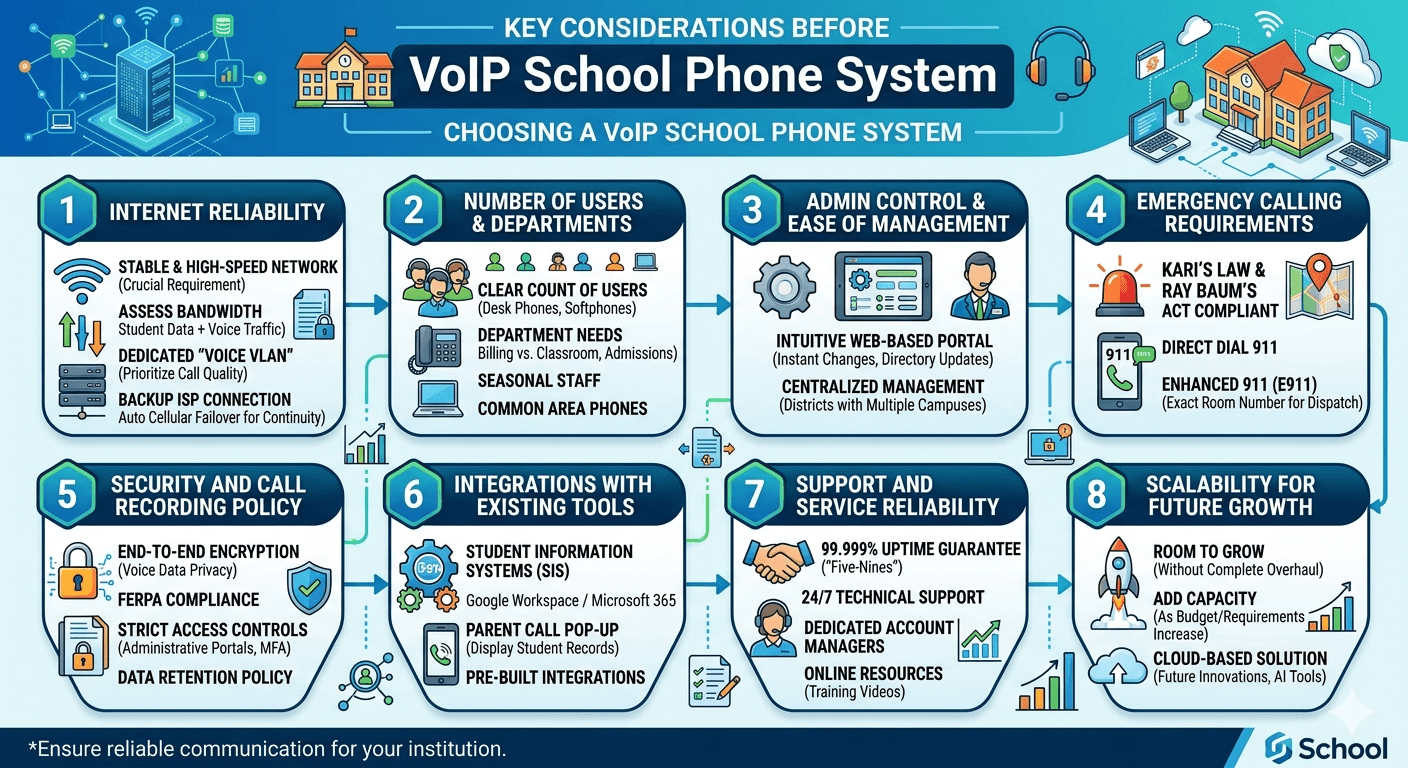
What to Consider Before Choosing a VoIP School Phone System
Choosing the right communication platform requires a careful evaluation of your institution’s specific needs and existing infrastructure. Not all providers are created equal, and some may offer specialized features that are more beneficial for K-12 schools than others. When you evaluate the telecommunications company ringcentral on k-12 education, for example, you might find different integration options compared to other major providers. It is important to look beyond just the price and consider the long-term reliability and support the provider offers.
The transition to a new system should be a well-planned process that involves input from IT staff, administrators, and teachers. Understanding how each group will use the phone system will help you select the right hardware and software configurations. Additionally, schools must ensure that any new technology complies with safety regulations and data privacy standards relevant to the education sector.
-
Internet Reliability
Since VoIP relies entirely on your internet connection, having a stable and high-speed network is the most critical requirement. Schools must assess their current bandwidth to ensure it can handle both the data needs of students and the voice traffic of the new phone system. Many schools implement a dedicated “Voice VLAN” to prioritize phone traffic over other internet activities, ensuring crystal-clear call quality even when the network is busy.
It is also wise to have a backup internet connection in place. In the event of a primary ISP failure, a secondary connection can keep the phone system operational. Many modern routers can automatically switch to a cellular data backup if the main line goes down. Ensuring internet reliability is the first step in guaranteeing that your VoIP phone system for Schools and Education remains a dependable resource for your entire community.
-
Number of Users and Departments
Before implementation, you must have a clear count of how many desk phones, softphones, and common area phones (like those in hallways or teacher lounges) are needed. Phone systems for schools are often priced per user, so having an accurate count helps in budgeting. You should also consider the different needs of various departments; the billing office may need more advanced call handling features than a standard classroom.
-
Identify the number of full-time and part-time staff members.
-
Determine which areas require physical desk phones vs. softphones.
-
Map out the specific needs of specialized departments like Admissions or Athletics.
-
Account for seasonal staff or student workers who may need temporary access.
-
Plan for “common area” phones that are used by multiple people.
By mapping out your users and departments, you can customize the system to fit the workflow of your school. This ensures that you are not overpaying for features that won’t be used, while also ensuring that high-demand areas have all the tools they need to be successful.
-
Admin Control and Ease of Management
One of the main reasons to choose a private school cloud phone system is the ease with which it can be managed. Administrators should look for a system with an intuitive web-based portal that allows them to make changes instantly. Whether it is updating the holiday greeting, adding a new teacher to the directory, or checking call logs, these tasks should be simple enough for non-technical staff to handle if necessary.
Centralized management is particularly important for large school districts with multiple campuses. Instead of visiting each site to update phone settings, an IT manager can push updates to the entire district from a single location. This level of control saves time, reduces travel costs, and ensures that all schools in the district are following the same communication protocols.
-
Emergency Calling Requirements
Safety is the top priority for any educational institution. When choosing a VoIP phone system for Schools and Education, it must be fully compliant with laws like Kari’s Law and Ray Baum’s Act. These regulations require that any phone in the building can dial 911 directly without a prefix (like dialing ‘9’ first) and that the system provides the exact location (down to the room number) to emergency dispatchers.
According to the Federal Communications Commission (FCC), multi-line telephone systems must ensure that emergency responders can find the caller quickly in large buildings.
Modern VoIP systems use Enhanced 911 (E911) technology to transmit this precise location data automatically. Ensuring your system meets these legal requirements is not just about compliance; it is about protecting the lives of students and staff.
-
Security and Call Recording Policy
Protecting the privacy of students and staff is a legal and ethical obligation. Schools must ensure that their VoIP provider uses encryption to protect voice data from being intercepted. Furthermore, if the school decides to use call recording, there must be clear policies in place regarding who can access those recordings and how long they are stored. Security should be a primary concern when you evaluate the telecommunications company get voip on k-12 education.
-
Ensure the provider offers end-to-end encryption for all calls.
-
Verify that the system complies with FERPA and other privacy regulations.
-
Establish strict access controls for administrative portals and call logs.
-
Regularly update passwords and use multi-factor authentication (MFA).
-
Define a clear data retention policy for voicemails and recordings.
A secure communication system builds trust within the school community. Parents need to know that their conversations with teachers are private, and staff need to feel secure in their daily communications. By prioritizing security features and establishing clear usage policies, schools can mitigate risks and focus on their core mission of education.
-
Integrations with Existing Tools
To maximize efficiency, a school phone system should integrate with the software your staff already uses. Many VoIP platforms can connect with Student Information Systems (SIS), Customer Relationship Management (CRM) tools, and productivity suites like Google Workspace or Microsoft 365. For example, when a parent calls, a pop-up on the staff member’s screen could display the student’s record, allowing for a more informed and efficient conversation.
These integrations reduce the need for staff to switch between different applications, saving time and reducing errors. They also allow for better data tracking, as call logs can be automatically attached to student or parent files. When selecting a system, ask providers about their API capabilities and pre-built integrations to ensure the new phone system will work harmoniously with your current digital ecosystem.
-
Support and Service Reliability
When a school’s phone system goes down, it can create a major disruption and potential safety hazard. Therefore, choosing a provider with a proven track record of reliability is essential. Look for companies that offer a 99.999% uptime guarantee (often called “five-nines”). This ensures that the service is available almost all the time, even during peak usage hours.
Additionally, evaluate the quality of the technical support provided. Schools need a partner who understands the urgency of educational environments and can provide quick resolutions to any issues. Check for 24/7 support options, dedicated account managers, and online resources such as training videos and user manuals. Reliable support ensures that your VoIP phone system for Schools and Education remains an asset rather than a source of frustration.
-
Scalability for Future Growth
Educational institutions are not static; they evolve over time. Whether your school is planning to expand its physical footprint or increase its enrollment, your communication system must be able to keep pace. Choosing a cloud-based solution ensures that you have the “room to grow” without needing a complete system overhaul in a few years. Scalability should be a key factor in your long-term telecommunications strategy.
The best phone systems for schools allow you to start with what you need today and add more capacity as your budget and requirements grow. This flexibility protects your investment and ensures that you always have access to the latest communication technology. As education continues to change, a scalable phone system provides the foundation for future innovations, such as advanced AI tools or new collaboration platforms.
Read More: What Does Cancelled Call Mean? Guide for iPhone and Android
Final Thoughts: Is VoIP Right for Your Educational Institution?
Transitioning to a VoIP phone system for Schools and Education is a strategic move that addresses the modern challenges of academic communication. By moving away from costly and inflexible legacy hardware, schools can enjoy a more reliable, feature-rich, and cost-effective way to stay connected. The benefits range from immediate financial savings to improved campus safety and better parent-teacher collaboration. In an era where digital connectivity is paramount, having a robust cloud-based communication platform is no longer a luxury—it is a necessity for any forward-thinking institution.
Ultimately, the decision to implement VoIP should be based on a thorough assessment of your school’s unique needs and goals. Whether you are a small private school looking to improve professionalism or a large district aiming to centralize management, there is a VoIP solution tailored for you. By carefully considering factors like internet reliability, security, and integration, you can choose a system that will serve your educational community for years to come. The future of school communication is in the cloud, and the time to make the switch is now.
FAQs
-
Is a VoIP phone system for Schools and Education reliable?
Yes, modern VoIP systems are highly reliable, often providing 99.999% uptime. As long as the school has a stable and high-speed internet connection, the call quality and system availability are typically superior to traditional analog lines. Many schools also use backup internet connections to ensure the phone system remains operational even if the primary service is interrupted.
-
Can we keep our existing school phone numbers?
Absolutely. Most VoIP providers offer a process called “porting,” which allows you to transfer your current phone numbers from your old provider to the new cloud system. This ensures that there is no disruption for parents or the community who already have your contact information.
-
How does VoIP improve school safety during emergencies?
VoIP systems improve safety by providing campus-wide paging, instant SMS alerts to parents, and direct 911 dialing that transmits the exact room location to emergency responders. These systems can also be integrated with security cameras and door access controls for a comprehensive safety network.
-
Do teachers need to have physical desk phones in every classroom?
Not necessarily. While some schools prefer desk phones for their ease of use, many are moving toward “softphones.” These are apps installed on classroom computers or teacher laptops, allowing them to make and receive calls without the need for additional hardware.
-
What happens if the school’s internet goes down?
If the internet goes down, most VoIP systems can automatically redirect incoming calls to a backup number, such as a mobile phone or another campus. Additionally, staff can continue to use the mobile app on their smartphones using cellular data, ensuring communication is never completely severed.
-
Is it difficult to train staff on a new VoIP system?
Most VoIP platforms are designed to be very user-friendly. The interfaces for both the physical desk phones and the mobile apps are usually intuitive. Most providers also offer training videos, webinars, and documentation to help staff get up to speed quickly.
-
Can a VoIP system handle multiple campus locations?
Yes, this is one of the greatest strengths of a cloud-based system. All campuses can be managed under a single account, allowing for free calling between buildings and a centralized directory. This makes communication across a large school district much more seamless and organized.
-
Are there any specific hardware requirements for school VoIP?
The primary requirement is a stable internet connection and a modern network router. For the phones themselves, you can choose to purchase IP desk phones, or simply use existing computers and mobile devices with softphone applications. Many schools choose a hybrid approach based on the needs of each department.
-
How does a VoIP system help with parent-teacher communication?
It provides teachers with a professional way to communicate with parents without giving out their personal cell phone numbers. Features like voicemail-to-email also allow teachers to stay updated on parent inquiries during their planning periods without being interrupted by a ringing phone during class time.