
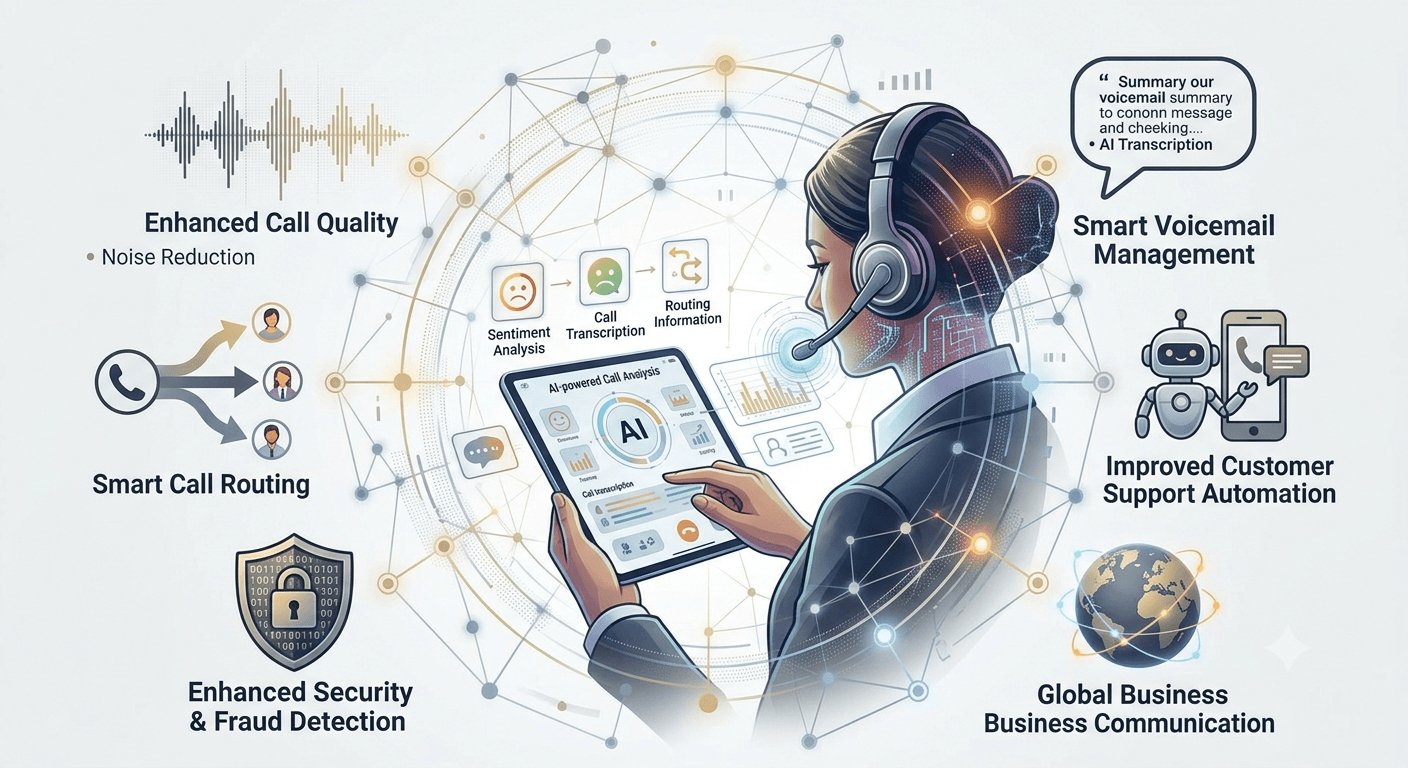
The integration of AI in VoIP is fundamentally changing how businesses communicate by blending voice over internet protocol with advanced machine learning algorithms. This transformation allows systems to go beyond simple voice transmission, offering intelligent features like automated sentiment analysis, real-time language translation, and predictive network adjustments. As we move into 2026, ai voip technology is no longer an optional luxury but a core component for companies seeking to optimize their workflows and enhance customer engagement through smarter, data-driven interactions. By leveraging these intelligent tools, organizations can ensure higher call clarity and more efficient resource management.
1. Enhanced Call Quality and Reliability
The implementation of AI in VoIP has addressed one of the most persistent challenges in internet-based telephony: maintaining consistent audio quality across varying network conditions. Advanced algorithms now analyze data packets in real-time to identify potential disruptions before they impact the user experience. By predicting network congestion and adjusting settings instantaneously, these systems provide a level of reliability that previously rivaled traditional landlines but now surpasses them in many technical aspects.
According to a report by Mordor Intelligence, the AI in telecommunications market is expected to reach $14.99 billion by 2029, growing at a CAGR of 28.46%. This massive growth is a testament to the value that these technologies provide.
Modern telecommunications rely heavily on the stability of the internet connection, and ai voip solutions are designed to mitigate the inherent instability of public networks. These systems use packet loss concealment techniques that use machine learning to “fill in” the gaps when data is lost during transmission, ensuring the listener hears a continuous stream of sound. This level of technical sophistication is a primary reason why many experts consider voip the future of telecommunications for global enterprises.
AI-Driven Noise Reduction
AI-driven noise reduction is a breakthrough feature that identifies and isolates human voices from background sounds during a call. By training on millions of audio samples, the system can distinguish between a speaker’s voice and distracting elements like keyboard typing, barking dogs, or traffic noise, effectively muting the latter.
AI-powered VoIP optimizes remote and office communication by using intelligent noise isolation, echo cancellation, and dynamic gain control to eliminate background distractions and feedback. Additionally, it enhances voice frequency response and reconstructs audio in low-bandwidth situations, ensuring crystal-clear, natural-sounding conversations regardless of the environment.
Adaptive Bandwidth Management
Adaptive bandwidth management allows the system to monitor the available internet speed and adjust the codec bitrate accordingly without dropping the call. This ensures that even if the network slows down, the AI in VoIP system prioritizes voice data over other types of traffic to maintain a clear connection.
AI-driven VoIP optimizes call quality by continuously analyzing throughput, prioritizing voice packets over background data, and dynamically adjusting buffers to eliminate jitter. It also ensures seamless Wi-Fi-to-cellular handoffs and automatically switches codecs or reduces data usage during silence to maintain clear, efficient connections.
Real-Time Quality Monitoring
Real-time quality monitoring provides administrators with detailed insights into the health of their communication infrastructure. These tools track metrics like Mean Opinion Score (MOS), jitter, and latency, allowing the system to automatically reroute traffic if a specific network path is underperforming.
AI-driven VoIP monitoring provides IT administrators with instant quality alerts, automated troubleshooting suggestions, and clean dashboard visualizations of global performance. By tracking historical data across locations and integrating with existing IT tools, it allows teams to quickly pinpoint recurring bottlenecks and manage network health from a single platform.
2. Smart Call Routing
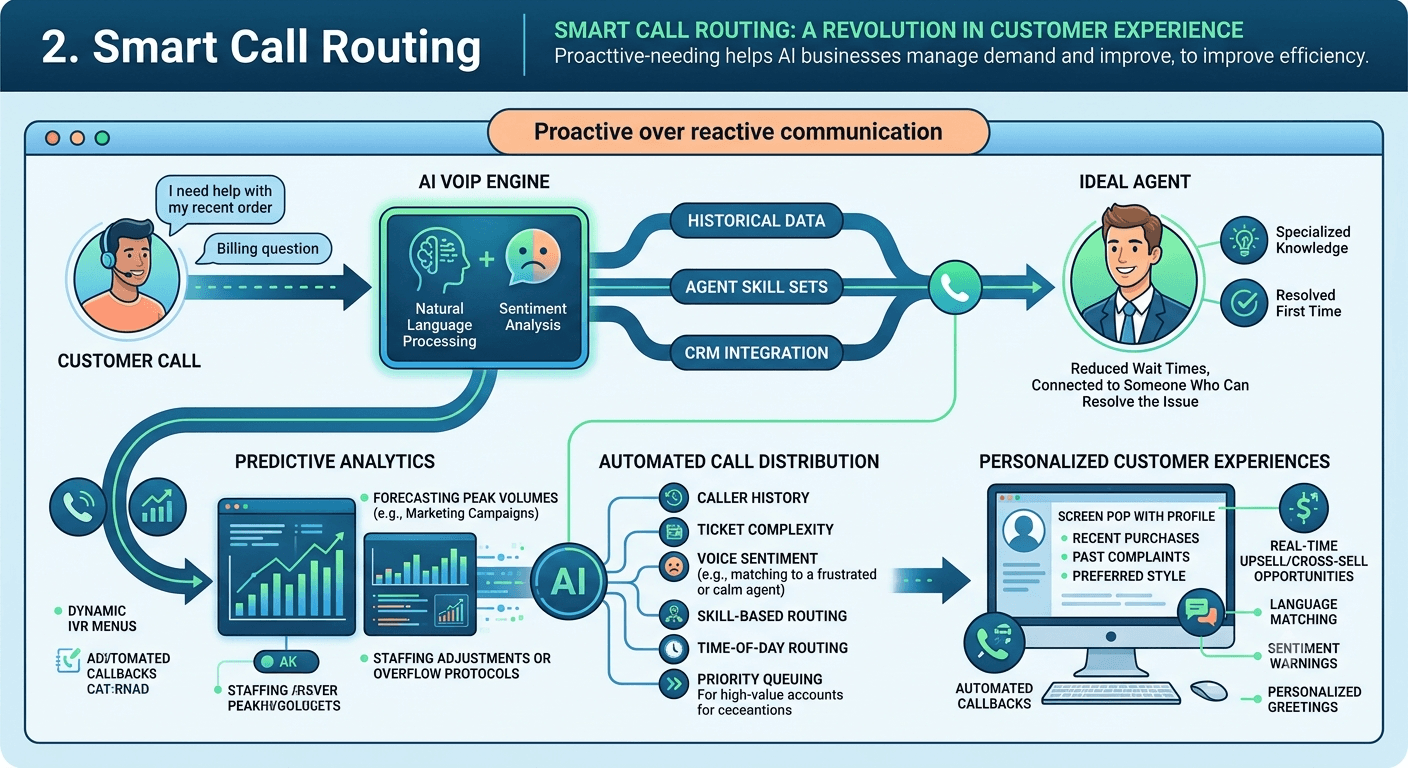
Smart call routing represents a significant leap forward from traditional “press one for sales” menus. By utilizing AI in VoIP, systems can now evaluate the intent of a caller through natural language processing and route them to the most qualified agent based on historical data and current skill sets. This reduces wait times and ensures that customers are connected to someone who can actually resolve their specific issue on the first attempt.
The use of predictive modeling in routing helps businesses manage peak call volumes more effectively by anticipating when surges will occur. This component of voip ai news highlights how companies are moving toward a proactive communication model rather than a reactive one. By analyzing past calling patterns, the system can suggest staffing adjustments or activate automated overflow protocols to maintain high service levels.
Automated Call Distribution
Automated call distribution has evolved into a highly intelligent process that considers more than just agent availability. The AI in VoIP system can look at the caller’s history, the complexity of their previous tickets, and even the sentiment of their voice to decide which department is best suited for the interaction.
AI-driven routing optimizes the customer experience by using CRM data to identify callers instantly, sending high-value accounts to priority queues, and matching individuals with specialized experts. It also balances call volume by using automated callbacks to eliminate hold times, adjusting routing based on time zones, and seamlessly shifting overflow to external centers during peak hours.
Predictive Analytics
Predictive analytics within cloud systems allow businesses to forecast future communication needs with remarkable accuracy. By examining trends in call duration and frequency, the AI in VoIP engine can provide insights into customer behavior that were previously hidden in vast amounts of raw data.
AI-driven predictive analytics forecast call volumes based on marketing campaigns to optimize agent schedules, identify the best times to reach leads, and flag potential churn from communication drops. It also uncovers emerging regional inquiry trends and analyzes escalation patterns to directly improve employee training.
Personalized Customer Experiences
Personalized customer experiences are achieved by feeding real-time data to agents as they answer the phone. The AI in VoIP system can pull up a customer’s recent purchases, past complaints, and even their preferred communication style, allowing for a tailored interaction that builds stronger brand loyalty.
AI-powered agent assistance provides screen pops of customer history, real-time cross-selling suggestions, and sentiment tracking to alert agents if a caller is frustrated. It also personalizes the experience using native language matching, tailored greetings, and dynamic IVR menus that adapt to the caller’s recent activity.
3. Smart Voicemail Management
Voicemail management has been completely reimagined through the application of AI in VoIP, turning a static audio storage system into a dynamic information hub. Instead of listening to long messages, users can receive concise summaries and action items delivered directly to their inbox or chat applications. This saves significant time for busy professionals who might otherwise spend hours each week checking and responding to voicemails.
These systems also help in decluttering the inbox by automatically filtering out spam or telemarketing messages. The integration of voip ai into voicemail systems ensures that important messages from key stakeholders are highlighted, while low-priority notifications are archived for later review. This intelligent sorting is essential for maintaining productivity in a fast-paced corporate environment.
AI-Driven Voicemail Transcription
AI-driven voicemail transcription uses advanced speech-to-text technology to convert audio into highly accurate text. The AI in VoIP software can distinguish between different speakers and even capture technical jargon or industry-specific terminology with high precision.
AI-driven transcription instantly delivers readable, formatted text via email or SMS with multi-language support and searchable archives for easy information retrieval. It automatically pulls key dates, action items, and caller contact details from the conversation for seamless entry directly into your CRM.
Prioritization of Voicemails
Prioritization of voicemails involves the system analyzing the content of a message to determine its urgency. If the AI in VoIP identifies words like “urgent,” “emergency,” or “contract,” it can move that message to the top of the user’s queue or send an immediate push notification to their mobile device.
AI visual voicemail organizes messages using keyword categorization, customizable handling rules, and automated spam filtering to save user time. It tracks missed calls by matching calendar data, clusters related voicemails for context, and uses visual sentiment indicators to show if a caller is happy or upset before you listen.
Integration with Communication Platforms
Integration with communication platforms ensures that voicemail data is not siloed within the phone system. By connecting AI in VoIP with tools like Slack, Microsoft Teams, or Salesforce, businesses can ensure that the right information reaches the right people immediately, regardless of the platform they are currently using.
AI-driven integration automatically syncs voicemail statuses across devices and routes transcripts directly to team channels, CRM client records, or new support tickets. It also allows employees to reply via text or chat from a single interface while centralizing all communication logs for effortless compliance management.
4. Enhanced Security Features
Security is a paramount concern for any digital communication platform, and AI in VoIP is playing a critical role in defending against increasingly sophisticated cyber threats. Traditional security measures often rely on static rules, but AI-powered systems can learn from new attack patterns and adapt their defenses in real-time. This proactive approach is vital for protecting sensitive corporate data and preventing unauthorized access to the communication network.
According to research from Deloitte, approximately 63% of technology companies are now utilizing AI to improve their network security and reliability.
This trend is particularly evident in the VoIP sector, where AI is used to monitor for anomalies such as SIP toll fraud or unauthorized international calling. By identifying these issues as they happen, the AI in VoIP system can shut down compromised accounts before significant financial damage occurs.
Fraud Detection Algorithms
Fraud detection algorithms analyze calling patterns to identify behavior that deviates from the norm. If an account suddenly starts making hundreds of international calls to high-cost destinations, the AI in VoIP system will flag this as potential toll fraud and temporarily suspend the service while alerting the administrator.
AI secures networks by blocking robocall patterns and automated fraud scripts while using geofencing to restrict access from high-risk regions. It also uses voice biometrics to detect vishing and flags account takeovers by monitoring for unauthorized administrative access, unusual login locations, or unfamiliar devices.
Real-Time Threat Monitoring
Real-time threat monitoring involves a constant scan of the network for signs of malicious activity. By using machine learning, the AI in VoIP system can distinguish between a spike in legitimate traffic and a Distributed Denial of Service (DDoS) attack, allowing it to mitigate the threat without interrupting service for regular users.
AI network security continuously scans for malware signatures and zero-day vulnerabilities, instantly encrypting voice data and monitoring API calls for unauthorized extraction. If a threat is detected, it automatically isolates the compromised endpoint to stop lateral movement and alerts the IT security team immediately.
Data Encryption Enhancements
Data encryption enhancements use AI to manage and rotate encryption keys more effectively, ensuring that voice data remains secure even if part of the network is compromised. The AI in VoIP system can also analyze the strength of the encryption in use and suggest upgrades if it detects that the current standards are becoming vulnerable to modern decryption techniques.
AI-driven data protection automates TLS certificate management, dynamically encrypts data based on sensitivity, and shields metadata from traffic analysis. It ensures secure call storage via multi-factor authentication, verifies identities through voice fingerprinting, and maintains strict compliance with GDPR and HIPAA regulations.
5. Improved Customer Support Automation
The role of customer support has been transformed by AI in VoIP, allowing businesses to provide high-quality assistance without the need for a massive staff. Virtual assistants and intelligent chatbots can now handle a wide range of common inquiries, from billing questions to technical troubleshooting. This frees up human agents to focus on more complex and emotionally nuanced tasks that require a personal touch.
In the context of voip providers ai-powered call analytics 2026, these automated systems are becoming much better at understanding context and nuance. Instead of just looking for keywords, they can understand the intent behind a customer’s question and provide a relevant, helpful response. This improvement in natural language understanding is a key reason why more businesses are comfortable letting AI handle the first line of customer interaction.
AI-Powered Chatbots
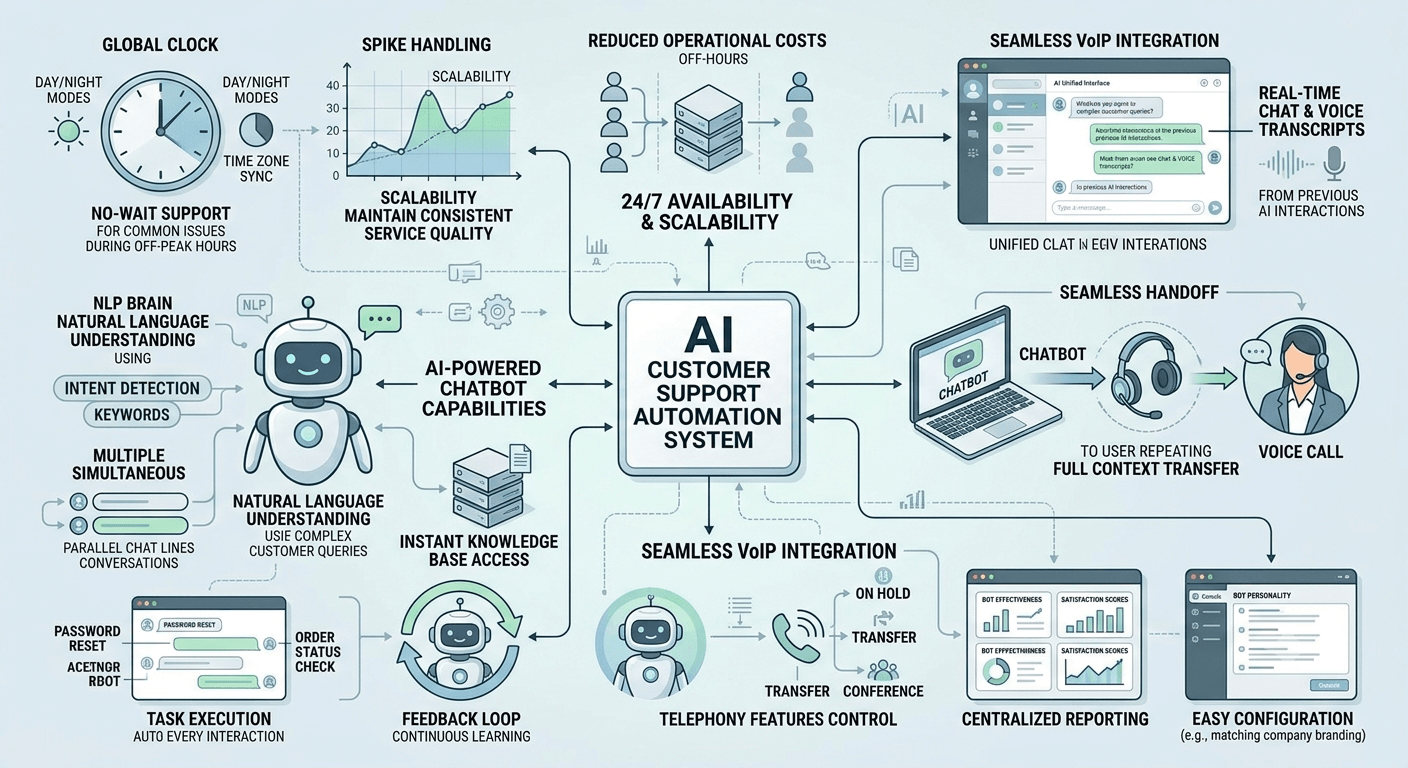
AI-powered chatbots integrated into VoIP systems provide a seamless transition between text-based and voice-based support. A customer might start a conversation with a bot on a website and then be transitioned to a voice call with the same bot, or a human agent, without having to repeat their information.
AI virtual assistants use natural language processing to understand complex queries and access knowledge bases to handle multiple customer conversations simultaneously. They gather information before human transfers, perform automated tasks like resetting passwords or checking order statuses, and continuously learn from every interaction to improve performance.
24/7 Availability
One of the greatest benefits of AI in VoIP is the ability to offer 24/7 support without the cost of a night shift. Customers can get answers to their questions at any time of the day or night, which is particularly important for global companies operating across multiple time zones.
Providing no-wait support for routine issues during off-peak hours reduces operational costs and scales effortlessly during sudden spikes in volume. This ensures consistent service quality around the clock, automatically scheduling follow-ups for human agents and boosting customer satisfaction through immediate responsiveness.
Seamless Integration with VoIP Systems
Seamless integration ensures that the AI doesn’t feel like a separate layer but is a natural part of the communication experience. When a call is placed through an AI in VoIP system, the automation tools have full access to the telephony features, such as placing callers on hold, transferring calls, or initiating a conference.
A unified interface connects voice and SMS under a single number, enabling seamless, context-rich handoffs from bots to human agents. It automatically logs all conversation transcripts, centralizes performance reporting, and allows easy configuration of bot personalities to match the brand.
Benefits of Artificial Intelligence in VOIP Systems
The primary benefit of integrating AI in VoIP is the massive increase in operational efficiency. Organizations no longer need to manually sort through call logs or listen to hours of recordings to find valuable insights. Instead, ai-powered call analytics features in cloud voip systems can automatically highlight trends, such as which products are being mentioned most frequently or which regions are experiencing the most technical issues.
Increased productivity by automating routine communication tasks.
Lower operational costs through reduced staffing needs for basic support.
Improved call clarity and reliability through automated network management.
Enhanced security and fraud protection using real-time monitoring.
Better data-driven decision-making through advanced call analytics.
Higher customer satisfaction via personalized and faster service.
Scalability to grow with the business without significant infrastructure investment.
Furthermore, the ability to compare ai-powered call analytics features in cloud voip systems allows businesses to choose the specific tools that align with their goals. Whether the focus is on improving sales conversion rates or decreasing support resolution times, there is an AI tool designed to optimize that specific metric. This level of customization ensures that the technology provides a direct return on investment.
Read More: How to Find Owner of Phone Number? Proven Methods
Final Thought
The integration of AI in VoIP is not merely a trend but a fundamental shift in how we perceive and use telecommunications. By automating the mundane, securing the vulnerable, and enhancing the quality of every interaction, AI is making communication more human-centric and efficient than ever before. As these technologies continue to evolve, the businesses that embrace them will find themselves better equipped to handle the complexities of the modern digital landscape, while those who wait may struggle to keep up with the pace of innovation.
Frequently Asked Questions (FAQs)
What exactly is AI in VoIP and how does it work?
AI in VoIP refers to the integration of machine learning and artificial intelligence into voice over internet protocol systems. It works by analyzing audio data and network traffic in real-time to perform tasks like noise cancellation, automated call routing, and transcription. By learning from large datasets, the system can predict network issues and understand human speech patterns to improve the overall communication experience.
How does AI improve the clarity of my phone calls?
AI improves call quality primarily through advanced noise suppression and bandwidth management. It can identify and filter out background sounds like wind or office chatter while prioritizing voice data packets on your network. This ensures that even if your internet connection is unstable, the voice remains clear and free of the robotic artifacts common in older digital phone systems.
Can AI in VoIP help protect my business from fraud?
Yes, AI is highly effective at detecting fraud by monitoring for unusual calling patterns. For instance, if your account suddenly makes dozens of calls to high-cost international numbers at 3 AM, the system will recognize this as an anomaly and block the calls immediately. It also uses voice biometrics to help verify that the person on the other end of the line is who they claim to be.
Will using AI in VoIP save my company money?
While there may be an initial cost for AI-enabled features, most companies see significant long-term savings. This comes from automating routine customer support tasks, reducing the need for manual call monitoring, and preventing expensive toll fraud. Additionally, by optimizing bandwidth usage, businesses can often avoid costly infrastructure upgrades while still supporting more users.
What are AI-powered call analytics?
AI-powered call analytics involve the use of machine learning to extract deep insights from every phone conversation. Unlike basic logs, these analytics can tell you the sentiment of the caller, the most frequently discussed topics, and the performance of your sales team. This data allows management to make informed decisions about training, marketing, and product development based on actual customer feedback.
How does AI make call routing smarter than traditional systems?
Traditional routing is usually based on simple menus or agent availability. AI in VoIP makes it smarter by considering the caller’s history, the sentiment of their voice, and the specific expertise of available agents. This means a frustrated customer can be automatically sent to a senior manager, or a caller with a specific technical issue can be routed directly to the engineer best suited to help them.
Does the AI actually transcribe and summarize my voicemails?
Yes, modern systems can transcribe audio into text with high accuracy and even provide a summary of the key points. This allows you to read your voicemails in your email or chat app rather than listening to them. The AI can also identify action items, such as a requested callback time or a specific phone number, and highlight them for you to see at a glance.
What is the future of AI in the telecommunications industry?
The future involves even deeper integration, with AI handling real-time language translation, more human-like virtual assistants, and autonomous network healing. We will likely see AI becoming the primary interface for most initial business communications, with human intervention reserved for complex problem-solving and relationship building. As data processing power increases, these systems will become even more seamless and indistinguishable from natural human interaction.