Bandwidth has the lower selected US outbound SMS and Voice API rates in this comparison, while Signal House is worth evaluating for supported integrations and guided setup. Signal House lists a lower incoming voice rate per minute, but billing increments can change the actual cost. Choose using your workflow, voice call durations and complete pricing quotation.
Signal House vs Bandwidth is a comparison between communications infrastructure and the way your business will operate it. Review Signal House's supported arrangement alongside an equivalent Bandwidth pricing proposal. A developer maintaining a custom application, an agency using HighLevel and an enterprise connecting a cloud phone platform can need very different products, support and commercial terms.
 Ratings use the G2 product profiles for Signal House and Bandwidth. They reflect customer feedback rather than independent delivery, audio-quality or support-response tests.
Signal House Vs Bandwidth: Voice And Business Messaging Comparison
The table follows the comparison's name order rather than a universal ranking. It separates a supported workflow from direct infrastructure procurement and identifies important pricing boundaries. The lowest selected transmission component is useful evidence, but it does not establish the cheapest complete employee application or the strongest fit for every buyer.
| Provider | Best Fit | Buying Considerations | Pricing & Evaluation |
|---|---|---|---|
|
| SMS From $0.0065/SegmentSelected US local outbound base; fees extra. Voice: $0.012/min out, $0.005/min in.$25 new-account credit advertised.View Offer And Account Credit | |
|
| Local SMS $0.004/PartSelected published US outbound component; quote applies. Local voice: $0.01/min out, $0.0055/min in. Other charges extra.30-Day Build Free Trial; restricted SMS testing.Review Evaluation And Account Terms |


Begin with a complete customer task. A caller should reach the right destination, a reply should reach the correct employee and a completed booking should stop unnecessary follow-up. Identify which provider, integration or internal application owns each step. A successful API request is only part of that customer journey.
Signal House Or Bandwidth: Which Provider Wins?
Lower Selected Local Outbound SMS Component: Bandwidth
Bandwidth's published US pricing lists local 10DLC outgoing SMS at $0.004, compared with Signal House's $0.0065 per outgoing segment. For a matched 10,000-part workload, those base components are $40 and $65. Confirm billable units, applicable volume terms and the account offer before applying this comparison to production.
Bandwidth is therefore the first cost-focused evaluation for this selected component when its commercial arrangement and required application fit. Signal House may still be the better operating purchase when a supported integration removes work your team would otherwise fund. Measure that work; do not assume it offsets the difference for every customer.
Lower Selected Outgoing Voice API Component: Bandwidth
Bandwidth lists selected US local outgoing voice at $0.01 per minute, compared with Signal House's initial outgoing band of $0.012. Those figures favor Bandwidth before optional features and other charges. Its published Voice API offer also describes 6-second billing increments, which can matter substantially for short answered calls.
The conclusion does not cover every destination, contract or telephone architecture. Match the product and requested routes, then compare connection components and billing rules. An employee app, a SIP trunk and a programmable voice flow are different purchases. A lower rate for one should not be presented as the complete price of another.
Lower Listed Incoming Rate Per Minute: Signal House
Signal House lists incoming US voice at $0.005 per minute, compared with Bandwidth's selected local incoming component of $0.0055. That makes Signal House lower when comparing the same number of chargeable minutes. It does not guarantee a lower bill for the same real calls because the providers describe different rounding increments.
A long incoming conversation ending at an exact minute boundary may favor Signal House on this component. A short conversation may favor Bandwidth after rounding. Use actual voice call-duration records rather than choosing a winner from a single per-minute row. The worked examples below show why the distinction matters.
First Demonstration For A Supported HighLevel Workflow: Signal House
Signal House documents a GoHighLevel messaging integration with custom sub-account pricing. It is a relevant starting point for eligible agencies that want help connecting a client workflow. Ask for sender ownership, staff permissions, replies and funding to be demonstrated in the proposed arrangement, including what remains the agency's responsibility.
Bandwidth markets infrastructure and integrations to application builders and communications providers. It can also be relevant to an agency operating its own platform or a confirmed compatible connection. Do not reduce this comparison to a claim that only one supplier can support business clients. The required commercial model and application determine the fit.
First Enterprise Carrier And BYOC Evaluation: Bandwidth
Bandwidth documents carrier integrations for platforms including Microsoft Teams, Zoom, Webex, Genesys and Five9. That makes it relevant when the requirement is connecting an existing enterprise communication environment rather than purchasing a new standalone phone app. Confirm the exact platform, integration model, countries and licenses.
Signal House also lists SIP connectivity, so it deserves a matched evaluation where the required configuration is supported. Ask both suppliers to distinguish native integration, compatible trunking and custom work. A familiar platform name in a menu does not establish every feature or replace the platform's separate subscription.
What Signal House And Bandwidth Provide
Signal House: Supported Connections And Programmable Communications
Signal House publishes messaging and voice services, with named integrations including GoHighLevel, Shopify, Medusa and Make. Its voice page lists browser softphones, SIP trunks, device endpoints and webhook-controlled handling. These capabilities should be demonstrated in the environment your staff will actually operate.
Determine what is standard configuration, what a connected application supplies and what requires development. The person managing SMS needs usable conversation history, while the person answering calls needs an appropriate interface. A provider can support the underlying operation without including every employee-facing screen in a general account.
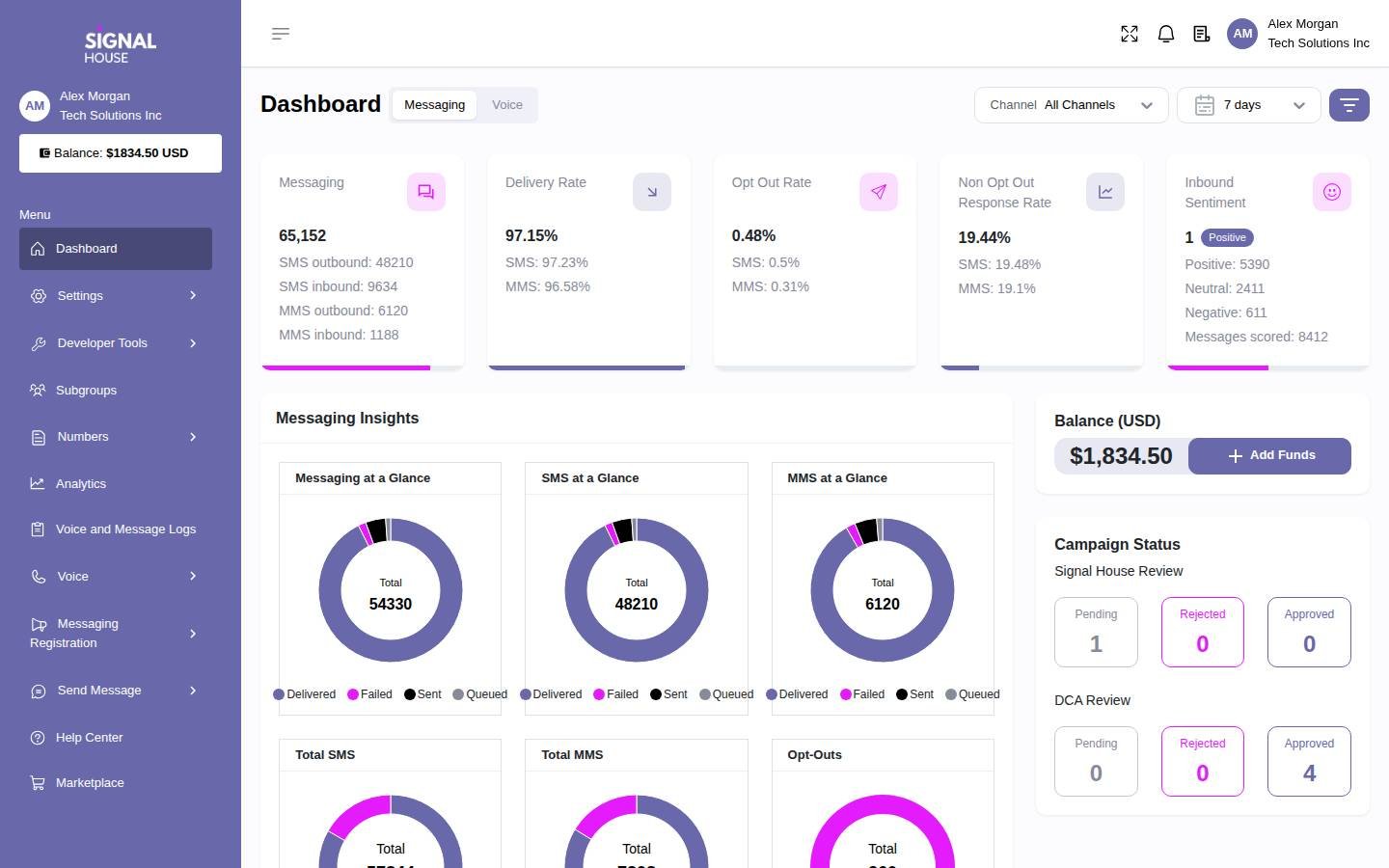
Request A Signal House Workflow Demo
Bandwidth: APIs, Network Services And Enterprise Connections
Bandwidth provides programmable communication APIs, number management and carrier connectivity. Its public pricing separates messaging, Voice API, authentication and SIP discussions. The appropriate purchase depends on whether the customer is building an application, operating a telephone platform or connecting a licensed enterprise system.
Evaluate Bandwidth with the person responsible for the architecture and the person responsible for daily operations. The Bandwidth developer portal, number-management interface and employee phone workspace serve different needs. Identify who owns each before assuming the infrastructure pricing quote describes the full service your employees expect.
Signal House Vs Bandwidth Features And Application Responsibilities
| Requirement | Signal House | Bandwidth | What To Validate |
|---|---|---|---|
| Programmable call control | SHML webhooks | BXML and voice events | Map instructions, callbacks and failures |
| Voice billing | Whole-minute terms published | 6-second API billing advertised | Use voice call-level durations and contract rules |
| Customer messaging | API and named integrations | Messaging API and callbacks | Demonstrate staff reply handling |
| Agency workflow | HighLevel client-pricing proposition | Application and carrier-provider evaluation | Confirm hierarchy, permissions and commercial scope |
| Enterprise platform connection | Confirm SIP configuration | Named BYOC and platform integrations | Verify licenses, countries and supported functions |
| Employee application | Demonstrate supported workspace | Identify supplied or connected software | Infrastructure is not every staff-facing screen |
| Evaluation | New-account credit | Build trial plus production transition | Observe recipient and channel restrictions |
| Support | Human assistance advertised | Signature, Silver and Gold plans | Confirm entitlement, escalation and implementation scope |
A useful demonstration ends with a completed task and an assigned operational owner. Ask an administrator to change a route, an employee to handle a reply and finance to locate the associated usage. These practical steps reveal whether a feature is available in the proposed account or merely possible through additional software.
A Finished Phone App Is Different From Transport
A 5-person office might want a shared number, office hours, voicemail assignments and mobile access. A software company may want programmable control embedded in an existing application. Both need communications delivery, but the staff interface and implementation responsibilities differ. Write down the required experience before comparing provider rates.
For Signal House and Bandwidth, identify the supplier of the dialer, shared inbox, customer records and reporting. Ask who maintains a third-party connection and who updates it when business rules change. A lower transport bill is useful only when the complete workflow remains affordable and manageable.
Carrier Procurement And Integration Procurement Have Different Questions
A carrier-focused request may involve routes, capacity, number inventory and platform interconnection. A supported integration request may focus on onboarding, employee access and business events. Compare these scopes explicitly. A vendor helping with one portion is not automatically responsible for the rest of the stack.
Bandwidth can be a strong infrastructure candidate without being the simplest new application for a nontechnical office. Signal House can be a useful integration candidate without eliminating all technical work. Request a responsibility outline covering configuration, testing, launch and maintenance, then evaluate the actual proposal.
Signal House Vs Bandwidth Pricing: Selected US Components
The following pricing comparison uses selected published US components in dollars. Bandwidth presents volume-based pricing and requests quotations for complete terms; Signal House also offers account and volume arrangements. The figures below are comparison inputs, not an assurance that every buyer can obtain an identical production contract.
| Component | Signal House | Bandwidth | Scope |
|---|---|---|---|
| Local outgoing SMS | $0.0065/segment | $0.004/part | Selected bases; carrier fees and account terms extra |
| Toll-Free outgoing SMS | $0.0079/segment | $0.007/part | Match sender and actual fee schedule |
| Short-Code outgoing SMS | $0.0065/billable unit | $0.008/billable unit | Rental, setup and other charges excluded |
| Local outgoing Voice API | $0.012/min | $0.01/min | Selected components; rounding can differ |
| Local incoming Voice API | $0.005/min | $0.0055/min | Lower minute rate does not ensure lower call cost |
| Incoming local messaging | Confirm platform base | Confirm current platform and carrier total | Do not infer a complete zero charge |
| Number rental | $1/month local messaging; voice-enabled quote | Obtain number and capability quote | Actual product and contract scope required |
Use the Bandwidth pricing page to identify the relevant product and request a complete pricing offer. Obtain the applicable Signal House API or integration pricing schedule as well. Keep number rental, registration, carrier fees, optional features, taxes, commitments and software visible rather than assigning missing charges a zero value.
Matched Billable-Unit Examples Before Other Charges
The models below assume the same number of chargeable minutes for each provider to isolate the selected unit-pricing difference. They do not yet account for different rounding on the same real voice call durations. Incoming SMS is excluded because a matched current platform-and-carrier total was not established for both suppliers.
| Monthly Workload | Signal House | Bandwidth | Selected Component Difference |
|---|---|---|---|
| 10,000 outgoing local SMS parts + 1,000 outgoing minutes | $77 | $50 | Bandwidth lower by $27 |
| 10,000 outgoing local SMS parts + 10,000 outgoing and 10,000 incoming minutes | $235 | $195 | Bandwidth lower by $40 |
| 1,000 outgoing local SMS parts + 1,000 outgoing and 10,000 incoming minutes | $68.50 | $69 | Signal House lower by $0.50 |
| 10,000 outgoing + 10,000 incoming Voice API minutes only | $170 | $155 | Bandwidth lower by $15 |
Bandwidth is lower on the selected light and balanced mixed workloads. Signal House is slightly lower in the incoming-heavy illustration. These are component calculations, not production invoices or performance tests. Apply actual voice call durations, negotiated terms and the full application cost before deciding which service is cheaper.
Sender Type Can Reverse A Messaging-Pricing Result
Bandwidth's selected outgoing local SMS component is lower, but its short-code row differs. Signal House publishes a selected outgoing short-code base of $0.0065, compared with Bandwidth's $0.008. Across 10,000 billable units, that is $65 versus $80 before short-code rental, setup and other charges.
The selected outgoing toll-free bases also differ from local rates. Use the sender you intend to purchase, not the lowest figure from any row. Short codes in particular can carry substantial recurring or setup expenses. A lower transmission component does not establish the cheaper complete sender arrangement.
Carrier Fees And Number Rental Need Their Own Pricing Quote
Carrier surcharges depend on the sender, network, message type and direction. An illustrative common $0.0045 component applied to 10,000 outgoing parts adds $45. This is an assumption for explaining the arithmetic, not a claim that both vendors always apply identical carrier schedules.
Under that assumption, the light mixed example expands from $77 to $122 for Signal House and from $50 to $95 for Bandwidth before remaining charges. The $27 difference stays unchanged, while its share of the expanded total becomes smaller. Use the actual network mix when replacing the illustration with a forecast.
Signal House lists entry local messaging numbers at $1 monthly and quotes voice-enabled local numbers separately. Bandwidth's different product materials illustrate number rental in different contexts, so obtain the actual recurring number and capability charges in writing. Do not treat an old comparison-table figure as a universal current offer.
Commitments, Volume Bands And Staff Work
Ask how discounts qualify, whether a minimum applies and what eligible usage counts toward it. Negotiated pricing can be valuable at stable volume while creating unused obligation in quiet periods. Signal House describes graduated outgoing voice bands; do not apply a reached lower band retroactively to the entire workload.
Bandwidth's published volume-oriented offer likewise requires matched commercial terms. Include onboarding, engineering, application hosting and support arrangements. Suppose a particular supported workflow demonstrably saves 1 staff hour monthly at an assumed internal value of $35. That benefit could exceed a $27 component difference by $8, but it must be verified for that business.
If your existing application already automates the work, there may be no incremental staff saving to claim. Compare marginal costs caused by the decision. Do not assign an employee's whole salary to one provider or assume new engineering maintenance is free. The purpose is to identify a sustainable complete service.
Voice Billing Increments: Why Per-Minute Rates Can Mislead
Compare The Same Voice Calls, Not Just The Same Billable Minutes
Signal House publishes whole-minute rounding after a 1-minute minimum for answered calls. Bandwidth describes 6-second billing for its Voice API. The following examples assume rounding each connected voice call upward to the stated increment with no other applicable voice minimum or charge. Confirm the actual product and agreement before using them for budgeting.
| Scenario | Signal House | Bandwidth | Interpretation |
|---|---|---|---|
| 100 outgoing voice calls of 23 seconds | 100 billable minutes; $1.20 | 40 billable minutes; $0.40 | Assumes whole-minute vs 6-second rounding |
| 100 outgoing voice calls of 65 seconds | 200 billable minutes; $2.40 | 110 billable minutes; $1.10 | 65 seconds rounds to 120 vs 66 seconds |
| 100 incoming voice calls of 23 seconds | 100 billable minutes; $0.50 | 40 billable minutes; $0.22 | Short-call rounding outweighs the minute-rate difference |
| 100 incoming voice calls of 180 seconds | 300 billable minutes; $1.50 | 300 billable minutes; $1.65 | Exact-minute example favors the lower incoming rate |
These examples show that Bandwidth can cost less for short incoming voice calls even with a higher incoming rate per minute. Conversely, an incoming call ending on an exact minute boundary can favor Signal House on the selected component. The distribution of durations matters, so obtain voice call-level records instead of relying only on an average call length.
Do Not Round The Monthly Total Instead Of Each Call
A group of short calls can generate more chargeable time than a single conversation with the same combined duration. The difference becomes larger when a minimum is applied separately to each voice connection. Aggregate elapsed minutes can therefore understate the budget even when the per-minute rate itself is correct.
Build a representative duration sample for the Bandwidth and Signal House quote review. Include answered calls, voicemail, transfers and failed attempts under the supplier's actual rules. Ask how each leg is measured. This gives finance a clearer model and reduces the temptation to claim savings from a favorable but incomplete pricing row.
Signal House Vs Bandwidth Voice: Call Control, SIP And Additional Features
SHML And Bandwidth BXML Require A Voice Compatibility Review
Signal House documents SHML returned by a webhook. Bandwidth uses BXML instructions and voice events to coordinate an application. Similar operations, such as speaking a greeting or transferring a caller, do not make the implementations interchangeable. Check instruction behavior, authentication, request fields, event types and failure handling.
For a practical voice flow, write the expected outcome for a new booking, existing-customer question, invalid keypad selection and closed office. Then add an unavailable employee and an unsuccessful transfer. A successful migration preserves those outcomes; it does more than return an XML document that looks familiar.
Voice Transfers And Multiple Legs Need Complete Pricing
A customer voice conversation can create incoming and outgoing connections with different durations. A conference, browser participant or external transfer can add components. Identify the actual connection path and the features invoked. Do not assume that every conversation can be priced by multiplying elapsed time by one outgoing rate.
For Bandwidth, ask how the chosen Bandwidth BXML operations and voice connection types appear on the invoice. For Signal House, request the same explanation for the target configuration. Keep the optional feature schedule beside the connectivity quote. A low component is less useful when the proposed implementation triggers unmodeled charges.
SIP And Bring Your Own Carrier Integrations
Bandwidth's listed enterprise connections make it relevant for an organization retaining Teams, Zoom or a contact-center platform while changing the carrier arrangement. Confirm integration type, platform licensing, country availability and supported functions. Carrier service does not automatically include the collaboration software's employee subscriptions.
Signal House lists SIP trunks and endpoints, which should be evaluated against the actual PBX or application. Obtain a matched pricing quote and demonstration. A compatible SIP connection, a vendor-supported native integration and a custom deployment have different maintenance responsibilities even when all can place a successful call.
Recording, Voice Streaming And AI Agent Costs
Bandwidth lists recording at $0.002 per minute and bidirectional streaming at $0.004 per minute in its selected public schedule. If both apply to a 1,000-minute workflow, the respective components are $2 and $4 before connectivity and any other processing. These are not complete AI receptionist prices.
Signal House's listed recording and other analysis capabilities need the applicable feature quotation. For either supplier, separate telephony, speech processing, model use, application hosting and human escalation. Confirm whether particular components are combined or separately chargeable so the model does not omit costs or count the same service twice.
Test what the AI actually accomplishes. Can it capture a correct callback number, handle an interruption and route a case outside its instructions? A pleasant voice is useful, but an incorrect booking or an invented answer can create substantial staff work. Choose using the outcome the business needs.
Signal House Vs Bandwidth Business Messaging And Customer Replies
SMS Segments And Personalized Content
Forecast billable parts, not merely the number of people contacted. Long content, links, customer names and encoding can change segment count. Bandwidth's messaging webhook documentation includes a segment-count field, which is useful for reconciliation. The chosen account schedule should define how that count maps to charges.
A campaign to 10,000 people can generate 20,000 outgoing parts if each message needs 2 segments. At the selected local components, that becomes $130 for Signal House and $80 for Bandwidth before fees. Preview real personalized content with long names and links rather than testing only a short generic sentence.
Keep the message clear and identifiable. Removing essential information to avoid an extra segment can create confusion and unnecessary calls. A useful reminder should tell the customer who is contacting them and what action is needed. Measure the operating result alongside the transmission cost.
Two-Way Messaging Needs A Reply Workflow
Receiving a message is not the same as assigning responsibility for it. A customer responding to an appointment reminder may request a different time or report a problem. Decide which application records the reply, alerts the employee and updates the relevant business record.
Signal House buyers should demonstrate the reply journey inside the proposed integration. Bandwidth application builders should identify the incoming webhook and the staff workspace it feeds. Include an after-hours reply and a message received by the wrong team. These examples reveal gaps a successful outgoing send cannot show.
Webhooks, Retries And Duplicate Events
Bandwidth's messaging documentation describes callbacks delivered at least once, so duplicate events can occur. It also specifies a response deadline and retry behavior. Design the receiving application to acknowledge events promptly and process them safely. A slow external system should not create repeated customer notifications.
For Bandwidth, keep event identity and type distinct from the broader conversation identifier. A later delivery update can be legitimate even when it concerns the same Bandwidth message. Your implementation should suppress duplicates without discarding new information. Apply equivalent tests to a Signal House integration, including a temporary outage and recovery.
Sender Registration, Consent And Suppression
US application messaging over local numbers requires the appropriate brand and campaign process. Toll-free verification and short-code provisioning follow different paths. Registration does not create customer consent, and a rented number does not prove unrestricted permission to send. Describe the actual business and use case accurately.
Maintain permission evidence and a process for honoring opt-outs across the systems used by that business. A stopped contact should not return through an import, another sender or a queued automation. Provider assistance with onboarding is useful, but the business still needs accurate records and responsible communication practices.
Signal House's terms restrict specified traffic categories, including certain third-party activity involving bought, sold or shared consumer information. Bandwidth buyers also need approval for their proposed traffic and sender arrangement. Neither provider should be framed as a way to avoid registration, content restrictions or customer preferences.
MMS, RCS And Authentication Are Separate Products
Bandwidth lists additional messaging and authentication capabilities. Signal House publishes MMS alongside its core messaging services. Confirm the exact channel your business needs, including sender eligibility, destination, media behavior and the staff reply process. Do not infer unverified channel support from a general communications description.
A verification code is also a security workflow, not merely an ordinary text. A media message can have different fees and limitations from SMS. An application spanning several channels still needs consistent customer context and preference management. Obtain a specific demonstration before treating a product list as a complete omnichannel service.
Bandwidth Build Vs Signal House Evaluation And Production Access
What The Bandwidth Build Trial Actually Tests
Bandwidth describes a 30-day Build trial with 3,000 shared credits for supported testing. Its SMS experience is restricted to sending between the provisioned Bandwidth number and the mobile number verified at signup. The production messaging application requires a separate account transition and the appropriate sender setup.
The Build messaging documentation limits the trial to SMS for US and Canadian numbers, with no MMS and additional content rules. Use it to test sending, replies and callbacks within those restrictions. It is not a free production campaign service and does not permit texting an arbitrary customer list.
Read the Bandwidth Build messaging trial requirements before planning your evaluation. A successful self-test does not establish production throughput, commercial access or every destination. Define what remains to be validated in an approved production pilot.
Signal House Credit Is Different From A Fixed Trial Period
Signal House advertises $25 in new-account credit. That is not a verified 30-day unlimited-service offer, nor proof that every feature or traffic category is enabled immediately. Confirm how credits apply, which operations are permitted and what approvals must be completed before the planned evaluation.
Use either offer to answer implementation questions, not as the final measure of total cost. Trial allowances and production contracts are different. Document the workflow you have verified and the features, countries or customer interactions still requiring confirmation. That makes the next conversation with sales more concrete.
Getting A Matched Production Quotation
Give Signal House and Bandwidth the same traffic assumptions, destinations, features and staff requirements. Request the contract term, any commitment, sender pricing, account funding rules and support scope. Ask for a sample invoice structure. A quote should explain the purchased service rather than merely repeat a starting unit rate.
Leave unresolved items visibly unresolved. If incoming SMS totals, number capability charges or an integration fee are missing, mark them for follow-up. Production access and commercial suitability should be confirmed before porting numbers or promising clients a launch date.
Signal House Vs Bandwidth Support And Business Fit
Included Support And Contractual Commitments
Bandwidth's Signature plan lists included availability around the clock through email, chat and phone. Its Silver and Gold arrangements add specified services and commitments. Obtain the entitlement that applies to your account; do not assume every advanced service or response commitment is included with a basic purchase.
Signal House advertises human assistance across plans and dedicated Slack for qualifying volume. Confirm hours, escalation and responsibility for connected software. Compare implementation help, incident response and custom development separately. Availability does not guarantee immediate resolution, and a friendly onboarding experience does not define a service-level agreement.
Small Offices And Appointment-Based Businesses
Signal House is worth demonstrating first when a supported integration can complete booking updates, callbacks and customer replies with an interface staff understand. Check the total subscription and workflow instead of assuming the public messaging rate is the entire service. Name the person who can change hours and assignments.
Bandwidth can fit a small operation with a suitable maintained application or developer. The lower selected components may matter, but building an entire employee workspace solely to save a modest transmission amount can be poor value. Compare the full implementation against a supported alternative that already fits daily work.
Agencies And Multi-Client Applications
Signal House's documented HighLevel client-pricing proposition makes it relevant for eligible agencies. Demonstrate separate businesses, permissions, funding and offboarding. Confirm who owns each number and consent record. Supported agency pricing is not sufficient evidence of every white-label, billing or reporting feature.
Bandwidth deserves a technical and commercial evaluation when the agency is operating a custom multi-client service or carrier-connected platform. Ask about the intended account hierarchy, client attribution and contract responsibilities. Do not assume an API account automatically supplies a finished resale portal or grants every commercial right.
Enterprises, PBXs And Contact-Center Platforms
Bandwidth is a relevant first evaluation for organizations comparing documented platform integrations and carrier operations. Include number management, porting, emergency configuration, observability and incident escalation. The business should identify how the carrier, platform vendor and internal team share responsibility.
Signal House should be assessed where its confirmed SIP or programmable workflow fits the same requirements. Obtain written route and feature coverage. A business using an established enterprise stack should preserve required functions and staff processes, rather than choosing a generic API based on a narrow message-rate difference.
Reliability, Security And International Coverage
Measure Your Workflow Under Realistic Conditions
For a fair voice comparison, use the relevant destinations, equipment and networks. Record voice connection setup, audio, keypad handling, handoff and final outcome. For messaging, distinguish an accepted request, downstream status, reply and completed action. Customer ratings do not replace a defined operational pilot.
Bandwidth's network ownership is relevant to architecture and procurement, but it does not independently prove better results for every customer interaction. Signal House's advertised delivery claims likewise do not establish your campaign outcome. Use documented observations and event identifiers when investigating a problem.
Credentials, Permissions And Spending Exposure
Keep production credentials out of public pages, screenshots and shared staff notes. Use supported authentication, restrict permissions and plan key rotation. Configure incoming callbacks securely. Your application should record enough operational evidence to diagnose an issue without collecting unnecessary personal information.
Signal House documents calling-region and spend-per-minute controls, along with SIP transport options. Confirm the actual secure mode and what each control blocks. For Bandwidth, configure the corresponding protections for the selected account, product and application. An alert is not automatically a hard spending cap.
Name the employee who receives warnings and can pause affected traffic. Include a process for revoking access, reviewing unusual destinations and preserving incident evidence. These controls belong in the operating plan, not just a demonstration slide. A technically capable platform still needs a responsible owner.
International Requirements Need Separate Confirmation
Build a matrix of countries where you need number inventory, incoming voice calls, outgoing voice calls and each messaging channel. Verify them independently. A general global coverage statement does not establish every number type or permission for your account. Local documentation and sender requirements can affect availability.
Bandwidth's enterprise carrier offer and Signal House's supported destinations should be quoted against that matrix. The US examples here do not establish international rates. If the business handles regulated information, also examine the exact product, contract, storage and connected software instead of inferring suitability from a general security badge.
How To Evaluate And Switch Between Signal House And Bandwidth
1. Inventory The Application, Numbers And Responsibilities
List telephone numbers, sender registrations, routing, webhooks, recordings and connected applications. Record who owns each resource. Separate the carrier service from the employee application and business rules. This helps the team recognize whether it needs a provider change, a better integration or a simpler staff process.
Export representative message parts and voice call-level durations, including direction and destination. Reconcile them with invoices and identify unusual incidents separately. Duration detail is especially important because the selected voice billing increments differ. A monthly total alone can hide the main source of a projected saving.
2. Prototype The Important Customer Journeys
Test a call answered by staff, an unavailable destination, voicemail and an unsuccessful transfer. For messaging, include a normal reply, a request to change an appointment and an opt-out. Use authorized test participants and respect the restrictions of the chosen trial or pilot account.
For a Bandwidth-to-Signal House change, document BXML, SHML, event and authentication differences. For the reverse direction, do the same rather than assuming the application transfers unchanged. Record the employee's final task and the associated usage, not just whether a transport request succeeded.
3. Compare Complete Costs And Net Payback
Include commitments, sender fees, optional services, software, support and maintenance beside the usage model. Suppose migration costs an illustrative $540 and verified net monthly savings are $27. Simple payback is 20 months. At a verified net $90 monthly saving, the same assumed expense pays back in 6 months.
Those examples depend on net savings after added work and fees. The table's component difference is not automatically net profit. For an existing application, estimate the cost of preserving required behavior. For a new application, compare the ongoing owner and support burden as carefully as the build estimate.
4. Plan Porting And Production Cutover
Confirm portability and receiving-provider requirements for the actual numbers. Keep the existing service active until the move is confirmed. Voice and messaging activation can require separate steps, so verify both. Update the staff instructions, outgoing identity and reply destinations as part of the cutover.
Agree on a fallback and name the person authorized to change routing. Preserve necessary settings, consent evidence and customer records before disabling old resources. Do not promise a disruption-free transfer without evidence from the proposed arrangement. A careful handoff protects the business while the new service is validated.
5. Reconcile The First Production Invoice
Check the first invoice against the pricing quote and pilot. Compare chargeable minutes with voice call-level rounding, verify message parts and inspect optional feature use. Separate legitimate traffic growth from unexpected charges or repeated events. Confirm that any commitment or discount was applied according to the agreement.
Finally, ask staff whether the process still works. Can they find conversations, assign callbacks and understand exceptions? A successful switch improves the complete operating service. Lower transport costs are useful when the people using that service can deliver consistent customer outcomes.
Signal House Vs Bandwidth Pros And Cons
Signal House Pros
- Named supported integrations make it relevant to eligible businesses seeking guided implementation.
- A documented HighLevel client-pricing proposition supports an agency-specific evaluation.
- The selected incoming rate per minute and short-code outbound base are lower, subject to product and billing qualifications.
Signal House Cons And Buying Considerations
- Selected local outgoing SMS and Voice API components are higher than Bandwidth's published figures.
- Whole-minute rounding can affect short-call economics; unquoted fees remain part of procurement.
- Supported setup does not establish unrestricted eligibility or every finished application feature.
Bandwidth Pros
- Lower selected local outgoing components and published 6-second voice billing support a cost-focused evaluation.
- Documented carrier integrations are relevant to enterprise platforms and custom applications.
- A restricted Build trial and included Signature support provide concrete evaluation and support arrangements to inspect.
Bandwidth Cons And Buying Considerations
- Published volume-based components require a full pricing quote; they are not a complete service invoice.
- Build SMS testing is limited and should not be presented as unrestricted customer messaging.
- Application ownership, number charges and advanced support entitlements need explicit agreement.
Frequently Asked Questions About Signal House Vs Bandwidth
Is Bandwidth Cheaper Than Signal House?
Yes on the selected US local outgoing SMS and Voice API components. Signal House has a lower selected incoming rate per minute and short-code outgoing base, but actual billing rules and sender expenses can change the outcome. Compare the whole workload, commercial agreement and application cost before naming an overall winner.
Why Can Bandwidth Be Cheaper For Short Incoming Voice Calls?
Its published 6-second Voice API billing can produce fewer chargeable minutes than Signal House's whole-minute rounding. That benefit can outweigh a higher incoming per-minute component. Use actual durations and confirm account-specific billing rules. A long conversation ending on an exact minute boundary can produce a different result.
Which Provider Is Better For GoHighLevel Agencies?
Signal House is a relevant first demonstration because it documents a supported HighLevel messaging and client-pricing arrangement. Check Signal House's agency offer against your traffic, access and funding requirements. Bandwidth remains worth evaluating for a confirmed connection or a custom platform the agency is prepared to operate.
Does Bandwidth Build Let Me Text Customers Immediately?
No. Its documented SMS trial is restricted to the mobile number verified at signup, with additional content and product limits. Production customer messaging requires the appropriate full account and sender setup. A successful self-test does not establish unrestricted campaign permission or production throughput.
What Free Evaluation Does Each Provider Offer?
Signal House advertises $25 in new-account credit rather than a verified fixed-duration trial. Bandwidth advertises a 30-day Build trial with 3,000 credits and restricted SMS testing. Credits are not the same as minutes or unlimited messages; confirm what each operation consumes and which services are enabled.
Does Bandwidth Include Support?
Yes. Its Signature plan lists included availability through email, chat and phone around the clock. Other success plans add specific services and commitments. Confirm your entitlement and escalation path. Included support does not mean every custom development task is covered or that every incident is immediately resolved.
Can Signal House Replace A Bandwidth Voice Application?
Conditionally, if the necessary instructions, destinations and integrations are supported. BXML and SHML should be evaluated as different implementations. Test events, errors, transfers and employee actions, then estimate migration and maintenance. Do not assume similar voice-control concepts establish a drop-in replacement.
Are These Complete Business Phone Systems?
Not automatically. This comparison focuses on communication infrastructure and supported workflows. Your staff still need the appropriate app, routing and customer-management process. Establish what is included, what connected software supplies and who maintains it before interpreting a usage rate as the complete employee service price.
Can I Keep My Existing Phone Numbers?
Potentially, if those specific numbers are portable and the receiving provider accepts the proposed arrangement. Confirm requirements, ownership and activation before canceling the current service. Verify both calls and messaging after the transfer. Number portability does not remove sender-registration or product-eligibility requirements.
Should I Compare Other Voice And Messaging Providers?
Yes, when neither option meets the required destinations, employee workflow or commercial model. Our communications API alternatives comparison provides a broader starting point. Shortlist by essential requirements, then compare complete costs and pilot results rather than collecting the lowest unrelated headline rates.
Final Verdict: Bandwidth For Selected API Economy, Signal House For A Supported Fit
Bandwidth leads the selected local outbound component comparisons and deserves an enterprise carrier evaluation. Signal House is a relevant starting point for eligible businesses seeking a supported integration. Incoming call duration, sender choice, contract terms and staff work determine how those advantages translate into a complete purchase.
Choose after obtaining a demonstrated workflow, matched pricing and a named operational owner. Request Signal House's matched offer if its supported arrangement fits your business, and compare it with the appropriate Bandwidth configuration. A clear procurement decision is more useful than an unqualified cheapest-provider badge.
Customer Feedback On Signal House And Bandwidth
The G2 product profiles used here show Signal House at 4.8/5 and Bandwidth at 4.4/5. These are customer-source ratings, not our measured technical scores. Different reviewer roles, products and deployment conditions mean the numbers should supplement the decision rather than establish performance superiority.
Signal House reviewer Ismail A., rating it 5/5, praised onboarding assistance and support. Bandwidth reviewer Jesse D., rating it 4.5/5 in an incentivized review, valued account-manager and messaging-team help while raising concerns about ticketing and self-service support processes. That is an individual experience, not a guaranteed current support outcome.
Bandwidth reviewer Bob Z., rating it 5/5, appreciated consolidated number and call administration but also wanted improvements to ticket handling. Use these themes to ask practical questions about the portal, escalation and incident ownership. Historical comments should not be treated as authoritative evidence of current API authentication or product access.
Combine customer feedback with a representative pilot and written terms. Staff should understand the workflow, developers should be able to diagnose failed events and finance should be able to explain the invoice. Those results are more useful than assuming an aggregate score predicts your deployment.
Affiliate Disclosure: We may earn a commission when you purchase through selected links, at no additional cost to you. Recommendations reflect the workflows, limitations and commercial assumptions explained in this article.