SignalWire is the stronger starting point for developers building custom voice applications and comparing selected US outbound SMS costs. Signal House is worth considering for eligible businesses seeking named integrations, guided setup and a lower published local incoming voice rate. The right choice depends on voice call direction, message segments, application requirements and the complete account agreement.
SignalWire vs Signal House is a comparison between 2 programmable communications platforms with different buying propositions. A software team evaluating SignalWire may want detailed voice call control, browser voice calling and an AI runtime. An agency may care more about connecting an existing customer workflow, separating clients and getting help with registration. This guide compares those practical requirements alongside selected public voice prices, evaluation restrictions and ongoing operating and support responsibilities.
 Customer ratings refer to the named G2 product profiles. They reflect customer feedback rather than independently measured call quality, delivery performance or an AI-specific score.
SignalWire Vs Signal House: Quick Comparison
Start with the job your business needs to complete. Buying a communications API does not automatically supply every employee screen, customer record, reporting view or routing rule. The table distinguishes the providers' propositions and highlights questions that can change the final purchase. The order follows this comparison's title rather than a universal ranking.
| Provider | Best Fit | Buying Considerations | Pricing & Evaluation |
|---|---|---|---|
|
| Local SMS $0.00415/SegmentSelected US outbound base. Local voice: $0.008/min out; $0.0066/min in. Other charges extra.Review Trial And Production Terms | |
|
| Local SMS $0.0065/SegmentSelected US outbound base. Local voice: $0.012/min out; $0.005/min in. Other charges extra.View Offer And $25 Account Credit |


SignalWire Vs Signal House: Which Provider Is Better?
Best For Custom Voice Applications: SignalWire
SignalWire is the better initial shortlist choice when your team wants to program the voice call experience. SignalWire documentation distinguishes declarative voice call flows, REST operations, browser communication and persistent event-driven control. That structure gives a developer different ways to connect an application instead of forcing every requirement through 1 style of integration. The advantage matters when the workflow itself is a product you maintain.
A booking platform, for example, may need to answer an incoming call, identify the customer, collect a reference, consult its database and transfer to an employee. The business still needs to define permissions, data handling and failure behavior. SignalWire gives the technical team building blocks; it does not remove the need for application ownership. Choose this route when someone can maintain the code after the first demonstration.
Best Fit For A Supported Integration: Signal House
Signal House deserves attention when an eligible business wants to connect a named platform and get onboarding help. Its integrations page includes HighLevel, Shopify, Medusa and Make. Those listings are useful starting points for an agency or operator who already has a working customer process. Verify the specific connector, account structure and channel capabilities instead of assuming every integration exposes the complete API.
For example, a HighLevel agency should demonstrate messages reaching the intended conversation, replies returning correctly and each client's usage being assigned accurately. A retailer should test the event that initiates a notification and the staff action that follows a reply. Signal House is a candidate for that operating model, but the suitability of each business, audience and traffic category still requires confirmation.
Lower Selected Outbound Components: SignalWire
At the selected public starting rates used here, SignalWire has the lower US local outbound SMS base and the lower local outbound voice minute component. These are meaningful differences for applications dominated by appointment reminders, service notifications or outgoing calls. However, a base-rate comparison becomes a complete buying answer only after sender charges, carrier fees, support, optional processing and software costs are included.
SignalWire's advantage in those components should not become a claim that it is cheaper for every workload. An incoming-heavy operation can produce a different result. Negotiated rates, volume bands and account-specific terms can also change the arithmetic. Ask both providers to price the same traffic file and destination mix rather than comparing 2 unrelated advertised minimums.
Lower Selected Incoming Minute Rate: Signal House
Signal House lists a lower local incoming voice minute rate in the comparison below. That may matter to a business receiving many customer calls and placing relatively few outgoing calls. The qualification is important: its published whole-minute rules can affect short calls, and the actual billing increments of the SignalWire product must be verified before comparing identical recorded voice call durations.
The practical winner is therefore conditional. Use SignalWire as the first technical evaluation for custom application work and selected outgoing costs. Evaluate Signal House when its supported integration model or incoming-heavy economics fits. Neither a customer rating nor an affiliate relationship establishes a universal winner for reliability, developer experience or the lowest final invoice.
What Is SignalWire?
SignalWire provides programmable communication tools for building voice calling, messaging and related real-time experiences. The SignalWire product documentation separates voice call instructions from resource management and client-side communication. For a SignalWire buyer, that means the project can involve several interfaces with different responsibilities. Decide which interface owns each part of the application before estimating development effort or comparing another provider's implementation.
SignalWire SWML, REST, Browser SDK And Relay
SWML describes voice call flows in JSON or YAML and is presented as a recommended starting point for calls and AI agents. SignalWire REST endpoints handle operations such as managing resources and initiating communications. The Browser SDK supports communication inside a web experience. Relay uses a persistent connection for event-driven control from a process you host. These approaches address different architectural needs and should be evaluated separately.
For a simple recorded greeting and transfer, a hosted SignalWire call document may be sufficient. A tightly integrated dispatch application might need database lookups, event handling and custom staff controls. SignalWire's documentation helps identify the intended path, but the SignalWire engineering estimate should include deployment, monitoring, support and maintenance. A short successful SignalWire prototype is useful evidence of feasibility, not proof that the entire application is production-ready.
SignalWire Compatibility API And Existing Applications
SignalWire also documents cXML, an XML-based interface in its Compatibility API. SignalWire describes compatibility with TwiML documents. That can make SignalWire relevant when reviewing an existing application, but Document compatibility is only 1 part of migration. Authentication, resource identifiers, endpoints, error handling, media behavior and commercial rules still deserve testing in the actual application.
Do not assume SWML, cXML and Signal House's SHML are interchangeable because their names sound similar. Compare the required instructions and callback payloads method by method. A team may preserve much of its business logic while replacing the communications adapter. Another application may need a more substantial rewrite. The answer comes from the application's dependencies rather than the presence of a familiar acronym.
SignalWire Pros And Cons
- Pros: Several documented development approaches, published selected usage rates and a separate AI runtime proposition.
- Pros: A compatibility interface worth evaluating for an existing TwiML-based workflow.
- Cons: Custom applications require ongoing technical ownership, support, monitoring and staff-facing design.
- Cons: Production access, resource charges and support entitlements need attention beyond a low usage headline.
What Is Signal House?
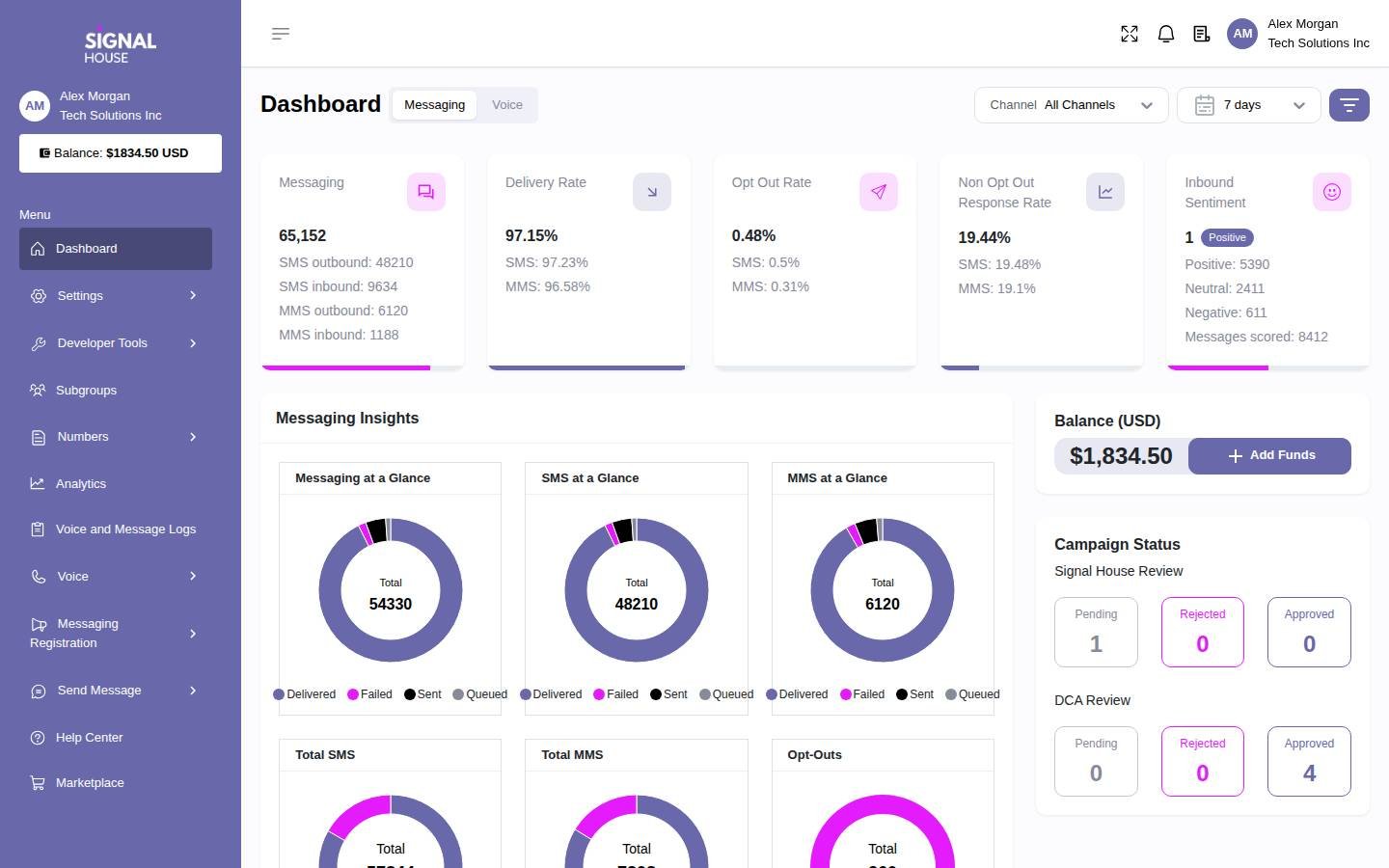
Signal House offers business messaging and voice capabilities through an account, APIs and named integrations. Its public positioning emphasizes assistance with setup and integration alongside usage-based charges. That may appeal to an operator who wants a practical customer communication workflow without treating every interface as a new software project. Confirm the exact supplied functionality before assuming the account replaces a complete business phone system.
Signal House Voice And SHML Workflows
The voice product lists SHML webhook control, SIP options and browser capabilities. A business should demonstrate the exact route it intends to use, including what happens when an employee cannot answer. Browser voice calling, forwarding to a mobile number and connecting a SIP endpoint may involve different resources and chargeable legs. Request a written explanation of the chosen configuration rather than assuming 1 minute covers every connection.
For an inbound service business, a useful demonstration would include opening hours, an unavailable employee, a missed call and a callback assignment. A software team should also examine the events available for monitoring, support and reconciliation. Signal House's guided setup proposition is relevant to implementation, but it does not establish feature equivalence with every SignalWire method or guarantee a completed custom integration at no additional cost.
Signal House Pros And Cons
- Pros: Named business integrations and an onboarding proposition relevant to eligible agencies and smaller operators.
- Pros: A lower selected incoming minute component and a new-account credit offer.
- Cons: Selected local outgoing SMS and voice components are higher than the SignalWire rates compared here.
- Cons: Missing base fees, integration scope, voice-enabled number rental and optional processing need a quote.
Review Signal House And Account Credit
SignalWire Vs Signal House Features And Application Ownership
A feature checklist is helpful only when it identifies who supplies the working experience. An API may make call recording possible while leaving your team to create the recording screen, set permissions and build deletion controls. A connector may place messages in an existing CRM while exposing only selected voice calling functions. Use the following requirements to define what the provider, integration partner and your business each own.
| Requirement | SignalWire | Signal House | What To Validate |
|---|---|---|---|
| Call control | SWML, cXML and other documented interfaces | SHML webhooks and listed calling capabilities | Exact instructions, callbacks and failure handling |
| Browser calling | Browser SDK development path | Browser capabilities listed | Supplied interface, authentication and connection charges |
| SIP connection | Selected SIP components published | SIP endpoints and trunks listed | Legs, transport, media security and destination rates |
| AI answering | Separate AI runtime offer | Obtain proposed configuration and quote | Application provider, transport and human fallback |
| Existing CRM | Validate proposed connector or custom work | Named integrations including HighLevel | Supported actions, permissions and maintenance owner |
| Staff application | Identify built or connected workspace | Demonstrate included or connected workspace | Calls, replies, assignments and reporting |
| Support | Basic and separately priced paid tiers | Human assistance and qualifying dedicated access | Hours, escalation, response terms and implementation scope |
| Production access | Account and sender restrictions apply | Eligibility and sender approval apply | Distinguish permitted testing from production traffic |
Define The Employee Experience Before Buying
Ask an employee to complete a realistic task during evaluation: open a customer conversation, place a call, record the outcome and hand the next action to a colleague. Watch where the employee changes applications and where context disappears. A technically successful connection can still create extra work if staff must manually copy notes, search separate logs or guess who owns a reply.
For SignalWire, establish whether your team will build that workspace, embed a component or connect an existing application. For Signal House, establish which interface is supplied by the provider and which belongs to the connected platform. Include subscription fees for that platform in the budget. The comparison should reflect a usable workflow for the actual users rather than a list of available API verbs.
Separate AI Features From Telephone Connectivity
SignalWire publishes an AI agent runtime at $0.16 per minute, with transport charged separately. The SignalWire offer describes standard speech recognition, language-model and speech-generation capabilities within the runtime. Premium options and the selected connection can add costs. That is a different product from purchasing a basic PSTN voice minute, so a low telephone rate should not be presented as the complete price of an AI receptionist.
Ask Signal House to demonstrate and quote any proposed AI answering configuration, including the application or partner that supplies it. Do not infer a matching native runtime simply from its programmable voice calling features. For either provider, test a caller correcting a detail, interrupting an answer and requesting a person. The result should be a recorded next action that staff can use, with a clear route when the automation cannot help.
SignalWire Vs Signal House Pricing: Selected SMS And Voice Rates
The following prices are selected US components rather than complete monthly plans. SMS is compared by the relevant billable segment or unit, and voice calling is compared by chargeable voice minutes. Sender rental, registration, carrier charges, optional processing, taxes and account-specific commitments are excluded unless explicitly stated. Confirm the actual country, product and direction before applying any figure to a forecast.
| Component | SignalWire | Signal House | Scope |
|---|---|---|---|
| Local outgoing SMS | $0.00415/segment | $0.0065/segment | Carrier fees, registration and sender charges extra |
| Toll-Free outgoing SMS | $0.0068/segment | $0.0079/segment | Use the matching sender and fee schedule |
| Short-Code outgoing SMS | $0.0065/billable unit | $0.0065/billable unit | Rental, setup and spend requirements differ |
| Local outgoing voice | $0.008/min | $0.012/min | Selected starting components; verify billed legs |
| Local incoming voice | $0.0066/min | $0.005/min | Verify increments before modeling raw durations |
| Incoming local SMS | $0.00415/segment base | Confirm incoming platform base | Carrier rows are not a complete platform quote |
| Local number rental | $0.50/month | $1/month messaging; voice-enabled quote | Confirm actual capability and account terms |
The official SignalWire rate deck separates PSTN, SIP and WebRTC. The $0.003 SIP or WebRTC component should not replace the local PSTN rate in an ordinary outgoing voice telephone-call estimate. If a call connects multiple chargeable resources, obtain the complete leg-by-leg calculation. Signal House's published messaging number rental also should not be treated as a confirmed voice-enabled number price.
SMS Segments, MMS And Sender Types
A customer-visible text can contain more than 1 billable segment. Encoding, message length and concatenation affect the final count, so estimate from representative templates rather than a campaign's contact count alone. A short reminder and a long promotional text with special characters may produce different usage. Compare the segments shown in delivery records with those used on the invoice before increasing campaign volume.
Sender type also changes the comparison. SignalWire lists $0.0068 for selected toll-free outgoing SMS against Signal House's $0.0079. For the selected short-code outbound usage components, both list $0.0065 per relevant unit. Equal message rates do not mean equal short-code bills: rental periods, setup, minimum spend and enablement charges can dominate a smaller program. Treat each sender as a separate commercial evaluation.
MMS needs its own model. The selected local outbound MMS rate is $0.02 at both providers, before applicable carrier charges and other terms. That does not make every image campaign identical in cost or behavior. Check supported media, sender approval, file handling, delivery events and whether an employee can see the customer response in the intended application. A customer-facing result requires more than message submission.
Carrier Fees And Incoming SMS Are Separate Questions
Carrier surcharges can be material even when platform rates look small. Use the actual recipient-network distribution and the relevant sender type when estimating them. Avoid adding 1 provider's all-in price to another provider's platform-only number. If both offers exclude carrier fees, keep those fees visible as a separate calculation and confirm whether the pass-through rules genuinely match.
Signal House's public incoming carrier-fee rows do not establish a complete zero platform charge for receiving SMS. Ask for the incoming base and any related fees in writing. SignalWire publishes an incoming local SMS component, but that still does not remove applicable network or account charges. Reply-heavy support workflows need an incoming-and-outgoing model rather than a forecast based solely on broadcasts.
Numbers, Subscribers And Optional Processing
SignalWire lists local numbers at $0.50 monthly and toll-free numbers at $0.80 monthly. The SignalWire subscriber resource is separately listed at $3 monthly and represents a user entity for supported communication applications. Determine whether your SignalWire design creates billable subscribers; do not automatically add that charge for every employee who only accesses an external CRM or assume it replaces other application and support costs.
Optional SignalWire processing also needs its own line. Published examples include recording at $0.002 per minute and recording transcription at $0.02 per 15 seconds. Keep the transcription unit intact when comparing a quote; it is not a $0.02-per-minute claim. Signal House lists recording-related capabilities, but a capability listing is insufficient evidence that recording, retention or transcription is free.
SignalWire Vs Signal House Monthly Cost Examples
These examples hold chargeable voice minutes equal to isolate rate differences. They are not invoice predictions based on recorded voice call durations, because billing increments, minimums and leg rules must be established first. Each scenario uses the selected local outbound SMS component and local incoming or outgoing voice calling components. Neither example includes number rental, carrier fees, registration, optional features, support, tax or connected software and support.
| Monthly Workload | SignalWire | Signal House | Selected Component Difference |
|---|---|---|---|
| 10,000 outgoing local SMS segments + 1,000 outgoing minutes | $49.50 | $77 | SignalWire lower by $27.50 |
| 10,000 outgoing local SMS segments + 10,000 outgoing and 10,000 incoming minutes | $187.50 | $235 | SignalWire lower by $47.50 |
| 1,000 outgoing local SMS segments + 1,000 outgoing and 10,000 incoming minutes | $78.15 | $68.50 | Signal House lower by $9.65 |
| 10,000 outgoing + 10,000 incoming voice minutes only | $146 | $170 | SignalWire lower by $24 |
Example 1: A Light Outbound Workflow
For 10,000 outgoing local SMS segments and 1,000 outgoing billable voice minutes, SignalWire's components total $49.50: $41.50 for messages plus $8 for calls. Signal House totals $77: $65 plus $12. The $27.50 difference is a useful starting point, but it is small enough that 1 recurring software or support charge or a different support arrangement could change the operational decision.
Suppose both offers also incurred an illustrative $0.0045 carrier fee on each of those 10,000 outgoing segments. That assumption adds $45 to each example, taking the selected totals to $94.50 and $122. The difference remains $27.50. This is a calculation technique, not a claim that every carrier charges that fee or both accounts have identical pass-through treatment.
Example 2: Balanced Calling And Messaging
For 10,000 outgoing SMS segments, 10,000 outgoing voice minutes and 10,000 incoming voice minutes, SignalWire totals $187.50 in the selected components. Signal House totals $235. The $47.50 difference reflects a workload in which the outgoing advantages outweigh the lower incoming rate. A business comparing this scenario should still allocate costs across clients or departments rather than hiding them in 1 combined usage total.
Use your recent traffic export to replace the demonstration quantities. Separate reminder campaigns from employee conversations and inbound service calls from outbound sales activity. A monthly average can conceal an expensive peak, a client sending unusually long texts or a destination outside the quoted local category. Run the model for an ordinary month and a busy month before choosing a commitment.
Example 3: An Incoming-Heavy Business
For 1,000 outgoing SMS segments, 1,000 outgoing voice minutes and 10,000 incoming voice minutes, SignalWire totals $78.15 while Signal House totals $68.50. Signal House is $9.65 lower in those selected components. This reversal shows why “cheaper than SignalWire” or “cheaper than Signal House” needs a defined workload. The number of incoming calls can matter as much as the message count.
For voice alone at these starting rates and matched billable voice minutes, the component crossover occurs when incoming voice minutes equal 2.5 times outgoing voice minutes. At 1,000 outgoing and 2,500 incoming voice minutes, both calculations produce $24.50. This narrow relationship excludes SMS, fees, rounding and changing volume bands. It is an aid for examining traffic direction, not a universal break-even rule for a complete account.
Volume Discounts Need Their Own Forecast
Signal House publishes graduated outgoing voice calling bands, meaning a lower rate applies to the minutes within that band rather than automatically repricing every earlier minute. Messaging discounts and number tiers have their own qualifications. SignalWire also invites commercial discussions for additional options. Keep the initial comparison at a consistent published level, then request both volume offers against the same forecast and commitment.
A seasonal agency should ask what happens when client volume falls below the expected threshold. A growing software business should ask how subaccounts combine, whether unused commitments expire and which charges qualify toward a spend requirement. The relevant number is the total obligation across the contract, including slower months, rather than the most attractive marginal rate printed beside a high-volume band.
Voice Billing Increments Can Change The Comparison
Signal House states that answered calls have a 1-minute minimum and round up to whole minutes. That makes call-level voice duration important. For example, 100 answered calls lasting 65 seconds each produce 200 chargeable voice minutes under that rule. Applying its selected outgoing rate gives $2.40 in that component, before other charges. Multiplying the raw 108.33 minutes by the rate would understate the result.
The current SignalWire product's exact minimum and rounding rules should be obtained before calculating the same voice call sample. A per-minute price alone does not identify the increment. Do not assume 6-second billing because a document mentions short-duration calls, and do not copy another provider's rounding rule into the SignalWire estimate. Ask for a sample SignalWire detail record and reconcile the rated units against an invoice.
Also distinguish call attempts from connected calls and connected duration from every billed leg. Transfers, conferencing, forwarding and recordings can add separately priced resources. A 3-minute customer conversation may include an incoming leg, an outgoing employee leg and optional processing. The right question is which resources the proposed design creates and how each one is metered under the actual agreement.
SignalWire Voice APIs Vs Signal House Calling Workflows
Call Routing, Transfers And Unavailable Employees
Test more than a successful transfer. Ask what happens when the first employee is busy, the second number does not answer and the caller disconnects during a greeting. Decide whether a failed transfer returns to a menu, creates a callback task or goes to voicemail. SignalWire and Signal House should be evaluated against the same written scenarios so differences in default behavior become visible.
The operational record matters too. Employees need to know who called, what happened and what action remains. If an application shows only a technical completion event, staff may interpret an unanswered employee leg as a resolved customer request. Map technical states into meaningful business outcomes. Keep enough detail to investigate a failed voice interaction without exposing recordings or customer information unnecessarily.
SIP, Browser Calling And Audio Quality
SignalWire offers SIP and browser development paths, while Signal House lists SIP and browser voice calling capabilities. Test the actual devices, networks and destinations your staff will use. A browser demonstration on an engineer's wired connection says little about a remote employee's wireless headset or a receptionist's busy office network. Include microphone permissions, device selection and recovery after a connection interruption.
Measure usable audio in both directions and check whether delay affects conversation. Record the environment, destination, timestamp and call identifier for problems. Compare equivalent configurations before attributing every failure to a provider. Application design, local network conditions, codecs and the destination can all affect the experience. No independent call-quality or uptime benchmark was conducted for this article.
AI Agents, Recordings And Data Ownership
For an AI-enabled SignalWire project, build a cost model that includes runtime and the selected transport. As a narrow illustration, 1,000 minutes at $0.16 plus 1,000 selected local outgoing PSTN minutes at $0.008 produces $168 before other charges. That arithmetic assumes those resources and quantities apply; it is not an all-inclusive receptionist subscription or a promise that every deployment has that price.
Before enabling recordings or transcripts with either provider, decide who can access them, how long they are retained and how a deletion request is handled. Verify the notice and consent requirements applicable to the calls you make. If a connected AI or CRM service receives the content, include that service in the data-flow review. A provider's encryption feature does not settle the application's complete privacy obligations.
Business Messaging: Delivery Events, Replies And Registration
From API Acceptance To A Useful Customer Outcome
An accepted API request is the start of a message workflow, not evidence that a customer received or read it. Store the provider identifier and later status events, distinguish temporary errors from permanent failures and make retry behavior visible. A delayed webhook should not automatically cause a second customer message. Establish which system owns retries before running 2 integrations against the same conversation.
SignalWire developers should map the chosen messaging interface's event behavior into their application. Signal House buyers should demonstrate the corresponding behavior in the named connector or API. Check where failed messages appear and whether ordinary employees can understand the recommended action. A technically complete event feed has limited business value if nobody notices a failed appointment notification until the customer complains.
Replies, Opt-Outs And Client Separation
Test replies containing an ordinary question, a wrong number and an opt-out request. Define which system updates suppression status and how quickly other campaigns see the change. Keep customer preferences attached to the right sender and business context. A customer who stops messages from 1 client should not accidentally alter an unrelated client's records because an agency used a shared integration carelessly.
For multi-client use, examine permissions, number ownership, campaign records and usage attribution before importing contacts. SignalWire's technical account structure and Signal House's agency-facing proposition both need validation against the specific business model. Neither removes registration or traffic eligibility requirements. Confirm whether the proposed account may serve the intended clients and whether each client needs separate registration and approval.
HighLevel And Existing CRM Workflows
Signal House explicitly markets a HighLevel integration and client-pricing proposition. That makes it relevant for an eligible agency already operating within that ecosystem. Confirm the installed version, supported actions, message routing, staff permissions and whether voice calling features are included in that connector. Do not assume a messaging connection automatically replaces every phone function in the platform.
A SignalWire connection to an existing CRM may involve a separate integration or custom development. Ask who maintains that connection, what happens after either system changes and how support tickets cross vendors. The SignalWire API's flexibility can be valuable, but maintenance should be assigned rather than left implicit. For broader market context, see our Twilio alternatives and competitors guide.
SignalWire Trial Mode Vs Signal House Account Credit
SignalWire has account trial restrictions and a separate messaging trial path. Signal House advertises a new-account credit. These are different evaluation arrangements, so neither should be presented as an unrestricted fixed-duration free trial. Verify the current offer, eligible charges and production transition before promising a launch date or calculating how much testing a credit will buy.
SignalWire Trial Mode And Funding
The SignalWire trial-mode documentation explains restrictions on destinations, numbers and international use. Exiting that mode requires a payment method and at least $5 in paid funding. That is a customer-funded balance rather than a $5 promotional credit. Adding a payment method also enables automatic top-up under the documented account process, which deserves review before handing access to a larger team.
Use the restricted SignalWire environment to validate basic routing and application behavior. Do not treat it as permission to contact an entire customer list. Confirm which functions remain limited after funding and which require sender registration, verification or additional approval. An unrestricted technical account and an approved production messaging campaign are different milestones in the deployment process.
SignalWire Messaging Platform Free Trial
The separate SignalWire messaging trial is designed for limited tests with a verified mobile recipient and a trial number. The SignalWire published limit includes 200 segments per day, and trial content receives a prefix. Those conditions make it useful for checking a basic message flow, but they do not reproduce a production campaign's audience or sender identity. Verify the supported API path for your exact test.
Moving into SignalWire production requires the appropriate approved sending arrangement. Keep the trial number and production number plan explicit, and do not build an application around a temporary identifier without checking transition rules. Capture credentials in a secure configuration system and document which environment owns each webhook. Many avoidable launch problems arise from a working test account being mistaken for the finished production configuration.
Signal House Credit And Evaluation Questions
Signal House advertises $25 in new-account credit. Ask how the credit applies to registration, numbers, usage and other charges, and what happens when it is consumed. Credit value does not establish a fixed number of messages because sender charges and carrier fees may also apply. Confirm payment and top-up behavior before allowing production automation to run without supervision.
Evaluate a complete customer journey within the allowed account scope: submission, delivery event, incoming response, employee action and usage record. Ask the provider to explain any feature that cannot be tested before approval. The purpose is to identify a dependable operating process and an accurate commercial offer, rather than simply exhausting the available credit or collecting a successful first-message screenshot.
SignalWire Vs Signal House Support And Operating Cost
SignalWire lists free Basic support through email and community channels, with separate paid tiers. Premium is priced at 5% of monthly usage with a $1,200 monthly minimum, while Enterprise uses 8% with a $5,000 monthly minimum. Confirm the applicable usage definition, response commitments and account terms. A paid SignalWire support plan should be modeled separately from message or minute charges.
Signal House advertises human assistance across plans and qualifying dedicated Slack access at specified usage levels. That proposition may matter to buyers seeking guided setup, but access to a channel is not a guaranteed resolution time. Request the actual support hours, escalation path and implementation boundary. Clarify whether a broken third-party connector is handled by the provider, the platform vendor or a separate agency.
Compare The Support Your Business Actually Needs
A developer with a noncritical prototype may be comfortable investigating documentation and waiting for ordinary assistance. A reception operation that loses bookings during an outage needs a different plan. Define the business impact of a failed voice calling route, the maximum acceptable delay before acknowledgement and the person authorized to change routing. Buy the entitlement that matches those needs instead of choosing from support slogans.
Paid support floors can be much larger than the component differences in a small workload. Conversely, a large business may place more value on a contractual escalation path than a modest usage discount. Do not add SignalWire's Premium floor to every customer estimate; it applies when that tier is selected. Similarly, do not represent Signal House's advertised assistance as unlimited custom engineering.
Include Staff Time Without Inventing Savings
Estimate the hours required for registration, configuration, support, reconciliation and incident handling. Assign those hours using your own labor cost and a realistic maintenance plan. A supported integration may reduce some tasks, but a provider's marketing claim is not evidence that your team will save a particular number of hours. Compare the operating work observed during your own pilot.
For illustration, a $27.50 monthly component advantage can be outweighed by a recurring application fee or additional staff effort. That does not prove either platform is operationally cheaper. It means the purchasing worksheet should contain software, support and labor alongside network usage. A low SMS rate becomes more useful when the surrounding workflow is maintainable and the invoice can be reconciled.
Which Businesses Should Choose SignalWire Or Signal House?
Developers And Product Teams
Shortlist SignalWire when your product depends on custom voice call behavior, a browser experience or an AI-enabled workflow that your engineers will own. During evaluation, build the difficult part first: an interrupted interaction, an unavailable destination or a state change arriving after a timeout. A basic greeting demonstrates connectivity, while these cases reveal how much application work the team must maintain.
Signal House can still be relevant to a development team, particularly where its supported workflow or incoming-heavy profile fits. Ask for API documentation and a demonstration of the exact required event model. Compare implementation effort honestly on both sides. Do not equate a larger collection of development approaches with an automatically better outcome for a small application with straightforward requirements.
Marketing Agencies And HighLevel Operators
Consider Signal House when its named integration supports your actual client workflow and commercial model. Validate client registration, staff access, billing separation and ownership before promising the service across an agency portfolio. Some lead-generation and consumer-data practices are restricted under its terms, so agency positioning should not be interpreted as blanket acceptance of every traffic source or business category.
SignalWire may appeal to an agency that has its own engineering capability and wants to control the communication layer. The agency then needs a maintenance plan and a clear boundary between client support and provider support. Compare the cost of that ownership with the value of a supported connector. A lower outgoing component is useful only if the client-facing service remains manageable.
Small Businesses And Incoming Service Teams
A small business should start by asking which application staff will actually use. If the need is a shared business number, call history and simple follow-up, evaluate the finished workflow rather than selecting an API solely by price. SignalWire can support a custom implementation, but development and connected software may be disproportionate to a simple requirement.
Signal House is worth testing for an incoming-heavy service operation if the proposed configuration, assistance and number capabilities fit. Use real voice call durations and the correct rounding rules before treating its incoming rate as a saving. A busy front desk also needs a reliable fallback, clear opening-hours behavior and an employee who owns every unresolved request.
Security, International Calling And Account Controls
Limit credentials to the systems that need them, separate development from production and remove access when staff or contractors leave. Confirm which permissions each provider supports and how actions are recorded. An API token copied into a shared spreadsheet can create financial and privacy exposure regardless of the platform's underlying security features. Establish a practical credential-rotation and incident process.
For SIP, confirm the supported transport and media security settings at both ends. Signal House lists TLS and SRTP alongside other connection options, so secure configuration should be verified rather than assumed for every route. Review the corresponding SignalWire setup for the selected interface. Check recording access, exported logs and connected services as part of the same data-flow assessment.
International availability requires destination-specific confirmation. Ask about allowed countries, number eligibility, documentation, local rules, outgoing permissions and the exact rate deck for each route. Do not apply US local figures to overseas traffic. A platform's broad communication capabilities do not establish that every country, sender type and business category is available to a new account.
How To Switch Between SignalWire And Signal House
1. Inventory The Complete Workflow
Export the numbers, sender registrations, application endpoints, routing rules, permissions and recent traffic records. Record who owns each customer conversation and which system initiates automated messages. Include recordings, reporting exports and integrations that run quietly in the background. This inventory helps distinguish a simple provider change from a larger application migration with separate data and software dependencies.
2. Confirm Account And Number Eligibility
Get approval for the intended business model and channels before scheduling a move. Verify portability for the actual numbers and establish any re-registration work for messaging. SignalWire publishes no-charge local and toll-free port-in and a $5-per-number port-out fee, but operational eligibility and the final account terms still apply. Request Signal House's corresponding transfer costs and process rather than assuming symmetry.
3. Build And Test An Isolated Route
Use an approved test number or permitted evaluation route. Translate the required voice call instructions and event handling rather than changing credentials and hoping the applications match. Test replies, errors, retries, transfers and unavailable employees. Keep test activity separate from production campaigns so a duplicated event cannot unexpectedly contact a real customer or create an incorrect billing record.
4. Reconcile Costs And Plan The Cutover
Compare sample usage records with the modeled charges, including segment counts and rounded call units. Assign an owner for the switch and define what would trigger rollback. Keep customers informed of any workflow change that affects them. Do not cancel the previous account until number ownership, routing, incoming responses and required records have been checked under the new arrangement.
5. Review The First Production Invoice
Check the actual invoice against the pilot assumptions and investigate unfamiliar resource charges. Confirm that old numbers, subscribers, recordings and integrations are closed or retained intentionally. Migration economics depend on net recurring benefit: an illustrative $550 move takes 20 months to recover at $27.50 monthly net savings, or 10 months at $55. Those assumptions should be replaced with your own complete usage and support costs.
Frequently Asked Questions About SignalWire Vs Signal House
Is SignalWire Cheaper Than Signal House?
SignalWire has lower selected US local outgoing SMS and outgoing voice calling components in this comparison. Signal House has the lower selected incoming minute rate. The cheaper complete account depends on traffic direction, billable segments, duration rounding, number fees, support and software. Request matching quotes before describing either provider as universally cheaper.
Is Signal House A Good SignalWire Alternative?
Signal House is a relevant alternative for eligible businesses whose required integration and operating model it supports. Its incoming rate and guided setup proposition may be attractive. It should not be treated as a drop-in replacement for every SignalWire interface, browser application or AI configuration without testing the actual requirements.
Which Is Better For Custom Voice Development?
SignalWire is the stronger initial technical shortlist choice for a team seeking the documented SignalWire SWML, REST, Browser SDK and Relay approaches. The final decision depends on the application. Compare the required voice call instructions, events, permissions, support, deployment model and staff experience rather than judging the platform solely by the number of available APIs.
Does SignalWire Offer A Free Trial?
SignalWire provides restricted trial arrangements, including a separate messaging trial path. Account trial mode is not unrestricted production access. Exiting that mode requires paid funding and a payment method, while production messaging has additional sender requirements. Confirm the current terms instead of advertising an unsupported fixed-duration unlimited free trial.
Does Signal House Offer A Fixed-Duration Trial?
The verified public offer is a $25 new-account credit. A credit is different from a guaranteed number of free days or unlimited usage. Ask which charges consume it, what approvals apply and whether billing begins automatically after it is used. Evaluate the whole workflow within the permitted account scope.
Can SignalWire Or Signal House Replace A Business Phone App?
Either may supply components of a business voice calling workflow, but the employee application must be identified and demonstrated. Ask where staff answer calls, see history, return messages and transfer work. API access, browser capability and a named integration do not by themselves establish a complete ready-made phone application for every employee.
Does SignalWire Work With HighLevel?
Evaluate the specific connector or custom integration being proposed rather than assuming native support from general API availability. Establish who supplies it, which messaging and voice calling functions it exposes and who maintains it. Signal House explicitly lists a HighLevel integration, but its exact connector capabilities and client eligibility should also be demonstrated.
Are SWML And SHML The Same?
No interchangeability should be assumed. SignalWire's SWML and Signal House's SHML belong to different platforms. Compare instructions, authentication, events and failure behavior individually. SignalWire's separate cXML compatibility proposition is also a distinct interface; it does not establish compatibility between every call-control language or every part of an existing application.
Is The SignalWire $0.003 Rate An All-In Phone Call Price?
No. The selected $0.003 figure is a SIP or WebRTC component. Public PSTN voice rates are listed separately, and an application can create additional chargeable resources. Use the rate for the actual connection and direction. An AI runtime, recording, forwarding leg or connected application may add further costs.
Which Provider Has Better Support?
The public offers describe different support arrangements rather than proving a universal winner. SignalWire separates Basic and paid support tiers. Signal House advertises human assistance and qualifying dedicated access. Compare your actual entitlement, hours, escalation path and implementation scope. Customer review comments are useful context but do not guarantee a particular response or resolution.
Can I Keep My Existing Numbers?
Possibly, subject to portability, ownership, documentation and product eligibility. Confirm each number and its messaging registration before planning a switch. A successful voice port does not automatically validate every messaging workflow. Keep the previous service available until incoming calls, responses and required records have been checked after the agreed transition.
Which Provider Is Better For International Business Messaging?
There is no single answer from the selected US comparison. Build a country-by-country requirement list covering senders, directions, volume, local documentation and permitted content. Obtain destination-specific commercial terms from both providers. Test the actual route and response workflow before treating general international capability as approval for the intended campaign.
Final Verdict: SignalWire Vs Signal House
Choose SignalWire as the first evaluation when custom voice calling behavior, developer control and selected outgoing component costs are central to the project. The documented SignalWire development approaches make it a serious candidate for teams prepared to maintain the application. Include the actual connection, resources, processing and support tier in the budget so the attractive base rate remains grounded in a working design.
Evaluate Signal House when a named integration, guided setup or incoming-heavy workload aligns with your requirements. Its selected incoming rate can help particular traffic profiles, but it is not the lower-cost answer for every mix. The strongest decision is a complete pilot and matching quote that includes staff experience, account approval and all recurring obligations.
Customer Feedback On SignalWire And Signal House
The named G2 profiles show SignalWire at 3.4/5 and Signal House at 4.8/5. The review histories differ, so these figures should not be read as matched technical measurements. Neither score establishes a voice-quality, message-delivery or uptime winner. Use the score alongside recent feedback about the workflows your business actually needs.
SignalWire feedback includes Chris G.'s praise for documentation and building an AI application, alongside Greg S.'s concerns about ticket responses, account limitations and subscriber billing. Those are individual experiences rather than verified findings about every current account. They support asking precise questions about implementation and escalation.
Signal House reviewer Ismail A. describes helpful onboarding, while Denise B. appreciates organization and asks for clearer guidance. Treat that feedback as context for your own demonstration. Ask both providers to show how your staff will investigate failed communications, understand charges and get help when a customer workflow stops.
Affiliate Disclosure: We may earn a commission through selected links on this page. Recommendations depend on the stated business requirements and comparison scope. An affiliate relationship does not establish that a provider is cheapest or best for every business.