Signal House is worth considering for eligible businesses seeking guided setup, named integrations and lower selected incoming voice rates. MessageBird, now branded Bird, is a strong shortlist choice for multichannel development and lower selected US local outbound SMS components. Existing MessageBird accounts and the newer Bird platform have separate credentials and balances, so confirm the account being compared before applying a price.
Signal House vs MessageBird is a comparison of business workflows as well as network usage. A small agency may want messages inside its existing CRM, while a software team may want programmable voice, delivery events and several messaging channels. This guide explains the product boundaries, selected commercial components and implementation responsibilities that determine which offer fits the business.
 Ratings use the named G2 profiles: Signal House and Bird. The Bird profile includes experiences from different product generations, so its score is not a separate technical rating for every current API or voice route.
Signal House Vs MessageBird: Quick Comparison
Choose the application and account before choosing the rate. Signal House can connect named business tools and programmable voice calling configurations. Bird has a broader product portfolio, with an important distinction between older MessageBird connectivity accounts, the engagement platform and the newer bird.com account. A familiar brand name does not make their APIs, balances or commercial agreements interchangeable.
| Provider | Best Fit | Buying Considerations | Pricing & Evaluation |
|---|---|---|---|
|
| Local SMS $0.0065/SegmentSelected US outbound base. Voice: $0.012/min out; $0.005/min in. Additional charges apply.View Offer And $25 Account Credit | |
|
| Local SMS $0.0035/SegmentCurrent Bird US outbound base; carrier fees extra. Legacy MessageBird rates may differ.Pay-as-you-go evaluation requires funded wallet; terms apply.Review Usage And Funding Terms |


Is MessageBird The Same As Bird?
MessageBird is associated with the Bird brand, but that does not mean every older account has become the same newer platform account. Bird's current account guidance for MessageBird customers distinguishes the older Connectivity Platform, the engagement platform and bird.com. Identify the login and API host your application uses before comparing migration requirements.
An older MessageBird balance and access key remain with that account. Creating a bird.com account using the same email address does not transfer them. The newer platform has its own API keys and wallet. This is relevant even if you remain within the same brand family: changing the integration can still involve credentials, payloads, billing and application work.
Why This Comparison Uses Current Bird Rates Carefully
The published Bird US rates used below belong to the identified newer platform pricing pages. They are not a promise that an existing MessageBird customer automatically receives identical rates or functionality. If you have a negotiated or older account, obtain the applicable rate card and contract. Compare that offer separately with a Signal House quote for the same workload.
For a new application, use documentation that matches the account you will provision. For an existing application, inventory its dependencies before assuming the move is a credential change. A brand transition can preserve useful infrastructure while leaving different interfaces in operation. The practical task is to identify the actual service, not merely replace a company name in a spreadsheet.
Signal House Vs MessageBird: Which Provider Is Better?
Best Fit For A Supported HighLevel Workflow: Signal House
Signal House explicitly lists HighLevel messaging integration and a client-pricing proposition. That makes it a relevant starting point for an eligible agency already running customer conversations there. Demonstrate sending, replies, client separation and usage attribution inside the intended account. The value is the usable workflow and implementation assistance rather than a claim that the provider has the lowest rate for every channel.
Ask what voice functions, if any, the proposed connector exposes. A messaging integration does not establish that every phone feature has moved. Confirm the business model, traffic eligibility and owner of the connection. Guided setup is useful when it addresses your actual requirements, but it should not be interpreted as unlimited custom development or automatic approval of every client.
Lower Selected Local And Toll-Free SMS Components: Bird
Bird's current selected US local outbound SMS component is $0.0035 per segment, compared with Signal House's $0.0065. For 10,000 segments, those components are $35 and $65. Bird also lists a lower selected toll-free outbound component. Carrier fees, number rental, registration, connected software and other terms remain additional, so these figures establish a usage comparison rather than a complete invoice winner.
This finding should remain visible even where Signal House is a strong operational fit. A business with an existing developer team may find the lower Bird component valuable. Another business may justify a higher component through an integration or service arrangement that reduces its own operating work. The comparison becomes useful when those differences are priced and demonstrated instead of hidden behind a universal recommendation.
Lower Selected Incoming Voice Component: Signal House
Signal House publishes $0.005 per incoming US minute in the selected offer. Bird lists $0.009 for local incoming calls plus a separate handling charge of $0.004 per minute billed by the second. Incoming-heavy operations therefore deserve their own calculation. The example models later in this guide show why a lower SMS rate does not necessarily produce the lower mixed-workload total.
Keep duration rounding and the actual voice call design visible. A forwarded call can contain an incoming connection and an outgoing connection, and an application may add optional processing. Confirm the relevant number capabilities and fees before treating a rate comparison as the complete price of a receptionist or shared office phone workflow.
Broader Multichannel Development Shortlist: Bird
Bird is a strong initial shortlist when a team needs to combine communication channels and own a custom application. Its current portfolio includes SMS, WhatsApp, email and programmable calling functions. Evaluate only the products that solve a real requirement, then confirm their shared account behavior and individual commercial terms. A larger catalog is helpful when the business will use it.
Signal House can still be suitable for a narrower application, particularly where a named integration fits. Conversely, an older MessageBird customer may prefer to retain a working application until a migration has a clear economic or functional benefit. Choose on the required workflow, documented capabilities and complete obligations rather than a brand's size or an affiliate placement.
Signal House Overview: Business Messaging And Voice
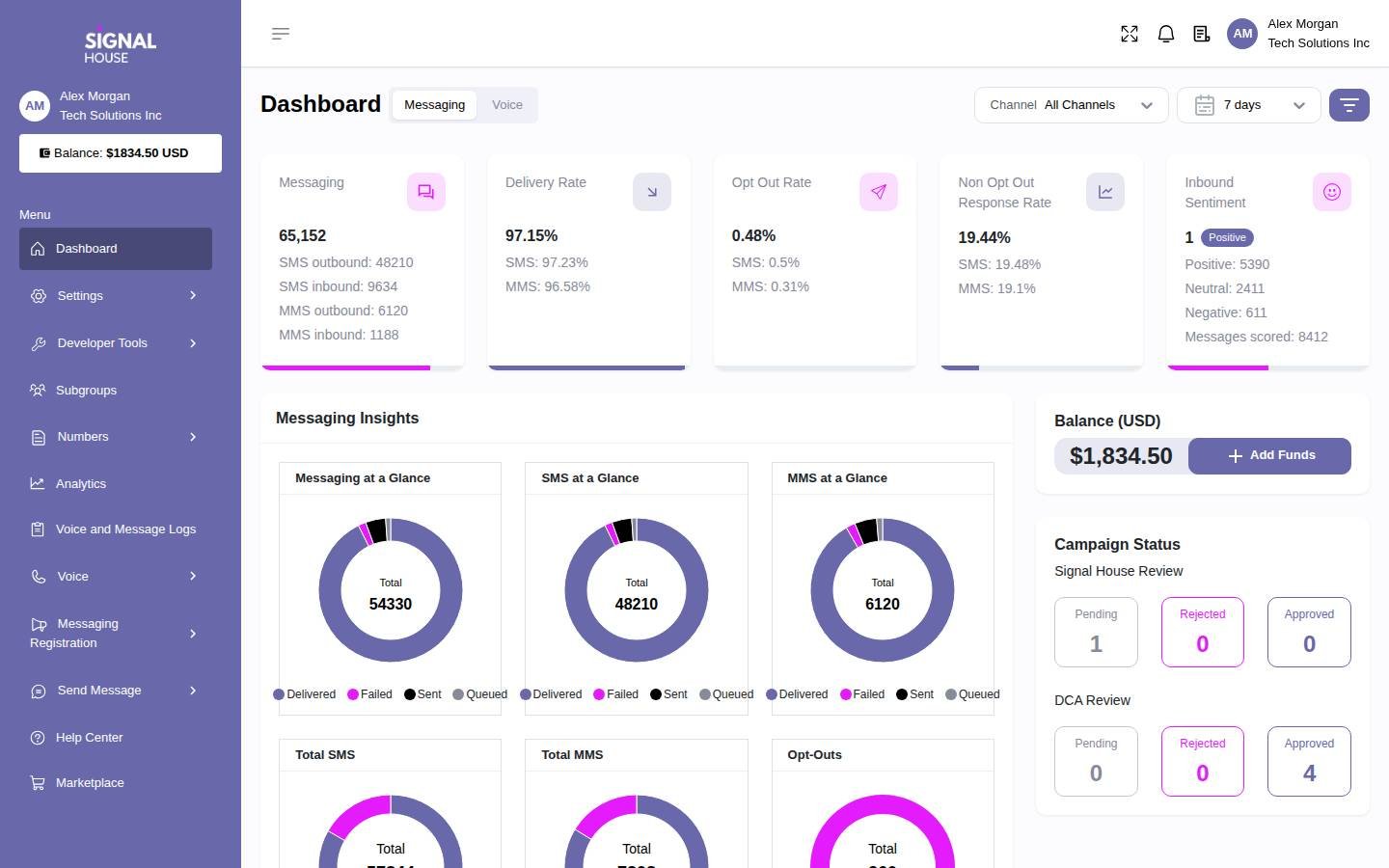
Signal House offers messaging, programmable voice and named integrations with an emphasis on setup assistance. It is relevant to eligible businesses seeking an operating workflow around their existing software. The provider should show which employee functions it supplies directly, which belong to the connected platform and which require additional configuration or development.
Named Integrations And Setup Responsibilities
The public integration list includes HighLevel, Shopify, Medusa and Make. Each connection has a particular purpose, so do not assume a retail notification connector exposes the same functionality as an agency workspace. Show the event that initiates a message, the location of a customer reply and the staff action that follows. Include a failed message in the demonstration.
Ask who maintains the integration when either system changes. A business may depend on a connected platform's subscription, permissions or automation limits in addition to Signal House usage. Include those dependencies in the quote and support process. A useful implementation leaves employees able to identify an unresolved customer interaction without asking an engineer to inspect every technical log.
Programmable Calling And SIP Options
Signal House lists SHML webhook instructions, browser WebRTC softphones, SIP trunks and individual endpoints. These are different paths for a voice application. An existing PBX, a browser-based employee and a mobile forwarding destination can create different resources and costs. Define the intended configuration before assuming every capability is included in a single minute rate.
For a service business, test opening-hours behavior, unavailable staff, voicemail and callbacks. For a custom application, examine the supported events and the information needed to reconcile a call. Feature availability is important, but the final result also depends on staff access, application design and clear responsibility for follow-up.
Review Signal House And Account Credit
MessageBird And Bird Overview: Match The Product To The Account
Bird's current documentation describes communication products within a newer workspace and wallet model. Older MessageBird connectivity and engagement accounts remain distinct. For a buyer, this means a comparison must identify the product generation as well as the feature. An older integration tutorial, an engagement-platform screenshot and a current bird.com rate may describe different purchasing and implementation paths.
Developer APIs And The Employee Workspace
Bird documents APIs, events, SIP calling and browser capabilities. Establish how those components become the interface employees will use. Some projects will rely on a custom application, while others use supplied or connected tools. Ask staff to complete an ordinary task: find a customer, respond, place a call and record the outcome. The available API is only part of that experience.
A small team should not assume a communications platform replaces every feature of its existing business phone application. A developer team should not assume a prebuilt screen provides all the events its product needs. Confirm permissions, reporting, shared conversation ownership and the responsibility for maintaining the voice and messaging workflow after launch.
Current Bird Plans Use Spendable Deposits
The current Bird SMS and voice pages distinguish pay-as-you-go use from paid plans that add a spendable monthly deposit and raise specified limits. A deposit is funding available for eligible consumption, rather than automatically an additional fee on top of the same usage. Model payment cash flow and consumed service cost separately so the same amount is not counted twice.
Check renewal and unused-balance rules before committing. A funding plan can continue collecting its recurring payment even when the wallet has a balance. The current wallet guidance says unused ordinary balance carries forward. That is different from assuming an unlimited included allowance or a transferable balance from an older MessageBird account.
Signal House Vs MessageBird Feature Comparison
Compare the exact voice and messaging requirements against the proposed account. A feature listing can establish a development option without establishing the finished employee experience. This table separates integrations, application work and billing boundaries so the evaluation reflects who will operate the service and who will maintain it.
| Requirement | Signal House | MessageBird/Bird | What To Validate |
|---|---|---|---|
| Business messaging | API and named integrations | Legacy and current APIs are separate | Credentials, callbacks, billing and sender setup |
| Programmable voice | SHML, profiles and SIP options | Current call sequences, SIP and browser capabilities | Actual required routing and employee interface |
| HighLevel workflow | Named messaging integration | Identify proposed connector or partner | Client permissions, supported actions and maintenance |
| Multichannel project | Confirm currently available channels | Broader current channel portfolio | Countries, approvals and product-specific prices |
| Employee experience | Demonstrate supplied or connected workspace | Demonstrate current or connected application | Answering, replies, assignments and reporting |
| Funding | New-account credit; confirm ongoing terms | New wallet separate from older credits | Renewal, top-up and usable balance |
| Voice billing | Whole-minute terms published | Calling rate plus separately metered handling | Destination prefixes, durations and legs |
| Support | Human help and qualifying dedicated channel | Account-specific workspace options and assistance | Hours, escalation and implementation scope |
Test One Complete Customer Journey
Choose a real scenario, such as an appointment confirmation followed by a customer asking to reschedule. Watch where the reply appears, who receives an alert and whether the employee sees the relevant record. Then test a failed notification and a missed voice call. The workflow should make unresolved work visible rather than simply report successful API acceptance.
Use the same scenario with Signal House and the selected Bird product. Record the software used, manual steps, permissions and support dependency. A lower usage component may be attractive, but an implementation that creates duplicate tasks or hides failed communications can increase operating work. The decision should include both the communication connection and the staff process.
Signal House Vs MessageBird Pricing: Selected US Components
The selected Bird figures in this comparison are current bird.com rates, not guaranteed terms for every legacy MessageBird agreement. All examples are in USD and use the stated sender, direction and calling assumptions. Numbers, registration, carrier fees, tax, software and optional features remain excluded unless expressly included. Obtain a matching quote before making a contract decision.
| Component | Signal House | MessageBird/Bird | Scope |
|---|---|---|---|
| Local outgoing SMS | $0.0065/segment | $0.0035/segment | Selected current Bird component; carrier fees extra |
| Toll-Free outgoing SMS | $0.0079/segment | $0.0035/segment | Numbers, registration and other fees excluded |
| Short-Code outgoing SMS | $0.0065/billable unit | $0.0070/segment | Rental, setup and other sender charges excluded |
| Local incoming SMS | Confirm platform receiving base | $0.0010/segment | Carrier receiving fees may also apply |
| US outgoing voice | $0.012/min starting component | $0.0049–$0.099/min + handling | Bird rate depends on prefix; see separate handling meter |
| US local incoming voice | $0.005/min | $0.0090/min + handling | Selected current Bird local receiving rate |
| Voice handling | Confirm complete configured charges | $0.0040/min, billed per second | Bird handling is additional to calling components |
| Number rental | $1/month local messaging; voice-enabled quote | Voice number schedule from $0.50/month | Match capability, setup and exact product |
SMS Sender Types Can Reverse Part Of The Comparison
Bird lists $0.0035 per selected outgoing local or toll-free segment, while Signal House lists $0.0065 locally and $0.0079 toll-free at the selected starting level. For short-code outgoing usage, Signal House's $0.0065 is below Bird's $0.0070. Short-code rental, setup and management requirements need a separate calculation; a lower segment component does not establish a lower complete short-code program.
Incoming messages need their own line. Bird lists a selected receiving component of $0.0010 per segment, before applicable carrier charges. Signal House's incoming carrier-fee rows do not establish its complete platform receiving base. Ask for that missing price instead of assuming zero. A conversation-heavy service workflow can differ materially from a mainly outbound notification program.
Message Segments And Carrier Charges
A customer-visible text can create multiple billable segments. Estimate using actual templates, including personalization, links and special characters. If 10,000 outgoing local messages each become 2 segments, the selected components are $130 for Signal House and $70 for Bird. That change can matter more than an apparent saving calculated from recipient count alone.
Carrier fees must be modeled with the relevant sender and destination mix. As a simple illustration, adding the same hypothetical $0.0045 surcharge to 10,000 single-segment messages adds $45 to both local examples. The selected totals become $110 and $80, retaining a $30 difference. This assumption is not a claim that every carrier or account uses that fee.
Numbers, Registration And Optional Features
Request rental for the number capabilities you will actually use. Signal House's $1 local messaging rental is not a confirmed voice-enabled number quote. Bird's voice number rental schedule belongs to its stated product and does not settle every messaging setup or registration charge. A number should be checked for the required voice, SMS and other capabilities before it becomes the business's main contact point.
Registration also creates costs separate from traffic. The current Bird US SMS page lists campaign subscriptions with collection every 3 months. A qualifying $10 monthly campaign therefore represents $30 over that billing period, before other registration or usage charges. Confirm campaign classification, submission fees and the current agreement for the actual account.
Signal House Vs MessageBird Monthly Cost Examples
The following models combine selected local outbound SMS, US local incoming voice and a lower-priced outgoing Bird destination prefix. Every modeled call lasts an exact whole number of minutes, so the voice call-rate and per-second handling meters align for this illustration. Bird's outgoing assumption is $0.0049 plus $0.0040 handling, while incoming is $0.0090 plus $0.0040 handling. These are selected components, not complete invoice quotes.
| Monthly Workload | Signal House | Current Bird | Selected Component Difference |
|---|---|---|---|
| 10,000 outgoing local SMS segments only | $65 | $35 | Bird lower by $30 |
| 10,000 outgoing SMS segments + 1,000 outgoing voice minutes | $77 | $43.90 | Bird lower by $33.10 |
| 10,000 outgoing SMS segments + 10,000 voice minutes each direction | $235 | $254 | Signal House lower by $19 |
| 10,000 outgoing SMS segments + 1,000 outgoing and 10,000 incoming minutes | $127 | $173.90 | Signal House lower by $46.90 |
| 10,000 outgoing SMS segments + 10,000 outgoing and 1,000 incoming minutes | $190 | $137 | Bird lower by $53 |
Outbound Messaging And Calling Example
For 10,000 outgoing local SMS segments and 1,000 outgoing voice minutes under those exact-minute assumptions, Signal House totals $77 in the selected components: $65 for SMS and $12 for calls. Bird totals $43.90: $35 plus $8.90. Bird is $33.10 lower in that model before numbers, carrier fees, registration, software and other applicable charges.
The outgoing destination assumption is essential. Bird's published range for the selected US landline/mobile category extends from $0.0049 to $0.099 before handling, depending on prefix. Applying the lower endpoint to every customer number would be misleading. Use the actual destination mix and obtain the required account rate card before projecting the full monthly voice bill.
Incoming-Heavy And Balanced Examples
For 10,000 outgoing SMS segments, 1,000 outgoing minutes and 10,000 incoming minutes, Signal House totals $127 in the selected components. Bird totals $173.90 under the same stated assumptions. Signal House is $46.90 lower because the incoming calling component outweighs Bird's outgoing SMS advantage. This is why a messaging-only forecast can produce the wrong recommendation for a busy incoming service operation.
With 10,000 outgoing SMS segments and 10,000 minutes in each voice direction, the selected totals are $235 for Signal House and $254 for Bird. For an outgoing-heavy mix of 10,000 outgoing minutes and 1,000 incoming minutes alongside those SMS segments, the result changes to $190 and $137. Traffic direction, destination and duration belong in the model together.
High-Rate Prefixes And Negotiated Offers
At the $0.099 upper destination component plus $0.004 handling, 1,000 exact outgoing minutes would produce $103 for those Bird components rather than $8.90 at the lower endpoint. That calculation is a sensitivity illustration, not a claim that an ordinary business's entire traffic uses the highest rate. Break the actual numbers into the appropriate route categories.
Signal House also publishes graduated outgoing voice bands, and both commercial offers may have account-specific terms. Keep volume discounts distinct from starting rates and check whether a discount applies to only one fee component. A useful quote uses the same forecast, destination list, commitments and optional features for both providers.
Signal House Vs MessageBird Voice Billing: Rounding And Handling
Bird Has Two Different Meters In This Comparison
The current Bird US voice pricing page separates the calling rate from a $0.0040-per-minute handling fee billed per second. It also states that calls are billed in whole minutes rounded up. Apply the whole-minute rule to the selected calling component and the per-second rule to handling, then confirm that treatment against the actual rate card and call record.
Signal House publishes a 1-minute answered-call minimum followed by whole-minute rounding. That means 100 answered voice calls of 65 seconds produce 200 billed minutes for its selected calling component. Older MessageBird help pages describe billing in different ways, so they should not be mixed with current Bird prices to produce a fabricated per-second all-in quote.
| Call Sample | Signal House | Current Bird | Calculation Scope |
|---|---|---|---|
| Outgoing; 23 seconds each | $1.20 | $0.64 | Bird: 100 rounded call minutes + 2,300 handling seconds |
| Outgoing; 65 seconds each | $2.40 | $1.41 | Bird: 200 rounded call minutes + 6,500 handling seconds |
| Incoming local; 23 seconds each | $0.50 | $1.05 | Bird: 100 rounded incoming minutes + 2,300 handling seconds |
| Outgoing; 180 seconds each | $3.60 | $2.67 | Bird: 300 call minutes + 18,000 handling seconds |
The displayed Bird amounts combine the selected lower outgoing destination component or local incoming component with handling calculated from the actual connected seconds. Figures are aggregated before rounding to cents. The model excludes number rental, taxes, optional processing, other call legs and account-specific invoice rounding. Confirm the real meter and currency precision before projecting production costs.
Forwarding Creates More Than One Connection
The current incoming-call guidance describes forwarding as an incoming call plus an outgoing leg, with a single handling fee for the call rather than a separate handling fee on every leg. That matters when a business forwards customer calls to employees' mobile phones. Ask how the provider links the records and how the rated total appears in the invoice.
Request the corresponding leg and processing explanation for the proposed Signal House configuration. Do not assume every transfer, browser connection, conference or recording has the same price as an ordinary direct call. A customer conversation can be represented by several technical records, so the application should preserve enough context to reconcile them without counting the interaction as several separate leads.
Browser Calling, SIP And The Employee Experience
Both platforms list browser and SIP capabilities. Test the route staff will actually use, including microphone permissions, device selection, network changes and unavailable employees. An existing office PBX requires different setup from a browser-based service application. Confirm authentication, inbound voice routing, required transport settings and the capacity included in the proposed account.
It currently lists browser phone and call-sequence capabilities within its voice offer, but that is not proof it includes every function of your previous business phone application. Ask an employee to answer, transfer, return a missed call and record the outcome. Evaluate Signal House with the same tasks and identify any additional software required.
AI Voice, Recordings And Human Handoffs
A programmable voice connection is not automatically a complete AI receptionist. Identify which service supplies the model, speech processing, business logic and staff handoff. Its AI and call-sequence features should be evaluated against the exact application, while Signal House should demonstrate the proposed configuration if automation is required. Include every additional service in the budget.
For either option, test a caller correcting information, interrupting an answer and asking for a person. Decide what staff receive after the interaction. A useful outcome is a complete callback request, an accurate booking or a clear transfer result. A pleasant automated greeting alone does not establish that the system can handle the business's important exceptions.
MessageBird Alternatives For Messaging: APIs And Delivery Workflows
Submission Is Not The Same As Customer Delivery
A successful API response means the platform accepted an operation under the relevant interface. It does not prove that a customer read the message or that an employee completed the next action. Store the identifier and later events, then translate technical states into understandable business outcomes. Staff should be able to distinguish a pending reminder from a permanent failure that needs attention.
It documents delivery events and current webhook behavior; older MessageBird callbacks can differ from the newer API. Signal House's connector or API should be tested against the same outcomes. Preserve the event trail needed for troubleshooting while avoiding unnecessary exposure of customer content. A usable reporting view connects the technical result to the original business task.
Retries Must Avoid Duplicate Customer Contact
Define which system owns retries before connecting several automations to the same account. A delayed event should not cause a second appointment reminder or duplicate sales message. Use the selected API's idempotency and retry rules where available, and distinguish duplicate event delivery from a later legitimate update. Do not copy assumptions from an older MessageBird integration into a newer Bird workflow without checking them.
Signal House integrations also need a clear retry owner. An application, CRM and provider can each have their own scheduling behavior. Test a timeout after submission and examine what happens when the original message later succeeds. The business should have one consistent customer-facing result and a record explaining the steps taken.
Rate Limits And Throughput Are Different Questions
Its current plans publish API request limits, while organization or provider restrictions may also apply. A higher request limit does not guarantee an equal rate of carrier delivery. Batch requests introduce another distinction between the number of accepted requests and the messages inside them. Verify the effective limits for the chosen API and sender before planning a time-sensitive campaign.
Build pacing and backoff into the application, including the documented handling of a rate-limit response. Ask Signal House to demonstrate the corresponding constraints and queue behavior for the proposed connector. A campaign is operationally useful when the team understands when messages will be submitted, what can delay them and how to investigate an incomplete batch.
Signal House Vs MessageBird For Agencies, HighLevel And Retail
HighLevel Agencies And Client Billing
Signal House is a direct shortlist candidate when the business already uses HighLevel and its integration matches the required workflow. Validate client numbers, conversation routing, permissions and billing attribution before expanding across accounts. Its agency-facing proposition does not establish approval for every client or consumer-data practice, so confirm eligibility before promising the service.
A MessageBird or Bird connection to the same environment must be identified precisely. Ask whether the connector belongs to a partner, an older API or the newer platform, who maintains it and which functions it exposes. A general claim that a provider has an API is not enough to establish a supported CRM integration or a ready-made client billing process.
Retail Notifications And Customer Replies
For retail, demonstrate the complete order or service journey. A notification should refer to the correct customer event, respect preferences and route a response to someone who can help. Signal House's named Shopify and Medusa connections make them useful evaluation starting points. Check the exact functions and any charges rather than inferring that every abandoned-cart or support workflow is included.
The broader channel portfolio may be relevant where the retailer needs several communication channels or countries. Compare the actual software, template requirements and staff process for each channel. A platform can offer more options while still requiring application work to make customer history usable. Buy the functions needed for the launch, with a clear maintenance plan for later expansion.
Small Businesses Without An Internal Developer
A small business should begin with the interface and support arrangement. Ask who will configure numbers, handle failed messages, change voice routing and investigate an unexpected charge. A lower usage rate is helpful only when the business can operate the service. Include a partner or connected application in the comparison if one is needed to supply the employee workflow.
Signal House's guided setup proposition can be relevant here, while Bird may suit a business using a supported application or implementation partner. Demonstrate the actual setup rather than choosing solely from a price row. For wider market context, review our Twilio alternatives and competitors guide.
Signal House Account Credit Vs MessageBird And Bird Evaluation
Signal House New-Account Credit
Signal House advertises $25 in new-account credit. Confirm how registration, numbers, usage and other eligible charges draw from it, and what happens when it is exhausted. The verified offer is a credit rather than a fixed-duration unlimited trial. Its value for testing depends on approval requirements and the costs of the particular configuration.
Evaluate a permitted complete journey: submission, delivery record, reply, employee action and usage entry. For voice, add an unanswered destination and callback. Ask the provider to identify functions that cannot be tested before approval. The objective is to establish the operating process and commercial scope rather than simply produce a successful first-message screenshot.
Current Bird Evaluation Requires The Correct Wallet And Account
The current SMS quickstart requires a funded organization wallet. Its account guidance describes a minimum top-up of 15 units in the wallet currency, which is $15 for a USD wallet. Customer-funded balance is not a promotional credit or proof of a fixed free-trial duration. Confirm the applicable evaluation offer for the exact account before treating historical MessageBird trial claims as current.
The quickstart uses a built-in template and a selected shared sender for its limited introductory path. That does not establish approval for the business's production sender and audience. Check the actual sender requirements, destination controls and spend limits. An account with money available can still need registration and configuration before a customer campaign is ready.
Plan Deposits Should Not Be Counted Twice
A paid Bird funding plan adds spendable balance while also raising listed limits. If an eligible $15 deposit funds $10 of usage, the consumption is $10 and the remaining $5 is still balance under the stated ordinary-wallet model. Do not add the deposit and the same $10 again to claim $25 in consumed service cost. Cash committed and service consumed are different budget measures.
Review automatic renewal and top-up behavior separately. A business may prefer pay-as-you-go during a pilot, then choose a funding plan for capacity rather than a usage allowance. Keep older MessageBird credits out of that calculation unless the provider confirms the applicable account arrangement. An unspent historical balance should not be assumed transferable to the newer Bird wallet.
Registration, Eligibility And International Communication
US application-to-person messaging needs the appropriate sender approval or verification for the number type. Prepare accurate business details, the actual use case, sample content and the consent process. Ask both providers to confirm eligibility and current charges. A marketing claim about quick approval should not become a guaranteed launch date for a particular campaign.
Signal House's terms restrict unsolicited traffic and certain third-party lead-generation or consumer-data practices. Bird also has applicable service and usage requirements. An agency account or API key does not approve every client's audience. Establish the permitted business model before importing contacts or making a commitment on a client's behalf.
Keep Customer Preferences Consistent
Carry opt-out and suppression records through any provider or application change. Identify the authoritative system and how updates reach every relevant automation. A customer who opts out should not receive a duplicate campaign simply because another platform has an outdated copy of the audience. Test ordinary replies, wrong numbers and preference changes as part of the pilot.
For recorded voice interactions, establish the notice, access and retention process appropriate to the calls and locations involved. Then configure permissions and deletion rules accordingly. A communication feature does not remove the business's responsibility to manage customer information within its own workflow and applicable agreement.
Number Availability Is Different From Destination Reach
For international use, build a country matrix covering number type, outbound destinations, channel, local documentation and traffic eligibility. Bird's broader portfolio makes it relevant to the shortlist, but it does not establish every route for every account. Ask Signal House to confirm the exact proposed international scope as well. Do not apply the US cost examples to an overseas destination.
Also confirm where employees may access the application and which interface they use. A number available in a country, a destination reachable from a trunk and an employee logging in from another country are separate requirements. Keep them separate in the quote and test plan so an apparently global offer does not hide a missing operational capability.
Signal House Vs MessageBird Support And Security
Compare The Actual Support Entitlement
Signal House advertises human assistance across plans and qualifying dedicated Slack access for committed volume. The current support page directs buyers to account-specific workspace options, technical documentation and email assistance. Confirm hours, escalation, response commitments and implementation scope for the exact product. Neither description by itself establishes unlimited development help or a guaranteed resolution time.
For an older MessageBird customer, identify which support route owns the account and the integration. A newer Bird workspace's entitlement should not be assumed to cover every legacy product. Keep the account identifier, request identifier and timestamps available so a problem reaches the right team. A clear report helps both the provider and your staff investigate the same event.
Protect Credentials And Limit Unintended Spending
Separate development from production, restrict API permissions and remove obsolete contractor access. Bird documents scoped keys and destination or spending controls; verify the effective controls in the account being used. Ask Signal House to demonstrate its available access and spend settings. The goal is that an integration can do its assigned job without receiving unnecessary authority over the entire account.
For SIP, verify transport and media settings at both ends rather than assuming every connection is encrypted. Review voice recordings, logs, exports and connected applications within the same data-flow assessment. A provider's corporate security statements do not settle every product, region or contractual requirement. Match the actual service and configuration to the business's needs.
Emergency Calling Is A Material Voice Requirement
The current Bird voice guidance states that its route does not carry emergency-service calls. A business using that configuration needs another supported emergency route in its phone system. Confirm the corresponding requirements and provisioning for any Signal House setup rather than assuming equivalence from ordinary voice calling capability. This is relevant when replacing an office telephone route, not merely adding an application notification feature.
Document how staff recognize service limitations and how alternative routes are maintained. The same principle applies to a depleted wallet, a blocked destination or an unavailable employee. A reliable business process gives staff a usable next step when the expected communication cannot complete. No independent uptime or audio-quality benchmark was conducted for this comparison.
How To Switch Between Signal House And MessageBird
1. Identify The Existing Platform And Contract
Record the actual login, API host, account identifier, billing agreement and balance. Distinguish older MessageBird connectivity from engagement and newer Bird accounts. Export the numbers, sender registrations, voice routes and connected applications. This prevents a migration plan from assuming that a brand name establishes technical compatibility or automatic transfer of prepaid funds.
2. Confirm The Receiving Configuration
Ask the destination provider to approve the business model and confirm number portability, sender requirements and expected voice capabilities. Obtain the complete rate card, including handling, rounding, optional features and support. For Signal House, demonstrate the required connector. For Bird, confirm the newer account's prerequisites and any work needed to translate the older application.
3. Map Requests, Events And Customer Records
Translate the required fields and event behavior instead of changing keys alone. Bird publishes a migration guide for the older connectivity SMS interface; use it as a starting point for that specific move, not proof of compatibility with Signal House. Preserve customer references, opt-outs and conversation ownership in the receiving application. Test timeouts, retries and late events before real traffic.
4. Pilot Voice And Messaging Separately
Validate incoming calls, outgoing destinations, transfers, message replies and employee permissions. Reconcile actual call durations and segment counts with the quote. Keep voice and messaging findings separate until both are stable. A successful number port or test SMS does not establish that every channel, registration or connected software feature is ready.
5. Review The First Invoice And Close Resources Deliberately
After cutover, confirm incoming routes, staff access, customer preferences and usage attribution. Retain the previous service until the agreed transition is complete. Then intentionally close or retain old numbers, funding plans, recordings and credentials. Compare the first complete invoice with the forecast, especially where destination rates, handling fees or recurring deposits create unfamiliar line items.
Signal House Vs MessageBird Pros And Cons
Signal House Strengths And Limitations
- Strength: Named HighLevel and retail integrations with guided implementation positioning.
- Strength: Lower selected incoming US calling component than the current Bird local example.
- Strength: Published selected voice rates and answered-call rounding terms.
- Limitation: Higher selected local and toll-free outgoing SMS components.
- Limitation: Voice-enabled number rental, incoming SMS base, optional costs and integration scope need confirmation.
MessageBird And Bird Strengths And Limitations
- Strength: Lower selected current-platform US local and toll-free SMS components.
- Strength: Broader channel portfolio and programmable voice options for evaluation.
- Strength: Current documentation separates funding, request limits and calling charges.
- Limitation: Older MessageBird accounts, keys and balances do not automatically transfer to the newer platform.
- Limitation: Prefix-dependent voice rates, handling fees and the employee application must be included in the decision.
Frequently Asked Questions About Signal House Vs MessageBird
Is Signal House Cheaper Than MessageBird?
Not for every workload. The current Bird local outgoing SMS component is lower in the selected comparison, while Signal House has the lower selected incoming voice component. Existing MessageBird account terms may differ from newer Bird rates. Compare the actual account, traffic direction, destinations, rounding, carrier charges and software before choosing a complete cost winner.
Is Signal House A Good MessageBird Alternative?
Signal House is a relevant alternative for eligible businesses whose required integration, support arrangement and voice configuration it can demonstrate. Its fit may be strongest around a named workflow or incoming-heavy requirement. It should not be presented as universally cheaper or a drop-in replacement for every MessageBird API.
Did MessageBird Become Bird?
Yes, MessageBird is associated with the Bird brand, but the account systems are not all interchangeable. Current documentation distinguishes older MessageBird connectivity, the engagement platform and bird.com. Identify the actual service and login before comparing credentials, balances, application features or pricing.
Can I Use MessageBird Credits On A New Bird Account?
No. Bird's current guidance says MessageBird credits remain with the older account and cannot be moved to a bird.com account. The newer platform uses its own funded wallet. Check any account-specific arrangement with support, and do not include an older prepaid balance as available funding in a new-platform forecast.
Do MessageBird API Keys Work With The New Bird API?
No. The older MessageBird API and the newer Bird platform use different keys and authentication arrangements. A migration requires the correct credentials and a review of requests, events, identifiers and billing. Changing a hostname without mapping the application's dependencies is not a complete migration plan.
How Much Is Bird SMS In The US?
The selected current-platform outgoing local and toll-free base is $0.0035 per segment, with separate carrier fees and other charges. Short-code outgoing usage is $0.0070 per segment. Longer texts can create multiple segments, and numbers, registration or connected software can add cost. These figures do not guarantee the terms of every legacy MessageBird agreement.
Why Does Bird Voice Have An Additional Handling Fee?
The current published offer prices handling separately from the destination or receiving rate. It lists $0.0040 per minute billed per second in addition to the selected calling rate. Include both meters and confirm the actual rate card. For forwarding, the current documentation describes 2 call legs with 1 handling fee for the call.
Which Provider Is Better For HighLevel Agencies?
Signal House is a direct initial candidate because it explicitly lists a HighLevel messaging integration and client-pricing proposition. Confirm traffic eligibility, client separation, permissions and voice scope. A MessageBird or Bird connection should be assessed through the specific connector or implementation partner rather than assumed from general API availability.
Does Signal House Offer A Free Trial?
The verified public offer is $25 in new-account credit, rather than a confirmed fixed-duration unlimited trial. Ask which costs consume it and what approval restrictions apply. A credit does not guarantee a particular number of messages or minutes, because registration, numbers and other charges may affect the evaluation budget.
Can I Test Bird Without Buying A Monthly Plan?
Yes. Current Bird SMS and voice pages offer pay-as-you-go use without a required monthly funding plan, subject to account setup, wallet funding and the applicable restrictions. That is different from a verified unlimited free trial. A paid funding plan can raise listed limits and add spendable balance, with its own renewal terms.
Can I Keep My Existing Numbers?
Potentially, subject to portability, ownership, documentation and product eligibility. Confirm every number's required voice and messaging capabilities before scheduling a move. A completed voice port does not automatically validate sender registration or every application workflow. Check incoming calls, replies and records after the agreed transition.
Which Provider Is Best For International Voice And Messaging?
Bird is a strong initial shortlist for a broader international multichannel requirement, but the final choice needs a country-specific evaluation. Confirm number availability, outgoing destinations, sender rules and employee access separately. Ask Signal House to quote the same requirements rather than extending the selected US examples to all international traffic.
Final Verdict: Signal House Vs MessageBird
Evaluate Signal House when an eligible business needs a named integration, setup assistance or a lower selected incoming voice component. Verify the complete configuration and costs. Its operational fit can be valuable without describing it as the cheapest option for every message or call.
Shortlist Bird when its lower selected outgoing SMS components, programmable voice options or broader channel portfolio match the project. Existing MessageBird users should first identify their account and agreement, then compare a supported migration with staying on the working service. The best decision combines a complete quote, a realistic pilot and clear ownership of customer follow-up.
Customer Feedback On Signal House And MessageBird
The named G2 profiles show Signal House at 4.8/5 and Bird at 3.9/5. The Bird profile includes experiences across different products and platform generations, so it is not a new-platform-specific performance score. Neither rating establishes a voice-quality, message-delivery or uptime winner for a particular deployment.
Signal House reviewer Ismail A. describes helpful onboarding, while The T. appreciates the dashboard and wants clearer voice setup guidance. Their historical comment about missing US voice prices is not adopted as current because the provider now publishes the selected schedule used here.
Bird reviewer Jayraj M. values WhatsApp inbox management while noting setup expertise and pricing considerations. A consulting reviewer appreciates the interface but reports support and formatting concerns. These are individual experiences, not findings that every current API or account behaves the same way. Use them to guide questions during your own evaluation.
Affiliate Disclosure: We may earn a commission through selected links on this page. Recommendations depend on the stated business requirements and comparison scope. An affiliate relationship does not establish that a provider is cheapest or best for every business.