The best SMS APIs for SaaS platforms connect reliable sending with customer-level controls, delivery events and clear usage records. Compare Signal House for eligible projects prioritizing implementation assistance, Twilio for documented ISV onboarding, and Telnyx for a lower selected US transport base. TextGrid, Bandwidth, Sinch, Infobip and Bird address other application, pricing and account requirements.
Choosing an SMS provider such as Signal House is only part of the decision. A SaaS platform must also identify the customer responsible for each sender, handle replies correctly and prevent 1 tenant's activity from disrupting everyone else. This guide compares 8 candidates around those operating requirements rather than treating the cheapest message as the complete answer.
 Ratings use G2 as a common customer-feedback source, not our hands-on performance scores. TextGrid has no numeric rating displayed because its G2 listing has not been reviewed. Price examples are selected components; confirm the complete production quotation.
Best SMS APIs For SaaS Platforms Compared
This is an editorial shortlist, with Signal House first for a supported evaluation of eligible projects. Twilio and Infobip have particularly relevant documented customer-onboarding models. The sequence is not a claim that every provider offers identical tenant controls, that Signal House is universally cheapest or that a customer rating proves delivery performance.
Selected prices below refer to US SMS sending components in USD. Carrier charges, registration, numbers, receiving, support and account commitments can change the total. A low rate matters only after the supplier confirms production eligibility for the platform and its customers.
| Provider | Best Fit | Buying Considerations | Pricing & Evaluation |
|---|---|---|---|
|
| $0.0065/SegmentSelected US local outgoing SMS base; carrier fees extra. $25 new-account credit advertised.View Offer And Account Credit | |
|
| $0.0083/SegmentSelected US sending or receiving SMS base; carrier, number and registration fees extra.Review ISV Setup | |
|
| $0.004/PartSelected local sending or receiving SMS base; additional fees apply.Review Account Eligibility | |
|
| $0.0035/SegmentSelected outgoing US SMS base; carrier fees extra. Direct API access needs confirmation.Check API Eligibility | |
|
| $0.004/MessageSelected outgoing US 10DLC card. Numeric models assume single-part messages; fees extra.Review Build Evaluation | |
|
| Configuration QuoteNew SMS integrations use Conversation API. Do not reuse a legacy standalone tariff.Review Current API Setup | |
|
| Configuration QuoteObtain destination, sender and CPaaS X terms for the proposed setup.Review Trial And Quote | |
|
| $0.0035/SegmentSelected outgoing US SMS base; incoming $0.001/segment. Additional fees apply.Review Funding And Setup |



Which SMS API Is Best For Your Platform?
For a team needing a documented starting architecture for customer onboarding, begin with Twilio's ISV guidance. For a platform evaluating an explicit multi-tenant orchestration layer, examine Infobip CPaaS X. For lower selected outgoing US bases, compare TextGrid, Bird and Telnyx while keeping access, account environment and fees visible.
Signal House belongs in the shortlist when implementation assistance and the proposed commercial arrangement fit an eligible project. Ask it to demonstrate tenant administration rather than infer public API functionality from a CRM integration. Bandwidth suits infrastructure-led procurement, while Sinch warrants a current Conversation API evaluation.
| Requirement | Start With | Why It Belongs In The Evaluation |
|---|---|---|
| Assisted eligible project | Signal House | Confirm an agreed customer model and setup assistance; not a proven universal SaaS tenant API |
| Documented ISV onboarding | Twilio | Specific account and Messaging Service guidance for customer businesses |
| Explicit multi-tenant orchestration | Infobip CPaaS X | Entities, applications, resource assignments and customer-scoped event concepts |
| Lowest selected US outgoing base tie | TextGrid and Bird | $0.0035 per segment each; production access and full invoice remain separate |
| Selected lower transport base with managed account review | Telnyx | $0.004 per local part; confirm limited-release Managed Accounts eligibility |
| Infrastructure and commercial configuration | Bandwidth | Assess the complete SMS resource model through the proposed deployment |
| Current multi-channel product path | Sinch | Use the SMS channel of Conversation API for new integrations |
Choose The Customer Model Before The Vendor
A platform sending its own product alerts has a different requirement from SaaS software letting hundreds of businesses communicate with their customers. The second model needs ownership, registration and usage attribution for each business. A demonstration that sends from the platform's own number does not prove the customer-operated model is supported.
Write down whether customers bring their own accounts, use platform-managed resources or participate in another supported arrangement. This decision affects authentication, invoicing, support and migration. Resolve it early enough that the first successful integration does not lock the SaaS product into an unsuitable account structure.
8 SMS API Providers For Embedded Business Communication
1. Signal House: For An Assisted Evaluation Of Eligible Projects
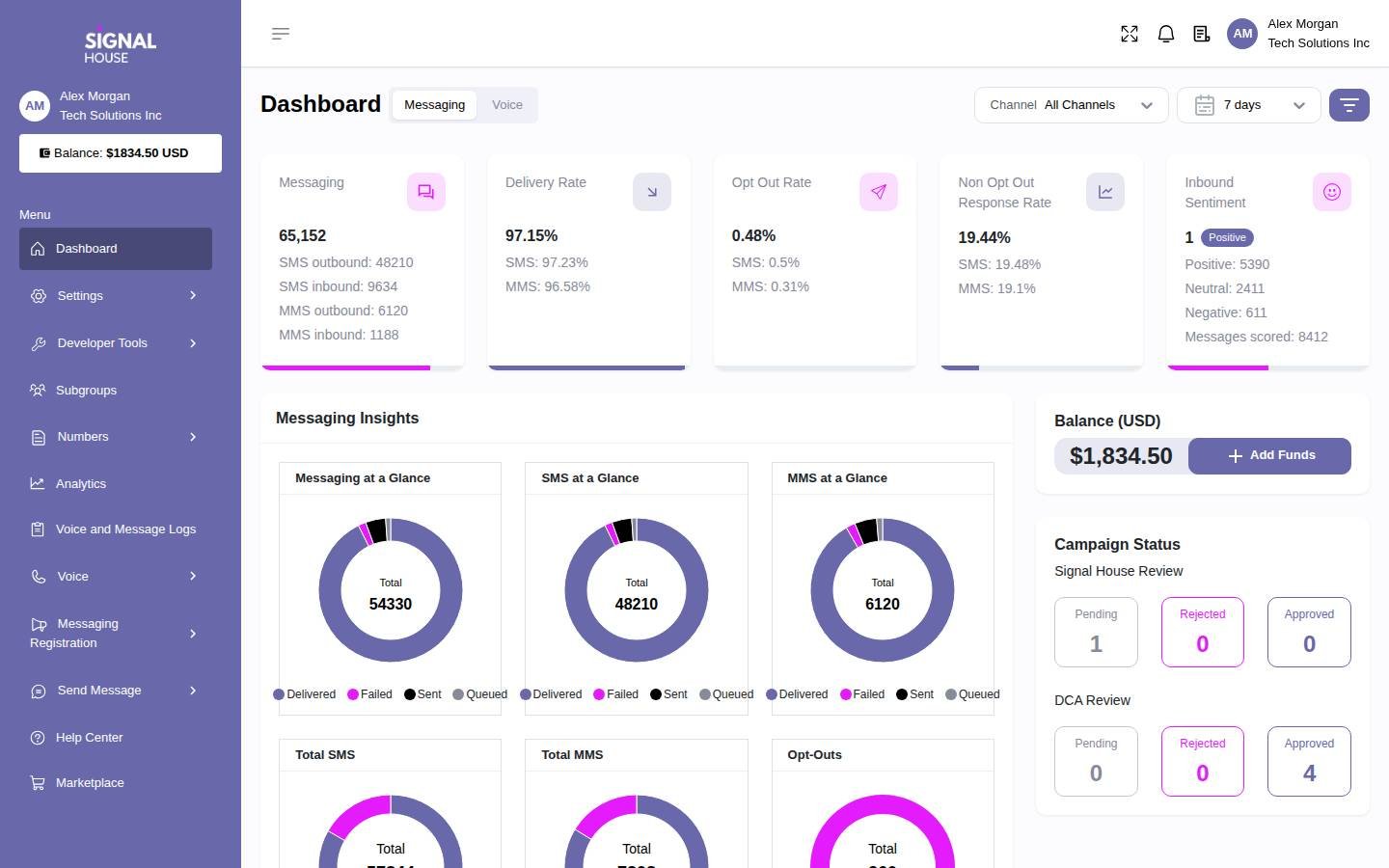
Signal House provides messaging APIs and publishes a selected local outgoing SMS base of $0.0065 per segment, with carrier charges separate. It is worth evaluating when a team wants help establishing the proposed setup. The advertised $25 new-account credit is an evaluation allowance, not an unlimited timed trial or a production-approval guarantee.
The important SaaS API question is the exact customer-management model. Request a demonstration of tenant creation, sender assignment, permissions, usage records and account restrictions. Its documented GoHighLevel integration does not by itself establish equivalent public API functions for an arbitrary SaaS platform. Obtain the complete receiving rate rather than assume a missing component is zero.
Best fit: developers with an implementation owner and eligible traffic that the supplier agrees to support. Main trade-off: the proposed tenant model and complete terms need confirmation. Its traffic policy also needs to fit the actual customer base; a platform relationship is not blanket approval for every campaign category.
2. Twilio: For Documented ISV Onboarding
Twilio is a useful engineering benchmark because its ISV documentation explains account and Messaging Service arrangements for customer traffic. It identifies customer-mapped subaccounts with Messaging Services as the preferred A2P architecture, while identifying unsupported alternatives. This is stronger evidence for a new SaaS platform design than a generic claim that a vendor supports business texting.
The selected US outgoing and incoming SMS base is $0.0083 per segment before carrier and other charges. Assess the required support, numbers and operational features alongside it. Twilio is not the lowest selected base in this comparison, but documented onboarding can reduce uncertainty when the product has many customer senders.
Best fit: engineering teams that can own the integration and benefit from a defined ISV API path. Main trade-off: the complete expense can exceed a low headline forecast. Preserve customer opt-outs during account restructuring; the official onboarding guidance warns that account-level mechanisms do not simply follow every architectural change.
3. Telnyx: For A Lower Selected US Base And Managed-Account Evaluation
Telnyx publishes a selected local sending and receiving SMS base of $0.004 per part, with carrier fees separate. That makes it a relevant cost comparison for a development-owned SaaS application. It does not establish a finished client dashboard, a particular SMS account entitlement or a guaranteed lower invoice for every country.
Its Managed Accounts guide describes subordinate account administration, reporting and billing, but calls the feature limited release for qualifying users. Confirm eligibility before designing the product around it. An account model available to an established manager should not be assumed to appear automatically in every new signup.
Best fit: developers wanting control of their communication workflow and prepared to validate the required account arrangement. Main trade-off: the tenant provisioning and commercial model need an explicit approval path. Demonstrate customer-scoped credentials, sender allocation and usage collection with at least 2 test tenants before accepting the design.
4. TextGrid: For Approved, Cost-Focused API Deployments
TextGrid advertises a standard US outgoing SMS base of $0.0035 per segment, with carrier fees additional. It ties Bird's selected outgoing base in the numeric subset here. The comparison is limited to that component; it is not a universal lowest-cost or most-capable platform award.
Check access before building. Its limitations guide says bulk operations need permission, future-dated API scheduling is unsupported and a Twilio Messaging Service SID cannot be supplied as the sender. GoHighLevel-connected accounts can also have direct API restrictions. Familiar endpoint shapes do not establish full compatibility with another provider's product.
Best fit: an approved application whose needs match the documented feature set. Main trade-off: the platform may need to own scheduling and migration changes itself. Prove the exact send, reply, callback and suppression path under the intended account; a CRM login or an existing key is not sufficient evidence of API permission.
5. Bandwidth: For Infrastructure-Led Procurement
Bandwidth positions its messaging services for embedding into products and publishes a US 10DLC outgoing reference of $0.004 per message. Its wider number and communications infrastructure can be relevant when a platform expects a procurement process around resources, traffic and operational responsibilities rather than a simple self-service checkout.
Confirm the unit definition and complete quotation. The public card uses per-message wording, so the numeric model below explicitly assumes single-part messages. Do not apply that reference to arbitrary multipart content or treat it as an all-in quote. Number availability, account structure, SMS receiving and additional fees remain separate questions.
Best fit: product teams ready to assess communications infrastructure with a supplier. Main trade-off: the complete configuration must be established through the commercial and implementation process. Use the Build evaluation to inspect the relevant API capabilities, then confirm which resources and permissions apply to the proposed production environment.
6. Sinch: For A Current Conversation API Project
Sinch supports a broad communication portfolio, but its old standalone SMS REST documentation is marked end of sale for new business. New integrations are directed to the SMS channel of Conversation API. A developer following an old tutorial should not assume that historical product remains the correct starting point.
Evaluate the current channel configuration, sender requirements and conversation events together. Obtain a quote matching the product and destinations rather than copy a legacy tariff or an unselected calculator value. A shared conversation layer can be useful, but it does not make every channel's sender rules, price or event behavior identical.
Best fit: teams planning a current multichannel integration with an owner for channel-specific implementation. Main trade-off: product-path and account verification come before price comparison. Keep the customer identity, channel identity and sender ownership explicit so the application can route replies without confusing businesses that share the same software.
7. Infobip: For Explicit Multi-Tenant Orchestration
Infobip's CPaaS X documentation is directly relevant to SaaS. It describes applications and entities for organizing customers, scoped keys, resource assignments, customer-level usage and event subscriptions. Evaluate that layer when the product needs repeatable tenant onboarding rather than only a single shared sending credential.
Ask for the exact commercial and operational scope of the intended deployment. Infobip offers channel APIs and broader applications; a price for one does not establish the other. Country, sender, traffic and the platform's required functionality should be part of the quote. No universal starting US tariff is invented here.
Best fit: platforms that need to examine tenant orchestration across communication channels. Main trade-off: implementation and pricing need to match the selected layer. In a pilot, deliberately attempt a cross-tenant record lookup and confirm the configured access boundary, rather than treating a marketing description as proof that the application's own authorization is complete.
8. Bird: For A Current-Platform And Account-Specific Evaluation
Bird's current US page lists local outgoing SMS at $0.0035 per segment and receiving at $0.001, before carrier and other charges. It is a relevant cost comparison, especially where reply volume matters. Verify the exact platform, sender and contract before applying those components to an existing account.
Its account guide distinguishes the older MessageBird Connectivity Platform, Engagement Platform and newer bird.com environment. Existing credits and API keys do not automatically transfer to the newer account. A familiar brand name or matching login email does not make these integrations interchangeable.
Best fit: developers able to establish the current account and implementation path. Main trade-off: legacy guidance and new documentation must not be mixed. Demonstrate the proposed customer organization model, scoped access, event handling and billing before presenting it as a completed multi-customer service inside your product.
Why Plivo Is Not In This New ISV SMS Shortlist
Plivo's current SMS availability documentation says new messaging is provisioned to direct brands through sales and is not currently offered to resellers or ISVs. That makes it unsuitable to recommend here as an ordinary new multi-brand platform option, despite its established APIs and public tariff pages.
A SaaS business sending only its own company notices has a different use case from sending on behalf of customer businesses. An existing approved contract also needs its own assessment. Ask about the exact scenario instead of assuming technical subaccounts or a published rate override the current enrollment restriction.
How To Choose A Multi-Tenant SMS API Architecture
Map each real business to its application identity, sender resources, permissions and commercial responsibility. Those boundaries should survive onboarding, SMS submission, incoming SMS replies, support access and cancellation. A tenant identifier added only to a reporting spreadsheet is not a substitute for enforced application authorization.
| Boundary | Product Responsibility | Evidence To Request |
|---|---|---|
| Customer identity | Map each business separately from employee logins | A documented tenant, account and sender relationship |
| Sender resources | Assign numbers or sender identities to the correct customer | Production approval and usable sender state |
| API credentials | Keep secrets server-side with appropriate scope | Cross-tenant access attempts are rejected |
| Delivery events | Authenticate and attribute each SMS lifecycle update | Valid, repeated and unrelated events handled correctly |
| Incoming communication | Route SMS replies to the correct business and conversation | A reply reaches only the authorized workspace |
| Usage and billing | Allocate parts and resources without mixing customers | Reconciled tenant totals against provider records |
| Offboarding | Revoke access and establish resource ownership | Documented export, release or migration procedure |
Customer-Owned Accounts Versus Platform-Managed Resources
With customer-owned accounts, each business may have a direct provider relationship while the software connects through an approved authorization method. With platform-managed resources, the platform may administer the SMS sending relationship and bill its customers. Confirm the supported arrangement, its contracts and the account permissions before choosing either design.
Neither model removes operating work. Customer-owned accounts need connection and recovery handling. Platform-managed accounts need spending controls, usage allocation and customer support. Define who can release a number or revoke a connection, and how the customer continues operating if it leaves the software.
Separate Business Identity From A User Login
A tenant can have several employees, locations and senders. An employee may also have access to more than 1 customer account. Keep those relationships explicit. Authorize the action against the tenant and resource rather than trust a number or tenant field supplied by the browser.
For example, a support employee investigating a message should see only the customers their role permits. An administrator's ability to see all traffic is not a test of ordinary customer isolation. Review the customer view, support view and internal operating view separately.
Model Sender Onboarding As A Product Journey
Customer onboarding should show what information is needed, which step is incomplete and when sending is permitted. The product should distinguish account creation from sender registration and campaign approval. A successful payment or API key does not establish that a new sender can immediately transmit production SMS traffic.
Use the API provider's current registration process for the destination and use case. Twilio's ISV onboarding guide is a useful concrete reference for US 10DLC architecture. It should not be generalized into a promise that other countries, sender types or suppliers use the same objects and approval steps.
Assign Ownership And Spending Limits Per Customer
Record who is allowed to send, which traffic the platform supports and who pays for excess use. A single tenant can otherwise consume a disproportionate share of a shared balance or queue. Show customers understandable usage information without exposing another business's content or financial activity.
A technical usage ceiling and a commercial allowance are different controls. A plan might include an allocation while the application has its own safety threshold. Explain what happens at each boundary and how an authorized person can review it without silently sending unexpected traffic.
Delivery Webhooks, Replies And Application Reliability
The API send response begins the message lifecycle; it does not prove the recipient received or acted on the text. A useful SMS API integration records the original business event, provider reference, tenant and later SMS delivery state. Incoming API events need an equally clear path back to the correct business workflow.
Authenticate Events And Enforce Tenant Routing
Use the provider's documented API request-validation method and a secure API endpoint. A callback containing a plausible message identifier is not sufficient authorization. The application should also verify that the referenced account, sender and tenant relationship match its records before updating customer-visible information.
Do not expose a platform-wide secret in a customer's browser or mobile app. Keep credentials in the appropriate server-side environment and grant narrower access where the provider supports it. Rotation should have a planned handover so fixing a credential does not unexpectedly stop unrelated customers.
Handle Repeated And Out-Of-Order Events
A provider can send more than 1 legitimate event for an SMS message. Your SaaS event model should distinguish repeated delivery of the same event from a later state update. Deduplicating every callback solely by message identifier can discard meaningful progress; accepting every event without reconciliation can create duplicate staff actions.
Preserve the event identity, type and relevant ordering information available from the chosen provider. Process an event once for the business action it represents. Keep enough history to investigate a state discrepancy without allowing an old callback to make a completed outcome appear newly pending.
Design Retries Around Uncertain Outcomes
An application API timeout does not always mean the provider rejected the request. Blindly repeating a batch can create duplicate customer SMS notifications. Record API submission attempts and reconcile available provider references before retrying uncertain work. Use idempotency mechanisms only where the specific API endpoint documents them.
SMS delivery failure also needs classification. An opted-out recipient, invalid number and temporary network issue are different cases. The correct action may be stopping, correcting setup, waiting or asking staff to review another permitted contact method. Automatic repetition is not a universal recovery strategy.
Give Replies A Real Business Destination
For two-way SMS messaging, test which tenant receives the reply and which employee sees it. A shared receiver number requires a deliberate routing design; a dedicated sender still needs correct application associations. Confirm how the product handles an incoming SMS message that cannot be matched confidently.
An SMS appointment reply should not vanish into a technical log while the customer expects help. Connect the event to the business's operational queue, preserve context and make unresolved work visible. A successful incoming webhook is only the beginning of that customer-service process.
SMS API Pricing For SaaS: Compare More Than The Sending Base
A complete budget includes both directions, billable parts, numbers, registration, carrier charges, support and the platform's own operation. Selected US rates provide a useful starting comparison. They cannot establish a universal cheapest service for different countries, contract types or customer mixes.
| Provider | Selected Public Unit | Modelled Outgoing Component | Excluded Or Unresolved |
|---|---|---|---|
| TextGrid | $0.0035/segment | $35 | Carrier fees, resources and production API eligibility |
| Bird | $0.0035/segment | $35 | Carrier fees, sender resources and correct account environment |
| Telnyx | $0.004/part | $40 | Carrier fees, resources and managed-account eligibility |
| Bandwidth | $0.004/message | $40 for 10,000 single-part messages | Carrier fees and complete account quote; do not extend to arbitrary multipart content |
| Signal House | $0.0065/segment | $65 | Carrier fees, resources and incoming platform base quote |
| Twilio | $0.0083/segment | $83 | Carrier fees, registration, resources and other applicable charges |
| Sinch | Current SMS channel quote | Not modelled | Match Conversation API product, country and account terms |
| Infobip | Configuration-specific quote | Not modelled | Match SMS destinations and required CPaaS X setup |
Which Providers Have The Lowest Selected Base?
TextGrid and Bird tie at $35 for 10,000 selected outgoing SMS parts in this subset. Telnyx is $40, Signal House $65 and Twilio $83. These are transmission components before other charges. TextGrid needs approved API access, and Bird's rates must match the current account environment.
Bandwidth's displayed $0.004 per-message component also produces $40 for 10,000 single-part messages under the stated assumption. Its multipart treatment and complete production agreement still require confirmation. Sinch and Infobip are not assigned invented comparable subtotals for unspecified new configurations.
Incoming Usage Can Change The Comparison
At the selected components, 10,000 outgoing plus 2,000 incoming parts total $37 for Bird, $48 for Telnyx and $99.60 for Twilio. Carrier fees and other costs remain excluded. Ask Signal House for the complete incoming SMS platform component rather than infer it from a carrier table.
Use the actual conversation pattern. A notification-only product and an employee conversation tool can have very different receiving volumes. A lower outgoing rate may not translate into the best overall SMS budget when replies, number inventory and customer support differ.
Count Message Parts After Personalization
Ordinary GSM-7 content commonly fits 160 units in a single part and 153 per part once concatenated. Unicode commonly uses 70 and 67, with route-specific exceptions. Personalization and appended wording can change the final count. Inspect the rendered SMS message rather than budget only from a short template.
If 10,000 visible SMS messages each require 2 parts, the outbound quantity becomes 20,000. At Signal House's selected local base that component is $130, rather than $65. This is a unit-counting example, not a statement that every template or provider route uses the same segmentation outcome.
Model Per-Tenant Resources And Margin
A SaaS platform with 40 customers each generating 500 single-part outgoing SMS messages has 20,000 parts to allocate. It may also need resources and registration for each business, rather than 1 shared sender for all customers. Obtain the legitimate setup before applying a low pooled SMS transport forecast.
For illustration, a retail charge of $0.02 on an expense component of $0.008 creates a $0.012 contribution before other costs. That is a 60% margin on that retail component and a 150% markup on that expense component. Neither figure establishes net profit after support, fees and fixed overhead.
Include Engineering And Migration Expense
An SMS component saving of $50 per month takes 12 months to recover a hypothetical $600 migration expense, before ongoing changes. If added maintenance reduces the net saving to $10 monthly, the payback becomes 60 months. These are planning examples rather than provider quotes or measured migration outcomes.
Keep platform API pricing separate from a supplier's CRM integration package. A connection with its own monthly plan and rates may be a different purchase. Compare equivalent production configurations and customer responsibilities before announcing a saving to the SaaS product team.
Transactional Notifications, Two-Way Messaging And Verification
Not every short message belongs to the same product design. An order alert, an employee conversation and a sign-in challenge have different lifecycle requirements. Choose the relevant API or service and quote its actual billing basis instead of treating a raw API send endpoint as a complete solution for every case.
Product-Owned Notifications
For a software application's own SMS alerts, define which events justify communication and when they expire. A delayed reminder can become misleading after the customer has already completed the task. The SaaS application needs a way to cancel or withhold obsolete work according to the supported sending model.
Rate a pilot on the correctness of the SMS notification and its operational outcome, not only how quickly an API send request succeeds. Include a duplicate business event, a changed appointment and an unavailable destination. These cases reveal whether the product is ready for real customer activity.
Customer Businesses Sending To Their Users
A platform enabling customer businesses to send SMS needs an onboarding and oversight process for those businesses. Record the relevant sender identity, supported use case, consent process and support contact. A single account approval for the SaaS company should not be treated as permission for unrelated customers' traffic.
Make any customer-visible SMS sending limits understandable. If a tenant must complete another approval step, say so directly. Product users should not discover through unexplained failed sends that a required registration or resource assignment was never finished.
OTP And Authentication Services
A raw SMS API transports content; it does not automatically supply a complete verification lifecycle. Compare a dedicated verification product when the application needs code generation, expiry, attempt controls and fraud-related features. Quote that service separately from a basic sending component.
Twilio Verify is one relevant documented example, and several shortlisted providers have verification offerings to evaluate. Avoid treating account verification traffic as unlimited free testing. Set application-side spending and abuse controls so a public endpoint cannot generate unbounded paid SMS requests.
Security, Throughput And Production Operations
The SaaS platform needs a stable operating model around the messaging supplier. Define the limits, the monitoring and who investigates failures. Customer feedback and advertised scale are useful discovery signals, but they do not establish your account's permitted SMS throughput, event behavior or support resolution time.
Protect Shared Capacity From A Noisy Tenant
Apply appropriate per-customer SMS queues and limits in the application. One campaign should not indefinitely delay another customer's time-sensitive notice. Confirm whether the provider's limits are account-wide, sender-specific or another unit, then map the SaaS product's scheduling and capacity model to those boundaries.
For example, 6,000 billable SMS parts submitted at a permitted rate of 10 parts per second require at least 600 seconds, or 10 minutes, just for submission at that rate. This is capacity arithmetic, not a provider throughput entitlement or a promise of handset delivery within that time.
Monitor Useful States And Spending
Track accepted work, rejected work, pending delivery, reported outcomes and incoming replies with the tenant context intact. Alert on an unusual change in volume or failures. A system that reports only successful HTTP responses can miss a large downstream SMS problem.
Monitor cost as well as SMS message quantity. A destination change or longer rendered content can increase spending without an obvious increase in visible messages. Give operators enough information to identify the responsible workload and act without exposing unrelated customer data.
Define Support And Incident Ownership
Confirm who the platform can contact, which support arrangement is included and what an escalation requires. Availability is different from a guaranteed resolution. Agree which issues belong to the supplier, the application team and a customer administrator before the first live SMS incident.
Maintain a short incident record with affected identifiers and scope. A problem isolated to 1 sender needs a different response from an application-wide credential failure. Useful diagnostics can prevent a support discussion from becoming an unstructured exchange of private customer screenshots.
How To Test And Integrate An SMS API For SaaS
Use a controlled pilot that includes at least 2 tenants. A single successful SMS message proves little about isolation, customer attribution or accounting. Build the first evaluation around a complete business journey and its failure cases rather than the maximum number of messages a SMS trial allows.
| Pilot Case | What To Inspect | Acceptance Evidence |
|---|---|---|
| 2 separate customer businesses | Sender assignment, account scope and customer views | No cross-customer exposure or action |
| Successful outgoing SMS | Business event, rendered content and provider reference | The intended approved sender and tenant are recorded |
| Incoming reply | Recipient number, conversation context and employee access | The response reaches the correct customer workspace |
| Repeated webhook | Event identity and application state | A duplicate event does not repeat a staff action |
| Later lifecycle event | Distinct event versus repeated delivery | Valid progress is retained without inventing handset behavior |
| Uncertain request result | Timeout, provider identifier and reconciliation | The application does not blindly create duplicate paid sends |
| Opt-out and offboarding | Restrictions, access revocation and resource ownership | Preferences and boundaries remain effective |
| Usage reconciliation | Direction, parts, tenant and resource fees | A traceable forecast matches the tested billing scope |
A Practical Acceptance Sequence
- Confirm the supplier accepts the platform and intended customer traffic.
- Document the customer, account and sender model before creating production resources.
- Configure server-side credentials and the provider's event-validation method.
- Onboard 2 controlled tenants and assign the relevant resources.
- Send, receive and inspect events under each customer's permissions.
- Test opt-outs, failed submissions, duplicate events and uncertain request outcomes.
- Reconcile usage and the selected charges by customer.
- Document support, offboarding and migration limitations before rollout.
Move A Small Workload Before A Full Migration
Identify the data and resources that can move, those that require a new approval and those that must remain with the original provider. Preserve customer preferences during the transition. A number port, an application credential and a sender campaign registration are different objects and may have different processes.
Keep the original path available where appropriate until the new workflow meets its acceptance criteria. Avoid sending the same real customer event through both paths accidentally. A rollback should restore operation without re-enrolling everyone or discarding completed business actions.
Keep A Provider Boundary In Your Application
Separate business intent from supplier-specific API requests and events. The product might request an appointment reminder while a provider API adapter handles its concrete sender and payload. This can make future changes easier, but it does not remove differences in features, registration, pricing or callback semantics.
Our guide to Twilio alternatives and competitors helps distinguish product categories. A familiar endpoint or SDK is a starting point for compatibility testing, not proof that a replacement can execute every feature of the existing deployment.
Frequently Asked Questions
What Is The Best SMS API For SaaS Platforms?
The best choice depends on the customer model. Twilio is a strong starting comparison for documented ISV onboarding, and Infobip CPaaS X for explicit tenant orchestration. Compare Signal House for an assisted eligible setup and Telnyx, TextGrid or Bird for their selected economics and account fit.
Which SMS API Is Cheapest?
TextGrid and Bird share the lowest selected outgoing US base in the matched subset here at $0.0035 per segment. That does not establish the lowest full invoice. Confirm production access, current account environment, incoming usage, carrier fees, resources and support for the actual workload.
Can A SaaS Platform Use One Sender For Every Customer?
Do not assume that is appropriate or permitted. The design must match the sender identity, use case, customer ownership and destination requirements. A shared SMS number also needs correct reply routing. Confirm the supported model before pooling unrelated businesses behind a single sender.
Is Plivo Suitable For A New Multi-Brand SMS Platform?
Its current SMS availability page excludes new reseller and ISV messaging onboarding. A direct-brand notice service or an existing agreement needs separate confirmation. Technical subaccounts and historical documentation do not override the current enrollment rule.
Are Subaccounts The Same As Complete Tenant Isolation?
No. Subaccounts can help organize resources, but the application must still enforce authorization, sender ownership and customer-scoped events. Test the actual permissions and data paths. Do not assume a tag or reporting filter prevents cross-customer access.
Can I Use A Messaging API For OTP Verification?
Yes, raw transport can deliver a code, but a complete verification process requires additional lifecycle and abuse controls. Evaluate a dedicated verification service when those capabilities matter, and compare its own pricing rather than using the raw sending rate as a complete authentication budget.
Does A Successful Send Response Mean The Text Was Delivered?
No. The request can be accepted before a later carrier result is available. Track the provider's documented lifecycle and distinguish acceptance, delivery reporting and the user's action. A delivery receipt itself does not prove that the customer read the text or completed the intended task.
Is Signal House A Drop-In Replacement For Twilio?
Do not assume a complete drop-in replacement. Confirm the exact endpoints, sender onboarding, customer model, events and required API features. Its selected SMS rate and implementation assistance can make it worth evaluating, but they do not establish compatibility with every Twilio product or existing application.
Do Telnyx Managed Accounts Come With Every Signup?
No universal entitlement should be assumed. Its current Managed Accounts guide describes limited-release access for qualifying users. Confirm eligibility and the proposed billing arrangement before making that feature essential to your product architecture.
What Should A Production Pilot Prove?
It should prove eligible onboarding, correct tenant attribution, sending, replies, event handling and reconciled usage under the intended account. Include failure and duplicate scenarios, then document support and offboarding. Trial access alone is not proof that the complete production service is approved.
Choose An SMS API That Fits The Product's Customer Model
Choose the provider around the way customers join, send, receive and pay. Signal House can merit an assisted evaluation; Twilio and Infobip provide concrete platform architecture references; Telnyx, TextGrid and Bird offer useful selected price comparisons. Bandwidth and Sinch deserve configuration-specific procurement and product-path review.
Keep eligibility, enforced tenant boundaries and complete cost ahead of a headline ranking. A working pilot with clear ownership is more useful than a low base rate or a feature that the proposed account cannot access. Select the option the engineering and operations teams can maintain as customer SMS activity grows.
Customer Feedback On SMS API Providers
G2 customer feedback on SMS providers can help shape evaluation questions. Signal House reviewer Ismail A. values onboarding guidance and support. Twilio reviewer Midhun N. likes the development experience while noting pricing and configuration effort; that review is marked incentivized. These are individual opinions, not measured proof of the proposed SaaS deployment.
Use feedback to ask better questions about setup, diagnostics and support ownership. The ratings represent the named products across different workloads and periods. They do not prove the specific API customer architecture, permission model or account agreement required by your application.
Affiliate Disclosure: We may earn a commission through Signal House affiliate links in this guide. Editorial order and customer ratings do not establish a universal lowest price or independently tested delivery winner.