
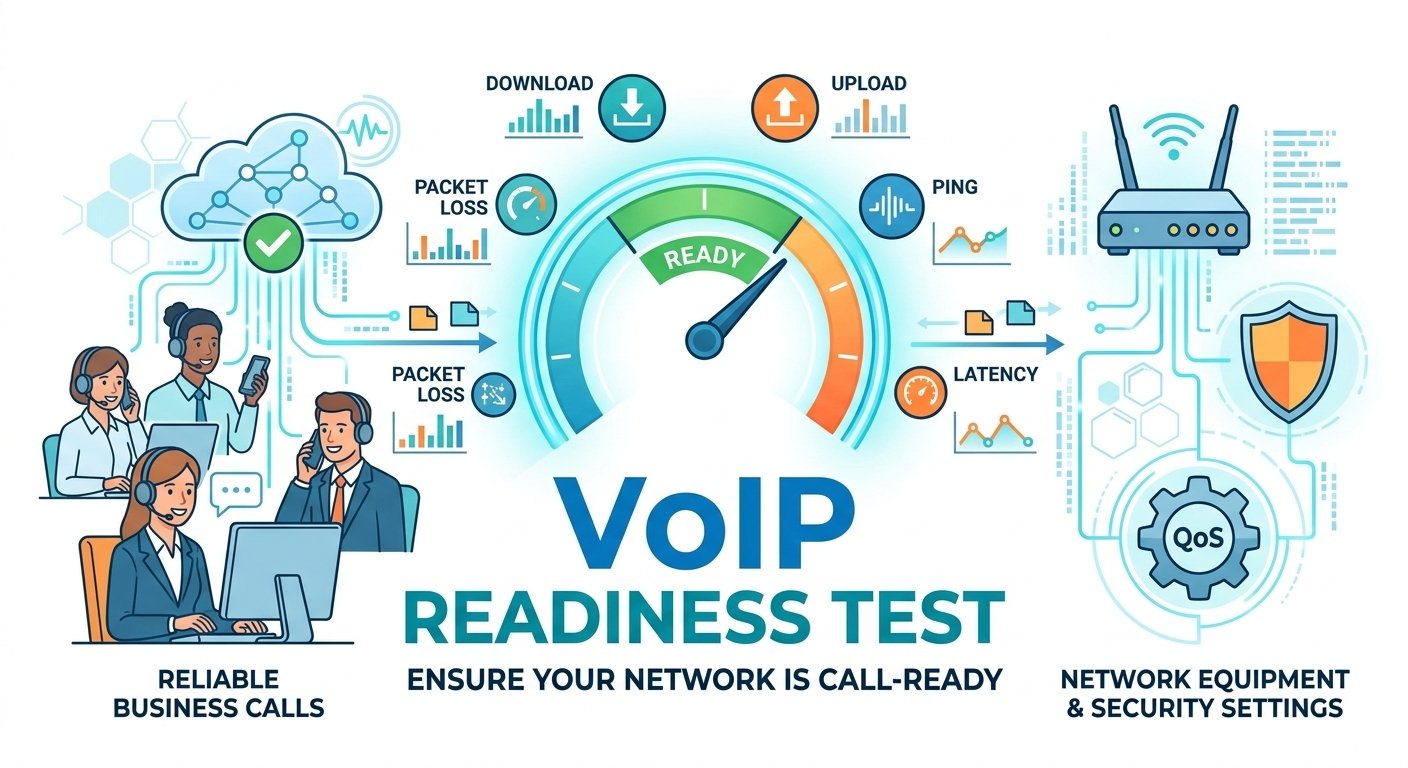
A VoIP readiness test checks whether your internet connection, network equipment, and security settings can support reliable business phone calls. It measures upload and download capacity, latency, ping, jitter, packet loss, and Quality of Service settings before you deploy or expand an internet-based phone system. Running a VoIP readiness test during normal working hours helps identify bandwidth bottlenecks, unstable Wi-Fi, firewall issues, and call-capacity limits. With the right results, a business can improve its network before customers or employees experience dropped calls, delay, echo, or choppy audio.
What is a VoIP readiness Test?
A voip readiness test functions as an automated evaluation tool examining current internet capacity for digital telephony integration. Enterprises utilize specific voice over ip speed test platforms to simulate real-time audio traffic across existing networks. This voip speed test replicates data packet movement between internal servers and external destinations perfectly. Analysts rely on the resulting voip stats to confirm basic compatibility before transitioning to advanced digital telecommunications setups entirely.
Executing this network readiness test highlights potential structural flaws within office hardware configurations immediately. A reliable voip test tool accurately measures essential factors such as upload limits and transmission delays. Managers review these voip quality tests to decide whether hardware upgrades remain necessary before full software deployment. Implementing a proper voip testing framework guarantees seamless internal collaboration and excellent customer interactions from day one.
Why Should I Do a VoIP readiness Test?
Initiating a voip readiness test prevents severe communication failures stemming from inadequate local infrastructure. Inadequate connections cause frustrating audio cutouts, forcing administrators to constantly check network stability during peak operational hours. According to the International Telecommunication Union (ITU) standard G.114 specification, transmitting audio data exceeding 150 milliseconds creates unbearable conversational lag. Running a preliminary voip test speed analysis helps circumvent these precise delay-related disasters entirely.
Completing a viop test provides actionable insights into expected telecommunication performance under heavy workloads. Using a sophisticated voip tester helps evaluate the telecommunications company century link on voip systems rapidly and efficiently. Organizations regularly check voip quality to guarantee smooth external communications, preventing clients from experiencing fragmented dialogue. Consistently utilizing a dedicated connection bandwidth test ensures companies maximize their technological investments without suffering unexpected downtime.
Why You Need a Strong VoIP Connection
-
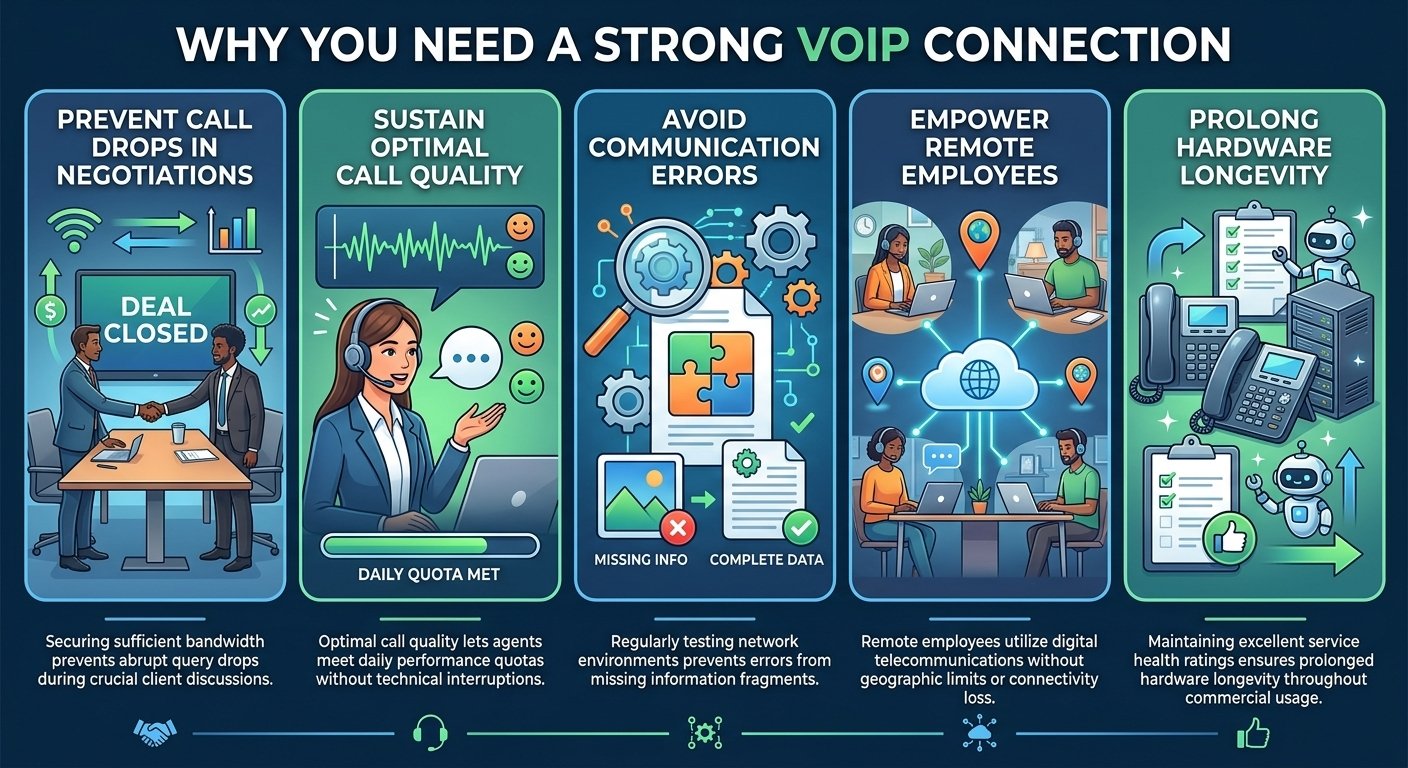
Securing sufficient bandwidth for voip prevents incoming queries from dropping abruptly during important client negotiations.
-
Sustaining optimal voip call quality guarantees agents can meet daily performance quotas without experiencing technical interruptions.
-
You must test telephone and network environments regularly to prevent costly communication errors caused by missing informational fragments.
-
Empowering remote employees to utilize digital telecommunications resources without experiencing geographic limitations or continuous connectivity loss.
-
Maintaining an excellent voip phone service health rating ensures prolonged hardware longevity throughout continuous daily commercial usage.
The Meaning of Different Network Speeds
Understanding download and upload metrics remains vital when attempting to evaluate network connectivity capabilities. Download velocity represents how rapidly local devices pull external data inward from remote internet sources. Conversely, upload pace indicates how fast internal hardware pushes outbound voice packets toward receiving endpoints. Both figures significantly influence calling speed and overall audio clarity during live business discussions.
| Concurrent calls | Approximate bandwidth needed |
|---|---|
| 1 call | 100 Kbps |
| 5 calls | 500 Kbps |
| 10 calls | 1 Mbps |
| 15 calls | 1.5 Mbps |
| 20 calls | 2 Mbps |
Executing a voip readiness test often reveals stark differences between inbound and outbound transmission rates. Typical broadband services deliver massive downloading capabilities while severely restricting uploading potential. A noticeable bottleneck occurs when an organization attempts to send heavy outgoing voice traffic through a constrained uplink channel. Therefore, utilizing an ip address speed check specifically focused on upload capacity remains critically important to guarantee smooth outbound audio.
VoIP Network Quality Parameters
Professionals must evaluate several distinct operational metrics to guarantee excellent voice over ip quality test outcomes. Evaluating the telecommunications company get voip on networking requires deep analysis of hidden structural factors affecting audio streams. Every successful pre call test carefully examines specific indicators to predict future telecommunication stability accurately.
1. Bandwidth
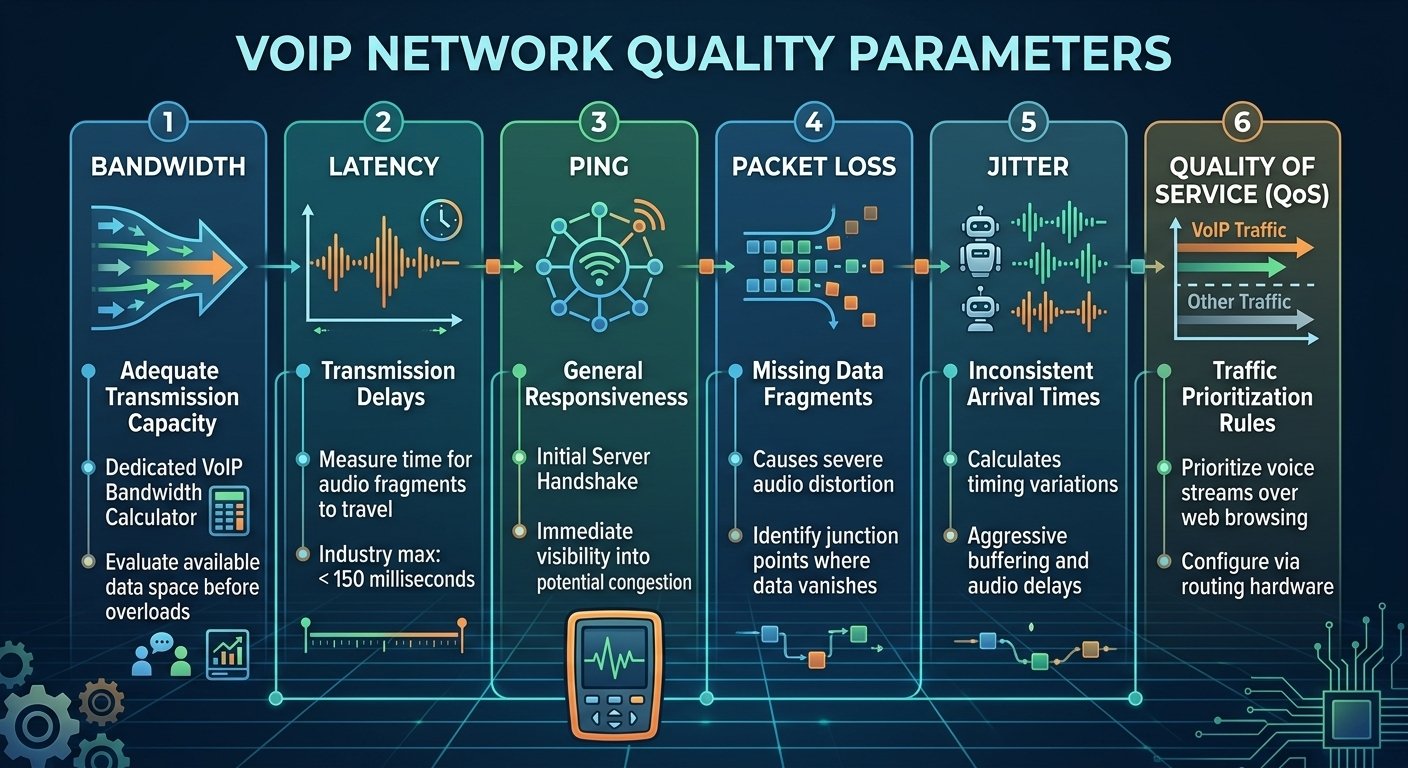
Securing adequate transmission capacity stands as the foundational requirement for any successful telecommunications deployment. Using a dedicated voip bandwidth calculator helps administrators determine exact capacity needs based on total user counts. Accurately projecting future usage prevents sudden communication collapses during rapid organizational growth phases. A fundamental voip readiness test evaluates how much data space exists before system overloads occur. Network managers frequently monitor voip bandwidth usage to adjust available resources before audio streams degrade. Relying on a reliable net work test ensures every simultaneous conversation receives enough data space.
2. Latency
Experiencing high transmission delays creates awkward conversational gaps that frustrate both employees and customers. A standard voip latency test measures the exact time required for audio fragments to cross geographical distances. Industry experts uniformly agree that the maximum latency for voip should never exceed 150 milliseconds to maintain natural dialogue pacing. Minimizing latency for voip preserves the illusion of instantaneous face-to-face communication across vast physical distances.
Conducting a speed and latency test highlights routing inefficiencies between office hardware and remote servers. Physical distance greatly impacts latency in voip, meaning cross-country discussions inherently experience slightly longer delivery times. Reducing latency voip metrics requires eliminating unnecessary hardware bottlenecks scattered throughout the local routing environment entirely.
3. Ping
Monitoring ping times provides immediate visibility into general responsiveness across established digital pathways. The ping measurement calculates the exact millisecond delay involved in establishing initial server handshakes. Fast ping responses indicate healthy routing infrastructure, whereas sluggish times point toward severe congestion issues. Network testing tools utilize ping to simulate the initial contact phase of digital voice handshakes.
Utilizing a what is my ip speed check tool usually displays ping alongside traditional bandwidth numbers. Maintaining an exceptionally low ping guarantees instantaneous audio delivery during complex multiparty conferencing sessions. Network technicians rely heavily on continuous ping monitoring to isolate transient routing disturbances before they escalate into major outages.
4. Packet Loss
Missing data fragments cause severe audio distortion, leaving callers struggling to comprehend fragmented sentences. Utilizing a dedicated packet loss test website reveals exactly how much information disappears during active transit. Even a minor loss rate completely destroys phone call quality test results, rendering professional conversations impossible. Finding the source of dropped packets remains the top priority during network troubleshooting sessions.
Wireless environments historically generate higher loss rates compared to stable physical ethernet connections. Performing a strict voip readiness test identifies precise junction points where audio data silently vanishes. Addressing these hardware faults eliminates annoying digital artifacts and restores smooth telecommunications functionality entirely.
5. Jitter
Inconsistent packet arrival times create a phenomenon known as jitter, which severely disrupts steady audio playback. A specialized voip jitter test calculates the timing variations between individual incoming data fragments. Elevated variations force receiving systems to buffer audio streams aggressively, creating noticeable playback delays. Controlling these erratic delivery schedules prevents robotic or chopped audio symptoms.
Deploying high-grade routing equipment typically smooths out erratic arrival patterns efficiently. Keeping jitter variations minimal remains an absolute voip latency requirements standard for modern business environments. Consistent delivery pacing ensures smooth audio reconstruction, allowing listeners to hear perfectly natural voice tones continuously.
6. Quality of Service (QoS)
Implementing strict traffic prioritization rules guarantees telecommunication applications receive preferential treatment over standard browsing activities. A proper lan qos test confirms whether routing hardware correctly identifies and prioritizes active voice streams. Establishing intelligent voip quality of service policies prevents heavy file downloads from suffocating delicate audio channels. Properly executed qos test procedures eliminate sudden audio drops during heavy office data usage.
Configuring QoS properly requires administrative access to central office routing hardware interfaces. Professionals performing a thorough voip readiness test always verify these prioritization settings before concluding their assessments. Proper configuration ensures seamless volte audio testing results and pristine voice clarity regardless of surrounding network congestion.
Why VoIP Quality Testing Matters
Ignoring underlying infrastructure flaws inevitably leads to disastrous external interactions and severe reputational damage. According to Vonage’s 2024 Global Customer Engagement Report, 33% of businesses expect to increase their mobile phone call volume soon. Fulfilling this expansion requires executing rigorous voip testing services to accommodate increased traffic volumes securely. Regular network tests provide the empirical data needed to scale communication frameworks successfully.
Consistent evaluation via dedicated voip network monitoring tools prevents minor routing anomalies from becoming major communication blockages. Administrators rely on accurate feedback to justify purchasing advanced networking equipment securely. When you consider that 74% of customers are likely to take their business elsewhere after one poor interaction, it’s clear that your business can’t afford to ignore these issues. In other words: Every experience matters, so make sure every phone call counts.
Checking Your Firewall
Security barriers act as essential gatekeepers protecting sensitive corporate data from malicious external threats. However, aggressively configured security gateways often misidentify legitimate voice streams as suspicious data, blocking them entirely. Evaluating the telecommunications company get voip on cox business frameworks reveals that overly restrictive firewalls frequently cause unexplained call drops. Properly configured firewalls differentiate between dangerous intrusions and harmless voice packets.
Executing a comprehensive voip readiness test highlights specific security policies interfering with essential communication protocols. Administrators must carefully adjust security parameters to allow uninterrupted audio transit without compromising internal safety. Balancing robust protection with seamless voip performance requires meticulous configuration and continuous network analysis.
-
Firewall Vulnerabilities
Opening multiple access ports simultaneously exposes internal digital infrastructure to potential external exploitation. Executing a proper voip readiness test alongside thorough voip qa testing helps locate unnecessary openings that hackers might utilize to penetrate local systems. Identifying these specific vulnerabilities ensures organizations maintain strict security postures while operating advanced telephony solutions. Administrators rely on these insights to harden their defensive perimeters effectively against modern cyber threats.
Closing unused pathways hardens the protective perimeter against unauthorized data extraction attempts safely. Institutions that evaluate the telecommunications company get voip on edu networks must continuously audit these digital gateways perfectly. Securing these vulnerabilities prevents sophisticated digital attacks from compromising vital corporate communications.
-
Open Port Tests
Verifying active access points confirms that designated audio traffic channels remain clear of digital obstructions. Specialized tools scan internal gateways to ensure required telephony ports remain correctly accessible. Blocked ports instantly prevent incoming connections, making it impossible to receive external client inquiries. Confirming port availability guarantees external voice traffic reaches internal destination phones instantly.
Utilizing an advanced call tester confirms successful bi-directional data flow through newly configured security openings. Accurate open port verification represents a critical step within any professional voip readiness test deployment. Correctly mapping these ports aligns internal routing protocols with external provider requirements flawlessly.
Read More: How To Silence Unknown Caller iPhone: A Complete Guide
Conclusion
Establishing a flawless digital communication environment demands proactive infrastructure analysis and continuous performance monitoring. Running a detailed voip readiness test empowers organizations to identify hidden structural bottlenecks before they impact daily operations. By diligently evaluating bandwidth, managing latency, and configuring firewalls correctly, businesses can guarantee pristine audio clarity continuously. These proactive measures ultimately save tremendous amounts of capital by preventing catastrophic telecommunication failures. Upgrading enterprise telecommunications should never involve blind guesswork or crossing fingers. Regularly employing a reliable voip readiness test remains the most effective strategy for ensuring robust, uninterrupted, and highly professional conversational experiences across all digital channels securely.
FAQs
-
What is a VoIP readiness test?
A VoIP readiness test evaluates whether your internet connection, local network, and security configuration can reliably support internet phone calls. It checks measures such as speed, available bandwidth, latency, ping, packet loss, jitter, and QoS.
-
What is the difference between a standard speed test and a VoIP test?
A standard speed test mainly measures upload and download rates. A VoIP test evaluates those speeds alongside call-specific factors such as jitter, packet loss, ping, latency, and voice-traffic handling, giving a more useful forecast of phone call quality.
-
Can I run a VoIP test over a Wi-Fi connection?
Yes, and you should test the same Wi-Fi connection used for calls. Also run a wired Ethernet test if possible. Comparing both results helps determine whether wireless interference, signal strength, or congestion is causing the problem.
-
How do I fix a failing VoIP test result?
Start by connecting devices through Ethernet, restarting the router, stopping heavy downloads, and testing again. If issues continue, enable QoS, inspect cables and hardware, update router firmware, and provide the results to your ISP or VoIP provider for further diagnosis.
-
What is acceptable latency for VoIP?
Low and stable latency is best for natural conversation. Delays become noticeable as latency rises, especially when there is also jitter or packet loss. Test at different times and aim for consistently responsive performance rather than relying on one reading.
-
How much bandwidth does VoIP use per call?
A common planning estimate is around 100 Kbps per simultaneous call, but actual usage depends on the codec, phone platform, encryption, and network overhead. Add extra capacity for cloud applications, video meetings, browsing, and traffic spikes.
-
Why does my VoIP call have choppy audio?
Choppy sound is often caused by high jitter, packet loss, unstable Wi-Fi, congestion, or insufficient bandwidth. A voip call quality test can identify which measurement is outside a healthy range.
-
Does QoS improve VoIP call quality?
QoS can improve reliability by prioritizing voice packets when a network is busy. It does not increase the size of the internet connection, so businesses with insufficient capacity may still need a faster or more balanced service plan.
-
Should remote employees test their home internet for VoIP?
Yes. Remote agents should run a voice over IP test from their regular work location, ideally during their expected working hours. This helps identify home Wi-Fi, router, bandwidth, or ISP problems before they affect customer calls.