
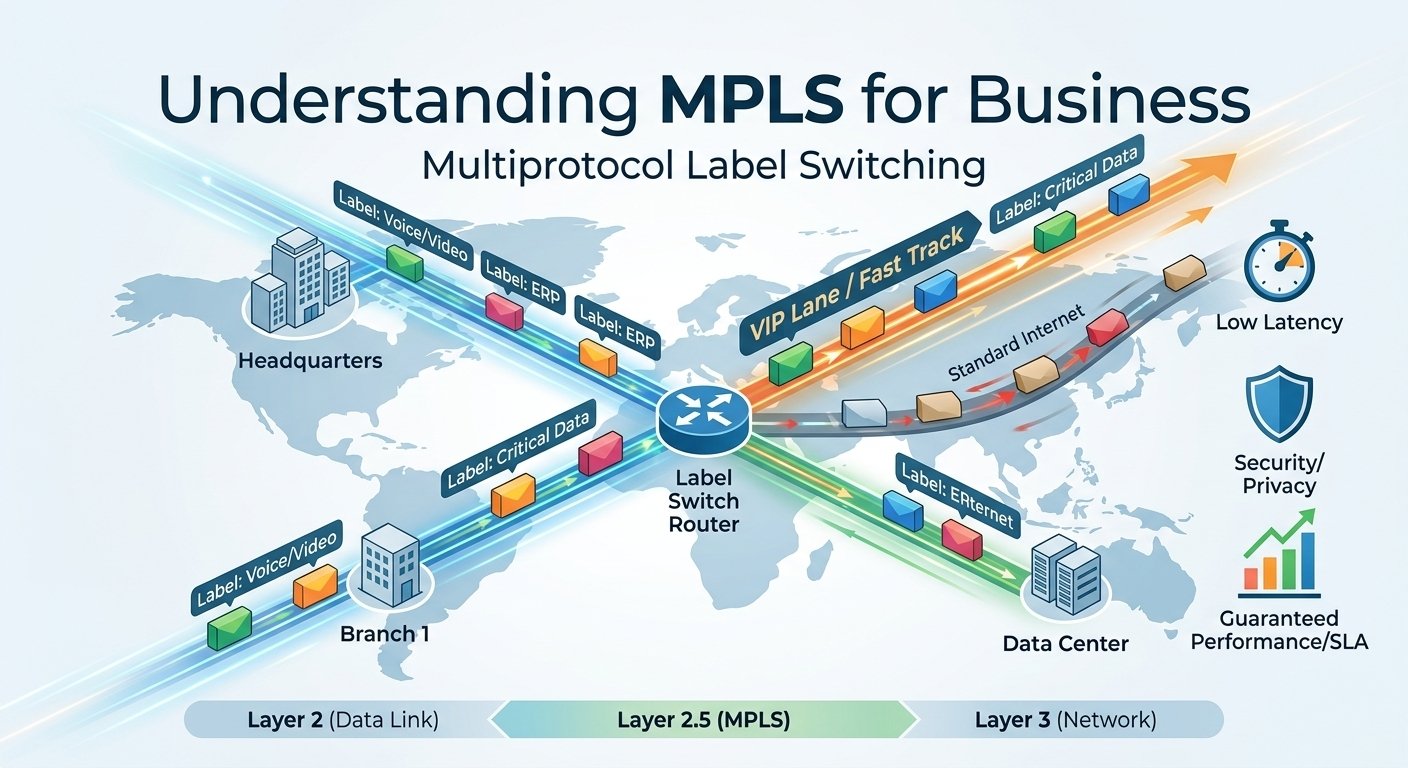
Multiprotocol Label Switching (MPLS) is a specialized routing technique used in high-performance telecommunications networks. It directs data from one network node to the next based on short path labels rather than long network addresses, effectively avoiding complex lookups in a routing table.
Operating at a layer that sits between traditional Layer 2 (Data Link) and Layer 3 (Network), it is often called a Layer 2.5 protocol. This technology ensures that time-sensitive applications like voice and video receive priority, providing businesses with a reliable, private-like connection that guarantees consistent performance and high-speed data transfer across various locations.
What Is MPLS?
Multiprotocol Label Switching is an ultra-reliable, premium-grade, IP-connected bandwidth solution that helps organizations build robust private networks. This technology has served as a bedrock of corporate networking for more than twenty-five years, proving its longevity in an ever-changing digital landscape. In standard IP routing, packets of data contain no information beyond the target destination IP address. Consequently, every router along a packet’s journey must make an independent forwarding decision based on the network-layer header, which can lead to inefficiencies.
The mpls meaning in networking is best understood as a way to streamline this process. By using labels to make forwarding decisions, the system avoids the need for routers to reference large in-memory routing tables at every hop. This efficiency is vital for modern enterprises that rely on real-time communications. While the technology is decades old, it remains a preferred choice for companies that require guaranteed uptime and predictable latency for their mission-critical applications.
How Does MPLS Work?
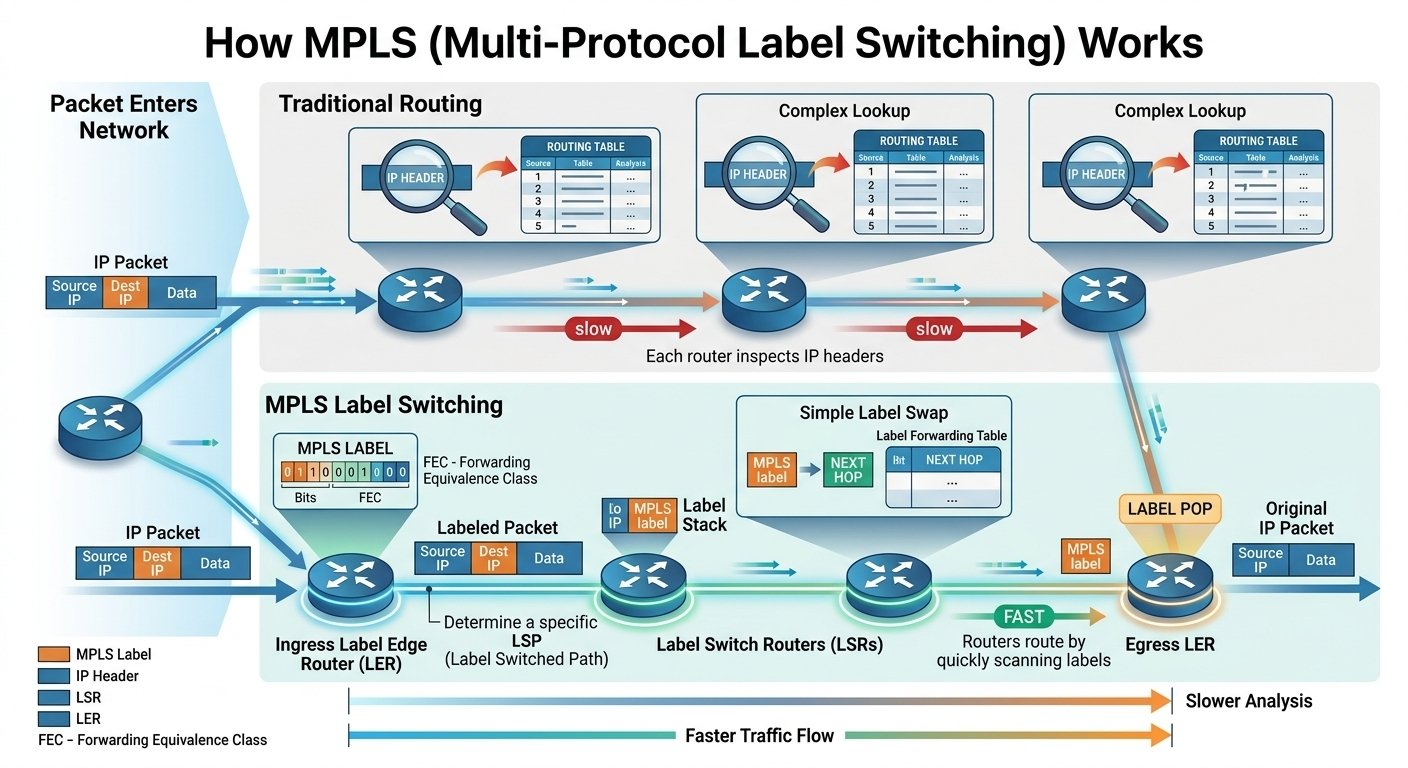
This routing technique leverages the concept of predetermined labels to route traffic instead of relying solely on ultimate source and destination addresses. When a packet enters the network, it is assigned to a specific Forwarding Equivalence Class, which is indicated by appending a short bit sequence or label to the packet. This label tells the routers exactly where the data needs to go without requiring a deep dive into the IP header at every single stop along the path.
The efficiency of this system comes from the fact that routers only need to look at the label to determine the next hop. This process is much faster than traditional routing, where each device must inspect the entire IP packet and consult a complex routing table. By following a Label Switched Path, the data travels along a path that has been pre-calculated for speed and reliability. This mechanism allows network administrators to specify paths for different types of traffic, ensuring that the most important data takes the most efficient route.
Key MPLS Components: Labels, FEC, and LSPs
The functionality of these networks depends on several control and forwarding elements working in harmony. Labels provide the necessary instructions for routers, while Forwarding Equivalence Classes define how groups of packets with similar characteristics should be treated. Label Switched Paths serve as the actual highways through the network. When these components interact, they create a seamless flow of data that is both fast and secure.
-
32-bit label stack entry
Every packet in this environment carries at least one label stack entry. This entry is small, consisting of only 32 bits, yet it contains all the information required for forwarding, quality of service treatment, and loop prevention. The following table breaks down the specific fields within this entry:
| Field | Bits | Role |
| Label | 20 | Forwarding value |
| Traffic Class | 3 | QoS priority, formerly EXP |
| Bottom of Stack (BoS) | 1 | Last label flag |
| TTL | 8 | Hop limit |
-
LDP vs. RSVP-TE: when to use which
Labels and paths do not appear spontaneously; they are created and distributed by specific signaling protocols. Two of the most common options are the Label Distribution Protocol (LDP) and the Resource Reservation Protocol with Traffic Engineering. Choosing between them depends on whether the network needs to follow the shortest path or requires stricter control over the route and bandwidth.
| Feature | LDP | RSVP-TE |
| Path selection | Follows IGP shortest path | Explicitly defined, strict/loose hops |
| Bandwidth reservation | No | Yes, admission control |
| Fast Reroute (FRR) | Not native, requires extensions | Built-in, sub-50ms protection |
| Label distribution | Hop-by-hop | Downstream-on-demand |
| Typical use | Best-effort VPNs | Traffic engineering, latency-sensitive flows |
The Benefits of MPLS for Your Business
The advantages of deploying this networking technology are numerous and impact both the technical performance and the end-user experience. By providing better bandwidth management and utilization of resources, companies can scale their operations without compromising on quality. It has established itself as the gold standard for connecting corporate locations, such as retail stores, warehouses, and data centers, where mission-critical data must move reliably.
| Business need | MPLS mechanism that addresses it |
| Site-to-site WAN with consistent delay | LSPs remain unchanged; forwarding behavior stays predictable |
| Voice / video | Traffic Class bits prioritize real-time flows over bulk data |
| Private connectivity without encryption | L3 VPN isolates customer routes natively |
| Contractual performance | SLA with measurable metrics, uptime, latency, and jitter |
The implementation of these services often results in a significant reduction in network congestion. According to research by various networking experts, the deterministic nature of label switching allows for much higher levels of uptime compared to public internet routing. Additionally, the security provided by native route isolation means that data stays private as it moves between branch offices and headquarters, which is a vital requirement for industries like finance and healthcare.
MPLS and SD-WAN
Software-Defined Wide Area Networking emerged to address the need for high-performance networking at a more accessible price point. SD-WAN moves the routing intelligence to the customer premises, allowing for the use of multiple internet connections concurrently. It determines the best path for data based on real-time performance metrics of each individual circuit. While some might see these as competing technologies, they actually serve different purposes and can be used together.
SD-WAN provides high resiliency and multi-path capabilities, making it excellent for general internet traffic and cloud-based applications. However, it lacks the inherent end-to-end quality of service guarantees that a dedicated circuit offers. While SD-WAN can simulate high performance by moving packets between broadband links, it cannot match the physical priority given to traffic within a provider’s core network. This is why many enterprises continue to value the stability of a managed service.
MPLS + SD-WAN: Enter MPLS+
Melding a primary private network with an SD-WAN overlay is the next logical step for many businesses. This hybrid approach, commonly referred to as a Hybrid WAN (combining MPLS and SD-WAN). It allows a company to keep its most sensitive and critical traffic on a guaranteed path while offloading less important data to cheaper broadband connections. This setup provides an additional layer of redundancy and diversity to the network architecture.
-
Critical voice and video traffic stay on the prioritized circuit to ensure no drops or lag.
-
General web browsing and cloud backups move through the SD-WAN managed broadband links.
-
The SD-WAN appliance acts as the brain, automatically rerouting traffic if one connection fails.
This combination enables the network to be both agile and stable. If a primary circuit experiences issues, the SD-WAN component can immediately shift priority traffic to an alternative path, ensuring business continuity. This evolution of the technology demonstrates that it is not being replaced, but rather enhanced by newer software-defined capabilities to meet modern demands.
MPLS Advantages and Limitations
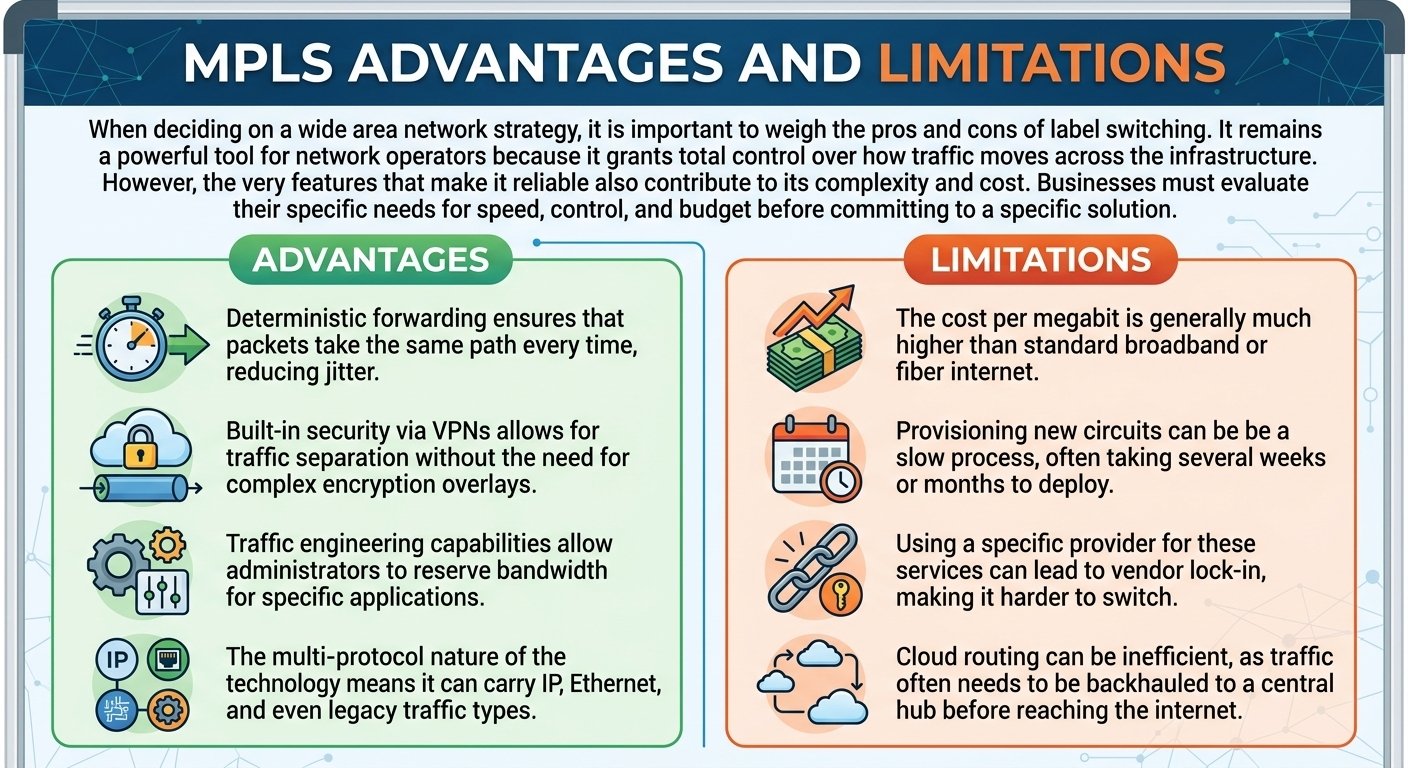
When deciding on a wide area network strategy, it is important to weigh the pros and cons of label switching. It remains a powerful tool for network operators because it grants total control over how traffic moves across the infrastructure. However, the very features that make it reliable also contribute to its complexity and cost. Businesses must evaluate their specific needs for speed, control, and budget before committing to a specific solution.
-
Advantages
The main advantages of this technology are tied to predictability and traffic control. This makes it the preferred choice for business-critical traffic that cannot afford the unpredictability of the public internet.
-
-
-
Deterministic forwarding ensures that packets take the same path every time, reducing jitter.
-
Built-in security via VPNs allows for traffic separation without the need for complex encryption overlays.
-
Traffic engineering capabilities allow administrators to reserve bandwidth for specific applications.
-
The multi-protocol nature of the technology means it can carry IP, Ethernet, and even legacy traffic types.
-
-
-
Limitations
Despite its many strengths, this solution is not the most flexible option for every type of traffic. Its limitations are most apparent when a company needs to move quickly or reduce costs.
-
-
-
The cost per megabit is generally much higher than standard broadband or fiber internet.
-
Provisioning new circuits can be a slow process, often taking several weeks or months to deploy.
-
Using a specific provider for these services can lead to vendor lock-in, making it harder to switch.
-
Cloud routing can be inefficient, as traffic often needs to be backhauled to a central hub before reaching the internet.
-
-
Read More: Is Wireless Caller Spam? Meaning & Benefits
Final Words
The meaning of mpls in the modern business world has evolved from a simple routing speed-up technique to a comprehensive solution for reliability and quality. While newer technologies like SD-WAN offer flexibility and cost savings, the deterministic nature and service level agreements of a labeled network remain unmatched for mission-critical operations. By understanding how these systems work and how they can be combined with modern software-defined tools, businesses can create a robust, high-performance network that supports their growth and ensures seamless communication across the globe.
FAQ’s
-
What is MPLS in simple terms, and why do companies still use it?
In simple terms, it is a way of labeling data packets so they can take a “fast lane” through a network. Companies still use it because it offers guaranteed performance and reliability that the standard internet cannot provide, which is essential for phone calls and video meetings.
-
What is the MPLS full form?
The acronym stands for Multiprotocol Label Switching. It is called multiprotocol because it can handle various types of network traffic, and label switching refers to the method of using short labels to direct data instead of long IP addresses.
-
What is MPLS in networking for a non-technical reader?
For a non-technical reader, think of it like a VIP pass at an airport. While everyone else has to wait in long lines and have their documents checked at every gate, the labeled data has a pre-cleared pass that lets it move quickly through special checkpoints, reaching its destination much faster and more reliably.
-
How does MPLS work when data travels from one office to another?
When data leaves the first office, the entry router attaches a label to it. Every router in the provider’s network simply looks at that label and passes it to the next designated stop. Once it reaches the destination office, the label is removed, and the data is delivered.
-
How MPLS is different from sending traffic over the internet?
It is a private network managed by a service provider. Unlike the internet, which is a public “best effort” system where your data competes with everyone else’s, this private network provides a dedicated path with a contract that guarantees speed and quality.
-
What is an MPLS circuit, and what does a customer actually receive?
A circuit is the physical and logical connection provided to a business. A customer receives a dedicated port and a connection that links their site directly to the provider’s private network, usually accompanied by a service level agreement (SLA) that guarantees performance.
-
What is an MPLS service, and how is it usually delivered by a provider?
This is a managed networking service where the provider takes care of the routing and hardware. It is delivered via a dedicated line (like fiber) that connects the business premises to the provider’s core network equipment.
-
What is MPLS used for in everyday business networks?
In everyday business, it is used to connect remote offices to the headquarters, support crystal-clear VoIP phone systems, and ensure that important databases and applications run smoothly without being slowed down by other internet traffic.
-
What are the benefits of using MPLS instead of a basic broadband connection?
The main benefits include consistent speeds, much lower latency, higher security, and a professional support team. Broadband can be inconsistent and slow during peak hours, whereas this technology provides a stable environment 24/7.