
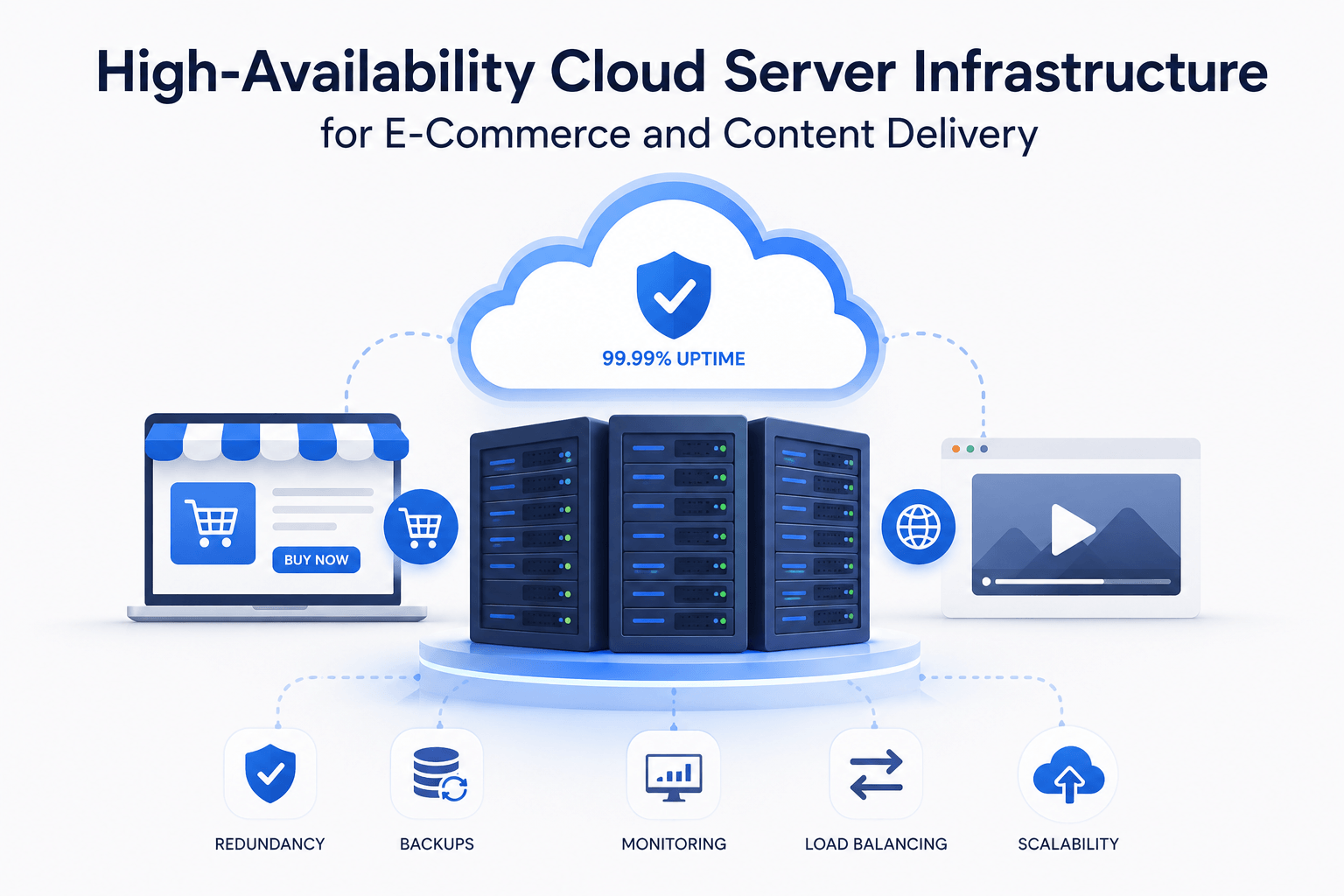
E-commerce stores and content platforms depend on reliable infrastructure to keep websites, checkout systems, databases, and media available to users. High-availability hosting combines adequate server resources with redundancy, monitoring, backups, traffic management, and a recovery plan to reduce the impact of hardware, network, or application failures.
Learn how high-availability hosting, NVMe storage, redundancy, backups, and scalable server resources can help e-commerce and content platforms reduce downtime and maintain reliable performance.
Ensuring Reliable Uptime for Online Stores
Downtime can prevent customers from browsing products, completing purchases, or accessing content. For high-traffic websites, even a short outage during a busy sales period can result in lost transactions and additional support work.
A resilient setup should therefore look beyond raw server specifications. Fast NVMe storage and sufficient CPU and memory can improve performance, but availability also depends on network reliability, application architecture, database redundancy, backups, monitoring, failover configuration, and the hosting provider’s infrastructure.
Essential Features of High-Availability E-Commerce Hosting
High-traffic e-commerce and media platforms require specific technical infrastructure capabilities:
- Fast NVMe SSD Drives: NVMe storage can reduce storage-related latency and improve I/O performance for databases and applications. Actual WooCommerce, Magento, or custom application performance also depends on CPU, memory, caching, database configuration, and application design.
- Dedicated CPU and RAM Allocations: Prevent database lag during high-volume sales events and seasonal traffic surges.
- Automated Daily Snapshots: Maintain regular backups of application files and databases, with retention appropriate to how frequently data changes. Server snapshots can provide convenient recovery points, but critical e-commerce data may require more frequent backups and off-server or off-site copies.
- Multi-Region Node Mirroring: Build redundant server setups across distinct geographical locations to balance incoming web traffic smoothly.
- Uptime and Performance Monitoring: Monitor server availability, response times, CPU and memory usage, storage capacity, database health, and application errors. Alerts allow administrators to investigate problems before they develop into longer outages.
- CDN and Caching: A content delivery network (CDN) can cache static assets closer to users, reducing load on the origin server and improving delivery times across different regions. Application and database caching can further reduce repeated processing on high-traffic websites.
- Database Resilience: For stores with frequent orders, inventory changes, or account activity, database availability is just as important as web-server uptime. Depending on the scale of the platform, replication, managed database services, frequent backups, and tested recovery procedures can reduce the risk of losing recent transactional data.
- Network and DDoS Protection: Traffic attacks or abnormal request spikes can make an otherwise healthy server unavailable. Evaluate the provider’s network capacity, DDoS mitigation options, firewall controls, and rate-limiting capabilities according to the risk profile of your website.
Choosing Server Locations in Northern Europe
Northern Europe has become an important data-center region, with parts of the Nordic market benefiting from strong fiber connectivity, relatively cool climates, and access to renewable or low-carbon electricity. These advantages vary by country, facility, and provider, so server location alone should not be treated as a guarantee of performance or sustainability.
For websites serving customers in Scandinavian and European performance can launch a high-speed Sweden VPS to support resource-heavy e-commerce stores.
An additional server or caching node in Estonia may also be worth considering for applications serving users in the Baltic region, depending on the provider’s network routes and the geographic distribution of the audience.
Server location should generally be selected according to where users are located. Physical distance is only one factor; network peering, routing, CDN configuration, server capacity, and application architecture can have an equally important effect on real-world response times.
Choosing Infrastructure for a Growing Online Store
When comparing hosting for a growing e-commerce platform, look beyond headline CPU and storage specifications. Consider available memory, storage performance, bandwidth policies, server locations, DDoS protection, backups, monitoring, recovery options, network reliability, and technical support. For critical stores, also consider how the architecture would respond if the primary server, data center, or network route became unavailable.
Payment options may matter as well, particularly for international customers or businesses that prefer cryptocurrency. hosting-bitcoin.com provides a way to compare VPS and dedicated-server providers that accept crypto payments, including options across multiple geographic locations. Before choosing a service, compare the actual provider’s infrastructure, resource allocation, backup policy, support terms, network specifications, and service-level commitments.
FAQ’s
What is high-availability hosting?
High-availability hosting uses redundancy, monitoring, failover, backups, and other infrastructure measures to reduce downtime and keep websites and applications accessible when individual components fail.
Why is high availability important for e-commerce websites?
E-commerce stores depend on continuous access to product pages, customer accounts, databases, and checkout systems. Downtime can interrupt purchases, affect customer experience, and create additional recovery and support work.
Does NVMe storage improve e-commerce performance?
NVMe storage can improve storage-related performance by providing fast read/write speeds and lower latency. However, overall website performance also depends on CPU, memory, caching, database configuration, network connectivity, and application design.
What is server redundancy?
Server redundancy involves having additional infrastructure available if a primary server or component fails. Depending on the architecture, this may include secondary servers, replicated databases, multiple locations, load balancing, or automatic failover.
What is the difference between server backups and snapshots?
A snapshot captures the state of a server or disk at a particular point in time, while a backup is typically a separate copy of important files or databases kept for recovery. Critical e-commerce systems may benefit from using both as part of a broader recovery strategy.
Does an e-commerce website need a CDN?
Not every store requires one, but a CDN can improve content delivery by caching static assets closer to visitors. It can also reduce demand on the origin server, which can be particularly useful for geographically distributed audiences and high-traffic websites.
How does server location affect e-commerce website speed?
Hosting closer to your main audience can reduce network latency, but physical distance is only one factor. Network routing, peering, CDN configuration, server resources, and application optimization can also affect real-world performance.
Is a VPS suitable for a high-traffic e-commerce store?
Yes, VPS has sufficient resources and the overall infrastructure is designed for the store’s workload. As traffic and availability requirements increase, additional servers, load balancing, database replication, caching, or dedicated infrastructure may become necessary.