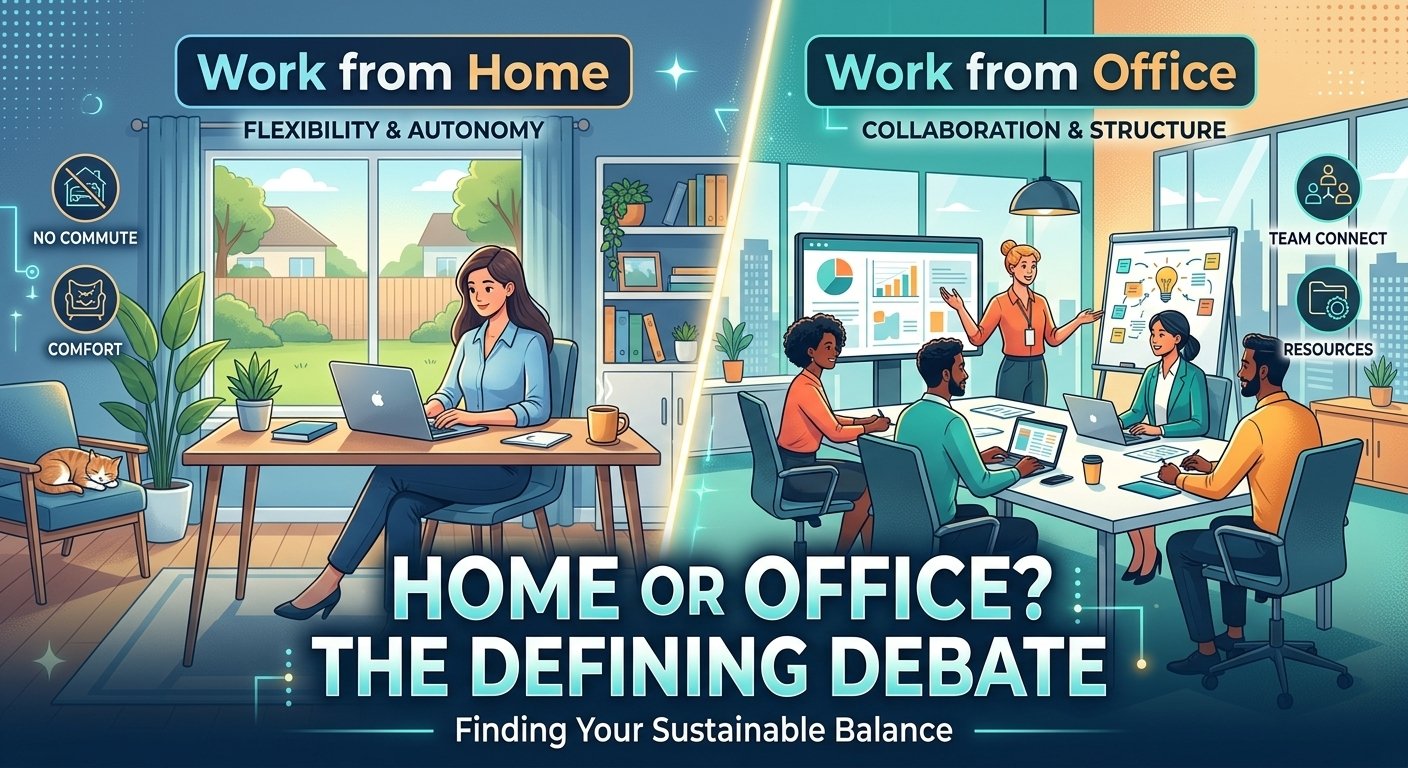
Working from home offers greater flexibility, no daily commute, and more control over your workspace, while office work provides face-to-face collaboration, clearer separation between work and home, and easier access to colleagues and workplace resources. Neither option is better for everyone—the right choice depends on your role, working style, home environment, and employer.
Some employees are more productive at home, while others work better with the structure and social interaction of an office. Hybrid work combines elements of both and can be a practical option when the role allows it.
Comparison: Work From Home vs Work From Office
| Pros of Working From Home | Cons of Working From Home | Pros of Working in an Office | Cons of Working in an Office |
| Flexible Schedule | Isolation and Lack of Social Interaction | Structured Workspace | Commuting Stress and Time Consumption |
| Customizable Workspace | Distractions and Home Responsibilities | Opportunities for Collaboration and Networking | Less Personal Freedom and Flexibility |
| Less Commuting and Expenses | Communication Challenges | Access to Resources and Immediate Support | Office Politics and Distractions |
| Increased Productivity | Technology and Costs | Clearer Work-Life Boundaries | Limited Control Over Environment |
| Better Work-Life Balance | Difficulty with Work-Life Balance | Enhanced Learning and Growth | Potential Health Impacts |
Pros of Working From Home
The rise of work from home culture has brought about numerous benefits that were previously unavailable to the average employee. Gaining total control over your schedule fundamental changes daily productivity. This shift is not just about where you sit, but about how you manage your energy and time.
1. Flexible schedule
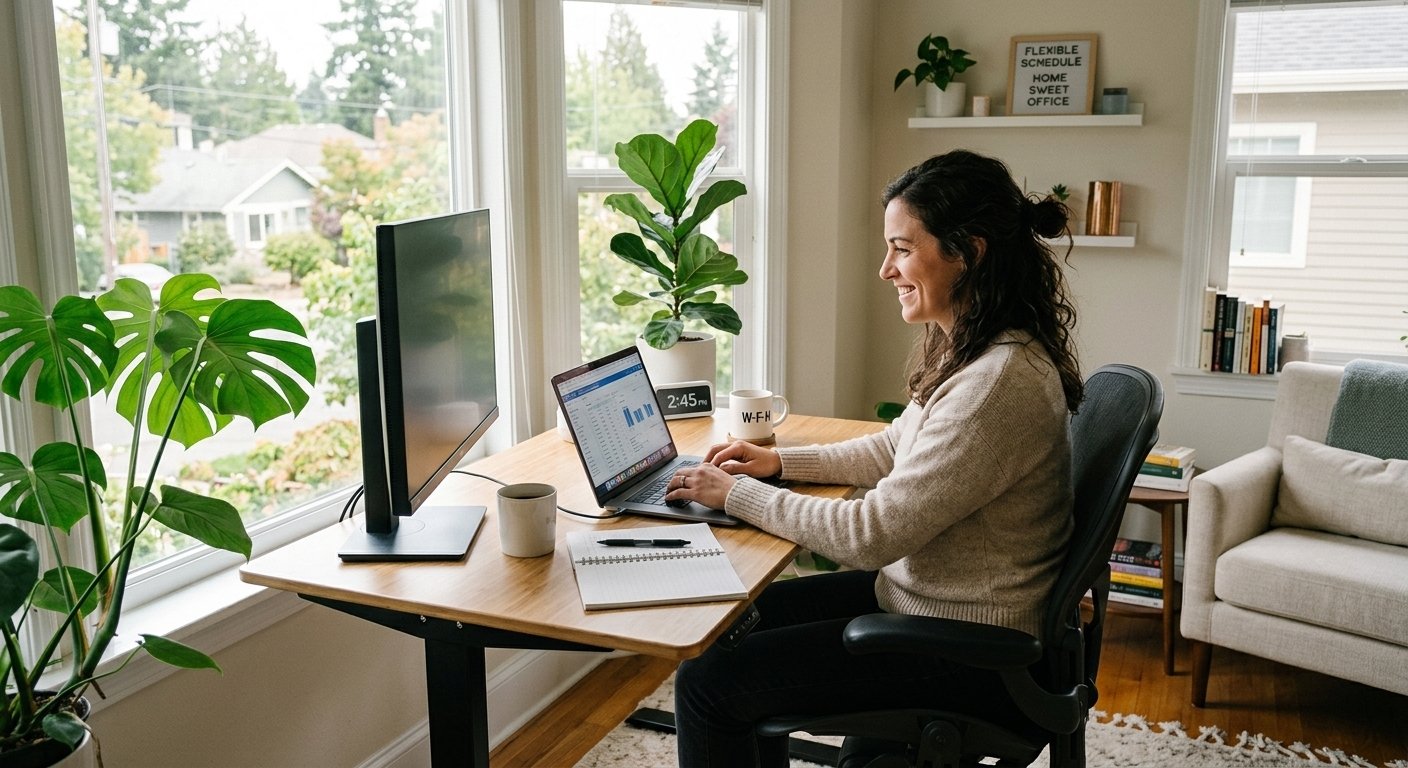
One of the most significant advantages is the ability to manage your own time. Unlike the rigid hours of an office, remote work often allows for a more fluid schedule where you can start earlier or end later based on your peak energy levels. This flexibility is a cornerstone of the better work from home experience that many professionals now seek. Post-pandemic employment expectations have permanently shifted.
In a 2022 McKinsey survey of U.S. workers McKinsey uncovered that 35% of professionals have the option to work from home full-time since the pandemic began.
This shift has changed the expectations of the workforce, making flexibility a primary requirement for many job seekers. Having a flexible schedule means you can attend to personal errands or family needs without the stress of asking for time off for every small appointment. This level of trust between employer and employee often leads to higher job satisfaction.
2. Customizable workspace
When working in a home office, you have total control over your space. You can choose the lighting, the chair, and even the temperature to suit your personal preferences. This customizable nature is a major advantage of working at home compared to the standardized office workspaces that offer employees less control over lighting, temperature, furniture, or noise.
A personalized work from home can lead to better physical health, as you can invest in ergonomic equipment that specifically fits your body. Whether it is a standing desk or a quiet corner with natural light, these small changes can significantly reduce the physical strain of a long workday.
3. Reduced Commute and Expenses
Working from home can reduce commuting-related expenses such as fuel, fares, parking, and vehicle maintenance. Additionally, the costs associated with professional attire and buying lunch every day are greatly reduced.
These savings add up to a significant amount of extra disposable income over the year. Furthermore, the time saved by not sitting in traffic can be reinvested into personal hobbies, exercise, or extra sleep. This makes the it a double win for both the wallet and the clock.
4. Increased productivity and performance
Many studies, including a prominent report from Stanford University, suggest that remote work can lead to a 13% increase in performance. This is often attributed to a quieter surroundings and fewer interruptions from colleagues. For many, the office vs work from home debate is settled by the ability to enter a deep state of focus at home. As statistics show that 10% of employees work remotely full time.
When you remove the ambient noise of a busy office, you can often complete complex tasks in less time. This efficiency is a primary reason why many believe remote work vs office work efficiency is superior for roles that require deep concentration and analytical thinking.
5. Better work-life balance
The ability to integrate work and home life seamlessly is a major draw for the modern workforce. Without the barrier of a long commute, the transition from professional life to personal life happens instantly. This allows for more quality time with family and a reduction in the overall stress associated with juggling multiple responsibilities.
A better work-life balance is not just a perk; it is a necessity for long-term mental health. Employees who feel they have enough time for their personal lives are less likely to experience burnout and are generally more engaged when they are on the clock. This makes it one of the top benefits of working from home for employers who want to retain their best talent.
Cons of Working From Home
Despite the many benefits, there are also significant issues with work from home that individuals must navigate. The lack of a physical boundary between your professional and personal life can lead to unique challenges. Understanding these negatives of working from home is essential for anyone looking to make a long-term transition to remote work.
1. Isolation and lack of social interaction
Human beings are social creatures, and working at the home office can sometimes feel incredibly lonely. Without the casual watercooler chats or impromptu coffee breaks with colleagues, a sense of isolation can set in. This lack of social interaction is one of the most cited problems with working at home.
Over time, this isolation can impact mental well-being and decrease the sense of belonging to a team. It becomes much harder to build the rapport and trust that come naturally when you are sharing a physical space. For those who thrive on social energy, the cons of work from home can be quite daunting.
2. Distractions and home responsibilities
While the office has its distractions, the home setup presents an entirely different set of challenges. From laundry piles and dirty dishes to family members and pets, staying focused can be difficult. These distractions can lead to a decrease in the productivity of working from home vs office environment if not managed strictly.
Managing home responsibilities while trying to maintain a professional demeanor on video calls requires a high level of discipline. Without a dedicated office from home, it is easy for household chores to creep into your working hours, leading to a fragmented and less efficient workday.
3. Communication challenges
Effective communication is often harder when you are remote vs in person work. You lose the ability to pick up on non-verbal cues and body language, which can lead to misunderstandings. Relying solely on text-based communication or scheduled video calls can slow down the decision-making process.
In an office, you can often get a quick answer by walking over to a colleague’s desk. In a remote setting, you might have to wait for an email reply or a Slack message, which can interrupt your flow. These communication hurdles are among the top working from home concerns for managers and team leads.
Pros of Working in an Office
The traditional in office work still holds significant value in the professional world. There are certain aspects of corporate culture and professional development that are difficult to replicate in a virtual setting. For some employees, particularly those who value face-to-face interaction, an office provides structure and easier access to colleagues.
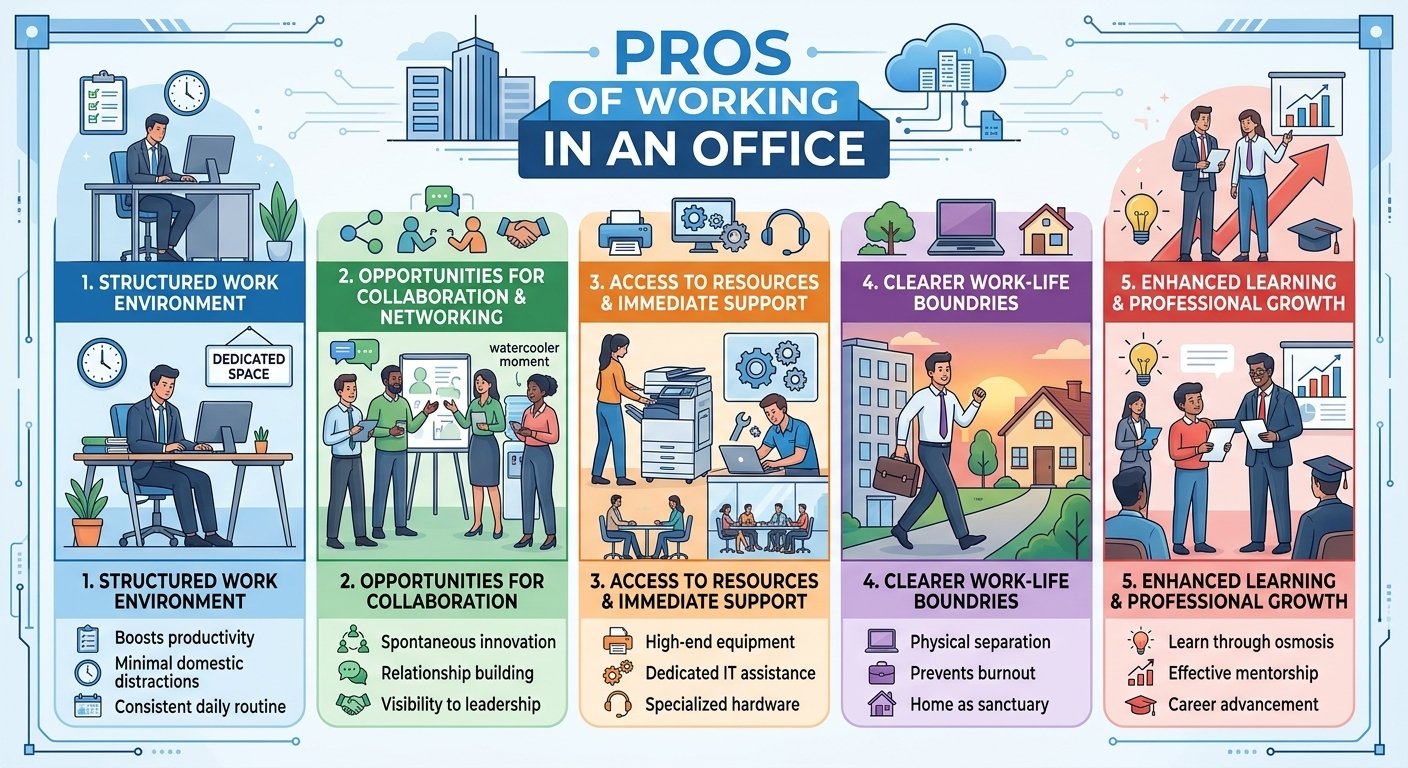
1. Structured work environment
An office provides a clear structure that helps many people stay on task. The dedicated space is designed specifically for productivity, with minimal domestic distractions. This helps to signal to the brain that it is time to focus, which can be beneficial for those who struggle with self-motivation.
A structured setting also includes set working hours, which can help in maintaining a consistent routine. Knowing that your colleagues are also working during these hours creates a sense of collective purpose. This structure is often why some people find that in-office work leads to higher productivity than remote work.
2. Opportunities for collaboration and networking
The value of spontaneous collaboration cannot be overstated. “Watercooler moments”—the unplanned conversations that happen in hallways—often lead to innovative ideas and quick problem-solving. This type of interaction is a core advantage of working in an office vs home.
Networking is also much more effective in person. Building relationships with senior leadership and colleagues from other departments is easier when you are physically present. These connections are vital for career advancement and are often harder to forge in a remote or remotely focused environment.
3. Access to resources and immediate support
When you are in the office, you have immediate access to high-end equipment, meeting rooms, and administrative support. If the printer breaks or you need a specific file, there is usually someone or somewhere to turn to immediately. This level of support can make the workday much smoother.
Having a dedicated IT team on-site means that technical glitches are resolved quickly, minimizing downtime. This infrastructure is a key reason why some industries continue to favor the office vs remote working model, especially those that handle sensitive data or require specialized hardware.
4. Clearer work-life boundaries
One of the greatest pros of working in an office is the physical separation between work and home. When you leave the building at the end of the day, there is a psychological “closing of the laptop” that allows you to leave work behind. This boundary is essential for mental health and long-term sustainability.
Having a separate space for work means that your home remains a sanctuary for relaxation and family. This clear distinction helps in preventing the burnout that often comes from the “always-on” culture of remote work. For many, the daily commute acts as a necessary buffer between their two worlds.
5. Enhanced learning and professional growth
For junior employees and those new to a company, being in the office is a significant advantage. You can learn through osmosis by observing how more experienced colleagues handle situations and interact with clients. This type of informal learning is one of the primary benefits of working in an office.
Mentorship programs also tend to be more effective when conducted in person. The ability to grab a quick coffee with a mentor or shadow them in meetings provides invaluable insights that are often lost in a virtual setting. Professional growth is often accelerated by the visibility and engagement that comes with in-office working.
Cons of Working in an Office
Despite its benefits, the traditional office model has several drawbacks that have become more apparent in recent years. The rigid nature of office life can sometimes be at odds with the needs of a modern, diverse workforce. Understanding these cons is essential for any company looking to implement a return-to-office policy.
1. Commuting stress and time consumption
The most cited disadvantage of working in an office is the commute. Whether it is sitting in traffic or navigating crowded public transit, commuting is a significant source of stress. This time is essentially “unpaid work” and can consume several hours of an employee’s day.
Beyond the stress, commuting has a negative environmental impact and can lead to physical exhaustion. The time lost to travel could be spent on exercise, family, or sleep, which are all vital for overall well-being. This is a major factor when comparing the pros and cons of remote workforce options.
2. Less personal freedom and flexibility
Working in an office usually means adhering to a strict schedule and a specific dress code. There is less freedom to manage your personal life during the day, which can be frustrating for employees who have become used to the autonomy of remote work. This lack of flexibility is a common complaint in the office vs work from home debate.
Employees often feel more monitored in an office setting, which can lead to a feeling of being micromanaged. The inability to adjust your environment or take breaks exactly when you need them can negatively impact morale and creative output.
3. Office politics and distractions
While the office is meant to be a place of work, it is often full of distractions. From loud conversations and phone calls to the constant “stop-bys” from colleagues, finding time for deep work can be a challenge. Office politics can also create a stressful environment that detracts from actual productivity.
Navigating the social hierarchy and interpersonal conflicts of an office can be emotionally draining. These distractions are a primary reason why many employees report that they are more productive when they work from home vs working from office.
4. Limited control over work environment
In a communal office, you have very little control over your surroundings. You may have to deal with uncomfortable temperatures, poor lighting, or an open-plan layout that offers no privacy. This lack of control can lead to physical discomfort and increased stress levels over time.
For individuals with sensory sensitivities or specific ergonomic needs, the standard office environment can be particularly challenging. The inability to customize your space is a significant drawback that is often overlooked in discussions about in-office productivity.
5. Potential health impacts
Spending a large portion of your day in an office can have various health implications. From the sedentary nature of desk work to the increased exposure to illnesses in a shared space, the office can be a breeding ground for health issues. Poor air quality and lack of natural light in some buildings can also impact long-term health.
Furthermore, the stress of commuting and navigating office dynamics can contribute to mental health struggles. In contrast, the ability to control your diet and exercise routine more easily at home is a significant advantage for those who prioritize their physical well-being.
Conclusion: Finding the Right Balance
The debate over office vs work from home is not about choosing one over the other, but about finding the right balance for your specific needs. Both environments offer unique advantages and challenges. The future of work is likely a hybrid model that combines the flexibility of remote work with the collaborative power of the office.
As we move forward, companies that offer a variety of options will likely see the highest levels of employee satisfaction and retention. Whether you prefer the quiet of a home office or the buzz of a corporate headquarters, the goal is to create a sustainable way of working that supports both professional excellence and personal happiness.
Read More: Power Dialers: How They Work, Pros, Cons, and Alternatives
Final Thought
The ultimate goal is choosing the environment that aligns best with your role, habits, and mental well-being. By carefully considering the pros and cons of each, you can design a career path that not only meets your professional goals but also enhances your quality of life. The most successful professionals of the future will be those who can adapt to whichever environment best serves their immediate tasks.
Work From Home vs Office: Which Is Better for You?
| Choose WFH if… | Choose Office if… |
|---|---|
| You work independently for long periods | Your role requires frequent face-to-face collaboration |
| You have a quiet home workspace | Your home environment is distracting |
| You value location flexibility | You prefer a structured daily routine |
| Commuting takes significant time | You live close to the workplace |
| Your role works well digitally | You need specialized workplace equipment |
| Your team communicates effectively online | You value regular in-person interaction |
These are general considerations rather than rules. Many jobs combine characteristics from both columns, which is why hybrid arrangements can work well for some teams.
Working from Home FAQs
-
Is working from home better than working in an office?
The answer depends on the individual’s role, personal work style, and lifestyle preferences. For those who value autonomy and have a dedicated workspace, working from home can be better. However, for those who thrive on social interaction and structured environments, the office might be the superior choice.
-
Is 100% remote work good?
Full remote work is excellent for flexibility and saving time on commutes, but it can lead to isolation if not managed carefully. It works best for self-motivated individuals and companies with strong digital communication cultures.
-
Is WFH increasing depression?
While not a direct cause, the isolation associated with working from home can exacerbate feelings of loneliness or depression in some individuals. It is important to maintain a social life outside of work and set clear boundaries to protect mental health.
-
What are the disadvantages of work from home?
The primary disadvantages include social isolation, potential for more domestic distractions, communication delays, and the blurring of boundaries between professional and personal life.
-
How can I stay productive while working from home?
Maintaining a strict routine, having a dedicated workspace, and using productivity tools can help. It is also important to take regular breaks and communicate frequently with your team to stay engaged.
-
Do employers prefer office work?
Some employers prefer office work for the ease of collaboration and oversight, while others have embraced remote work to save on overhead costs and access a wider talent pool.
-
What is a hybrid work model?
A hybrid work model allows employees to split their time between working from home and working in a physical office. This is becoming the most popular solution for modern businesses.
-
Can working from home save money?
Yes, it significantly reduces costs related to commuting, professional clothing, and buying meals. However, it may increase home utility bills and the cost of maintaining office equipment.
-
Which Is More Productive: Working From Home or Office?
Neither environment is automatically more productive. Productivity depends on the type of work, level of collaboration required, home or office environment, technology, management practices, and individual preferences. Tasks requiring uninterrupted concentration may suit remote work, while work involving frequent collaboration may benefit from in-person interaction.