

Collaboration in the workplace is the process where individuals or groups work together to achieve a common goal or complete a task. It involves sharing ideas, skills, and resources to solve problems efficiently. In the modern corporate landscape, it represents the backbone of organizational success, fostering an environment where diverse perspectives lead to innovative solutions. Effective collaboration goes beyond just working in the same space; it requires active communication, mutual respect, and synchronized efforts. Businesses that prioritize this approach often see higher productivity levels and improved employee satisfaction, making it a critical component of professional growth and operational excellence.
What is Collaboration in the Workplace?
Workplace collaboration happens when employees combine their knowledge and skills instead of working entirely independently. It may involve people within the same team or employees from different departments working together on a project, problem, or customer request.
For example, launching a new product may require marketing, sales, design, finance, and product teams to share information and coordinate their work.
To define collaboration in the workplace, one must look at how teams interact to produce results that an individual could not achieve alone. It is the practical application of collective intelligence, where the sum of the parts is greater than the individual contributions. This concept has become increasingly vital as businesses shift from hierarchical structures to more fluid, team-based models. In these environments, people from different departments and with varying levels of expertise come together to tackle complex challenges.
According to research, the time managers and employees spend on collaborative activities has surged by over 50% in the past two decades, and in many organizations, communication with coworkers takes up 72% of the work week.
It proves that workplace collaboration is no longer a peripheral activity but the core of how business is conducted. When people understand what is workplace collaboration, they recognize it as a deliberate strategy to break down silos and leverage the unique strengths of every team member.
Why is Collaboration in the Workplace Important?
In a fast-paced global economy, joint execution drives organizational agility. It is the engine that drives organizational agility, allowing companies to respond quickly to market changes and customer needs. When employees work together, they can identify potential risks earlier and brainstorm more creative solutions to overcome them. This collective approach reduces the burden on any single individual, leading to a more resilient and adaptable workforce.
Furthermore, it serves as a powerful tool for building trust and community among staff. Research by Gallup suggests that having a “best friend” at work—which often stems from close collaborative ties—leads to significantly higher individual engagement and performance. When people feel connected to their colleagues, they are more likely to go above and beyond for the organization. This sense of belonging is a key driver of retention, as employees are less likely to leave a company where they feel valued and supported.
Benefits of Collaboration in the Workplace
Effective collaboration can make it easier for teams to share knowledge, divide responsibilities, solve problems, and learn from one another. The exact benefits depend on how well the team communicates and how responsibilities are managed.
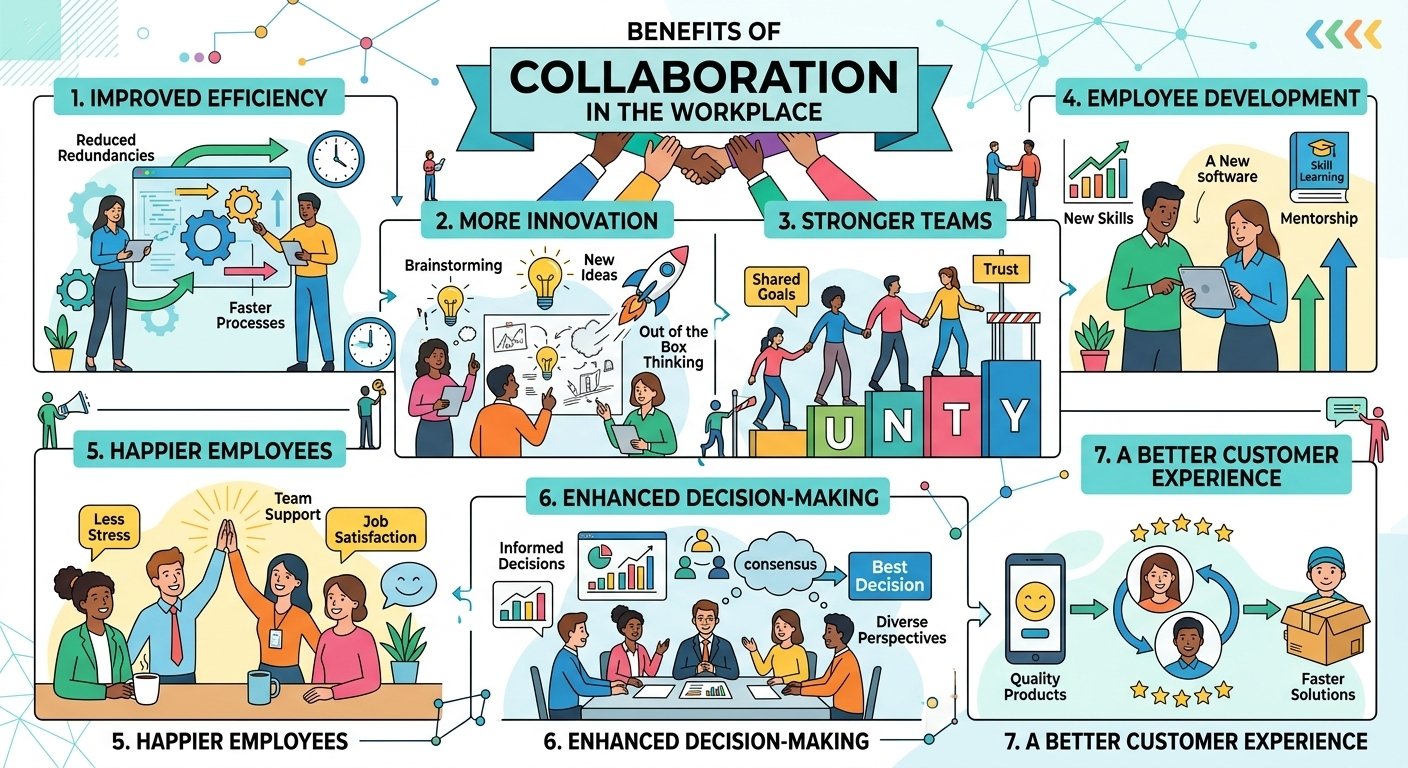
1. Improved efficiency
Efficiency is a direct result of workplace collaborative efforts, as it eliminates the redundancies that often occur when people work in silos. When a team collaborates effectively, they can streamline processes and automate repetitive tasks by sharing best practices. This leads to a more organized workflow where everyone knows their specific role and how it contributes to the final outcome.
In a collaborative work environment, the time spent searching for information or waiting for approvals is drastically reduced. Teams that use unified communication tools can resolve issues in real-time, preventing small problems from escalating into major delays. This streamlined approach allows the organization to deliver products and services to market faster, providing a significant competitive advantage.
2. More innovation
Bringing people with different skills and experiences into the same discussion can produce ideas that one department might overlook. For example, customer-support staff may identify a recurring customer problem that the product team can address in a future update.
3. Stronger teams
When individuals work together toward a common goal, they develop a shared history and a mutual understanding of each other’s work styles. This bond makes the team more effective over time, as they learn how to anticipate each other’s needs and provide support during high-pressure situations.
Strong teams are the foundation of a healthy organization, as they are better equipped to handle conflict and change. Through regular cooperation at work, team members learn to appreciate the different perspectives that their colleagues bring to the table. This mutual respect fosters a culture of inclusivity where every voice is heard and every contribution is recognized.
4. Employee development
Collaboration among workers is a fantastic catalyst for personal and professional growth. Working alongside others allows individuals to pick up new skills and gain exposure to different areas of the business that they might not encounter otherwise. This peer-to-peer learning is often more effective than formal training sessions, as it happens in the context of real-world tasks.
5. Happier employees
Humans are social creatures by nature, and working in a vacuum can lead to feelings of isolation and burnout. When employees feel that they are part of a team and that their work matters to others, their morale increases significantly. This positive atmosphere makes the office—whether physical or virtual—a more enjoyable place to be.
A collaborative culture also provides a safety net for indiviuals, as they know they can rely on their teammates when things get difficult. This reduced stress and increased support lead to higher job satisfaction and a more positive outlook on their career. Happy staff are also more likely to be brand advocates, helping to attract top talent to the organization.
7. A better customer experience
The ultimate beneficiary of workplace collaborations is often the customer. When internal teams work well together, the results are evident in the quality and consistency of the products and services provided. For example, if the marketing, sales, and product teams are in constant communication, the customer receives a unified message and a product that truly meets their expectations.
It ensures that customer inquiries are handled more efficiently, as the necessary information can be quickly gathered from various departments. This leads to faster resolution times and a more seamless journey for the client. In a world where customer experience is a key differentiator, effective collaboration can be the deciding factor in a company’s success.
Examples of workplace collaboration
Many of the world’s most successful companies have built their entire business models around the idea of collective effort. These organizations understand that by fostering a spirit of togetherness, they can achieve remarkable things.
-
Protiviti: Collaboration for innovation
Protiviti, a global consulting firm, uses collaboration to drive innovation across its various service lines. By creating cross-functional teams, they ensure that every client problem is looked at from multiple angles. This approach allows them to provide comprehensive solutions that a single-specialty firm might miss. Their focus on collaborative work has made them a leader in the consulting industry.
-
Workday: Collaboration for team bonding
Workday is known for its incredible company culture, which is built on the foundation of collaboration and team bonding. They organize regular team-building activities that are designed to help staff get to know each other outside of their daily tasks. This investment in relationships pays off in the workplace, as employees who like and trust each other are far more likely to collaborate effectively on projects.
8 Principles of successful collaboration in the workplace
To achieve effective teamwork in the workplace, certain core principles must be integrated into the daily routine. These principles act as the “ground rules” for how team members interact and work together. Without them, collaborative efforts can become disorganized and lead to frustration rather than results.
1. Efficiency
Efficiency means making the best use of everyone’s time and resources. This involves having clear agendas for meetings, using the right tools for communication, and avoiding unnecessary bureaucracy. When a team operates efficiently, they can focus their energy on high-value tasks that drive the project forward.
2. Trust
Trust is the bedrock of any collaborative relationship. Team members must trust that their colleagues will follow through on their commitments and that they have the best interests of the project at heart. Without trust, collaboration breaks down into micromanagement and suspicion, which stifles creativity and slows down progress.
3. Empathy
Empathy involves understanding the perspectives and feelings of others. In a team setting, this means recognizing when a colleague is overwhelmed and offering help, or understanding the different pressures that people in other departments might be facing. Empathy fosters a supportive environment where people feel safe to take risks.
4. Positivity
A positive attitude can be contagious and can significantly boost a team’s productivity. Positivity doesn’t mean ignoring problems, but rather approaching them with a “can-do” spirit and a focus on finding solutions. This mindset helps teams stay motivated even when faced with difficult challenges.
5. Clarity
Clarity is essential for preventing misunderstandings and ensuring that everyone is on the same page. This includes clear definitions of roles, responsibilities, and project goals. When everyone knows exactly what is expected of them, they can work with greater confidence and purpose.
6. Accountability
Accountability means taking ownership of one’s actions and their impact on the team’s goals. In a collaborative environment, individuals must be willing to admit when they have made a mistake and work to rectify it. This shared sense of responsibility ensures that the team remains focused on achieving its objectives.
7. Inclusivity
Inclusivity ensures that all voices are heard and valued, regardless of a person’s background or seniority. A truly inclusive team seeks out diverse perspectives and recognizes that the best ideas can come from anywhere. This principle is vital for fostering innovation and making everyone feel like a valuable part of the team.
8. Digital inclusivity
As more work moves online, digital inclusivity has become increasingly important. This means ensuring that all team members have access to the tools and training they need to participate fully in a digital environment. It also involves being mindful of different time zones and remote work setups to ensure that no one is left out of the loop.
How to improve collaboration in the workplace: 7 essential strategies and skills
Improving collaboration within teams requires a proactive approach from leadership and a willingness to adapt from employees. It is not something that happens overnight but is a continuous process of refinement. By implementing specific strategies, organizations can create a more cohesive and productive workforce.
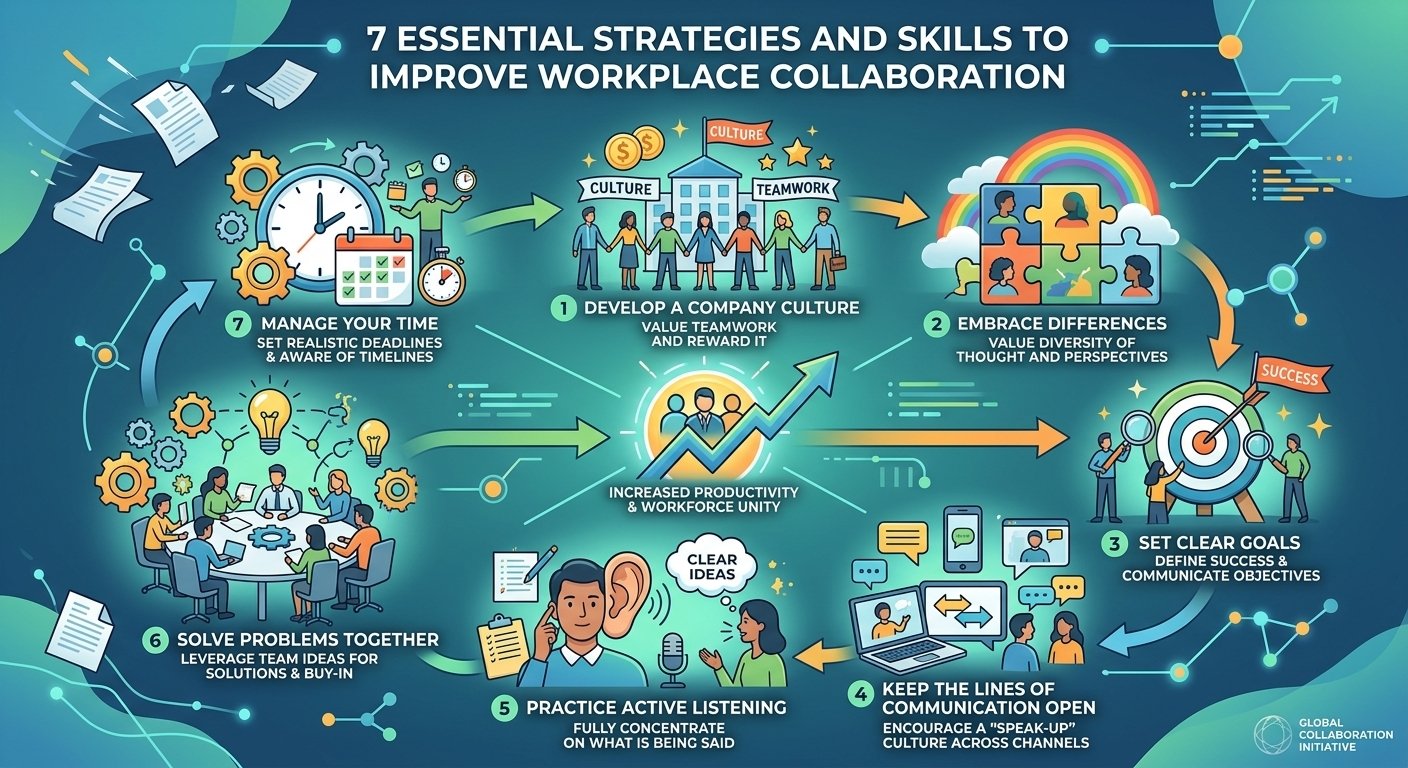
1. Develop a company culture
A strong company culture is the foundation of long-term collaboration. This culture should explicitly value teamwork and reward those who go out of their way to help their colleagues. When collaboration is part of the organization’s DNA, it becomes a natural part of how people work rather than a forced requirement.
2. Embrace differences
Diversity of thought is one of the greatest assets of any team. Embracing differences means actively seeking out people with different skills, experiences, and viewpoints. By encouraging a variety of perspectives, teams can avoid groupthink and develop more comprehensive and creative solutions to problems.
3. Set clear goals
Without clear goals, collaborative efforts can easily lose direction. It is important to define what success looks like for every project and to communicate these goals to all team members. When everyone understands the “why” behind their work, they are more likely to stay engaged and focused on the end result.
4. Keep the lines of communication open
Open communication is vital for identifying issues early and ensuring that everyone has the information they need to succeed. This involves not only formal meetings but also informal channels like instant messaging and video calls. Encouraging a “speak-up” culture ensures that important information isn’t siloed within specific departments.
5. Practice active listening
Active listening is a skill that is essential for effective cross-departmental work between teams. It involves fully concentrating on what is being said rather than just passively hearing the words. By practicing active listening, team members can gain a deeper understanding of each other’s ideas and concerns, leading to more productive discussions.
6. Solve problems together
Instead of assigning problems to a single individual, try to solve them collectively. Collaborative problem-solving allows the team to leverage a wider range of ideas and ensures that the final solution has the buy-in of everyone involved. This approach also helps to build trust and strengthen team bonds.
7. Manage your time
Effective time management is crucial for keeping collaborative projects on schedule. This involves setting realistic deadlines and ensuring that everyone is aware of their individual timelines. By managing time effectively, teams can avoid the stress of last-minute rushes and maintain a consistent level of quality in their work.
Tools that help with team collaboration in the workplace
In today’s digital world, having the right tools is just as important as having the right mindset. There are many software solutions designed specifically to facilitate collaboration among groups, whether they are in the same building or across the globe. These tools help to organize workflows, manage documents, and keep communication flowing.
| Tool | Primary Use |
|---|---|
| Microsoft Teams | Messaging, meetings and Microsoft 365 collaboration |
| Slack | Team messaging and channels |
| RingCentral | Business calling, messaging and meetings |
| Asana | Project and task management |
| Trello | Visual task management |
| Google Workspace | Documents, email, meetings and file sharing |
-
RingCentral
RingCentral is a comprehensive communication platform that offers messaging, video, and phone services in a single app. It is designed to help teams stay connected and collaborate effectively from anywhere. Its robust features make it an ideal choice for businesses that need a reliable and scalable communication solution.
-
Asana
Asana is a popular project management tool that helps teams track their work and meet deadlines. It allows users to create tasks, assign them to team members, and set due dates. Its visual interface makes it easy to see the status of various projects and identify any potential bottlenecks.
-
Trello
Trello uses a card-based system to help teams organize and prioritize their tasks. It is highly flexible and can be customized to fit any workflow. Trello is particularly useful for visual thinkers who want to see their progress at a glance and move tasks through different stages of completion.
-
Google Workspace
Google Workspace provides a suite of collaborative tools, including Google Docs, Sheets, and Slides. These tools allow multiple people to work on the same document simultaneously, with changes being saved in real-time. This level of joint efforts is essential for teams that need to produce high-quality content quickly.
-
ProofHub
ProofHub is an all-in-one project management and collaboration software that offers a centralized space for teams to plan and track their work. It includes features like task management, time tracking, and file sharing, making it a comprehensive solution for managing complex projects.
Challenges of Collaboration in the Workplace
| Challenge | What Can Happen |
|---|---|
| Too many meetings | Employees lose time for focused individual work |
| Unclear ownership | Tasks get duplicated or overlooked |
| Information overload | Important messages become difficult to find |
| Slow decision-making | Too many stakeholders delay decisions |
| Tool overload | Information becomes scattered across multiple platforms |
| Different priorities | Departments may disagree about goals |
| Time-zone differences | Global teams may struggle to communicate synchronously |
More collaboration isn’t always better. Effective collaboration means involving the right people at the right time while preserving enough time for focused individual work.
Read More: 09 Numbers: Cost, Meaning & Benefits
Final Thought
Collaboration in the workplace is more than just a buzzword; it is a fundamental shift in how we approach work in the 21st century. By embracing the principles of trust, empathy, and efficiency, and by utilizing the right tools, organizations can unlock the full potential of their people. The benefits are clear: more innovation, happier employees, and a better experience for customers. As the world of work continues to evolve, those who master the art of collaboration will be the ones who lead the way into the future.
FAQs
-
How do you encourage collaboration in the workplace?
Collaboration in the workplace is encouraged by fostering a culture where teamwork is actively celebrated and rewarded. Leadership should set the example by participating in collaborative efforts and making themselves accessible to their teams. Providing the right digital tools, such as project management software and unified communication platforms, is also essential. Additionally, creating opportunities for cross-departmental interaction through workshops or social events can help break down silos. When employees see that their collaborative efforts lead to tangible results and career growth, they are more likely to embrace the practice.
-
What Are the Barriers to Workplace Collaboration?
Common barriers include unclear responsibilities, poor communication, information silos, lack of trust, too many meetings, incompatible tools, conflicting priorities, and limited accountability.
-
What does collaboration mean in a professional context?
Collaboration in a professional context means the act of working together with one or more people to produce a specific outcome. It involves the integration of different skills, perspectives, and areas of expertise to solve problems or create something new. It is built on the foundation of shared accountability and open communication.
-
Why is workplace cooperation essential for remote teams?
Workplace cooperation is essential for remote teams because it bridges the physical gap between employees. Without the ability to interact in person, remote workers must rely on collaborative tools and a cooperative mindset to stay aligned. Effective cooperation ensures that remote employees feel like a valued part of the team and prevents them from feeling isolated.
-
What are some common examples of collaboration in the workplace?
Examples include a cross-functional team launching a new product, a group of designers brainstorming a new logo, or different departments working together to resolve a customer service issue. It also includes peer-to-peer mentoring and the use of shared digital workspaces to co-author documents.
-
How does collaboration improve decision-making?
Collaboration improves decision-making by bringing a wider range of perspectives to the table. When a diverse group of people evaluates a problem, they are more likely to identify potential pitfalls and consider a broader array of solutions. This leads to more informed and balanced decisions that have the support of the whole team.
-
Can collaboration help reduce employee burnout?
Yes, it can help reduce burnout by distributing the workload more evenly across the team. When employees know they can rely on their colleagues for support, the pressure of individual tasks is minimized. Furthermore, its social aspect provides emotional support and a sense of community that can protect against the feelings of isolation associated with burnout.
-
What role does technology play in organizational collaboration?
Technology acts as the enabler of organizational efforts, especially in large or global companies. It provides the platforms where people can share ideas, track progress, and communicate instantly. Without tools like video conferencing and cloud-based document sharing, modern collaboration would be significantly more difficult and less efficient.