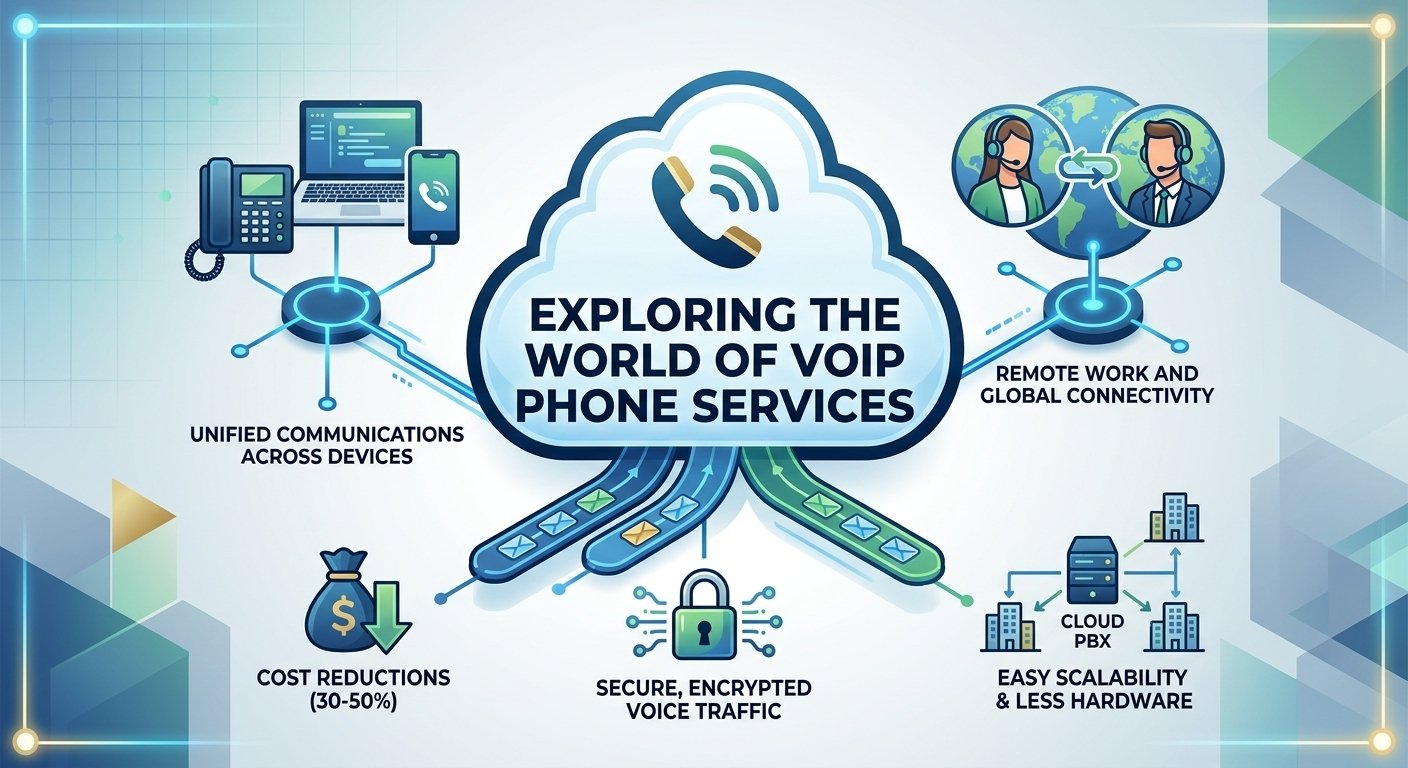
An autodialer is a system that automatically dials phone numbers without someone manually entering each one. Businesses use autodialers to make large numbers of calls for sales, customer support, appointment reminders, surveys, and notifications. Many modern autodialers can also connect answered calls to available agents or play pre-recorded messages, depending on their features.
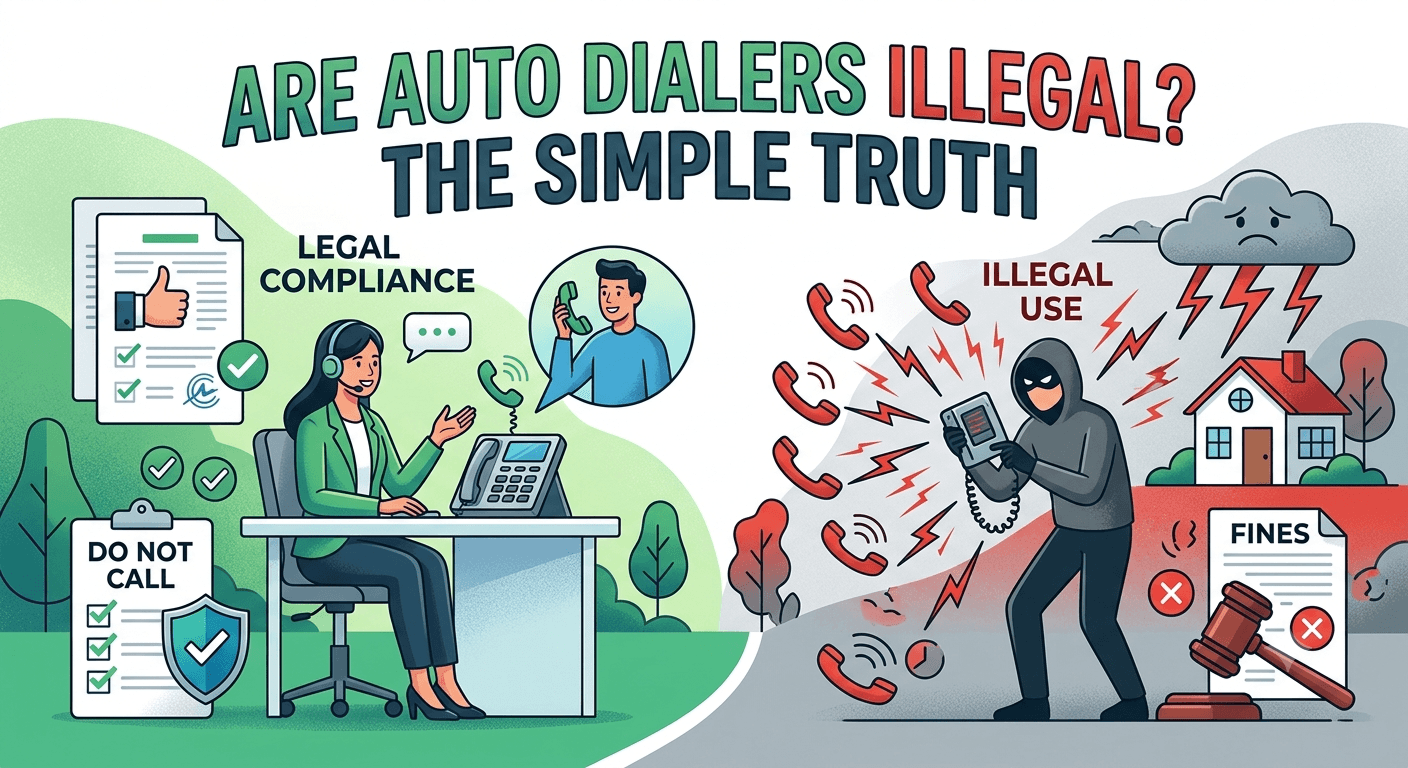
Auto dialers are not always illegal. They can be used, but there are strict rules under the Telephone Consumer Protection Act (TCPA). Businesses must get permission before calling or texting people with an auto dialer. Calling numbers on the Do Not Call list or sending recorded messages without consent can lead to big fines.
The direct answer is that auto dialers are not illegal by nature, but their operation follows by strict national and international regulations designed to protect consumer privacy. Whether an auto dialer is legal depends on the type of recipient, the nature of the message, and whether the caller has obtained prior express consent.
What Is an Auto Dialer?
An auto dialer refers to any software or hardware capable of dialing phone numbers automatically from a digital list. These systems are designed to reduce manual work involved in outbound communications. A modern phone dialer system often integrates with customer relationship management platforms to provide agents with relevant data before the call even begins. By automating the connection process, businesses can help agents spend more time talking to customers and improve overall conversion rates across various departments.
Are Auto Dialers Illegal? The Simple Legal Truth
Auto dialers are not illegal by themselves. Their legality depends on how they are used and where you are calling. In many countries, businesses can legally use auto dialers if they follow telemarketing laws, get the required consent, and respect rules such as Do Not Call (DNC) lists and calling time restrictions. Using an auto dialer for spam calls, robocalls without permission, or fraudulent activities can lead to fines and legal penalties.
The distinction between legal and illegal use often depends on the distinction of power dialer vs auto dialer configurations and how they interact with the public. Many businesses utilize an auto dialer for cold calling while strictly following consent guidelines to remain compliant with federal and state mandates. It is the responsibility of the business owner to ensure that their chosen software, whether it is a batch dialer or a complex power dialer ai, is configured to respect quiet hours and do-not-call registries. Failure to do so can turn a useful business tool into a legal risk that attracts heavy legal scrutiny.
Auto Dialer Laws Around the World
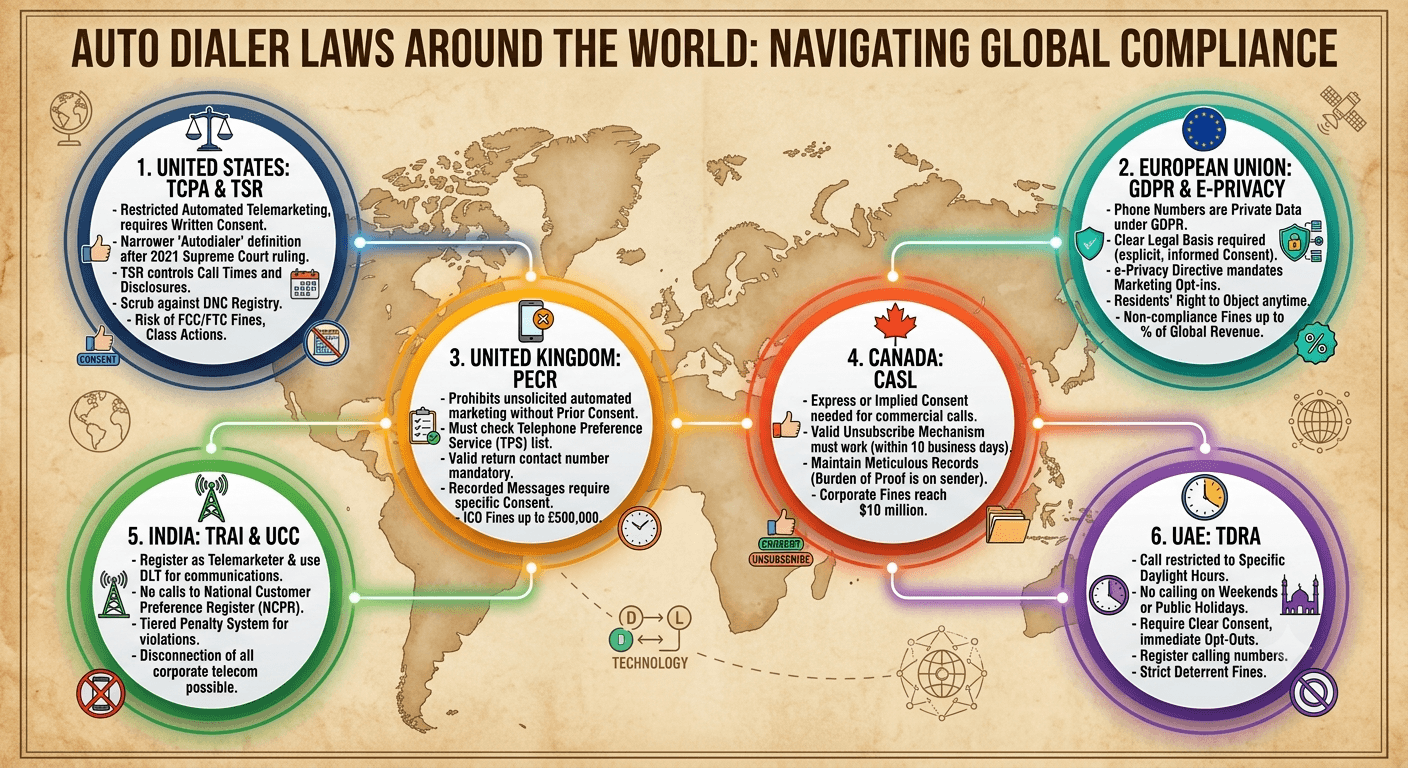
Businesses operating in different countries need to follow local calling laws. While some countries regulate technical capacity, others focus on the caller-recipient relationship.
1. United States: TCPA and TSR
The Telephone Consumer Protection Act (TCPA) restricts automated telemarketing without express written consent. While a 2021 Supreme Court ruling narrowed the definition of an autodialer to systems using random or sequential number generators, the Telemarketing Sales Rule (TSR) still enforces strict calling times and disclosures. Failure to scrub against the National Do Not Call Registry can lead to massive FCC/FTC fines and class-action lawsuits.
2. European Union: GDPR and e-Privacy
Under GDPR, phone numbers are private data. Automated calls require a clear legal basis—typically explicit, informed consent. The e-Privacy Directive mandates opt-ins for marketing calls and grants residents the right to object at any time. Non-compliance is treated as a major data breach, with penalties reaching a significant percentage of a company’s global annual revenue.
3. United Kingdom: PECR
The Privacy and Electronic Communications Regulations (PECR) prohibit unsolicited automated marketing without prior consent. Businesses must check the Telephone Preference Service (TPS) list and provide a valid return contact number. Recorded messages require specific consent as they are considered more intrusive. The Information Commissioner’s Office (ICO) can issue fines up to £500,000 for violations.
4. Canada: CASL
The Canadian Anti-Spam Legislation (CASL) covers commercial messages sent via automated dialers. It requires express or implied consent and a functional unsubscribe mechanism that must be honored within ten business days. With corporate fines reaching $10 million, businesses must maintain meticulous records, as the burden of proof regarding consent lies with the sender.
5. India: TRAI and UCC
The Telecom Regulatory Authority of India (TRAI) requires businesses to register as telemarketers and use Distributed Ledger Technology (DLT) to manage communications. Promotional calls to numbers on the National Customer Preference Register are strictly prohibited. Violators face a tiered penalty system that can result in the disconnection of all corporate telecom resources.
6. United Arab Emirates: TDRA
The TDRA restricts telemarketing to specific daylight hours and prohibits calls on weekends or public holidays. Businesses must obtain clear consent, provide immediate opt-outs, and register their calling numbers. These regulations are designed to prevent deceptive practices and high-pressure sales tactics through strict deterrent fines.
When Do Auto Dialers Become Illegal?
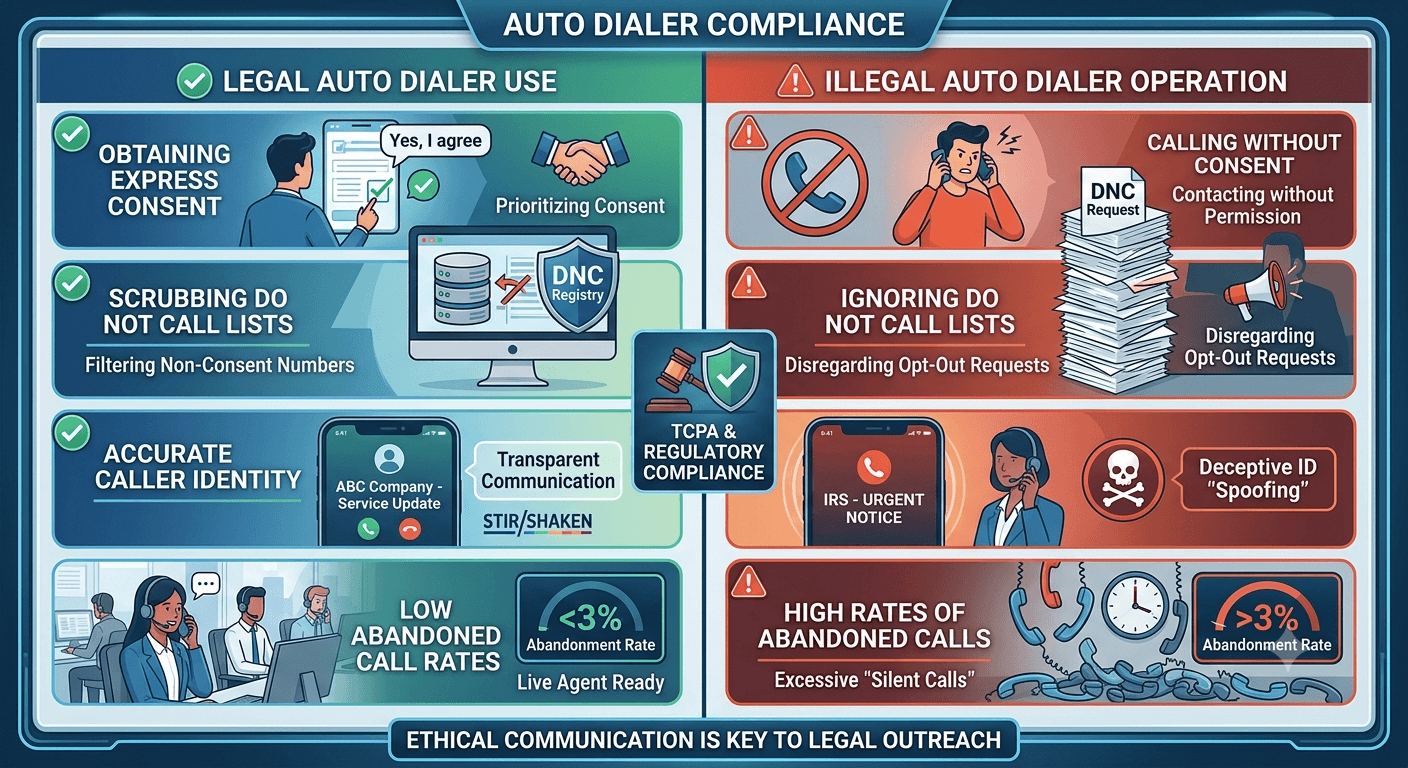
Autodialer become illegal when businesses ignore the rules when used to bypass regulations or ignore consumer preferences. Legality is compromised by lack of consent, deceptive identification, and persistent unwanted calls.
1. Calling Without Consent
The most important requirement is getting the customer’s consent. Contacting individuals—especially on mobile phones—without express permission is a privacy violation. Businesses must maintain clear records of how and when consent was obtained. Permission for one type of communication (e.g., service updates) does not grant the right to send marketing pitches.
2. Ignoring Do Not Call Lists
Calling numbers on national or state Do Not Call registries without an existing relationship is illegal. Companies should use built-in scrubbing features to filter these databases. Additionally, internal opt-out requests must be honored immediately across the entire organization to prevent repetitive, unlawful contact that often leads to expensive legal complaints.
3. Misleading Caller Identity
Using deceptive caller ID tactics, like “spoofing” local or government numbers, is illegal under laws like the Truth in Caller ID Act. A lawful dialer must provide accurate information about the caller’s identity and purpose. Using accurate caller ID via frameworks like STIR/SHAKEN reduces complaints and ensures the organization remains in good standing with regulators.
4. High Rates of Abandoned Calls
An abandoned call occurs when a dialer connects but no agent is available, creating a “silent call.” Most areas limit abandonment rates to approximately 3% of answered calls. Exceeding these limits can lead to heavy fines; businesses must ensure a live agent is ready for every answered call to avoid recipient harassment.
Penalties and Legal Risks
Beyond the immediate financial impact of fines, companies can face long-term damage to their ability to use telecom services. Carriers are increasingly proactive about blocking traffic from companies that show patterns of non-compliance, which can effectively shut down an entire sales department.
According to a 2025 industry study on telemarketing litigation, companies that fail to maintain proper consent records are significantly more likely to be targeted in class-action lawsuits.
Legal risks also include the possibility of personal liability for company executives if they are found to have knowingly allowed illegal calling practices. The reputational risk is equally high, as public records of illegal autodialing can deter potential customers and partners from doing business with the brand.
How to Stay Compliant When Using Auto Dialers
Legal calling operations require ongoing investment in technology and strict procedures. By keeping accurate customer records and transparency, businesses ensure their autodialer remains a compliant tool for growth.
-
Document Consent: Obtain express written consent before contacting any number.
-
Scrub DNC Lists: Regularly check databases against national and internal Do Not Call registries.
-
Verify Identity: Use STIR/SHAKEN and accurate caller ID to maintain trust.
-
Monitor Abandonment: Keep abandoned call rates below the 3% legal threshold.
-
Agent Training: Ensure agents provide mandatory name and company disclosures immediately.
-
Weekly Audits: Review call logs and consent records to identify compliance gaps.
-
Easy Opt-Out: Implement immediate voice or keypad-activated unsubscribe mechanisms.
-
Reputable Providers: Choose software partners that prioritize regulatory updates.
Read More: 357 Area Code: A Detail Guide Location
Conclusion
Auto dialers can save time and help businesses contact customers more efficiently, but they must be used responsibly. Following local laws, obtaining proper consent, and respecting customer preferences are essential. Businesses that focus on compliance can use auto dialers effectively while avoiding legal risks.
Businesses that stay ahead of these changes by adopting ethical communication practices will not only avoid penalties but will also lead their industries in customer satisfaction. In the end, a responsible approach to autodialing is the only way to ensure that your communication strategy remains both effective and lawful in the eyes of the world.
Frequently Asked Questions (FAQ)
-
Are auto dialers legal to use?
Auto dialers are legal to use as long as the organization follows local and international telemarketing laws, including obtaining proper consent and respecting do-not-call lists. Most countries allow the use of this technology for legitimate business purposes such as customer support, appointment reminders, and consented marketing. The legality depends on how the tool is configured and whether the caller is transparent about their identity and the purpose of the call.
-
Do auto dialers require prior customer consent?
In nearly all cases, especially for marketing purposes, auto dialers require prior express consent from the recipient before a call or text can be sent. Laws like the TCPA in the US and GDPR in the EU are very specific about how this consent must be collected and documented. Without verifiable consent, making automated calls to personal mobile numbers is generally considered illegal and can result in significant financial penalties.
-
What are the penalties for violating auto dialer laws?
The penalties for violating auto dialer laws can range from $500 to $1,500 per individual call in the US, while other countries may issue fines in the millions of dollars. These fines can accumulate rapidly if a business is found to be making thousands of non-compliant calls every day. In addition to monetary fines, companies may face class-action lawsuits, the loss of their telecom licenses, and severe damage to their professional reputation.
-
Can auto dialers be used for non-marketing calls?
Yes, auto dialers are commonly used for non-marketing purposes such as emergency alerts, healthcare notifications, and transactional updates, which often have different consent requirements. While these calls are generally viewed more favorably by regulators, they still must follow basic rules of transparency and respect for the recipient’s privacy. Even for service-related calls, it is best practice to allow users to manage their communication preferences easily.
-
How can businesses stay compliant when using auto dialers?
Businesses can stay compliant by using professional-grade dialing software that includes compliance features, maintaining rigorous data hygiene, and training staff on legal requirements. This includes regular scrubbing of lists against do-not-call registries and keeping exact records of every consent obtained. Regular audits of calling patterns and abandonment rates also help ensure that the technology is being used within legal boundaries.
-
Are auto dialers illegal in the UK?
Auto dialers are legal in the UK provided they comply with the Privacy and Electronic Communications Regulations and the UK GDPR. Callers must not contact anyone registered on the Telephone Preference Service and must always display their identity on the caller ID. The Information Commissioner’s Office oversees these rules and has the authority to issue heavy fines to companies that do not follow the prescribed automated calling procedures.
-
Is it illegal to get spam calls after 9pm?
Yes, in the United States and many other regions, it is a legal violation for telemarketers to call residential numbers outside the hours of 8 a.m. to 9 p.m. local time. These “quiet hour” regulations are strictly enforced to ensure that consumers are not harassed in their homes during the late night or early morning. Companies using automated systems must ensure their software is programmed to automatically stop dialing based on the recipient’s local time zone.