
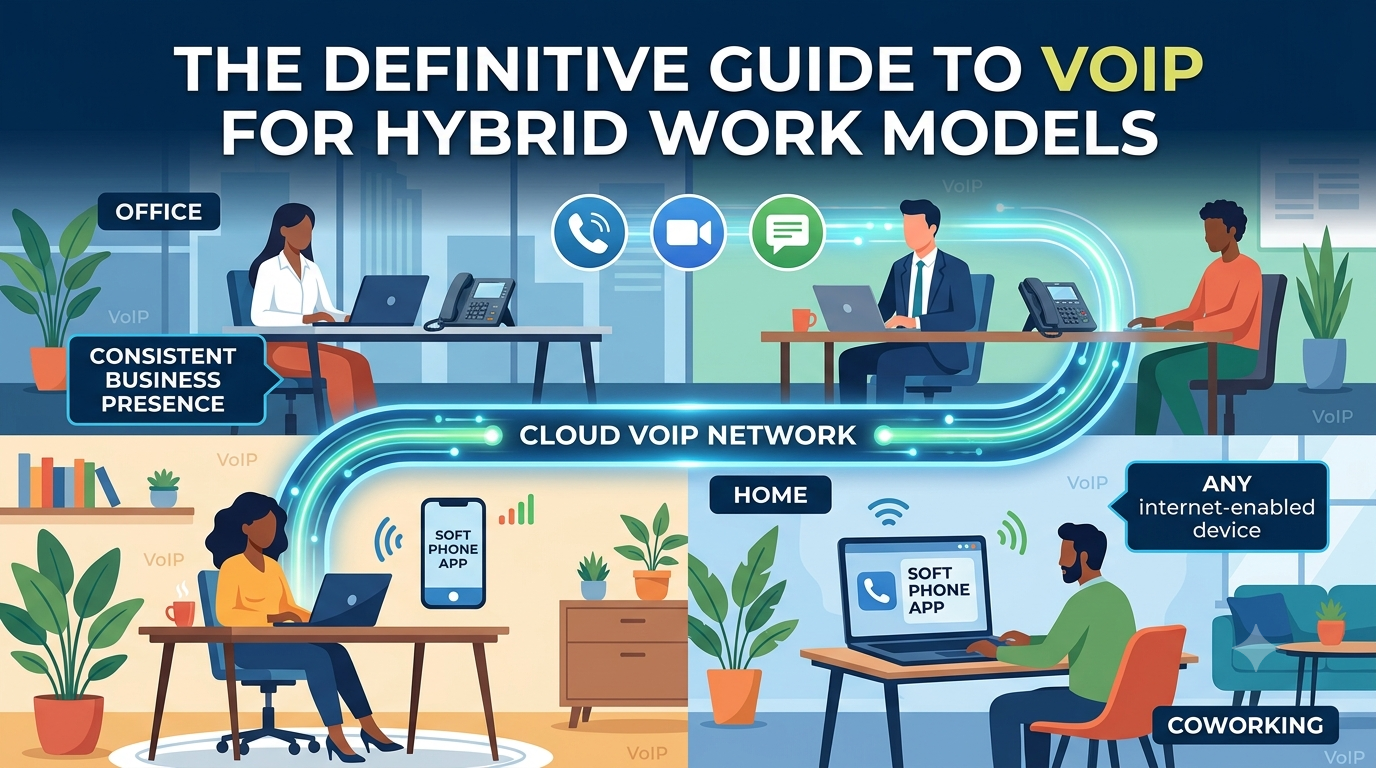
VoIP for Hybrid Work Models represents a transformative shift in how modern businesses communicate by replacing traditional copper-wire telephone systems with flexible, cloud-based technology. By converting voice signals into digital data packets transmitted over the internet, this technology allows employees to maintain a consistent business presence regardless of their physical location. Whether a team member is working from a corporate office, a home setup, or a remote coworking space, they can access their professional extension and collaboration tools through any internet-enabled device. This seamless integration ensures that communication remains fluid, professional, and uninterrupted in a distributed environment.
What is VoIP in a Hybrid Work Context?
In a modern professional environment, VoIP replaces traditional phone lines with internet-based calling, creating a unified communication layer. For businesses implementing VoIP for Hybrid Work Models, this means employees can use the same business phone number whether they are at the office, at home, or traveling for client meetings. The technology operates on the principle of mobility, allowing calls to be answered on desk phones, laptops, or specialized mobile apps. This versatility gives teams the flexibility to work from anywhere without the client ever knowing the difference in the employee’s physical location.
The integration of VoIP for Hybrid Work Models goes beyond simple voice calls; it incorporates video conferencing, instant messaging, and file sharing into a single interface. By centralizing these functions, companies eliminate the need for multiple disparate subscriptions, which often lead to communication silos. When an employee logs into their softphone application on their laptop, they have access to the same directory, call history, and voicemail as they would on their physical desk phone. This level of consistency is the foundation of a successful hybrid strategy, ensuring that operational standards remain high regardless of the workspace.
How VoIP is Powering Hybrid Working
The shift toward flexible working has accelerated the adoption of cloud-based communications, making VoIP for Hybrid Work Models a central pillar of corporate infrastructure.
According to a study by Global Workplace Analytics, nearly 56% of the American workforce holds a job that is compatible, at least partially, with remote work.
By leveraging high-speed internet, VoIP systems enable real-time synchronization across various time zones and regions. This capability is essential for companies looking to tap into global talent pools while maintaining a cohesive culture. The ability to route calls intelligently based on staff availability ensures that customer service levels do not drop when employees are working from home. Furthermore, the integration of team messaging and voip allows for a “presence” feature, where colleagues can see if someone is on a call, in a meeting, or available for a quick chat, mimicking the organic interactions of a physical office.
Are Fixed Phone Lines the Thing of the Past?
As we look toward the future of telecommunications, traditional Public Switched Telephone Network (PSTN) lines are rapidly becoming obsolete. Fixed lines are inherently tied to a specific physical location, which is a major bottleneck for companies adopting VoIP for Hybrid Work Models. If an office closes for the day or an employee is working remotely, a fixed line requires complex and often expensive call forwarding setups that may not always function reliably. In contrast, cloud-based systems are location-independent, meaning the “line” follows the user rather than the building.
The maintenance of hardware for traditional lines is also a significant burden for modern IT departments. Legacy systems require on-site PBX hardware that needs regular servicing and manual upgrades. VoIP for Hybrid Work Models removes this physical constraint, as the “brain” of the phone system resides in the cloud and is maintained by the service provider. For businesses, this translates to less downtime and the ability to scale up or down without calling a technician to install new wiring. The flexibility offered by the best voip services for remote and hybrid teams makes the choice to move away from fixed lines almost inevitable for growing companies.
How Does VoIP Allow Employees to Work from Home?
The primary mechanism that allows VoIP for Hybrid Work Models to function for remote staff is the “softphone” application. This is a software program installed on a computer or smartphone that functions exactly like a physical desk phone. Employees can dial numbers, transfer calls, and host conference calls directly from their work laptops. Because the system is hosted in the cloud, all the settings and preferences for an employee’s extension are stored online. When they log in from their home Wi-Fi, the system recognizes their identity and routes their calls accordingly.
Security is another critical aspect of how these systems support home-based work. Modern VoIP solutions often include encrypted signaling and media, ensuring that sensitive business conversations remain private even over residential internet connections. Additionally, many companies utilize the best mdm for hybrid teams with remote workers to manage these communication apps on personal or company-issued devices. This allows IT managers to push updates, ensure security protocols are met, and remotely wipe data if a device is lost, providing a secure environment for remote professional communication.
The Benefits of VoIP over Fixed Line Phone Systems for Hybrid Working
1. Provides Employee Flexibility
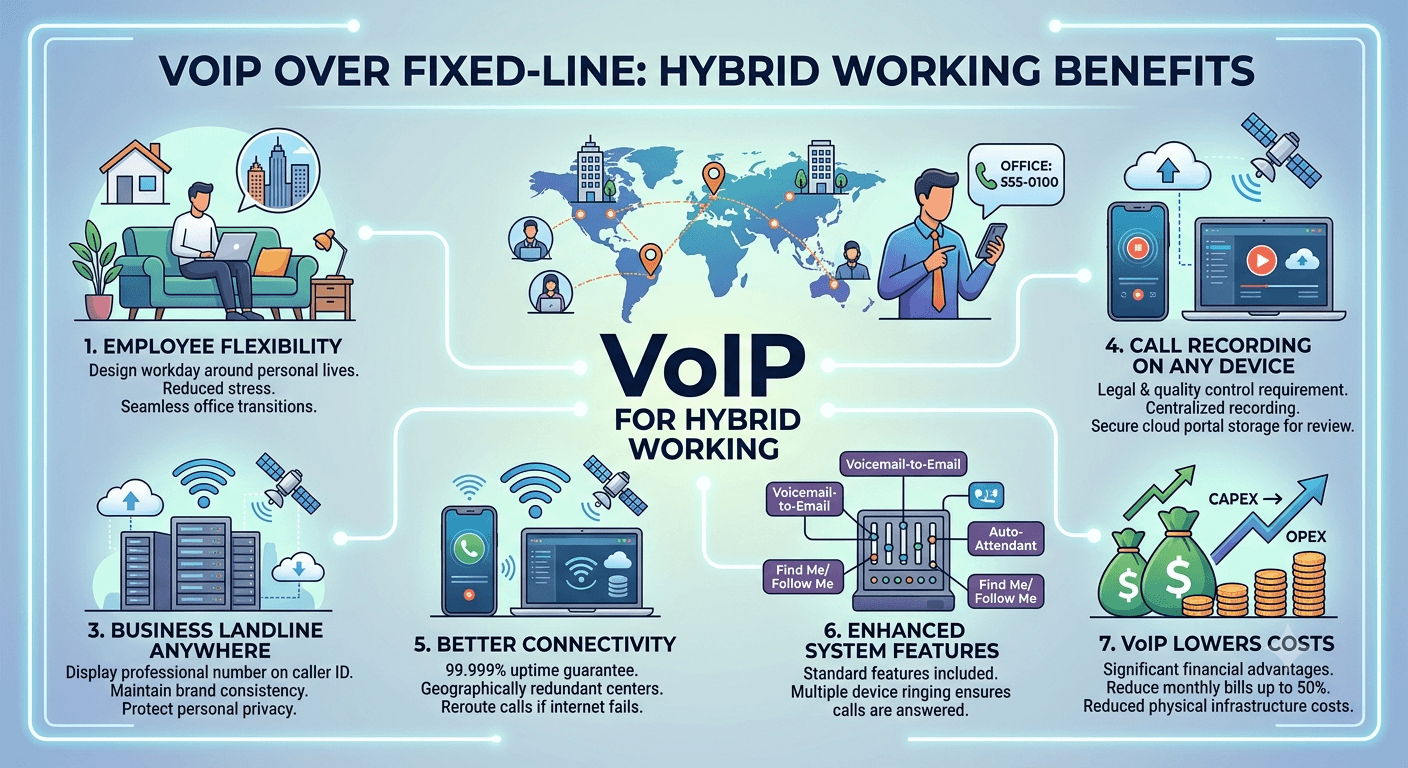
The implementation of VoIP for Hybrid Work Models allows employees to design their workday around their personal lives without sacrificing professional availability. This flexibility is a key driver in employee retention and satisfaction, as it reduces the stress of being tethered to a physical desk. With a cloud-based system, an employee can start their morning answering calls from their home office and transition to the physical office in the afternoon without any disruption to their communication flow.
2. Connect with Multiple Employees Across Multiple Locations
VoIP for Hybrid Work Models excels at bridging the geographical gap between distributed team members. Whether a company has five employees in different states or five hundred across different continents, the system treats them as if they are in the same building. Extension-to-extension dialing remains free and instantaneous, which encourages frequent collaboration and helps maintain the social fabric of the organization even when people rarely meet in person.
3. Use Your Business Landline Anywhere
One of the most professional benefits of VoIP for Hybrid Work Models is the ability to display a professional business number on caller ID, regardless of the device used. When an employee makes a call from their personal mobile phone using the VoIP app, the client sees the company’s office number. This maintains a high level of brand consistency and protects the employee’s personal privacy by keeping their private cell phone number hidden from the public.
4. Call Recording on any Device
In many industries, maintaining records of conversations is a legal or quality control requirement. VoIP for Hybrid Work Models makes call recording simple and centralized. Unlike traditional systems that might require expensive hardware at each location, cloud VoIP allows managers to record and store calls from any device used by the employee. These recordings are typically stored in a secure cloud portal where they can be reviewed for training or compliance purposes at any time.
5. Better Connectivity
Reliability is a cornerstone of VoIP for Hybrid Work Models. Most top-tier providers offer 99.999% uptime guarantees, utilizing geographically redundant data centers to ensure service is never interrupted. If one internet connection goes down, calls can be automatically rerouted to a mobile device or another office location. This level of redundancy is far superior to traditional lines, which can be knocked out by local physical damage to a single telephone pole or exchange.
6. Enhanced System Features
Legacy phone systems often charge extra for basic features like voicemail-to-email, auto-attendants, or detailed call analytics. With VoIP for Hybrid Work Models, these features are usually included as standard. Advanced functionalities like “find me/follow me” services ensure that a call rings on an office phone first, then a mobile app, and finally a home office phone, making it virtually impossible for an important client call to go unanswered during business hours.
7. VoIP Lowers Costs
The financial advantages of moving to VoIP for Hybrid Work Models are significant for both small businesses and large enterprises. By eliminating the need for expensive physical infrastructure and per-minute long-distance charges, companies can reduce their monthly telecommunications bills by up to 50%.
Research from Deloitte suggests that businesses transitioning to cloud-based communications can save significantly on operational overhead by moving from a CapEx (capital expenditure) model to an OpEx (operating expenditure) model.
Hybrid Work Models: How to Prepare Your Office
Preparing a physical office for VoIP for Hybrid Work Models requires a shift in how the local network is managed. Since the phone system now shares the same bandwidth as the company’s data, ensuring a robust and stable internet connection is the first priority. Quality of Service (QoS) settings should be configured on office routers to prioritize voice traffic over less urgent data, like large file downloads or background updates. This prevents “jitter” or dropped calls during peak usage times in the office.
Beyond the technical setup, the physical layout of the office may need to change to support a hybrid staff. Since not all employees will be in the office at the same time, companies are moving toward “hot-desking,” where desks are not assigned to specific people. VoIP for Hybrid Work Models supports this by allowing employees to “log in” to any desk phone with their unique credentials. This turns any workstation into their personal office extension instantly, providing a seamless transition between their home and office environments.
Keys to Successful Hybrid Work Models
Develop a Strategy
To successfully implement VoIP for Hybrid Work Models, leadership must look ahead and plan for future growth. A strategy should involve anticipating issues that may impact the business, such as fluctuating staff numbers or changing regional regulations. Forward-looking leadership allows a business to remain agile. When developing your strategy, consider the following points to guide your decisions:
Analyze how your employees currently collaborate and where the friction points are in your existing system.
Determine how your business handles customer service and whether a cloud transition could speed up resolution times.
Evaluate your current hardware to see if it can be repurposed or if a full migration to softphones is more efficient.
Assess your team’s readiness for new technology and plan for a phased rollout if necessary to ensure smooth adoption.
Create a System of Employee Support
The human element is the most important part of any VoIP for Hybrid Work Models rollout. Leaders must act as support pillars, especially when transitioning away from traditional office norms. Fostering a culture of connection is essential when team members are physically separated. This involves more than just providing the tools; it requires active listening and adjustment to employee needs.
Establish open communication channels where remote and in-office workers can interact casually, reducing the “out of sight, out of mind” feeling.
Ask specific questions regarding workload management and how changing personal circumstances might affect their availability.
Listen to feedback about the technology—if an employee is struggling with call quality at home, work with them to troubleshoot their internet setup.
Conduct regular “check-ins” that focus on mental well-being and team morale rather than just project deadlines.
Utilize Communications Solutions
In the current market, having an optimized communications system is a non-negotiable requirement for success. Whether a business is fully remote or utilizes VoIP for Hybrid Work Models, the technology must be dependable. Streamlined solutions help businesses remain competitively relevant by ensuring that no customer query goes unanswered due to technical limitations.
Leveraging the best voip services with mobile apps for distributed teams 2026 ensures that your infrastructure is future-proof. These solutions offer integrated video and messaging, which are vital for maintaining team cohesion. By using a single provider for all communication needs, businesses reduce the complexity of their IT stack and make it easier for employees to master the tools they use every day. This holistic approach to technology is what separates successful hybrid companies from those that struggle with the transition.
Common Hybrid Work Challenges VoIP Helps Solve
1. Missed Calls
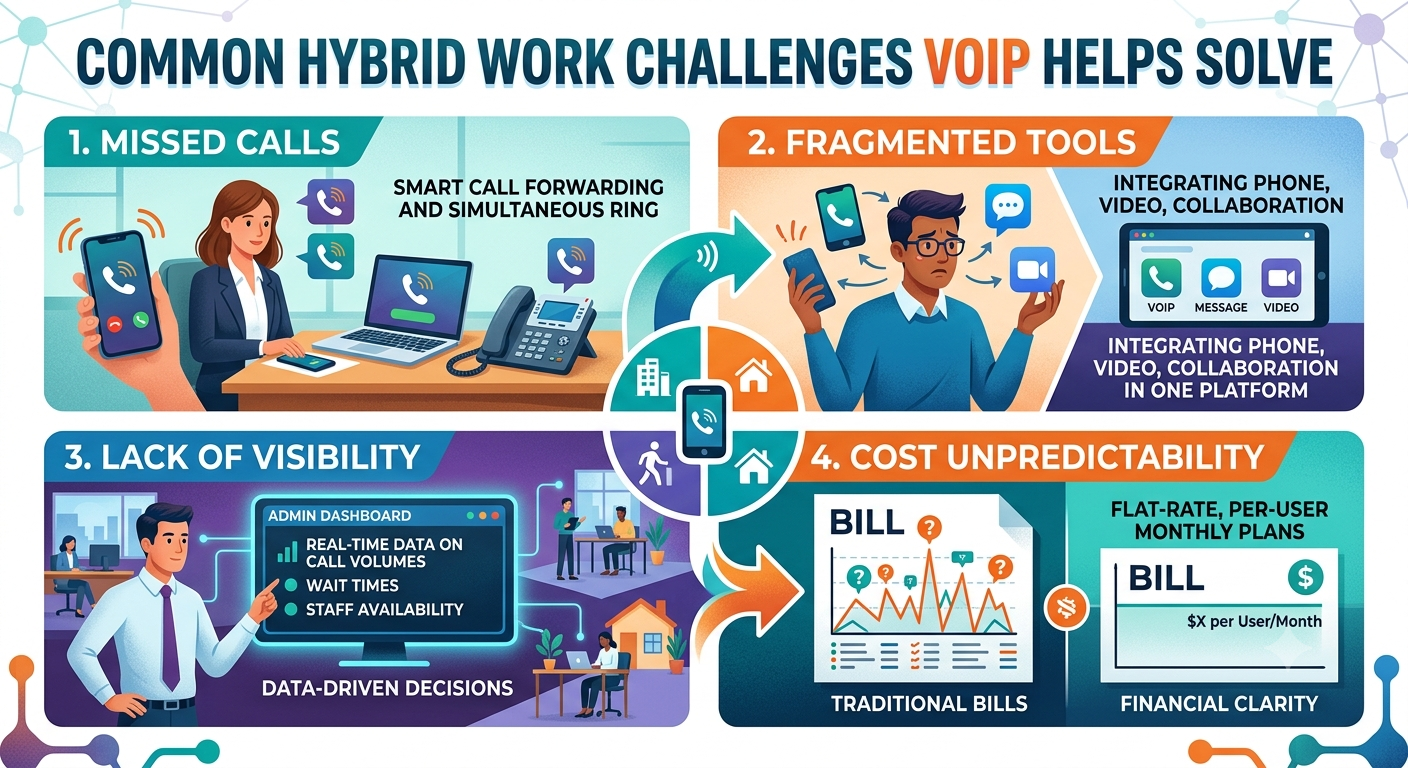
In a traditional setup, if an employee isn’t at their desk, the call usually goes to a generic voicemail. VoIP for Hybrid Work Models solves this through smart call forwarding and simultaneous ring features. This ensures that the employee is reachable on their mobile app or home computer at the same time as their office phone. By reducing the number of missed calls, businesses improve customer satisfaction and ensure that time-sensitive opportunities are never lost due to a simple change in location.
2. Fragmented Tools
Many businesses suffer from “app fatigue,” where employees have to switch between five different platforms for calling, texting, video, and project management. VoIP for Hybrid Work Models solves this by integrating phone, video, and collaboration into one platform. When team messaging and voip are combined, an employee can transition a text chat into a voice call or a video meeting with a single click. This consolidation saves time and reduces the mental load of managing multiple logins and interfaces.
3. Lack of Visibility
One of the biggest concerns for managers in a distributed environment is understanding how work is being handled. VoIP for Hybrid Work Models provides admin dashboards that offer real-time data on call volumes, average wait times, and staff availability. This visibility allows managers to make data-driven decisions about staffing levels. If a manager sees that call wait times are increasing, they can quickly reassign remote staff to help handle the load, ensuring that service levels remain consistent regardless of where the staff is located.
4. Cost Unpredictability
Traditional phone bills can vary wildly based on long-distance calls and hardware repairs. VoIP for Hybrid Work Models typically operates on a flat-rate, per-user monthly plan. This provides businesses with financial clarity and makes budgeting for growth much simpler. There are no hidden costs for adding new features or scaling the system to include new hires. This predictability is especially beneficial for small to medium-sized enterprises that need to manage their cash flow tightly while expanding their hybrid operations.
Actionable Tips for Implementing VoIP in a Hybrid Model
Implementing a new communication system requires more than just a subscription; it requires a thoughtful rollout. Before choosing a provider for VoIP for Hybrid Work Models, it is essential to map out your team’s specific communication needs. Do they need heavy CRM integration? Are they primarily using mobile devices? Answering these questions early will prevent you from paying for features you don’t need or missing out on ones that are critical to your workflow.
Once a provider is selected, rigorous testing of the mobile apps is a priority. Ensure that remote staff get the same call quality as office staff by testing the app on various network speeds. Additionally, take full advantage of the built-in analytics to track how calls are being handled. Use this data to refine your call routing strategies. Finally, invest time in training employees on advanced features like call park, hot-desking, and video integration so the business gets the full value of the VoIP for Hybrid Work Models investment.
VoIP and the Logistics of Scalability
When discussing the growth of a business, we often look at how physical resources are managed. For example, some companies follow best practices for scaling ppe programs hybrid work to ensure that safety and physical gear are distributed correctly as teams grow. VoIP for Hybrid Work Models offers a similar but much more efficient scalability for communications. Adding a new user to a digital phone system takes minutes rather than the days or weeks it would take to install new physical phone lines.
This digital scalability is a major competitive advantage. As a company expands into new markets, they can instantly acquire local phone numbers in those regions through their VoIP provider. This gives the business a local presence without the need for a physical office in that city. The ability to scale the communication infrastructure at the same pace as the workforce ensures that the company’s internal and external connectivity never becomes a bottleneck for growth.
Read More: Cheap VoIP For Restaurants USA : A Comprehensive Guide
Final Thought
Adopting VoIP for Hybrid Work Models is no longer an optional upgrade but a fundamental requirement for the modern, agile business. By breaking the tether to the physical office, VoIP empowers employees with flexibility, enhances collaboration across distances, and significantly reduces operational costs. As the landscape of work continues to evolve toward a more distributed and flexible future, the businesses that thrive will be those that embrace these cloud-based solutions to keep their teams connected and their customers satisfied.
Frequently Asked Questions
What is hybrid-working?
Hybrid working is an operational model that allows employees to split their time between working in a central office and working remotely, usually from home. This model focuses on flexibility, allowing teams to leverage the benefits of in-person collaboration while also enjoying the autonomy and reduced commute times associated with remote work. For this model to be successful, businesses must utilize digital tools like VoIP to ensure that communication remains seamless regardless of where the individual is located on any given day.
What technology is helpful for hybrid working?
The most helpful technology for this model includes cloud-based communication platforms like VoIP, project management software, and secure VPNs or MDM solutions. VoIP for Hybrid Work Models is particularly critical as it handles the primary external and internal voice communication. Additionally, video conferencing tools, collaborative cloud documents, and instant messaging apps are essential for maintaining the real-time flow of information between office-based and remote staff members.
What’s the best VoIP phone system?
The best system depends on your specific business size and needs, but top-tier providers often include RingCentral, Nextiva, and 8×8. These services are highly rated because they offer robust mobile apps, extensive integrations with other business software, and high reliability. When choosing the best voip services for remote and hybrid teams, look for a provider that offers 24/7 support and a user-friendly interface that requires minimal training for your employees to master.
How easy is it to start hybrid working?
Starting a hybrid model is relatively simple if you have the right digital infrastructure in place. The first step is transitioning your communication to a cloud-based VoIP system, which can often be done without any downtime. Once the technology is set, establishing clear policies regarding office attendance and communication expectations is key. With the right VoIP for Hybrid Work Models, the technical transition can happen in a few days, allowing the company to focus on the cultural shift of managing a distributed team.
Can VoIP work with my existing office hardware?
Yes, many VoIP systems are compatible with existing IP phones, and for older analog phones, you can use an Analog Telephone Adapter (ATA). However, to fully leverage VoIP for Hybrid Work Models, many companies prefer to use softphones on laptops or mobile apps. This reduces the need for physical hardware and allows for greater mobility. If you have high-quality IP desks phones already, your new VoIP provider can usually “provision” them to work with the new cloud service.
Is VoIP secure for remote employees?
Modern VoIP providers use advanced encryption protocols to secure voice data as it travels over the internet. This makes VoIP for Hybrid Work Models highly secure, often more so than traditional phone lines which can be physically tapped. To enhance security further, businesses can use multi-factor authentication for their VoIP apps and ensure that all remote work is conducted over a secure internet connection.
Do I need a special internet connection for VoIP?
While you don’t need a “special” type of internet, you do need a stable and high-speed connection. For VoIP for Hybrid Work Models to function clearly, the connection should have low latency and sufficient bandwidth to handle voice data alongside other tasks. Most standard fiber or high-speed cable internet connections are more than enough for high-quality VoIP calling, even when multiple people are using the connection simultaneously.
How does VoIP handle emergency calls like 911?
VoIP systems use a feature called E911 (Enhanced 911) to handle emergency calls. Because VoIP for Hybrid Work Models is location-independent, users must register their physical address with the service provider. When a 911 call is placed, the system automatically sends this registered address to the emergency dispatcher. It is important for hybrid workers to update their location in the system if they move to a different long-term remote work location.