

Implementing a high-quality voip for law firms allows legal professionals to streamline client communications, enhance data security, and reduce overhead costs significantly. Unlike traditional landlines, a legal voip system operates over the internet, providing features such as automated call recording, advanced encryption, and seamless integration with practice management software. By adopting a modern law office phone system, firms can ensure their attorneys remain accessible whether they are in the courtroom, at home, or in the office. This flexibility, combined with professional features like interactive voice response and multi-site connectivity, makes voip solutions for law firms the superior choice for modern practice.
How VoIP Improves Law Firms’ Communication
The legal industry has traditionally relied on legacy hardware that often lacks the flexibility required for today’s fast-paced environment. By transitioning to a voip for law firms, partners and associates can enjoy a unified communication platform that bridges the gap between different office locations. This digital transformation ensures that every client call is handled with the highest level of professionalism, regardless of the physical location of the staff member answering the phone. Modern systems allow for a centralized management interface where administrators can oversee all communication channels from a single dashboard.
Communication in a law firm is not just about making calls; it is about managing information and maintaining accessibility. Using a law firm phone system ensures that missed calls are a thing of the past, as intelligent routing can send calls to multiple devices simultaneously. This means a lawyer can answer a critical inquiry on their mobile device while traveling between meetings, maintaining a consistent professional presence. Furthermore, the ability to transition from a voice call to a video conference or a secure chat session within the same platform enhances the collaborative capabilities of the entire legal team.
What is VoIP Telephony?
VoIP, or Voice over Internet Protocol, is a technology that allows you to make voice calls using a broadband internet connection instead of a regular phone line. For lawyers, this means that their law office phone system is no longer tied to a desk; it is tied to their digital identity. This technology supports various devices, including specialized IP phones, computers, and mobile applications, all functioning under a single business number. It simplifies the infrastructure of the office by using the same network for both data and voice, reducing the complexity of managing separate service providers.
Specific Benefits of VoIP PBX for Law Firms
The implementation of a Private Branch Exchange (PBX) hosted in the cloud offers several advantages that are specifically beneficial for legal environments. One of the primary benefits is the ability to maintain a professional image through custom greetings and automated attendants that guide callers to the right department or attorney. This ensures that even small firms can appear as established and organized as their larger counterparts. Additionally, the cloud-based nature of these systems means that they are naturally resilient to local power outages or physical disasters that might take an on-site system offline.
1. Improved Operational Efficiency
Operational efficiency is greatly enhanced when a legal voip system is integrated with other business applications. For instance, when a call comes in, the system can automatically pull up the client’s file in the practice management software, allowing the attorney to have all relevant case details at their fingertips. This reduces the time spent searching for information and allows the legal team to provide immediate and accurate updates to their clients. Streamlining these small interactions throughout the day leads to significant cumulative time savings for the entire firm.
2. Increased Security and Compliance
Security is a non-negotiable aspect of any law practice, and modern voip for lawyers includes advanced encryption protocols to protect sensitive conversations. These systems are often built to meet or exceed industry standards for data protection, ensuring that attorney-client privilege is maintained even in a digital environment. Features like encrypted call recording and secure access controls help firms stay compliant with local and national regulations regarding data privacy.
According to a report by Deloitte, professional services firms moving to cloud communications can see a productivity boost of nearly 20% due to streamlined and secure workflows.
3. Integration with Digital Tools
The ability to link a law firm voip phone system with tools like Microsoft Outlook, Slack, or specialized legal software is a game-changer. This integration allows for automated logging of call times, which simplifies the billing process and ensures that every billable minute is accounted for. Instead of manually entering call durations into a ledger, the system can sync the data directly to the client’s billing account. This not only reduces human error but also ensures that the firm is compensated fairly for all the time spent on client communications.
Benefits of Using VoIP Phone Systems for Your Law Practice
One of the most immediate benefits that partners notice after switching to voip for law firms is the significant reduction in monthly expenses. Traditional phone companies often charge high fees for long-distance calls, maintenance, and per-line rentals that can add up quickly. A legal voip system typically operates on a subscription-based model with flat rates, including unlimited local and long-distance calling. This predictable cost structure makes it much easier for firms to manage their monthly budgets and forecast future growth without worrying about fluctuating communication bills.
Beyond cost, the scalability offered by a law firm phone system is unparalleled in the world of telecommunications. As a firm grows, adding a new user is as simple as creating a new account in a web portal and plugging in a headset or IP phone. There is no need for a technician to come to the office to run new wires or configure complex hardware. This flexibility allows firms to adapt to changes in their workforce, such as bringing on summer associates or expanding into a new branch office, with minimal effort and zero downtime.
VoIP PBX Features that Enhance Communication for Law Firms
The features provided by a modern legal phone system are specifically tailored to meet the rigorous communication needs of a busy practice. These tools go beyond simple calling and provide a comprehensive platform for managing all client interactions. By utilizing these features, firms can improve their responsiveness and ensure that every communication is documented and accessible. This level of organization is crucial for managing complex cases that involve multiple parties and high volumes of information.
Research indicates that 67% of law firms have increased their budget for cloud-based tools to support remote litigation and hybrid client consultations over the last two years. This trend highlights the growing importance of having a robust communication infrastructure that can support diverse working styles. By leveraging these features, firms can stay ahead of the curve and provide a level of service that matches the digital expectations of modern clients.
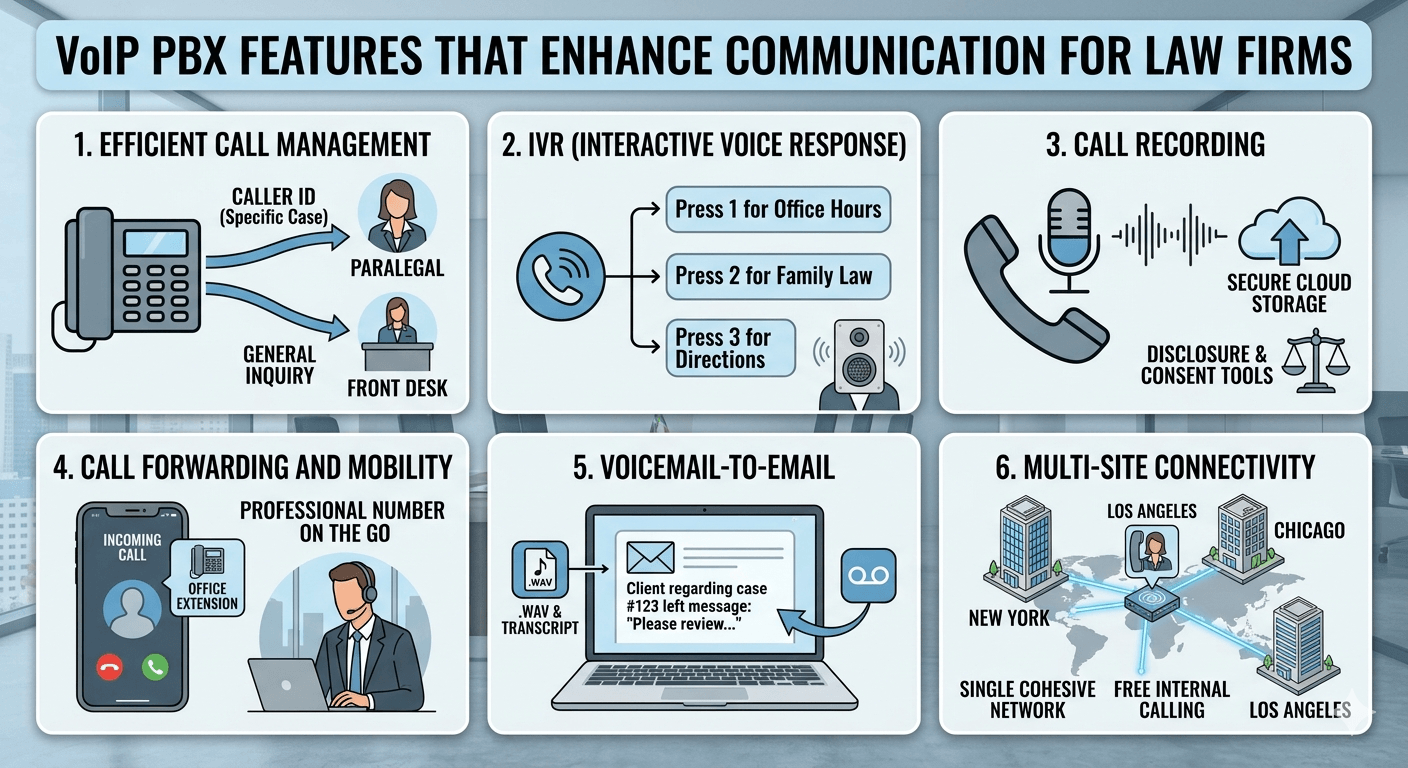
1. Efficient Call Management
Call management in a legal setting involves more than just answering the phone; it requires precise routing to ensure that the right person handles the right inquiry. With a legal voip system, you can set up advanced routing rules based on the time of day, the caller’s ID, or the department they wish to reach. For example, calls regarding a specific case can be routed directly to the paralegal assigned to that matter, while general inquiries go to the front desk. This ensures that clients are connected to the most helpful resource as quickly as possible.
2. IVR (Interactive Voice Response)
An IVR system acts as an automated receptionist that can greet callers and offer them a menu of options. This is a vital feature for voip for lawyers because it helps filter calls before they ever reach a staff member. A firm can set up an IVR that allows callers to hear office hours, get directions to the office, or select a specific practice area like family law or criminal defense. This not only improves the caller’s experience by providing immediate information but also frees up the administrative staff to focus on more complex tasks.
3. Call Recording
Call recording is an essential feature for many law firms, providing a reliable record of client instructions and legal discussions. A voip system for law firms allows for automatic or on-demand recording that is stored securely in the cloud. These recordings can be used for training purposes, to resolve disputes regarding what was said during a call, or as a reference for complex legal details. It is important to ensure that call recording is done in compliance with local privacy laws, and modern VoIP systems provide the necessary tools to play disclosures or seek consent as required.
4. Call Forwarding and Mobility
Mobility is a key requirement for modern attorneys who spend significant time out of the office. The call forwarding and mobile app features of a law office phone system allow users to take their office extension with them on their smartphones. This means that when a client calls the office number, the attorney’s mobile phone rings, allowing them to maintain a professional appearance without giving out their private cell number. This separation of personal and professional life is highly valued by many legal professionals.
5. Voicemail-to-Email
Voicemail-to-email is a simple but powerful feature that sends a recording and often a transcript of a voicemail directly to an attorney’s email address. This allows for quicker review of messages, as reading a transcript is often faster than listening to a recording. It also makes it easier to archive messages by saving them directly into a client’s digital folder. This feature ensures that even if an attorney is in court all day, they can quickly scan their emails during a break to see if any urgent matters require their attention.
6. Multi-Site Connectivity
For firms with multiple offices, a legal phone system can unite all locations under a single, cohesive network. This allows for free internal calling between offices, regardless of where they are located geographically. It also enables a centralized receptionist to manage calls for all locations, which can lead to significant cost savings by reducing the need for administrative staff at every site. Multi-site connectivity ensures that the firm functions as a single entity, providing a consistent experience for both employees and clients.
Specific VoIP Use Cases for Law Firms
Different types of law practices have unique needs when it comes to their communication systems. A solo practitioner requires a system that makes them look established and ensures they never miss a lead, while a large international firm needs a system that can handle thousands of simultaneous calls across various time zones. Understanding what are the voip solutions helpful for law firms depends largely on the scale and scope of the practice. Fortunately, the inherent flexibility of VoIP technology means it can be customized to fit any of these scenarios perfectly.
-
Small and Mid-Size Law Firms
For smaller firms, the primary goal is often professional branding and cost control. Using voip for lawyers allows a small team to have features like music-on-hold, professional greetings, and extension-to-extension dialing that make them appear larger and more organized. The low entry cost of a cloud-based legal phone system is particularly attractive for firms that want high-end features without a massive upfront investment. It allows them to compete with larger firms on a more level playing field by providing a seamless and professional client intake process.
-
Large Firms with Multiple Offices
Large firms require a law firm phone system that is robust, reliable, and capable of high-volume traffic. In these environments, the focus shifts toward advanced management tools and disaster recovery. A centralized administration portal allows the IT department to manage thousands of users and monitor system health in real-time. Additionally, the ability to quickly reroute calls in the event of an office closure ensures business continuity. Large firms also benefit from the deep analytics provided by these systems, which help in auditing communications for compliance and quality control.
-
International Law Firms
International law firms face the challenge of coordinating across different countries, languages, and time zones. A law office phone system for an international practice can provide local phone numbers in various countries, allowing international clients to call a local number to reach their legal team. This significantly lowers the barrier for global clients and enhances the firm’s international presence. Furthermore, the use of a unified voip system for law firms ensures that internal communications remain secure and cost-effective, regardless of the distance between offices.
Implementing a Legal VoIP System in Your Practice
The process of implementing a new legal phone system is more straightforward than most people expect. Because the system is largely software-based, there is no need for invasive construction or extensive rewiring of the office. Most law firms can transition to their new system over a weekend, ensuring that there is no disruption to their regular business operations. The key to a successful implementation is working with a provider that understands the specific needs of the legal industry and can guide you through the configuration of your new system.
-
Evaluate your current internet bandwidth to ensure it can handle the additional voice traffic without compromising speed.
-
Select the hardware that best fits your needs, whether it is physical IP desk phones, headsets for computers, or mobile apps.
-
Design your call flow, including your IVR menus, ring groups, and voicemail configurations.
-
Port your existing phone numbers to the new legal voip system to maintain continuity for your clients.
-
Train your staff on the new features, such as call recording, conference calling, and integration with legal software.

-
Easy Integration Without Expensive Hardware
One of the best aspects of modern voip for law firms is the ability to use your existing infrastructure. If you already have high-quality computers and a reliable network, you may only need to purchase a few headsets to get started. Many firms choose to use “softphones,” which are software applications that turn a computer or tablet into a fully functional phone. This eliminates the need for expensive physical hardware and allows for a more flexible and modern workspace. For those who prefer the feel of a traditional phone, IP-enabled desk phones are available at a wide range of price points.
-
The Importance of a Robust Internet Connection
Since a legal phone system relies entirely on your internet connection, having a stable and fast broadband service is essential. It is often recommended that firms have a dedicated internet line for their voice traffic or use routers that support Quality of Service (QoS). QoS allows the router to prioritize voice packets over other types of data, like large file downloads or web browsing, ensuring that your calls are always clear and free of jitter. Investing in a high-quality internet connection is a small price to pay for the reliability and features that VoIP provides.
-
Utilize Your Existing Hardware with ATA Adapters
If your firm has invested heavily in traditional analog phones and you are not ready to replace them, you can use Analog Telephone Adapters (ATA). These small devices plug into your internet connection and allow your old analog phones to function on a voip for law firms network. This can be a great way to transition to a newer system while spreading out the cost of hardware upgrades over time. While you may not get all the advanced display features of a modern IP phone, the core benefits of a legal voip system will still be accessible to your team.
-
No Extensive Training Required for Law Firm Staff
Modern voip solutions for law firms are designed to be intuitive and user-friendly. Most attorneys and administrative staff can learn the basic functions of the system within a few minutes. The interfaces for making calls, checking voicemails, and setting up conference calls are often similar to the apps people use every day on their personal smartphones. Providing a brief training session or a simple “quick start” guide is usually all that is needed to ensure that everyone in the firm is comfortable and productive with the new legal phone system.
Economic and Security Advantages of Modern Legal Phone Systems
The financial benefits of adopting a voip for law firms extend beyond just lower monthly bills. The reduction in maintenance costs is significant, as there are no on-site servers to maintain or specialized technicians to hire for every minor change. Most updates and troubleshooting can be handled remotely by the service provider, which is often included in the monthly subscription fee. This allows law firms to reallocate their IT budget toward other strategic initiatives, such as cybersecurity or legal research tools, rather than just maintaining a phone line.
Security remains a top priority, and a high-quality law firm phone system provides multiple layers of protection. Data centers used by top-tier VoIP providers are equipped with physical security, redundant power supplies, and advanced firewalls to prevent downtime and data breaches. Furthermore, the use of Transport Layer Security (TLS) and Secure Real-time Transport Protocol (SRTP) ensures that your calls are encrypted from end to end. This level of protection is essential for maintaining client trust and adhering to the ethical obligations of the legal profession.
ROI of Implementing a Law Firm VoIP Phone System
When evaluating the return on investment (ROI) for a legal voip system, it is important to look at both direct and indirect savings. Direct savings include lower call rates, reduced hardware costs, and the elimination of separate long-distance charges. Indirect savings come from increased productivity, as staff spend less time on administrative phone tasks and more time on billable work. Additionally, the ability to support remote work can lead to savings on office space and utilities, as well as improved employee retention by offering a better work-life balance.
-
Direct cost reduction on monthly telecommunication bills by up to 50% in many cases.
-
Reduced need for dedicated on-site IT staff to manage telephony hardware.
-
Lower hardware acquisition costs compared to traditional PBX systems.
-
Increased billable hours through automated call logging and tracking integrations.
Read More: Best Free Messaging Apps Without Phone Number for Ultimate Privacy
Final Thought
Transitioning to a dedicated voip for law firms is one of the most impactful upgrades a practice can make in 2026. By combining cost-efficiency with high-end features like call recording, seamless mobility, and robust security, these systems provide a complete communication solution for the modern legal professional. Whether you are a solo attorney or part of a global firm, a legal voip system ensures that you remain connected, compliant, and professional at all times. Ultimately, the right technology allows your firm to focus on what matters most: providing exceptional legal representation to your clients.
Frequently Asked Questions
-
Do lawyers use VoIP?
Lawyers across the globe have widely adopted VoIP technology because it meets their unique needs for mobility, security, and integration. A voip for law firms provides the necessary tools for remote depositions, secure client consultations, and automated billing that traditional phone systems simply cannot offer. As more legal work moves to digital and hybrid models, the use of a legal voip system has become the industry standard for maintaining professional and reliable communication channels.
-
What is the main advantage of VoIP?
The main advantage of a legal voip system is its incredible flexibility and cost-effectiveness compared to traditional landlines. It allows law firms to access a wide range of advanced features like IVR, call recording, and CRM integration without a massive upfront investment in hardware. Additionally, it provides attorneys with the mobility to work from anywhere while still appearing to be at their office desk, which is crucial for modern practice management and client satisfaction.
-
What is a legal voip system?
A legal voip system is a specialized communication platform designed to handle the specific security, privacy, and billing requirements of the legal profession. These systems often include advanced encryption to protect attorney-client privilege and integrate directly with legal practice management software to track billable time. By choosing a system tailored for lawyers, firms can ensure they stay compliant with industry regulations while enjoying the benefits of modern cloud-based telephony.
-
Is it safe to use VoIP for confidential communications?
Yes, using voip for law firms is very safe as long as the provider uses strong encryption protocols such as SRTP and TLS. These technologies scramble the voice data packets, making it virtually impossible for unauthorized parties to intercept or listen to your calls. Most reputable providers of a law firm voip phone system prioritize security and compliance, offering a level of protection that often exceeds what is available through traditional, unencrypted analog phone lines.
-
How can VoIP improve customer service in a law firm?
A legal phone system improves customer service by ensuring that clients can always reach someone who can help them. Features like automated attendants, ring groups, and find me/follow me ensure that calls are directed to the right person quickly. Additionally, the integration with client files allows attorneys to be better prepared for every call, providing a more personalized and efficient experience for the client. This responsiveness is key to building strong, long-lasting client relationships.
-
What happens if the internet goes down?
If your internet connection fails, most modern voip solutions for law firms have built-in disaster recovery features that automatically reroute calls to a mobile device or a secondary location. This ensures that your law firm phone system remains operational even if your physical office experiences a network outage. Many firms also choose to have a secondary, low-cost internet connection as a backup to ensure total continuity for their communication needs.
-
Why is everyone switching to VoIP?
Businesses and law firms are switching to VoIP because it offers more features for less money while supporting the modern need for remote and flexible work. The ability to integrate a law office phone system with other digital tools like email and billing software provides a level of efficiency that traditional phones cannot match. Furthermore, the sunsetting of old copper-wire telephone networks by many major telecommunications providers is making the transition to digital systems a necessity for all modern organizations.
-
Can I keep my current phone numbers?
Yes, you can almost always keep your existing phone numbers when you switch to a legal voip system through a process called number porting. Your new provider will work with your old carrier to transfer your numbers to the new platform, ensuring that there is no interruption in service for your clients. This allows you to maintain your established brand and contact information while upgrading your underlying technology to a more modern and capable law firm phone system.