
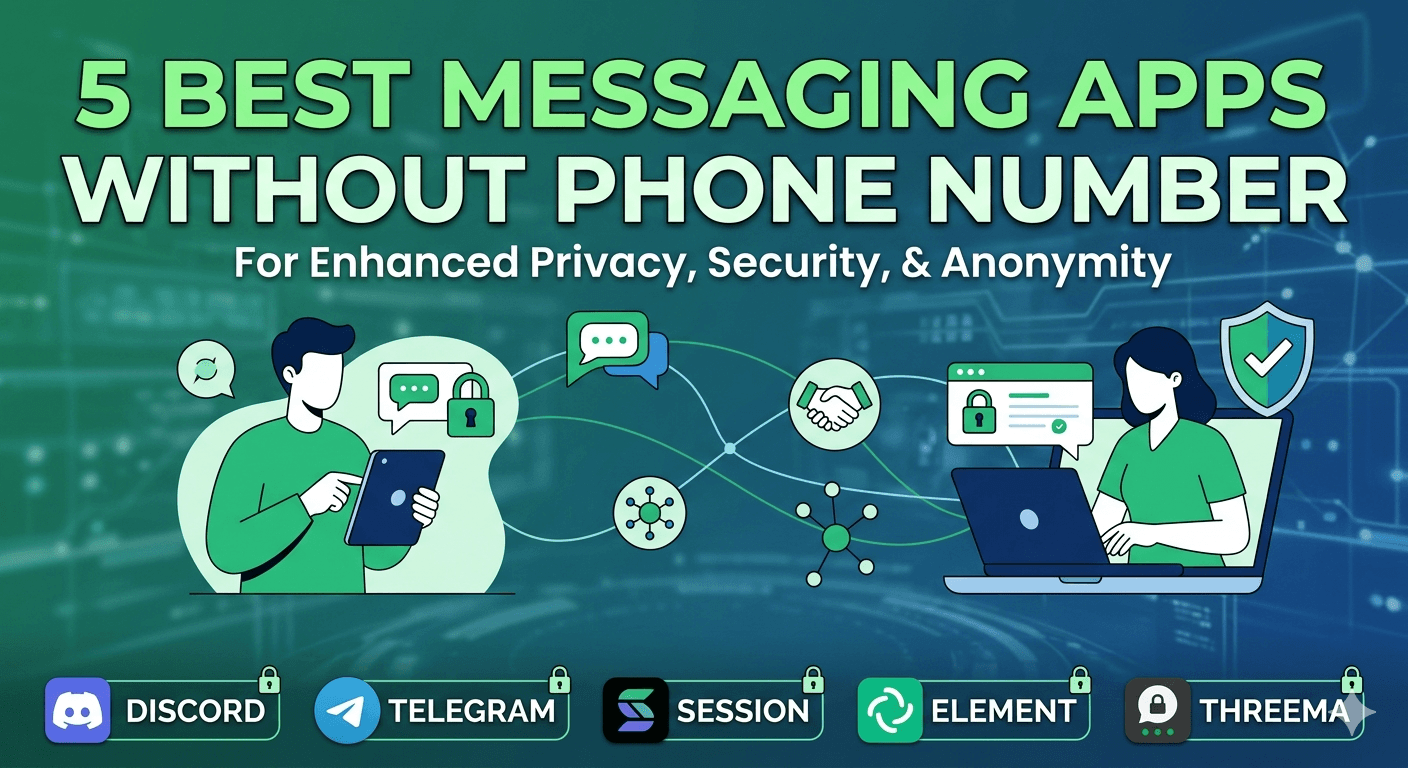
Finding free messaging apps without phone number is a priority for users seeking enhanced privacy and security. These applications allow you to communicate via Wi-Fi or mobile data without linking your personal cellular digits to an account. By using unique usernames, email addresses, or decentralized IDs, these platforms bypass traditional verification methods. Top choices include Discord, Telegram, and Session, which offer various features like encrypted chats, group rooms, and file sharing. Whether you want to avoid spam, maintain anonymity, or use a device without a SIM card, these apps provide a reliable and secure alternative to standard SMS and phone-linked messengers.
Why Use Messaging Apps Without Phone Numbers?
The shift toward privacy-conscious communication has made free messaging apps without phone number incredibly popular in recent years. One of the primary reasons people seek these platforms is to maintain anonymity. In an era where data breaches are common, giving out your primary phone number can expose you to identity theft, targeted advertising, and unsolicited spam calls. By choosing a platform that only requires a username or an email, you create a buffer between your digital identity and your real-world persona. This is particularly useful for online marketplaces, gaming communities, or professional networking where you might not want to share personal contact details immediately.
Another significant factor is the rise of multi-device usage. Many users own tablets or laptops that do not have cellular capabilities. Using free messaging apps without phone number allows these devices to become fully functional communication tools. Instead of relying on a SIM card, these apps use the internet to synchronize messages across all your gadgets. Furthermore, travelers often find these apps essential because they can stay in touch with friends and family using local Wi-Fi without having to deal with the complexities of purchasing local SIM cards or paying international roaming fees.
Security-conscious individuals and professionals often prefer these platforms because they typically offer robust encryption. Traditional SMS messaging is notoriously insecure and can be intercepted relatively easily. According to research by the Electronic Frontier Foundation (EFF), platforms that do not require a phone number often implement decentralized protocols that make it much harder for third parties to track user activity. This added layer of security ensures that your private conversations remain private, catering to the growing demand for secure messaging services in both personal and professional spheres.
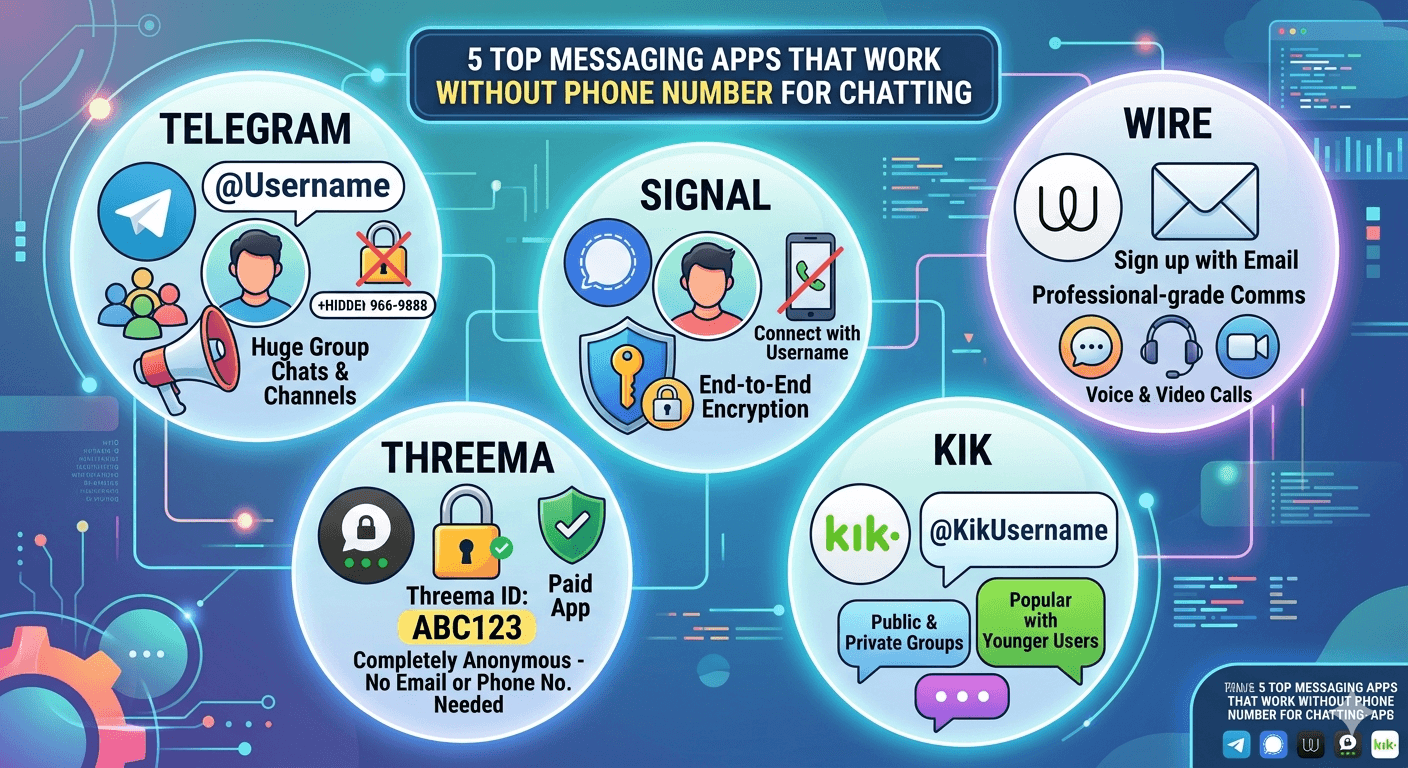
5 Top Messaging Apps That Work Without Phone Number for Chatting
When looking for the most reliable free messaging apps without phone number, several names consistently rise to the top. These apps have built reputations for stability and feature-rich environments that rival traditional texting apps.
Telegram: While Telegram often asks for a phone number during initial setup, it allows users to hide their number completely and communicate solely through usernames. This makes it a powerful hybrid option. Once your account is established, you can find and chat with others using their unique handles. It is widely known for its massive group chats and channel features, which are ideal for broadcasting information to large audiences.
Signal: Recently, Signal has introduced features that allow users to connect without sharing their phone numbers directly with others. By using usernames, Signal maintains its position as a top-tier secure messaging app no phone number required for visibility. It uses the highly regarded Signal Protocol to ensure that every message sent is end-to-end encrypted, making it a favorite for privacy advocates worldwide.
Wire: Wire is a professional-grade communication tool that allows for account creation using just an email address. This makes it one of the best free messaging apps without phone number for those who want a clear separation between their personal life and their digital communications. It supports high-quality voice and video calls, making it suitable for both casual chats and business meetings.
Threema: Threema is unique because it doesn’t require an email or a phone number at all. Upon setup, it generates a random Threema ID, making it a completely anonymous private chat app without phone number. While it is a paid app, the level of anonymity it provides is unparalleled, ensuring that no personal metadata is collected or stored on their servers.
Kik: Kik has long been a staple in the world of messaging without phone number. It relies entirely on usernames, making it a popular choice for younger users and those who frequent online forums. It offers a simple interface and allows for the creation of public and private groups, serving as a versatile mobile chat app for various social needs.
10 Free Chat Apps for Messaging on Your Phone
The variety of available platforms means there is something for everyone, whether you prioritize social features, security, or ease of use. Here are ten free messaging apps without phone number and phone-linked options that define the current landscape:
WhatsApp: Although it requires a phone number, it remains the most used messaging app worldwide. It is included here because many people use it as their primary wifi messaging app without phone number concerns after the initial setup.
Facebook Messenger: This app allows you to chat with anyone on your friend list without needing their phone number. It is a convenient way to contact someone without a phone line if you are already on social media.
Telegram: As mentioned, its username-based system makes it a top contender for those seeking free messaging apps without phone number functionality.
Signal: Its new username feature has revolutionized how users interact on the platform, emphasizing privacy.
Viber: Similar to WhatsApp, it needs a number for setup but functions perfectly over Wi-Fi for international calling and texting.
Line: Popular in Asia, Line offers a wide array of stickers and games, allowing users to connect via ID rather than just digits.
WeChat: A massive multi-purpose app that uses IDs for connecting users, though it has stricter verification processes in some regions.
Kik: The classic username-only platform that remains a go-to for many who want to text without phone number links.
Discord: Originally for gamers, Discord has become a mainstream communication hub that uses usernames and “tags” for identification, requiring no phone number for most server interactions.
Snapchat: This platform is built on the idea of ephemeral messaging and uses usernames for adding friends, making it a prominent app for texting without phone number exposure.
What Sets Secure Messaging Apps Apart from Traditional Chat Platforms?
The primary distinction between secure free messaging apps without phone number and traditional platforms like SMS is how data is handled. Traditional SMS is sent over the cellular network in plain text, meaning your service provider can see, store, and potentially share your messages. In contrast, modern secure apps prioritize user sovereignty. They often employ a decentralized architecture, meaning there is no central server that holds all user data. This significantly reduces the risk of mass surveillance and large-scale data leaks.
Furthermore, secure apps focus on minimizing metadata. Metadata is the “data about the data,” such as who you talked to, when, and for how long. Even if the content of a message is encrypted, metadata can still reveal a lot about a person’s life. Many free messaging apps without phone number are designed to collect as little of this information as possible. By not requiring a phone number, these apps remove a key piece of metadata that links your digital activity to your physical identity.
How End-to-End Encryption Works
End-to-end encryption (E2EE) is the gold standard for digital privacy. In the context of free messaging apps without phone number, E2EE ensures that only the sender and the receiver can read the messages. When you send a message, it is scrambled into an unreadable code on your device. It stays in this scrambled state while traveling across the internet and is only decrypted when it reaches the recipient’s device. No one in the middle—not the internet service provider, not the app developer, and not a hacker—can decipher the content.
Research indicates that the implementation of E2EE has led to a significant decrease in successful unauthorized interceptions of private communications. A study by the International Data Corporation (IDC) suggests that as more businesses adopt encrypted messaging services, the overall cost of cybercrime related to data theft is expected to stabilize. For users of free messaging apps without phone number, this technology provides peace of mind, knowing that their secret apps to chat are protected by complex mathematical algorithms that are virtually impossible to break with current computing power.
Key Features to Look for in Secure Messaging Apps
When choosing among the many free messaging apps without phone number, it is essential to evaluate several key features to ensure you are getting the best balance of usability and protection. Not all apps are created equal, and some may offer better security than others.
Encryption Protocol: Look for apps that use open-source, peer-reviewed encryption protocols like the Signal Protocol. Open-source means the code is available for anyone to audit, ensuring there are no “backdoors” for hackers or governments.
Self-Destructing Messages: This feature allows you to set a timer on your messages, after which they disappear from both devices. This is a hallmark of many apps for secret messaging.
Multi-Device Sync: The best messaging app without phone number should allow you to access your chats from a PC, tablet, and phone seamlessly without compromising security.
Minimal Data Collection: Check the privacy policy to see what data the app collects. Ideally, the app should not store your IP address, location, or contact list.
Two-Factor Authentication (2FA): Even if an app doesn’t use a phone number, it should offer 2FA via an authenticator app or email to prevent unauthorized access to your account.
Top 8 Messaging Apps That Work Without Phone Numbers
For those who want to dive deeper into the most private options, here are eight specific free messaging apps without phone number that prioritize user autonomy and security above all else.
1. Element
Element is a decentralized messaging app that operates on the Matrix protocol. It is one of the most robust free messaging apps without phone number because it allows users to host their own servers if they choose. This means you have total control over your data. For the average user, you can simply sign up on the default Matrix.org server using just a username and password.
Sign-Up Process
The sign-up process for Element is straightforward. You navigate to the website or download the app, select a “home server,” and choose a username. No phone number or email is required to get started, although adding an email can help with password recovery. Once inside, you can join thousands of public rooms or create private, encrypted group chats with friends.
2. Session
Session is an extremely secure messaging app no phone number required that uses a unique “Session ID.” When you create an account, the app generates a long string of characters that serves as your address. There is no central server; instead, Session uses a decentralized onion-routing network to hide your IP address and metadata, making it one of the best private messaging app without phone number choices available today.
3. Jami
Jami is a unique peer-to-peer (P2P) communication platform. It does not use any servers to store or relay messages. When you use Jami, your device communicates directly with the recipient’s device. It is a completely free messaging app without phone number that supports HD video calls and file sharing, all while being fully encrypted and decentralized.
4. Briar
Briar is designed for activists, journalists, and anyone needing a secret chat app without phone number in high-risk environments. It can sync via Bluetooth or Wi-Fi if the internet is down, or via the Tor network when online. It requires no central server and no phone number, ensuring that your connections are peer-to-peer and highly resilient to surveillance.
5. Threema
As mentioned previously, Threema is a powerhouse in the privacy world. It is a chat app without phone number that generates a Threema ID for each user. It allows you to verify your contacts by scanning their QR codes in person, which adds a layer of physical security to your digital communications. It is widely used by government agencies and security-conscious corporations.
6. SimpleX Chat
SimpleX Chat is a revolutionary messaging app that doesn’t use any user identifiers at all—not even a random ID that stays the same. It uses “incognito” profiles for every connection you make. This makes it impossible for the platform to link your different conversations together, providing the highest level of privacy among free messaging apps without phone number.
7. Ricochet Refresh
Ricochet Refresh is a specialized private chat app without phone number that runs entirely on the Tor network. It allows you to chat without revealing your location or IP address to anyone, including the person you are talking to. Every account is a hidden service on the Tor network, making it one of the most secure messaging app no phone number options for those who need total anonymity.
8. Status
Status is more than just a messaging app; it is a gateway to the decentralized web. It combines a secure messaging app without phone number with a crypto wallet and a Web3 browser. It uses a peer-to-peer protocol called Waku, which ensures that no single entity has control over your messages or your data.
Comparison Table of the 8 Best Messaging Apps that Work Without Phone Numbers
| App Name | Primary Identifier | Encryption | Best For |
| Element | Username | Matrix E2EE | Community Building & Self-Hosting |
| Session | Session ID | Onion Routing E2EE | Total Metadata Privacy |
| Jami | Jami ID | P2P E2EE | Direct P2P Video/Voice |
| Briar | P2P Link | Tor/P2P E2EE | Offline & High-Risk Messaging |
| Threema | Threema ID | NaCl E2EE | Corporate & Personal Security |
| SimpleX | None (Dynamic) | SimpleX E2EE | Maximum Anonymity |
| Ricochet | Tor Address | Tor Hidden Service | Censorship Resistance |
| Status | Public Key | Waku E2EE | Web3 & Crypto Integration |

Get an Affordable Virtual Number for Easy Registration & Verification!
Sometimes, you might want to use apps like WhatsApp or Viber but still want to protect your primary digits. In these cases, getting a virtual phone number is a perfect solution. You can use these numbers for the initial registration and verification process, effectively turning those platforms into free messaging apps without phone number links to your real identity. This allows you to enjoy the broad reach of popular apps while maintaining your personal privacy.
Several services allow you to purchase or even get free temporary numbers for SMS verification. This is a common strategy for people who want to keep their professional and personal communications separate. By using a virtual number, you can bypass the requirement for a physical SIM card, allowing you to use texting apps without phone number hardware limitations on any device with an internet connection. This bridge between traditional telephony and modern apps provides the ultimate flexibility for the modern user.
Going Beyond Personal Privacy: Why Organizations Need a Broader Security Lens
For businesses, the use of free messaging apps without phone number is not just about personal preference; it is about risk management. Traditional communication channels are often the weakest link in a company’s security infrastructure. Employees sharing sensitive information over unencrypted SMS or personal social media accounts can lead to disastrous data leaks.
According to a 2023 report by IBM, the average cost of a data breach has reached $4.45 million, highlighting the financial necessity of secure communication.
Organizations should encourage the use of encrypted messaging services that do not rely on personal identifiers. This ensures that even if an employee’s personal device is compromised, the corporate communication channels remain isolated and protected. Furthermore, using decentralized platforms allows companies to maintain a clear audit trail and manage access permissions more effectively than they could with a fragmented network of personal phone numbers. Implementing these tools is a proactive step toward building a resilient and secure digital workplace.
Read More: Can You Use Google Voice in Canada? Complete Guide for Calls, Setup, and Alternatives
Wrapping Up
The landscape of digital communication is changing, and the demand for free messaging apps without phone number continues to grow. These tools offer a way to text without phone number risks, providing a safe haven for private conversations in an increasingly public world. Whether you choose a decentralized powerhouse like Element, an anonymity-focused app like Session, or a versatile social platform like Discord, the power to control your data is now firmly in your hands. By understanding how these apps work and what features to look for, you can stay connected with the world while keeping your personal information exactly where it belongs—with you.
The freedom to communicate without being tied to a physical SIM card or a permanent phone number is a significant milestone in digital rights. It allows for more inclusive communication for those without traditional cellular access and provides a necessary shield for those in sensitive positions. As technology continues to evolve, these apps like whatsapp without phone number requirements will likely become the standard rather than the exception, ushering in a new era of private, secure, and accessible global communication.
Frequently Asked Questions
Is there a messaging app without a phone number?
Yes, there are many messaging apps that do not require a phone number for registration. These include platforms like Session, Discord, Element, and Kik. Instead of using a phone number, these apps rely on unique usernames, email addresses, or generated IDs to identify users. This allows you to communicate over Wi-Fi or mobile data without ever revealing your personal cellular digits or needing a physical SIM card.
Is there a 100% free texting app?
Yes, several apps offer 100% free texting services over an internet connection. Apps like WhatsApp, Telegram, and Messenger allow for unlimited texting between users of the same app. For texting to actual phone numbers (SMS), Google Voice offers free texting within the US and Canada. However, most apps that allow you to text without a phone number are entirely free as long as both parties are using the same platform.
Which messaging app works without SIM?
Most modern messaging apps work without a SIM card as long as the device is connected to a Wi-Fi network. Examples include Facebook Messenger, Skype, Discord, and Telegram. Since these are wifi messaging app without phone number requirements for active service, you can use them on tablets, laptops, or smartphones that have had their SIM cards removed or deactivated.
Can I send messages without a phone number?
Yes, you can send messages without a phone number by using internet-based chat platforms. You can sign up for services like Discord or Kik using only an email address or username. Once your account is created, you can send texts, images, and videos to other users. This is a common way to stay in contact with someone without a phone line or when you want to keep your personal number private.
Are there any truly private messaging apps?
Truly private messaging apps are those that offer end-to-end encryption and do not collect user metadata. Apps like Session, Threema, and Signal (with its username feature) are considered some of the most private options. Because they are free messaging apps without phone number requirements, they ensure that your identity is not linked to your communications, providing a higher level of anonymity than standard chat apps.
What are the best-encrypted messaging apps that work without a phone number?
The best-encrypted messaging apps without a phone number are Session, Element, and Threema. Session uses onion routing to hide your metadata, Element uses the decentralized Matrix protocol, and Threema uses a unique ID system. These apps ensure that your messages are scrambled and unreadable by anyone except the intended recipient, providing top-tier security for your private conversations.
How to choose a secure messaging app?
To choose a secure messaging app, you should look for several key factors: end-to-end encryption, an open-source codebase, and a transparent privacy policy. Additionally, check if the app requires a phone number; free messaging apps without phone number are generally better for anonymity. Researching the developer’s reputation and ensuring the app doesn’t store logs of your activity or IP address are also vital steps in making a safe choice.
What are the best group messaging apps that work without phone numbers?
The best group messaging apps that work without phone numbers are Discord and Telegram. Discord is excellent for creating structured communities with multiple channels and roles. Telegram supports massive groups of up to 200,000 members and offers powerful moderation tools. Both platforms allow users to join and interact using only usernames, making them ideal for large-scale social or professional collaboration without sharing personal contact information.