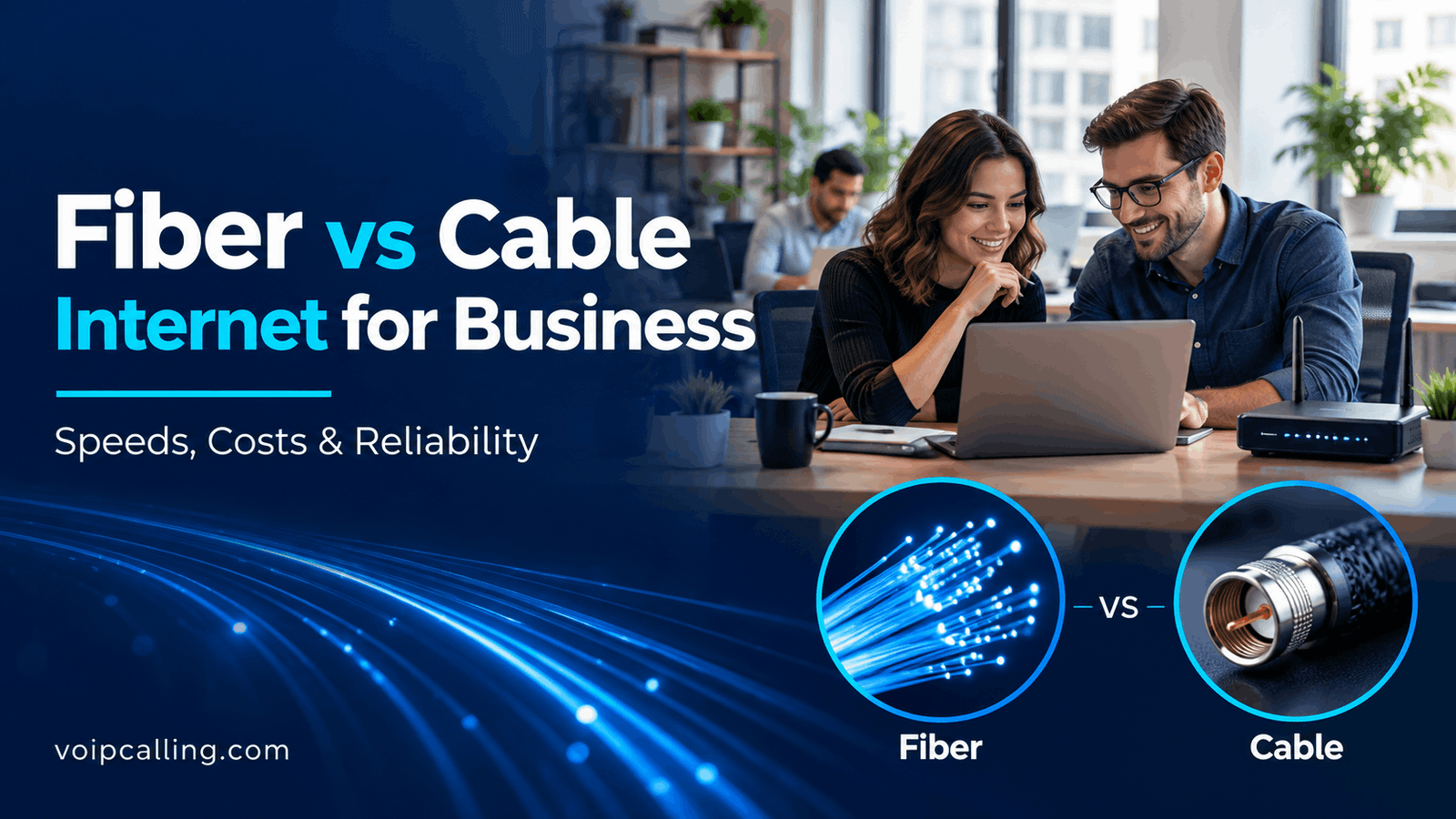
For a permanent U.S. business using regular uploads, cloud tools and overlapping meetings, suitable fiber is our first connection type to shortlist. AT&T Business Fiber leads our starting recommendations. Cable can be the better practical purchase when the actual upstream capacity, local installation and complete quote meet the requirement.
Fiber versus cable is not simply a contest between download numbers. Compare the access technology reaching the premises, both directions of capacity, busy-hour application performance, service agreement and recovery plan. A fast advertised tier cannot establish all of those details.
Affiliate notice: VoIPCalling.com may earn a commission through it, at no additional cost to you. This guide compares services intended for eligible U.S. locations.
Fiber vs Cable Internet for Business: Quick Overview

| Buying factor | Fiber business internet | Cable business internet |
|---|---|---|
| Connection to the premises | Optical access for a fiber-to-premises proposal. | Typically coaxial local access with fiber elsewhere in a hybrid network. |
| Download capacity | Compare the actual eligible tier. | Can offer substantial download capacity; verify the local tier. |
| Upload capacity | Suitable services often publish symmetrical options. | Check the upstream profile separately; do not assume it matches download. |
| Office workload | Our starting shortlist for regular outgoing work and meetings. | A practical wired alternative when the actual capacity fits. |
| Deployment | Verify building readiness, permission and installation scope. | Verify the existing local access and any installation requirements. |
| Reliability and support | Read the plan agreement and design recovery. | Read the plan agreement and design recovery. |
| Dedicated access | Fiber does not automatically mean dedicated service. | The delivery medium alone does not define dedicated versus shared access. |
Our overall starting winner: suitable fiber for an eligible permanent office. Practical local winner: cable when its complete proposal better serves the requirement. We have not benchmarked every network or building, and do not assign a universal latency or uptime score to either medium.
Third-Party Rating Context
J.D. Power 2026 small-business internet satisfaction: AT&T 686/1,000; Verizon 680/1,000; segment average 659. AT&T ranked highest in that segment, defined as businesses with fewer than 20 employees. Official study rates the broader provider experience. It is not a measured fiber-versus-cable comparison or a rating for a specific plan. Use it alongside the actual local service proposal.
What Is Fiber Internet for Business?
Fiber-to-premises access carries the connection over optical infrastructure to the business location. The service may then connect through a gateway, firewall, switches and Wi-Fi inside the office. Confirm that fiber reaches the premises instead of inferring that from a general network brand.
Several business fiber services in this guide publish equal upload and download rates. That can simplify planning for outgoing files, backups and video meetings. Inspect the actual plan: neither symmetrical capacity nor the fiber medium automatically establishes dedicated access.
Best starting fit: a suitable permanent workplace where outgoing work matters. Check the address and installation scope before choosing a tier. A provider’s city listing or a connected neighbour does not guarantee the same service in your suite.
What Is Cable Internet for Business?
Cable service commonly uses a hybrid fiber-coaxial network: fiber carries traffic through part of the network and coaxial access completes the path to the premises. Spectrum’s published business description explicitly makes this distinction.
A cable service can deliver useful wired business connectivity and substantial download capacity. Request the upstream profile and access specification rather than assuming the advertised download number describes both directions.
Best starting fit: an eligible local wired offer that supports the work at a suitable complete cost. Cable should not be rejected merely because another medium has a higher theoretical maximum. Compare the service that can actually be ordered.
Pricing: Fiber Is Not Automatically More Expensive
| Provider and plan | Published reference | Conditions to retain |
|---|---|---|
| AT&T Fiber 300 | $60 standalone; $40 eligible wireless bundle. | Online offer eligibility; qualifying mobile cost additional. |
| Frontier Business Fiber 500 | $49.99 for 24 months. | Includes stated $10 AutoPay/ACH discount. |
| Verizon Fios Business 300 | $64 with stated billing discount. | Fees/equipment extra; two-year auto-renewing term. |
| GFiber Business 1 Gig | $100. | Business-address eligibility; applicable fees additional. |
| Spectrum Business 500 | $50 for one year. | Eligible online-only offer; no bundle required; confirm later rate. |
| Comcast Business entry offer | $70 one-year pricing. | Check local access, billing conditions, extras and future rate. |
References reviewed October 8, 2026. Tables use “+ taxes”; request all other applicable charges. These plans have different capacities, promotion periods and conditions, so the figures do not establish a universal cheapest medium.
Compare recurring service, equipment, setup, necessary additions and any required bundle over the same ownership period. A low internet-line price can conceal another required bill. A one-year promotion and a longer price lock are different offers.
For example, a hypothetical $50 monthly plan that rises to $80 after one year costs $1,560 over two years before extras. A hypothetical $60 plan staying at that rate costs $1,440. The example explains the calculation; it is not a quotation for either provider.
Upload and Download Speeds: Compare Both Directions
Download capacity helps when receiving files and updates. Upload capacity helps when sending project files, transmitting meeting video and backing up work. Concurrent activity in each direction determines what the office needs.
Two offers with the same download headline can have very different upstream profiles. Ask for both numbers in the written quote. A larger download tier does not compensate automatically for an upstream bottleneck.
The following example uses a decimal 1 GB file, approximately 8,000 megabits. Dividing that by a continuously available upload rate gives the idealized time:
| Available upload rate | Ideal time for a 1 GB file | Buying lesson |
|---|---|---|
| 20 Mbps | 400 seconds—about 6 minutes 40 seconds. | Check the actual upstream capacity. |
| 100 Mbps | 80 seconds—about 1 minute 20 seconds. | More outgoing capacity reduces the theoretical transfer time. |
| 300 Mbps | About 27 seconds. | Equipment and the remote destination must also keep up. |
Real transfers take longer because of overhead, other traffic and application or remote-server limits. These are example upload rates, not representative measurements for every cable or fiber connection.
Choose from workload, not staff count alone. A small creative studio can need more upstream capacity than a larger office mainly handling documents and web transactions.
Calling, Meetings and Cloud Applications
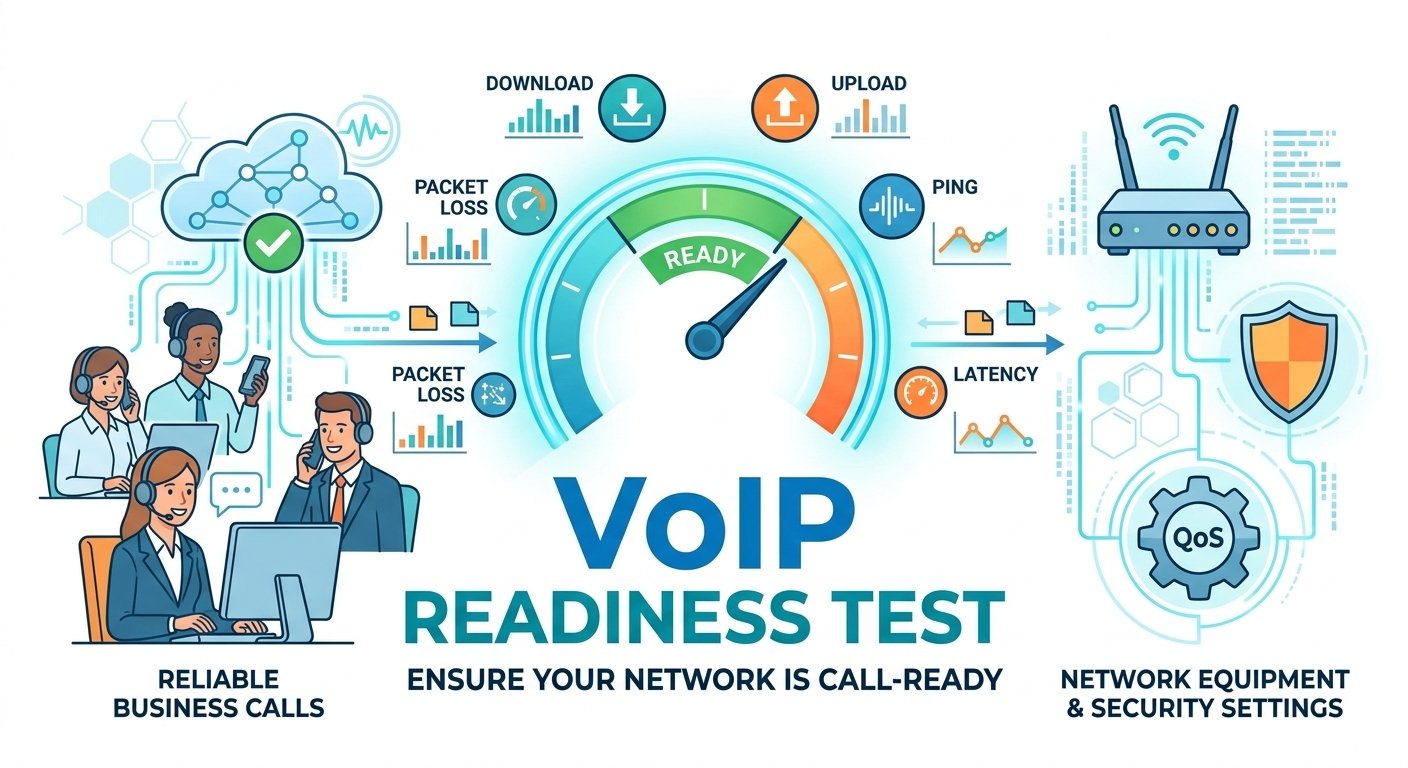
For calls and meetings, examine responsiveness and stability under normal load. A quiet-time speed result does not establish how the connection behaves while staff upload files or backups run.
Run representative applications together and record interruptions, slow responses and reconnection behaviour. Include the router, Wi-Fi and application in the investigation. A remote service problem or an overloaded firewall can affect both fiber and cable.
Our assessment: suitable symmetrical fiber is a strong starting choice for repeated outgoing work. Suitable cable can serve the same applications when its actual upstream capacity and busy-hour performance fit. We do not claim that every fiber connection has lower latency than every cable service.
Internet access does not automatically include a complete phone system. Confirm calling licences, numbers, hardware and network requirements separately. Match any static addressing or VPN needs with the actual provider offer.
Reliability: Compare the Service and Recovery Arrangement
A suitable wired service avoids dependence on indoor cellular reception for the main access path, but neither fiber nor cable eliminates outages. Cuts, equipment, local power and other failure conditions still need consideration.
Read the actual agreement. Support availability, network reliability marketing and an SLA are different. An uptime guarantee backed by credits does not mean physical interruptions cannot happen or that every business loss is reimbursed.
Choose continuity from essential tasks: payments, calls, orders or all ordinary work. A second connection helps only when routing, power and applications can use it. Test primary failure and restoration with the responsible technician.
Two subscriptions or provider names do not prove physical independence. Ask about building entrances, local routes and shared dependencies where material. Backup needs to address the failure you want to survive.
Fiber vs Cable Is Different from Dedicated vs Shared
Fiber and cable describe delivery technology; dedicated and shared describe the access service allocation. Standard symmetrical business fiber can use shared infrastructure. A separate enterprise dedicated offer can have its own bandwidth and contractual scope.
The AT&T Dedicated Internet product is distinct from standard Business Fiber. The Comcast dedicated-service page also describes dedicated delivery options over HFC or fiber. Do not infer the service category solely from the last access cable.
When contracted capacity, performance metrics or escalation matters, request the appropriate dedicated or managed proposal. Compare its agreed handoff, measurement points, exclusions and remedies separately from broadband promotions.
Dedicated internet still connects to the public internet. It does not automatically create a private route to every application or replace other networking and security requirements.
Installation, Availability and the Office Network
Provide the full U.S. address and suite to each bidder. Ask whether service is ready for normal installation or requires a survey, construction or property agreement. Existing local infrastructure can make one option more practical without establishing a nationwide deployment-time winner.
Clarify what the provider installs and what your business supplies. Inside cabling, switches, firewall configuration and access points can remain your responsibility. Place the gateway where it can serve the network and obtain permission for building work where needed.
For multi-gigabit service, verify port and firewall capacity before paying for it. A device cannot use more than its own connection permits. A faster access tier also does not automatically improve wireless coverage behind a wall.
Keep the old service until essential applications pass checks on the new connection. Allow for overlap and cancellation obligations rather than treating the installation appointment as complete acceptance.
Top Fiber Providers to Shortlist First
AT&T Business Fiber
The official ATT offer lists symmetrical tiers, an included gateway, no data caps and no annual internet contract. AT&T is our first overall fiber shortlist for a suitable permanent location. Read our Business Fiber review or request a premises-specific Fiber proposal.
Verizon Fios, Frontier and GFiber
Compare Fios Business, Frontier Business Fiber and GFiber Business where eligible. Their commercial offers, commitments and included equipment differ. Match upload needs and installation with the full local quote.
Frontier is part of Verizon, so the two brands should not automatically be treated as independent backup networks. A local fiber service outside these national names may also be worth a proposal when it better serves the building.
Cable and Other Wired Proposals Worth Comparing
Spectrum Business
Spectrum describes its standard service as fiber-powered with coaxial access to the premises. Its listed online 500 Mbps promotion is a useful local pricing reference, but the accepted upstream profile and later rate still matter.
Comcast Business
The internet page lists download tiers up to 300 Mbps, 500 Mbps, 1.25 Gbps and 2 Gbps, with different one-year and price-lock structures. Ask how the proposed connection is delivered and which upstream capacity applies. Standard broadband and dedicated service are different products.
Our recommendation is to compare the actual local wired proposal rather than assume every offer from a cable operator uses the same medium or speed profile. A suitable service with workable setup and cost can be the best local purchase.
Pros and Cons of Fiber and Cable
Fiber: strengths and tradeoffs
Strengths: suitable symmetrical options can support outgoing work and provide straightforward capacity planning. Tradeoffs: premises eligibility, installation requirements and internal network limits still need attention; a fiber label does not supply a universal SLA.
Cable: strengths and tradeoffs
Strengths: an available wired proposal can deliver useful business capacity and practical value. Tradeoffs: verify upstream service, promotion expiry and the actual delivery specification instead of relying on the download headline.
Neither medium alone tells you which service is cheapest, fastest at the address or most dependable over time. Decide from qualified proposals and observed application fit.
Clear Starting Winners by Business Requirement
| Business requirement | Starting winner | Why |
|---|---|---|
| Frequent project uploads, cloud backups and overlapping meetings | Suitable symmetrical fiber. | Give outgoing work sufficient capacity. |
| Suitable fiber is unavailable or needs impractical deployment | A qualified cable or other wired proposal. | Choose workable local access that supports the applications. |
| Routine browsing and cloud transactions on a strict budget | The lowest suitable complete local quote. | Either medium can win on total value. |
| Contracted capacity, performance and escalation | A dedicated or managed service proposal. | The agreement and scope decide, not the medium alone. |
| Poor coverage in a meeting room | Fix the internal network first when wired access works. | A subscription upgrade does not solve every Wi-Fi limitation. |
| Continued essential work during an outage | Tested primary-plus-backup and power design. | Recovery needs routing and application compatibility. |
If Neither Wired Option Fits
A qualified fixed-wireless service can deserve evaluation when wired access is unsuitable. AT&T Internet Air uses cellular towers and remains at its specific approved service address; its hub is not portable. Check equipment, coverage and permitted activity.
AT&T Wireless Broadband is portable for permitted on-the-go, temporary-site and emergency needs. Unlimited data is paired with maximum tiers up to 25, 50 or 100 Mbps, and restrictions include public/guest Wi-Fi, entertainment, continuous streaming and web hosting. Read our Business Wireless review.
These are separate alternatives, not fiber or cable services. Test essential applications and any recovery arrangement rather than assuming a wireless product substitutes identically for a wired office connection.
Compare Two Quotes Before Switching
- Access: identify what reaches the premises and whether the service is shared or dedicated.
- Capacity: record both directions and any relevant committed or maximum rates.
- Application fit: test simultaneous work during normal busy periods.
- Commercial scope: compare equipment, setup, extras, promotions and later prices.
- Agreement: separate commitment, support and service-level remedies.
- Recovery: verify backup, power and restoration behaviour.
- Acceptance: resolve material issues before cancelling the previous service.
To start with AT&T, select the role before the tier: wired Fiber, fixed Air or permitted portable Wireless Broadband.
After an inquiry through the supplied referral route, you can typically expect a response within 24–48 business hours. This is an expected sales-response window, not an installation or repair guarantee.
Frequently Asked Questions
Is fiber or cable better for business internet?
Suitable fiber is our starting choice for a permanent office with regular outgoing work. Cable can be the better local purchase when its capacity, setup and complete price fit.
Is cable always cheaper?
No. Local offers differ, and hardware, promotions, later rates and required bundles affect the total cost. Compare equivalent requirements over the same period.
Does fiber always have equal upload and download speeds?
Do not assume that from the medium alone. The fiber services discussed publish symmetrical options, but verify the exact ordered plan.
Is cable too slow for business calls?
Not automatically. Assess actual capacity and application stability under normal load. Neither medium alone determines calling quality.
Does fiber guarantee no downtime?
No. Check the actual service agreement and design suitable recovery. A credit-backed guarantee does not prevent physical outages.
Is fiber-powered internet the same as fiber to the office?
Not necessarily. A hybrid service may use fiber to a node and coaxial access to the premises. Ask for the actual delivery specification.
Do I need dedicated access if I choose fiber?
Choose dedicated scope only when the requirement justifies it. Standard business fiber and dedicated internet are distinct purchases.
Will changing to fiber improve Wi-Fi everywhere?
Not automatically. Internal coverage and equipment may need changes even when the new access service performs well.
Can these U.S. prices apply overseas?
No. The selected domestic references require eligible U.S. locations. International services need a separate quote.
Final Recommendation
Start with suitable AT&T Fiber and compare the available local wired proposals. Fiber is our preferred starting access type for a permanent office with regular uploads, calls and cloud work. Cable remains a strong practical alternative when its actual service profile and complete quote fit.
Choose usable two-way capacity, a workable installation and tested recovery. The best business connection is the one that supports the operation—not simply the medium with the strongest marketing headline.
Provider names and trademarks belong to their respective owners. VoIPCalling.com is an independent publisher.
Customer Reviews: Positive Feedback and a Useful Caution
Belinda C., G2, 5/5, May 1, 2026: she gave positive feedback about dependable internet and phone service. Her review does not identify one of the three packages covered here.
Richard T., IT Director, G2, 4.5/5, August 20, 2025: he valued a dedicated account manager but raised concerns about attention to smaller businesses and responses during incidents. His review explicitly concerns IPFLEX internet and phone service, rather than a verified Fiber, Air or Wireless Broadband installation.
These examples help frame questions about support and service fit. For your own purchase, seek recent feedback about the same access product in a comparable location and verify the quoted support arrangement.
Affiliate disclosure: VoIPCalling.com may earn a commission through it, at no additional cost to you.