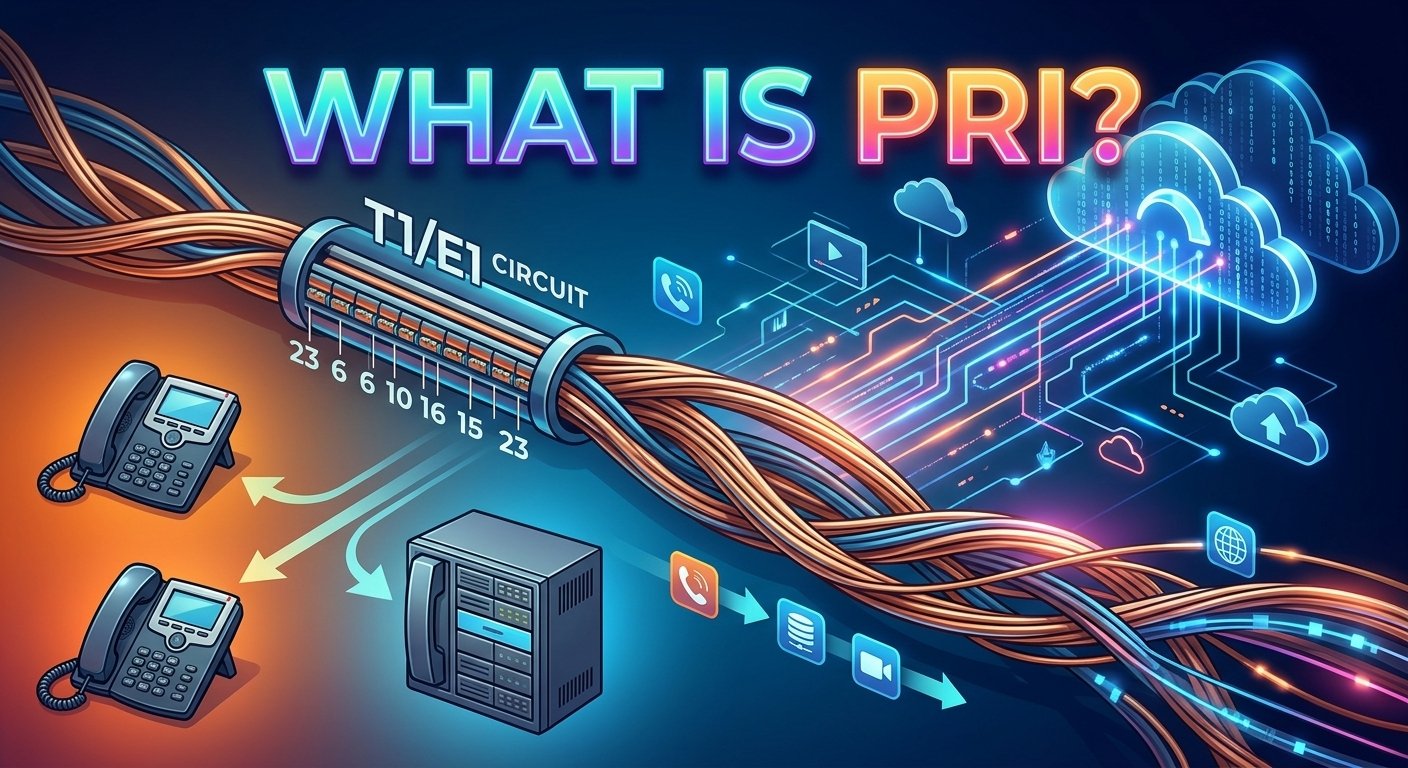
Once the absolute backbone of enterprise telecommunications, this legacy protocol is a digital connection linking a business telephone network to the public switched telephone network. By utilizing physical copper wires, it allows companies to transmit up to 23 simultaneous voice, data, or video calls over a single traditional line.
Although these old physical circuits are quickly being replaced by modern cloud solutions, it is still incredibly important for network administrators to understand this classic phone pri technology. Let’s delve into the essentials, hardware capabilities, and the future trajectory of these configurations in the ever-evolving business landscape.
What Is PRI?
The first step to figuring out what is pri is to understand its basic structure. It is an acronym for Primary Rate Interface. It is a dedicated digital telephone line that connects enterprise telephone systems to the larger telecommunications network. A primary rate isdn is different from regular analog lines because it can carry several voice and data transmissions at the same time between two physical locations. Establishments requiring high volumes of concurrent communications, such as large hospitals or inbound call centers, relied heavily on this setup for decades to manage high traffic.
These traditional networks offer strong, committed digital connectivity. A standard pri phone system provides a lot of physical capacity, fast data transfer, and integrated operations without the internet. While there are newer virtual technologies available, understanding the basic rate interface definition is useful for organizations to understand the evolution of modern telecommunications. To determine what is pri compatible, you need to consider your current hardware.
Features of a PRI Line
The physical characteristics of a pri circuit are essential to understanding the circuit. The architecture is complex and requires particular signal handling capabilities and wiring, which are different from standard consumer broadband. When people ask “what is pri?” they are often amazed by the technicality of it.
-
Physically composed of two pairs of copper wires connecting the carrier network to the customer premises.
-
Capable of transmitting 23 separate communications simultaneously, including pri voice, raw data, or video packets.
-
Each channel inside the connection maintains a 64 kbps capacity for highly stable data transmissions.
-
Highly adaptable hardware, working seamlessly with mixed EPABX setups or an IP PBX infrastructure.
-
Readily joins two private branch exchange platforms together, instantly expanding available channels.
How PRI Works
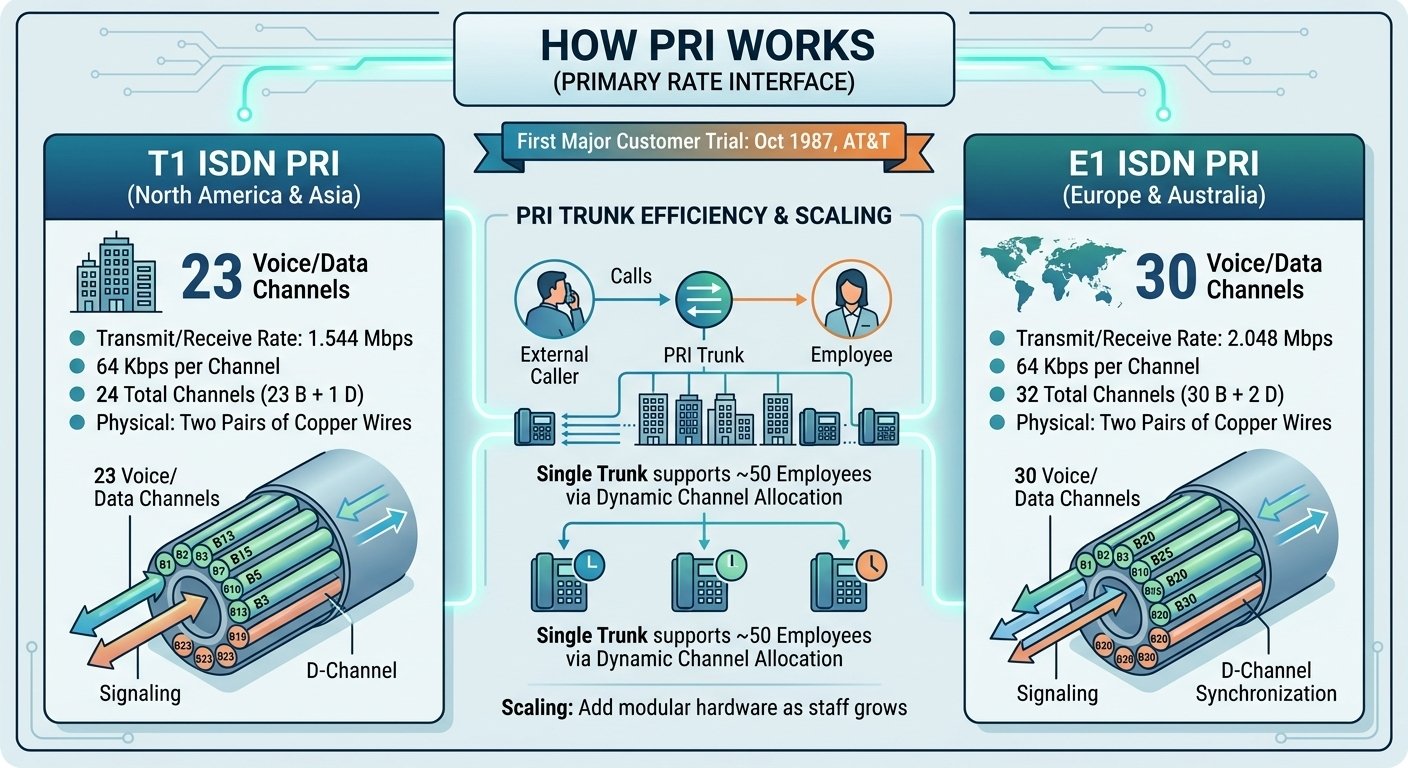
The actual physical cable that connects your telecommunications equipment is categorized into two distinct formats: T1 and E1. According to historical technology records, the first major customer trial of an ISDN primary rate interface occurred in October 1987 through AT&T, proving its enterprise viability. The basic structure has not changed since then, using dedicated circuit-switched networks. This is one of the reasons why tech experts talk about what is pri when they explain it.
A key element of this mechanism is direct inward dialing. This enables an outside caller to call an employee’s extension without going through a central receptionist. With dynamic channel allocation, a single pri trunk can support up to 50 employees, since it is highly unlikely that all the staff will be on the phone at the same time. Understanding what is pri scaling is understanding modular hardware additions.
| E1 | T1 |
| Used in Europe and Australia | Used in North America and Asia |
| Provides 64 Kpbs for data transmission | Provides 64 Kpbs for data transmission |
| Transmit and receive a rate of 2.048 Mbps | Transmit and receive rate of 1.544 Mbps |
| Physically contains two pairs of copper wires | Physically contains two pairs of copper wires |
| 32 total channels | 24 total channels |
| 30 channels used for voice, data, video | 23 channels used for voice, data, video |
| 2 channels are used for signaling | 1 channel used for signaling |
Benefits of PRI
Before the rise of broadband internet, relying on a pri primary rate interface offered massive advantages for large-scale operations. Organizations enjoyed enhanced capabilities that outmatched standard consumer landlines. Those who fully understand what is pri recognize these historical benefits.
-
Cost Savings: Sharing physical circuits reduces monthly expenses compared to installing individual analog phone lines for every desk.
-
Outstanding Call Quality: The all-digital transmission eliminates signal degradation, ensuring every basic rate interface interaction remains crisp and clear.
-
Unmatched Reliability: Dedicated physical circuits minimize localized downtime, offering superior uptime compared to early internet-based communication tools.
-
High Productivity: Advanced software-defined features like caller ID, secure conferencing, and dynamic call routing empower staff to handle interactions efficiently.
Drawbacks of PRI Systems
While it has a strong history, traditional hardware has its drawbacks in a cloud-first world. Physical copper lines are becoming more and more costly to maintain, and the hardware is not as agile as virtual platforms. Network capacity upgrades involve buying and installing all new equipment, not just clicking a button on a web dashboard. The hardware constraints are very apparent when assessing what is pri.
Furthermore, major providers are actively phasing out these legacy networks globally. Studies and market analyses indicate a staggering 96% decrease in ISDN orders over the past decade as the telecommunications industry prepares for an inevitable network switch-off. Consequently, clinging to this aging framework exposes organizations to diminishing IT support, rising costs, and outright obsolescence.
Alternatives To PRI
As traditional physical networks are becoming a thing of the past, modern organizations need strong, long-term alternatives. The selection of the best alternative is largely dependent on existing infrastructure limitations, IT budget, and the volume of communications per day.
1. Analog POTS lines
The simplest legacy format available is called Plain Old Telephone Service. It uses only one analog circuit, so only one conversation can take place at a time per line. This old format works well for small amounts of traffic but is not at all appropriate for scaling businesses.
2. SIP trunking
SIP is a digital connection between your current private branch exchange and the internet. It doesn’t require any physical copper wires to be pulled into your building, but rather virtual data connections. This particular configuration significantly lowers physical maintenance expenses and provides scalable solutions for expanding teams.
3. Hosted VoIP
Hosted Voice over Internet Protocol shifts the entire communication workload to off-site cloud servers managed by experts. The service provider handles all physical maintenance, core software updates, and server troubleshooting. This alternative removes the need for expensive on-premise hardware entirely, giving users incredible mobility.
Hosted VoIP vs. PRI vs. SIP Trunking
A direct comparison of the three major telecommunications strategies must be made in order to evaluate the three. To make informed IT budgets, it is important to understand what is pri compared to modern cloud tools.
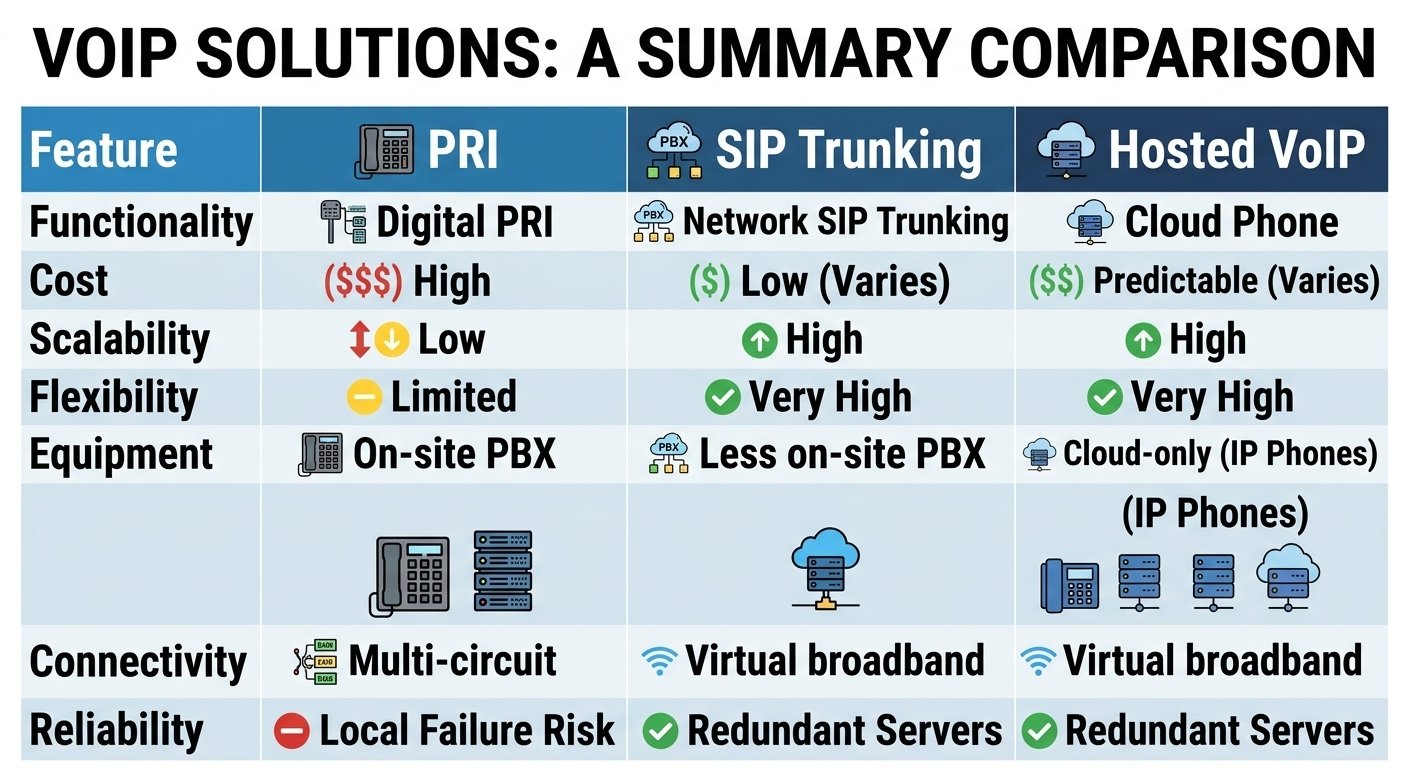
| Feature | PRI | SIP Trunking | Hosted VoIP |
| Functionality | Traditional digital phone lines to carrier’s PSTN | Uses SIP protocol for voice calls over internet | Cloud-based phone system hosted offsite by a provider |
| Number of simultaneous calls | Up to 23 | Variable | Variable |
| Scalability | Limited | Scalable | Scalable |
| Flexibility | Limited | Flexible | Flexible |
| Cost | Typically more expensive than SIP trunking or hosted VoIP | Uses SIP protocol for voice calls over the internet | Can be less expensive than PRI, but may vary depending on usage |
| Equipment & maintenance | Requires on-site legacy PBX system and hardware and maintenance | Can reduce PRI/PSTN line costs by sending calls over the internet | No on-site equipment required.<br><br>Hardware is minimal, just IP phones needed |
-
Startup costs
The initial investments are highly dependent on the technology route selected. Hosted VoIP requires minimal up-front investment, as the provider provides the back-end servers. On the other hand, traditional copper-wire systems involve the purchase of physical interface cards, high-priced PBX equipment, and professional installation on site.
-
Ongoing costs
The long-term ROI of any enterprise communication platform is determined by monthly maintenance fees. Over time, traditional setups can add up to expensive long-distance charges and high maintenance costs. In the meantime, online options usually come with fixed monthly fees that include unlimited local calls and extensive software capabilities.
-
Connectivity
Overall system agility is determined by the physical needs to get online. Legacy architectures require several physical circuits to be directly connected to a server room. Cloud solutions and modern SIP configurations work completely over virtual connections and require only a very stable enterprise broadband connection.
-
Backup and redundancy
Disaster recovery separates mediocre networks from true enterprise-grade solutions. Virtual frameworks boast redundant remote hosting sites, automatically redirecting incoming traffic during local power outages. Physical networks remain highly vulnerable to localized physical damage, offering little backup capability.
-
Business continuity
Corporate communications should never be stopped by severe weather or regional physical disruptions. Cloud-based tools enable employees to instantly route their office numbers to mobile devices from anywhere. If the central physical hardware fails, on-premise setups simply can’t reroute traffic.
-
Flexibility and upscaling
Planning for exponential corporate growth requires a platform that expands frictionlessly. Adding capacity to a virtual system happens via an online portal in mere minutes. Expanding a traditional hardware configuration forces IT teams to order, wait for, and successfully install physical components.
-
Call quality
Clear and precise audio is critical when dealing with professional clients. Legacy digital networks provide reliable, clear sound without relying on broadband. But, modern internet protocols now offer high-definition sound quality that is equal to or better than older analog protocols.
How To Choose the Right Business Phone System
Choosing the right telecom strategy involves a comprehensive inventory of existing equipment and future growth plans. If your facility already has a large PBX that is paid for and has thousands of simultaneous local calls, then using the existing physical interfaces may still have a place for a short time. But, if you are stuck with legacy physical infrastructure, you are not very flexible when it comes to geographical location and remote work.
Moving to a hosted configuration provides unparalleled organizational agility and complete disaster recovery. Intuitive web portals centralize management completely, eliminating the need for specialized on-site technicians. Virtual solutions are the absolute ultimate choice for most forward-thinking enterprises, as they do not have to purchase large equipment and can still receive regular software updates remotely.
Simplify Your Communication Infrastructure
An aging infrastructure is constantly consuming IT resources and limiting collaboration opportunities. Organizations can easily upgrade their entire audio and video conferencing environment by partnering with top cloud communication providers. Transparent pricing models eliminate unpredictable monthly maintenance fees and confusing service fees. Learning what is pri helps you realize why upgrading is necessary.
Read More: Free Phone Number Lookup: How to Search a Phone Number? 2026 Guide
Final Thought
Understanding the basic rate interface and its larger enterprise counterpart is absolutely vital for grasping telecommunications history. While these dedicated copper systems fueled immense corporate growth for decades, their physical rigidity simply cannot match the demands of modern remote workframes. Transitioning toward agile, cloud-hosted platforms ensures long-term business continuity, drastically lower operational expenses, and a future-proof network architecture.
FAQs
-
What is PRI fundamentally?
It is a standard digital interface that can be used to send several voice and data signals at once over the public switched telephone network via physical copper wires.
-
What is a PRI circuit?
It is a physical hardware connection, typically utilizing two pairs of copper wires, that directly links a company’s private branch exchange to the local carrier network.
-
What is sip and PRI?
SIP is a modern internet-based protocol for virtual call routing, whereas the older telecommunications standard relies entirely on physical copper wire circuits and localized hardware.
-
What is a PRI line in telecommunications?
It is a dedicated digital communication channel capable of transmitting 23 separate voice, data, or video interactions concurrently on a single physical cable.
-
What does PRI mean for small organizations?
It means having the robust capacity to handle dozens of simultaneous incoming calls without needing to purchase separate analog phone lines for every individual office desk.
-
Is PRI considered an outdated legacy technology?
Yes, it is largely considered legacy hardware today because global telecom providers are actively switching off their physical copper networks in favor of internet protocols.
-
How do I PRI network components upgrade properly?
You must completely replace or migrate the physical on-premise hardware to a modern cloud-based gateway to handle modern virtual traffic effectively.
-
What is the difference between a PRI telephone and POTS?
The modern digital interface handles up to 23 simultaneous digital interactions, while an older POTS setup only supports one single analog conversation at a time.
-
Can a PRI system handle live video data?
Yes, the 64 kbps data channels can be effectively used to send live video and other raw data formats in addition to regular corporate voice traffic.