
RingCentral is our stronger starting shortlist for a business that needs a broader communications system, while Google Voice is often the better fit for straightforward calling within an existing Google Workspace environment. For a solo user, Google’s paid standalone plans can also be relevant. There is no single winner across all three situations.
The deciding factors are your required call handling, countries, integrations and total cost. RingCentral’s extra breadth matters only when your team will use it. Google Voice’s lower entry price matters only when the eligible plan covers your work and you account for any required Workspace subscription.
This expanded comparison distinguishes free personal Google Voice, paid standalone Voice and managed team plans. It compares the business offering primarily with RingCentral RingEX, and explains when contact-centre requirements need a separate evaluation. Information was checked October 4, 2026. Prices are US-dollar references and may vary by market, offer and contract.
Google Voice for Business vs RingCentral at a Glance
| Area | Google Voice for Business | RingCentral RingEX |
|---|---|---|
| Main fit | Calling within a Google Workspace environment. | Employee calling and broader business communications. |
| Team subscription | Voice licenses added to a paid Workspace subscription. | RingEX licenses; Google Workspace is not a prerequisite. |
| Entry pricing reference | Starter $10/user/month, before Workspace and applicable extras. | Core from $20/user/month annually in an official guide; verify current pricing. |
| Shared call handling | Standard/Premier team plans support ring groups and auto attendants. | Match routing and queue requirements to the quoted package. |
| Collaboration | Works alongside Workspace tools such as Meet and Calendar. | Calling, meetings and team communication within the product family. |
| International needs | Check first-party country support and carrier-link options separately. | Check numbers, global-service eligibility and destination rates. |
| Contact centre | Evaluate specialized requirements beyond an ordinary phone workflow. | RingCX is a separate contact-centre product and buying decision. |
Which Google Voice Version Are You Comparing?
“Google Voice” can mean three different buying situations. Mixing them together makes a comparison misleading.
| Version | Intended comparison | What to remember |
|---|---|---|
| Free personal Voice | Basic personal use by an eligible individual. | It is not the managed team subscription discussed in the business feature table. |
| Paid standalone Voice | One person using an eligible personal Gmail account. | Starter and Standard standalone plans do not create a multi-user company deployment. |
| Workspace add-on Voice | An organization assigning and managing employee licenses. | Include the paid Workspace requirement and choose the plan supporting your team workflow. |
Example: A founder may start with a personal number. Once reception and sales staff must share responsibility, the evaluation should shift to managed licenses, call handling and company control of numbers. The founder’s individual experience does not establish that the same subscription scales to everyone.
What Is Google Voice for Business?
Google Voice supplies business phone numbers and calling through supported devices, with voicemail transcription and administration for managed users. Its attraction is especially clear when your organization already runs on Google Workspace.
For teams, evaluate the Workspace add-on rather than assuming a personal Gmail subscription provides company-wide administration. Paid standalone Starter and Standard plans are available for one user with a personal Gmail account; their features and availability differ from managed team subscriptions.
Example: A solo consultant may find a standalone paid plan suitable. A company with six employees needs to assess the managed team offering, shared handling and ownership of work numbers.
The free personal version should not be used as the baseline for claims about paid business support or team features.
What Is RingCentral RingEX?
RingEX is RingCentral’s employee communications service. Its product family brings business calling together with messaging, meetings and collaboration, supported by account administration and integrations.
The current US pricing page includes Core, Advanced and newer AI Customer Engagement bundles. Other official documents still reference Ultra. Ask for the exact plan and feature schedule on your quote instead of assuming every older comparison describes the current offer.
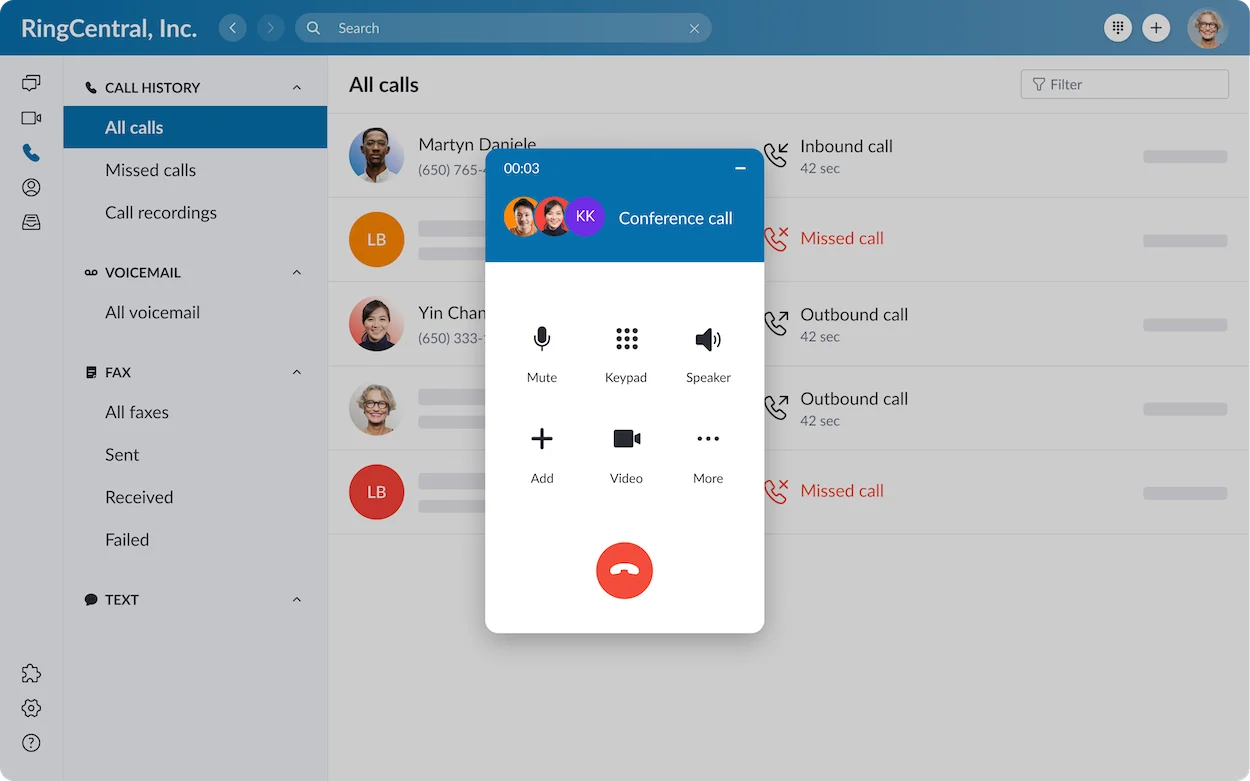
Read our RingCentral review for the wider overview.
Pricing: Compare the Full Bill
Google Voice Business Plans
Google lists Workspace add-on pricing at $10/user/month for Starter, $20 for Standard and $30 for Premier. Starter supports up to ten users; Standard and Premier support larger organizations. These are Voice charges, not a combined price for every Workspace service.
If you already pay for Workspace and will keep it, calculate Voice as an additional cost. If you are adopting Workspace to obtain managed Voice, include both subscriptions in the buying decision.
RingCentral Costs
RingCentral’s official number-buying guide references Core from $20/user/month with annual billing. Obtain current monthly and annual quotes for the specific package you need. Account for additional numbers, messaging, international usage, optional tools and applicable fees.
Do not compare Google’s entry plan with an annual RingCentral starting rate unless both support the same work and their commitments are clear.
A Five-User Budget Example
Five Google Voice Standard licenses cost $100/month at the listed $20 rate, before Workspace and extras. Five eligible RingCentral Core licenses at the $20 annual reference also equal $100/month, or $1,200 over twelve months, before extras.
This arithmetic does not establish feature equivalence. One offer may require another subscription or a higher package for your essential workflow. Request an itemized estimate before calling either option cheaper.
Call Routing, Ring Groups and Reception
Google Voice Standard and Premier team plans include auto attendants, ring groups and call queuing. Starter is therefore not the correct price benchmark for a team that requires those shared-call features.
For RingCentral, request a demonstration of the precise routing arrangement and any queue enhancements you need. Confirm whether the quoted package or an optional product supplies it.
Example: A repair business needs a booking menu, three staff answering calls and an after-hours destination. Ask both providers to demonstrate opening hours, unanswered calls and the handover between staff. A matching feature name does not prove identical behavior.
Choose based on that demonstration and the administrator’s ability to maintain it. A configuration that works only when the original installer is available can create an operational burden.
Apps, Devices and Call Quality
Google Voice supports browser calling and mobile apps. RingCentral supports desktop, mobile and web experiences. Both providers also document compatible business-phone equipment; verify exact models before reusing existing hardware.
There is no sound basis here for declaring one service universally clearer. Internet stability, Wi-Fi, headsets, device permissions and network configuration affect everyday calls.
Practical test: Have the same employees place and receive calls on the actual office and remote networks. Test a transfer, an unanswered call and a mobile worker. Record problems with timing and device details so you can distinguish network issues from configuration errors.
Integrations and Team Collaboration
Google Voice integrates with the Google environment, including Meet and Calendar. This can suit a business whose staff already use those tools and do not need a separate communications workspace.
RingCentral promotes a broader app ecosystem, including business-platform and CRM connections. Verify the specific integration’s plan eligibility, logging behavior and administrative requirements before treating it as a reason to buy.
Example: A sales company wants calls associated with customer records. Demonstrate an existing contact, a new caller and a duplicate record. The useful result is a reliable workflow, not the number of app logos in a marketplace.
If you already pay for meetings or chat, count a consolidation saving only when you can cancel the existing subscription and the replacement meets your requirements.
Recording, AI and Reporting
Google’s current documentation includes recording and AI note-taking capabilities across eligible subscriptions. Premier adds automatic recording and advanced reporting through BigQuery. Check the exact subscription, language availability and rollout requirements.
RingCentral’s included assistance and separately priced AI products have different scopes. A receptionist, conversation-intelligence tool and meeting summary are different requirements. Ask which license supplies each function.
Evaluation: Use realistic terminology and customer accents when testing summaries. Check who can access recordings, how long they are kept and how corrections or exports work. Features alone do not establish that the resulting records fit your business process.
International Calling and Phone Numbers
Google lists first-party Voice availability in fourteen countries or regions, including the US, Canada, UK and several European markets. Additional countries can involve SIP Link or Carrier Link arrangements with a carrier; this is a different deployment from Google directly providing the phone service.
Premier supports additional international-location requirements, but the word “international” does not mean every country or destination is available without cost.
RingCentral likewise requires separate checks for number availability, global-service eligibility and calling rates. Calling another country and obtaining a local number there are different questions.
Example: A UK company employs staff abroad and calls US customers. Price employee service locations, customer destinations and number requirements separately. Confirm any required local carrier or additional license.
Toll-Free Numbers: A Difference That Can Decide the Choice
Google’s business-number porting documentation lists toll-free numbers among unsupported features. If your existing public number is toll-free, verify its eligibility before planning a switch to Google Voice. Do not assume an ordinary local-number porting procedure covers it.
RingCentral offers toll-free numbers, with eligibility, rental charges and usage allowances to confirm. This makes it a more relevant initial shortlist when a toll-free customer number is essential, provided the proposed package meets the rest of your requirements.
Example: A nationwide service business has advertised its toll-free number for years. Preserving that number is an essential requirement, so number eligibility should be checked before comparing subscription prices or app appearance.
SMS and Customer Conversations
Google Voice business texting is restricted by market: current documentation describes US-number texting to US destinations, subject to applicable policies. Do not present it as unrestricted international business messaging.
RingCentral messaging can involve registration, allowances and overage. Shared customer texting may require an eligible bundle or additional product.
Example: Two assistants answer appointment enquiries. Test whether the proposed service supports the intended shared workflow, conversation visibility and handover. Individual employees being able to text does not automatically provide a coordinated customer inbox.
Pros and Cons
| Provider | Reasons to shortlist | Tradeoffs to check |
|---|---|---|
| Google Voice | Clear Voice license prices; familiar Workspace environment; eligible team-routing features. | Workspace cost for managed teams; country and SMS limits; specialized workflow requirements. |
| RingCentral | Broader communications; app ecosystem; options for growing operational needs. | Package complexity; optional-product spending; full fees and commitment. |
Which Should Your Business Choose?
Choose Google Voice When
Your business already uses Workspace, eligible countries cover your staff and the correct Voice plan handles your calling needs. It is especially worth testing when you want to add telephony to an established Google environment.
Choose RingCentral When
You need communications across multiple tools or locations and can identify the additional functions that justify the price. Evaluate its integrations, administration and optional customer tools against specific tasks.
Evaluate Another Option When
Your main requirement is a particular country’s number, a shared customer-conversation workflow or specialized sales calling. Neither provider should win by default if that requirement is poorly supported. See our RingCentral alternatives and VoIP provider comparison.
Best Choice by Business Scenario
| Business scenario | Start with | Reason and condition |
|---|---|---|
| Solo consultant | Google Voice paid standalone. | Worth comparing for one-person calling when US eligibility and its feature scope fit. |
| Small Workspace team | Google Voice managed business plan. | Fits an existing Google environment; choose Standard or Premier when shared routing is required. |
| CRM-focused sales operation | RingCentral. | Evaluate the specific CRM connector and required package through a realistic call-logging test. |
| Business retaining a toll-free number | RingCentral. | Verify portability, allowance and charges before signing. |
| Team with employees in several countries | Country-by-country assessment. | Neither an international-calling claim nor a global label proves local service eligibility. |
| Dedicated contact centre | Separate contact-centre evaluation. | Price agent operations, channels and supervision; RingCX is distinct from RingEX. |
These recommendations are use-case judgments based on documented scope, not ratings from a firsthand test. A successful pilot and complete quote should determine the final purchase.
Before Switching Providers
- List essential numbers, users, locations and calling workflows.
- Verify number portability and compatible hardware.
- Pilot the exact plan with representative employees.
- Confirm setup, usage, fees, renewal and cancellation terms.
- Keep the existing service active until migration and call handling are confirmed.
Record the configuration owner and how staff will obtain support. A successful first call is only one part of a successful migration.
Google documents separate business and personal porting procedures. Use the instructions for your actual subscription. Confirm the account name, service address and authorization details with the current provider, and allow for country-specific processing requirements rather than promising a fixed completion date.
Moving a phone number does not automatically transfer every voicemail, message, recording or routing rule. Identify what must be retained, confirm export options and rebuild the required call handling before cutover.
Frequently Asked Questions
Can Google Voice replace RingCentral?
Yes, for a business whose required workflows fit the eligible Voice plan. Verify number types, routing, recording, integrations and countries first; replacement does not imply identical features.
Is Google Voice for Business free?
Managed business Voice is a paid service. Free personal Voice and paid standalone single-user plans are separate offerings with different requirements.
Does Google Voice always require Workspace?
No. Paid standalone plans exist for a single user with a personal Gmail account. Managed multi-user Voice uses a paid Workspace subscription.
Is Google Voice cheaper than RingCentral?
It can be, but include Workspace, required plan upgrades and usage. Compare equivalent workflows and commitments instead of only starting rates.
Does Google Voice support ring groups?
Yes, on eligible Standard and Premier Workspace add-on subscriptions. Do not assume a standalone single-user plan provides the same team feature.
Does RingCentral require Google Workspace?
No. RingEX is a separate business communications subscription. Particular integrations can have their own prerequisites.
Which is better for a contact centre?
Define agent, channel, supervision and reporting requirements first. RingCentral offers RingCX separately; this RingEX comparison does not establish contact-centre feature parity.
Final Verdict: RingCentral or Google Voice?
For straightforward calling within an established Workspace team, start with Google Voice. For broader business communications, specific CRM workflows or essential toll-free requirements, start with RingCentral. A solo user should compare Google’s paid standalone offering separately.
Choose the service whose eligible plan handles your daily tasks at an acceptable complete cost. Confirm the actual package, run a representative pilot and check migration and renewal terms before committing.
Affiliate disclosure: Some links in this article are affiliate links. If you purchase through them, VoIPCalling may earn a commission at no additional cost to you. Confirm current pricing, features, availability and terms before choosing a provider.