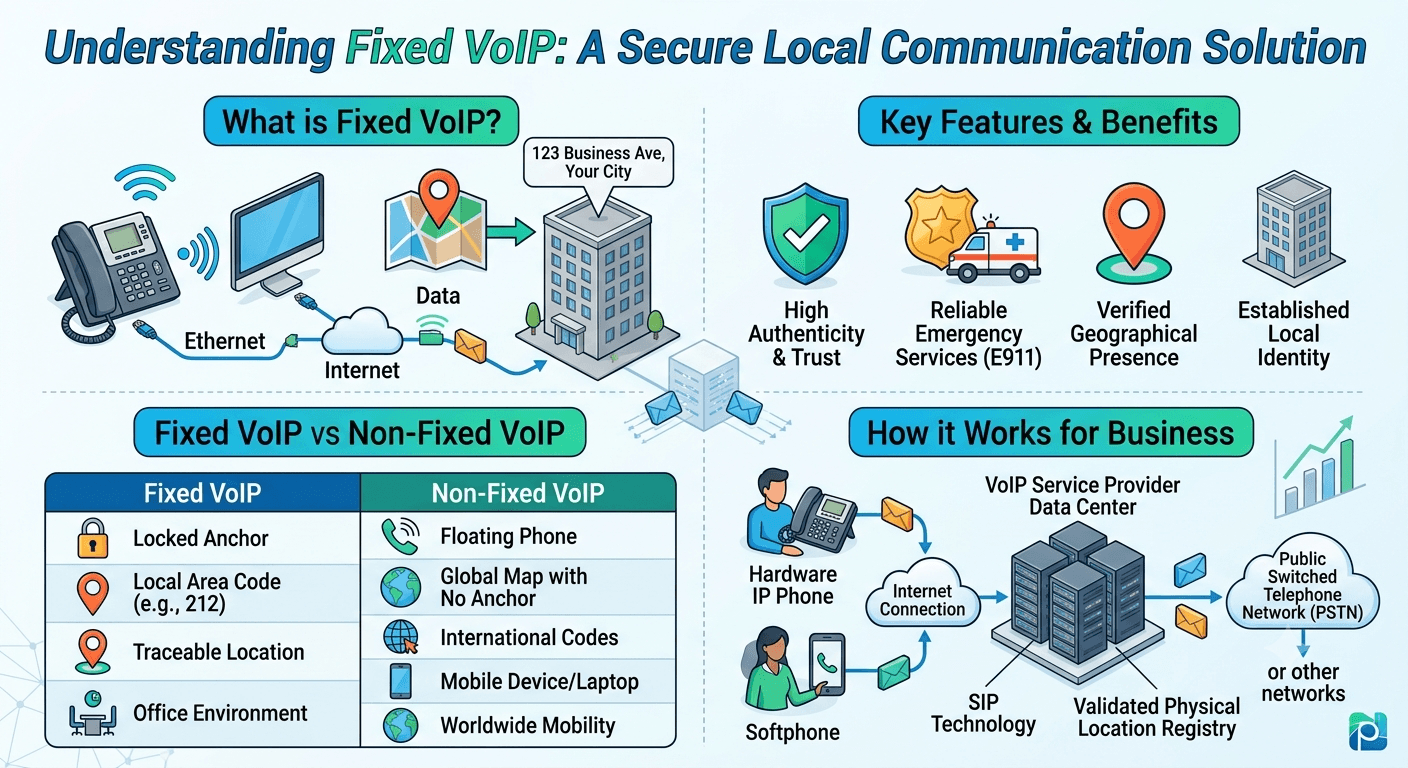
Fixed VoIP is a type of Voice over Internet Protocol service that is linked to a physical address, much like a traditional landline. Unlike non-fixed alternatives that can be assigned to any location globally, this system requires a verified geographical presence to function. This connection to a specific office or home address makes it a highly reliable communication tool for businesses that value local identity and security. Because the service is address-locked, it provides superior emergency service routing and helps build trust with customers who recognize local area codes as a sign of legitimate, established operations.
What is “fixed VoIP?”
The term fixed VoIP refers to a communication system that transmits voice data over the internet but maintains a tether to a physical geographic location. This service is provided by a host that requires a residential or business address to activate the account. In the world of modern telephony, it acts as the modern replacement to the Public Switched Telephone Network, offering the flexibility of internet-based calls while retaining the accountability of a fixed line.
When a provider issues a fixed VoIP number, that number is registered in a database along with a physical street address. This process allow that the service provider can verify the identity of the user, which helps reduces the chances of the number being used for spam or fraudulent activities. For companies operating out of a central headquarters, this technology provides a stable and professional communication endpoint that remains consistent regardless of the internal hardware used.
What’s the difference between fixed and non-fixed VoIP numbers?
The main difference between these two systems lies in their requirement for a physical anchor and the level of trust they are in the telecommunications system. While both use the internet to make calls, their administrative and functional profiles differ significantly across several key categories.
| Feature | Fixed VoIP | Non-fixed VoIP |
| Physical Address | Requires a physical address that matches the local area code. | Does not require a physical address; can be established in any region or country. |
| Emergency Services | Highly dependable; addresses are easily traceable by emergency services. | Harder for emergency services to identify caller location as it is not linked to an address. |
| Mobility & Access | Accessible on different devices only if authorized for the specific registered address. | High mobility; accessible from any internet-connected device (PC, laptop, mobile) worldwide. |
| Costs | International and long-distance calls can be expensive. | Cheap and cost-efficient for long-distance and international calling. |
| Trust & Local Presence | High authenticity; local numbers naturally encourage trust. | Traditionally lacks a local code, though modern solutions now allow for local area code integration. |
| Ease of Setup | Difficult to establish a presence outside of your current physical location. | Easy to establish a global presence regardless of your actual location. |
How does fixed VoIP work?
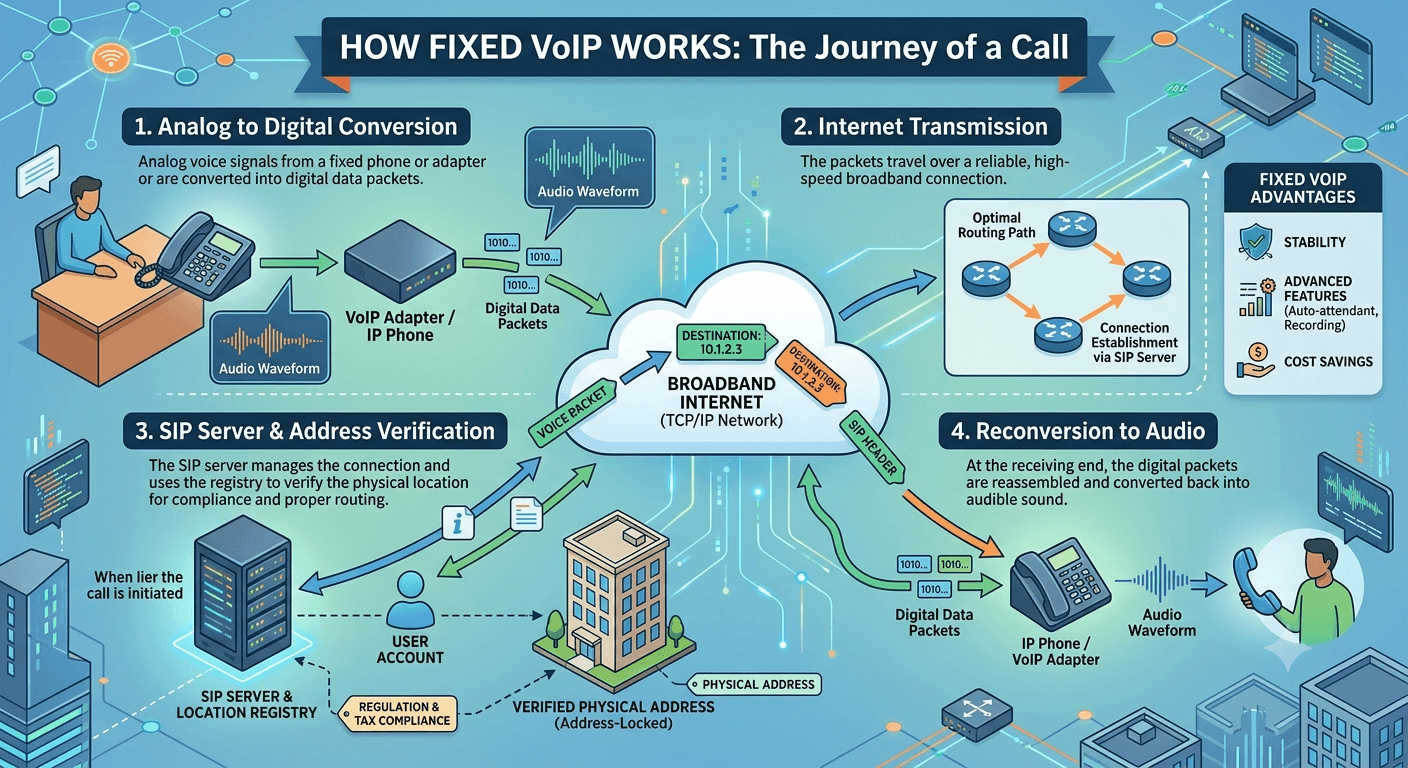
Fixed VoIP works by converting analog voice signals into digital data packets. These packets travel over a broadband internet connection rather than through the copper wires used by traditional phone companies. Once the data reaches its destination, it is converted back into audio for the receiver. The “fixed” aspect is managed through the service provider’s registry, which maps the IP address and the account to a validated physical location provided during the signup process.
This system relies on a technology known as Session Initiation Protocol (SIP) to manage the connection. When you dial a number, the SIP server identifies the destination and establishes the path for the data packets. Because the service is address-locked, the provider can ensure that the routing of the call complies with local regulations and tax laws, which are often tied to the physical location of the business fixed line.
According to a report by Global Market Insights, the VoIP market size exceeded USD 40 billion in 2022 and is projected to grow at a CAGR of over 10% through 2032. This growth is partly driven by the transition of businesses from aging hardware to address-verified digital solutions that offer both stability and advanced features like auto-attendants and call recording.
Why Some Businesses Choose Fixed VoIP?
For many established organizations, the use of a fixed VoIP number is a non-negotiable requirement for maintaining professional standards. This is particularly true for businesses in the financial, legal, and healthcare sectors, where identity verification and security are very important. Having a number tied to a physical office location prevents the business from being flagged as a “robocaller” or a “spammer,” which is a common issue with unverified internet numbers.
Furthermore, these systems offer a level of reliability that matches traditional telephony but with the added benefits of digital integration. Businesses can enjoy high-definition voice quality and advanced call-handling features without losing the reliability of a fixed line. This setup is ideal for companies that operate primarily from a single location and want to ensure their communication infrastructure is recognized as a trusted business in the local business community.
-
It establishes a verifiable business presence in a specific geographic market.
-
It simplifies compliance with local telecommunications regulations.
-
It provides a higher level of security against account hijacking and fraud.
-
It ensures that the company appears in local directory listings and “white pages” databases.
When businesses may not need (or want) fixed VoIP
Despite its benefits, a fixed phone number is not the right fit for every organizational structure. Startups with entirely remote teams, for instance, might find the physical address requirement to be a significant hurdle. If a company lacks a central office and employees are scattered across different states or countries, a non-fixed voip mean is often more practical because it allows for total geographic independence.
Additionally, companies that focus heavily on international sales may find the limitations of a fixed VoIP system too restrictive. If you need to appear local in London, Tokyo, and New York simultaneously while your office is in Chicago, the address-locking nature of fixed systems will prevent you from obtaining those local identifiers. In these cases, the flexibility of a non-fixed voip number is more valuable than the security benefits of a fixed one.
-
Remote-first companies without a dedicated physical headquarters.
-
Businesses that frequently move locations or operate as pop-up shops.
-
Organizations that require a large volume of international local numbers for marketing.
-
Freelancers and solopreneurs who prefer to keep their home address private from service registries.
The Pros and Cons of Fixed VoIP
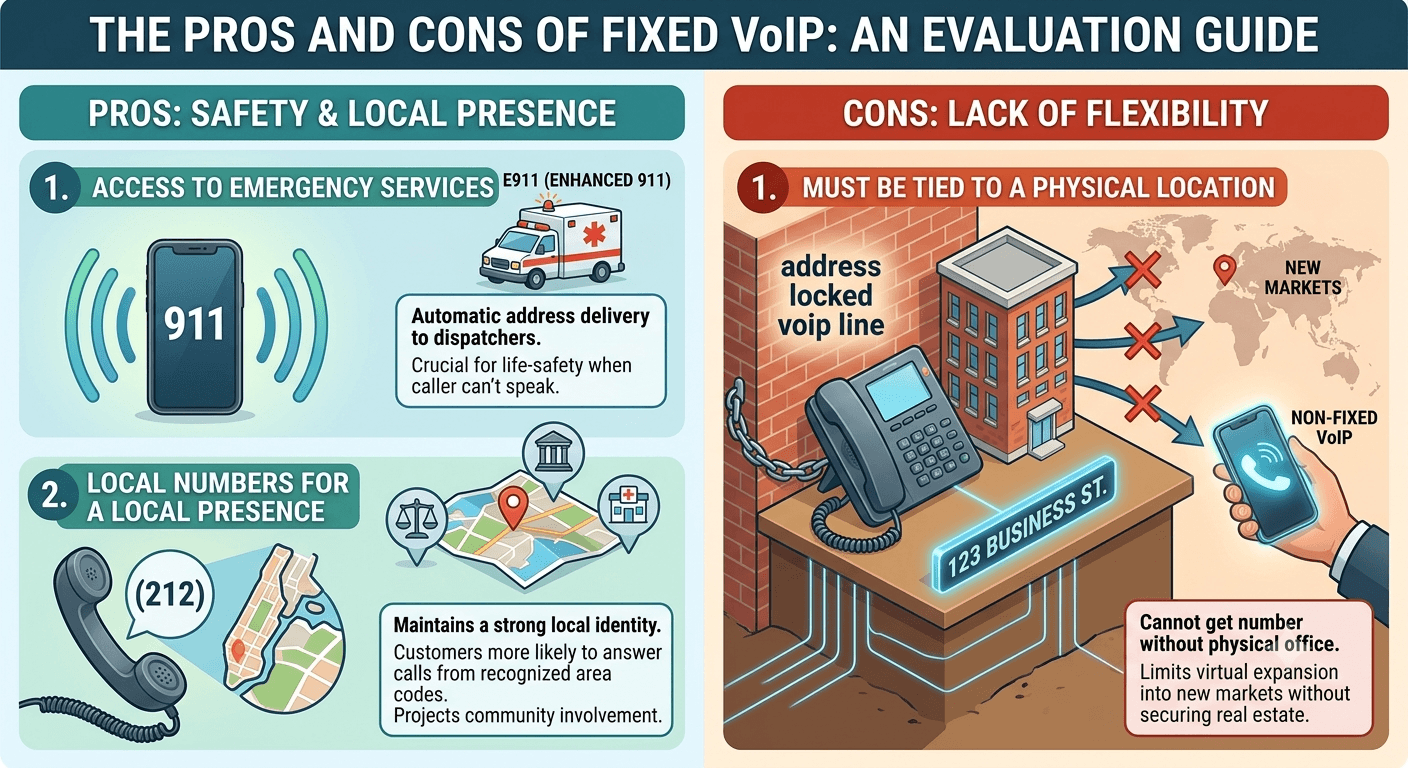
Before choosing fixed VoIP looking at the balance between security and mobility. While it provides a reliable solution for professional communication, it also creates certain restrictions that might limit a highly mobile workforce. Understanding these trade-offs is essential for selecting the right communication technology for your specific operational needs.
-
Pros
The primary advantages of this system are based in safety and brand perception. Because the service is regulated more strictly than non-fixed alternatives, it offers features that are critical for life-safety and customer relationship management.
1. Access to emergency services
One of the most significant benefits of using a fixed VoIP phone is its compatibility with E911 (Enhanced 911) services. In the United States, the Federal Communications Commission (FCC) requires VoIP providers to provide E911 services, which automatically deliver the caller’s registered location to emergency dispatchers. Because fixed VoIP is tied to a specific address, this information is highly accurate, ensuring that first responders can find the location even if the caller is unable to speak.
2. Local numbers for a local presence
A fixed VoIP number allows a business to maintain a strong local identity. Customers are more likely to answer calls from a local area code that they recognize rather than an unknown toll-free number or a number from a distant city. This local presence is vital for service-based businesses like law firms, medical clinics, and retail stores that rely on a local customers and want to project a sense of community involvement.
-
Cons
The limitations of this service are almost entirely related to its lack of flexibility. For a modern, growing business, these restrictions can sometimes feel like a step backward toward traditional landline limitations.
1. Must be tied to a physical location
The biggest drawback is the requirement for a physical address. This means you cannot simply sign up for a fixed number in a city where you do not have a physical office. This “address locked voip line” nature limits the ability of a company to expand its virtual presence into new markets without first securing physical real estate, which can be an expensive and time-consuming barrier to growth.
Miscellaneous tips if you have a VoIP phone system
Once you have decided to implement a fixed VoIP system, there are several steps you can take to maximize its efficiency. Managing a digital phone system requires a bit more technical oversight than a traditional line, but the results are far more rewarding in terms of call quality and feature sets.
Optimization involves ensuring that your local area network is prepared for the increased data load and that your staff understands how to utilize the software interfaces provided by the host. A well-configured system can serve as the backbone of your entire customer service operation.
1. See if you can keep your existing phone number
Most providers allow for “number porting,” which is the process of moving your current fixed phone number from a traditional carrier to a VoIP service. This is a crucial step for established businesses that do not want to lose their existing brand recognition or update their marketing materials. Before signing a contract, verify that the new provider can successfully port your specific number without long periods of downtime.
2. Set up VoIP call forwarding
One of the best ways to overcome the physical limitations of a fixed system is to utilize advanced call forwarding. Even though the number is anchored to your office, you can set up rules that forward calls to mobile devices or home offices after a certain number of rings. This ensures that your team stays reachable even when they are away from their desks, maintaining the “fixed” identity while enjoying “non-fixed” mobility.
3. Run speed and QA tests
VoIP quality is depends on your internet connection’s health. You should regularly run tests to check for “jitter” and “latency,” which can cause dropped calls or audio delays. A business fixed line requires a stable upload and download speed to maintain crystal-clear audio. Many providers offer Quality of Service (QoS) settings on routers that prioritize voice traffic over other types of data, such as large file downloads or video streaming.
How do I get a fixed VoIP number?
Obtaining a fixed VoIP number is a simple process, but it requires more documentation than a non-fixed one. You must first select a reputable provider that specializes in business-grade VoIP services. During the registration process, you will be asked to provide a valid physical address within the service area of the area code you desire.
The provider will then verify this address, often by checking utility records or business registration databases. Once verified, they will assign the number to your account. You can then choose to use hardware IP phones, which look like traditional office phones but plug into ethernet ports, or use software-based “softphones” on your computers. The key is that the provider will always associate your service with that specific physical location for billing and emergency service purposes.
-
Research providers that offer fixed VoIP services in your specific region.
-
Prepare documentation to prove your business or residential address.
-
Select a hardware or software interface that fits your workflow.
-
Complete the E911 registration to ensure your address is correctly mapped in emergency databases.
-
Test the system by making outbound and inbound calls to verify the local caller ID display.
Final Thought
Choosing between different types of internet-based telephony depends largely on your business model and your need for geographic stability. While a nonfixed VoIP offers unparalleled flexibility for a global, mobile workforce, the fixed VoIP system remains the gold standard for businesses that need to establish deep roots in a local community. By combining the technical advantages of the internet with the security and trust of a physical address, fixed VoIP provides a professional, reliable, and secure communication foundation that can scale alongside your business.
FAQs
-
What is the difference between fixed and non-fixed VoIP?
The main difference is that a fixed VoIP number is linked to a physical address and a local area code, whereas a non-fixed VoIP number can be created without a physical address and used from anywhere in the world. Fixed systems offer better E911 support and higher trust, while non-fixed systems offer greater flexibility and lower costs for international operations.
-
Why would someone have a VoIP phone number?
Businesses and individuals use these numbers because they are generally more affordable than traditional landlines and offer advanced digital features. They allow for integration with CRM software, provide high-definition audio, and enable features like voicemail-to-email, which are not available on standard analog lines.
-
How to get a fixed VoIP number?
You can get one by signing up with a VoIP service provider and providing a verified physical address. The provider will confirm your location and assign a number that corresponds to your local area code. You will then need an internet connection and a device—either a specialized IP phone or a computer with softphone software—to start making calls.
-
Do you have to pay monthly for VoIP?
Yes, almost all VoIP providers operate on a subscription-based model. You typically pay a monthly fee per user or per line, which usually includes a set amount of minutes or unlimited local calling. This monthly cost is often quite lower than the cost of maintaining a traditional business fixed line through a legacy carrier.
-
What is fixed dialing numbers?
Fixed dialing numbers (FDN) is a service mode of a GSM phone’s SIM card that restricts outgoing calls to only a predefined list of numbers. While it shares the word “fixed,” it is a security feature for mobile phones and is different from a fixed VoIP service, which relates to the geographical registration of an internet phone number.
-
Is a fixed VoIP number a landline?
Technically, no, it is not a landline because it uses the internet instead of copper wires. However, it is often treated like a landline by banks, government agencies, and emergency services because it is tied to a specific physical location. This makes it a “digital landline” in terms of its practical use.
-
Can I use fixed VoIP for my remote team?
You can, but it is more complicated than using non-fixed options. You would need to have a central office address to register the number. Your remote employees could then log into the system from their homes, but the outgoing caller ID would still reflect the central office’s local area code and address.
-
Does fixed VoIP work during a power outage?
Unlike traditional landlines that draw power from the phone jack, VoIP requires an active internet connection and power for your router and devices. To keep a fixed VoIP system running during an outage, you would need a backup power supply, such as a UPS (Uninterruptible Power Supply), or a failover system that redirects calls to a mobile network.
-
What are the bandwidth requirements for fixed VoIP?
A single high-quality VoIP call typically requires about 100 Kbps of upload and download bandwidth. For a small office with ten simultaneous users, a stable connection with at least 1-2 Mbps of dedicated bandwidth for voice is recommended to ensure that call quality does not degrade when other employees are using the internet for data-heavy tasks.