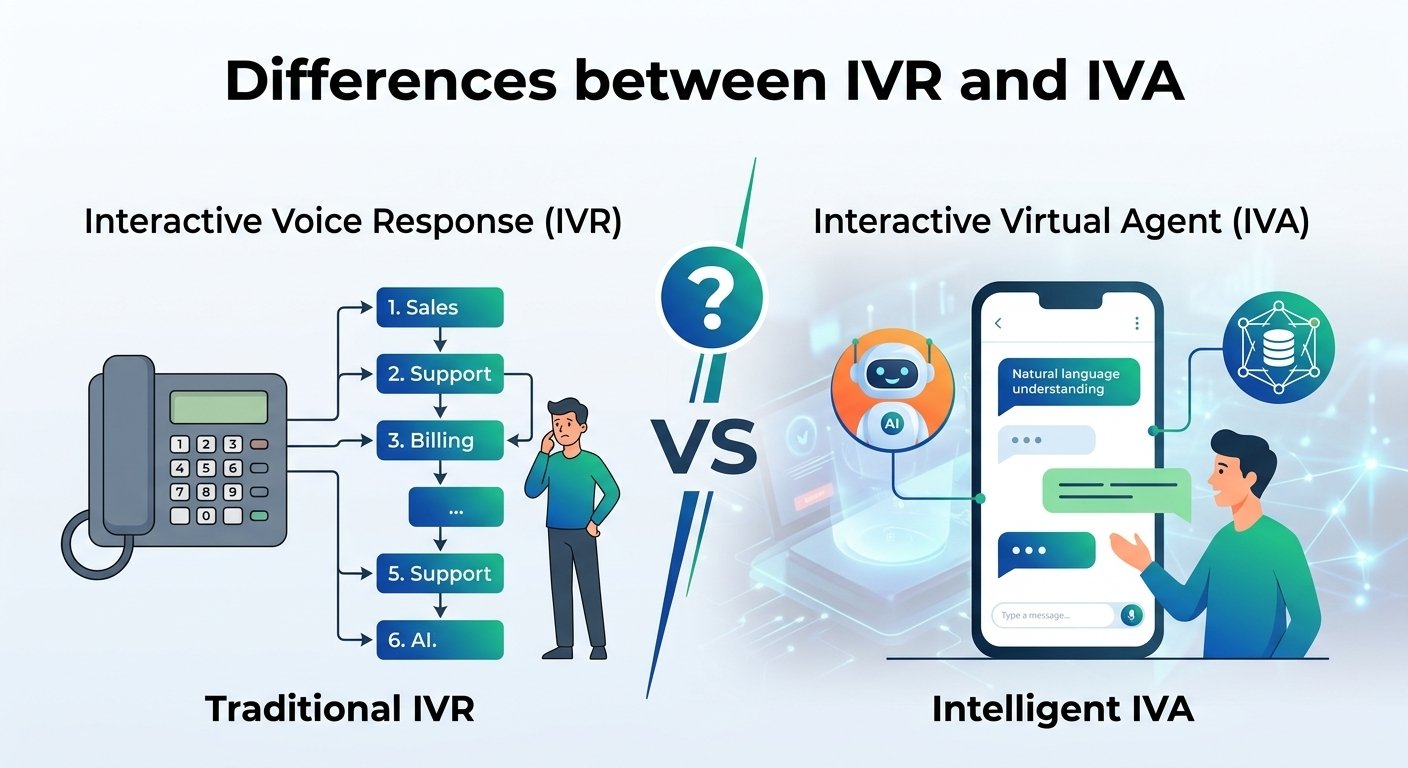
Interactive Voice Response (IVR) directs incoming interactions based on keypad choices, while an Intelligent Virtual Agent (IVA) uses artificial intelligence to enable true conversational experiences.
The specific technology that best fits your operational needs will largely depend on the volume of interactions you have daily, your budget, and your expectations for user experience. By knowing the iva vs ivr, organizations can choose the best customer service automation solution for their needs without overspending. This complete guide dissects these two leading systems and provides you with practical tips to help you put the best support system in place for your business.
What Is Interactive Voice Response?
Interactive Voice Response is an automated communication system that enables callers to interact with a phone menu using either dual-tone multi-frequency keypad inputs or simple speech commands. The main use of this technology is to automate appointment scheduling, bill payments, and department routing, significantly reducing the administrative burden on human employees.
The platform ensures that consumers are directed to the right place at the right time by analysing incoming selections properly. This standardized framework revolutionizes the way inbound communications are handled in technical support environments, leading to increased efficiency and smoother day-to-day operations.
-
Key features of IVR
The basic skill of this routing technology is to understand the customer’s needs as soon as they are connected and send them on their way. Callers use static menus to choose specific digits that represent different departments, enabling organizations to have organized communication channels.
-
-
-
Having pre-programmed keypad options that allow consumers to access sales, technical support or billing departments without the need for a human receptionist.
-
Letting consumers say why they are calling, without having to navigate through a numerical menu.
-
Providing pre-recorded information about business hours and basic account information to alleviate pressure on live support staff.
-
-
-
The advantages of IVR
In environments with a lot of inbound traffic, deploying standard routing technology is very cost effective as consumers are able to navigate to the appropriate resources very quickly. Basic queries are resolved without human involvement, which significantly reduces metrics such as average handle time and abandonment rates.
Moreover, this system is a great tool for after hours and not to leave unhelpful voicemails. This reduces the time that live representatives have to spend manually moving people and allows them to focus more on effectively addressing complex technical issues.
-
The limitations of IVR
Rigid technological frameworks are strictly predefined and have a lot of friction if the consumer needs some help outside the menu options. The timing and frequency of prompts is critical, and if not designed well, can lead to overwhelming user dissatisfaction.
Another major disadvantage is that it lacks the ability to understand intent and nuanced questions, which leads to unnecessary handoffs between departments. Organizations usually start looking into an iva system as a powerful alternative when standard menus don’t capture the intricacies of complex conversational context.
What Is an Intelligent Virtual Agent?
An Intelligent Virtual Agent is a sophisticated software solution that uses AI to facilitate seamless and authentic conversations with customers. This advanced digital assistant combines natural language processing with voice biometrics, enabling it to accurately understand human speech and respond dynamically.
This contact center iva solution is not just about offering hard-coded numerical options; it’s about handling complex requests efficiently and continuously learning from interactions. Staff then move on to higher value activities, which increases the productivity of the workplace and reduces operational burnout.
-
Key features of IVA
The backbone of all these smart virtual assistants can do for modern enterprises is their advanced natural language processing capabilities. The software can fully analyze dialogues, identify speech patterns, understand the context of the dialogue, and provide appropriate responses according to the sentiment analysis results.
-
-
-
Seamless integration with external customer relationship management databases to deliver highly personalized support based on real-time account information.
-
Implementing omnichannel capabilities on chat, email, and voice channels to ensure consistent support experiences around the world.
-
Dynamically searching internal knowledge bases to provide consumers with accurate contextual information instead of closed yes/no answers.
-
-
-
The advantages of IVA
By introducing conversational AI to consumers, companies ensure a high-quality personalized experience that goes beyond simple communication routing. These powerful digital assistants work around the clock, without needing to take breaks, which means there are no hold queues and consumer satisfaction metrics are significantly improved.
A 2026 research report by Gartner found that conversational AI in enterprise settings can save agents a lot of time and money, and increase operational efficiency by up to 30%. By keeping historical interaction data, you have a continuous stream of training data, which means that the machine learning algorithms continuously improve future performance.
-
The limitations of IVA
Highly developed technological systems require significant capital expenditure, intensive start-up setup and ongoing expert maintenance to operate optimally. Before full deployment, organizations need to have absolute trust that their automated frontline support will act exactly as, or better than, a human representative.
Without proper monitoring, platforms can fall victim to serious security threats and potentially provide users with inaccurate information, leading to frustration. If there are no regular reviews to monitor negative sentiment and specific keywords, the whole implementation can have a serious impact on brand reputation.
Differences between IVR and IVA
When it comes to iva vs ivr, artificial intelligence has more capabilities, but sometimes, it may be too much to deploy. Each enterprise has its own unique demographic characteristics and it is important to understand the operational priorities before undertaking a total overhaul of existing telecommunication infrastructures.
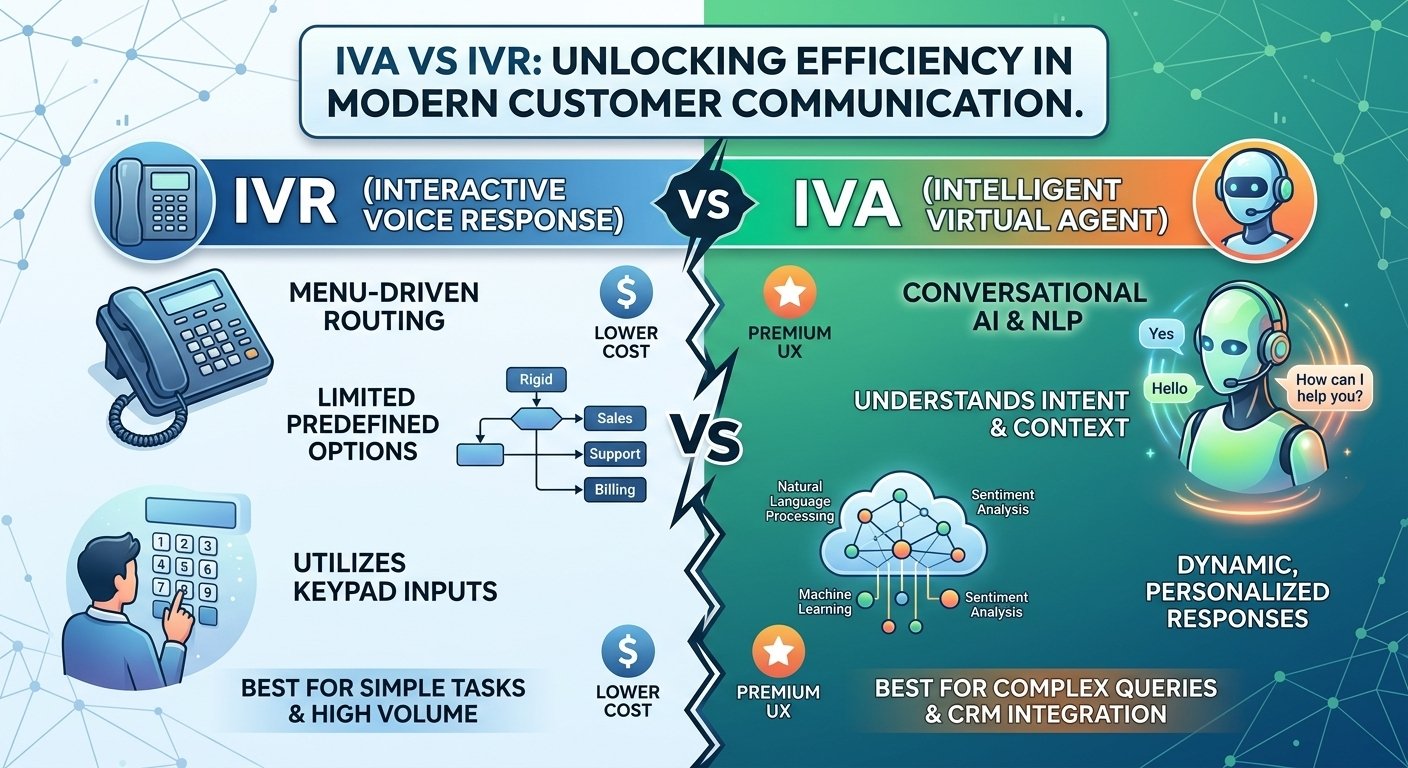
The choice of the best framework is largely dependent on the balance between the costs of deployment and the long-term automation goals. Knowing these differences allows leadership teams to maximize service efficiency while staying within budget.
| Interactive Voice Response (IVR) | Interactive Virtual Agent (IVA) |
| Menu-driven | Conversational |
| Limited options | Wide-range of responses |
| Dependent on agent availability | Virtual agents available 24/7 |
| Can’t request same agent as previous call | Virtual agents retain interaction history |
| Replicates existing call flows | Requirements gathering and customer research |
| Set and forget | Launch and monitor |
| Optimize for popular options | Examine accuracy and helpfulness |
| Instant changes when needed | Major updates need planning |
1. User experience
When users come to any support portal, they are expecting a super smooth and seamless experience that is exactly what they need at the moment. Standard predefined audio prompts lead people through simple activities in a methodical way, with highly structured but sometimes rigid interactions.
On the other hand, AI enables a very conversational approach, allowing people to describe their issues in a natural way and not having to go through a complicated keypad tree. This sophisticated method significantly speeds up the resolution of complex issues, creating a much better brand impression.
2. Flexibility
When you’re doing a traditional ivr iva comparison, you’ll see that a rigid menu offers absolute certainty when it comes to destination routing, and that’s ideal for simpler organizational structures. Standardized configurations are still much simpler to update locally, without the need for extensive linguistic training modules.
Today’s iva telephony systems are very good at adapting to context; they can anticipate what the consumer needs based on past behaviors. Although more difficult to manage at first, this huge flexibility guarantees high accuracy resolutions on various communication channels at once.
3. Implementation and maintenance
The inbound routing configuration is still very simple and cheap, as the logical paths are still very linear and predictable. Administrators just give certain keypad numbers to certain departments, and they don’t really consider the emotional context or nuances of conversations.
To understand the need for the rigorous initial investment required for training the linguistic algorithm, it is necessary to analyze an extensive iva case study. Nevertheless, the Harvard Business Review notes that the long-term financial value of continuous machine learning integration is extraordinary, as it can autonomously answer more and more complex questions.
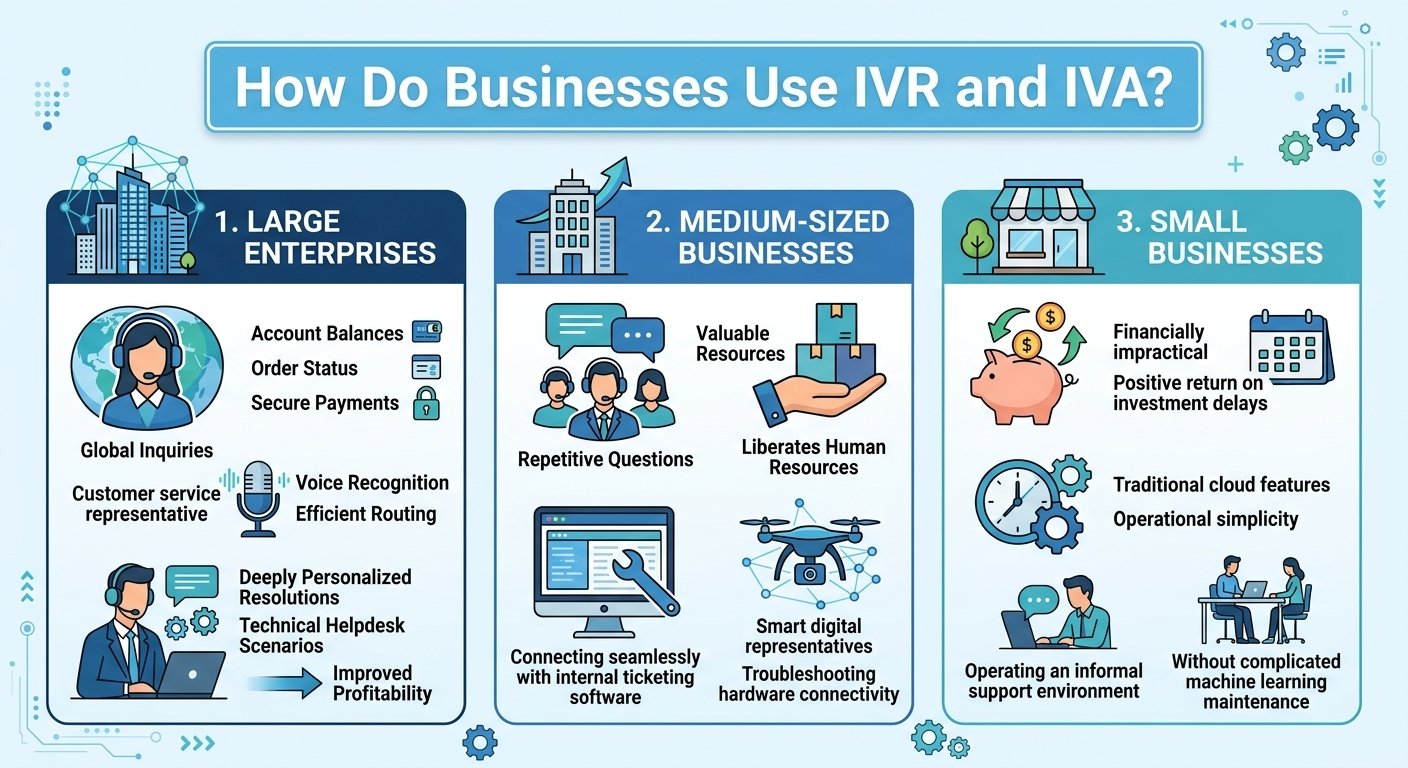
How Do Businesses Use IVR and IVA?
1. Large enterprises
Basic routing is used extensively by multinational companies for large-scale queries such as checking account balances, order statuses, and secure payments. These large-scale systems can be made to function efficiently with voice recognition enhancements, which will not be swamped by a large volume of inbound traffic.
At the same time, an iva contact center solution can help large businesses with highly customized solutions to complex technical helpdesk situations. These advanced integrations actively troubleshoot complex software issues with consumers, making a huge impact on enterprise profitability and operational bottlenecks.
2. Medium-sized businesses
Standard routing is often used in growing companies to manage moderate volumes of traffic without any problems, particularly if the majority of the questions are repetitive and appear in the daily communication log. By funneling many customer questions to automated messages, you free up precious human resources to address much more complex customer issues.
As the goal becomes to deliver high-end brand experiences, an iva call center solution offers an invaluable digital frontline asset. These intelligent digital agents integrate effortlessly with in-house ticketing systems and resolve hardware connectivity issues automatically, without involving human agents.
3. Small businesses
In most cases, running an informal support environment is too costly and too much work for smaller teams to deploy complex artificial intelligence. Traditional cloud services can handle simple day-to-day tasks without the need for specialized cloud administration expertise or high monthly licensing fees.
While a sophisticated iva phone system may sound like a great idea when staffing is low, the time it takes to configure the system can make it difficult to see a return on investment. The same routing mechanisms provide the same practical value for localized operations, but without complicated machine learning maintenance cycles.
Setting Up a Call Flow or Auto Attendant for SMBs
-
Call flows
Configurable directory trees direct callers to specific departments, depending on the specific skill needed and the hours of operation. These streamlined mechanisms ensure that interactions are delivered to the right people at the right time, without the need for complex AI systems.
Overflow parameters are easily set up by administrators, and should primary representatives be busy, the system seamlessly routes people to secondary available resources. These are not conversational programs, but rather one-way programs that are strictly controlled by the technology and the consumer chooses the exact path to follow.
-
Auto attendant
Acting as a completely digital receptionist, this specialized technology greets incoming traffic professionally using highly polished pre-recorded audio messages. When the professionals are busy, they know that each and every interaction is answered promptly and courteously, no matter how chaotic the workplace is.
This is a very cost effective approach that improves first call resolution and gives the impression of a much larger corporate entity. The administrative changes can be made quickly without much technical knowledge, which is an excellent alternative to setting up complicated iva ors parameters.
-
When to consider a call flow or auto attendant
These are the fundamental routing mechanisms that should be strongly considered by organizations that want to improve the reliability of communication without investing in large capital projects, rather than advanced conversational tools. These practical solutions are effective in traffic management and are successful in catering for consumers who are totally unwilling to use speech-based navigation.
Choosing the Solution Right for Your Business
To make the final decision between iva vs ivr, you need to take into account the size of your organization, budget constraints, and the desired level of support. Basic routing mechanisms handle large volumes of traffic efficiently, and intelligent virtual agents offer the sophistication needed for highly personalized and autonomous resolutions.
The right technology can enable your employees to be very productive and effectively close any service gaps you may have securely. Focus on user experience and strong data security measures to ensure that your selected infrastructure enhances the entire consumer experience seamlessly.
FAQs
-
How do I choose between iva vs ivr for my company?
Selecting the correct infrastructure depends entirely upon your daily interaction volume, budget limitations, and necessity for complex conversational personalization.
-
What does IVA stand for in call centers?
It stands for Intelligent Virtual Agent, which represents an advanced artificial intelligence software application designed to handle complex consumer dialogues autonomously.
-
What is IVR and IVP?
Interactive Voice Response handles keypad-based departmental routing, whereas IVP typically refers to Interactive Voice Processing, encompassing broader automated audio functionalities.
-
What does IVA stand for in the context of IVR?
Within telecommunications, it signifies an Intelligent Virtual Agent acting as a highly sophisticated, conversational upgrade to traditional rigid keypad menus.
-
What is IVR used for?
Organizations utilize this technology to automatically sort incoming traffic, schedule basic appointments, and securely process standardized billing transactions without human intervention.
-
Which iva solutions perform best for limited financial resources?
Smaller enterprises should avoid expensive artificial intelligence entirely and instead deploy foundational auto attendants to project professionalism without breaking budgets.
-
Does modern iva ai replace human representatives completely?
No, these digital assistants merely handle repetitive, mundane inquiries autonomously, thereby allowing human personnel to dedicate their expertise toward complicated emotional escalations.
-
Are sophisticated iva integrations necessary for basic routing?
Connecting external databases remains entirely unnecessary if your sole objective involves transferring individuals to designated extensions utilizing standard numerical keypad presses.