Call routing, vital communication solution, determines the direction of incoming business interactions, effortlessly transferring callers to particular departments. A perfect call center routing system will keep frustration at bay, avoid unnecessary transfers, and significantly reduce wait times.
Once the proper phone routing software is in place, operations are very efficient. This cloud telephony call routing technology is used by businesses of all sizes to optimize their support channels. In this guide, we’ll uncover how a well-planned telephone routing system can revolutionize your business and boost customer satisfaction with ease.
What Is Call Routing?
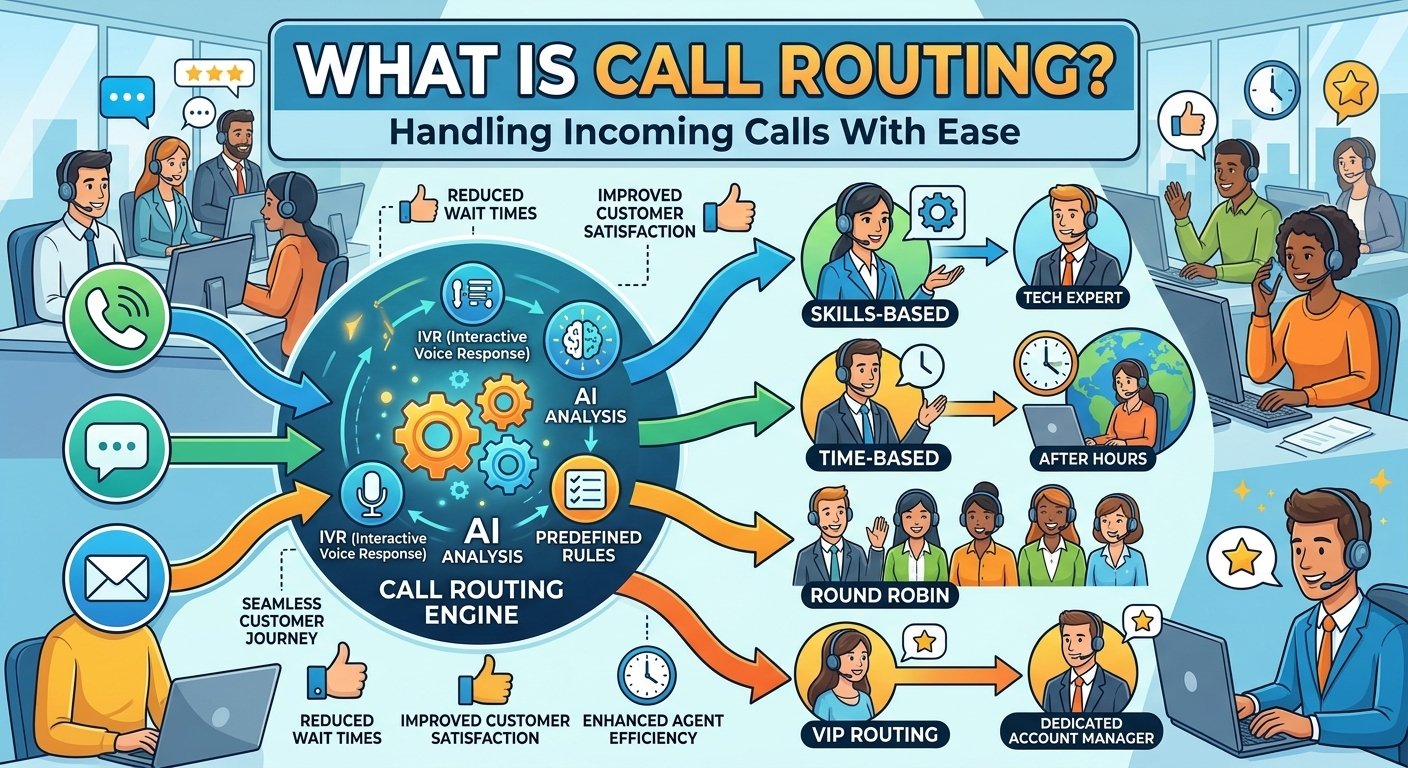
In the context of call routing meaning, it is a more advanced telephone management function that routes incoming calls to a queue and distributes them according to a set of rules. Automatic call routing is a call path that is seamlessly directed by programmed logic, Interactive Voice Response, or auto-attendants instead of a manual receptionist. The main goal is to match the client with the most qualified person as quickly and painlessly as possible.
Call routing for small business setups is particularly important for customer support, as it helps ensure that customers are routed to the right agent who can provide them with the necessary support. If they don’t have strong call routing systems in place, businesses can face high call abandonment rates and a loss of consumer confidence. By grasping what is call routing, executives can optimize workflows, making sure that each call is handled with professionalism and competence from the outset.
Benefits of Call Routing
For any growing business, a modern business call routing framework is essential to stay competitive. Companies with the best telephone call routing enjoy tremendous improvements in their operations.
Benefits for Contact Centers
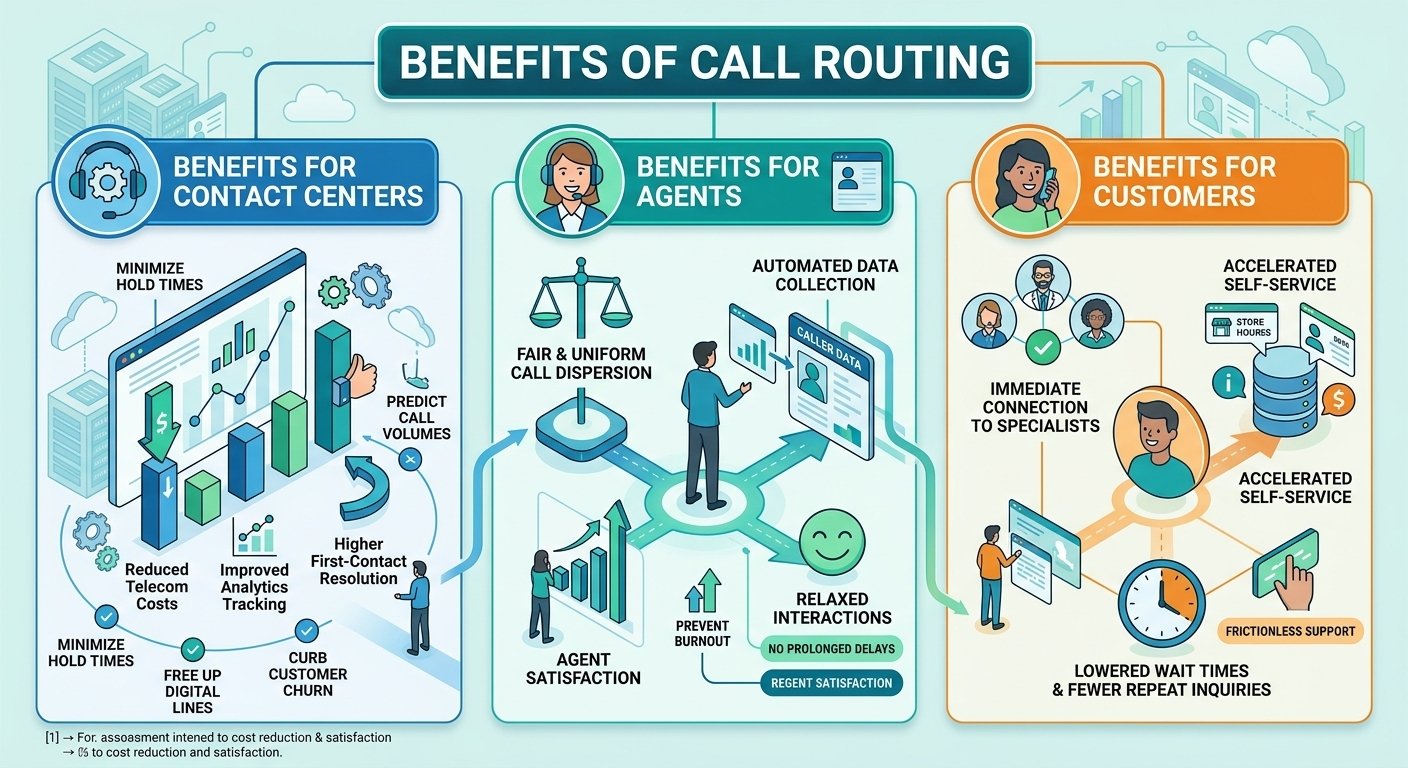
By using a call routing platform, you can reduce administrative hurdles and improve efficiency overall. Virtual call routing brings about significant improvements to a contact center in a number of operational areas:
-
Drastically reduced telecom pricing by minimizing hold times and freeing up digital lines.
-
Improved analytics tracking for predictive call volume management and resource allocation.
-
Enhanced first-contact resolution rates, which ultimately curbs customer churn and builds loyalty.
According to SQM Group’s research, for each 1% improvement in first call resolution rate, the operating costs for your contact center reduce by 1%, and customer satisfaction simultaneously increases by 1%. This proves that optimizing incoming call routing is a direct pathway to operational profitability.
Benefits for call center agents
A good call center call routing protocol will actively help to avoid employee burnout by seamlessly managing workload. A dependable phone routing system distributes tasks efficiently, granting agents the following indispensable perks:
-
Fair and uniform dispersion of routed calls across all available personnel.
-
Automated collection of caller data before the conversation even begins, aiding in preparation.
-
More relaxed interactions since callers are not irritated by prolonged delays.
Benefits for customers
An intelligent call routing mechanism means a better and memorable consumer experience. A seamless support journey for shoppers and clients is achieved via:
-
Immediate connection to specialized agents trained for specific types of calls.
-
Accelerated access to vital self-service information like store hours or account balances.
-
Significantly lowered wait times and fewer frustrating repeat inquiries.
How Does Call Routing Work?
Behind the scenes, an efficient inbound call routing structure works to manage telecom traffic. The online call routing infrastructure intercepts the signal when a client initiates contact, presents an auto-attendant menu and immediately evaluates the situation to make an immediate routing decision. This real-time processing ensures that there is no delay and the caller is always engaged.
Call routing decisions made by the software can be based on time of day, caller ID routing information, and relationship information stored in your database. Advanced call routing integrations use artificial intelligence to match callers with employees based on past interactions, making sure that the telephone routing system always makes the most logical match.
Different Types of Call Routing
By utilizing effective call center routing strategies, you can provide a better user experience each and every time. These are the most common approaches to effective calls routing.
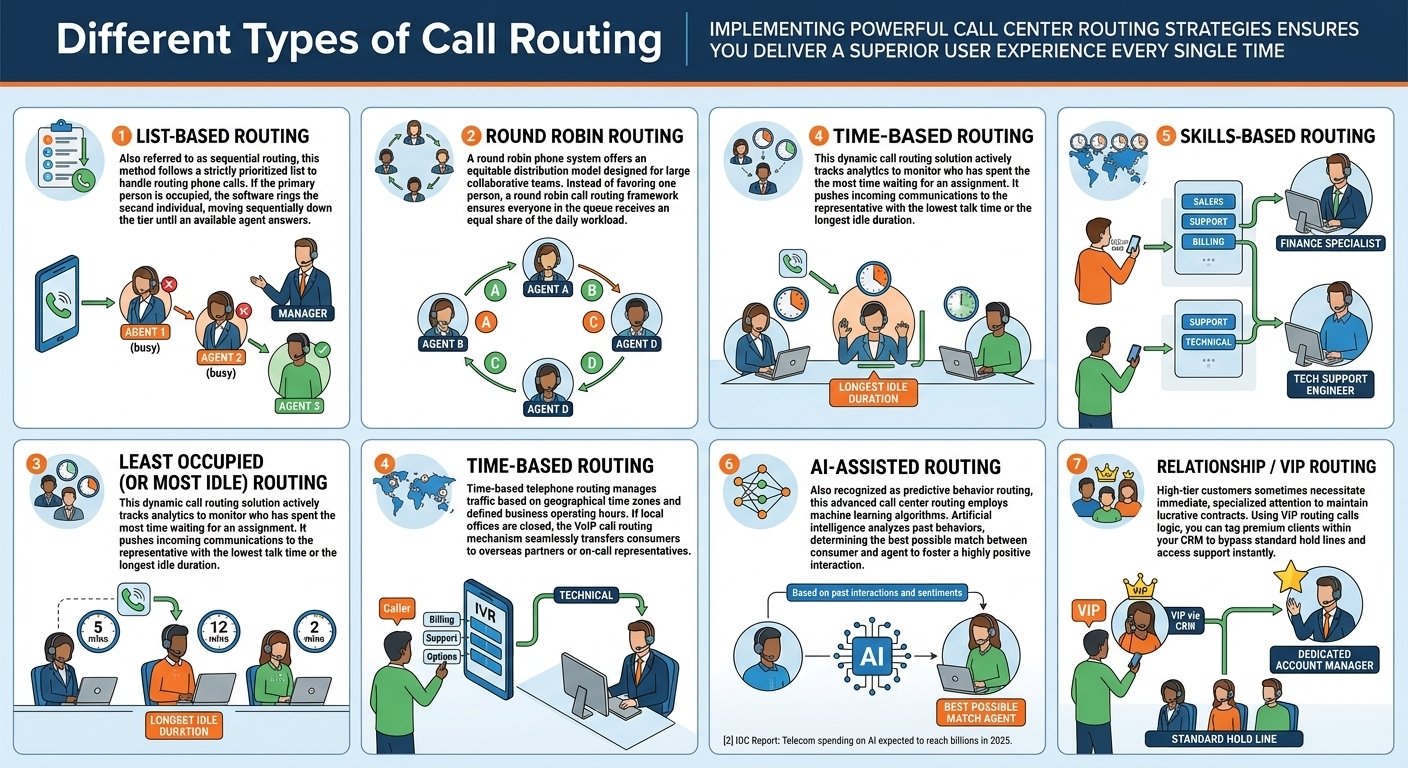
1) List-based routing
This approach, also known as sequential routing, prioritizes a list of routes to process phone calls. When the first person is busy, the software will ring the second person, and so on down the line until the agent is available.
This particular telephone routing configuration is very useful when managers wish to have experienced experts to deal with the majority of the inquiries. The call routing service maintains a high level of quality control by maintaining trainees as backups only.
2) Round robin routing
A round robin phone system is an equitable distribution model for large collaborative teams. A round robin call routing system provides equal distribution of daily work to everyone in the queue.
Agent A handles the first interaction, agent B handles the second interaction, etc. This phone call routing software is a favorite among many growing organizations as it proactively prevents workload imbalances and staff resentment.
3) Least occupied (or most idle) routing
This is an active call routing solution that monitors analytics to see who has been waiting the longest for an assignment. It forwards incoming communications to the representative who has the lowest talk time or longest idle time.
With this kind of live call routing, supervisors can distribute their workforce evenly among all internal departments. It is proactive in protecting support teams from burnout by distributing time evenly.
4) Time-based routing
Time-based telephone routing is based on geographical time zones and business hours. This setup is often used by organizations that have clients around the world, allowing them to offer support around the clock without having to keep a night shift.
In the event of local offices being closed, the voip call routing mechanism easily switches consumers to overseas partners or on call representatives. This ensures uninterrupted service, demonstrating the best of flexible call routing systems.
5) Skills-based routing
Skills-based routing routes a caller to the representative who has the exact knowledge they need to solve their specific problem. A phone routing service uses IVR inputs to gauge the necessary expertise level before making a transfer.
For example, if it’s a billing issue, you need a finance expert, not a technical support engineer. This personalized call routing method can save a lot of time and effort by avoiding unnecessary internal transfers.
6) AI-assisted routing
This advanced call center routing is also known as predictive behavior routing and uses machine learning algorithms. AI studies past behaviors and identifies the most suitable match between consumer and agent to ensure a very positive interaction.
According to a recent report by IDC, global telecom service provider investments in AI-powered routing will total $1.375 trillion in 2025. This signifies a major industry shift towards automated proficiency and intelligent call routing.
7) Relationship/VIP routing
Sometimes, high-tier customers require immediate and specialized attention in order to keep lucrative contracts. With VIP routing calls logic, you can label high-value customers in your CRM and route them straight to support without having to wait on hold.
This smart phone routing puts key contacts in touch with their assigned account managers. In the event that that manager is not available, the phone routing systems arrange a quick callback, making VIPs feel extremely valued.
So, what’s the best call routing strategy?
If you frequently ask, “provide me with routing best practices for growing businesses,” the ultimate answer is a hybrid approach. The most robust call center routing system is one that combines multiple routing methods at once to fill in any gaps in the system.
Consider implementing a skill-based auto-attendant to route the inquiry to the appropriate category, then a least-occupied approach within that category. Comprehensive phone routing systems, when layered, ensure optimal efficiency and maximum consumer satisfaction.
Deeper Dive Into How Call Routing Works
Incoming call routing is a systematic process with multiple stages to ensure accuracy. Let’s dive into how a sip call routing framework handles these critical steps from beginning to end.
Step 1: Call qualifying
In the first qualification phase, callers are placed in the telecommunications network, and the provider intercepts the analog or digital signal. The software automatically tries to find the person from caller ID databases and CRM systems. The business call routing protocol does the following to determine the exact nature of the inquiry:
-
The software captures the phone number routing data.
-
The system references CRM records for past interaction history.
-
The platform applies basic analytical logic to segment the user.
Step 2: Call queuing
After qualifying, the user is placed in a particular holding pattern called a queue, waiting for the next available representative. The telephone routing system puts the person in a line that is categorized, whether it is sales, billing or technical support. The automatic call distributor actively checks the availability of agents in this departmental queue by doing the following:
-
Callers listen to customized holding music or promotional messages.
-
The system calculates and announces estimated wait times.
-
The platform prepares to dispatch the connection based on queue priority.
Step 3: Call distribution
The last step is distribution, where the phone call routing software finally routes the individual to a live representative. The software follows pre-set guidelines to complete the technical connection seamlessly. When all lines are busy above a reasonable threshold, the routecall protocol activates other actions to maintain the customer experience:
-
The system connects the call path to an open agent.
-
If unavailable, it offers a convenient queue callback option.
-
As a last resort, it directs the individual to a digital voicemail box.
Final thought
In conclusion, understanding the complexities of contemporary telephony solutions is crucial for success in today’s competitive landscape. You ensure your teams are optimized to handle inbound interactions, ensuring your support is stellar and your operational excellence is uninterrupted. Always make sure to optimize your settings to meet the changing demands of your customers.
FAQs
-
What is routing with an example?
In telecommunications, routing is the process of directing a connection through a network to its final destination. An example is when a customer dials a support hotline, inputs a digit for billing, and the system automatically forwards them to the finance department.
-
What is audio call routing?
Audio routing refers to the specific management and direction of voice-based signals within a communication network. It ensures that vocal interactions are sent to the correct headset, extension, or digital mailbox without dropping the fragile connection.
-
What is IVR call routing?
Interactive Voice Response routing relies on spoken commands or keypad inputs from the caller to determine their intended destination. The software analyzes these prompt responses to accurately forward the individual to the most appropriate representative or self-service menu.
-
How do I route calls to another phone?
To forward communications, you access your VoIP provider’s dashboard or mobile settings and input the desired destination number. Once activated, any incoming interaction is seamlessly redirected to the newly designated device, ensuring you never miss a vital inquiry.
-
Does a small business need a routing system?
Yes, implementing a dedicated call routing platform is vital for maintaining a credible, professional corporate image. It prevents callers from experiencing endless ringing, organizes departmental inquiries logically, and scales effortlessly as the enterprise expands.
-
What is predictive behavior routing?
This is an advanced call routing solution utilizing artificial intelligence and machine learning to analyze historical customer profiles. The algorithm attempts to match the caller with a specific agent whose personality and track record suggest a highly successful resolution.
-
How does skill-based distribution differ from round robin?
Skill-based distribution prioritizes the agent’s distinct expertise over their current availability, ensuring complex problems reach qualified technicians. In contrast, round robin focuses purely on equal task distribution, sending tasks sequentially regardless of the specific topic.
-
Can call routing reduce business operational costs?
Absolutely, because an optimized setup noticeably lowers average handle times and boosts first-contact resolution rates. By minimizing the time clients spend navigating menus and talking to the wrong departments, companies drastically reduce their monthly telecommunication expenses.
-
What happens if all agents are busy during a routed call?
When all staff members are completely occupied, the software typically places the individual in a categorized queue with holding music. If the wait exceeds a defined time limit, the platform can offer an automated callback option or redirect them to an answering service.