
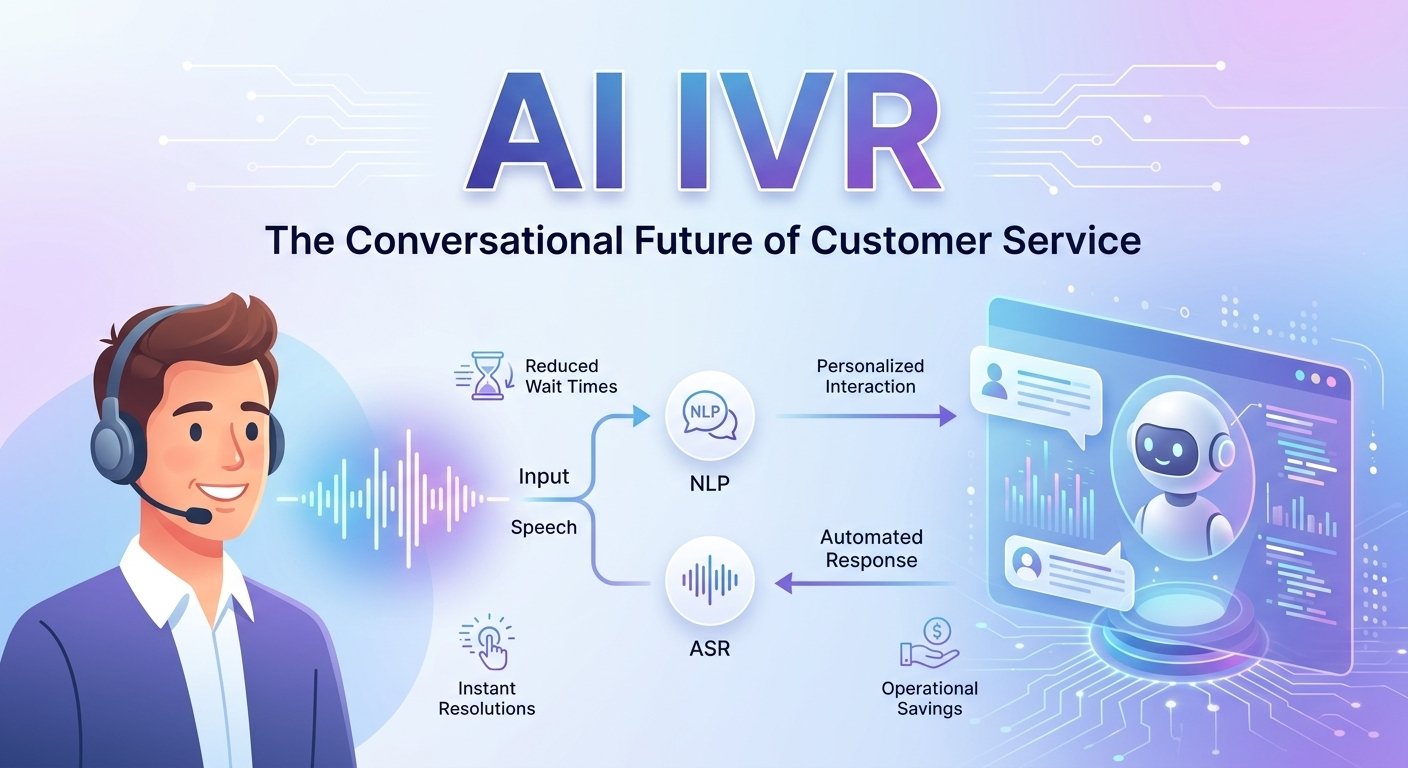
AI IVR (Artificial Intelligence Interactive Voice Response) fundamentally changes how businesses handle customer calls. Instead of forcing users through frustrating, rigid phone menus, an AI IVR uses natural language processing to understand spoken requests and resolve issues instantly. This automated voice response technology eliminates long wait times and routes complex inquiries to the right human agent.
By seamlessly integrating with your customer database, AI IVR systems offer personalized, conversational experiences that traditional menus simply cannot match. If you want to reduce operational costs while keeping buyers happy, adopting a smart, speech enabled IVR is the ultimate business solution today.
What is AI IVR?
An automated ivr system replaces static keypad menus with intelligent, conversational interactions. Rather than pushing buttons, callers use natural speech to request help, schedule appointments, or check balances. This modern technology instantly analyzes caller intent to offer prompt self-service resolutions without human intervention.
These conversational ivr software setups feel like interacting with a live assistant. They reduce overall wait times and optimize operations by filtering out repetitive inquiries. Live support teams can then dedicate their energy toward complicated troubleshooting tasks.
How it works
-
Captures spoken words and converts them into text using advanced speech recognition.
-
Analyzes the core meaning and intent behind the phrase, ignoring background noise.
-
Formulates a logical response or triggers a specific backend workflow.
-
Delivers the reply using human-sounding voice generation.
Core advantages
-
Conversations flow naturally, removing the annoyance of navigating fixed menus.
-
Wait times drop significantly since typical requests get handled instantly.
-
Buyers receive round-the-clock assistance without relying on office hours.
-
Companies experience massive cost reductions by minimizing live agent transfers.
Typical use cases
-
Managing reservations and booking schedules automatically.
-
Processing secure payments over the phone.
-
Routing callers to the correct department based on intent.
-
Answering frequently asked questions without delay.
Key technologies
-
Automatic speech recognition transforms audio into readable text.
-
Natural language processing evaluates context to determine true intent.
-
Machine learning detects patterns to enhance accuracy continuously.
-
Text-to-speech converts digital responses into friendly, spoken audio.
AI IVR vs. Traditional IVR
Comparing traditional setups with a modern ivr platform ai reveals a stark contrast in capabilities. Older systems provide a frustrating traditional ivr customer experience, whereas intelligent systems adapt dynamically. This distinction heavily influences brand perception and operational speed.
Reviewing an ivr vs ai phone agent comparison features benefits table clarifies these differences. Proper ivr testing services reduce customer friction dramatically before launch. Below is a detailed breakdown of how legacy tools stack up against smart voice assistants.
| Feature | Traditional IVR | AI IVR |
| Caller interaction | Menu navigation via keypad | Conversational speech input |
| Learning capability | Fixed, no adaptation | Learns from every interaction |
| Speech recognition | Limited, keyword-based | Natural language, accent-tolerant |
| Call routing | Rules-based | Contextual, based on intent and history |
| Personalization | None | Pulls from CRM and past behavior |
| Resolution capability | Basic questions only | Handles complex, multi-step issues |
| Customer experience | Slow and rigid | Fast, intuitive, and human-like |
How Conversational AI IVR Works
A functional conversational ai ivr relies on an integrated technology stack functioning in real time. Each component plays a vital role in understanding, processing, and responding to human speech accurately.
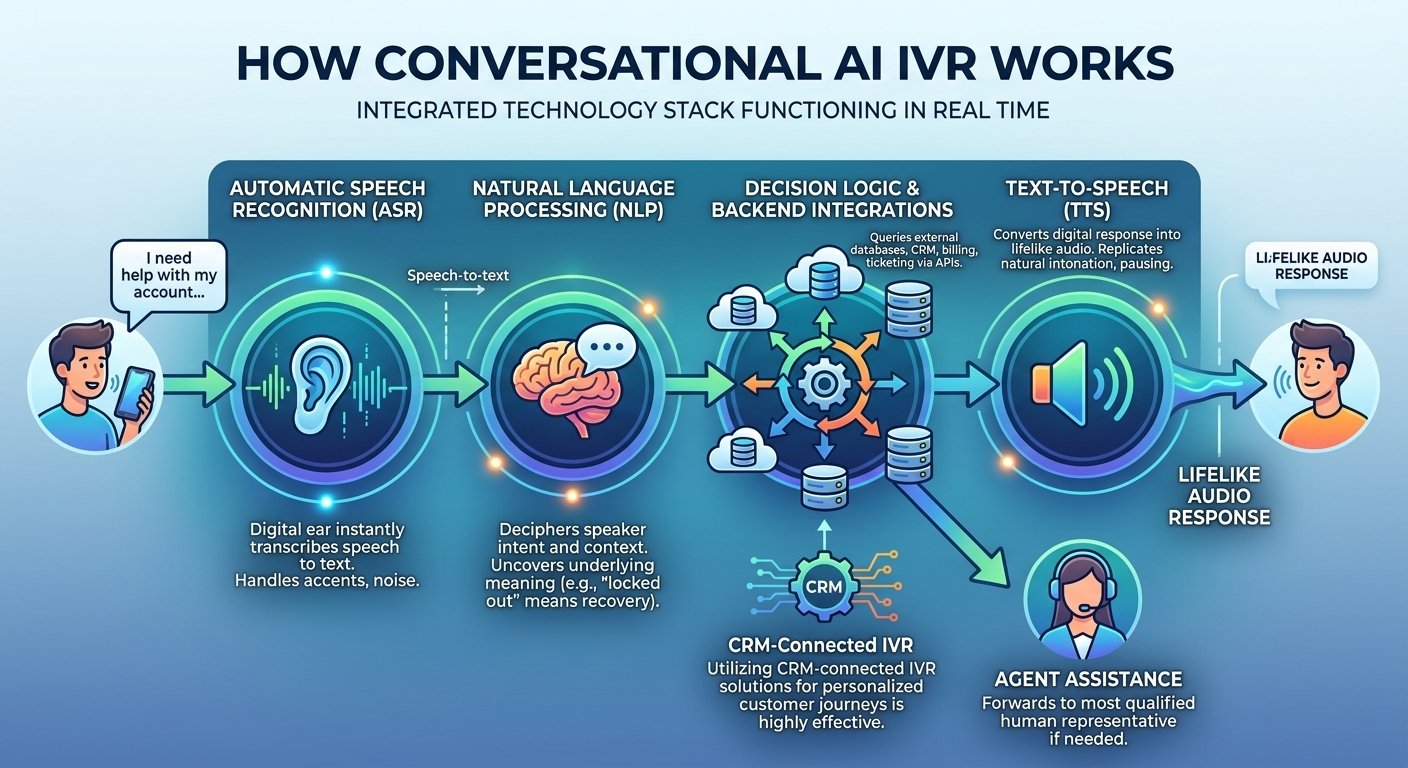
By combining these backend tools, businesses deliver flawless support experiences. Let us examine the technical pillars that make this possible.
-
Automatic speech recognition (ASR)
This layer acts as the digital ear, instantly transcribing spoken language into text format. Advanced systems easily process heavy accents, rapid speech, and ambient noise without losing accuracy.
Unlike older keyword-based setups, modern ASR models handle diverse acoustic environments. This guarantees a smooth interaction for users calling from busy streets or driving in cars.
-
Natural language processing (NLP)
This tool deciphers what the speaker actually means rather than focusing strictly on literal translations. Moving beyond rigid prompts, NLP uncovers underlying context and emotional tone.
If someone says they are locked out, the system understands they require account recovery immediately. This intelligence prevents buyers from getting stuck in endless, irrelevant loops.
-
Decision logic and backend integrations
Once the intent is clear, the decision engine figures out the best next step. It seamlessly queries external databases, billing software, or ticketing platforms via secure APIs.
For a customized journey, utilizing crm-connected ivr solutions for personalized customer journeys is highly effective. If an automated resolution fails, the engine instantly forwards the call to the most qualified human representative.
-
Text-to-speech (TTS)
The final step involves converting the generated digital response into lifelike audio. Current generative models replicate natural human intonation, pausing, and emotional resonance flawlessly.
Brands can customize the tone and pacing to perfectly match their corporate identity. This capability ensures that an automated voice response never sounds robotic or detached.
Benefits of AI-Powered IVR
Switching to an intelligent setup elevates the entire support ecosystem across speed, cost, and quality. An ai powered ivr brings massive operational advantages that legacy systems simply cannot match.
Here are the primary business gains you can expect after deploying these modern systems.
1. Immediate contextual understanding
Returning callers no longer have to explain their situation from scratch. The system instantly recognizes past interactions, recent purchases, and active support tickets to tailor its greeting.
This level of insight eliminates redundant steps and shortens the overall handling duration. Buyers feel valued when the technology anticipates their exact needs upon connection.
2. Precise, intelligent call routing
Instead of relying on fixed button presses, dynamic routing evaluates urgency, intent, and customer tier. A VIP client experiencing billing trouble will bypass the standard queue entirely.
Precision filtering significantly drops escalation rates and boosts first-contact resolution metrics. Customers reach the exact specialist required without bouncing between multiple departments.
3. Seamless conversations across channels
Modern platforms maintain interaction memory across various communication mediums effortlessly. A user starting a request via text message can call later without repeating their details.
This omnichannel memory mirrors human multitasking capabilities. It establishes a fluid, connected ecosystem that significantly enhances overall buyer satisfaction.
4. Operational intelligence at scale
Every single interaction generates high-fidelity data regarding user behavior and system performance. Managers can easily pinpoint exact friction points and adjust staffing models to meet demand spikes.
Unlike basic logs, this analytics layer explains the underlying reasons behind drop-offs. It transforms raw call data into actionable strategic insights for the entire organization.
5. Built-in adaptability and improvement
These intelligent platforms constantly refine their understanding of phrasing and emotional context. Machine learning algorithms ensure that the software becomes smarter with every incoming query.
A previously unrecognized slang term will eventually trigger the correct resolution path automatically. This self-improving nature requires zero manual reprogramming from internal IT staff.
6. Persistent engagement that builds loyalty
Following a successful resolution, the voice assistant can offer helpful follow-up suggestions smoothly. Providing proactive tracking details after handling a refund creates a sense of professional closure.
Such value-added moments turn basic administrative tasks into excellent relationship-building opportunities. Consequently, businesses enjoy reduced churn rates and stellar brand loyalty scores.
Applications of AI in IVR for Businesses
These versatile platforms manage diverse operational duties beyond simple call deflection. Departments across the entire corporate structure utilize an inbound ivr system to realize ai-driven ivr complex knowledge-based support advantages effortlessly. From proactive outreach to secure transactions, the use cases remain virtually limitless.
-
Customer support and help desks
Intelligent platforms effortlessly manage account lookups, password resets, and typical billing inquiries autonomously. This early intent identification prevents frustrating misrouting scenarios entirely.
According to a recent deployment case study by McKinsey, utilizing agentic intelligence for care workflows drives a 24 percent increase in first-contact resolution. The exact same study notes a 30 percent productivity improvement among human agents globally.
-
Outbound communication and proactive engagement
Beyond accepting calls, the platform places outbound dials for appointment reminders or targeted surveys. Integrating CRM records ensures that each proactive message feels incredibly relevant.
This automated outreach successfully engages consumers without overburdening internal staff members. It guarantees consistent follow-ups while maintaining excellent service standards.
-
Compliance and security assurance
Regulated sectors rely heavily on automated systems to standardize scripts and mask sensitive data. The software logs interactions meticulously and triggers instant alerts during compliance breaches.
Financial and healthcare institutions maintain strict regulatory adherence by removing human error from critical verification steps. This guarantees complete peace of mind during external audits.
-
Scheduling and transactional automation
High-volume environments like medical clinics and hospitality chains utilize voice bots to manage reservations. Callers book, cancel, or modify appointments without ever speaking to a receptionist.
This specific automation drastically cuts administrative workload and reduces costly appointment no-shows. Frontline workers can completely focus on physically present visitors.
-
Business continuity and disaster response
During unexpected outages or severe weather events, intelligent routing maintains open communication lines. It instantly broadcasts critical updates and provides alternative contact methods dynamically.
These platforms easily absorb massive call surges without crashing or degrading audio quality. Companies sustain their reputation for reliability even under extreme crisis conditions.
Examples of AI IVR in Action
To fully grasp the impact, examining realistic corporate scenarios proves highly beneficial. These practical illustrations demonstrate how a speech ivr resolves everyday industry challenges.
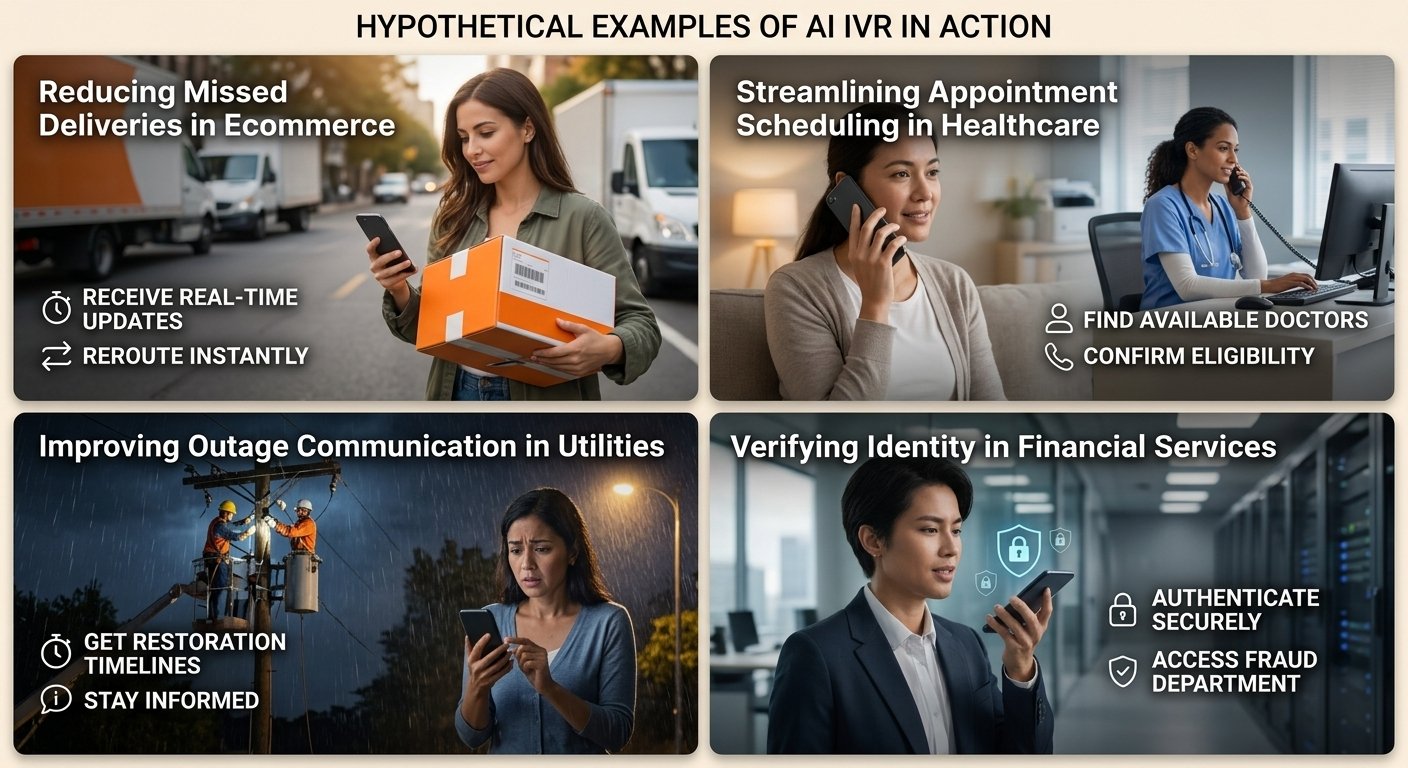
From logistics to banking, automated solutions drive immense tangible value.
Scenario 1: Reducing missed deliveries in ecommerce
Retailers often deal with complaints regarding delayed or missing packages daily. By implementing ivr workflows for rescheduling deliveries by phone, buyers instantly receive real-time tracking updates.
The software offers immediate rerouting options without placing the individual on hold. This drastically reduces the volume of repetitive inquiries hitting the main support floor.
Scenario 2: Streamlining appointment scheduling in healthcare
A busy regional hospital deploys a voice assistant to handle soaring daily call volumes. Patients simply state their preferred doctor and receive immediate availability options.
The system confirms insurance eligibility and processes cancellations flawlessly. This drastically lowers administrative friction and optimizes the daily calendar for practitioners.
Scenario 3: Improving outage communication in utilities
When a severe storm knocks out regional power, utility call centers become instantly overwhelmed. The intelligent platform detects the surge and proactively informs callers regarding expected restoration timelines.
It offers text-based updates, keeping anxious residents informed without clogging the queue. Transparency increases significantly while panic-driven repeat calls plummet.
Scenario 4: Verifying identity in financial services
When a banking client reports suspicious activity, the software steps in to verify their identity securely. Utilizing voice biometrics and recent transaction history, it authenticates the user instantly.
The platform then routes the verified caller directly to the fraud department. This eliminates dangerous delays and protects sensitive financial assets perfectly.
Measuring the ROI of AI IVR
Validating your technological investment requires tracking precise performance metrics before and after launch. True return on investment encompasses direct financial savings alongside massive operational agility improvements. Reviewing a structured metric table clarifies exactly where these systems generate the most value.
| Metric | What It Tells You | Typical AI IVR Impact |
| First-call resolution (FCR) | Issue solved on the first try | Increases by up to 5% over industry benchmarks. |
| Average handle time (AHT) | Time spent per interaction | Decreases by up to 38% through task automation. |
| Call containment rate | % of calls resolved without agents | Achieves up to 60% containment successfully. |
| Customer satisfaction (CSAT) | Direct feedback on experience | Scores frequently exceed 80% due to contextual replies. |
| Agent utilization rate | Human team efficiency levels | Automates routine tasks, boosting high-value focus. |
| Operational cost per call | Cost to serve via voice channel | Drops from $7.00 to under $1.00 per resolution. |
Beyond immediate financial reductions, these setups deliver incredible compounding advantages. A frictionless phone journey builds immense trust and strengthens overall brand perception.
Additionally, this technology scales effortlessly during seasonal spikes without requiring massive hiring drives. It guarantees stellar business continuity regardless of external market disruptions.
Common Challenges of AI IVR Implementation
While the benefits remain outstanding, deploying this technology presents specific operational hurdles. Recognizing these barriers early ensures a smooth, highly successful launch phase.
Navigating these obstacles requires solid planning and strict alignment with internal IT personnel.
1. System integration issues
Failing to connect the voice platform with internal billing or CRM software cripples its effectiveness. Without proper data access, the assistant cannot deliver personalized, accurate answers.
Prioritizing vendors offering open APIs solves this dilemma instantly. Involving database administrators early prevents frustrating launch delays.
2. Incomplete or low-quality data
Machine learning models completely rely on the historical data fed into them during training. If customer records remain outdated or highly fragmented, the assistant will generate incorrect responses.
Cleansing and unifying internal databases before activation is absolutely crucial. Training the engine on high-quality transcripts guarantees excellent early accuracy rates.
3. Risk of ‘AI hallucinations’
Occasionally, conversational models confidently generate factually incorrect information. This poses severe risks when discussing sensitive legal, medical, or financial matters.
Implementing deterministic logic for critical queries easily mitigates this dangerous flaw. Establishing strict confidence thresholds ensures instant human escalation when uncertainty arises.
4. Maintaining consistency across scenarios
Highly dynamic voice setups occasionally suffer from uneven pacing or mismatched conversational tones. Users might enjoy a flawless interaction one day and a confusing one the next.
Rigorously testing edge cases and negative inputs stabilizes the overall flow. Creating a strict user experience guide aligns phrasing perfectly.
5. Organizational resistance to change
Internal staff frequently view automation as a direct threat to their ongoing employment security. Managers might actively distrust algorithmic decision-making during the initial rollout phase.
Positioning the technology as an augmentation tool rather than a replacement eliminates this anxiety. Demonstrating how it handles repetitive chores boosts overall morale dramatically.
How to Implement AI in IVR: Practical Tips
Launching a conversational ivr software requires a highly structured, strategic approach. It spans technology alignment, data preparation, and careful journey mapping.
Following an organized framework guarantees a seamless, highly profitable deployment.
1. Define measurable goals
Establish clear, quantifiable objectives before selecting any specific software vendor. Determine whether the priority is lowering costs, boosting containment, or reducing handle times.
These distinct targets heavily influence design choices and post-launch optimization strategies.
2. Choose a platform that aligns with your tech stack
Evaluate vendors based on their native machine learning capabilities and omnichannel features. Ensure they provide seamless, API-driven connections to your existing support platforms.
Selecting a visual flow builder allows marketing teams to iterate designs without touching complex code. Modern platforms offer retailers ivr menus order tracking tools no coding required, ensuring rapid deployment.
3. Map out common customer journeys
Avoid building generic, uninspired dialogue paths that frustrate callers. Analyze historical logs to identify the most frequent intents and map their ideal resolution routes.
Documenting exact user inputs and fallback escalation points ensures a highly contextual, realistic training environment.
4. Integrate deeply with your existing systems
An effective voice assistant must take definitive action, not merely recite information. It needs real-time access to transaction histories, knowledge bases, and inventory databases.
This deep integration transforms a reactive answering machine into a highly proactive service channel.
5. Test across edge cases and tones
Conduct rigorous role-playing sessions to evaluate how the engine handles frustration and heavy accents. Expose the setup to unexpected phrasing and loud background noises deliberately.
According to a conversational intelligence deployments in contact centers are projected to reduce agent labor costs by $80 billion globally by 2026. Testing thoroughly ensures you capture your share of those savings without alienating clients.
6. Monitor performance and iterate
Following the official launch, meticulously track containment, abandonment, and escalation metrics. Gather user sentiment feedback to identify confusing dialogue branches.
Consistently adjusting scripts and retraining models guarantees that the system improves progressively over time.
Trends Shaping the Future of AI IVR
The landscape of automated voice response systems continuously evolves as generative models advance. Future platforms will adapt seamlessly to nuanced human emotions and complex business environments. Understanding these impending shifts helps corporations future-proof their technological investments.
- Emotional context is becoming a core signal: Modern engines actively learn to detect underlying stress, extreme urgency, or rising dissatisfaction. This allows the dialogue flow to shift dynamically based entirely on a caller’s mood. Sentiment analysis will soon dictate routing protocols, bypassing menus entirely for deeply frustrated individuals.
- Generative AI is reshaping scripted interactions: Rigid, pre-written scripts are rapidly fading out in favor of dynamic, brand-aligned generation. The platform formulates unique replies tailored to the exact context of the current conversation. This allows for incredibly flexible, highly human-sounding dialogues that maintain strict regulatory compliance effortlessly.
- Voice becomes a true omnichannel participant: The modern consumer journey flows fluidly across text, web chat, and traditional phone calls. Next-generation setups maintain conversational context across every single touchpoint simultaneously. A discussion initiated via a mobile app smoothly transitions to voice without losing any previous progress.
- IVR is expanding beyond support: Corporations utilize an intelligent ivr chatbot for far more than basic troubleshooting. Sales qualification, proactive dispatching, and automated client onboarding now happen entirely over the phone. Embedding voice intelligence into broader sales strategies scales operations massively without sacrificing personal touches.
- Transparency and control are becoming non-negotiable: As algorithms handle highly critical decisions, executives demand complete operational visibility. Auditable logic trails and strict escalation thresholds have become standard requirements.
Must-Have Features in Modern AI IVR Platforms
Evaluating a potential automated ivr system requires focusing on flexibility and long-term scalability. The right software must handle immense volume while delivering pristine audio quality. Ensure your chosen vendor supports these non-negotiable technical features.
- Strong natural language capabilities: The foundational core remains the ability to process ambiguous phrasing and diverse dialects perfectly. Pretrained models tailored to specific industry vocabularies drastically improve baseline accuracy.
- Omnichannel support with unified context: Your chosen software must integrate completely with digital messaging applications and web portals. True omnichannel capability eliminates the need for callers to repeat their frustrating issues.
- Visual flow builder with low-code/no-code design: A drag-and-drop interface empowers non-technical staff to build and tweak conversational paths quickly. This agility prevents your support department from waiting on sluggish IT development cycles.
- Advanced call analytics and real-time reporting: Meticulous analytics identify hidden friction points and highlight exact abandonment locations. Granular reporting remains entirely essential for justifying the initial software investment.
- Secure, compliant, and auditable: Handling sensitive payments requires strict adherence to GDPR and PCI-DSS regulatory standards. Encrypted transmissions and detailed access logs protect the corporation against catastrophic data breaches.
- Customizable escalation logic: The setup must instantly recognize when algorithmic confidence drops below acceptable levels. Sentiment-based routing guarantees that angry clients reach human supervisors before canceling their accounts.
- Multilingual and global-ready: Global brands require software capable of detecting languages automatically and responding fluently. Native localization ensures that the brand voice remains culturally appropriate and highly inclusive.
Choosing the Right AI IVR Solution
Selecting the optimal setup requires finding a vendor that balances cutting-edge innovation with absolute stability. The platform must blend seamlessly into your existing unified communications ecosystem.
Tools like freshdesk voice assistant advanced ivr features or microsoft teams voice ivr ai features competitive advantage demonstrate how deep integration drives success. Prioritize solutions offering robust API access and dedicated deployment engineers. Implementing an ai based ivr is not just an upgrade; it is a fundamental transformation of your customer service strategy.
Read More: What Does DND Mean? A 2026 Guide
Final Thoughts
Embracing modern conversational tools elevates your brand reputation while dramatically slashing overhead expenses. An ai voice agent vs. traditional ivr systems comparison clearly proves that automation is the undisputed future of communication. By prioritizing intelligent routing and deep backend integration, your organization will deliver unparalleled support experiences. Invest in these transformative solutions today to secure a decisive competitive advantage.
Frequently Asked Questions About AI IVR
-
What is an AI IVR?
It is an advanced telephony system that utilizes natural language processing to understand spoken requests. Instead of pressing keypad numbers, callers speak normally to resolve their specific issues.
-
What does IVR stand for?
It stands for Interactive Voice Response. It is the underlying framework that allows computers to interact with humans through voice and touch-tone inputs.
-
What is IVR?
It is an automated telephony technology that gathers information from callers before routing them to appropriate agents. Traditional versions rely heavily on fixed keypad menus.
-
What is an IVR tool?
It is a software application utilized by call centers to manage incoming and outgoing communication flows. It handles greeting messages, menu selections, and skill-based agent routing.
-
How does a natural language ivr differ from a standard menu?
A natural language setup comprehends entire spoken sentences and extracts underlying intent. Standard menus only recognize rigid keyword commands or numerical keypad presses.
-
Can an inbound ivr system integrate with CRM platforms?
Yes, modern systems integrate flawlessly with leading customer relationship management databases. This allows the bot to greet users by name and reference previous purchases.
-
Is conversational ivr software secure for payments?
Absolutely, reputable platforms adhere to strict PCI-DSS compliance protocols. They encrypt sensitive credit card details and instantly mask numerical data during recording.
-
What is the average ROI of an automated ivr system?
Companies typically witness a 30 to 40 percent drop in operational costs while improving resolution rates. The software pays for itself by severely reducing live agent workloads.