
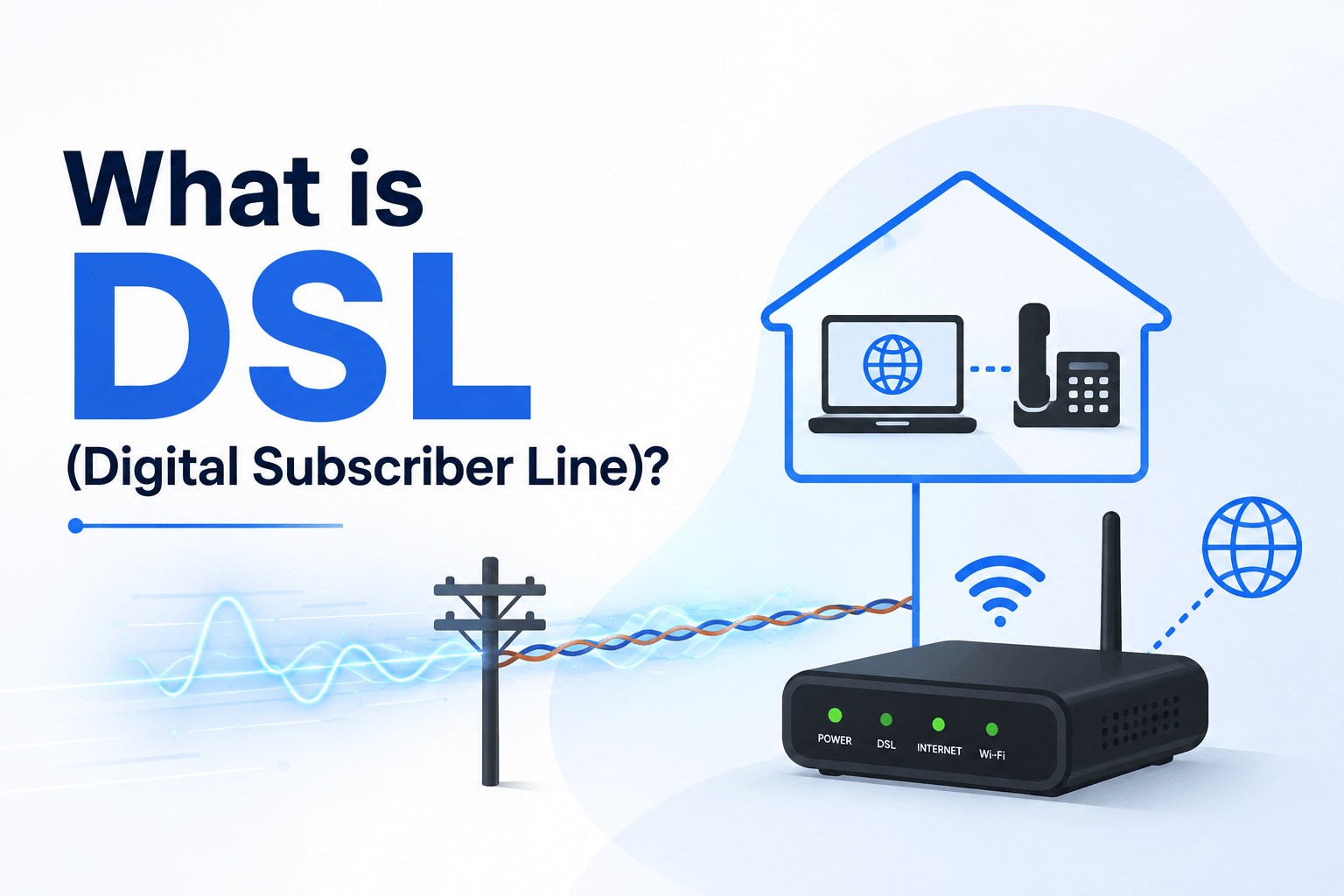
DSL (Digital Subscriber Line) is an internet access technology that transmits digital data over copper telephone lines. It uses frequency ranges above those traditionally used for analog voice calls, allowing compatible DSL services to provide an always-on internet connection while the telephone line can still be used for voice. DSL speed depends on the DSL technology, line quality and distance from the provider’s equipment.
What Is DSL?
A digital subscriber line, commonly referred to as DSL, is a communication medium designed to provide high-speed bandwidth over a local telephone network. Historically known as a digital subscriber loop, this technology was a major leap forward from dial-up, which required exclusive use of the phone line. Each DSL subscriber typically has a dedicated copper pair for the local loop between the premises and the provider’s DSL equipment. However, capacity farther upstream in the provider’s network is shared, so DSL should not be described as an entirely dedicated internet connection.
The dsl meaning in the context of modern networking refers to a family of technologies that provide digital data transmission over the wires of a local telephone network. It remains a popular choice for homes and small businesses because it leverages existing infrastructure, making it widely available. Unlike satellite internet, which can suffer from high latency, or fiber optics, which require expensive new installations, this technology offers a balance of accessibility and performance. It is particularly effective for users situated within a specific radius of a central switching station.
How Does DSL Work?
To understand how does dsl work, one must look at the hardware used at both ends of the connection. At the consumer’s location, a dsl transceiver, often called a dsl modem, connects to the computer or router. This device converts digital data from the computer into a high-frequency signal that can travel over the phone lines. On the other end, the internet service provider uses a Digital Subscriber Line Access Multiplexer (DSLAM) to receive these signals and route them to the wider internet.
| DSL Type | Download/Upload Pattern | Typical Use | Status |
|---|---|---|---|
| ADSL/ADSL2+ | Asymmetric | Residential broadband | Legacy/common in some areas |
| VDSL/VDSL2 | Usually asymmetric | Faster broadband over shorter copper loops | Still used in FTTC networks |
| SHDSL | Symmetric | Business/legacy connectivity | Specialized/legacy |
| HDSL | Symmetric | Legacy business circuits | Legacy |
| IDSL | Symmetric/low speed | Extended-reach legacy use | Largely obsolete |
The core mechanism involves splitting the signals. Since human speech occupies a very narrow frequency range of 0 to 3,400 Hertz, the copper wires have significant unused capacity. DSL technologies utilize frequencies that reach into the millions of Hertz to carry data packets. Because these frequencies are distinct, there is no interference between a phone conversation and a web browsing session. This separation allows the connection to remain always-on, eliminating the need to dial a number to gain access to the web.
Top 7 Types of DSL
1. Asymmetric DSL (ADSL)
ADSL is the most common version used by residential consumers because it allocates more bandwidth for downloading than for uploading. This reflects typical user behavior, where people stream more content than they create. Research from the early 2000s indicated that by mid-2002, there were roughly 26 million ADSLs in operation globally, with 80% serving residential users. It provides an efficient way to handle high-speed downloads without the need for symmetrical lines.
2. High-bit-rate DSL or HDSL
HDSL was developed to provide symmetric transmission, meaning it offers the same speed for both uploading and downloading data. It typically requires multiple pairs of copper wires to achieve high performance and was originally designed for professional environments. By eliminating the need for midspan repeaters, it simplified line architecture for early digital services. This version laid the groundwork for more advanced symmetric technologies used in modern business environments.
3. Very high-bit-rate DSL or VDSL
VDSL is a powerhouse in the xDSL family, offering significantly faster speeds over short distances. It can support downstream speeds up to 52 Mbps, making it suitable for high-definition television and complex multimedia applications. This type of connection is often used as the final leg in a network where fiber optics reach a neighborhood node and then distribute data to individual homes via existing copper lines.
4. Symmetric DSL (SDSL)
SDSL is a single-wire variant of HDSL that provides equal speeds for both sending and receiving information. It is often the preferred choice for businesses that run their own web servers or frequently upload large files to the cloud. Because it uses a single pair of wires, it is easier to implement than HDSL while still providing the reliability required for corporate applications.
5. Single-pair, high-speed DSL or SHDSL
Standardized in 2001, SHDSL is designed for professional use and can transmit data across multiple multiplexed copper lines. It offers symmetrical connectivity that is highly effective for linking distant local area networks (LANs) across a campus or large facility. It is particularly valued for its ability to provide high-speed service over longer distances than many other symmetric technologies.
6. Very-high-bit-rate DSL 2 (VDSL2)
VDSL2 is an enhancement of the original VDSL technology, designed to support the “Triple Play” of voice, video, and data. It can provide speeds up to 100 Mbps, which rivals some cable and fiber connections. According to the International Telecommunication Union (ITU), these standards allow for much more robust performance over existing infrastructure, ensuring that copper lines remain relevant in the age of 4K streaming.
7. ISDN Digital Subscriber Line (IDSL)
IDSL is a hybrid technology that uses ISDN signaling to provide data services. While it is slower than most other forms of DSL, it has the advantage of working over longer distances where other types might fail. It remains a niche solution for very specific legacy systems or areas with extremely limited infrastructure.
Importance of DSL
1. High-speed file downloads
The primary advantage of this technology is the ability to achieve high-speed downloads without specialized wiring. Modern modems can support multiple users in a single household, allowing for seamless streaming and browsing. When connected via an Ethernet cable, these systems provide a stable environment for heavy data tasks.
2. The opportunity to have a dedicated line
Unlike some other internet technologies, a dsl connection provides a dedicated link from your home to the central office. This means your speed is not directly impacted by your neighbors’ internet usage during peak hours. This consistency is vital for professionals who require a steady connection for video conferencing and remote work.
3. Less dependence on additional cables
One of the most significant benefits is the use of existing telephone infrastructure. This reduces the need for invasive installations and expensive construction projects to lay new cables. It makes high-speed internet accessible in older buildings and established neighborhoods where fiber might not yet be available.
4. Cost-effectiveness
Because it utilizes current phone lines, the setup costs for both the provider and the consumer are relatively low. This affordability has made it a standard choice for budget-conscious households and small businesses. Users can choose from various tiers of service to match their specific financial and performance needs.
5. Greater reliability and transparency
Dealing with a single telecommunications provider often simplifies the troubleshooting process. The technology is well-established and mature, meaning the hardware is reliable and service interruptions are generally rare. This transparency in service makes it an excellent choice for those who value uptime and predictable performance.
6. Support for security measures
Each connection is a point-to-point link, which inherently offers more privacy than shared-bus technologies like cable internet. This structure makes it easier to implement robust security protocols and authentication services. It provides a safer environment for handling sensitive business data and personal information.
7. Better uptime assurance
Dedicated connections typically experience less downtime because they are not subject to the same network congestion as shared systems. Businesses can rely on this stability to maintain productivity and serve their customers without interruption. Monitoring and maintenance are also more straightforward on a dedicated line.
DSL vs Cable
Cable internet utilizes the coaxial cables originally designed for television to provide data services. While cable often offers higher peak speeds than standard DSL, it is a shared medium, meaning your bandwidth can drop significantly when everyone in the neighborhood is online. In contrast, a dsl connection maintains a more consistent speed regardless of the surrounding traffic.
Geographic availability also differentiates these two services. Cable is highly prevalent in urban and suburban areas where television infrastructure is dense. However, in rural areas, telephone lines are much more likely to be present than coaxial cables. This makes what is dsl a more common answer for rural residents seeking a reliable broadband connection.
DSL vs Fixed Wireless Internet
Fixed wireless internet provides a connection through radio waves transmitted from a local tower to a receiver on the user’s property. This is an excellent solution for extremely remote areas where even telephone lines are in poor condition or nonexistent. However, it requires a clear line of sight to the tower and can be negatively impacted by weather conditions like heavy rain or fog.
DSL remains more stable than fixed wireless because it is a physical, wired connection. While fixed wireless can sometimes offer higher speeds, it is usually more expensive to set up and maintain. Most users prefer the wired stability of a telephone-based system if the infrastructure is available to support their needs.
DSL vs Fiber Optic Internet
Fiber optic internet is currently the gold standard for speed, using pulses of light sent through glass strands to transmit data. It can achieve speeds of up to 2 Gbps, which is significantly faster than any copper-based technology. However, fiber is expensive to install and is currently limited mostly to major metropolitan areas and technology hubs.
While fiber is superior in performance, DSL wins on availability and cost for many average users. For standard tasks like browsing, emailing, and streaming 1080p video, the speeds provided by advanced VDSL2 connections are often more than sufficient. It serves as a practical alternative for those who do not yet have access to a fiber-to-the-home network.
Final Words: How to Determine the Right Internet Connection for You
Choosing the right connection involves balancing your budget with your specific performance requirements. If you live in an area where fiber is unavailable, a high-speed dsl connection is often the most reliable and cost-effective alternative. It offers the stability of a dedicated line and the convenience of using your existing phone jacks. Consider your daily data usage, the number of people in your household, and whether you need symmetrical speeds for heavy uploading.
For small businesses and home offices, the reliability of a dedicated line cannot be overstated. While cable might promise higher numbers, the consistency of a telephone-based digital line often leads to a better user experience. Always check with local providers to see which versions of xDSL they support in your specific location. Taking the time to understand your infrastructure will ensure you stay connected without overpaying for features you don’t need.
Frequently Asked Questions
-
What is dsl and how does it differ from dial-up?
DSL is a high-speed, always-on connection that uses copper phone lines but operates at higher frequencies than voice calls. Unlike dial-up, it does not require you to dial a phone number to connect and it does not tie up your phone line while you are online.
-
Does a dsl connection require a special phone line?
No, it works over standard copper telephone lines that are already installed in most homes and businesses. You will, however, need a dsl modem and filters to prevent noise on your voice calls.
-
Can I use my phone while the internet is active?
Yes, one of the primary benefits of this technology is that it separates data and voice signals into different frequencies. This allows you to talk on the phone and browse the web simultaneously without any interference.
-
How fast is a typical dsl connection?
Speeds can range from 256 Kbps to 100 Mbps depending on the type of service and your distance from the provider. VDSL2 is the fastest version, often providing speeds comparable to cable.
-
What factors affect the speed of the connection?
The main factor is the physical distance between your location and the service provider’s central office. Other factors include the quality of the copper wiring and the type of dsl technology being used.
-
Is dsl better than cable internet?
It depends on your needs. DSL offers more consistent speeds because it is a dedicated line, whereas cable offers higher peak speeds but is shared with neighbors.
-
What is a DSLAM?
A Digital Subscriber Line Access Multiplexer is a network device located at the service provider’s central office. It connects multiple customer lines to a high-speed internet backbone.
-
Do I need a router with my dsl modem?
If you want to connect multiple devices via Wi-Fi, you will need a router. Many modern providers offer a gateway device that combines both a modem and a wireless router into one unit.