
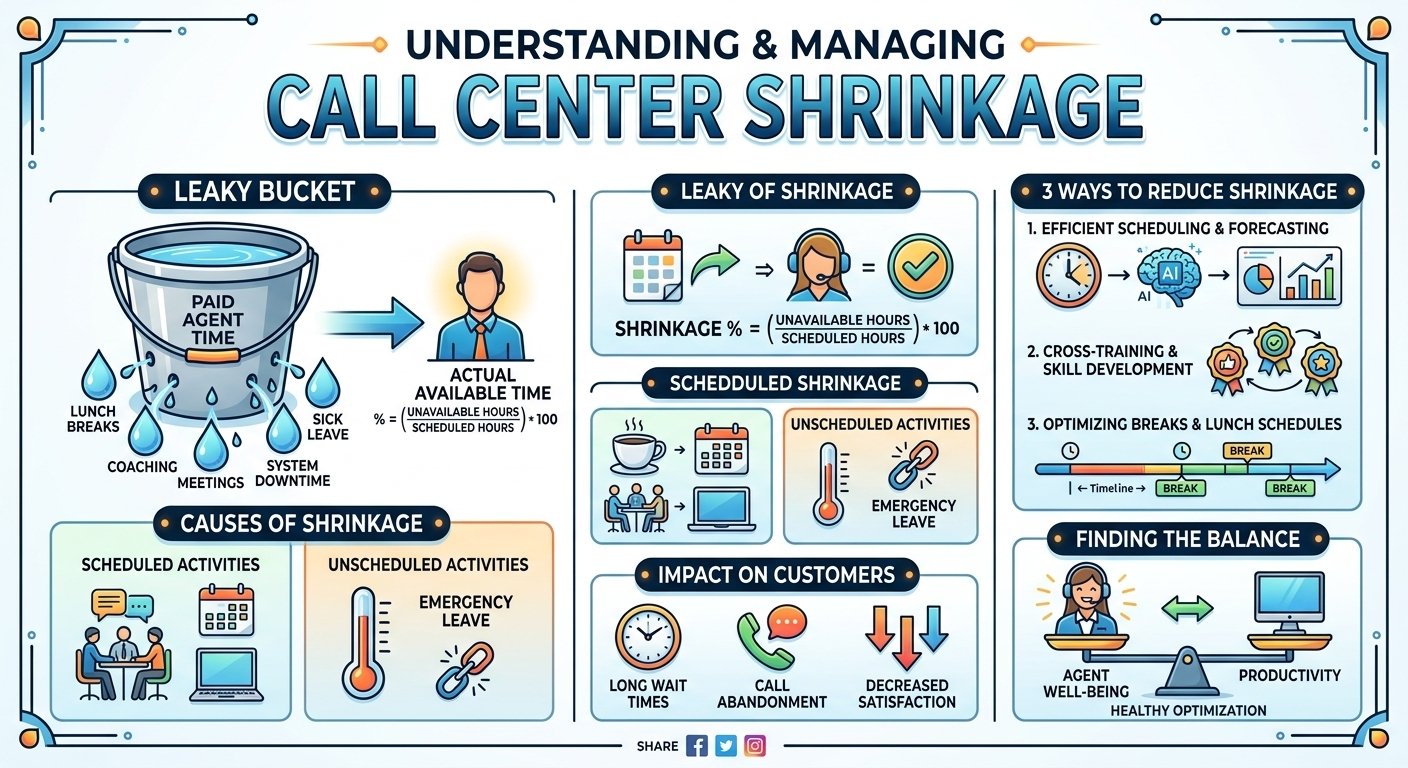
Call center shrinkage is a critical workforce management metric that measures the time agents are paid to work but are unavailable to handle customer interactions. This gap between total scheduled hours and actual time spent on calls is caused by various factors, including breaks, training, meetings, and unexpected absences. Understanding call center shrinkage allows managers to forecast staffing needs accurately, ensuring service levels remain consistent without overworking the team. Most high-performing organizations aim for a shrinkage rate between 30% and 35%, though these figures vary significantly by industry and operational requirements.
What Is Call Center Shrinkage?
On paper, every supervisor hopes their agents will always be available, logged in, and ready to assist the next customer. However, the reality of the industry dictates that a healthy call center shrinkage rate typically hovers around 30% to 40%. It essentially represents the “leaky bucket” of time in a contact center, where minutes are lost to necessary or unforeseen activities.
Tracking this metric is vital because it directly impacts the customer experience. When agents are busy with other tasks, wait times increase, and call abandonment rates rise. A Cornell University study on global call center management found that organizations that fail to account for these gaps often see a 20% decline in service level consistency. By defining call center shrinkage, leaders can better visualize the difference between their theoretical capacity and their actual daily output.
| Type | What It Means | Examples |
|---|---|---|
| Planned shrinkage | Known unavailability that can be included in schedules | Breaks, training, coaching, meetings, planned leave |
| Unplanned shrinkage | Unavailability that was not scheduled | Sickness, lateness, emergency leave, unexpected outages |
Planned vs Unplanned Shrinkage
| Planned Shrinkage | Unplanned Shrinkage | |
|---|---|---|
| Predictable? | Usually | Usually not |
| Examples | Breaks, training, meetings, planned leave | Sickness, lateness, emergencies, unexpected outages |
| Can be scheduled around? | Often | Limited |
| Should it be eliminated? | No | Not entirely possible |
| WFM approach | Include in forecasts and schedules | Forecast from historical patterns and maintain contingency coverage |
Planned shrinkage
- breaks
- lunch
- training
- meetings
- coaching
- scheduled leave
Unplanned shrinkage
- sickness
- lateness
- emergency absence
- unexpected technical downtime
Internal framework categories for call center shrinkage;
| Category | Description | Common Examples |
| Internal | Activities occurring within the building | Meetings, coaching, 1-on-1s |
| External | Factors keeping agents away from work | Sick leave, holidays, lateness |
| Operational | Systemic or technical downtime | Software updates, hardware failure |
Causes of Shrinkage
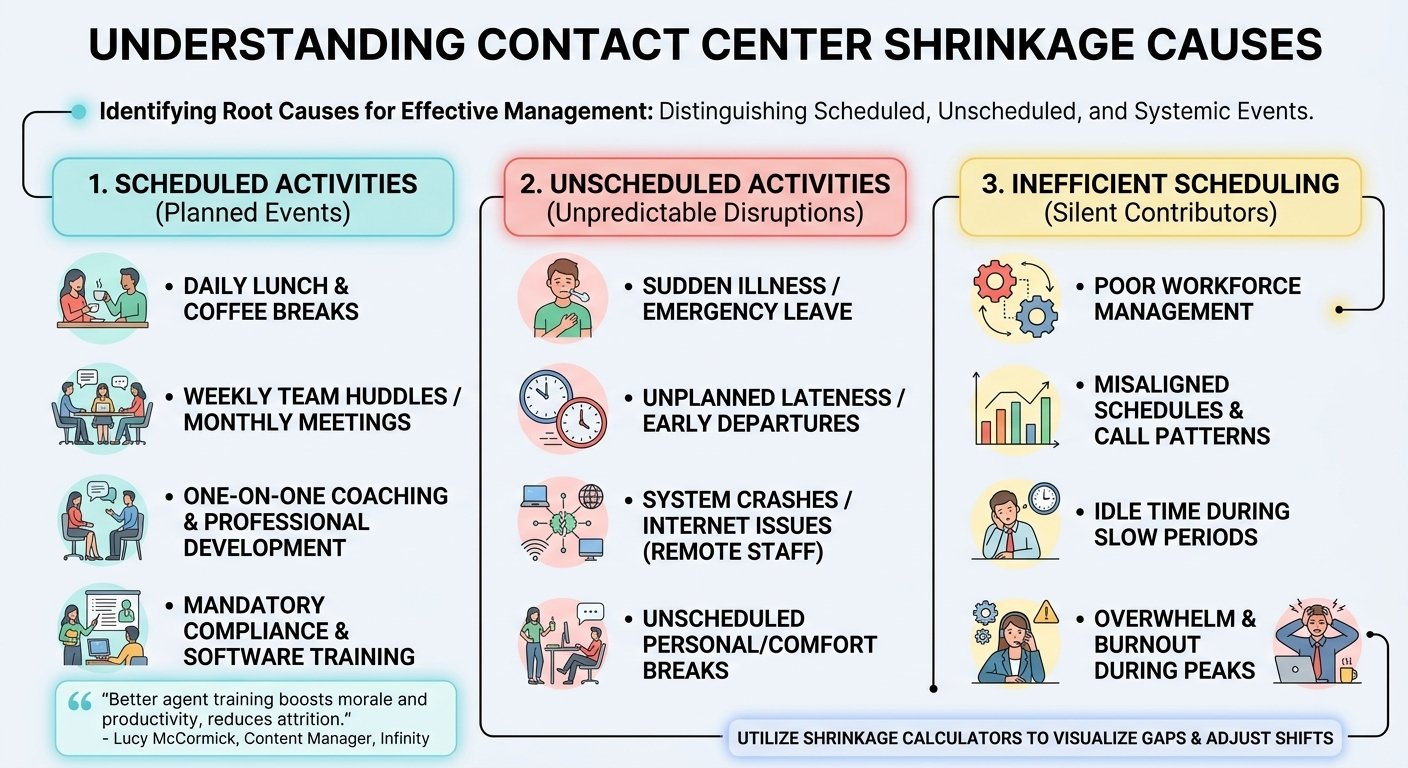
Identifying the root causes of contact center lost hours is the first step toward effective management. These causes are generally divided into scheduled and unscheduled events, alongside systemic inefficiencies that drain productive time. When managers analyze contact center shrinkage, they must distinguish between productive “off-phone” time and wasted idle time.
1. Scheduled activities
Scheduled shrinkage includes all the planned events that take an agent away from the phone. While these activities contribute to shrinkage call centre operations rely on them to maintain quality and compliance. These include:
-
Daily lunch and coffee breaks.
-
Weekly team huddles or monthly all-hands meetings.
-
One-on-one coaching and professional development sessions.
-
Mandatory compliance training or software onboarding.
According to Lucy McCormick, Content Manager at Infinity, better agent training can boost morale and productivity, build resilience, and reduce your overall attrition rate by giving agents everything they need to nail every single call and feel good about the job they’re doing.
2. Unscheduled activities
Unscheduled events are the unpredictable disruptions that can wreak havoc on a service level agreement. This form of contact centre shrinkage is often harder to manage because it occurs without warning. Common unscheduled activities include:
-
Sudden illness or emergency family leave.
-
Unplanned lateness or early departures.
-
System crashes or internet connectivity issues for remote staff.
-
Unscheduled personal breaks or “comfort breaks” beyond the standard allowance.
3. Inefficient scheduling
Poor workforce management is a silent contributor to operational shrinkage. When schedules are not aligned with historical call patterns, agents may find themselves idle during slow periods or overwhelmed during peaks. This mismatch leads to wasted labor costs or high burnout rates. Utilizing a call center shrinkage calculator helps planners visualize these gaps and adjust shifts accordingly.
Tracking Call Center Shrinkage
To manage what you cannot measure is impossible, and this is especially true for workforce efficiency. Tracking call center shrinkage involves more than just looking at attendance sheets; it requires a deep dive into real-time data and historical trends. Managers must use consistent reporting methods to ensure the data remains actionable for future planning.
-
Track key metrics
Monitoring specific key performance indicators provides a roadmap for understanding where time is being lost. By looking at these metrics, you can identify if the problem lies in agent behavior or administrative over-scheduling. The primary metrics to watch include:
-
Schedule Adherence: How closely agents follow their assigned start, stop, and break times.
-
Occupancy Rate: The percentage of time agents spend on live calls versus waiting for a new one.
-
Agent Idle Time: Minutes spent in an available state without receiving an interaction.
-
Average Handle Time: While not a direct shrinkage metric, increases here can indicate agents are taking longer than necessary on tasks.
-
Work out your shrinkage calculation
The standard shrinkage formula is a simple but powerful tool for workforce planners. To calculate the percentage, you take the total hours of unavailable time and divide it by the total scheduled hours, then multiply by 100. This provides a clear percentage that can be compared against industry benchmarks or internal goals.
| Component | Example Value |
| Total Scheduled Hours | 1,000 hours |
| Total Unavailable Hours | 300 hours |
| Calculation | (300 / 1000) × 100 |
| Resulting time loss | (300 / 1,000) × 100 = 30% |
Using this formula helps determine actual staffing requirements in call center environments so that hiring managers know exactly how many “extra” staff members are needed to cover the gaps. If your shrinkage is 30%, you need roughly 30% more staff than the raw call volume suggests.
3 Ways to Manage Call Center Shrinkage
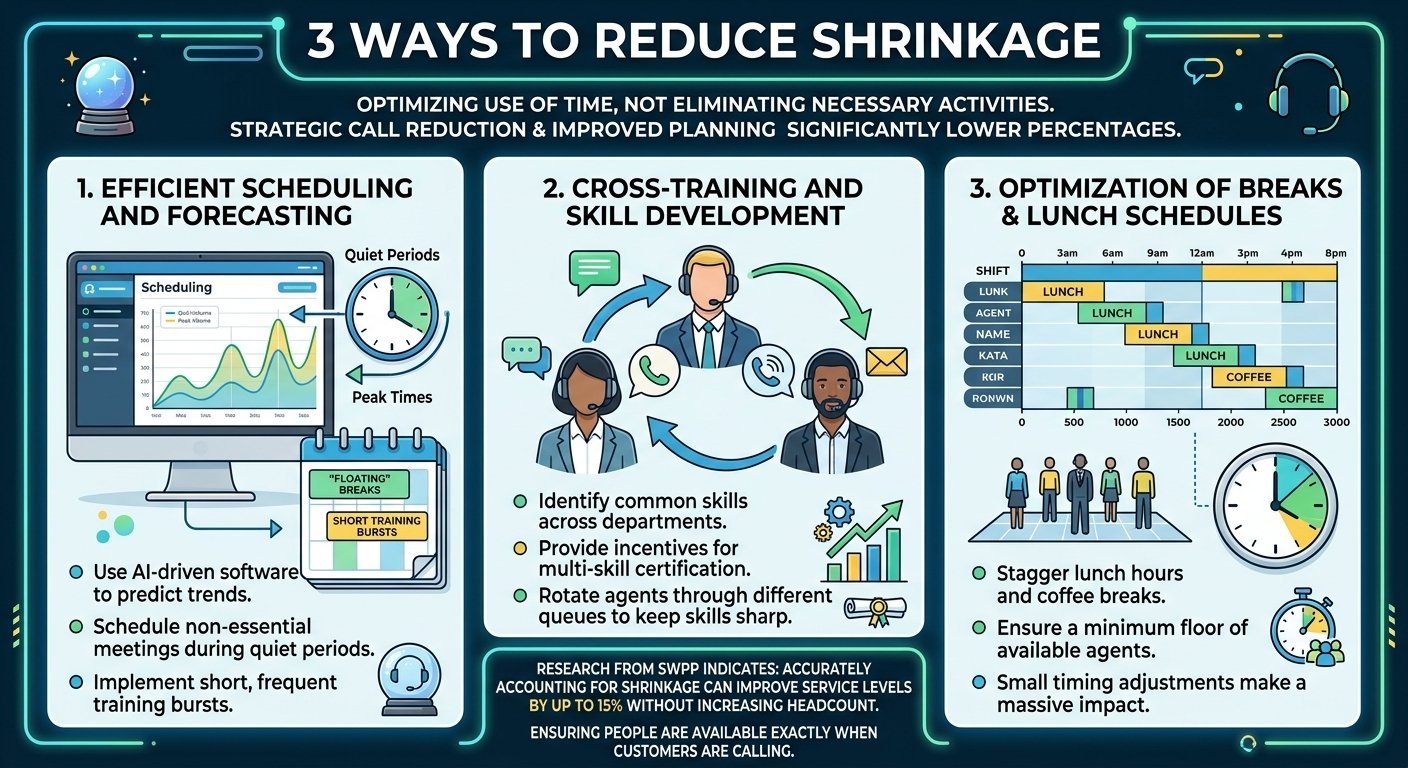
Reducing lost hour in call center environments does not mean eliminating breaks or training. Instead, it involves optimizing how that time is used and ensuring that resources are deployed where they have the most impact. Better forecasting, scheduling, absence management and workforce planning can help control avoidable shrinkage while preserving necessary off-phone activities.
1. Efficient scheduling and forecasting
Modern workforce management tools allow for much more precise forecasting than manual spreadsheets. By analyzing historical data, you can predict exactly when call volumes will spike. This allows you to schedule non-essential meetings and training sessions during historically quiet periods, effectively lowering the impact of contact center shrinkage. To minimize contact center shrinkage, use AI-driven software to predict seasonal and daily trends. Additionally, schedule “floating” breaks that adjust dynamically to real-time call volume. Finally, implement short, frequent training bursts rather than long, day-long seminars.
2. Cross-training and skill development
When agents are trained to handle multiple types of queries, the call center becomes more resilient. If one department experiences high shrinkage due to illness, cross-trained agents from another department can step in to fill the gap. This flexibility is a vital component of any strategy aimed at minimizing shrinkage in a call center. Identify common skills shared across different departments. Then, provide incentives for agents who complete multi-skill certification. And, rotate agents through different queues to keep their skills sharp.
3. Optimization of breaks and lunch schedules
A common mistake in contact centers is allowing too many people to go on break at the same time. Staggering lunch hours and coffee breaks ensures that there is always a minimum “floor” of agents available to answer calls. Small adjustments to the timing of these breaks can have a massive impact on the overall time loss reported across the contact center.
Research from the Society of Workforce Planning Professionals (SWPP) indicates that accurately accounting for shrinkage can improve service levels by up to 15% without increasing head count. This is achieved by ensuring that the people you have are available exactly when the customers are calling.
Balancing Shrinkage With Burnout
While the goal is to lower the time loss percentage, pushing agents too hard will backfire. High occupancy rates—where agents are on calls 90% of the time—lead to rapid burnout, which in turn increases unscheduled absences and turnover. Finding the right balance is essential for long-term operational health and reducing lost hour call center costs.
-
Offer flexible work arrangements
To lower time loss without causing burnout, call centers must balance productivity with agent well-being. Excessive occupancy rates often lead to higher turnover and unscheduled absences; however, offering flexible work arrangements—such as remote work for top performers, shift-swapping programs, and part-time shifts for peak hours—can significantly improve retention. By empowering agents with a better work-life balance, managers can reduce external shrinkage and maintain long-term operational health.
-
Improve communication and feedback
Open communication is essential for identifying the root causes of unavailability, especially when overwhelmed agents resort to “stealth” breaks or extended after-call work. By utilizing pulse surveys to gauge stress and real-time dashboards to improve adherence visibility, managers can proactively address these behaviors before they become habits. Ultimately, fostering a feedback-rich culture—where high performance is recognized without compromising well-being—ensures a more resilient and productive workforce.
Read More: Work From Home vs Work from Office: Pros and Cons
Final Thought
Shrinkage is a normal part of contact-center workforce planning because agents cannot spend every scheduled minute handling customer interactions. Breaks, training, meetings, leave and unexpected absences all reduce the number of hours available for customer work.
The goal is not to eliminate shrinkage. Instead, contact centers should measure planned and unplanned shrinkage separately, forecast it realistically, and schedule enough coverage to meet service requirements without removing necessary training, breaks or employee support.
Frequently Asked Questions
-
What is the average shrinkage for a call center?
In most professional environments, the average call center shrinkage falls between 30% and 35%. This figure accounts for all internal and external factors that prevent an agent from handling customer interactions while they are on the clock.
-
What does shrinkage mean in a call center?
Shrinkage represents the time for which agents are paid but are not actually available to take calls. It includes everything from scheduled breaks and training sessions to unscheduled absences and system downtime.
-
What is the 80/20 rule in call centers?
In call centers, “80/20” commonly refers to a service-level target of answering 80% of calls within 20 seconds. It should not be confused with the Pareto Principle, which is a separate concept sometimes described as the 80/20 rule.
-
What does shrinkage mean in WFM?
In workforce management, shrinkage is used to adjust staffing requirements for expected unavailability. For example, if 100 agents must be available and expected shrinkage is 30%, the required scheduled staffing is approximately 143 agents: 100 ÷ 0.70 = 142.86.
-
How much call center shrinkage is acceptable?
While it varies by industry, 30% to 35% is generally considered acceptable. Voice-heavy centers with complex training might see up to 40%, whereas chat-focused centers might operate closer to 25%.
-
How does call center shrinkage affect revenue?
High shrinkage leads to longer wait times, which results in higher call abandonment. This often leads to lost sales opportunities, decreased customer loyalty, and increased labor costs due to inefficient staffing.
-
Can remote work reduce call center shrinkage?
Yes, remote work can often reduce unscheduled shrinkage by lowering lateness due to commuting and decreasing sick leave. However, it requires robust monitoring tools to ensure that “internal” shrinkage doesn’t increase through household distractions.
-
What is the first step to reducing shrinkage?
The first step is accurate measurement. You must use a consistent formula to categorize and track where time is going before you can implement targeted strategies to recover those lost minutes.