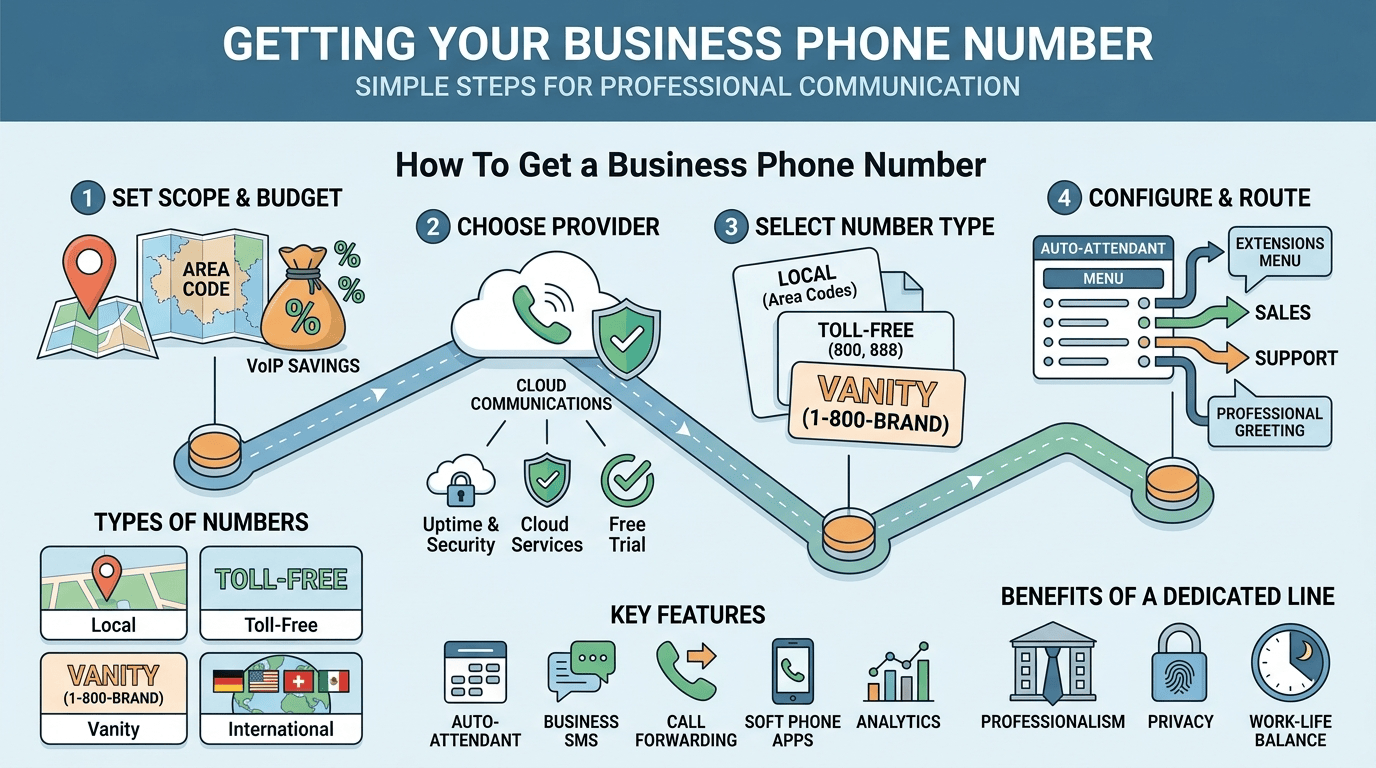
Before getting a business phone number, first you need to identify your communication needs and budget. Then, take a start by selecting a trustable cloud-based service provider that is aligned with your requirements. Once you select a provider, you can choose between local, toll-free, or vanity numbers to represent your brand. After securing the number, configure your call routing, extensions, and automated greetings to ensure a professional customer experience. This process allows you to separate personal and professional calls while accessing advanced tools like voicemail-to-text and call analytics to grow your business effectively.
What Is a Business Phone Number?
A business phone number is a dedicated communication line used specifically for professional purposes. Unlike a private mobile line, this is a corporate asset that belongs to the company rather than an individual employee. It serves as a central contact point for clients and is usually listed on official websites, business cards, and marketing materials. These numbers are often powered by Voice over Internet Protocol technology, which allows them to function over the internet rather than traditional copper wires.
Using a business number ensures a consistency in the business identity across all platforms. It does not confine to a single person or device, rather multiple team members can handle calls from different devices. All calls will appear as a same line from the same office. Where customer service and internal collaboration has become a priority, there such kind of flexibility becomes not a choice rather compulsion.
How To Get a Business Phone Number
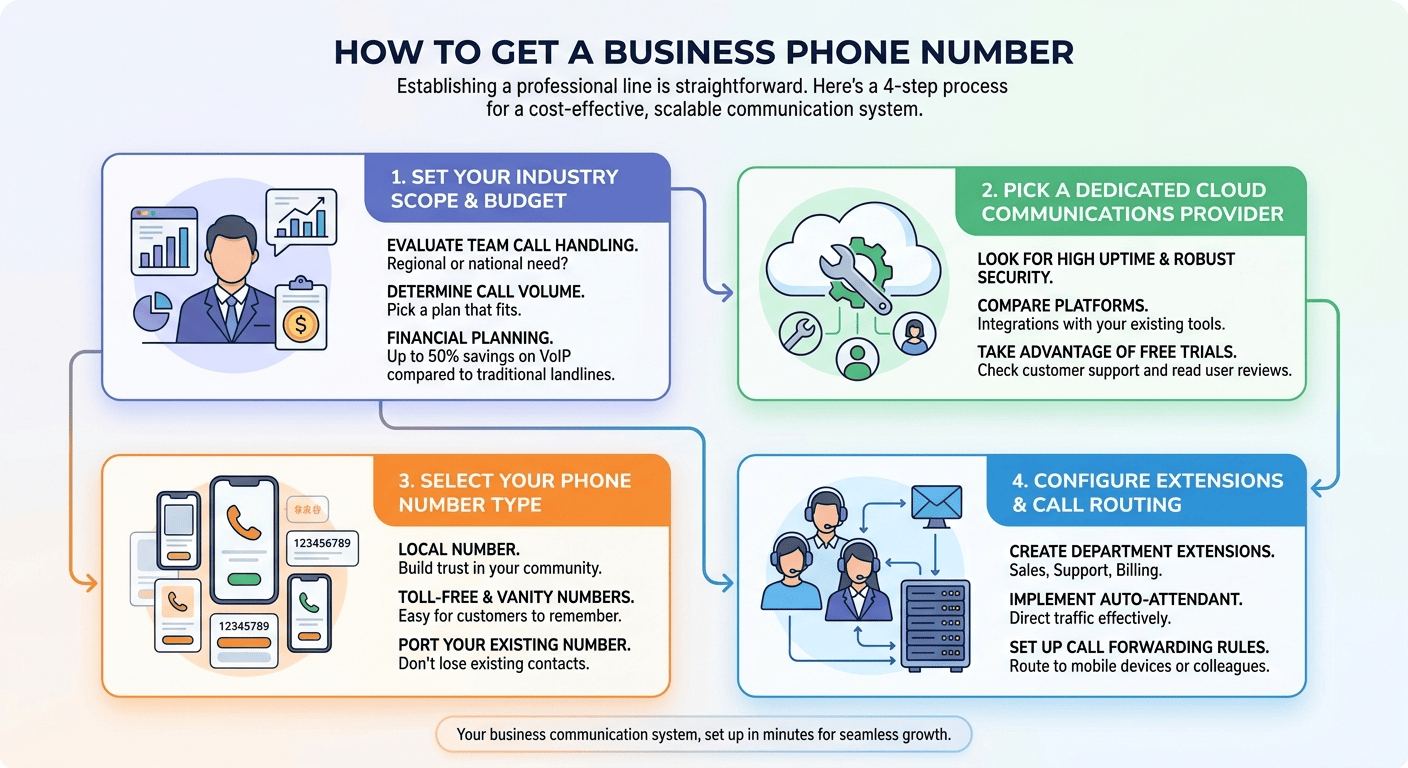
It is a very straightforward process to establish a professional line that can be completed in a few minutes. However, for that, a structured approach is required, which will ensure the growth and scalability of the business. By working according to the following steps, you can acquire that structured approach.
Step 1. Set your industry scope and budget
Before looking for business phone numbers, evaluate how your team handles calls. If you are a local service provider, you will likely need a regional area code to build trust within your community. Larger corporations often require toll-free options to accommodate a national customer base. Determining your call volume helps you decide whether a basic plan or an enterprise-level subscription is necessary.
Financial planning is equally important when you set up business phone number systems. Most providers offer tiered pricing based on the number of users or specific features like call recording.
Research shows that businesses switching to VoIP systems can save up to 50% on their communication costs compared to traditional landlines.
Hence, knowing your limits will prevents overspending on unnecessary features.
Step 2. Pick a dedicated cloud communications provider
Selecting the right partner is the most critical part of the process. You should look for a provider that offers high uptime and robust security to protect your business telephone numbers. Conduct a thorough comparison of available platforms to see which one aligns with your existing software stack, such as your CRM or email marketing tools.
Many companies offer business phone number free trials, allowing you to test the interface before committing. Check for 24/7 customer support and read user reviews to ensure the service is reliable. A good provider will make it easy to get a company phone number. Also, it provides the technical infrastructure needed to scale your operations without requiring complex hardware installations.
Step 3. Select the type of your phone number
Once you have chosen a platform, you can browse their inventory to buy a business phone number that fits your brand. You might choose a local number to maintain a neighborhood feel or a vanity number that is easy for customers to remember. Most services allow you to search for specific digits or phrases that represent your industry.
If you already have a phone number for business that your customers know, you can usually port it to the new service. This ensures you do not lose existing contacts while upgrading to a more modern system. Selecting the right digits is a key part of how to choose a phone number for business success, as it impacts how easily clients can reach you.
Step 4. Configure extensions and call routing
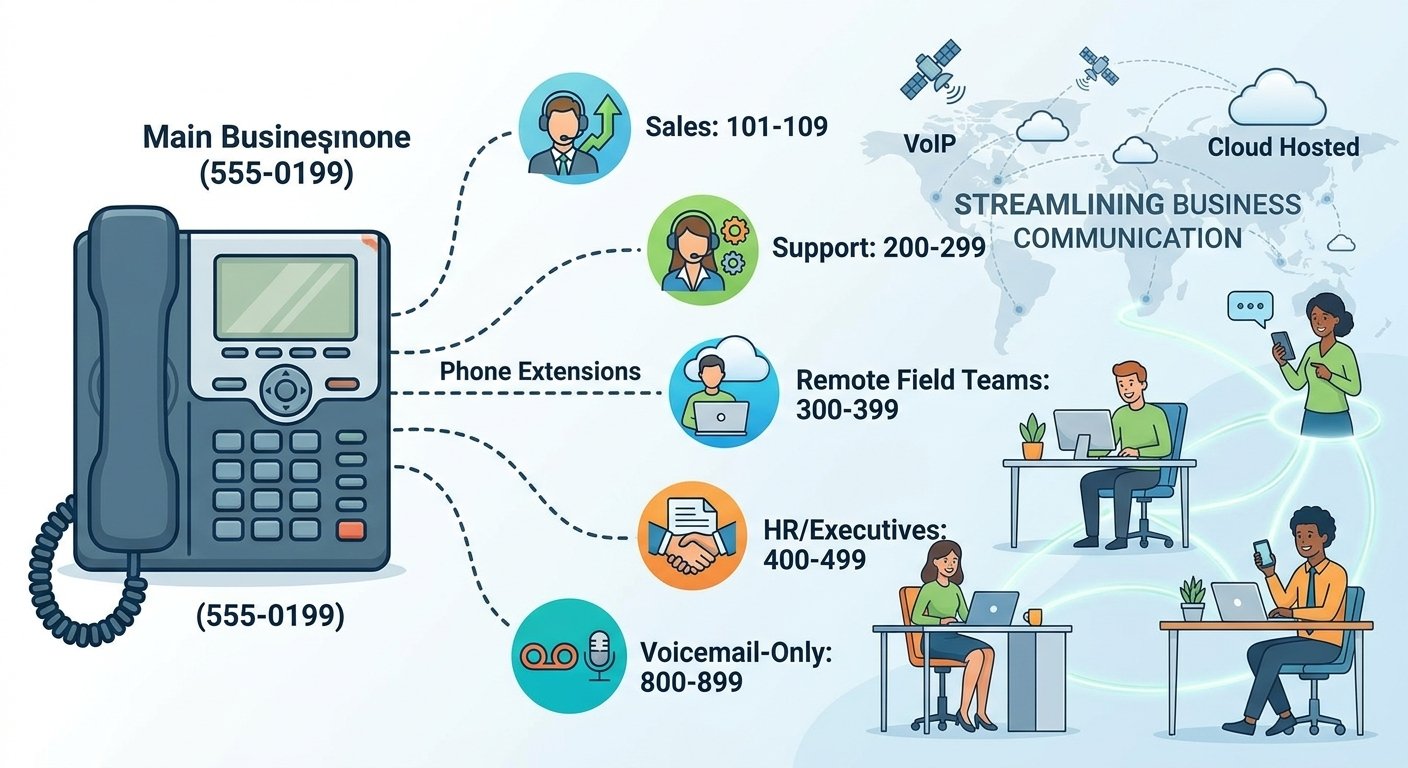
The final step involves setting up the internal logic of your phone system. Create extensions for different departments so that callers can easily reach sales, support, or billing. Implementing an auto-attendant can help direct traffic without the need for a full-time receptionist, making your small business phone number feel like a large corporate operation.
You should also set up call forwarding rules to ensure no inquiry goes unanswered. You can route calls to your mobile device during travel or to a colleague when you are unavailable. Taking the time to properly set up business phone number logic ensures a seamless experience for every caller who dials your corporate phone number.
Why You Need a Business Phone Number (Benefits)
Using a dedicated line offers significant advantages over using a personal mobile device for work. It creates a clear boundary between your private life and your professional responsibilities. When a call comes in, you immediately know it is for work, allowing you to answer with a professional greeting every time you use your phone number for my business.
-
Professionalism: Features like custom hold music and professional greetings build immediate credibility with new callers.
-
Privacy: You can keep your personal cell digits private by only sharing your telephone number for business with the public.
-
Analytics: Business systems provide data on call duration, peak times, and missed calls to help improve your service.
-
Work-Life Balance: You can set “Do Not Disturb” hours so that work calls go to voicemail after the business day ends.
- Better team collaboration: Multiple employees can share the same line, ensuring that someone is always available to help a customer.
Types of Company Phone Numbers Available
Understanding the different options available will help you choose the best phone numbers for business growth. Each type serves a specific purpose depending on your market reach and branding strategy.
1. Local phone numbers
Local numbers are tied to specific geographic area codes. They are perfect for businesses that want to establish a strong presence in a particular city or region. Customers are often more comfortable calling a local number because it suggests the business is nearby and accessible.
2. Toll-free phone numbers
These numbers start with prefixes like 800, 888, or 877. They allow callers to reach your business from anywhere in the country without paying long-distance fees. This is an excellent choice for a phone number for llc entities that operate nationally or offer remote support services.
3. Vanity phone numbers
A vanity number is a customized sequence that spells out a word, such as 1-800-FLOWERS. These are highly effective for marketing because they are easy to remember. Using a custom phone number for business advertising can significantly increase your call-back rates from billboards or radio ads.
4. Virtual VoIP numbers
Virtual numbers are not tied to a physical location or a specific SIM card. They run entirely through an internet connection, allowing you to use your business phone number on cell phones or computers. This is the most flexible option for modern, digital-first companies.
5. International numbers
If you have clients in other countries, you can obtain virtual numbers with foreign area codes. This allows international customers to call you at local rates, which removes the barrier of expensive international calling costs. It is a powerful way to get a corporate phone number that appeals to a global audience.
6. Direct Inward Dialing (DID) numbers
DID allows you to provide individual team members with their own direct lines while still using a central office system. This bypasses the main receptionist, allowing clients to reach specific employees directly. It is an efficient way to manage phone numbers of businesses with multiple departments.
Key Features a Business Phone Number Provider Should Offer
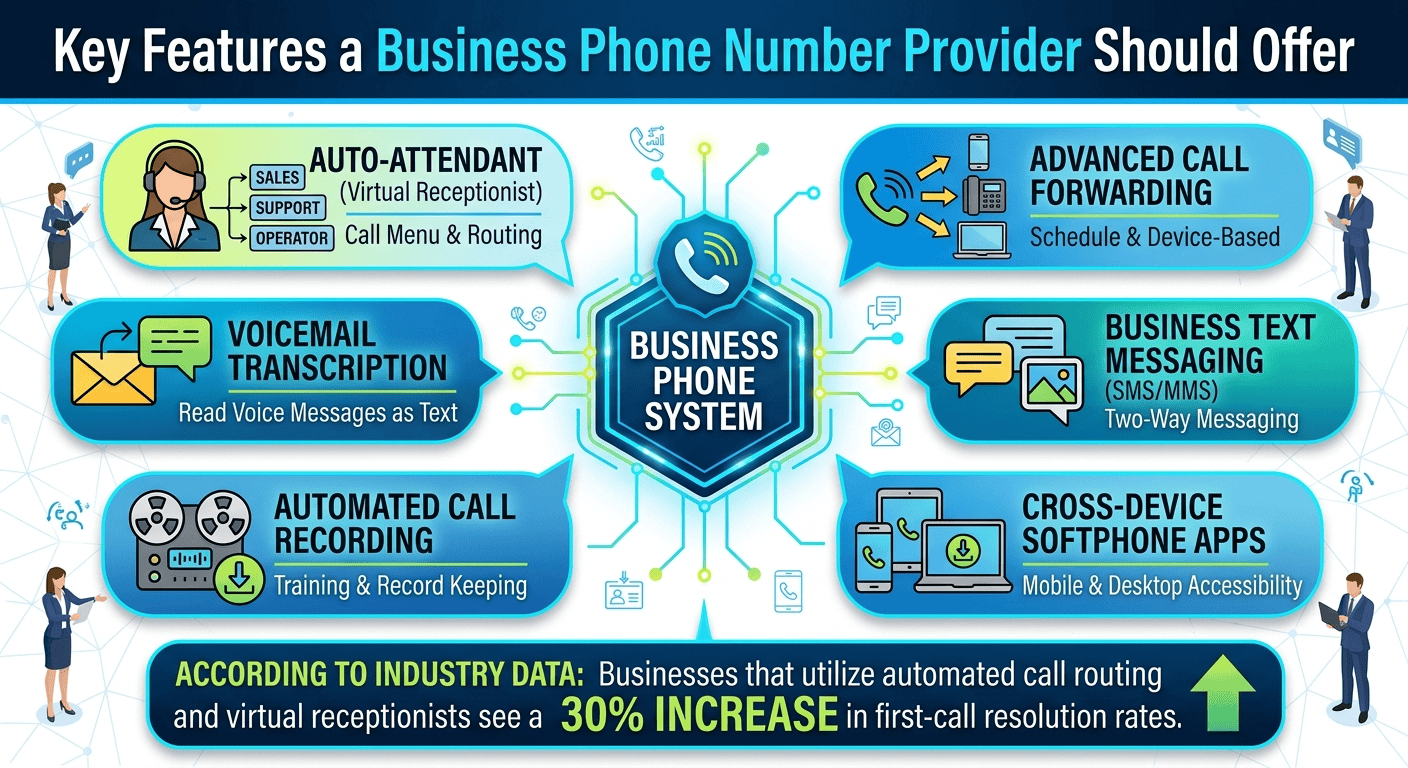
When you search for the best business phone number service, you should look for features that improve productivity. A modern system should do more than just send and receive calls. It should act as a comprehensive communication hub for your entire team.
-
Auto-attendants (virtual receptionists): These provide a menu of options for callers to choose from, ensuring they are directed to the right person.
-
Advanced call forwarding: This feature sends calls to different devices or numbers based on a schedule you define.
-
Business text messaging (SMS/MMS): Many customers prefer texting over calling, so having a phone number for work that supports SMS is vital.
-
Cross-device softphone apps: These apps allow you to take your business phone line anywhere using your laptop or smartphone.
-
Automated call recording: This is useful for training purposes and maintaining records of important client agreements.
-
Voicemail transcription: This service converts voice messages into text and sends them to your email for quick reading.
According to industry data, businesses that utilize automated call routing and virtual receptionists see a 30% increase in first-call resolution rates. This efficiency highlights the importance of choosing a provider that offers these essential tools as part of their standard package.
Top Business Phone Number Providers Compared
| Provider | Best for | Key features | Pros | Cons | Starting price |
| Nextiva | Growing businesses | CRM sync, video meetings | 99.999% uptime | Premium analytics cost more | $15/mo |
| Google Voice | Solopreneurs | Simple UI, spam filter | Very easy to use | Lacks advanced routing | $10/mo |
| RingCentral | Large enterprises | Robust APIs, cloud faxing | High scalability | Complex for small teams | $20/mo |
| Ooma Office | Micro-businesses | Virtual receptionist | No complex setup | Limited integrations | $19.95/mo |
| Grasshopper | Remote teams | Mobile-only focus | Professional image | No video tools | $14/mo |
| Vonage | Modular needs | Customizable apps | Flexible plans | Basic tiers are limited | $13.99/mo |
1. Nextiva: Best unified communications platform for growing businesses
Nextiva is widely recognized for its reliability and comprehensive feature set. It offers a seamless blend of voice, video, and messaging, making it a top choice for those who want to get business phone numbers that grow with them. Their customer support is frequently cited as a major benefit for small business owners.
2. Google Voice: Best for individuals and small teams
If you already use Google Workspace, this is the most convenient way to obtain a professional phone number. It integrates perfectly with your existing contacts and calendar. While it lacks some of the complex routing of other platforms, it is a great way to get a free business phone number for basic needs.
3. RingCentral: Best for international calling
For companies that need a global reach, RingCentral provides extensive international support. It allows you to manage a company telephone number across multiple countries from a single dashboard. Its advanced analytics and integration capabilities make it a favorite for data-driven enterprises.
4. Ooma Office: Best for micro-businesses
Ooma focuses on providing a high-quality experience for small offices that need a reliable telephone number business solution. It is known for its clear audio quality and easy hardware setup. It is a solid choice for those who prefer traditional desk phones alongside mobile apps.
5. Grasshopper: Best for solopreneurs
Grasshopper is designed specifically for people who want to keep their existing mobile phones but add a professional layer. It allows you to buy a phone number for business and route it directly to your personal device. It is a simple, effective way to separate work and personal calls without new hardware.
6. Vonage Business: Best budget-friendly VoIP number service
Vonage offers a modular approach where you can pay for exactly what you need. This makes it a cost-effective way to get a phone number for your business while keeping overhead low. Their mobile app is highly rated for its ease of use and consistent performance.
Best Practices for Choosing a Business Phone Number
Selecting the right digits is just the beginning of your professional communication strategy. You should also consider how the number will be perceived by your customers and how it will be used in your marketing efforts. A well-chosen number can serve as a powerful branding tool for years to come.
-
Know your audience and reach: If your clients are mostly in one city, stick with a local area code. If you are aiming for a national presence, a toll-free number is a better investment to get telephone number recognition.
-
Match your business style: A law firm might prefer a standard local number for a personal touch, while a tech startup might opt for a vanity number that highlights their innovation.
-
Use your number for marketing: Track which ads are performing best by using different numbers for different campaigns. This data helps you refine your advertising spend.
-
Prioritize essential features: Ensure the system you choose can handle your expected call volume and offers the automation tools you need to stay organized.
You should also verify if the provider allows for easy number porting. This ensures that if you ever decide to switch services, you can take your commercial phone number with you. Protecting your business identity is much easier when you own your number and have the flexibility to move it as your technology needs evolve.
Read More: How To Change Voicemail Password in 2026?
Final Thought
In the journey of establishing a professional brand and maintaining a required balance in your health and work-life, getting a business phone number is a crucial step. While selecting your number, it is recommended to be careful in choosing the provider and the number type. It would decide your credibility, enhance customer service, and give valuable insight into your communication. Therefore, even more than choosing the type of number, local, toll-free, or vanity, the right kind of provider will upgrade the overall growth of the company.
Business Phone Number FAQs
-
How can I get a business phone number?
You can get a business phone number by signing up with a VoIP or cloud communications provider like Nextiva, RingCentral, or Google Voice. Simply choose a plan, select your desired number from their inventory, and configure your settings. Most providers allow you to start using the number immediately through a mobile app or desktop software.
-
What is the difference between a virtual and traditional phone line?
A traditional line requires physical copper wiring and is tied to a specific location, whereas a virtual number operates over the internet. Virtual numbers are more flexible, allowing you to answer calls on any device and access advanced digital features like automated routing and voicemail-to-email.
-
Can I keep my existing number when I switch to a business service?
Yes, most providers offer a process called number porting. This allows you to transfer your existing local or toll-free number from your current carrier to a new business phone service provider. It usually takes a few days to complete, but it ensures your customers can still reach you at the same digits.
-
Is it possible to get a business phone number for free?
Some services offer a free version or a basic tier for individuals, though these often have limited features. For a fully professional experience with auto-attendants and multiple extensions, most businesses choose a paid plan which typically starts around $10 to $20 per month.
-
What features are most important for a small business?
Small businesses should prioritize features like an auto-attendant to handle calls professionally, call forwarding to ensure they never miss an inquiry, and business SMS to communicate with customers via text. Voicemail transcription is also highly recommended for staying organized on the go.
-
Do I need to buy new hardware for a business phone?
No, most modern business phone systems are app-based. You can use your existing smartphone, tablet, or computer to make and receive calls. However, if you prefer a physical desk phone, many VoIP providers sell hardware that plugs directly into your internet router.
-
How does a vanity number help my business?
A vanity number like 1-800-REPAIR makes your business more memorable for customers. It serves as a marketing tool that can increase brand recall and make it easier for people to contact you after seeing an advertisement on a vehicle or billboard.
-
Can I have multiple numbers for different departments?
Yes, business phone services allow you to add as many numbers as you need. You can have a main office line, a dedicated support line, and individual direct lines for each employee, all managed through a single central dashboard.
-
Does a business phone number work internationally?
Most cloud-based systems allow for international calling and the ability to purchase international virtual numbers. This means you can have a local number in another country that routes directly to your office, making it easier for global clients to reach you.