
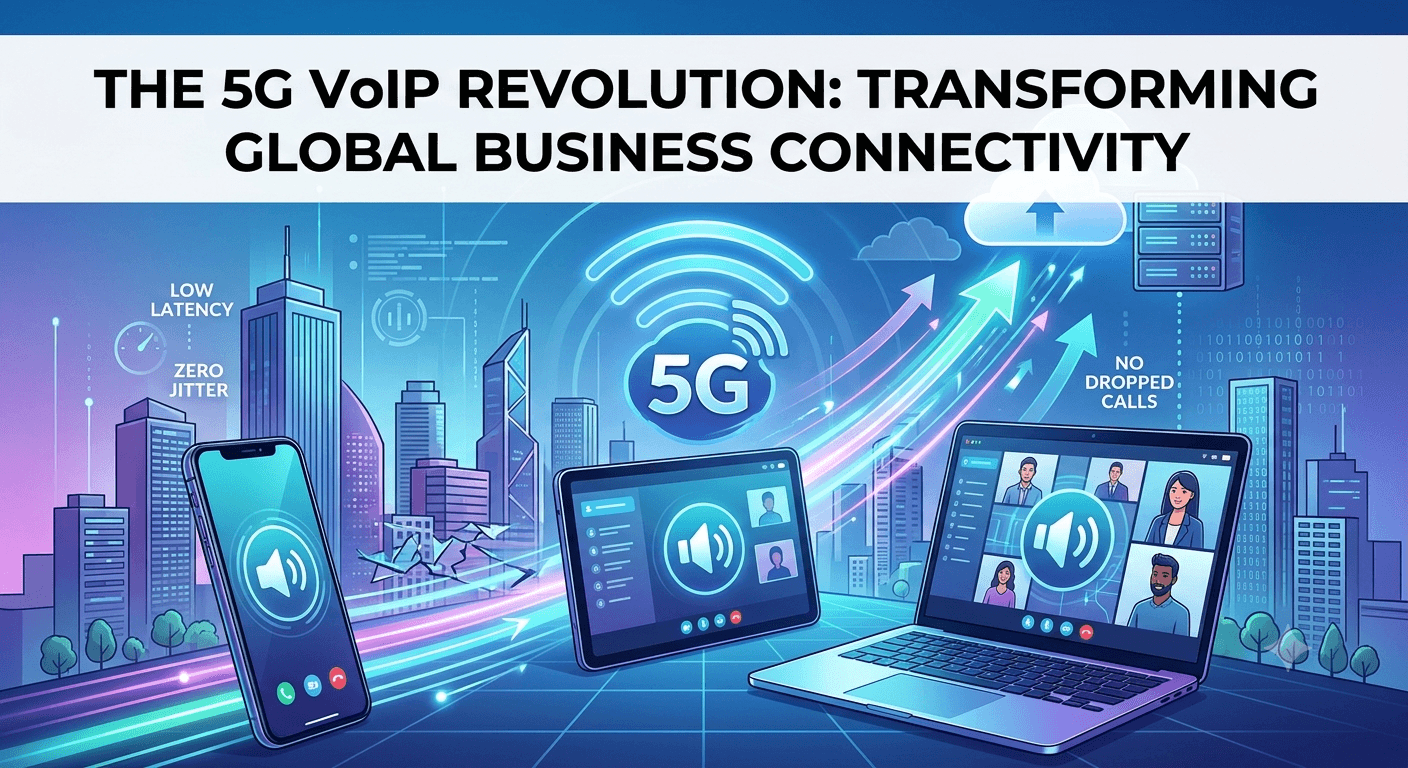
The Impact of 5G on VoIP represents a massive leap in digital communication, offering unprecedented speeds and reliability. By utilizing the 5th generation of mobile networks, Voice over Internet Protocol services transition from standard audio to high-definition, immersive experiences. This technological evolution virtually eliminates common issues like jitter and dropped calls through ultra-low latency and massive bandwidth. Businesses benefit from seamless connectivity, allowing remote teams to collaborate via high-definition video and real-time data sharing without the constraints of traditional hardware. Ultimately, 5G turns mobile devices into powerful, office-grade communication hubs, redefining the standard for global business connectivity.
What is 5G technology?
5G technology is the fifth generation of wireless cellular networks, designed to significantly increase the speed and responsiveness of wireless communication. Unlike its predecessors, 5G utilizes higher frequency bands and advanced antenna technology to provide ultra-low latency and massive data capacity. This allows for near-instantaneous downloads, seamless streaming, and the ability to connect millions of devices simultaneously. Beyond just faster smartphones, 5G acts as a foundational infrastructure for the Internet of Things (IoT), autonomous vehicles, and smart cities, fundamentally changing how we interact with the digital world.
Benefits of 5G on VoIP
The transition to fifth-generation wireless technology brings a suite of enhancements that directly solve the historical pain points of internet-based telephony. When we examine the Impact of 5G on VoIP, the most immediate benefit is the sheer volume of data the network can handle simultaneously. This capacity ensures that even in crowded urban environments or large office complexes, the 5g voip experience remains consistent and uninterrupted by signal congestion.
Furthermore, the integration of these networks allows for a more unified communication strategy. Businesses no longer need to worry about the degradation of service when switching between local Wi-Fi and mobile data. This reliability fosters a professional image, as clients and partners experience crystal-clear audio regardless of where the employee is located. The following list highlights the core advantages provided by this network evolution:
-
Increased network capacity allowing for more concurrent high-quality sessions.
-
Improved energy efficiency for mobile devices running communication apps.
-
Greater reliability in high-density areas with many connected devices.
-
Seamless handovers between different network types without call drops.
-
Support for massive machine-type communications alongside voice traffic.
1. Improved Call Quality
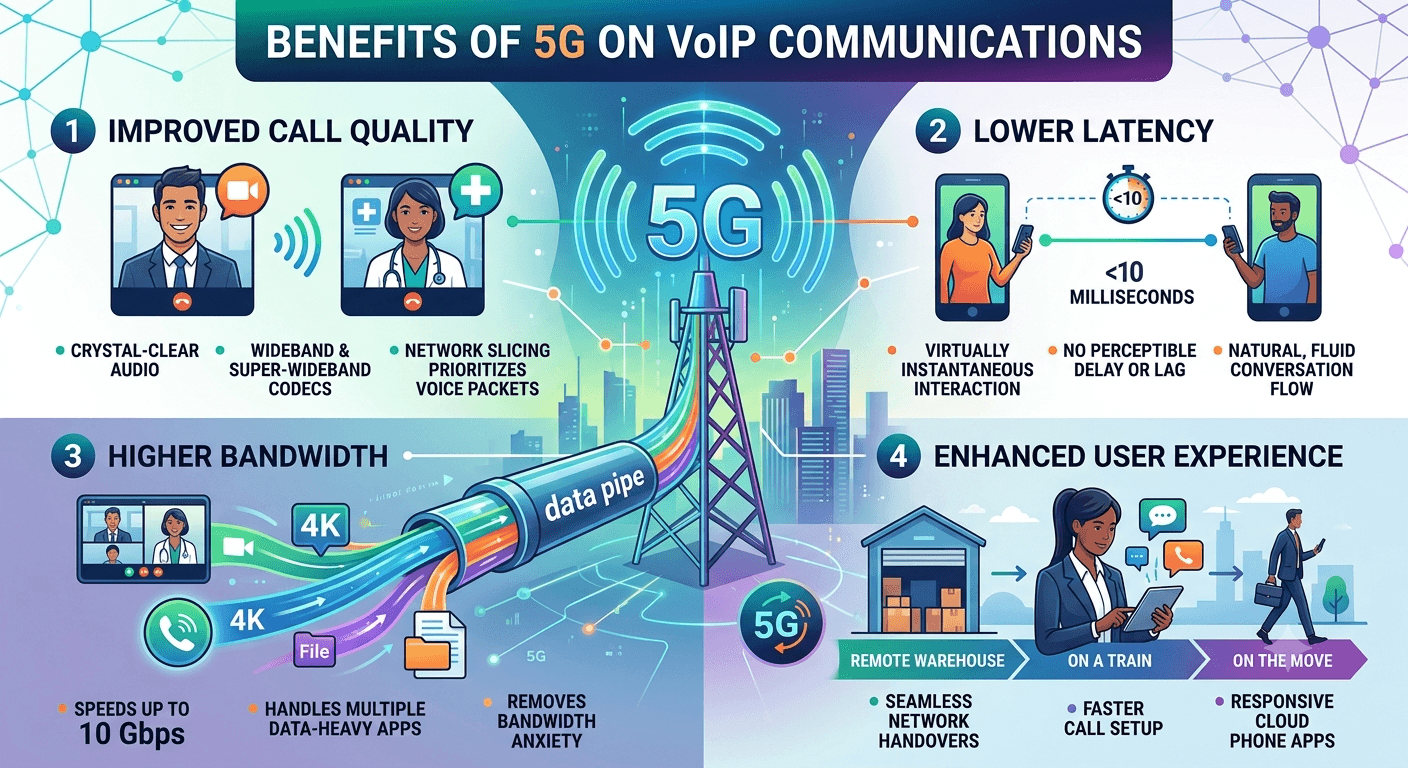
The most noticeable Impact of 5G on VoIP for the end-user is the significant jump in audio fidelity. Standard voice calls often compress data to fit within limited bandwidth, leading to “tinny” sound or missing syllables. With 5G, the network can support wideband and super-wideband codecs effortlessly, providing a depth of sound that rivals face-to-face conversation.
This improvement is not just about luxury; it is about clarity in business operations. In sectors like healthcare or legal services, where every word matters, the enhanced voip communications provided by 5G ensure that no critical information is lost due to poor signal. The network’s ability to prioritize voice packets through network slicing means that even during peak usage, your voice call remains the priority.
2. Lower Latency
Latency, or the delay between a person speaking and the other person hearing it, has long been the enemy of internet calling. The Impact of 5G on VoIP includes reducing this latency to under 10 milliseconds, which is virtually imperceptible to the human ear. In older 4G networks, latency could often spike, leading to that awkward situation where two people speak over each other because of the lag.
By achieving ultra-low latency, 5G allows for real-time interaction that feels natural. This is particularly vital for international business calls where distance already adds a layer of complexity. When the network response is instantaneous, the flow of ideas remains fluid, and the technical barriers to effective communication simply vanish.
3. Higher Bandwidth
The impact of internet bandwidth on cloud phone system performance cannot be overstated. High bandwidth means the “pipe” through which data flows is much wider, allowing for more data-heavy applications to run alongside voice calls. 5G provides speeds that can reach up to 10 Gbps, which is a monumental increase over previous generations.
With this much room, a single mobile connection can handle a 4K video conference, a high-quality voice call, and large file transfers all at once. This removes the “bandwidth anxiety” that often plagues remote workers who fear that their call will drop if a family member starts streaming a video in the next room or if a large background update begins.
4. Enhanced User Experience
The overall Impact of 5G on VoIP culminates in a superior user experience that bridges the gap between office-based and mobile work. Users expect their tools to work instantly and perfectly; 5G meets this expectation by providing a stable foundation for complex applications. The speed of call setup is faster, and the interface of cloud-based phone apps becomes more responsive.
Reliability plays a huge role in user satisfaction. When employees know their communication tools will work in the car, on a train, or in a remote warehouse, they are more likely to utilize the full range of features offered by their cloud phone system. This leads to better internal engagement and more proactive client outreach.
How 5G Improves VoIP Call Quality
The technical architecture of 5G is designed to handle the specific requirements of real-time data packets. Unlike static web browsing, voice data is sensitive to timing. The Impact of 5G on VoIP is seen in how the network manages packet loss. In older networks, if a packet of data was lost, you would hear a “glitch.” 5G uses advanced signal processing and higher frequency bands to ensure that packet delivery is much more reliable.
According to research by the International Telecommunication Union (ITU), 5G networks are designed to support a connection density of up to 1 million devices per square kilometer.
This means that even in a stadium or a busy city center, the Impact of 5G on VoIP ensures that call quality does not degrade due to local interference. The network remains robust, providing a dedicated “lane” for your voice data to travel without being slowed down by other types of traffic.
The 5G Impact on VoIP Latency: Why Lower Delays Matter
In the world of professional communication, timing is everything. The Impact of 5G on VoIP latency is perhaps its most transformative feature for collaborative environments. High latency creates a disconnect that can lead to misunderstandings and frustration during important negotiations. When communication is delayed, the non-verbal cues and the natural rhythm of speech are lost, making the interaction feel robotic.
The move to 5G infrastructure brings edge computing closer to the user, which shortens the distance data has to travel. This physical proximity, combined with the speed of the 5G radio interface, ensures that voice packets move at lightning speed. For businesses, this means that virtual meetings can finally replicate the immediacy of an in-person boardroom discussion, regardless of the geographical distance between participants.
Advanced VoIP Features Enabled by 5G
As the Impact of 5G on VoIP continues to unfold, we are seeing the emergence of features that were previously impossible due to technical constraints. We are moving beyond simple voice calls into a realm of integrated, intelligent communication. The 5g voip ecosystem is becoming a platform for innovation, allowing developers to build tools that utilize high-speed data and low latency to provide real-time assistance to users.
These advancements are not just incremental; they represent a fundamental change in how we perceive a “phone call.” A call is no longer just an audio stream; it is a data-rich session that can incorporate various forms of media and artificial intelligence. This evolution leads to enhanced voip communications that make businesses more agile and data-driven in their daily interactions.
1. AI-Driven Call Transcriptions & Analytics
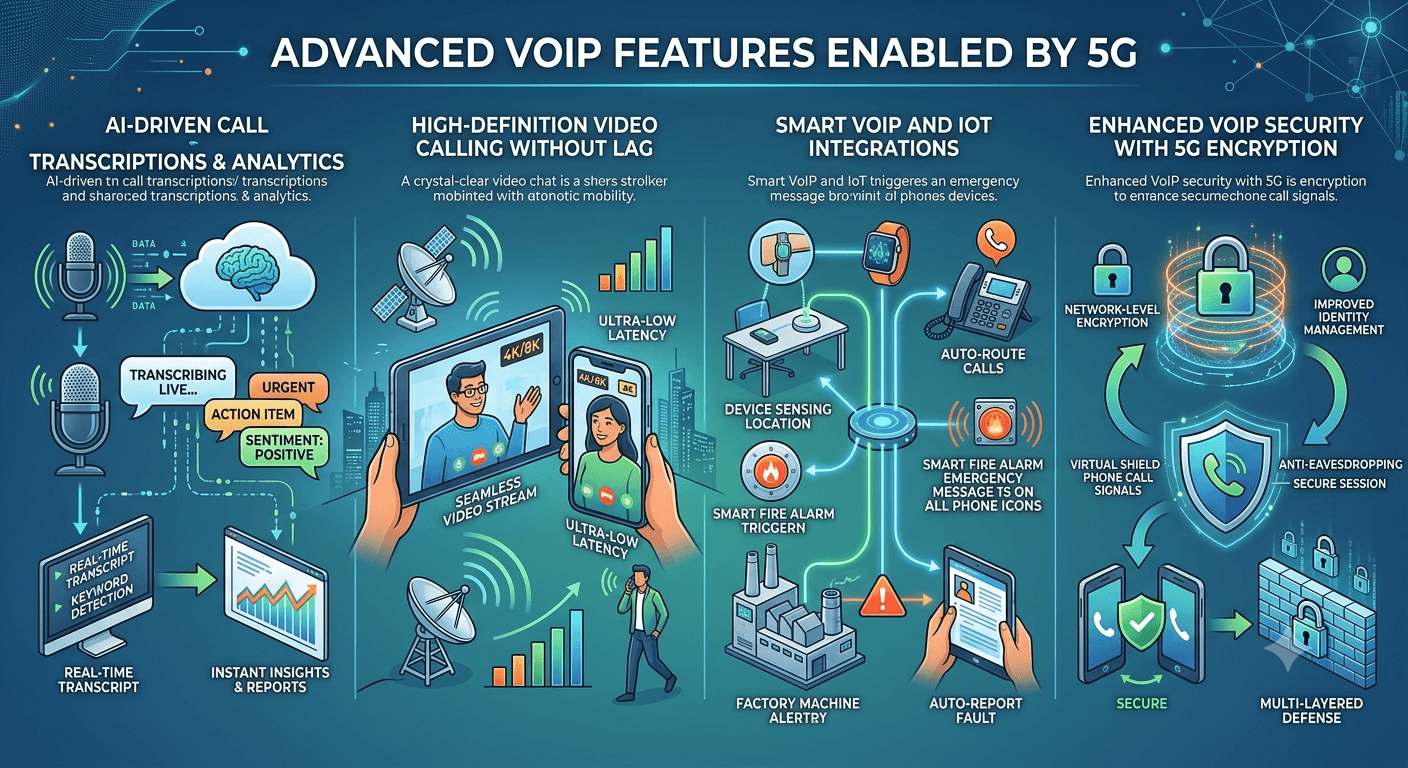
The Impact of 5G on VoIP allows for massive amounts of data to be sent to the cloud for processing in real-time. This enables AI engines to transcribe calls as they happen with incredible accuracy. These transcriptions can then be analyzed for sentiment, keyword detection, and action item extraction. Instead of a manager listening back to hours of recordings, the system can provide a summarized report of the day’s client interactions instantly.
Because 5G can handle the simultaneous upload of high-quality audio and the download of processed AI data, these features work without any lag. Employees can see a live transcript on their screen while they talk, which is invaluable for documenting technical requirements or ensuring compliance in regulated industries.
2. High-Definition Video Calling Without Lag
Video conferencing has become a staple of modern work, but it is often plagued by “freezing” or “pixelation.” The Impact of 5G on VoIP solves this by providing the necessary throughput for 4K and even 8K video streams on mobile devices. This level of clarity allows for detailed visual presentations and more personal connections through high-fidelity visual cues.
With the impact of internet bandwidth on cloud phone system stability, users can move around their environment while on a video call without fear of the connection dropping to a lower resolution. This mobility is essential for field technicians who need to show a problem to a remote expert or for real estate agents giving virtual tours of a property.
3. Smart VoIP and IoT Integrations
The massive device capacity of 5G allows for a more connected workspace where the VoIP system interacts with Internet of Things (IoT) devices. Imagine a scenario where your phone system automatically routes calls based on your physical location tracked by smart sensors, or where a fire alarm system automatically initiates an emergency VoIP broadcast to all handsets in the building.
The Impact of 5G on VoIP means that these integrations can happen instantly and reliably. In a manufacturing setting, a machine that detects a fault could trigger a VoIP call to the maintenance supervisor, providing an automated voice report of the issue. This level of automation streamlines operations and reduces response times during critical events.
4. Enhanced VoIP Security with 5G Encryption
Security is a primary concern for any business communication. The Impact of 5G on VoIP includes the adoption of more sophisticated encryption standards at the network level. 5G introduces improved identity management and additional security layers that protect against eavesdropping and “man-in-the-middle” attacks that were more prevalent on older, less secure networks.
By combining the internal security features of a cloud phone provider with the native encryption of the 5G network, businesses can achieve a multi-layered defense strategy. This is especially important as more employees work from public spaces where security risks are higher. The enhanced voip communications environment ensures that sensitive corporate data stays private and secure.
How the 5G Impact on VoIP Supports Remote Work & Mobility
The rise of the hybrid work model has made mobile connectivity more important than ever. The Impact of 5G on VoIP is the final piece of the puzzle that makes remote work indistinguishable from office work. In the past, remote workers were often limited by the quality of their home internet or the spotty coverage of 4G. 5G provides a high-speed, reliable alternative that can serve as a primary or backup connection for professional voice services.
The Ericsson Mobility Report highlights that by 2029, mobile data traffic is expected to grow by a factor of nearly three, driven largely by video and high-quality communication apps.
For mobile professionals, such as sales representatives or site inspectors, the Impact of 5G on VoIP means they can carry a full-featured office phone in their pocket. They can access the company directory, transfer calls to colleagues, and participate in multi-party conferences with the same reliability as if they were sitting at a desk. This level of mobility increases productivity and ensures that the workforce is always reachable, regardless of their physical location.
The impact of internet bandwidth on cloud phone system performance in rural areas is also significant. As 5G rolls out to more diverse locations, businesses can tap into talent pools in areas that were previously unreachable due to poor infrastructure. This democratization of high-speed connectivity is a major win for both employers and employees seeking more flexibility.
Preparing Your Business for the 5G VoIP Revolution
To fully capitalize on the Impact of 5G on VoIP, businesses must evaluate their current hardware and software ecosystem. While the network provides the speed, the devices and applications must be capable of handling it. This means upgrading to 5G-enabled smartphones and ensuring that your cloud phone service provider is optimizing their platform for 5G performance.
Businesses should also consider the following steps to ensure a smooth transition:
-
Audit current mobile device inventory to identify which hardware needs an upgrade.
-
Review service contracts with VoIP providers to ensure they support high-definition codecs.
-
Evaluate the need for network-slicing options if your business handles a high volume of critical calls.
-
Train employees on the new features enabled by 5G, such as mobile video conferencing and AI tools.
-
Assess the security protocols of your VoIP application to ensure they align with 5G standards.
-
Test the system in various locations to understand the real-world coverage for your mobile team.
The Impact of 5G on VoIP is not just a technological shift; it is a strategic opportunity. Companies that move early to adopt these 5g voip solutions will find themselves with a significant advantage in communication efficiency and client satisfaction.
Read More: Webrtc vs Sip: A Comprehensive Guide
Final Thoughts: The Future of VoIP is 5G-Enabled
The Impact of 5G on VoIP marks the beginning of a new era in business connectivity. We are moving away from the limitations of the past, where “internet calling” was sometimes synonymous with “unreliable.” Today, the combination of 5G speed and cloud flexibility creates a communication environment that is more powerful, secure, and versatile than anything we have seen before.
As businesses continue to adapt to a world that demands instant and high-quality interaction, the role of 5G will only become more central. The impact of internet bandwidth on cloud phone system capabilities will continue to drive innovation, leading to even more immersive and intelligent communication tools. Embracing this change now is the best way to ensure your business remains competitive, connected, and ready for whatever the future holds.
Frequently Asked Questions
-
How does the Impact of 5G on VoIP affect small businesses specifically?
The Impact of 5G on VoIP provides small businesses with enterprise-level communication tools without the need for expensive physical infrastructure. By using 5G-enabled cloud systems, small teams can enjoy high-definition video calls, AI-driven features, and professional reliability that was once only available to large corporations with dedicated landlines.
-
Will I need new hardware to benefit from 5g voip?
Yes, to take advantage of the Impact of 5G on VoIP, you will need devices that contain 5G-compatible modems, such as modern smartphones or 5G routers. While your existing VoIP software will still work on older networks, the benefits of ultra-low latency and higher bandwidth require a connection to a 5G network through compatible hardware.
-
What is the impact of internet bandwidth on cloud phone system audio?
The impact of internet bandwidth on cloud phone system audio is direct; higher bandwidth allows the system to use “lossless” or “high-definition” audio codecs. This means more data is used to represent the sound of your voice, resulting in a much clearer, more natural tone that eliminates the muffled sound often associated with older digital calling technologies.
-
Does 5G eliminate the need for office Wi-Fi for VoIP calls?
While 5G provides incredible speeds that can replace Wi-Fi in many scenarios, the Impact of 5G on VoIP is often seen in a hybrid approach. 5G is excellent for mobility and as a backup, but many offices will still use Wi-Fi 6 or 7 for internal networking. However, 5G offers a reliable alternative for employees who find office Wi-Fi congested or for those working remotely.
-
How does enhanced voip communications improve remote team collaboration?
Enhanced voip communications through 5G allow remote teams to use data-heavy tools like real-time screen sharing and multi-party HD video without lag. This creates a more cohesive environment where remote workers feel just as connected to the team as those in the office, leading to better project management and fewer communication errors.
-
Is 5G VoIP more secure than using 4G or public Wi-Fi?
Generally, yes. The Impact of 5G on VoIP includes the use of more advanced encryption and authentication protocols at the network layer. This makes 5G a more secure option for business calls than public Wi-Fi, which is often unencrypted and vulnerable to hackers looking to intercept sensitive corporate conversations.
-
Will 5G help with dropped calls in moving vehicles?
Yes, one of the major technical improvements of 5G is its ability to handle handovers between cell towers more efficiently at high speeds. The Impact of 5G on VoIP means that if you are on a call while traveling on a train or in a car, the network can maintain a stable connection much more effectively than 4G, significantly reducing the frequency of dropped calls.
-
Can 5G support more VoIP users in a single location?
The Impact of 5G on VoIP includes a massive increase in device density support. While 4G networks can struggle in crowded areas, 5G is built to support up to a million devices per square kilometer. This means that in a large office building or a convention center, every user can maintain a high-quality VoIP connection simultaneously without slowing down the network.