
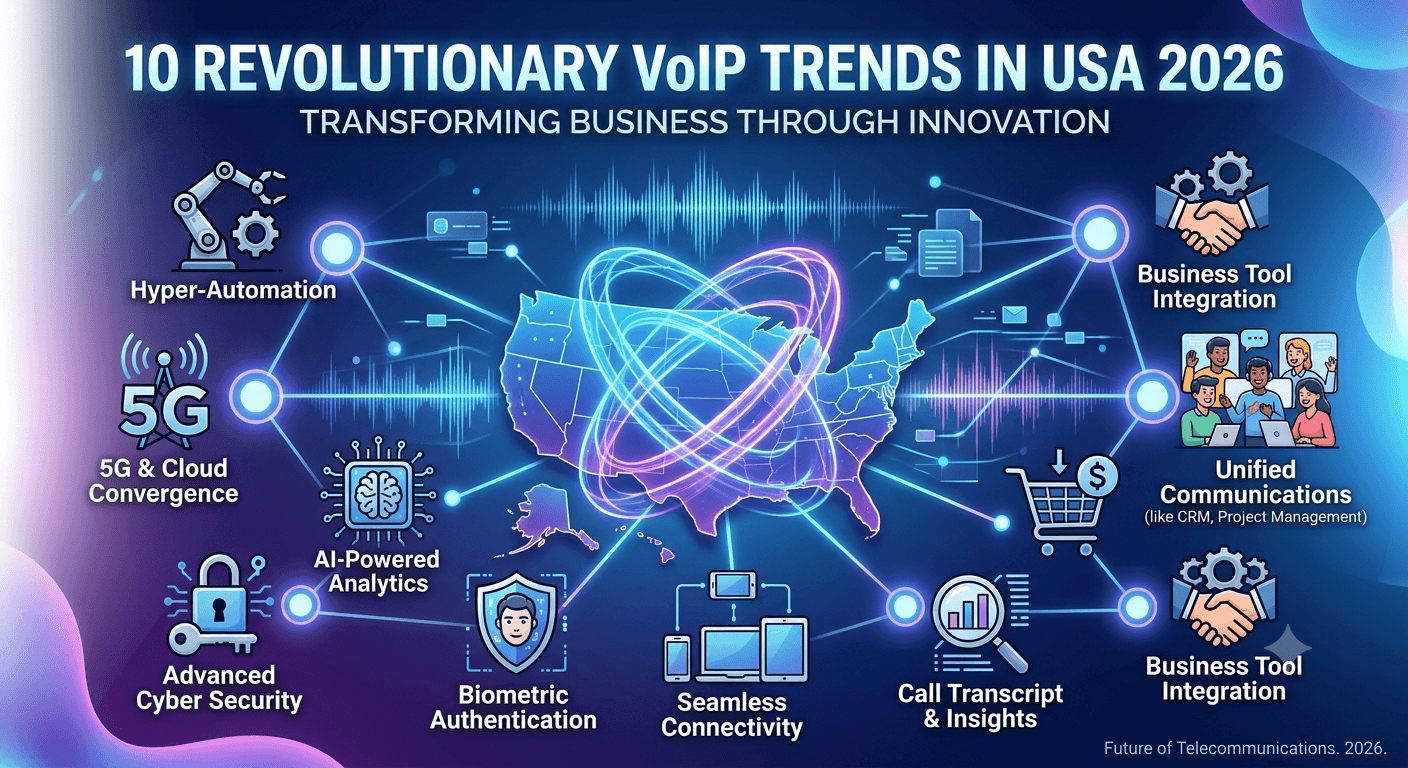
VoIP trends in USA 2026 indicate a massive shift toward hyper-automation and seamless connectivity across the corporate landscape. As the future of voip industry evolves, businesses are moving away from traditional hardware toward cloud-native ecosystems that prioritize artificial intelligence and 5G integration. By 2026, the adoption of Voice over Internet Protocol will no longer be an option but a necessity for survival in the global market. These developments focus on enhancing audio quality, securing data transmissions, and providing unified communication platforms that allow teams to collaborate from any location with unprecedented efficiency and reduced operational overhead.
What are VoIP Services USA?
VoIP services in the United States refer to the technology that allows users to make voice calls using a broadband internet connection instead of a regular analog phone line. This technology converts voice signals into digital data packets that travel over the internet. In the current landscape, voip the future of telecommunications is becoming evident as more domestic companies retire their copper-wire landlines in favor of digital infrastructure.
These services offer a variety of communication methods including voice calls, video conferencing, and text messaging through a single application. As we look at voip trends, the focus has shifted toward high-definition audio and low-latency connections. This digital transformation allows businesses to maintain a professional presence without being tethered to a physical office location.
Why are VoIP Services USA Important?
The importance of these services stems from the need for agility in a fast-paced economic environment. As organizations seek more robust ways to stay connected, the future of voip becomes the backbone of modern operations. Modern systems offer reliability that matches or exceeds traditional telephony while providing a suite of digital tools that physical hardware cannot replicate.
1. Reduced communication costs
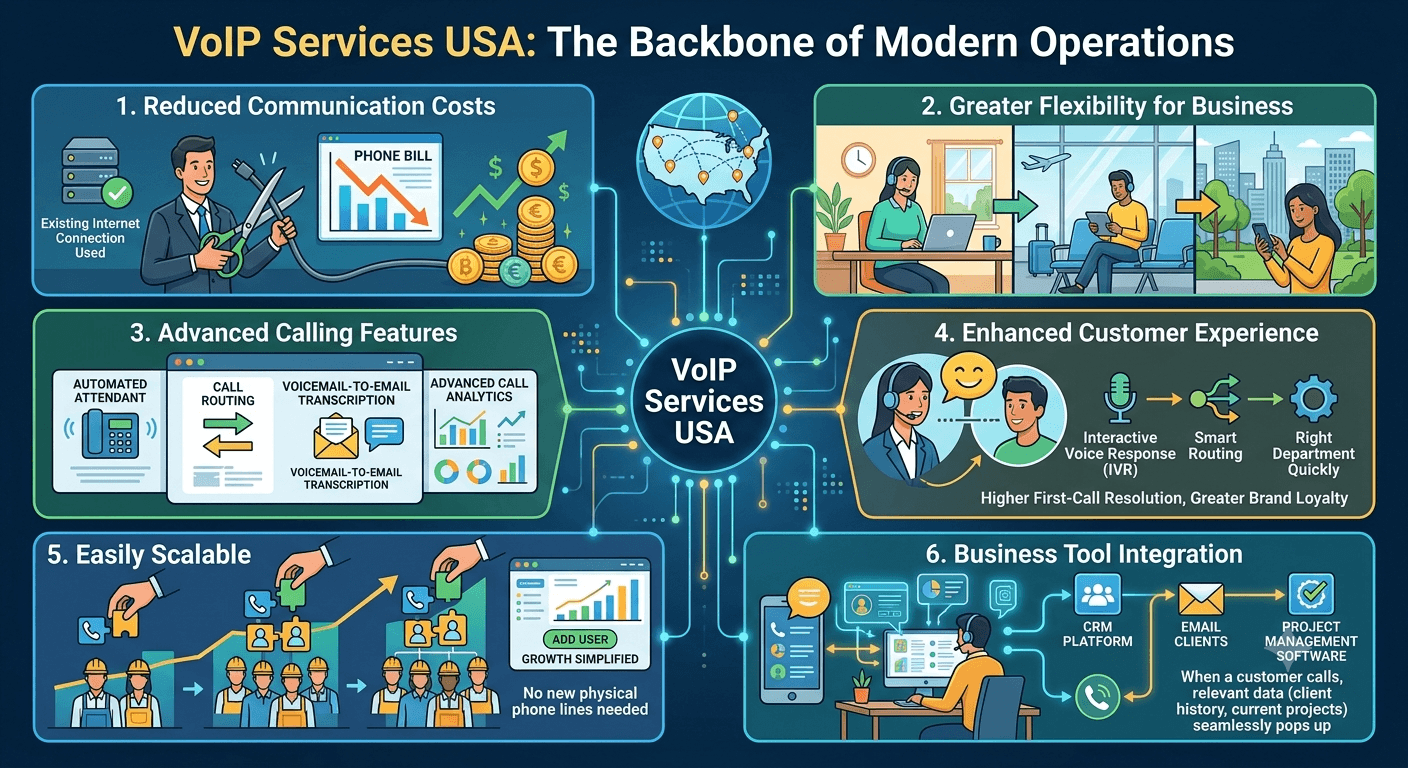
Lowering expenses is a primary driver for many companies switching to digital telephony. By utilizing an existing internet connection, businesses eliminate the need for separate phone bills and expensive maintenance for physical PBX systems. This is particularly beneficial for companies with high volumes of long-distance or international calls, as digital rates are significantly lower.
2. Greater flexibility for business
Flexibility is a cornerstone of the modern workplace. Employees can access their business phone lines from laptops, tablets, or smartphones regardless of their geographical location. This mobility ensures that the team remains reachable and productive, whether they are working from home, traveling, or in the office.
3. Advanced calling features
Standard features in modern systems go far beyond simple dial tones. Users benefit from automated attendants, call routing, voicemail-to-email transcription, and advanced call analytics. These features allow businesses to manage their communication flow more effectively and gain insights into team performance and customer interaction patterns.
4. Enhanced customer experience
Customer satisfaction is greatly improved through more efficient call handling. Features like interactive voice response and smart routing ensure that callers are directed to the right department quickly. According to recent voip statistics, businesses using integrated communication platforms report a significant increase in first-call resolution rates, which directly impacts brand loyalty.
5. Easily scalable
Growth is simplified when you do not have to install new physical lines for every new hire. Adding a user to a digital system is often as simple as updating a dashboard setting. This scalability allows businesses to expand or contract their communication capacity based on seasonal demands or rapid growth phases without capital-heavy investments.
6. Business Tool Integration
Modern communication systems do not exist in a vacuum. They integrate seamlessly with CRM platforms, email clients, and project management software. This integration ensures that when a client calls, the employee can see their entire history and current projects on the screen, leading to a more personalized and informed conversation.
How Do USA VoIP Services Work?
Understanding the technical process helps businesses appreciate the reliability of the system. The transition from voice to data and back again happens in milliseconds, ensuring that there is no perceptible lag for either party on the call.
1. Voice Conversion
When a user speaks into a handset or microphone, the analog sound waves are captured by the device. The system immediately uses a codec to convert these analog signals into digital data. This process ensures that the nuance of the human voice is preserved while being prepared for transmission over the internet.
2. Transfer Data
Once the voice is digitized, it is broken down into small units called packets. These packets are labeled with destination information and sent over the internet using the Internet Protocol. They may take different paths across the web to reach the destination as quickly as possible, bypassing network congestion points.
3. Dealing with Calls
A central server or a cloud-based PBX manages the routing of these packets. It determines where the call needs to go, whether it is another digital user or a traditional landline. During this phase, features like call waiting, forwarding, and caller ID are applied to the data stream based on the user’s configuration.
4. Voice-to-Data Conversion
At the receiving end, the digital packets are reassembled in the correct order. The system then converts this digital data back into analog sound waves that the receiver can hear through their speaker or headset. This conversion must be incredibly fast to avoid jitter or delays during the conversation.
5. End of the Call
Once the conversation concludes and one party hangs up, the session is terminated. The system then logs the call data for analytics and billing purposes. This data includes duration, time of call, and quality metrics, which are essential for future voip industry news reports and internal business audits.
Advantages of USA VoIP Services
The move toward digital communication offers a competitive edge in several key areas. Businesses that adopt these technologies early find themselves better positioned to handle the challenges of a globalized economy.
1. Savings
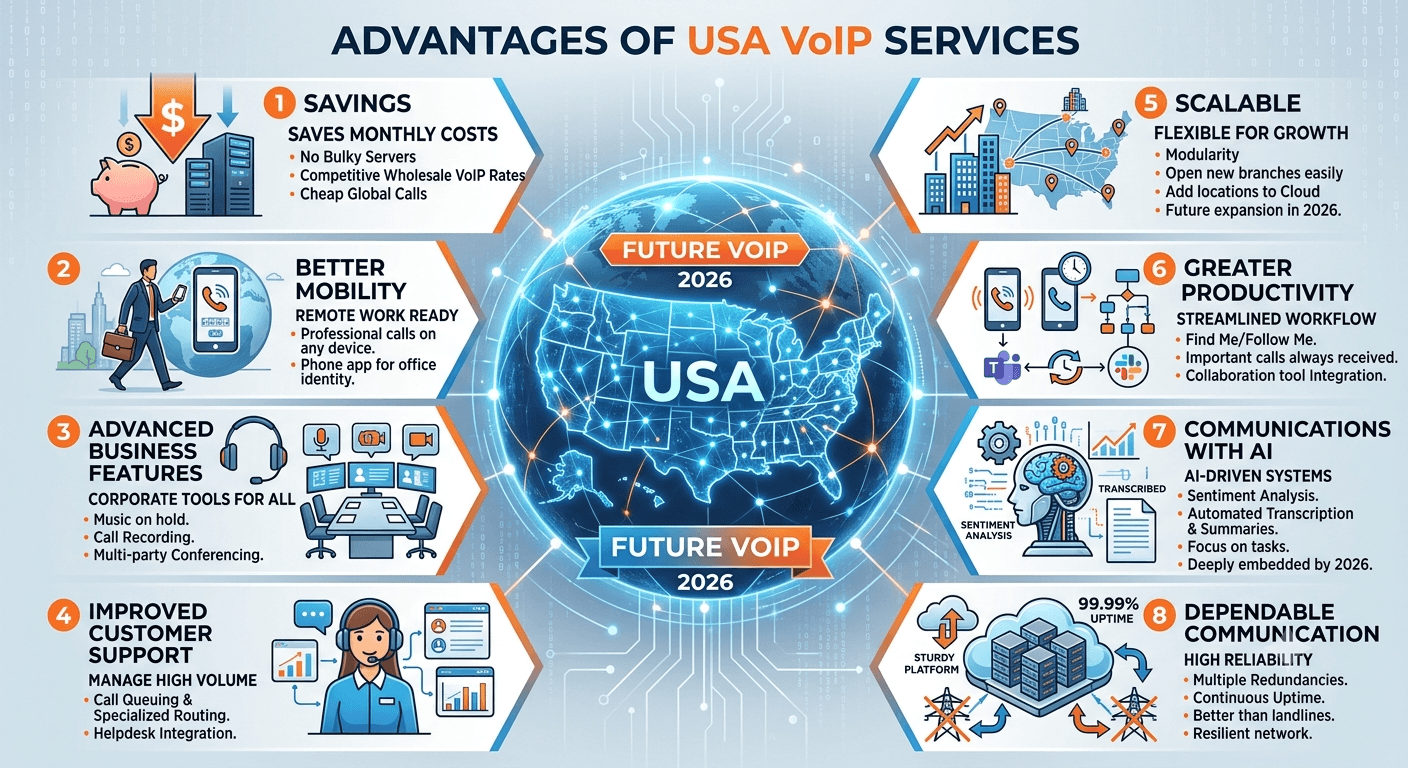
The most immediate advantage is the reduction in monthly recurring costs. Beyond the monthly subscription, businesses save on infrastructure, as there is no need to purchase or house bulky servers. Furthermore, wholesale voip termination rates have become extremely competitive, allowing for cheap global connectivity.
2. Better Mobility
In the era of remote work, mobility is a top priority. Employees are no longer tied to their desks to answer professional calls. A mobile app can turn any smartphone into an extension of the office phone system, maintaining a professional identity even when the worker is on the move.
3. Advanced Business Features
Businesses gain access to tools that were previously only available to large corporations with massive budgets. Features like music on hold, call recording for training, and multi-party conferencing are standard. These tools enhance the professional image of even the smallest startup.
4. Improved Customer Support
Support teams can use these systems to manage high volumes of inquiries more effectively. With call queuing and specialized routing, customers are never left waiting on a dead line. Integration with helpdesk software allows support agents to track every interaction across multiple channels within a single interface.
5. Scalable
The future voip landscape focuses on modularity. If a business opens a new branch in another state, they do not need to install a new hardware system. They simply add the new location to their existing cloud account. This flexibility is essential for businesses planning for long-term expansion in 2026.
6. Greater productivity
Productivity increases when communication is streamlined. With features like “Find Me/Follow Me,” calls can ring on multiple devices sequentially, ensuring important calls are never missed. Integration with collaboration tools like Microsoft Teams or Slack further enhances the workflow by keeping all communication in one place.
7. Communications with AI
By 2026, AI will be deeply embedded in communication systems. AI-driven sentiment analysis can tell a manager if a customer is becoming frustrated during a call. Automated transcription and summary tools save hours of manual note-taking, allowing employees to focus on solving problems rather than administrative tasks.
8. Dependable Communication
Modern cloud infrastructure is built with multiple redundancies. If one server goes down, the traffic is instantly rerouted to another, ensuring 99.99% uptime. This level of reliability is often superior to local landline connections which can be taken down by physical damage to cables or local power outages.
VoIP Services for Small Business in the USA
Small businesses find unique value in digital communication because it levels the playing field. In 2026, a small company can sound like a major corporation through the use of professional auto-attendants and sophisticated call routing. The low entry cost makes it possible for startups to have a full-featured phone system from day one.
Benefits of voip for businesses 2026 include the ability to hire talent from anywhere in the country without worrying about local phone infrastructure. A small business based in New York can have a team member in Texas using a local New York number. This creates a cohesive brand identity and allows for a more flexible hiring strategy that is not limited by geography.
How to Choose the Best VoIP Provider in the USA?
Selecting the right partner is crucial for long-term success. The market is saturated with options, making it necessary to evaluate providers based on specific criteria that align with business goals.
Check for a proven track record of uptime and reliability in the United States.
Evaluate the security protocols used, such as end-to-end encryption and compliance with industry standards.
Ensure the provider offers 24/7 customer support via multiple channels like phone, chat, and email.
Look for a transparent pricing model that does not have hidden fees for essential features.
Verify the ease of integration with your existing software stack, such as Salesforce or HubSpot.
Test the user interface to ensure it is intuitive for both administrators and end-users.
Quality of service is also a major factor. A good provider should offer tools to monitor your network performance and suggest optimizations. Since the voice quality depends on your internet connection, the provider should be able to help you configure your router for priority voice traffic.
VoIP Services USA Outlook to 2026
The outlook for the next few years is dominated by the convergence of 5G and cloud communication. As 5G networks become the standard across the USA, the limitations of mobile data will vanish, leading to crystal-clear video and audio calls even on the move.
Research by Gartner suggests that by 2026, over 75% of business conversations will be recorded and analyzed for insights, up from less than 20% in 2022.
Furthermore, voip trends suggest that security will become the top priority. As cyber threats evolve, providers are implementing biometric authentication and advanced threat detection to protect voice data. We will also see a rise in the use of WebRTC, allowing users to make calls directly from their browsers without any specialized software. The industry is also seeing a shift in wholesale voip termination rates, which are stabilizing as the market matures and efficiency increases.
The future of voip industry news will likely focus on how these systems integrate with the Internet of Things. Imagine a scenario where your office security system or smart lights can be controlled via your phone system during an emergency call. This interconnectedness will define the telecommunications landscape as we approach 2026.
Read More: VoIP for Nonprofits: Low-Cost Communication
Conclusion
The evolution of communication is moving at an incredible pace, and VoIP trends in USA 2026 highlight a future where boundaries between different communication forms disappear. For businesses, this means lower costs, higher productivity, and a more professional presence. By embracing these changes, companies can ensure they are ready for the demands of a digital-first economy. The shift toward cloud-based systems is not just a trend but a fundamental change in how the world stays connected.
Final thoughts on the matter suggest that the transition to digital telephony is inevitable for those who wish to remain competitive. The integration of AI, the expansion of 5G, and the focus on user experience are creating a robust environment for innovation. Whether you are a small startup or a large enterprise, the benefits of making the switch are clear. The reliability and feature set of modern systems provide a foundation for growth that traditional systems simply cannot match. As we look toward the future, the voice will remain the most powerful tool for human connection, and digital technology is the best way to carry it.
FAQs
What are VoIP services in the US?
VoIP services in the US are communication technologies that allow you to make voice calls, host video meetings, and send messages over the internet. Instead of using traditional telephone lines, these services turn your voice into digital data packets that are sent through your broadband connection to the receiver. This allows for more features and lower costs compared to old-fashioned phone systems.
Are VoIP services useful for business?
Yes, these services are incredibly useful for businesses because they offer advanced features like auto-attendants, call recording, and CRM integration that help improve efficiency. They also support remote work by allowing employees to use their business numbers on any device, which helps maintain a professional image and ensures that no client calls are missed regardless of where the team is working.
What equipment do I need for VoIP?
You primarily need a reliable high-speed internet connection and a device to make calls, such as a computer, a smartphone, or a specialized desk phone. If you want to use your existing analog phones, you can use an Analog Telephone Adapter to connect them to your internet network. Most modern businesses prefer using headsets with their computers or mobile apps for the best experience.
Is VoIP less expensive than traditional phone systems?
In almost every case, digital systems are significantly less expensive because they eliminate the need for dedicated phone lines and expensive on-site hardware. Businesses typically save on long-distance and international call rates, and the monthly subscription costs are generally lower than traditional landline services. Additionally, maintenance and setup costs are minimal since everything is managed in the cloud.
Will VoIP help distant workers?
Digital communication is the perfect solution for remote and distant workers because it provides them with full access to the office phone system from anywhere in the world. As long as they have an internet connection, they can receive calls, join conferences, and access company directories as if they were sitting at a desk in the main office. This makes managing a distributed team much simpler and more effective.
What is the future of the VoIP industry?
The future is centered on AI integration, 5G connectivity, and unified communications. We expect to see more automated services, better voice quality on mobile networks, and systems that can automatically transcribe and analyze every call for business intelligence. The industry is moving toward a total communication platform where voice, video, and data are perfectly synchronized.
How secure are modern VoIP systems?
Modern systems are very secure, utilizing advanced encryption protocols like SRTP and TLS to protect data as it travels across the internet. Providers also use multi-factor authentication and regular security audits to prevent unauthorized access. For businesses in sensitive sectors like healthcare or finance, many providers offer specialized compliance features to meet strict legal requirements.
Can I keep my current phone number?
Yes, the process called local number portability allows you to move your existing business phone numbers from your current carrier to a new digital provider. This ensures that you do not lose your established brand identity or require your customers to learn a new number. Most providers handle this transition for you during the setup process to ensure there is no downtime for your business.
What happens if the internet goes down?
While the system requires internet to make calls, most providers have built-in failover features. You can set the system to automatically route incoming calls to a mobile phone or another office location if your primary internet connection fails. This ensures that your business remains reachable even during local service interruptions, providing a level of continuity that traditional phones often lack.