
Spy Dialer is a popular web-based tool designed to help users identify the owners of mysterious phone numbers, email addresses, and physical locations. By tapping into billions of public records and using unique audio-capture technology, it allows individuals to hear a caller’s voicemail greeting without the person knowing they were searched. This platform is frequently used by people trying to avoid telemarketers or verify the identity of a missed call before responding. Because it offers a free entry point for reverse lookup services, it has become a go-to resource for those who want quick information without committing to a paid subscription or account creation.
When you land on the homepage of this platform, the first thing you see is a search bar. This interface is the gateway to identifying unknown callers. You can toggle between searching for digits, names, or addresses. The system is built to handle thousands of requests per hour, making it a robust engine for those in need of immediate digital identification.
The results page usually displays the name of the owner, the geographic location associated with the area code, and the type of line, such as landline or mobile. This initial search is the most critical step for anyone trying to determine if a call is worth their time or if it should be permanently ignored.
What is Spy Dialer?
Spy Dialer is a digital investigative tool that functions as a reverse phone book for the modern era. Unlike traditional directories that require you to have a name to find a number, this platform works in the opposite direction. It collects data from social media, public records, and commercial databases to create a comprehensive map of who owns which digits.
The service is primarily web-based, which means you do not need to download an application to your smartphone to use it. This makes it a discreet choice for people who want to look up a number on a shared device. It was created to bridge the gap between expensive private investigator tools and the common person’s need for basic caller identification.
The platform prides itself on being a “no-cost” option in an industry filled with paywalls. While many sites claim to be free only to ask for a credit card at the end, this service provides a significant amount of data without a mandatory payment. It has carved out a niche as a reliable first stop for verifying callers from all over the United States.
How does it work?
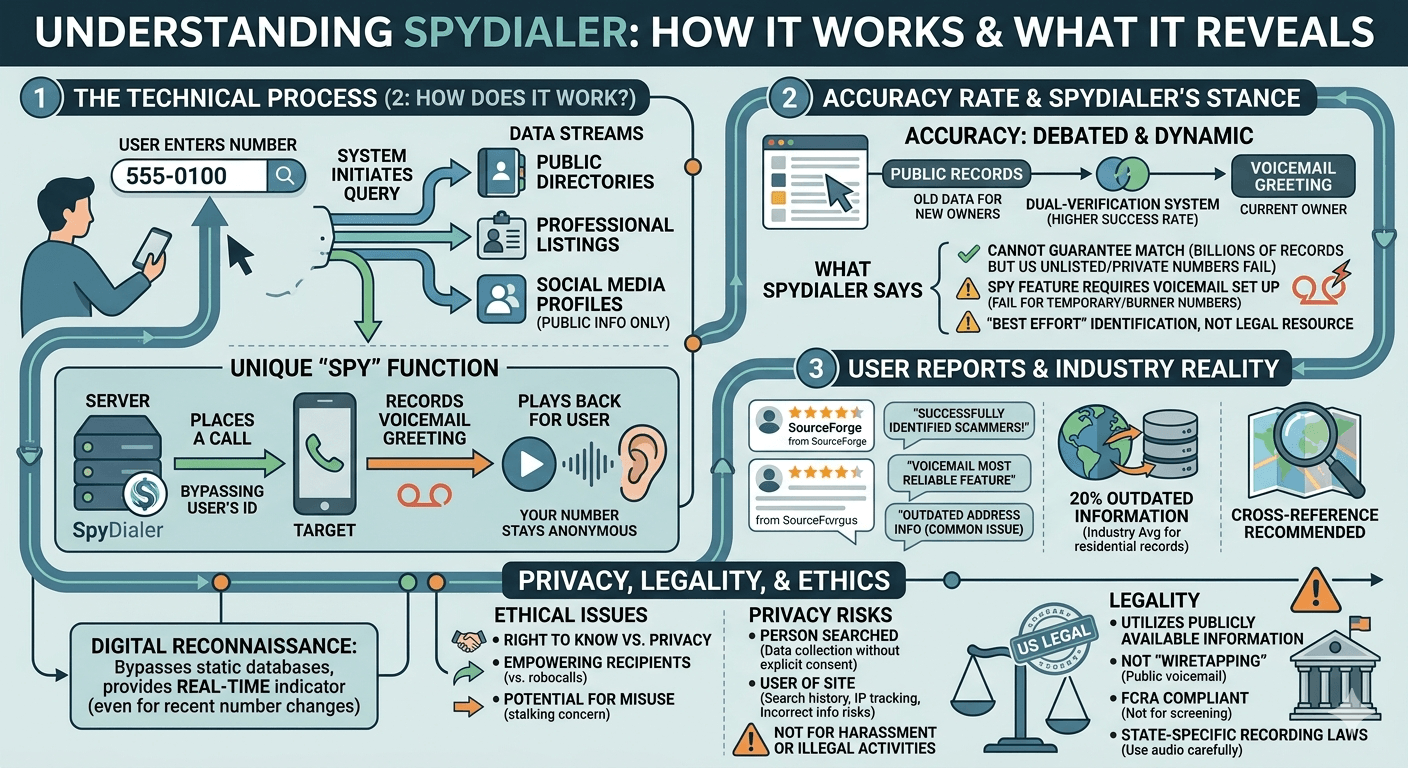
The technical process behind the scenes is quite sophisticated. When you enter a number into the search bar, the system initiates a query across multiple data streams. It looks for mentions of that number in public directories, professional listings, and even social media profiles where users have made their contact information public.
One of its most unique features is the “Spy” function. When this is activated, the system calls the number in question using its own servers. It records the outgoing voicemail greeting and plays it back for you. This allows you to hear the person’s voice or business name without your own number ever appearing on their caller ID or call logs.
This method bypasses the need for traditional database updates. Even if the owner of a number has recently changed, the voicemail greeting is a real-time indicator of who is currently using the line. It is a form of digital reconnaissance that provides a layer of certainty that static records often lack.
-
Accuracy rate
Accuracy is the most debated aspect of any reverse lookup tool. Because phone numbers are recycled every few months, keeping a database 100% accurate is an impossible task. However, the combination of data scraping and audio recording gives this platform a unique edge in the market compared to competitors. The accuracy often depends on how long the person has owned the number. If a number was recently purchased, the public records might still point to the previous owner, while the voicemail feature will likely reveal the new one. This dual-verification system is what helps maintain a higher success rate for active users.
The platform is quite transparent about its limitations. They state that while they have access to billions of records, they cannot guarantee a match for every single search. They emphasize that unlisted numbers or those protected by strict privacy settings may not yield a name or address. They also mention that their “Spy” feature depends on the recipient having a functioning voicemail box. If the person has not set up their voicemail or if the line is a temporary burner number, the audio capture will fail. They position themselves as a tool for “best effort” identification rather than a definitive legal resource.
Independent user reviews, such as those found on SourceForge, suggest a mixed but generally positive experience. Many users report that the tool successfully identified scammers and local businesses that were calling them incessantly. The voicemail feature is frequently cited as the most reliable part of the service. However, some users have noted that the address information can sometimes be outdated. This is a common issue across the industry, as people move frequently without updating public directories.
According to a study on telecommunications data, nearly 20% of residential phone records contain some form of outdated information. Users are encouraged to cross-reference the data found here with other sources.
-
Privacy risks, legality concerns, and ethical issues
Using a tool that “spies” on a voicemail naturally raises questions about ethics and privacy. While the tool is designed for convenience, it touches on sensitive areas of digital communication. It is important for users to understand that while they are gaining information, they are also participating in a system that aggregates personal data. The ethical debate often centers on whether someone has a right to know who is calling them versus the caller’s right to privacy. In the age of massive robocall campaigns, the consensus has shifted toward empowering the recipient. However, the potential for misuse in personal disputes or stalking situations remains a concern for privacy advocates.
The primary privacy risk is for the person being searched. If their information is in the database, it means their data has been collected from various sources without their explicit consent for this specific use. For the user of the site, there is the risk of their search history being logged or their IP address being tracked by the platform. There is also the risk that the information provided is incorrect, which could lead to a user confronting the wrong person. Privacy experts recommend that users of these tools should be cautious about how they use the results. Information obtained through a free reverse lookup should not be used for harassment or illegal activities.
In most jurisdictions within the United States, reverse phone lookup services are legal as they utilize publicly available information. Accessing a voicemail that is intended for the public to hear is generally not considered “wiretapping” because no private conversation is being intercepted. The service operates within the boundaries of the Fair Credit Reporting Act (FCRA) by stating that its data cannot be used for employment or housing screening. However, users must be aware of state-specific laws regarding recording. While the service does the recording for you, using that audio for malicious purposes could land a user in legal trouble. As long as the tool is used for personal identification and to avoid spam, it remains a legal and helpful resource for the general public.
Positives and Negatives of Spy Dialer
Every digital tool has its strengths and weaknesses. Spy Dialer is no exception. Its popularity stems from its accessibility, but its limitations are apparent to those who use it for professional or high-stakes investigations. Understanding both sides of the coin helps users set realistic expectations when they hit the search button.
On the positive side, the speed of the service is unmatched. You can get a name and hear a voicemail in under sixty seconds. On the negative side, the reliance on public data means that some results will inevitably be missing or incorrect. Here is a more detailed breakdown of what to expect.
-
The interface is incredibly user-friendly and requires no technical expertise.
-
You do not have to create an account or provide an email to see basic results.
-
The voicemail playback feature provides a layer of proof that text-based data cannot match.
-
It covers landlines, mobile phones, and even some VoIP numbers.
-
The service is completely free for a standard number of daily searches.
-
The data is pulled from a vast array of sources, increasing the chances of a match.
One of the most recurring complaints is the presence of advertisements on the site. Since the service is free, they rely on ad revenue to keep the servers running. These ads can sometimes be intrusive or lead to other sites that look like lookup tools but require payment. Another common negative pattern is the “no result” return. For very new numbers or those that are strictly unlisted, the platform often comes up empty. This can be frustrating for users who are being harassed by a sophisticated caller using ghost numbers. Some users also find the audio quality of the voicemail recordings to be low depending on the connection.
Is SpyDialer legitimate or misleading?
The legitimacy of this platform is often questioned because of its name. The word “spy” can imply something nefarious, but in reality, the service is a standard data aggregator. It is legitimate in the sense that it provides the service it promises: a way to look up information and hear voicemails for free. It is not misleading as long as the user understands what they are getting. It does not provide private text messages or GPS locations. It only provides what is legally accessible in the public domain. When compared to “scam” sites that promise the world and deliver nothing, this platform stands out as a functional and honest tool for the average consumer.
What are common problems of users of Spy Dialer?
One of the most frequent issues users face is a mismatch between the search result and the actual caller. This happens because the database might not have updated to show a recently transferred number. Another problem is the frequency of “busy” signals when trying to use the voicemail feature, which occurs if the platform’s servers are overloaded with requests.
Users also struggle with geographic confusion. A number might show up as being from a specific city, but the caller is actually thousands of miles away using a spoofed number. This is a limitation of the phone system itself rather than the tool. Finally, some users find it difficult to remove their own information from the site, which can be a point of frustration for privacy-conscious individuals.
Best FREE Spy Dialer alternatives
If you find that this specific tool isn’t meeting your needs, there are several other free options available. Each of these alternatives has a slightly different database or set of features. It is often a good idea to check a number across multiple platforms to ensure the data you are getting is consistent and accurate.
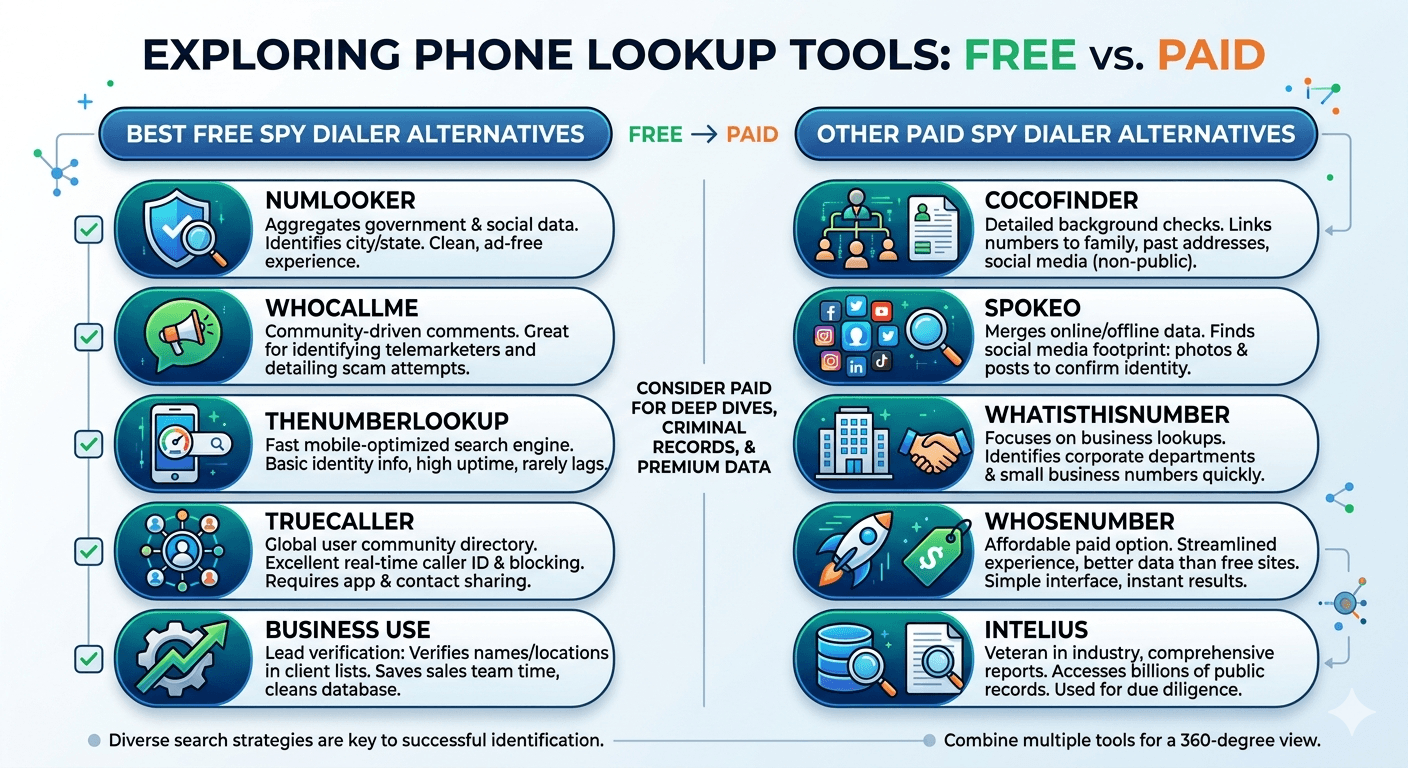
Using a combination of these tools can provide a 360-degree view of an unknown caller. While one might have a better name database, another might be superior at flagging spam or identifying the specific mobile carrier. Diversity in your search strategy is the key to successful identification.
1. NumLooker
NumLooker is a highly rated alternative that focuses on providing a clean, ad-free experience. It aggregates data from government records and social media to provide a comprehensive report on the caller. It is particularly good at identifying the city and state of the caller, which helps in filtering out international spam.
2. WhoCallMe
WhoCallMe is a community-driven site where users leave comments about specific numbers. This is incredibly helpful for identifying telemarketers. If a number has called hundreds of people, you will see a list of complaints detailing exactly what the caller was trying to sell or scam.
3. TheNumberLookup
TheNumberLookup offers a very fast search engine that is optimized for mobile browsers. It is a great choice if you are on the go and need to check a number quickly before answering. It provides basic identity information and is known for having a very high uptime, rarely suffering from server lag.
4. TrueCaller
TrueCaller is perhaps the most famous alternative, functioning as a global community of users who share their contact lists. This creates a massive, live directory. It is excellent for real-time caller ID and blocking, though it does require you to download an app and share your own contact list to get the full benefits.
Other PAID Spy Dialer alternatives
If you are a professional or someone who needs a deep dive into a person’s background, paid services are the way to go. These platforms pay for access to “premium” data that free sites cannot afford. This includes things like criminal records, property ownership, and even deep-web mentions of a phone number. Paid services also tend to have better customer support and higher security standards. If you are using these tools for legal or business purposes, the small investment is often worth the peace of mind and the depth of the report you receive.
1. CocoFinder
CocoFinder is a premium service that provides one of the most detailed background checks in the industry. Beyond just a name, it can link a phone number to family members, past addresses, and even social media accounts that aren’t publicly listed. It is a powerful tool for those who need more than just a surface-level identification.
2. Spokeo
Spokeo is a well-known name in the world of people search. It uses a proprietary algorithm to merge data from online and offline sources. It is particularly useful for finding the social media footprint of a caller, allowing you to see their photos and posts to confirm their identity.
3. WhatIsThisNumber
WhatIsThisNumber focuses heavily on the business side of phone lookups. It is excellent at identifying if a number belongs to a specific corporate department or a small business. Their reports are concise and designed for professionals who need to verify business contacts quickly.
4. WhoseNumber
WhoseNumber provides a streamlined paid experience that is very affordable. It is a middle-ground option for those who want better data than a free site but don’t want to pay for a full-scale background check. Their interface is simple, and they provide results almost instantly.
5. Intelius
Intelius is a veteran in the industry, offering some of the most comprehensive reports available. They have access to billions of public records and are often used by professionals for due diligence. If a number is out there, Intelius will likely find it, along with a wealth of supporting biographical data.
Reverse number lookup apps for your mobile phone
For many, a web-based search is not enough. Having an app that identifies callers in real-time as the phone rings is the ultimate convenience. Mobile apps integrate directly with your phone’s operating system, allowing them to provide instant alerts and automatic blocking of known scam numbers. These apps are essential in the modern era where “neighbor spoofing” makes every call look like it is coming from your own town. By using a database of millions of flagged numbers, these apps can warn you before you even pick up the handset.
1. Real Caller: Caller ID
Real Caller provides a robust identification service that works globally. It is particularly popular for its ability to identify international numbers, which are often the source of sophisticated scams. The app is lightweight and does not drain your battery like some of the more complex alternatives.
2. Reverse Lookup: Free Phone Number Lookup
This app is a straightforward tool that does exactly what it says. It provides a simple search interface for looking up numbers in your call log. It is a great choice for people who want a dedicated app without the social networking features of something like Truecaller.
3. Truecaller: Caller ID & Block
As mentioned, Truecaller is the gold standard for mobile caller ID. It not only identifies callers but also has a powerful “spam blocking” feature that automatically silences calls from known telemarketers. It is a comprehensive communication suite that replaces your standard dialer app.
4. Hiya: Spam Blocker & Caller ID
Hiya is known for its clean interface and high-quality data. It is a preferred choice for many because it does not have as many ads as its competitors. It provides a “reputation” score for every caller, helping you decide at a glance if you should answer or ignore the incoming call.
Is it legal to use reverse phone number lookup?
Yes, it is entirely legal to use these services for personal information. Most of the data provided by these platforms is part of the public record, which anyone can access if they have the time to look. These services simply automate the process of searching through thousands of databases on your behalf. However, there are legal restrictions on how you use that information. For example, you cannot use a reverse lookup to screen potential employees or tenants under the Fair Credit Reporting Act. You also cannot use the information to stalk or harass someone. As long as your intent is to identify a caller or verify a business, you are within your legal rights.
Enhance your call center operations
For businesses that run call centers, reverse lookup technology is a game-changer. It allows agents to see the name and history of a caller before they even answer the phone. This results in more personalized service and faster resolution times. When a customer feels recognized, their satisfaction with the company increases significantly.
Integrating these tools into your CRM (Customer Relationship Management) system can also help in identifying fraudulent leads. By automatically verifying the name and location of every incoming call, you can ensure that your team is spending their time on legitimate prospects rather than automated bots or fake inquiries.
Read More: Does Star 67 Still Work For Private Calls in 2026? A Complete Guide
Final Thought
Spy Dialer remains a unique and valuable tool in the landscape of digital identification. Its combination of public data scraping and the innovative voicemail capture feature provides a level of service that is hard to find for free elsewhere. While it has its limitations in terms of data freshness and ad presence, it serves as an excellent first line of defense against the rising tide of unknown callers and spam. By using it wisely and cross-referencing its findings with other platforms, you can navigate the digital world with much greater confidence and security.
Frequently asked questions
-
How does Spy Dialer work?
Spy Dialer works by aggregating public records and using a specialized server to call a number and record its voicemail greeting. This process allows the system to gather both digital data and audio verification of a caller’s identity without alerting the person being searched. The tool essentially acts as a bridge between various public databases and your search query.
-
How do you use Spy Dialer?
You use the tool by visiting the website, selecting the search type (phone, name, address), and entering the digits into the search bar. Once you click search, the system will process the request and display any available names, locations, and line types. You can then choose to listen to the voicemail greeting for further confirmation.
-
How do you remove yourself from Spy Dialer?
To remove your information, you must visit the privacy or “Opt-Out” section of the website and submit a formal request. The platform is required by various privacy laws to allow individuals to hide their data from public searches. Once the request is processed, your name and address will no longer appear in their search results.
-
Is there a completely free reverse phone lookup?
Yes, Spy Dialer is one of the few services that offers a functional reverse lookup without requiring a paid subscription. While it may have advertisements and daily limits, it provides actual names and locations at no cost. Other sites often promise a free search but hide the results behind a paywall.
-
How can I find the best reverse number lookup service?
The best way to find a reliable service is to read user reviews on independent platforms and test the service with numbers you already know. A high-quality service should provide consistent results and be transparent about where its data comes from. Look for services that have a high rating for accuracy and data privacy.
-
Are reverse number lookup services accurate?
Most services have an accuracy rate between 60% and 80% because phone data changes so frequently. While they are generally reliable for established landlines, they may struggle with mobile numbers that have recently been reassigned. Using multiple tools is the best way to ensure the information you receive is correct.
-
How do I find a number on Spy Dialer?
Simply enter the full ten-digit phone number into the search bar on the homepage and hit enter. The system will immediately begin scanning its database for matches. If a match is found, you will be taken to a report page containing all the public information associated with those digits.
-
Is it safe to check who called me?
Yes, it is perfectly safe to use a reverse lookup tool to identify a caller. Searching for a number does not notify the owner, and it protects you from interacting with potential scammers. It is a proactive step in maintaining your digital security and privacy.
-
Are there any mobile apps available for reverse number lookup?
Yes, there are several highly-rated apps like Truecaller, Hiya, and Real Caller that provide these services on your smartphone. These apps offer the added benefit of real-time caller ID and automatic spam blocking, making them more convenient than web-based searches for everyday use.