
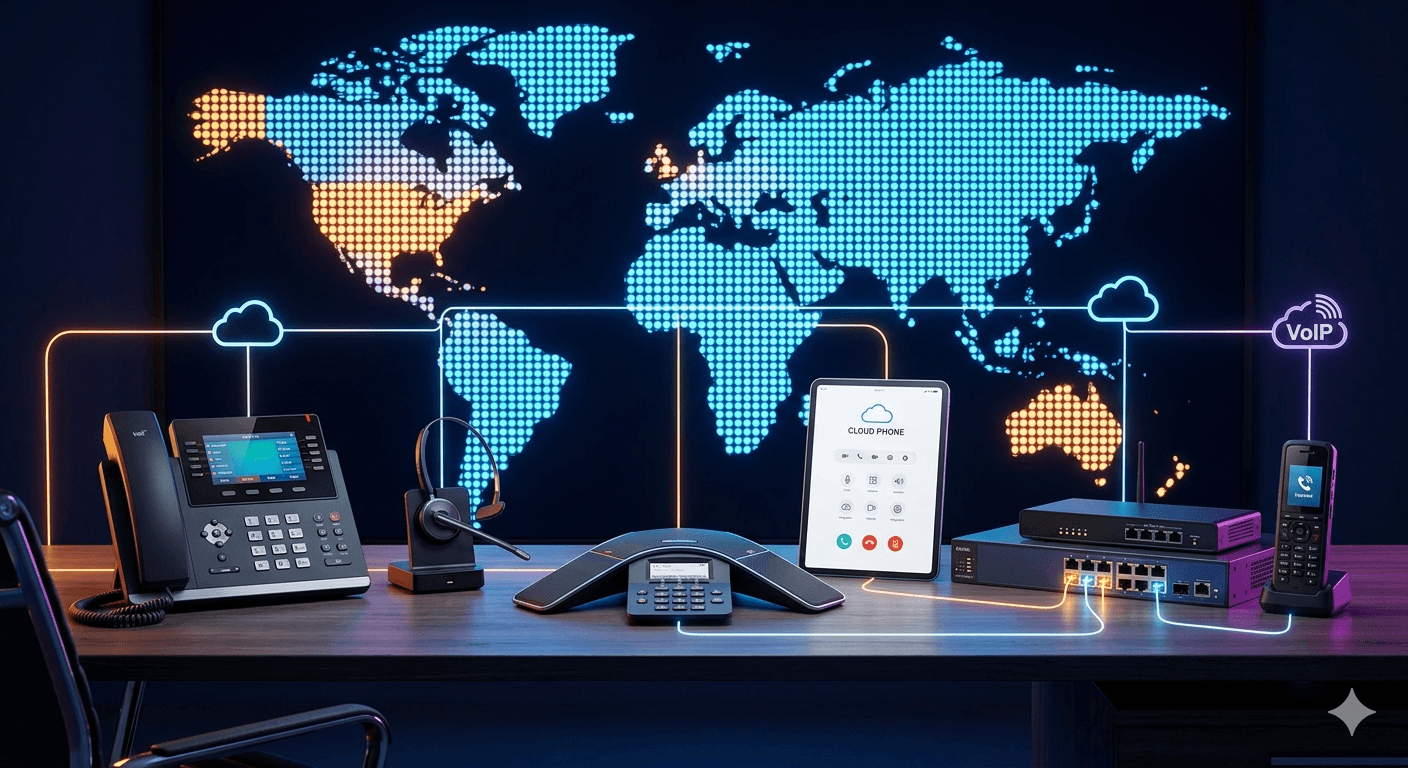
Selecting the best VoIP hardware for businesses is a critical decision for any organization transitioning from traditional landlines to modern internet-based communication. VoIP hardware encompasses the physical devices and infrastructure needed to convert voice signals into digital data packets. This include IP desk phones, headsets, analog telephone adapters, and high-performance routers designed to prioritize voice traffic. Investing in high-quality hardware ensures crystal-clear audio, minimizes dropped calls, and allows employees to leverage advanced features like video conferencing and CRM integration. Whether you are a small startup or a large enterprise, the right hardware forms the backbone of a reliable and scalable telephony system.
Understanding VoIP Equipment: Types of Hardware and How to Choose
VoIP equipment refers to the array of physical devices used to facilitate voice communication over an internet protocol network. Unlike traditional telephony equipment that relies on physical copper wires, these devices use digital technology to transmit data. The market for this technology is expanding rapidly.
According to research by Transparency Market Research, the global VoIP market is expected to reach a valuation of over $183 billion by 2027, driven largely by the corporate sector’s need for flexible and cost-effective communication tools.
When choosing the best VoIP hardware for businesses, it is essential to look at your specific operational needs. For example, a call center will prioritize high-end headsets and switches capable of handling hundreds of concurrent sessions, while a remote-first office might focus more on software-based solutions and portable voip devices. Understanding the different categories of hardware—from the core infrastructure to the peripheral tools used by employees—helps in building a system that is both efficient and future-proof.
What is VoIP and How Does it Work?
Voice over Internet Protocol is a technology that allows you to make voice calls using a broadband internet connection instead of a regular phone line. It works by taking your voice and turning it into digital data. This data is then broken down into small units called packets. These packets travel across the internet to the person you are calling. On the other end, the packets are put back together into sound so the receiver can hear what you are saying.
This process happens almost instantaneously, ensuring that conversation flows naturally. Because the data is digital, it can be shared across various platforms. You can use voip twilio integrations to connect your calls with web applications or use specialized voice over ip hardware to maintain a traditional office feel. The efficiency of this system lies in its ability to use existing internet bandwidth, which significantly reduces the costs associated with long-distance and international calling.
Can I Make VoIP Calls With a Regular Phone?
Many business owners wonder if they must replace every existing handset when switching to a modern system. The short answer is no; you do not necessarily need a specialized device to start. By using a voip device known as an Analog Telephone Adapter (ATA), you can connect your old analog phones to the digital network. The ATA acts as a bridge, converting the analog signals from your old phone into digital packets that the internet can understand.
However, while this is a cost-effective way to transition, it may limit your access to advanced features. Standard phones cannot display complex menus, support multiple lines as easily, or integrate directly with cloud-based directories. If you want the full benefits of the best VoIP hardware for businesses, upgrading to native IP phones is generally recommended for better audio quality and a more professional user interface.
Essential Equipment Needed for VoIP Systems
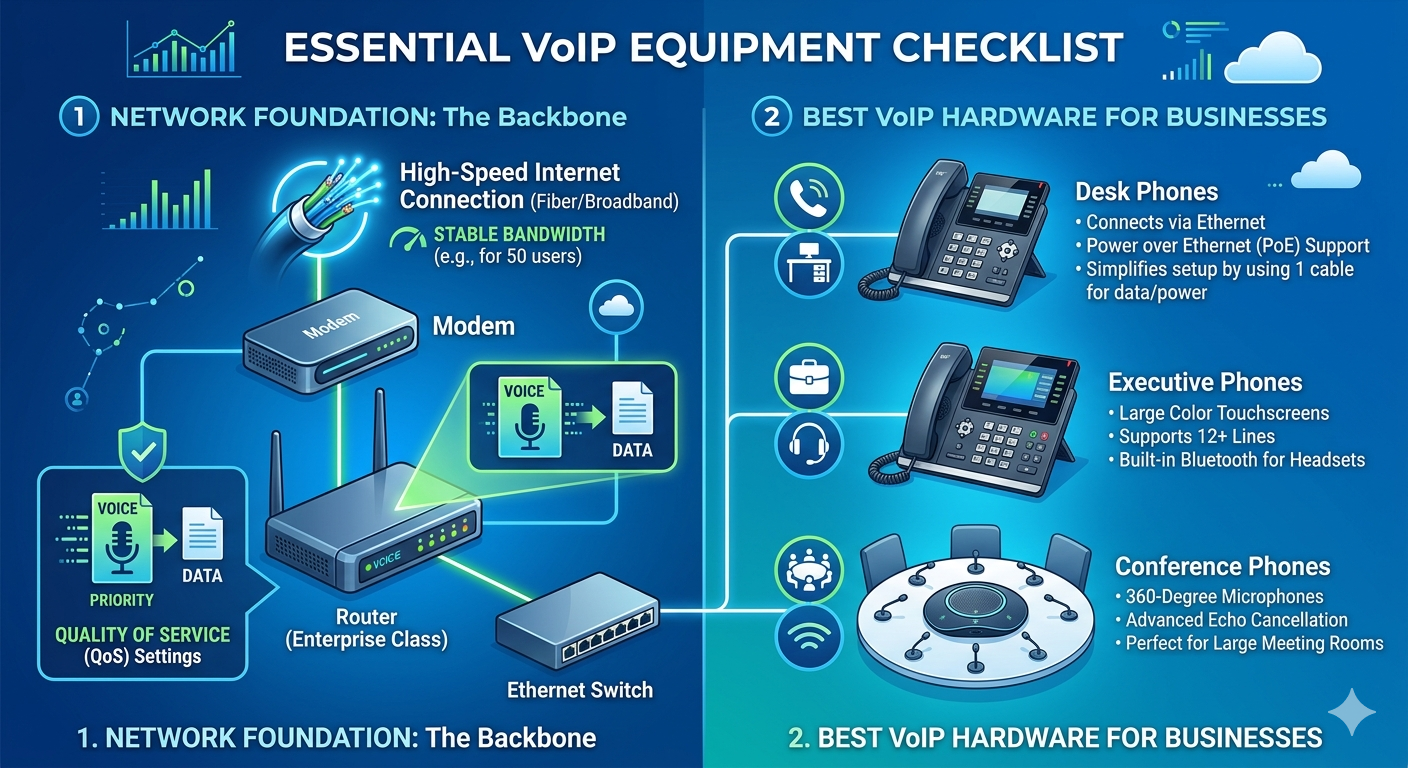
To build a functional communication network, certain components are non-negotiable. These form the foundation of your voip setup requirements and ensure that the network can handle the demands of real-time voice data.
Modem and Router
The modem is your gateway to the internet, provided by your service provider. However, the router is where the heavy lifting happens for your voice system. A standard home router might not suffice for a corporate environment. Businesses require routers with Quality of Service (QoS) settings. This feature allows the router to identify voice traffic and give it priority over other data, such as large file downloads or software updates. This prevents audio clipping and lag during important meetings.
High-Speed Internet Connection
While not a physical piece of hardware you buy in a store, your internet circuit is the most vital part of your voip system requirements. A single voice call typically requires about 100 kbps of bandwidth. For a business with 50 employees who might all be on the phone at once, you need a stable connection that can handle that load without fluctuating. Fiber optic connections are generally the gold standard for voice traffic due to their low latency.
Best VoIP Hardware for Businesses: Desktop IP Phones
Desktop IP phones are the most visible part of any telephony system. These devices are specifically designed to handle digital voice traffic and offer a range of features that traditional phones lack.
Desk Phones: These are the standard units found on most office desks. They connect via Ethernet cables and often feature Power over Ethernet (PoE) support, meaning they get their power and data from a single cable. This simplifies the voip hardware requirements list by reducing the need for numerous power outlets.
Executive Phones: Designed for high-level management, these phones often feature large color touchscreens, support for multiple lines (often 12 or more), and built-in Bluetooth for connecting headsets. They represent the premium end of voip phone hardware.
Conference Phones: These are the triangular or circular devices placed in the middle of meeting rooms. They feature 360-degree microphones and advanced echo cancellation to ensure everyone in the room is heard clearly by the remote party.
The Role of Cordless VoIP Phones in the Office
For employees who need to move around—such as warehouse managers, retail staff, or receptionists—cordless IP phones are essential. These typically use Digital Enhanced Cordless Telecommunications (DECT) technology rather than standard Wi-Fi. DECT is preferred because it operates on a different frequency, avoiding interference from the office Wi-Fi network and providing a much larger range.
A cordless system usually consists of a base station that connects to the internet and several handsets that pair with that base. This is a key part of call equipment for businesses that prioritize mobility. These handsets often include ruggedized versions that are resistant to drops, dust, and water, making them ideal for industrial environments.
Softphones: The Software-Based Hardware Alternative
A softphone is a piece of software that allows you to make calls from your computer, tablet, or smartphone. While it is technically software, it functions as a virtual voip device. For many modern businesses, softphones are replacing physical desk phones entirely. This approach is highly scalable; adding a new user is as simple as creating a new login in your system.
Using softphones significantly reduces the voip phone equipment costs for a business. Employees can use the same laptop they use for work to handle their calls. However, for a softphone to be effective, you must invest in high-quality peripherals, particularly a professional-grade headset, to ensure that the microphone and speaker quality match that of a dedicated desk phone.
Optional but Beneficial VoIP Equipment
Beyond the basics, there are several pieces of hardware that can enhance the performance and reliability of your business communication.
VoIP Gateway
A VoIP gateway is a specialized piece of internet/voice equipment that converts telephony traffic. If your business still uses a traditional PBX (Private Branch Exchange) system but wants to use digital calling, a gateway can connect the two. It acts as a translator between the legacy telephony equipment and the modern internet-based service, allowing for a phased transition to the cloud.
Switches for VoIP Networks
In an office with many IP phones, a standard router won’t have enough ports. You will need a network switch. For the best VoIP hardware for businesses, you should look for managed PoE switches. Managed switches allow you to create Virtual LANs (VLANs) to separate your voice traffic from your regular data traffic, which improves security and performance. PoE switches are particularly helpful as they provide power to the phones directly through the data cable.
Choosing Professional VoIP Headsets and Accessories
A common mistake businesses make is using cheap, consumer-grade headphones for professional calls. A proper voip headset is designed for all-day comfort and vocal clarity. These devices usually feature noise-canceling microphones that filter out the sound of colleagues talking or air conditioning units, ensuring the customer only hears the agent.
There are several types of headsets to consider:
Wired USB/RJ9 Headsets: Reliable and don’t require charging, but they limit movement.
Wireless Bluetooth Headsets: Great for mobility within a short range of the computer or phone.
DECT Wireless Headsets: Offer the best range (up to 300 feet) and the most secure connection for sensitive conversations.
Dual-Ear (Binaural) Headsets: Best for loud environments where the user needs to focus entirely on the call.
Single-Ear (Monaural) Headsets: Ideal for staff who need to remain aware of their physical surroundings while on a call.
VoIP Hardware Requirements: A Comprehensive List
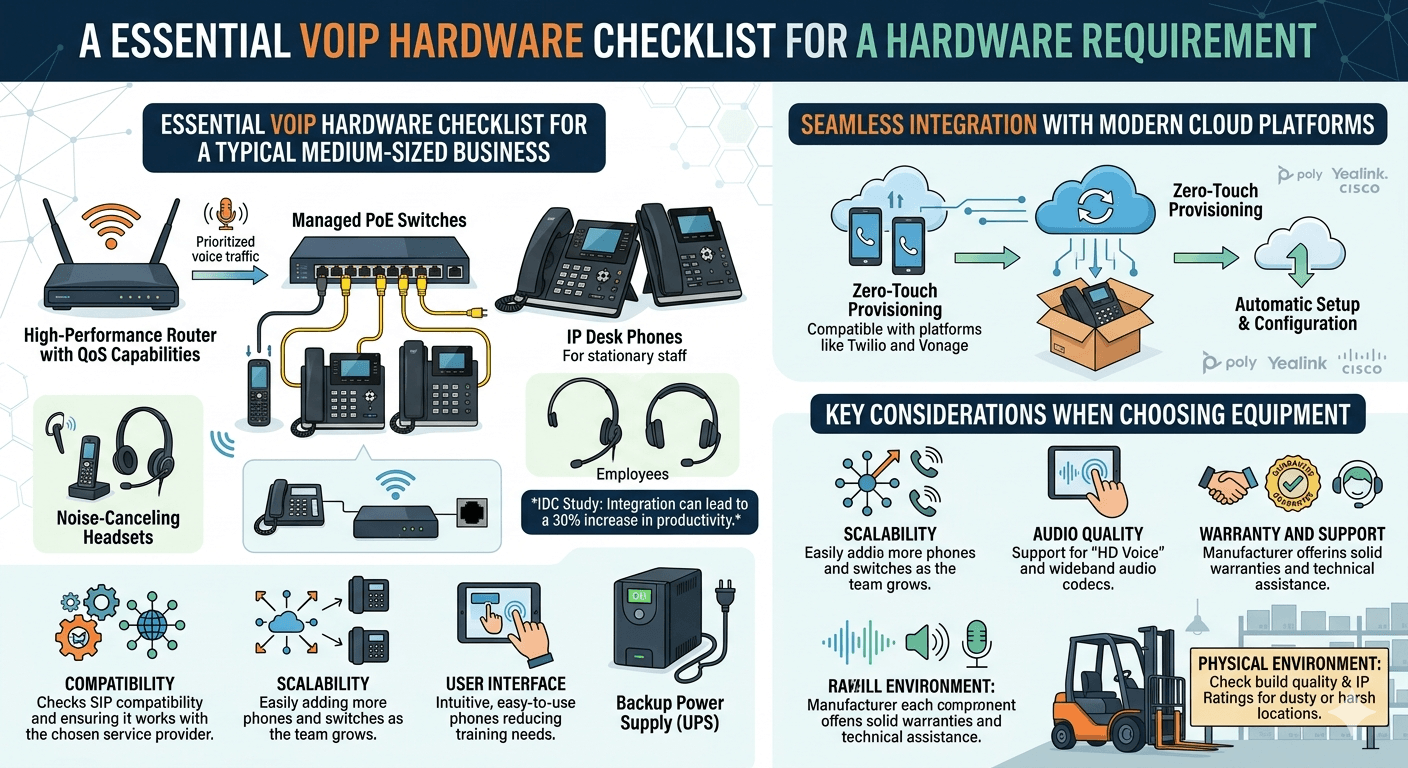
When planning your purchase, having a voip hardware requirements list ensures you don’t overlook critical components. A typical setup for a medium-sized business should include:
A high-performance router with QoS capabilities.
Managed PoE switches to power and connect desk phones.
IP desk phones for stationary staff and executive offices.
DECT base stations and handsets for mobile staff.
Noise-canceling headsets for every employee using a phone or softphone.
An ATA or Gateway if you are integrating legacy equipment.
Backup power supplies (UPS) to keep the voice system running during power outages.
A study by the International Data Corporation (IDC) suggests that companies that integrate high-quality unified communications hardware see a 30% increase in employee productivity. This is largely because high-quality hardware reduces the time wasted on technical glitches and poor audio quality, allowing for faster and more effective decision-making.
Integrating VoIP Equipment with Modern Platforms
Modern hardware is designed to be highly compatible with cloud platforms. For example, twilio voip phone setups allow developers to build custom calling experiences that work seamlessly with hardware from manufacturers like Poly, Yealink, and Cisco. Similarly, vonage hardware is often pre-configured to work out of the box with their specific cloud service, making the installation process much faster.
This integration allows for “zero-touch provisioning.” When you buy the best VoIP hardware for businesses from a reputable provider, the devices are often associated with your account before they even ship. When your employee plugs the phone into the internet at their desk, the phone automatically reaches out to the cloud, downloads its settings, and is ready to make calls in minutes. This eliminates the need for an on-site IT technician to manually configure every device.
Key Considerations When Choosing VoIP Equipment
Before finalizing your purchase of call center equipment or office hardware, consider the following factors to ensure you get the best value for your investment.
Compatibility: Ensure the hardware is compatible with your chosen service provider (e.g., checking for SIP compatibility).
Scalability: Can you easily add more phones or switches as your team grows?
User Interface: Is the phone easy to use, or will it require extensive training for your staff?
Audio Quality: Does the hardware support “HD Voice” or wideband audio codecs?
Warranty and Support: Does the manufacturer offer a solid warranty and accessible technical support?
Investing in the best VoIP hardware for businesses also means considering the physical environment. A dusty warehouse requires different voip product choices than a quiet executive suite. Always check the build quality and “Ingress Protection” (IP) ratings for devices going into harsh environments to avoid frequent replacement costs.
Integrating VoIP Hardware for a Professional Future
The transition to a digital voice system is not just about changing service providers; it is about equipping your team with the right tools. By selecting the best VoIP hardware for businesses, you are investing in the clarity and reliability of every interaction your company has with its clients. From the routers that prioritize your data to the headsets that protect your employees’ hearing and focus, every piece of call equipment plays a role in your professional image.
As you move forward, remember that the most expensive hardware isn’t always the best fit. The goal is to find a balance between functionality, ease of use, and cost. A well-planned voip installation, supported by a solid voip hardware requirements list, will serve your business for years to come, providing the flexibility needed to stay competitive in an increasingly digital world.
Read More: How to Switch from Landline to VoIP?
Final Thought
Building a robust communication network requires a strategic approach to selecting the best VoIP hardware for businesses. By focusing on high-quality IP phones, reliable network switches, and professional headsets, you ensure that your team can communicate without barriers. Technology continues to evolve, but the need for clear, reliable voice communication remains a constant in the business world. With the right hardware in place, your organization is well-positioned to handle the demands of today and the innovations of tomorrow.
Frequently Asked Questions
What is VoIP hardware?
VoIP hardware includes the physical devices used to make and receive calls over the internet. This includes IP desk phones, cordless DECT phones, analog telephone adapters (ATAs), and specialized network equipment like PoE switches and VoIP-optimized routers. It also covers peripherals like noise-canceling headsets that are essential for clear communication in a professional setting.
What hardware is needed for VoIP?
At a minimum, you need a high-speed internet connection, a modem, and a VoIP-compatible router. To actually make calls, you need a “terminal” device, which can be an IP phone, a computer with a softphone app and a headset, or a traditional analog phone connected to a VoIP adapter. For larger offices, a PoE switch is also required to connect and power multiple devices.
Is WhatsApp a VoIP?
Yes, WhatsApp is a popular example of a “consumer VoIP” application. It uses Voice over Internet Protocol technology to transmit voice and video calls as data packets over the internet, bypassing traditional cellular voice networks. While great for personal use, businesses usually opt for professional VoIP hardware and services that offer higher security, desk phone compatibility, and integration with business software.
Do I need a special phone for VoIP?
You do not strictly need a special phone, as you can use a regular phone with an adapter or use software on your computer. However, a dedicated IP phone is specifically designed for the best VoIP hardware for businesses. These phones offer better audio quality, dedicated buttons for features like transfer and hold, and the ability to handle multiple lines simultaneously without additional wiring.
What is a VoIP headset?
A VoIP headset is a pair of headphones with a built-in microphone designed for use with internet calling. Unlike standard headphones, they are optimized for the human voice frequency range and often include noise-canceling technology. They connect via USB, a dedicated headset port on an IP phone, or wirelessly via Bluetooth or DECT technology.
What is a VoIP gateway?
A VoIP gateway is a piece of hardware that converts traditional telephony traffic (analog or ISDN) into digital packets. This allows businesses to connect their legacy PBX systems to a modern VoIP service. It is an essential tool for companies that want to enjoy the cost savings of VoIP without immediately replacing all of their existing telephony equipment.
What is internet voice equipment?
Internet voice equipment is a broad term that covers any hardware used to facilitate voice communication over the web. This includes everything from the routers and modems that provide the connection to the IP phones, adapters, and conference units used by employees. It essentially describes the entire physical ecosystem required to replace traditional phone lines with a digital alternative.