Quo, formerly OpenPhone, is an excellent starting point for small businesses that want shared calls, texts and customer history on US, Canadian or North American toll-free numbers. RingCentral is the stronger starting point for businesses that need employee calling, meetings, messaging and more extensive administration across departments. Choose around the work your team does, the numbers it needs and the complete paid configuration.
This Quo vs RingCentral comparison covers pricing, features, integrations, AI, apps and practical buying considerations in 2026. Quo supports international calling. Its North American number offering should not be confused with a restriction on calling customers overseas. RingCentral RingEX is the employee communications product compared here; RingCX is a separate contact-centre evaluation.
Customer Ratings at a Glance

Quo — G2: 4.7/5 from 3,416 product reviews.

RingCentral RingEX — TrustRadius: 8.8/10 from 543 reviews and ratings.
The platforms use different scales and reviewer samples. Use the feedback to guide your evaluation alongside the product comparison.
Quo vs RingCentral: Quick Overview
| Requirement | Quo | RingCentral RingEX |
|---|---|---|
| Starting reference | Starter: $15/user/month billed annually | Core: $20/user/month billed annually |
| Best starting point | Small teams sharing customer calls, texts and history | Employee communications across roles, departments and sites |
| Number requirement | US, Canadian or North American toll-free numbers | Evaluate local numbers and deployment for each required market |
| International calls | Destination-based paid calling outside the US/Canada inclusion | US/Canada inclusion in the US offering; other destinations use rates or bundles |
| Customer handling | Shared inbox, internal notes and connected follow-ups | Routing and customer workflows within a broader communications system |
| AI evaluation | Sona reception plus plan-specific call summaries | Employee assistance plus specialist reception and intelligence products |
| Trial | Explore Quo’s 7-day trial | Explore RingCentral’s 14-day trial |
Quo vs RingCentral Pricing: Quo Starts Lower, but Business Is the More Useful Comparison for Many Teams

Quo pricing in US dollars
| Plan | Annual billing per user/month | Monthly billing per user/month |
|---|---|---|
| Starter | $15 | $19 |
| Business | $23 | $33 |
| Scale | $35 | $47 |
Quo includes one new or ported local or toll-free number per user. Additional numbers are listed at $5/month each. Taxes, messaging registration and usage-related charges can increase the invoice.
Five Starter seats represent a $75 monthly-equivalent annual base, or $900 over twelve months. Five Business seats represent $115 monthly equivalent, or $1,380 annually. With monthly billing, those five-seat bases are $95 and $165 respectively.

RingCentral RingEX pricing
RingCentral publishes a Core starting reference of $20/user/month paid annually, including one number per user. Five seats represent $100 monthly equivalent, or $1,200 over twelve months before extras. Get a current quote for higher packages and specialist requirements.
Compare equal requirements
Quo Starter is cheaper at the entry annual references. However, Quo’s Business plan is the relevant starting point when you need transfers, phone menus or the advertised HubSpot and Salesforce connectors. The cheapest phone licence may not include the workflow shown during a demonstration.
RingCentral’s final price also depends on the required package, numbers and specialist tools. A shared customer-texting requirement, for example, should be priced with the appropriate product rather than assumed from a general SMS feature.
Request one quote covering seats, extra numbers, messaging, international traffic, AI usage and setup. Compare annual totals and renewal conditions. Paying annually can lower the monthly equivalent while creating a longer financial commitment.
Quo vs RingCentral Calling Features: Quo’s Shared Customer Inbox vs a Wider Office Phone System
Why Quo works well for small teams
Quo brings calls, texts and customer context together around shared numbers. Internal threads, notes and tasks help teammates coordinate without asking the customer to repeat the conversation. That is a practical advantage for a small service business where several people handle the same enquiries.
Consider a customer who calls about a quote, texts a photograph and asks for an update the next morning. A shared conversation history helps the next employee see what happened and continue the follow-up.
Quo’s feature pages show configurable call flows and routing. Use its current plan comparison to establish entitlement: basic shared-number handling and a department phone menu are different requirements.
Why RingCentral works well across departments
RingCentral offers IVR menus, forwarding, shared lines, visual voicemail and switching calls between devices. RingEX also combines calling with employee communication tools. That broader environment matters when reception, accounts, managers and customer-facing staff need one system.
Demonstrate an opening-hours flow, an unanswered call, a department transfer and voicemail recovery. For Quo, add a shared text follow-up. For RingCentral, include the handover between departments and the tools employees use to collaborate afterwards.
Our assessment: Quo has a particularly compelling proposition when the shared customer conversation is the centre of the job. RingCentral deserves closer attention when that conversation is one part of a wider employee communications deployment.
Quo vs RingCentral Integrations: Quo Has More Than Basic Contact Sync
Quo’s current integration directory includes HubSpot, Salesforce, Pipedrive, Zoho CRM, HighLevel, Clio and Jobber, alongside Slack, automation platforms and API/webhook options. Do not describe Quo as a phone app with no business integrations.
RingCentral offers an app gallery, APIs and connections for CRM and business workflows, including Microsoft Teams options. The useful difference is whether the specific connector supports your process at the quoted price.
A home services firm should test whether a call summary reaches the correct job. A small sales team should test whether the call, message and follow-up reach the correct CRM contact. A professional services firm should test access to the record by the next person handling the customer.
Ask each provider to demonstrate an incoming caller match, a missed call and a completed interaction. Check duplicate contacts, changed ownership and synchronisation failures. Availability in an integration directory does not prove identical two-way behaviour.
Confirm the plan and any connected software licence needed. A built-in connector and an automation through another platform can have different costs, permissions and maintenance requirements.
Our guide to integrating VoIP with a CRM covers practical implementation questions.
AI: Sona Reception and Call Summaries Serve Different Jobs
Quo Sona
Sona is Quo’s AI agent for inbound calls. It can answer questions, collect details, transfer callers and send a text during a call. Configure it with your business information and test its responses before putting it into a live call flow.
Quo advertises 1,000 included automation credits, described as 10 Sona calls. That is a limited allowance rather than unlimited AI reception. Paid usage tiers and overage charges apply when you need more; confirm the allowance and billing rules for your workspace.
For a trades business, the useful test is whether Sona captures the caller’s name, address and reason for calling, then gives the team an accurate record. Ask an unexpected question and request a human to check the handover.
Call summaries and RingCentral AI
Quo lists call summaries and transcripts on Business, while Scale adds AI call tags. RingCentral’s portfolio includes employee assistance with notes, summaries and actions, plus specialist reception and conversation intelligence products. Verify the purchased package and additional products.
Reception answers a customer now; a summary helps an employee afterwards. Compare those separately. Use the same conversation with a date, price and promised action, then judge whether the saved record preserves the details.
Estimate expected AI usage before buying. A small number of after-hours enquiries and a busy front desk have different costs even when both use an AI receptionist.
Mobile and Desktop Apps: Quo Is Built Around Existing Devices
Quo offers Mac, Windows, iOS, Android and web access. RingCentral’s app also supports desktop and mobile working. Both deserve testing on the devices and networks employees actually use.
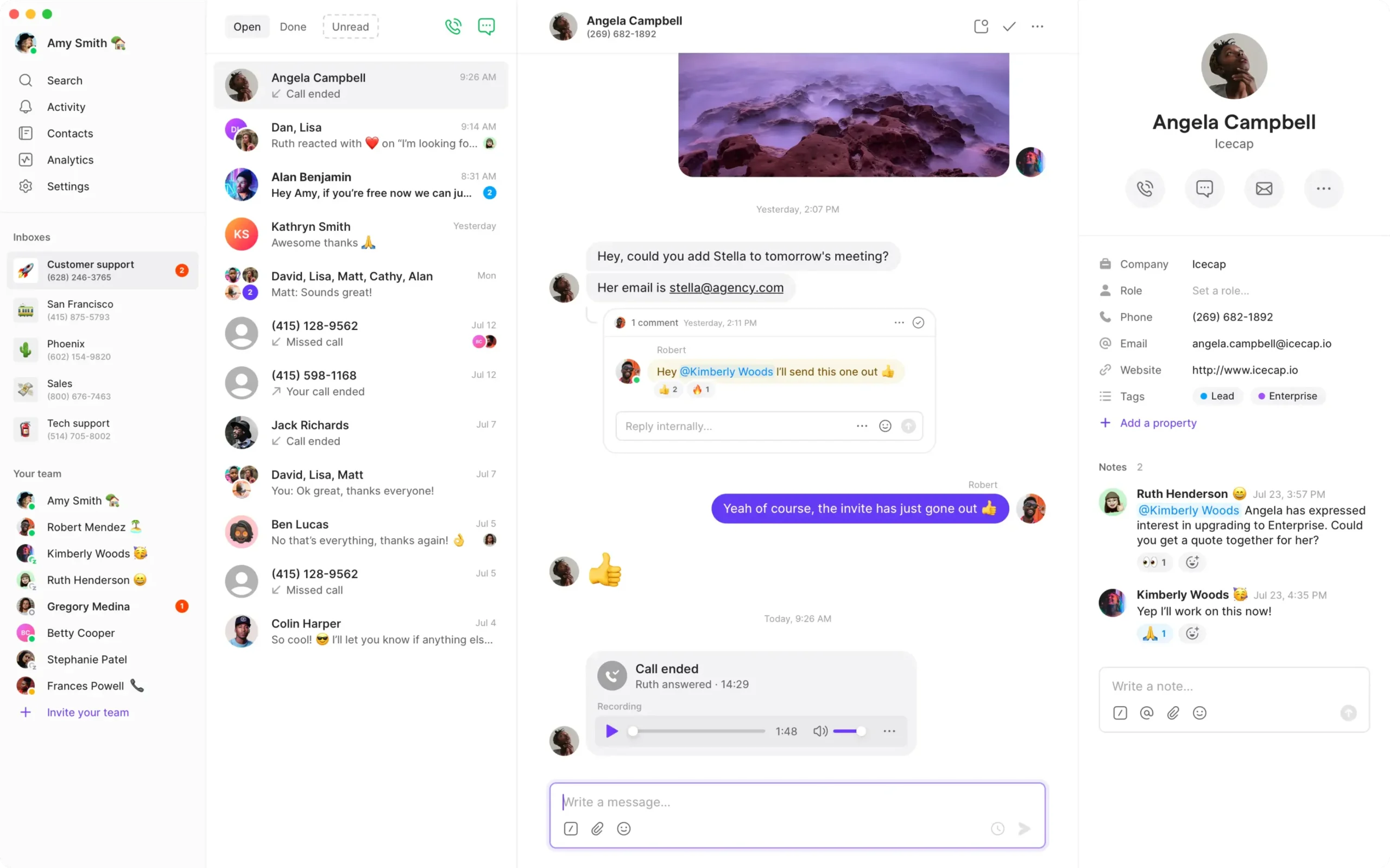
For Quo, have two teammates handle a customer conversation in sequence. Check whether the second person can see the previous text, note and call outcome without asking the first employee for context.
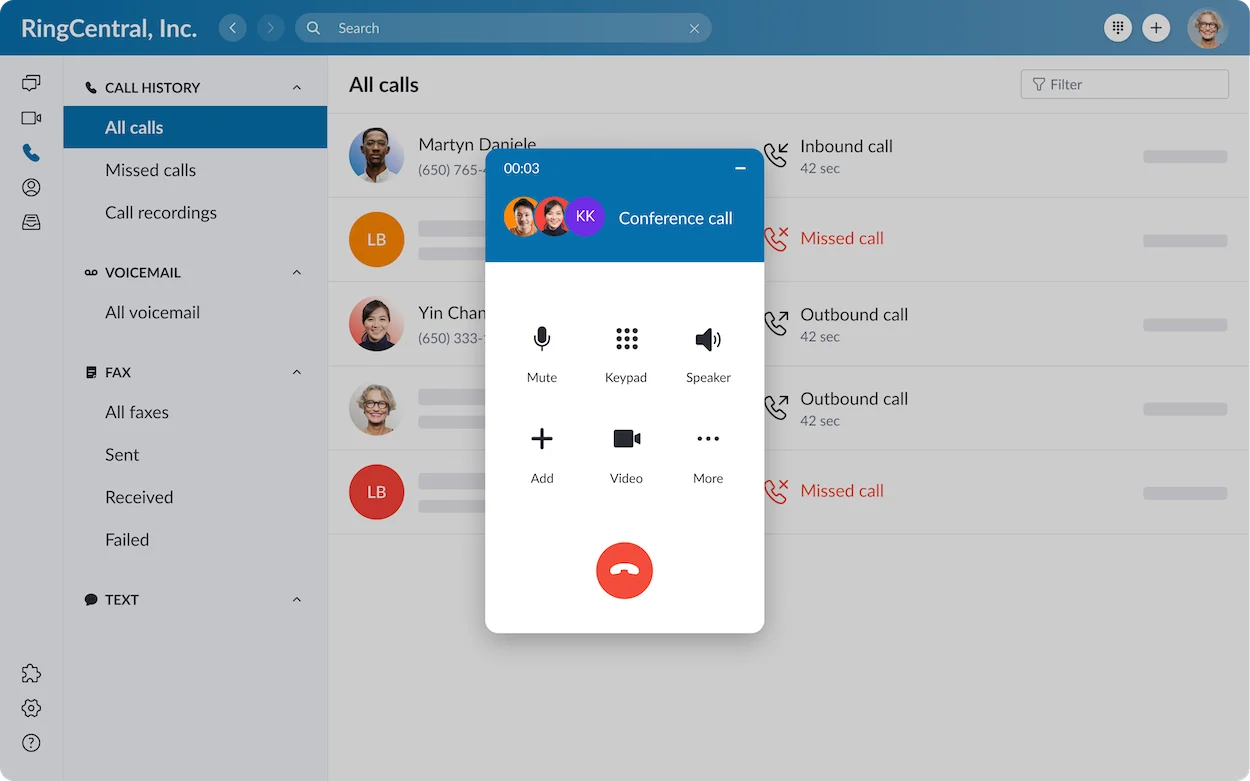
For RingCentral, test a receptionist transferring to a mobile colleague and an employee continuing a business conversation from another device. Include any desk phones in the actual deployment specification.
Test notifications with the phone locked, business caller ID and headset behaviour. Run calls on ordinary office Wi-Fi and mobile data. App availability does not, by itself, establish acceptable field performance on an unstable connection.
Employees who mostly work away from a desk should participate in the trial. A successful desktop demonstration is useful, but their mobile tasks may reveal a different requirement.
Quo vs RingCentral International Calling: Quo’s Number Geography Is Not Its Calling Geography
Quo supplies US, Canadian and North American toll-free business numbers, and supports paid international calling to other destinations. It is an excellent candidate when those numbers suit the business. It should not be rejected simply because some customers are overseas.
If the business needs a local UK, Australian or German number, Quo’s North American number catalogue does not meet that separate requirement. Evaluate a provider with the required local-number availability and confirm eligibility.
Quo includes calling and messaging to US and Canadian numbers under its fair-use policy. For other countries, charges depend on the destination. You can enable international calling and fund it with credits; check current destination availability and rates before relying on a particular route.
RingCentral’s US offering also includes US/Canada calling, with international rates or bundles for other destinations. Its inclusion should not be interpreted as a claim that the wider service is available only in two countries.
Prepare the same destination list for both providers, with expected minutes and landline/mobile splits. Ask about excluded traffic and external forwarding. Price your actual calls rather than assuming a country headline means every number type is included.
For example, a Canadian consultancy calling a UK supplier can evaluate Quo. A consultancy needing a UK local number as well must evaluate that number requirement separately. Calling abroad and presenting a local presence abroad are different purchasing decisions.
Quo vs RingCentral Reliability: Check Calls, Notifications and the Saved Record
RingCentral advertises 99.999% reliability. Obtain the applicable SLA and remedies from both providers rather than assigning Quo an unsupported uptime percentage or assuming a user rating measures availability.
Quo’s shared inbox makes the saved conversation part of the workflow. Test a call, text, note and colleague handover together. RingCentral’s broader deployment should also test transfers, queues and reporting across the departments involved.
During the busiest normal period, check incoming calls, missed-call notifications and audio on the intended network. When there is a problem, separate local Wi-Fi, headset or device behaviour from a service interruption.
Agree a fallback for internet loss and an urgent escalation route. Test whether an administrator can identify the affected call and give support the information needed to investigate. Recovery should be part of the pilot, alongside everyday usability.
Quo vs RingCentral Customer Support: Quo’s Channel Depends on the Plan
Quo lists email ticket support on Starter, live chat on Business, and priority support plus inbound phone support on Scale. Choose around the support access the business needs rather than assuming every subscriber can call support.
For RingCentral, confirm the channels, hours and onboarding included in the actual quote. A provider’s support resources and a contractual response target are different things.
Submit a practical setup question during evaluation. Assess whether the answer identifies the issue, gives a clear next action and explains who owns resolution. For integrations, ask how the phone provider coordinates with the CRM vendor.
For a number migration, request the documents, expected sequence and temporary routing arrangements. Do not cancel the old service before the port has completed successfully. Give reception staff and administrators enough training to handle routine changes.
Quo vs RingCentral Small Businesses: Quo Is a Leading Choice for Shared Calls and Texts
Quo is one of the strongest starting points for a small business that needs North American numbers, shared customer conversations and app-based working. A two-person agency, a small home services company or a growing consultancy can benefit from one visible history rather than scattered personal-phone conversations.
Evaluate Starter for straightforward calling and texting. Evaluate Business when transfers, menus and the advertised CRM connections are essential. Evaluate Scale when its support and automation features solve a clear need.
RingCentral is worth evaluating when the small business wants calling alongside wider employee communications. A firm with reception, several departments and regular internal meetings may place more value on that combination.
Keep the decision proportional to the job. A simple customer inbox does not require every enterprise administration feature, while a complex office flow should not be purchased solely around an entry price.
Have the people answering customers run the trial. Their ability to find the history, take ownership and complete the follow-up is more useful than a generic claim that one product is always easier.
Quo vs RingCentral Larger Businesses: Define What Must Grow With the Organisation
Quo can support growing teams, but growth should be measured by requirements rather than a headcount alone. Demonstrate shared-number access, permissions, reporting and the workflow needed when another team takes over a customer.
RingCentral deserves closer evaluation when the organisation needs communication and administration across departments, locations or deployment regions. Its higher packages include additional administrative and analytics options; price the required configuration.
A larger customer service operation should evaluate contact-centre requirements separately. Agent supervision, workforce processes and additional channels may require a specialist product such as RingCX rather than ordinary RingEX employee licences.
Define the report a manager needs, who can change routing and how departing employees lose access. Then test those tasks. A growing business should be able to add people without losing ownership of numbers, records or customer follow-ups.
Quo vs RingCentral: Pros and Cons
| Assessment | Quo | RingCentral |
|---|---|---|
| Strengths | Shared calls/texts, conversation history and small-team coordination | Calling, collaboration and administration across business roles |
| Buying limitation | North American number catalogue; international calling costs extra | Required higher tiers and specialist products can increase the total |
| Plan check | Transfers, menus, CRM entitlement and support channel | Administration, shared customer messaging and contact-centre requirements |
| AI cost check | Included credit allowance, paid usage and overages | Employee assistant entitlement and separately priced specialist tools |
Quo’s focused offering is a strength when it matches the business. RingCentral’s wider offering is valuable when employees need those additional capabilities. Neither advantage proves that every customer should buy the same provider.
Frequently Asked Questions
Is Quo the same as OpenPhone?
Quo is the current brand for the business phone service formerly known as OpenPhone. Older reviews and integrations may still use the earlier name.
Is Quo cheaper than RingCentral?
Quo Starter has the lower published annual entry reference. Compare the paid tier needed for your workflow, extra numbers, usage and AI before deciding on total cost.
Does Quo only call the US and Canada?
No. Those destinations are included under its applicable policy, while international calls to other supported destinations are charged separately.
Can Quo provide a UK local number?
Its business-number offering focuses on US, Canadian and North American toll-free numbers. A UK local-number requirement needs a different provider or configuration.
Is Sona unlimited on every plan?
No. The advertised included credit allowance is limited. Budget for additional usage and confirm the current rules before routing a busy main number through it.
Do both offer trials?
Quo advertises seven days. RingCentral advertises a 14-day RingEX trial for new subscribers, up to 20 lines and two desktop phones; SMS is excluded. Check payment, cancellation and trial-feature conditions before starting.
Final Recommendation: Quo for Small-Team Customer Conversations, RingCentral for Wider Business Communications
Choose Quo for evaluation when US, Canadian or toll-free numbers suit the business and shared calls, texts and customer history are the main requirement. Test the team handover and price the plan that preserves the required features. Read our Quo review for the broader offering.
Choose RingCentral for evaluation when calling sits alongside employee collaboration and more extensive administration. Demonstrate the department flow, confirm the purchased tier and price any specialist customer-contact tools. Our RingCentral review explores the platform.
Use the same customer journey, destination traffic and billing period for both quotes. A successful pilot and complete price are more useful than declaring a universal winner. If neither fits, compare other business VoIP providers.
Quo vs RingCentral Customer Reviews: What the Feedback Suggests Testing
Quo — G2
An organic review dated October 1, 2026 described Quo as easy to use for a travel business and valued its texting, app and web access after problems with a previous service.
An organic review dated September 24, 2026 praised support, setup, call-flow tools and storing information with contacts. Separately, an accessible G2 review excerpt requested faster desktop performance when composing and correcting messages. That excerpt does not establish a verified review date or score.
RingCentral RingEX — TrustRadius
An incentivized 7/10 review dated October 1, 2026 valued queues, administration and helpful support, while describing difficulty finding abandoned queue calls and confusion with reporting.
An incentivized 10/10 review dated September 24, 2026 described successful use across 180 dental-support sites and good voice quality on a correctly configured network. It also criticised first-line support and built-in analytics.
These paraphrased experiences suggest pilot tasks around everyday usability, customer records, reports and escalation. Individual reviews do not establish that every customer will have the same experience.
Affiliate disclosure: VoIPCalling.com may earn a commission if you purchase through an affiliate link in this article, at no additional cost to you. Recommendations reflect the product differences and business requirements discussed above.