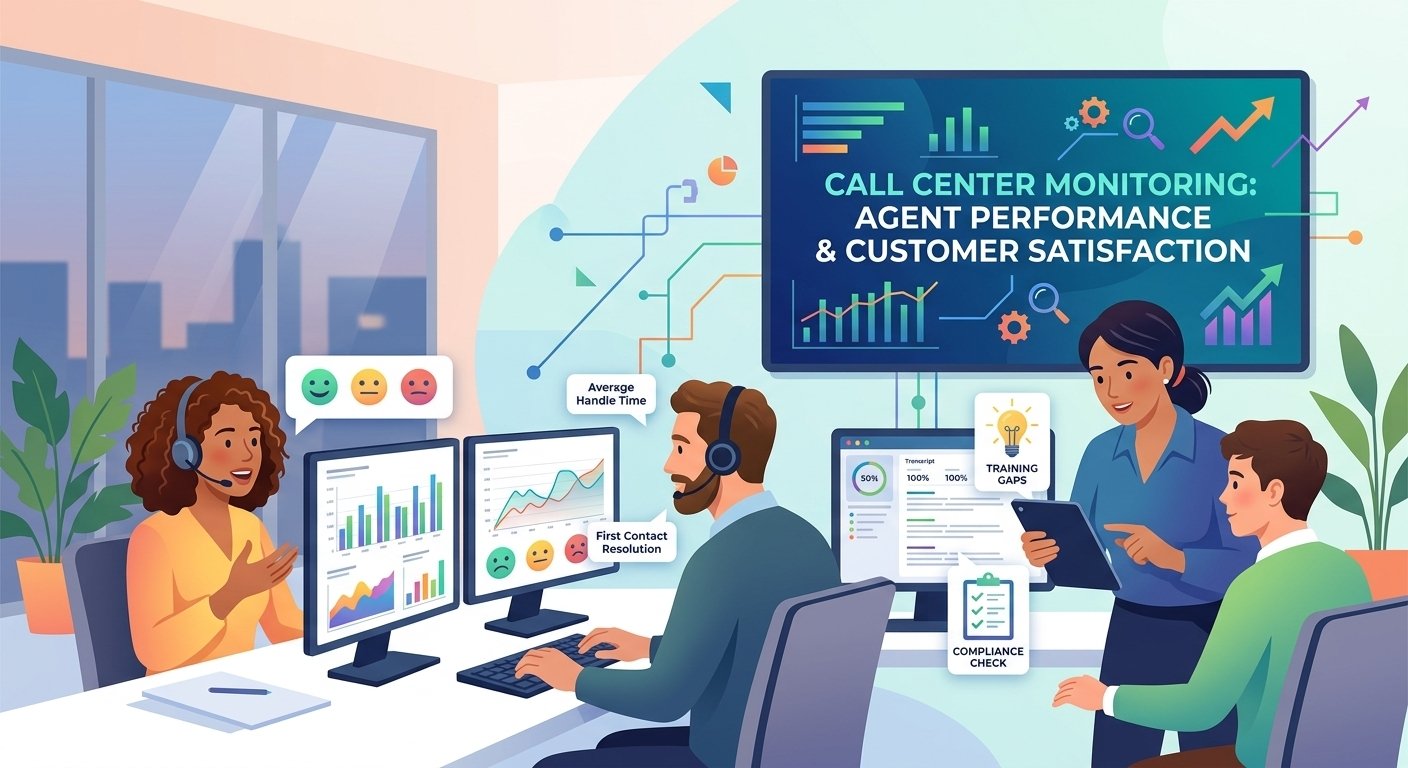
Call center monitoring involves evaluating customer interactions to assess agent performance, enhance service quality, and optimize business operations. This vital practice utilizes specialized software to listen to live conversations or review recorded interactions, turning raw data into actionable insights. Implementing a solid call center monitoring program allows managers to identify training gaps, ensure industry compliance, and elevate overall customer satisfaction.
By continuously analyzing these engagements, companies refine communication strategies and establish consistent support standards. A well-structured approach ultimately drives operational efficiency and helps organizations deliver outstanding, customer-centric experiences during every single interaction with their brand.
What Is Call Center Monitoring?
Contact center monitoring is the systematic observation and analysis of interactions between agents and customers. Supervisors or quality analysts review these engagements to provide immediate assistance, identify training opportunities, and maintain high service standards. Companies leverage advanced analytics tools to extract meaningful information regarding customer sentiment, duration, and efficiency.
Evaluating recorded conversations ensures compliance with regulatory standards while highlighting trends in consumer behavior. This proactive approach establishes clear benchmarks for support teams, allowing representatives to deliver consistent, high-quality experiences. Utilizing proper tracking mechanisms transforms standard conversations into strategic assets for continuous organizational improvement.
Why Is Call Center Monitoring Important?
Implementing a robust evaluation system offers measurable advantages for organizations aiming to boost client satisfaction and operational efficiency. Listening to daily conversations enables leadership to pinpoint operational hurdles, refine communication strategies, and enforce strict compliance protocols.
According to a 2023 McKinsey & Company research report, regularly evaluating support conversations can boost agent productivity by 15 percent while increasing retention scores by 20 percent.
- Enhances Customer Experience: Listening to calls helps organizations understand customer frustrations, proactively fix product issues, and evaluate support reps to provide better training on empathy and problem-solving.
- Boosts Agent Performance: It allows managers to give specific, actionable feedback based on real interactions. By sharing the strategies of top performers, companies can effectively coach their staff and build their confidence in handling difficult situations.
- Ensures Compliance and Security: Regular monitoring guarantees that employees adhere to strict industry regulations regarding secure data handling and consent, which protects sensitive information, helps detect fraud, and prevents costly legal penalties.
- Drives Data-Driven Decisions: Analyzing conversation data gives leadership valuable insights into market trends and consumer preferences. This concrete data can be used to guide product development, optimize marketing, and drive sustainable business growth.
What Call Interactions and Data Do You Monitor?
Establishing a comprehensive oversight framework requires tracking various interaction types and performance metrics. Organizations evaluate diverse data points to form a complete picture of operational health.
| Interaction Type | Primary Purpose | Key Data Tracked |
| Inbound | Resolving active consumer inquiries | Issue resolution speed, tone, empathy |
| Outbound | Proactive sales and marketing outreach | Script adherence, conversion rate |
| Internal | Staff collaboration and peer training | Protocol updates, department alignment |
| Sentiment | Assessing emotional shifts during talks | Voice tone, pacing, negative phrasing |
1. Inbound calls
Consumers initiate inbound engagements to seek technical assistance, resolve billing inquiries, or file complaints. Evaluating these specific interactions helps organizations accurately identify common frustrations and assess overall service effectiveness.
Reviewing incoming requests provides direct insight into immediate client needs. This data helps refine knowledge bases and streamline resolution pathways for faster future support.
2. Outbound calls
Representatives initiate outbound engagements for proactive marketing, sales outreach, and follow-up surveys. Tracking these conversations measures script adherence, professional demeanor, and overall conversion success.
Leadership analyzes outbound interactions to gauge the effectiveness of promotional campaigns. This detailed evaluation highlights areas where representatives require additional training in persuasion or objection handling.
3. Internal calls
Staff members generate internal engagements for peer training, departmental meetings, and cross-team collaboration. Assessing these internal communications improves corporate alignment and enhances the effectiveness of operational processes.
Tracking internal communication helps eliminate departmental silos and accelerates knowledge sharing. It ensures all team members remain updated on updated protocols and product features.
4. Customer sentiment
Sentiment analysis evaluates the emotional state of the consumer by analyzing tone of voice, word choice, and conversation pacing. This specific metric reveals hidden frustrations and highlights moments where representatives successfully de-escalate tense situations.
Understanding emotional shifts during an interaction allows managers to refine empathy training. It provides a deeper context beyond standard resolution metrics, focusing on the human element of service.
5. Agent performance metrics
Tracking specific performance indicators provides a quantifiable assessment of operational efficiency. Organizations regularly monitor call center performance using the following critical metrics:
-
Average handle time calculates the exact duration required to complete a single interaction successfully.
-
First contact resolution measures the percentage of inquiries resolved during the initial engagement without requiring escalation.
-
Transfer rate indicates the frequency of conversations routed to alternate departments for final resolution.
6. Compliance data
Tracking regulatory adherence ensures all required disclosures occur and sensitive information remains secure. This specific data proves that the organization operates within legal boundaries and strictly follows industry mandates.
Consistent oversight prevents costly legal infractions and builds trust with consumers. Automated flagging systems instantly alert management to any deviations from approved regulatory scripts.
Call Center Monitoring Tools and Solutions To Use
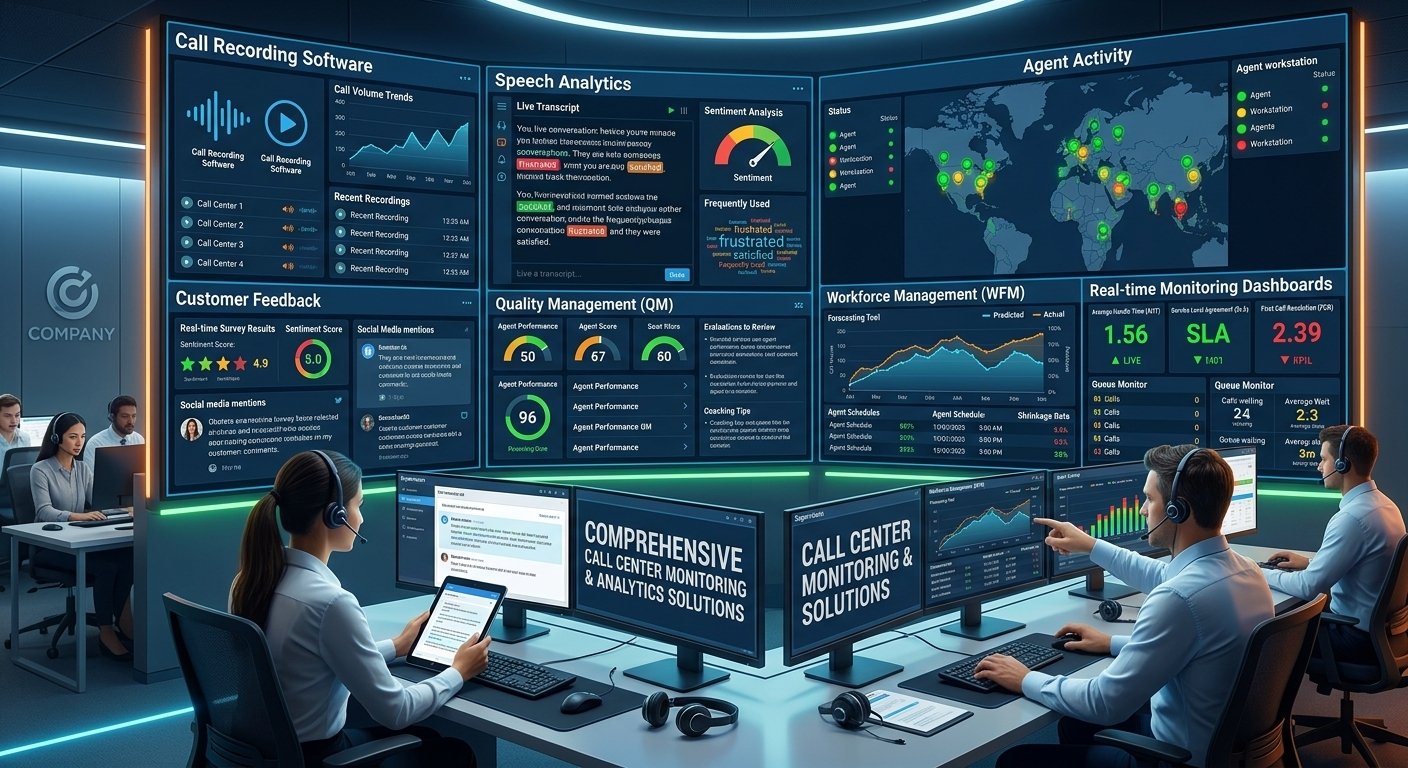
Deploying the right technological ecosystem is vital for extracting actionable insights from daily operations. Modern facilities rely on specialized software to track, record, and analyze vast amounts of interaction data efficiently.
-
Call recording software
Recording technology provides a secure, permanent archive of all consumer interactions for quality assurance and dispute resolution. These systems feature automated capturing, encrypted storage, and instant retrieval capabilities.
Accessing historical recordings allows managers to review complex cases and design targeted training materials. It serves as the foundational element of any comprehensive oversight initiative.
-
Speech analytics
Artificial intelligence powers speech analytics to instantly transcribe conversations and detect specific keywords or emotional shifts. This technology provides a macro-level view of emerging market trends and overall workforce performance.
Automated transcription eliminates manual listening, allowing analysts to review a higher volume of interactions in less time. It quickly identifies systemic issues affecting the client experience.
-
Quality management (QM) software
Dedicated quality platforms offer detailed performance dashboards, coaching workflows, and standardized evaluation templates. Management relies on these robust tools to automate manual administrative tasks and focus entirely on employee development.
Standardized grading ensures fair and objective performance reviews across the entire workforce. These platforms simplify the tracking of historical progress and highlight areas needing immediate intervention.
-
Workforce management (WFM) software
Resource planning technology ensures the facility maintains adequate staffing levels to handle anticipated interaction volumes. These predictive tools analyze historical trends to optimize schedules and minimize consumer wait times.
Proper staffing directly impacts service quality by preventing employee burnout and reducing queue frustration. Forecasting capabilities allow facilities to adapt quickly to seasonal spikes or unexpected volume surges.
-
Real-time monitoring dashboards
Live dashboards grant leadership immediate visibility into active queues, staff availability, and ongoing interaction metrics. Supervisors utilize this live perspective to address sudden bottlenecks and reallocate resources dynamically.
Visualizing live data prevents minor operational hiccups from escalating into major service disruptions. It ensures the facility operates efficiently during peak business hours.
-
Customer feedback tools
Post-interaction surveys, online review aggregators, and social media tracking tools capture unfiltered consumer opinions. These specialized platforms provide structured opportunities for clients to share their direct experiences with the brand.
Integrating external feedback with internal performance data highlights critical perception gaps. This dual perspective enables organizations to develop proactive strategies aligned with actual market expectations.
How To Conduct Call Center Monitoring
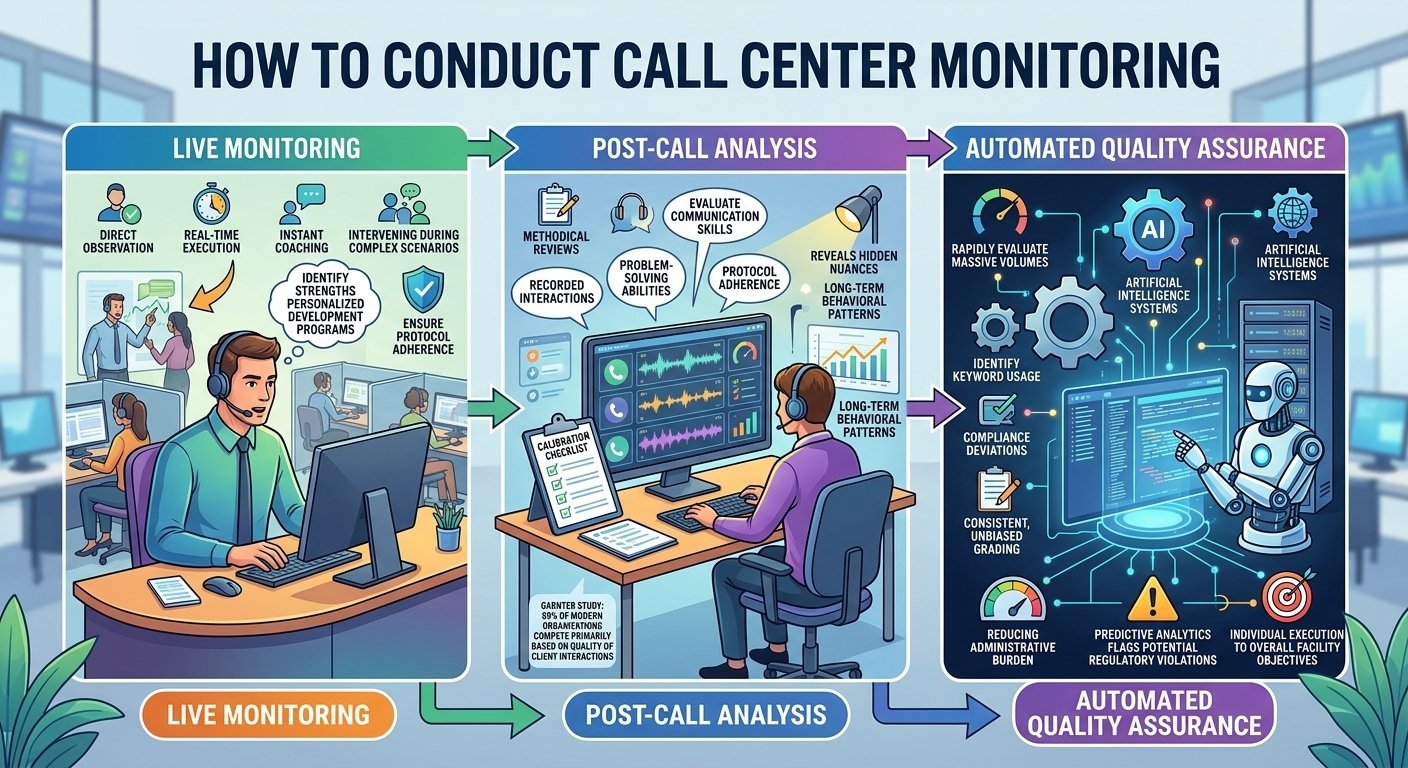
Establishing an effective oversight framework requires a structured approach to evaluation and feedback. Facilities utilize multiple methodologies to capture a complete picture of operational effectiveness.
-
Live monitoring
Supervisors directly observe active conversations to assess real-time execution and provide instant coaching. Intervening during complex scenarios allows leadership to prevent negative outcomes before they damage the brand reputation.
Observing active engagements helps managers identify individual strengths and design personalized development programs. This hands-on approach builds employee confidence and ensures strict adherence to approved protocols.
-
Post-call analysis
Methodical reviews of recorded interactions form the foundation of most quality assurance initiatives. Analysts evaluate communication skills, problem-solving abilities, and protocol adherence without the pressure of live intervention.
According to a 2024 Gartner study, 89 percent of modern organizations compete primarily based on the quality of their client interactions, making deep historical analysis vital. This thorough evaluation method reveals hidden nuances and long-term behavioral patterns across multiple touchpoints.
-
Automated quality assurance
Artificial intelligence systems rapidly evaluate massive volumes of interactions to identify keyword usage and compliance deviations. Automation ensures consistent, unbiased grading while drastically reducing the administrative burden on quality analysts.
Deploying predictive analytics flags potential regulatory violations instantly, mitigating risks across thousands of daily engagements. Automated scoring standardizes the evaluation process and seamlessly connects individual execution to overall facility objectives.
Call Center Monitoring Best Practices
Optimizing operational performance requires adherence to proven strategic methodologies. Implementing these core tactics ensures your oversight program delivers maximum return on investment.
-
Set Clear Objectives: Define specific goals before deploying new technology. Balance efficiency metrics with quality metrics (like first contact resolution), involve frontline staff in setting these goals, and review them quarterly.
-
Use a Multi-Faceted Strategy: Combine live observation, historical review, and automated analysis to get a complete picture of performance. Rotate monitoring schedules and use automated triggers to flag highly emotional calls for manual review.
-
Focus on Constructive Feedback: Frame monitoring as a development tool rather than a critique. Encourage agents to analyze their own calls and host peer-learning sessions where top performers share their successful techniques.
-
Invest in the Right Technology: Provide staff with communication platforms that integrate with existing systems. Involve employees in the software selection process to identify workflow challenges, and ensure you budget for comprehensive training.
-
Adapt Based on Customer Feedback: Regularly review customer surveys and external feedback to see operations from the consumer’s perspective. Create a dedicated committee to track these trends and adjust your evaluation criteria to meet shifting customer expectations.
Top Call Center Monitoring Software
Selecting the appropriate technological infrastructure is vital for establishing an effective oversight program. Several industry-leading platforms offer unique capabilities tailored to specific operational requirements.
| Software Name | Best Functionality | Ideal For |
| Nextiva | Omnichannel routing & live coaching | Growing businesses needing rapid deployment |
| Five9 | AI automation & predictive analytics | Enterprises focused on workflow automation |
| Enthu.ai | Autonomous sales conversation grading | Sales teams wanting automatic insights |
| Gong | Revenue intelligence & competitor tracking | Organizations strictly focused on revenue |
| Insightful | Detailed workforce productivity tracking | Managers needing application usage data |
1) Nextiva Call Center
Nextiva delivers comprehensive omnichannel capabilities optimized for growing enterprises seeking rapid implementation. It seamlessly handles inbound routing across web chat, email, and traditional voice channels.
Supervisors leverage intuitive interfaces for live observation, discrete in-interaction coaching, and seamless escalation management. The software features built-in compliance for strict regulatory frameworks, eliminating the need for lengthy security audits.
2) Five9 Contact Center
This future-oriented solution focuses heavily on artificial intelligence and workflow automation. Five9 aims to eliminate manual administrative processes, allowing analysts to focus entirely on human value-added activities.
Advanced predictive analytics and intelligent chatbots optimize the initial support stages before human intervention occurs. Comprehensive screen recording captures both audio and visual elements to pinpoint specific workflow bottlenecks and software navigation issues.
3) Enthu.ai
Operating as a specialized quality automation tool, this platform focuses intensely on driving revenue and optimizing sales conversations. It automatically evaluates multi-channel engagements to highlight missed upselling opportunities and crucial resolution moments.
Enthu ai provides clear visual reporting that highlights specific areas for contract renewals and cross-selling. It operates seamlessly in the background, delivering profound insights without requiring constant managerial intervention.
4) Gong
As a premier revenue intelligence platform, Gong accurately assesses relationship strength and conversion probability. It captures complex sales conversations to generate precise insights regarding operational execution and market positioning.
Artificial intelligence identifies recurring conversational patterns, competitor mentions, and underlying sentiment shifts. These deep insights equip sales leadership with the exact data needed to provide highly targeted, effective coaching.
5) Insightful
This specialized solution focuses primarily on workforce analytics and internal productivity tracking. Insightful generates concrete data regarding precise software usage, active time, and overall digital efficiency.
Management utilizes intuitive reporting dashboards to compare staff efficiency and identify critical operational bottlenecks. It provides a transparent view of internal resource allocation for organizations prioritizing maximum workflow optimization.
How to Choose the Right Call Center Monitoring Software
Selecting the perfect oversight platform requires a careful assessment of specific organizational pain points and technical constraints. Leadership must evaluate integration capabilities to prevent the creation of isolated data silos.
Prioritize platforms featuring intuitive user interfaces that minimize disruption to daily representative workflows. Determine scalability requirements early to ensure the chosen software can seamlessly accommodate future channel expansion and increased interaction volumes.
Final Words
Implementing a sophisticated call center monitoring architecture transforms disorganized interaction data into a formidable competitive advantage. Utilizing a blend of human observation and automated analytics ensures representatives consistently deliver exceptional service while maintaining strict regulatory compliance. Organizations prioritizing continuous, data-driven improvement naturally build stronger client relationships and achieve sustainable market growth. Investing the necessary resources into proper quality tracking ultimately creates a highly empowered workforce capable of exceeding modern consumer expectations.
-
What does call center monitoring mean?
-
What are the top 5 monitoring tools?
-
What are the three types of monitoring?
-
What is the main purpose of monitoring?
-
How does real time call monitoring work?
-
Why is a call center monitoring program necessary for compliance?
-
What is call quality monitoring software?
-
Can zoom monitoring be used for quality assurance?
-
How often should a business call monitoring evaluation occur?