

The best IPComms alternatives depend on whether you want a different SIP carrier, a managed connection for Microsoft Teams, or a new business phone application. Telnyx, Bandwidth, Twilio, Plivo and Sinch Voice are infrastructure candidates. CallTower is relevant for managed cloud voice. KrispCall, Calilio, RingCentral RingEX, Zoom Phone, GoTo Connect and Dialpad Connect fit employee phone-system evaluations.
This comparison covers IPComms competitors for different projects rather than treating every service as interchangeable. Keeping an existing PBX and replacing its trunk is different from moving employees to a hosted app. Start with the service you need, then compare number eligibility, traffic rules, technical responsibility and the complete monthly bill.
Ratings are G2 customer scores for the named products or platforms. They do not measure your SIP routes or certify call quality. Sinch and Plivo use overall-platform scores; Telnyx uses its CPaaS listing. Placement reflects service fit and editorial and partner priorities. We have not conducted hands-on call-quality testing.
What Are You Replacing At IPComms?
This guide covers IPComms at ipcomms.net, the provider offering US and Canadian voice services. Its portfolio includes SIP trunking, hosted PBX, numbers and Teams Direct Routing. Those products solve related but distinct problems: a trunk supplies connectivity to an existing system, while hosted PBX supplies the phone-system layer.
Before comparing IPComms alternatives, identify which product appears on your account. For a trunk, record the PBX or session border controller, numbers and destinations. For hosted PBX, add extensions, call flows, devices and employee applications. For Teams, identify the existing connection model and who administers the tenant.
The published SIP rate table lists US$0.010 per outbound minute to the US and Canada, US$0.009 per inbound minute to local numbers and no per-channel fee. Its hosted PBX pricing lists US$25 per account with two extensions, then US$3 per additional extension, with calls and numbers charged separately. Confirm the rate plan that applies to your account.
One important qualification when assessing IPComms competitors is traffic type. IPComms publishes restrictions on automated outbound campaign traffic. Read its acceptable use policy and describe your intended workflow to any replacement provider. A supported PBX or a dialer feature does not itself establish permission for every type of calling.
Compare The Best IPComms Alternatives
The first group of IPComms alternatives covers SIP infrastructure and managed voice. The providers still need to be qualified for your PBX, platform, number categories and operating model. CallTower is included for managed Teams-related requirements, rather than presented as an identical self-service trunk product.
| Provider | Best Fit | Buying Consideration | Pricing And Evaluation |
|---|---|---|---|
| SIP Control And Provisioning APIs | Capacity And Rates: Qualify destinations, call-attempt thresholds and applicable metered or channel pricing. | Inbound From US$0.0032/MinOutbound from US$0.005/min. Local starting references; numbers, other routes, extras and tax additional.Explore Telnyx SIP Pricing | |
| Wholesale Voice And Number Operations | Infrastructure Scope: Qualify origination, termination, numbers, account permissions and support. | Request A Matched QuotePrice numbers, traffic, required services, commitments and implementation.Request Bandwidth Pricing | |
| Elastic SIP And Developer Integration | Product Scope: Elastic SIP differs from custom Programmable Voice or contact-center products. | Request Route PricingPrice origination, termination, number rental, optional features and support separately.Explore Twilio SIP Pricing | |
| SIP-Based Voice Applications | Platform And Trunk: Qualify the exact architecture; the rating covers Plivo overall. | Request Workload PricingConfirm numbers, destinations, capacity controls and any application charges.Explore Plivo SIP Options | |
| Carrier Voice And SIP Requirements | Product Scope: Confirm the proposed voice product and account model; rating covers Sinch overall. | Request Voice PricingQuote numbers, inbound and outbound traffic, capacity, support and implementation.Explore Sinch Voice Options | |
| Managed Teams Voice | Connection Model: Qualify Operator Connect versus existing Direct Routing, licences and managed tasks. | Request Deployment PricingQuote carrier service, Microsoft licences, implementation, support and required extras.Explore CallTower Voice Options |


The second group contains IPComms competitors for a business replacing the employee calling workspace. They are relevant to a hosted phone-system decision. Standard business subscriptions should not be assumed to include wholesale interconnection, reseller rights or a connection to your existing PBX.
| Provider | Best Fit | Buying Consideration | Pricing And Evaluation |
|---|---|---|---|
| Shared Customer Conversations | Managed Workspace: Qualify numbers and paid features; not a wholesale interconnection substitute. | US$32/User/MonthAdvance, billed annually; up to 50 users. Numbers, traffic, extras and tax additional.Start A 7-Day KrispCall Free Trial | |
| Reception And Supervision | Premium Workflow: Qualify IVR, transfers, business hours, monitoring and number acceptance. | US$28/User/MonthPremium, billed annually; US$35 monthly. Numbers, traffic and applicable extras additional.Request A Calilio Demo | |
| Broader Employee Communications | Employee Platform: Qualify country, roles and RingEX scope; RingCX is separate. | Request Deployment PricingInclude licences, numbers, regional calling package, implementation and support.Request RingCentral Pricing | |
| Zoom-Based Workplaces | Architecture: Confirm native calling or qualified carrier integration and responsibility. | Request A Matched QuoteQualify country, number categories, calling package and any queue or reporting add-ons.Request Zoom Phone Pricing | |
| Central Phone Administration | Hosted Phone System: Confirm the actual package, numbers and deployment geography. | Contact SalesRequest users, numbers, traffic, engagement features and implementation in one proposal.Request A GoTo Connect Demo | |
| Employee Calling And Collaboration | Product Boundary: Connect differs from Sell and Support; qualify geography and numbers. | Request A Matched QuotePrice Connect tier, numbers, destinations, integrations and any additional products.Request Dialpad Pricing |






Prices are references for the stated plan or route. Confirm billing term, currency, number charges, traffic, optional features, taxes, implementation and support. Team sizes below are illustrative evaluation scenarios, not provider capacity guarantees. Scores refer to the product or platform named in the ratings summary.
1. Telnyx For SIP Pricing And Configuration Control
Telnyx belongs among IPComms alternatives when the business wants to retain a compatible PBX and examine its carrier costs or provisioning workflow. It is relevant to an IT or telecom team willing to own the customer-side system. Start by asking which trunk configuration and authentication approach the provider supports for your deployment.
For a 20- to 100-person organization with a PBX administrator, compare IPComms competitors using the same number inventory and traffic sample. Telnyx publishes local starting references of US$0.0032 per inbound minute and US$0.005 per outbound minute. Confirm the exact destinations and number categories rather than applying those rates to every call.
Also compare applicable metered and inbound channel arrangements. Your peak number of simultaneous conversations is different from your rate of new call attempts. Ask what limits, settings or commercial arrangements affect the actual workload, and how the team should request a change.
Pricing And Limitations: Add numbers, emergency service, optional features, taxes and technical effort. A low rate does not replace the PBX or its maintenance. The G2 rating shown is Telnyx CPaaS, 4.7/5 from 528 reviews, rather than a standalone SIP performance score.
2. Bandwidth For Number Operations And Carrier Connectivity
Bandwidth is one of the IPComms alternatives to investigate when numbers and PSTN connectivity are part of a larger enterprise or provider operation. Its infrastructure portfolio includes voice, number management and platform integration options. The appropriate comparison concerns the connection and administration your organization needs, not a ready-made employee dialer.
Among infrastructure-focused IPComms competitors, it is relevant to a telecom team managing several locations or customer deployments. Request a practical demonstration of number ordering, port status, routing changes and usage retrieval. Check whether the account permissions and records match the responsibilities of your administrators.
Where Teams calling is involved, qualify the precise integration and the associated Microsoft licensing. If the project is ordinary SIP connectivity to a PBX, keep that architecture explicit. A supplier’s broad platform portfolio does not mean every product or managed task is included in the same proposal.
Pricing And Limitations: Request a quote covering the chosen service, number categories, destinations, usage, commitments and support. Identify implementation and ongoing administration separately. Bandwidth’s G2 score is 4.4/5 from 504 reviews; it describes platform feedback rather than the performance of your future configuration.
3. Twilio For Elastic SIP And Developer Integration
Twilio fits IPComms alternatives when SIP connectivity forms part of a software-led voice architecture. Elastic SIP Trunking and application development are related purchasing areas, but they are not the same product. Establish which functions your existing PBX or application supplies before asking for a replacement design.
A technical organization with a custom calling workflow can compare IPComms competitors on how well they fit its system boundaries. For example, retain the existing routing logic while changing the PSTN connection, or deliberately rebuild part of the application. The proposal should state which of those projects it covers.
Keep trunk charges distinct from Programmable Voice, custom development and contact-center products. A feature available elsewhere in the Twilio portfolio is not automatically bundled with Elastic SIP. Ask who maintains the integration, monitors failures and makes changes after the initial implementation.
Pricing And Limitations: Request applicable origination, termination, number, optional-feature and support pricing. Include development and operation in the total. Twilio’s G2 rating is 4.1/5 from 562 reviews; the overall customer experience does not establish that your particular routes or application will perform identically.
4. Plivo For SIP-Connected Voice Applications
Plivo SIP Trunking is relevant among IPComms alternatives for a team connecting a compatible application to real telephone numbers. Its current SIP offering emphasizes inbound and outbound connectivity for voice applications, including supported voice-agent platforms. Confirm the exact product and integration path rather than relying on a historical product name.
For a company with a small engineering team, evaluate IPComms competitors using an actual inbound call and outbound callback. Identify how the application authenticates, where inbound calls are sent and how an error reaches the administrator. Test the application and trunk together instead of treating successful registration as complete acceptance.
If the project involves an AI voice workflow, qualify the supported platform, charging components and traffic approval. A SIP service supplies connectivity; it does not imply that application processing, speech services or other platform costs disappear. Confirm which party supports each component and how incidents are coordinated.
Pricing And Limitations: Obtain number, destination, usage and support pricing for the selected architecture. The G2 score is Plivo overall, 4.5/5 from 746 reviews. It is not a dedicated SIP trunking rating and should not be used as one.
5. Sinch Voice For Enterprise SIP Requirements
Sinch Voice is worth investigating among IPComms alternatives when the buyer needs to qualify enterprise SIP connectivity or a broader voice service relationship. Its portfolio contains multiple voice products. Ask the provider to identify the precise offering and account model intended for your use case.
A multi-location organization with its own phone platform should compare IPComms competitors on numbers, connection architecture, support and operational ownership. Specify inbound, outbound, toll-free and international needs separately. The ability to supply one category does not establish that every number or route on your existing account can move.
Where a reseller or partner model is relevant, request the appropriate commercial discussion rather than assuming an ordinary account permits resale. If you only need an enterprise trunk, avoid adding a broader platform project without a clear requirement. Keep the proposal aligned with the service layer you intend to replace.
Pricing And Limitations: Request a matched workload quote with implementation, commitments and support identified. Confirm the exact service’s technical requirements. The displayed G2 rating is Sinch overall, 3.8/5 from 35 reviews, not a product-specific score for Sinch Voice or SIP trunking.
6. CallTower For Managed Teams Voice
CallTower adds a managed cloud voice option to these IPComms alternatives. It is relevant when the goal is to retain Microsoft Teams while reviewing the provider supplying or coordinating calling. Its Operator Connect offering represents a different connection model from an existing Direct Routing deployment.
For a 100- to 500-person organization, compare IPComms competitors on implementation and ongoing administration as well as traffic. Confirm which Microsoft licences are needed, who assigns numbers and policies, and which locations the proposed service supports. Keeping Teams does not mean the carrier transition has no configuration work.
Have the proposal identify reception tools, recording or other add-ons individually. Ask who handles a porting exception and who helps if the tenant configuration needs attention. The purpose of a managed evaluation is to establish those responsibilities, not simply to replace one set of trunk credentials with another.
Pricing And Limitations: Obtain a deployment-specific quote for carrier service, required licences, implementation and support. Confirm number eligibility before planning a move. CallTower’s G2 score is 4.3/5 from 388 reviews and covers the provider overall rather than a specific Teams architecture.
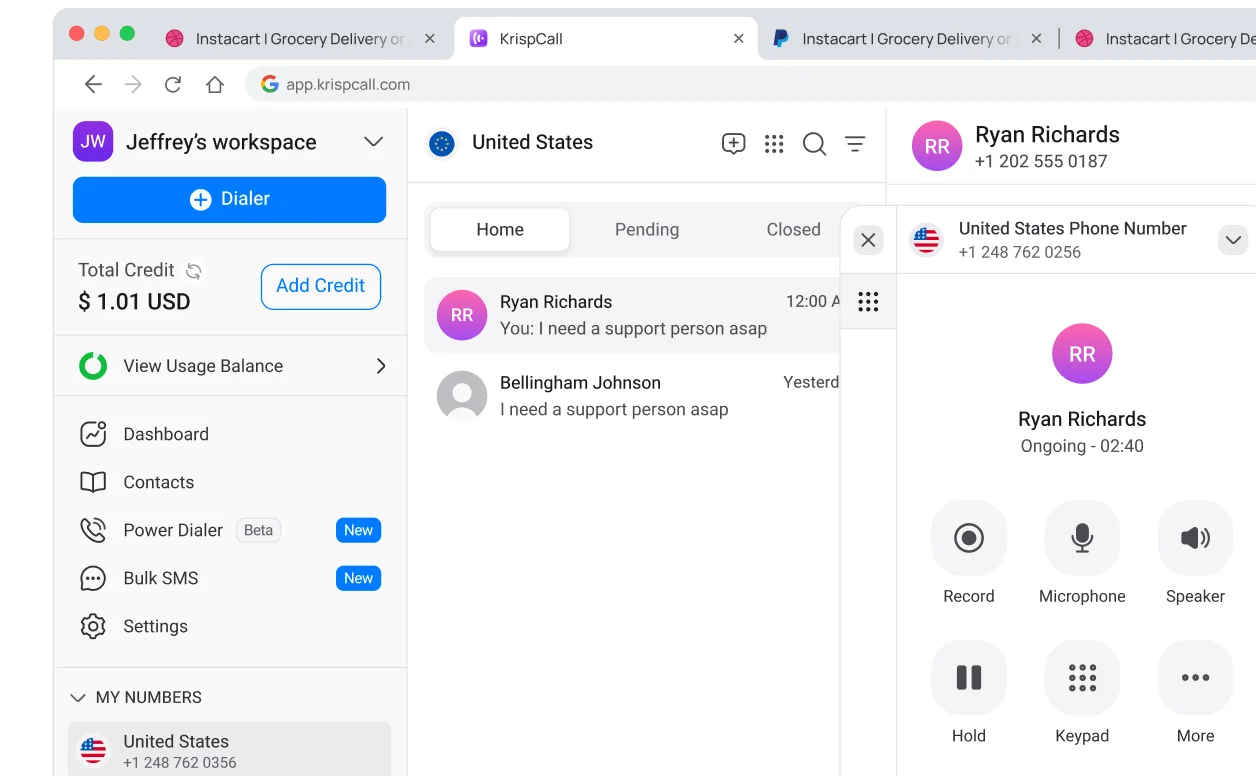
7. KrispCall For Shared Customer Calling
KrispCall is a sensible first application to assess among IPComms alternatives when a small business wants a shared customer-calling workspace. This is relevant to replacing the employee phone experience, rather than preserving a PBX and changing only its trunk. Confirm that the intended project matches that distinction.
For a five- to 50-person team, compare application-based IPComms competitors through daily tasks: answer a shared number, find the relevant conversation and hand a caller to a colleague. Identify the features that need a paid tier. A workable shared-number process is more useful than buying features no one uses.
Advance is referenced at US$32 per user per month billed annually or US$40 on monthly billing, with a stated fit up to 50 users. Qualify recording, transfers, dialer functionality and integrations. Ask separately about AI transcription and other extras rather than assuming the subscription includes every capability.
Pricing And Limitations: Confirm numbers, porting, usage and the provider’s approval for your traffic. A plan feature does not itself authorize every campaign. KrispCall’s G2 rating is 4.5/5 from 392 reviews. Our KrispCall review provides additional product context.
8. Calilio For Reception And Supervision
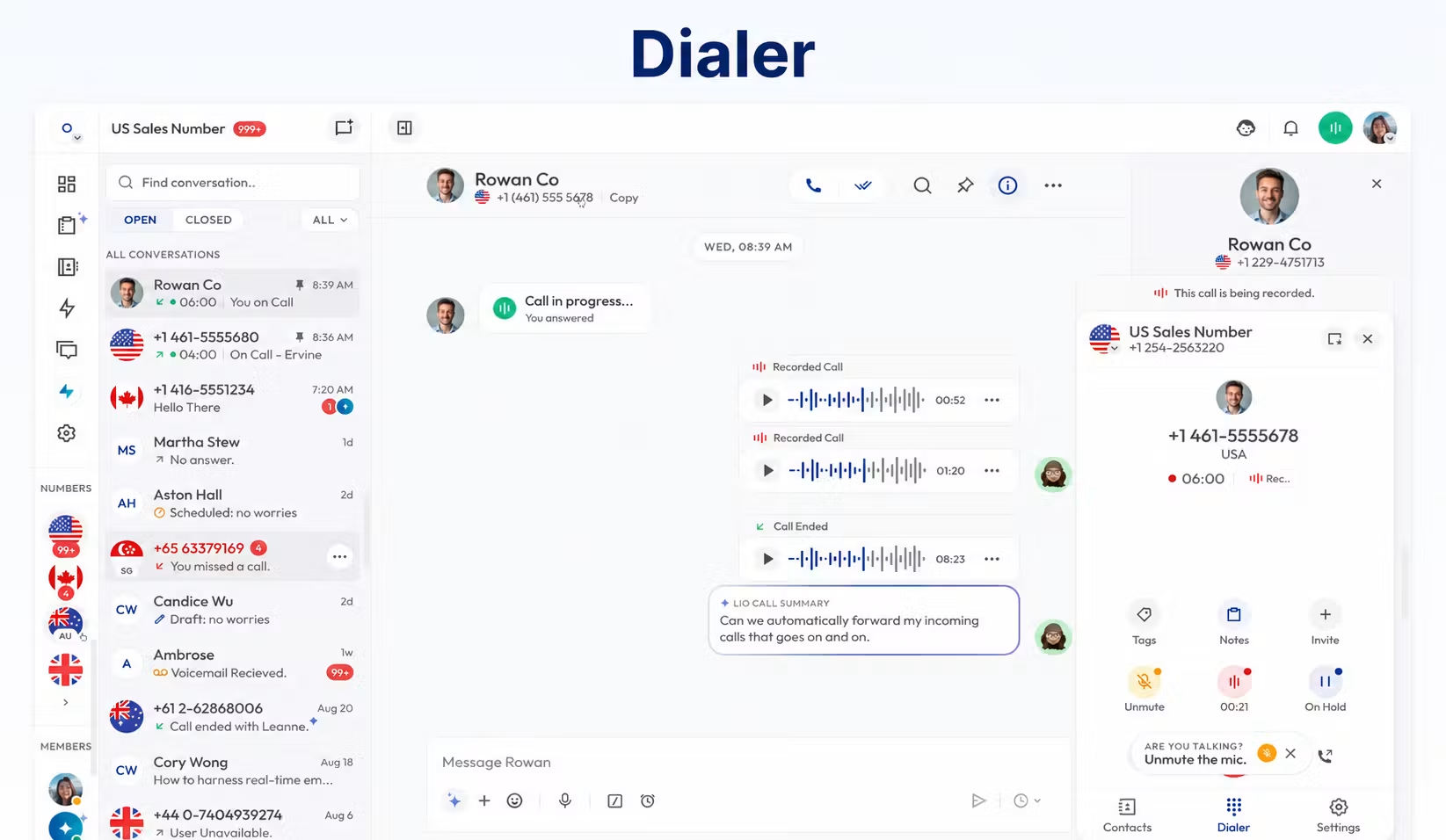
Calilio fits IPComms alternatives for a team focused on how incoming calls reach reception and the right department. The relevant evaluation concerns the phone application and routing workflow. Ask the people answering calls to demonstrate what they need instead of relying solely on the administrator’s feature checklist.
A ten- to 40-person company can compare hosted IPComms competitors by testing a greeting, a transfer, business-hours handling and a missed call. Include supervision if the business needs it. Test the actual configuration proposed for purchase so the demonstration does not depend on a higher tier or separate product.
Premium is the relevant reference when IVR, transfers, business hours and live monitoring are required. It is listed at US$28 per user per month billed annually or US$35 on monthly billing. Confirm calling allowances by destination, along with any storage, AI or other optional charges.
Pricing And Limitations: Check number eligibility and porting before committing. Include usage, taxes and applicable extras in the total. Calilio’s G2 score is 4.7/5 from 94 reviews, a smaller review base than several established platforms. Read our Calilio review for more detail.
9. RingCentral RingEX For An Employee Communications Platform
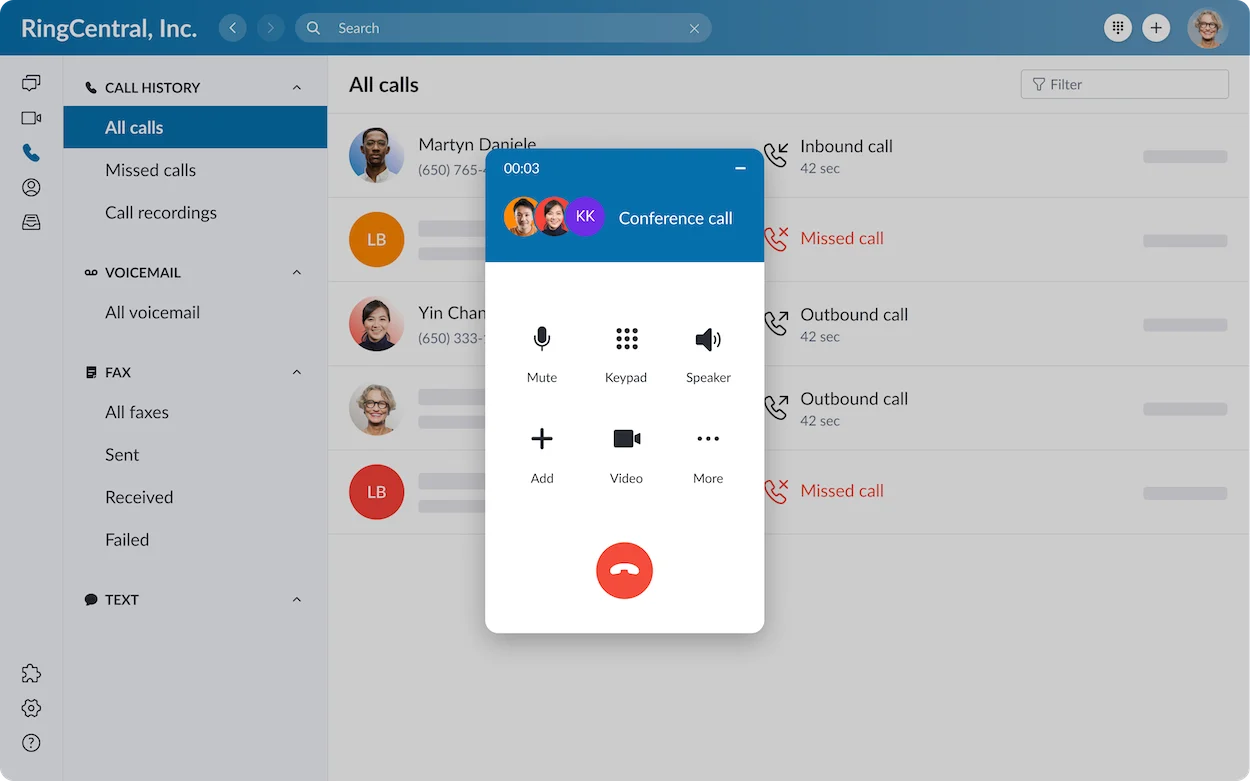
RingCentral RingEX belongs among IPComms alternatives when the company wants a broader hosted employee environment. It can be relevant to a project replacing a PBX and associated applications together. It should be evaluated as that combined project rather than compared directly with a trunk’s per-minute rate.
For a 50- to 250-person organization, compare IPComms competitors on user onboarding, branch administration and shared-number workflows. Ask which staff need licences and which roles can make configuration changes. Include a local administrator in the demonstration if central IT delegates responsibilities to individual offices.
Keep RingEX distinct from RingCX. If contact-center functionality appears in the proposal, identify which users need the additional product and what it adds. Check deployment geography and any requirement to keep another carrier connection. A broad product brand does not establish the details of a supported architecture.
Pricing And Limitations: Request a country-specific proposal covering licences, numbers, calling package, implementation and required add-ons. RingCentral RingEX has a G2 score of 4.2/5 from 1,553 reviews. Compare it as a named platform rather than a rating for the whole RingCentral portfolio.
10. Zoom Phone For Businesses Using Zoom
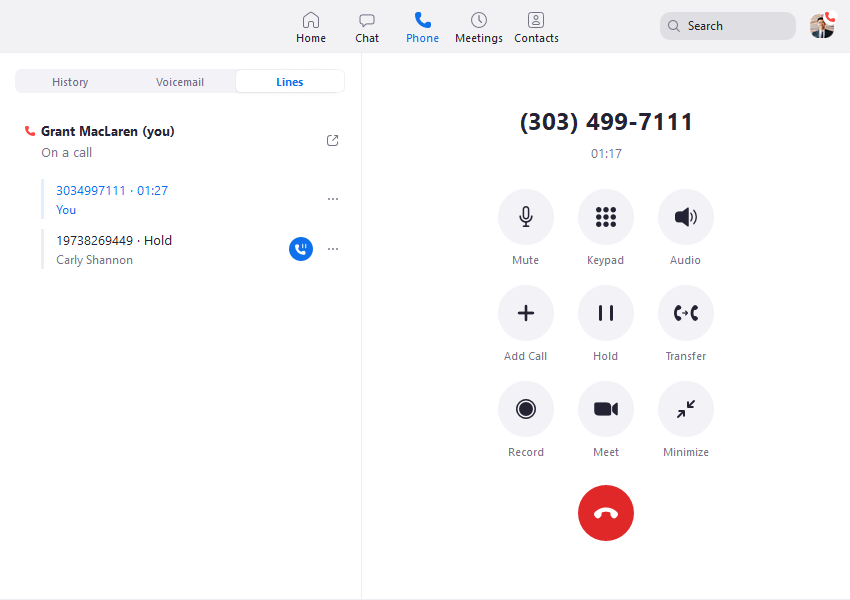
Zoom Phone is one of the IPComms alternatives for a business that wants telephone calling within its existing Zoom environment. Familiarity with meetings may help staff, but the phone-system decision still requires number, routing and support checks. Do not treat a meeting subscription as evidence of included telephony.
For a ten- to 50-person organization, compare application-focused IPComms competitors on direct numbers, shared answering, transfers and administrator tasks. Determine whether the proposed deployment uses native calling or a qualified carrier arrangement. That choice changes which organization owns the PSTN connection and how support is coordinated.
Zoom Phone, meetings and contact-center capabilities are distinct purchasing areas. Ask the provider to identify the exact licence or add-on supplying any queue reporting or supervision the business requires. If the goal is only to change the carrier behind a supported platform connection, keep that smaller scope visible.
Pricing And Limitations: Request a matched regional proposal for numbers, calling package and required extras. Confirm porting eligibility. Zoom Phone’s G2 rating is 4.6/5 from 2,694 reviews; a large sample does not remove the need to validate the service against your number inventory and workflows.
11. GoTo Connect For Multi-Location Hosted Calling
GoTo Connect is relevant among IPComms alternatives when the buyer wants a hosted phone system for departments or several offices. Evaluate the proposal through the actual business structure: reception, location-specific numbers, different opening hours and employees working away from the main office.
For a 20- to 150-person business, compare hosted IPComms competitors using the same call flows. Have the administrator change a schedule and an overflow destination. Include any devices the company intends to retain, and ask who is responsible for local network readiness and configuration.
Identify engagement, reporting or contact-center requirements separately from ordinary employee telephony. A broad product description can cover capabilities that belong to different packages. Ask which item on the order supplies each essential feature and whether the proposed country deployment supports it.
Pricing And Limitations: Request users, numbers, traffic, implementation and required add-ons together. Confirm service geography and porting acceptance. GoTo Connect’s G2 score is 4.4/5 from 1,438 reviews; use that platform feedback alongside a pilot rather than as a guarantee of performance at a specific office.
12. Dialpad Connect For Calling And Conversation Workflows
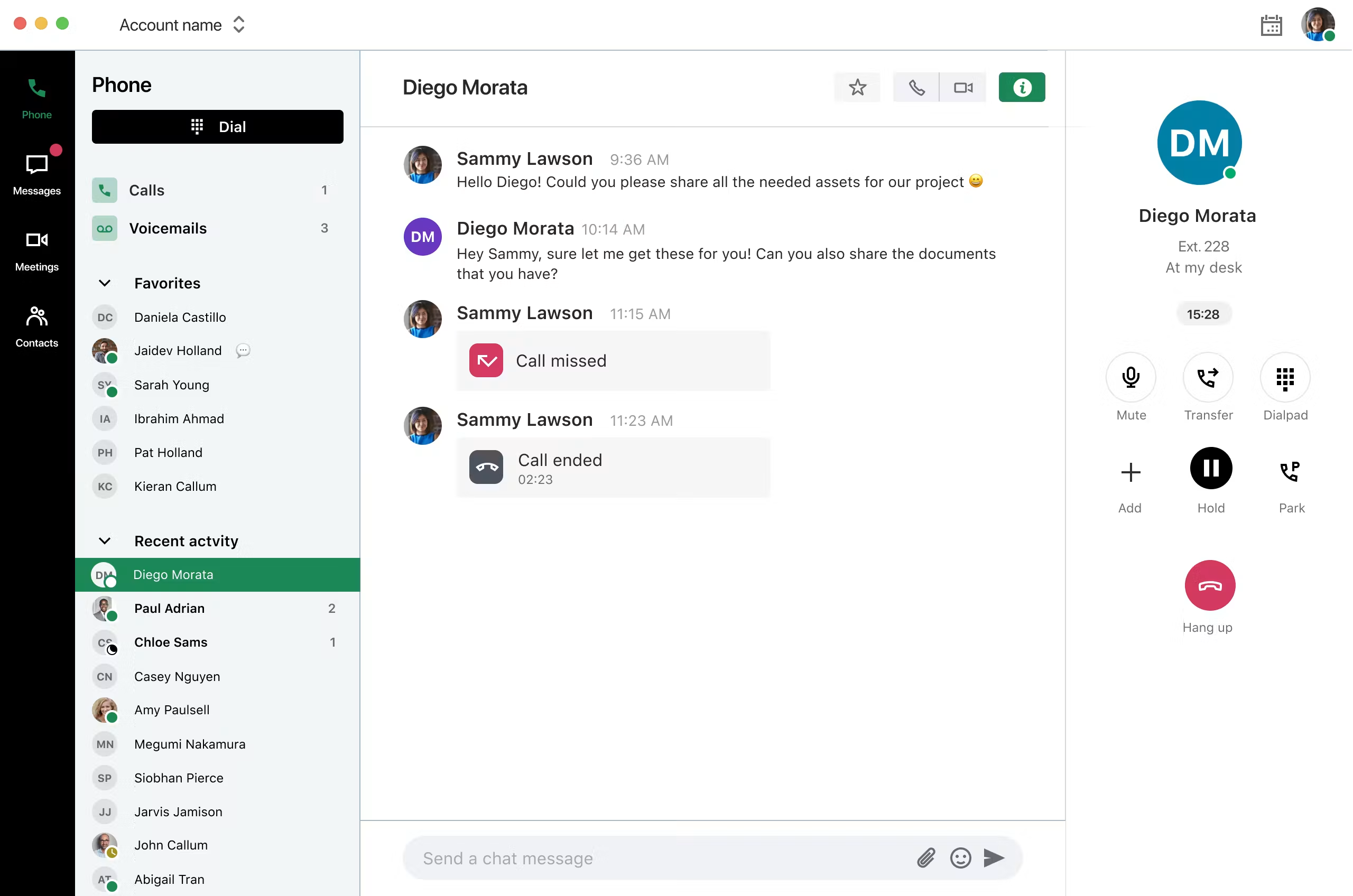
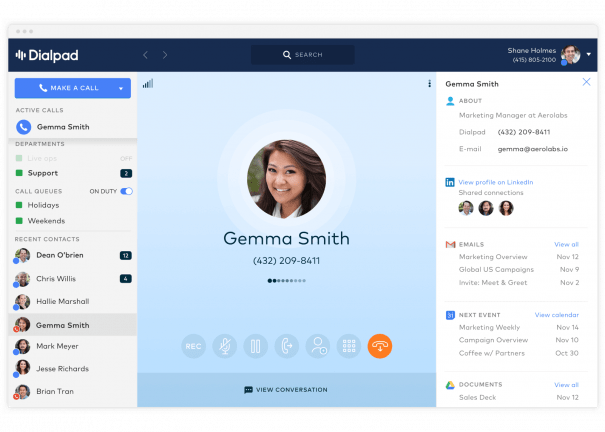
Dialpad Connect completes this list of IPComms alternatives for businesses replacing the calling application employees use. It is relevant when the team wants to examine calling alongside the conversation tools available in its chosen tier. State the desired workflow before comparing individual capabilities.
For a 15- to 100-person company, compare IPComms competitors through a representative user’s task: make or receive a call, complete the follow-up and locate the information in the appropriate customer record. Confirm the exact integration and purchased tier. A logo on an integrations page is not a complete workflow test.
Keep Connect distinct from Dialpad Sell and Support. If another product is needed, ask which users require it and why. Where AI-assisted features matter, qualify supported languages, retention, administrative settings and any usage restrictions that affect the intended deployment.
Pricing And Limitations: Obtain a matched proposal for Connect licences, numbers, calling destinations and additional products. Confirm regional access and porting. Dialpad Connect has a G2 rating of 4.4/5 from 4,269 reviews, representing customer feedback about the platform rather than an independent carrier test.
Choose IPComms Alternatives By The System You Keep
Keep The PBX And Replace Its SIP Carrier
If your PBX already does the job, begin with infrastructure-oriented IPComms alternatives. Document its version, authentication method, number formatting, supported codecs and required transport. Ask the proposed supplier to confirm the supported configuration. A generic statement that it offers SIP is less useful than a working configuration for your actual platform.
Compare IPComms competitors on the boundary between the carrier and your administrator. Who diagnoses a rejected call, who can change routing and what information is needed for a support ticket? Include your existing maintenance arrangement in the decision. Changing the trunk does not remove responsibility for the PBX, firewall or local network.
Replace The Hosted Phone System
Hosted IPComms alternatives replace more than connectivity. They can change extension administration, staff applications, devices and the way calls reach departments. Inventory those functions before purchasing. A company that currently needs only basic reception should not assume it must buy a separate contact-center platform to retain that workflow.
Evaluate application-based IPComms competitors through the same tasks. Include the staff member answering the main number, an employee receiving transferred calls and the administrator managing schedules. Check plan boundaries while testing. A demonstration on an unrestricted account can otherwise conceal the tier needed for the finished deployment.
Keep Teams And Review Its Voice Connection
For Teams projects, qualify IPComms alternatives against the current connection model. Direct Routing, Operator Connect and a platform’s native calling arrangements are different architectures. Retaining the Teams application does not establish that numbers, policies or licence requirements remain identical when the provider changes.
Ask IPComms competitors to identify the exact service and the tasks they will perform. Include tenant configuration, number assignment, reception tools and escalation. Where a session border controller is part of the design, establish who operates it. Avoid comparing a managed deployment with a trunk-only proposal without accounting for the difference in work.
Compare IPComms Competitors Using Your Actual Traffic
The cheapest IPComms alternatives cannot be identified from a seat price or a single destination rate. Gather recent inbound and outbound minutes, numbers by category, peak simultaneous calls, user or extension counts and required features. Give each supplier the same workload and ask for the same billing period.
Separate The Usage Bill From The Complete Service
For illustration, assume 1,000 outbound minutes and 800 inbound minutes qualify for the published local rate references. IPComms usage at US$0.010 outbound and US$0.009 inbound totals US$17.20. Telnyx usage at its published starting references of US$0.005 and US$0.0032 totals US$7.56. This is arithmetic for those assumptions, not a complete price comparison or a guaranteed quote.
When comparing IPComms competitors, add number rental, emergency service, optional features, tax and any other applicable charges. A hosted system also requires the relevant account or user cost. International, toll-free or other destinations can change the calculation. Confirm billing increments and any minimums in the account proposal.
Compare Account, Extension And Seat Models
Some IPComms alternatives charge by user, while IPComms’ published hosted PBX model combines an account charge, additional extensions and metered usage. Those models can behave differently for a quiet office, a busy support team or shared devices. Write down what constitutes a billable user, extension or shared endpoint in each proposal.
For a 12-person office, determine whether all 12 people need individual paid access and how shared reception is licensed. Compare IPComms competitors with the same features and realistic calling allowance. Annual-billing rates and monthly subscriptions should be normalized before deciding that one proposal is cheaper.
Account For Technical And Administrative Work
Infrastructure-focused IPComms alternatives can leave PBX administration with the buyer. Include the effort to configure, monitor and support that system. Conversely, if a hosted app removes hardware or maintenance costs, record the actual saving. Neither assumption should be hidden inside an optimistic recurring-price comparison.
Ask IPComms competitors to separate one-time migration, recurring service and optional support. Include any continuing agreements during the transition. A short overlap may be necessary to validate the move; an overlooked ongoing contract is a different problem. Review the applicable account terms before planning closure.
Check Compatibility, Traffic Rules And Troubleshooting
Confirm Traffic Eligibility Before Testing
IPComms’ published acceptable use policy restricts service to manual, human-initiated conversational traffic and prohibits automated outbound campaigns. That is an important product-fit constraint. When reviewing IPComms alternatives for a different workflow, describe the dialing method, purpose, expected volume and call pattern to the provider and request confirmation of suitability.
Do not assume IPComms competitors accept every workflow because they advertise APIs, AI agents or a power dialer. Product functionality and account permission are separate questions. Qualify the intended use before investing in integration, and ask which policies or approval steps apply. This is a service-selection check rather than a conclusion about whether a campaign meets legal requirements.
Distinguish Call Setup From Usable Audio
A connected call is only part of a successful test. Verify that both participants can hear one another, that hold and transfer behave as expected and that a return call reaches the right destination. For retained devices, confirm the proposed service supports the required configuration rather than assuming any SIP phone will work unchanged.
Ask IPComms alternatives what diagnostic information is available and how to provide it securely. Call detail records and SIP traces can help the appropriate technical team investigate a problem, but they serve different purposes. Agree on the evidence needed for an escalation, including a call identifier, affected numbers and the relevant timestamps.
Verify Capacity And Failure Handling Separately
Compare IPComms competitors on expected simultaneous conversations and new-call attempts. A trial account may have different limits from the proposed production service. Identify those limits before interpreting the result of a test. Also ask what happens if a destination, customer connection or provider endpoint becomes unavailable.
For a branch business, distinguish a provider-side alternate route from the ability of staff to keep working after a local internet failure. Test the approved fallback and assign responsibility for changing it. Do not perform unplanned changes to a production system merely to demonstrate a feature; use an agreed pilot configuration.
Plan Number Porting And The Service Cutover
Moving to IPComms alternatives requires a number inventory and an acceptance plan. Group numbers by business purpose, category and owner. Include the main published line, direct numbers, toll-free numbers and any number associated with messaging, fax or specialist equipment. Identify dependencies that need their own migration discussion.
Get Number Acceptance From IPComms Competitors In Writing
Ask shortlisted IPComms competitors to confirm the number categories they can accept and the records they require. Resolve account-name or authorization mismatches before scheduling the move. A supplier supporting your country does not establish that every number on the existing account is portable to its proposed service.
Assign an owner for the porting request and a person responsible for employee readiness. The new system needs working routes, devices and users before the business number arrives. Confirm commercial activation and existing-service closure separately so the project does not depend on an assumed billing sequence.
Pilot The Full Caller Journey
Test an external caller reaching reception, a transfer, a missed call, out-of-hours routing and an outbound callback. Include the integrations and records that employees rely on. If the project preserves the PBX, test that existing call flows survive the change of trunk rather than checking only basic connectivity.
For reseller or multi-customer deployments, test more than one endpoint configuration and verify usage attribution. Keep a short acceptance record with the result, outstanding issue and responsible owner. It helps the business decide whether the replacement is ready instead of relying on a general impression from a demonstration.
Agree On An Escalation And Recovery Procedure
Before the cutover, identify contacts for the existing supplier, the destination provider and your own system administrator. Agree on the checks that define success and the actions available if calls fail. Do not assume a completed port can be reversed immediately; recovery may depend on routing or coordination with other organizations.
Keep the appropriate existing services active until acceptance and closure responsibilities are confirmed. Remove obsolete access and configuration through the agreed process after the move. That makes the migration a controlled operational change rather than a number order followed by improvised troubleshooting.
Which IPComms Alternative Should You Shortlist?
For a retained PBX, begin with Telnyx and Bandwidth, then include Twilio, Plivo or Sinch Voice where the proposed architecture and account model fit. For a managed Teams-related project, include CallTower. These infrastructure and managed-service options need confirmation against actual numbers, traffic and technical responsibilities.
For a small business replacing its employee phone application, start with KrispCall and Calilio. Include RingCentral RingEX, Zoom Phone, GoTo Connect or Dialpad Connect when their workspace and deployment model better suit the organization. Choose two or three qualified proposals and put them through the same workflow and cost comparison.
The best alternative to IPComms is the service that solves the identified problem without leaving an essential responsibility unassigned. A lower rate, a familiar interface or a high score can be useful, but none is a complete purchasing decision. Confirm the architecture, account eligibility and recurring bill together.
Frequently Asked Questions
What Are The Best IPComms Alternatives?
Telnyx, Bandwidth, Twilio, Plivo and Sinch Voice are relevant infrastructure candidates, while CallTower fits managed voice evaluations. KrispCall, Calilio, RingCentral RingEX, Zoom Phone, GoTo Connect and Dialpad Connect fit employee phone-system projects. The best choice depends on the part of your existing service you intend to replace.
Who Are The Main IPComms Competitors For SIP Trunking?
Telnyx, Bandwidth, Twilio, Plivo and Sinch Voice are relevant candidates. Qualify the exact product, PBX compatibility, numbers, destinations, traffic rules, capacity and support. A provider appearing on a SIP shortlist does not establish that it can reproduce every configuration or accept every existing number.
Which IPComms Alternatives Are Cheapest?
There is no universal cheapest provider. Compare the same numbers, destinations, minutes, feature requirements and technical responsibilities. Starting traffic rates exclude other charges, while a low seat price may depend on annual billing or a tier that lacks required functionality. Obtain a matched account quote before deciding.
Can IPComms Competitors Keep My Existing PBX?
Potentially. A compatible SIP provider can replace the PSTN connection while the business retains its PBX. Confirm the system version, authentication, routing, devices and required features with the destination provider. Plan a pilot and identify who supports the PBX and local network after the change.
Is An IPComms Test Trunk A Permanent Free Service?
No. IPComms describes a limited test with eligibility checks, traffic restrictions and a defined test period. Its published offer provides for paid service afterward unless cancelled as required. Confirm the exact terms before applying; a temporary test number should not be described as permanent free production service.
Can I Use IPComms For Automated Dialing?
IPComms’ published acceptable use policy prohibits automated outbound campaign traffic and specifies manual, human-initiated conversational use. If your workflow differs, discuss it with the provider before deploying. For any replacement, confirm that the intended traffic is permitted instead of assuming a technical integration establishes approval.
Can I Keep Teams While Changing Voice Providers?
Potentially, subject to a supported connection model, licences and number acceptance. Direct Routing and Operator Connect are different architectures. Confirm the proposed tenant changes, administrator tasks and support boundaries, then coordinate the number migration. Keeping the application does not eliminate the carrier transition work.
Does A High G2 Rating Guarantee Better Call Quality?
No. A G2 score aggregates feedback about the named product or platform. It does not measure your routes, local network or configuration. Use customer reviews to frame questions, then evaluate compatibility, support and the actual caller journey through an agreed pilot.
What Customer Reviews Suggest Checking
Bandwidth’s G2 feedback includes positive comments about number management and helpful support, alongside reports of inconsistent responses and complicated processes. Use that mix to request a demonstration of an ordinary number order and an exception. Ask which support arrangement will apply to your account.
CallTower feedback includes praise for platform integration and service support. Individual reviewers also describe porting coordination difficulties and interface improvements they would like. That makes migration ownership and routine administration useful subjects for a demonstration, rather than evidence that every customer will have the same outcome.
Sinch’s broader-platform reviews include positive integration and usability experiences as well as criticism of setup complexity and support response. The score does not isolate SIP trunking. When evaluating IPComms alternatives, distinguish feedback about the overall platform from the precise service proposed for purchase.
Use the same principle across IPComms competitors: reviews help identify questions, while a matched quote and documented pilot establish deployment fit. A larger review base can provide more context, but it does not validate number eligibility, permitted traffic or your local network. Choose on the responsibilities and capabilities your team can verify.
Affiliate Disclosure: VoIPCalling may earn a commission when you use sponsored provider links. Partner relationships can influence placement. Confirm pricing, eligibility, service scope and contract terms directly with the provider before purchasing.