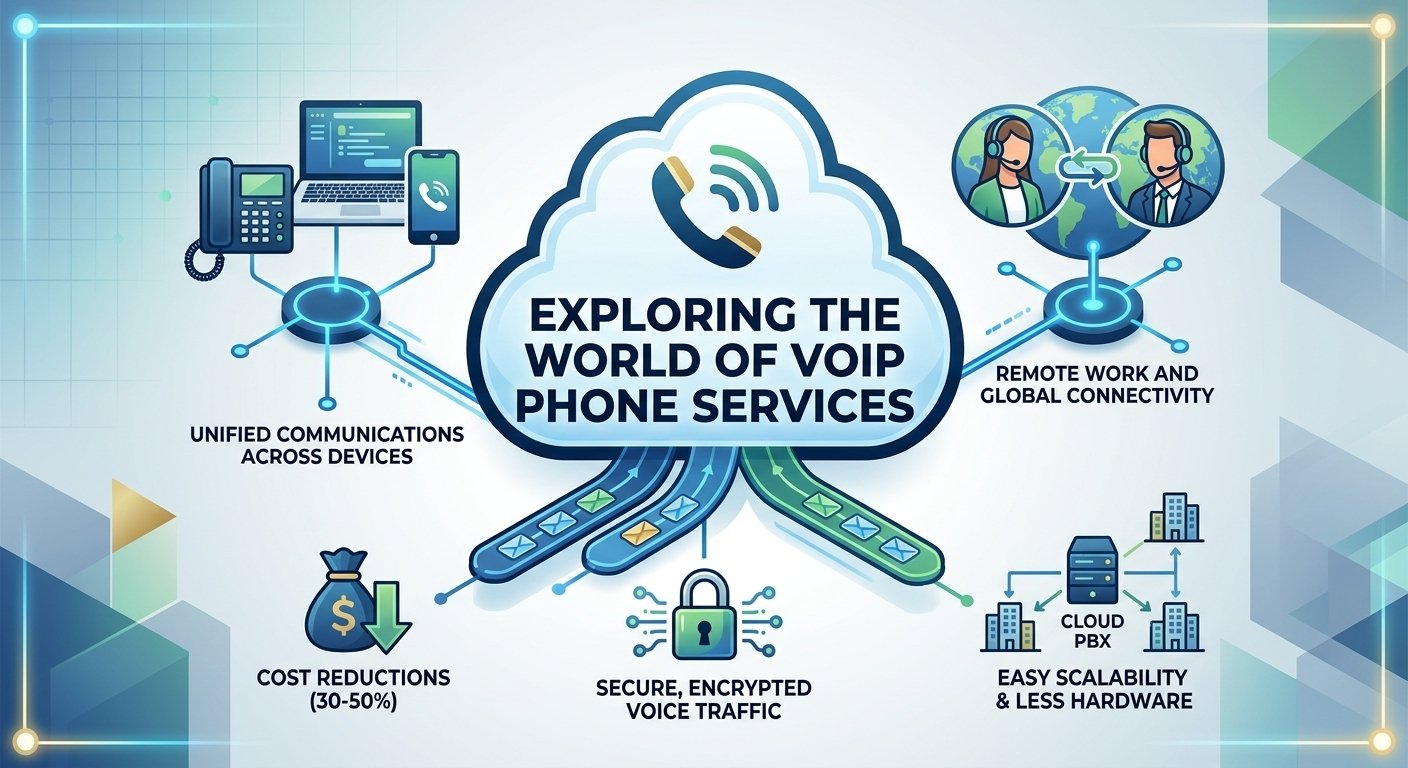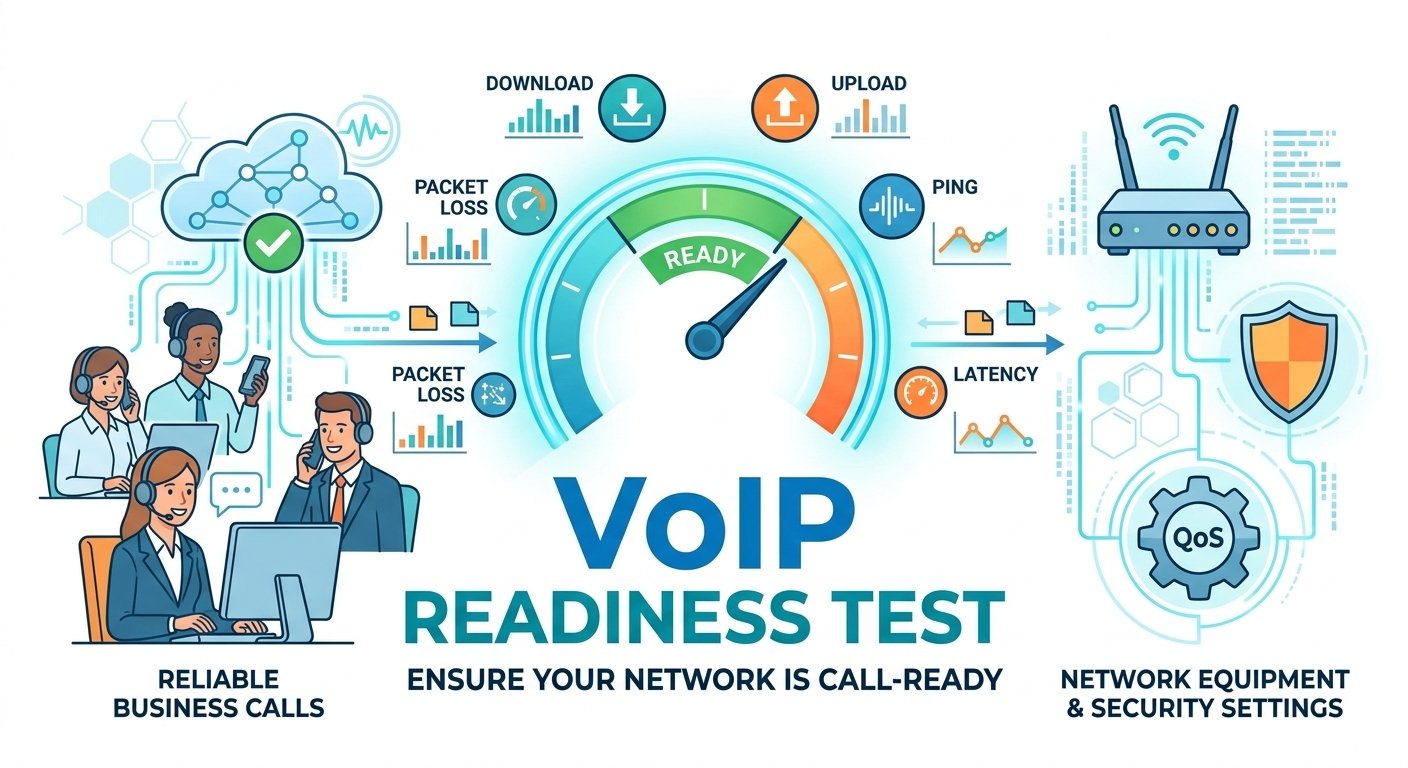
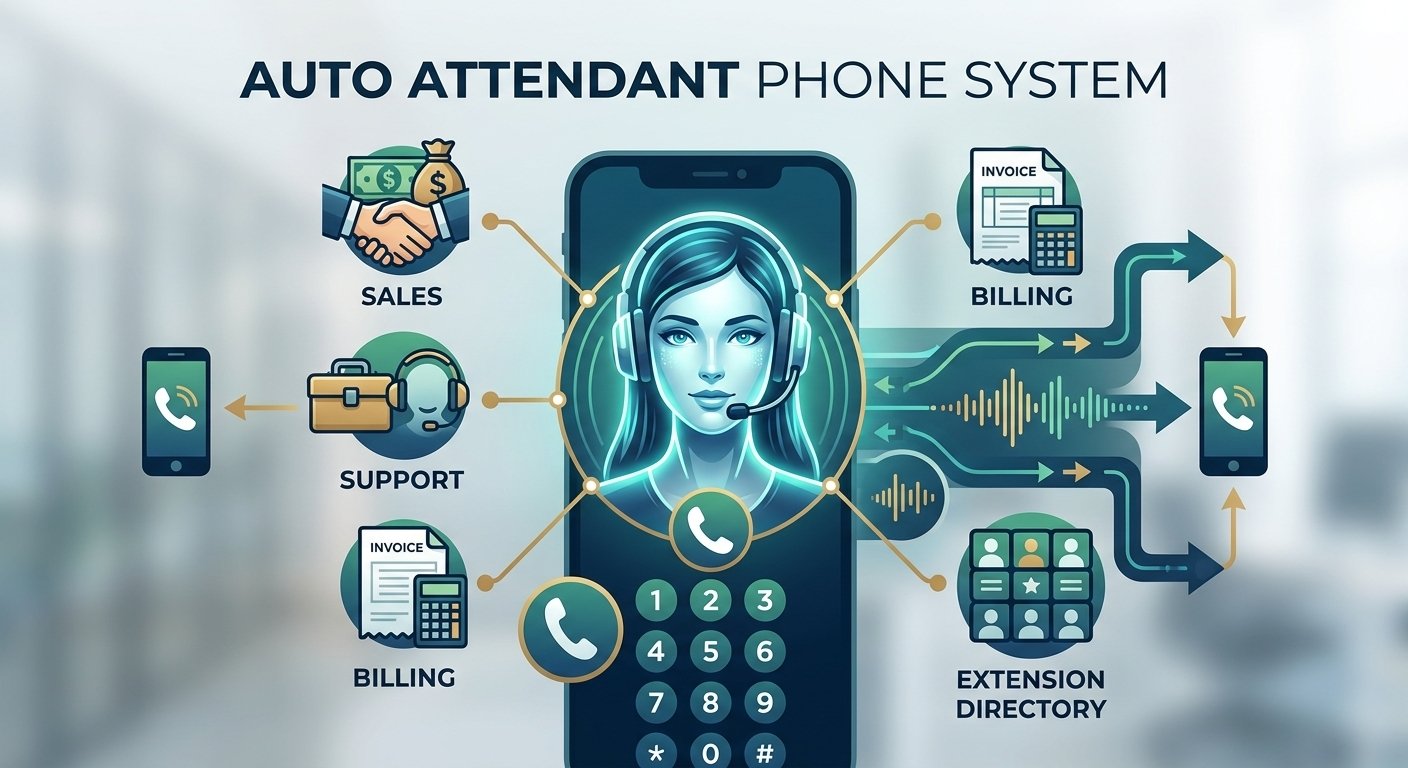
An auto attendant phone system is a professional communication feature that serves as a virtual receptionist. It automatically answers calls and provides a menu of options to route callers to the correct department or extension. This technology eliminates the need for a human operator to answer every initial inquiry, ensuring that every inbound call is greeted instantly and professionally. By utilizing pre-recorded messages and keypad navigation, an auto attendant phone system streamlines call flows, reduces wait times, and provides 24/7 accessibility for customers seeking information or support without requiring live agent intervention.
What is an Auto Attendant?
An auto attendant is essentially a voice-based navigation menu that helps manage incoming business communications. Think of it as a digital gateway that greets everyone who dials your company number. Unlike a traditional voicemail box that simply records messages, this system acts dynamically by interacting with the caller. It can offer various pathways, such as reaching a specific person through their extension, finding a department like sales or billing, or listening to pre-recorded information like office hours and physical location.
The modern auto attendant phone system has evolved significantly from its early mechanical roots. Today, it is usually a cloud-based feature integrated within a Voice over Internet Protocol platform. This allows businesses of all sizes to appear more established and organized. For a small startup, having an automated greeting gives the impression of a much larger enterprise, while for large corporations, it is a critical tool for managing thousands of daily interactions without overwhelming the front desk staff.
How Does an Auto Attendant Work?
The process begins when your business number is dialed by a caller. The system prevents the frustration of long ring times by picking up the call instantly. Upon connection, the auto attendant phone system plays a customized greeting. This greeting is often the first interaction a customer has with your brand, making it a vital component of your professional image. The system then presents a series of options, referred as a phone menu, which the caller navigates using their phone’s keypad or sometimes through voice commands.
1. A customer calls the business number
The call reaches the business phone system and is answered by the configured auto attendant.
2. The caller hears a greeting
A recorded message welcomes the caller and explains the available menu options.
3. The caller selects an option
For example, the caller might press 1 for Sales, 2 for Support, or 3 for Billing.
4. The system routes the call
The caller is transferred to the corresponding extension, department, ring group, voicemail box, or another configured destination.
5. Fallback rules apply if necessary
If nobody answers, the phone system can use another configured route, such as voicemail or another department.
Technically, the system relies on Dual-Tone Multi-Frequency signaling. When a caller presses a number on their keypad, it sends a specific tone that the software identifies to trigger a programmed action. If the caller selects the option for sales, the system instantly consults its routing table and forwards the signal to the specific handsets or ring groups assigned to the sales team. If no one is available to pick up, the system can be configured to send the caller to a specific voicemail or back to the main menu, ensuring the caller is never left in a dead-end connection.
Key Features of Auto Attendant Systems
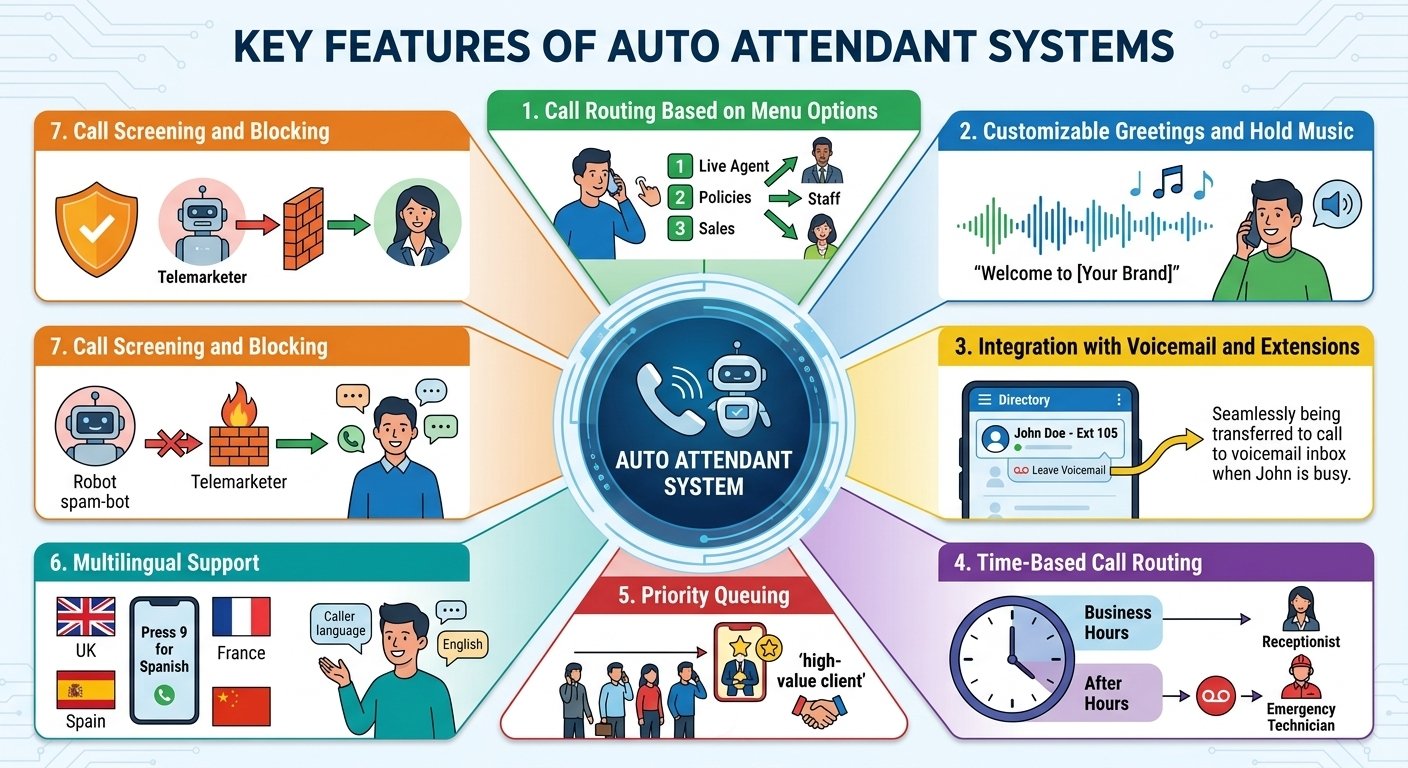
Every robust auto attendant phone system comes with a suite of features, which are designed to enhance both the caller experience and the administrative control of the business. These features are what separate a basic answering machine from a comprehensive communication hub.
1. Call Routing Based on Menu Options
The primary function of any auto attendant phone system is its ability to direct traffic. You can set up specific paths for different needs. For instance, pressing one might lead to a live agent, while pressing two provides a recorded message about shipping policies. This ensures that callers reach the most qualified person to handle their specific request, which significantly improves first-call resolution rates.
2. Customizable Greetings and Hold Music
Personalization is key in building brand loyalty. An auto attendant phone system allows you to upload your own audio files or use text-to-speech technology to create greetings that reflect your brand voice. Furthermore, when callers are being transferred or placed on hold, you can provide music or informational messages. This keeps the caller engaged and reduces perceived wait times, making the overall experience much more pleasant.
3. Integration with Voicemail and Extensions
Modern systems do not work in isolation. They are deeply integrated with the entire office directory. If a caller knows the extension of the person they are trying to reach, the auto attendant phone system can allow them to dial it immediately. If the recipient is busy, the call is seamlessly handed off to their personal voicemail, ensuring that the communication loop remains unbroken and professional.
4. Time-Based Call Routing
Businesses do not operate on a 24-hour live schedule, but their phones can. With time-based routing, your auto attendant phone system can change its behavior based on the clock. During business hours, it might route calls to the front desk. After hours, it can switch to a different greeting that informs callers of your opening times and offers the option to leave a message or reach an emergency on-call technician.
5. Priority Queuing
In high-volume environments, not all calls are equal. Some systems allow you to set up priority queuing within the auto attendant framework. This means that if a high-value client or an emergency line calls in, the system recognizes the number and places them at the front of the line. This ensures that your most critical interactions are handled with the urgency they deserve.
6. Multilingual Support
In our globalized economy, serving a diverse customer base is crucial. A high-quality auto attendant phone system offers multilingual menus. A caller might hear a greeting in English and then be prompted to “Press nine for Spanish.” Once selected, the entire menu and subsequent instructions are delivered in the chosen language, making your business accessible to a much wider demographic.
7. Call Screening and Blocking
Security and productivity are often overlooked aspects of phone management. An auto attendant phone system can help filter out robocalls and telemarketers before they ever reach your employees. By requiring a caller to interact with a menu, most automated spam bots are naturally defeated. Additionally, known nuisance numbers can be blocked entirely at the system level.
How to Set Up an Auto Attendant
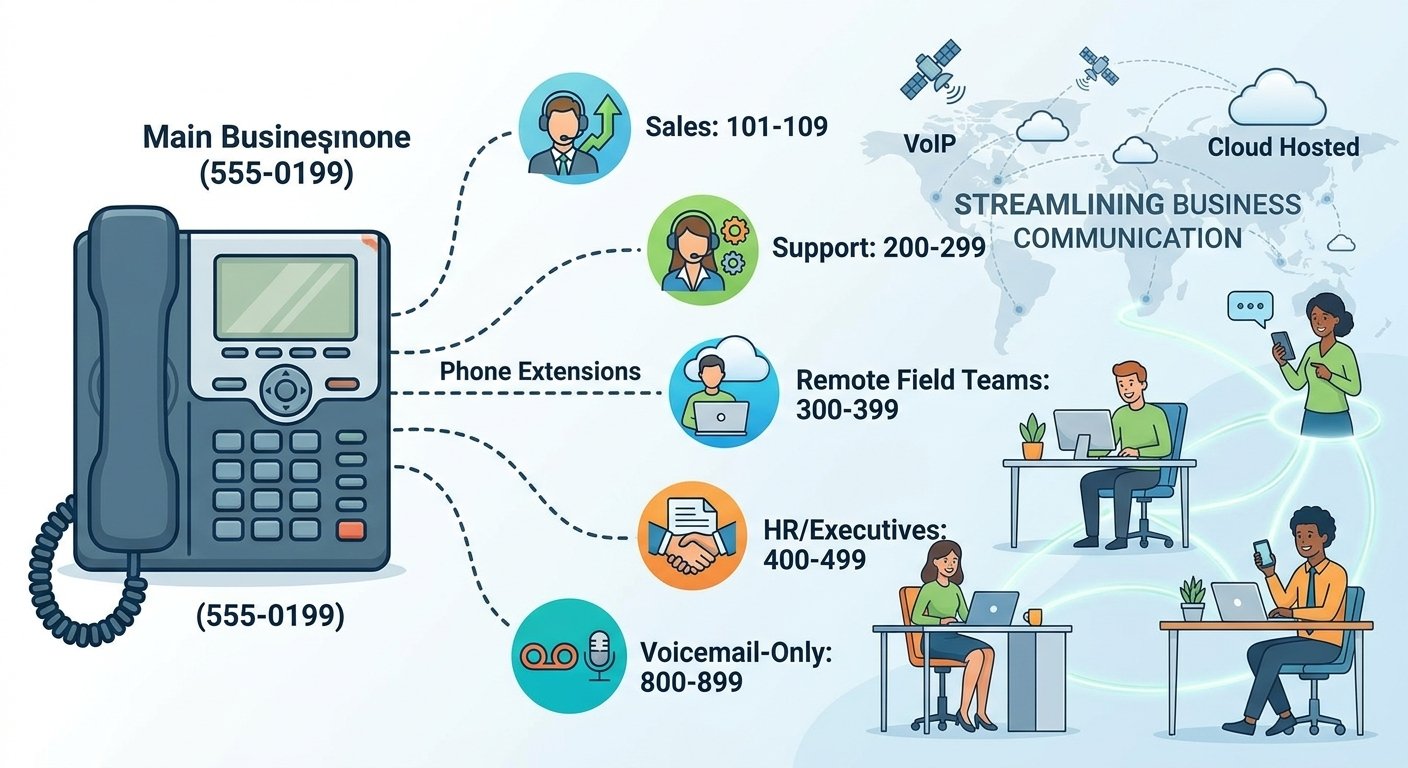
Setting up an auto attendant phone system is a straightforward process that usually takes place within a web-based dashboard. The first step involves defining your goals. You need to decide which departments need their own options and who the primary recipients for each line will be. Once you have a clear map of your desired call flow, you can begin the technical configuration by assigning numbers 0 through 9 to specific destinations like extensions, ring groups, or external mobile numbers.
After the routing logic is in place, the next phase is recording the audio. You can use professional voice talent for a high-end feel or use internal staff for a more personal touch. Most systems also offer high-quality text-to-speech engines that allow you to simply type your script. Once the audio is uploaded, you should configure your business hours and holiday schedules. The final and most important step is testing. You must call into your own system from an outside line to ensure every button press leads to the correct destination and that the audio levels are clear.
The Difference Between an Auto Attendant and IVR
While the terms are often used interchangeably, there is a technical distinction between an auto attendant phone system and an Interactive Voice Response system. An auto attendant is primarily a routing tool. It acts like a switchboard operator that directs calls based on simple inputs. It is the perfect solution for businesses that need to get people to the right department quickly without complex data interaction.
| Feature | Auto Attendant | IVR |
|---|---|---|
| Greets callers | Yes | Yes |
| “Press 1 for Sales” | Yes | Yes |
| Routes to departments | Yes | Yes |
| Database interaction | Usually limited | Can support it |
| Self-service transactions | Limited | More advanced |
| Account information | Usually no | Can be supported |
| Best for | Basic call routing | Advanced automated interactions |
An IVR system is much more advanced. It can interact with company databases to provide specific information to a caller. For example, when you call a bank to check your balance without speaking to a human, you are using an IVR. The IVR can verify your identity, fetch data from a server, and read it back to you. While an auto attendant phone system is a component of many IVR setups, the IVR itself is capable of handling entire transactions from start to finish.
Pros and Cons of Auto Attendants
| Pros | Cons |
| Professional corporate image and brand trust | Potential customer frustration from menu fatigue |
| Consistent and polite branded greetings | Lack of personal human touch |
| Reduced labor costs through staff redirection | Risk of lost business from long greetings |
| Constant availability with zero missed calls | Impersonal feel for high-end luxury services |
| Improved accuracy through caller self-selection | Danger of brand damage from routing loops |
| Easy scalability for new departments | Potential for high customer dissatisfaction |
| Faster connection by eliminating operator wait times | Limited effectiveness for complex inquiries |
How to Choose an Auto Attendant Phone System
Selecting the right provider requires a deep look at your current business needs and your future growth plans. Not all systems are created equal, and the best choice for a retail shop might be different from the best choice for a tech startup. You must evaluate the software based on its ease of use, the quality of its mobile app, and the reliability of its network.
1. Note Why Customers Call You
Before looking at technical specs, analyze your call volume. Do people call to check order status, or do they call for complex technical support? If your calls are mostly simple inquiries, a basic auto attendant phone system will suffice. However, if your callers need to reach many different specialized departments, you will need a system that supports multi-level menus.
2. Map Out Your IVR Call Flow
Visualization is a powerful tool in system design. Draw a flowchart of how you want a call to progress. Start from the main greeting and branch out into sub-menus. If your map looks like a tangled web, your customers will likely feel lost. A clean, logical call flow is the hallmark of a great auto attendant phone system. Ensure that there is always an easy way to get back to the main menu or speak to an agent.
3. Consider Your Budget
Pricing for these systems varies widely. Some providers include a full-featured auto attendant in their basic tier, while others charge a premium for multi-level menus. You should look at the total cost of ownership, including any per-user fees and the cost of toll-free numbers. Often, a slightly more expensive plan that includes more features is a better long-term value than a bare-bones budget option.
4. Determine Any Integrations or Analytics
Data is the lifeblood of modern business. You should choose an auto attendant phone system that provides detailed analytics. You want to know which menu options are pressed most often and at what point callers tend to hang up. Furthermore, if you use a Customer Relationship Management tool, look for a system that integrates with it. This allows your agents to see the caller’s history the moment the call is transferred.
5. Compare Auto Attendant Features
Once you have your shortlist of providers, do a feature-by-feature comparison. Look for things like a visual dial plan editor, which makes changing your menu as easy as dragging and dropping icons. Also, check the quality of their text-to-speech voices. Some sound very robotic, while others are nearly indistinguishable from a human voice. The quality of these features will directly impact how your brand is perceived.
The Best Auto Attendant Phone Systems
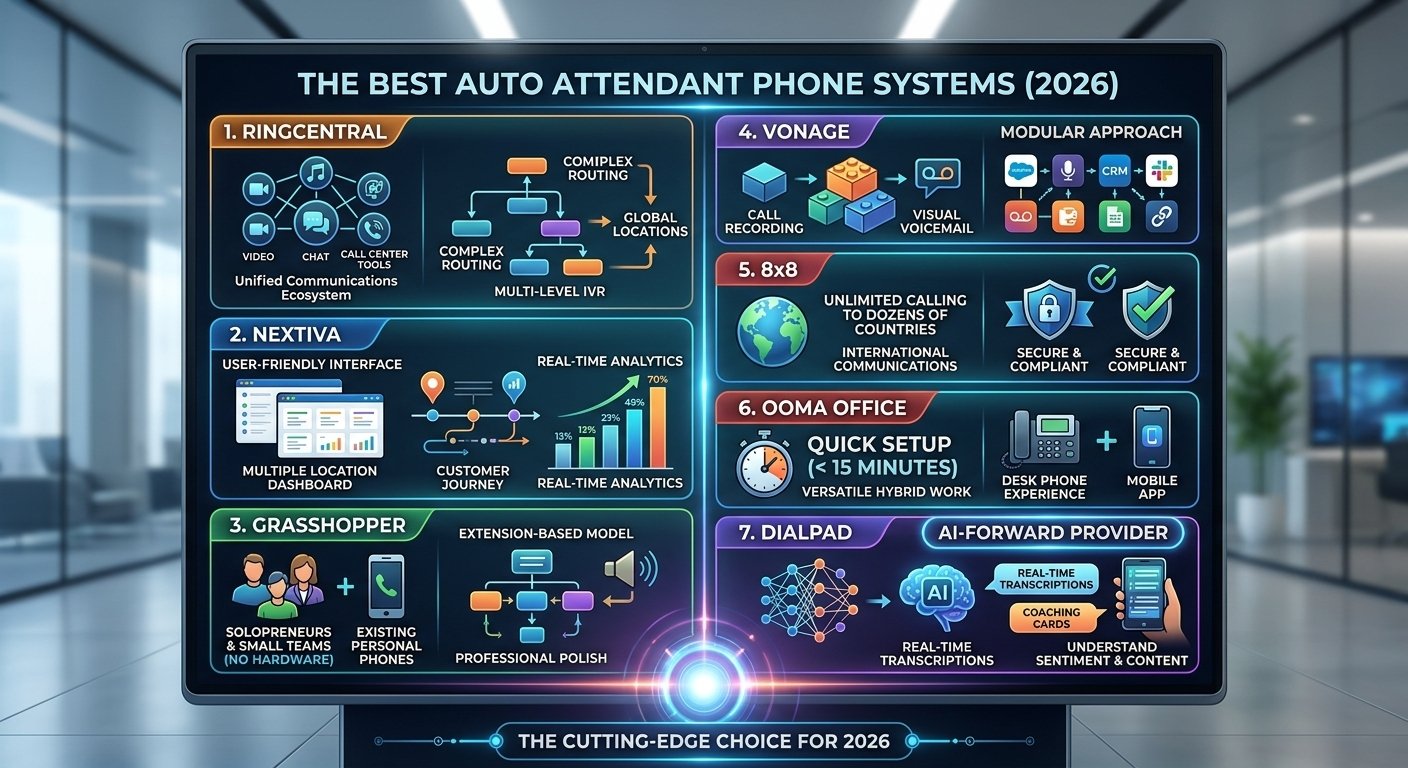
As we look toward the landscape of 2026, several providers stand out for their innovation and reliability. These companies have refined their automated features to be more intuitive and powerful than ever before.
-
RingCentral
RingCentral remains a leader in the unified communications space. Their auto attendant phone system is part of a massive ecosystem that includes video, chat, and detailed call center tools. It is particularly well-suited for businesses that have complex routing needs across multiple global locations. Their multi-level IVR is highly praised for its stability and the depth of its configuration options.
-
Nextiva
Nextiva is known for its “Amazing Service” and its focus on the customer journey. Their platform offers a very user-friendly interface for setting up an auto attendant phone system. One of their standout features is the ability to easily manage multiple locations from a single dashboard. They also provide excellent real-time analytics that help you optimize your menu based on actual caller behavior.
-
Grasshopper
For solopreneurs and very small teams, Grasshopper is a classic choice. It doesn’t require new hardware; it simply sits on top of your existing personal phones. While its auto attendant phone system is more of an “extension-based” model, it provides the professional polish that small businesses need to compete with larger rivals without the complexity of a full PBX system.
-
Vonage
Vonage has transformed from a residential provider into a powerful business tool. Their auto attendant phone system is highly customizable and integrates well with a variety of third-party applications. They are a great choice for businesses that want a modular approach, allowing you to add features like call recording or advanced visual voicemail as your business grows.
-
8×8
8×8 specializes in international communications. Their auto attendant phone system is robust and designed to handle global traffic with ease. They offer unlimited calling to dozens of countries, making them the go-to provider for teams with a heavy international presence. Their system is also known for high levels of security and compliance, which is vital for industries like healthcare or finance.
-
Ooma
Ooma Office is designed specifically for the needs of small businesses. Their auto attendant phone system is incredibly easy to set up, often taking less than 15 minutes to go live. They provide a high-quality desk phone experience alongside a mobile app, making it a versatile choice for hybrid work environments where employees move between the office and home.
-
Dialpad
Dialpad is the most AI-forward provider on this list. Their auto attendant phone system is supplemented by Artificial Intelligence that can transcribe calls in real-time and provide “coaching cards” to agents. If you want a system that not only routes calls but also helps you understand the sentiment and content of those calls, Dialpad is the cutting-edge choice for 2026.
Are Auto-Attendant Phone Systems IVR Alternatives?
In many cases, an auto attendant phone system is a perfectly suitable alternative to a full IVR, especially for small to medium-sized businesses. If your primary goal is to greet callers and get them to the right person, you don’t need the expense or complexity of a full IVR. Statistics from the communications industry suggest that nearly 70% of business routing needs can be handled by a standard auto-attendant without the need for database integration.
However, if your business requires customers to perform tasks like checking a bank balance, updating a prescription, or verifying a flight status, then an auto-attendant will not be enough. You must weigh the simplicity and lower cost of an auto attendant phone system against the advanced self-service capabilities of an IVR. For most growing companies, starting with a high-quality auto-attendant and upgrading to IVR features later is the most logical path.
Read More: How to Get a Business Phone Number? Guide and Top Providers
Conclusion
The evolution of the auto attendant phone system has made professional communication tools accessible to every business, regardless of size or budget. By 2026, these systems have become more than just a convenience; they are a critical component of a company’s brand identity and operational efficiency. Whether you are a solo freelancer or a global corporation, the right automated greeting can save you time, reduce your costs, and most importantly, provide your customers with a seamless and respectful experience from the moment they pick up the phone.
Frequently Asked Questions
-
What is an auto attendant phone system?
An auto attendant phone system is an automated business feature that answers incoming calls and provides a voice menu to help callers reach specific departments or extensions without a human operator. It acts as a 24/7 virtual receptionist, ensuring every caller is greeted professionally and routed to the correct destination through keypad or voice inputs.
-
What is the difference between an auto attendant and an IVR?
An auto attendant is a simple routing tool that directs calls based on menu selections (e.g., “Press 1 for Sales”). However, an IVR (Interactive Voice Response) is more advanced and can interact with databases to provide specific information like account balances or order status.
-
How much does an auto attendant phone system cost?
Most cloud-based VoIP providers include an auto attendant in their standard plans, which usually range from $15 to $35 per user per month. Some providers may charge extra for multi-level menus or advanced AI features, but for most small businesses, it is part of a bundled subscription.
-
What is the difference between a call queue and an auto attendant?
An auto attendant greets callers and asks them where they want to go. A call queue is a “waiting room” where callers are placed after they have made a selection, holding them in line until an agent becomes available to take the call.
-
How do auto attendants help remote and field service teams?
They can route calls to mobile phones or home offices seamlessly, so the caller never knows the agent isn’t in a central office. They provide a unified “front” for a team that might be geographically dispersed across the country.
-
Is an auto attendant the same as a virtual receptionist?
Technically, an auto attendant is the software system itself. The term “virtual receptionist” can refer to this software, but it is also sometimes used to describe a live person working remotely who answers calls for your business.
-
Which cloud platform has the best auto attendant for 2026?
RingCentral and Nextiva are generally considered the top choices for reliability and feature depth. GoTo Connect is often cited as the best for ease of setup due to its visual drag-and-drop editor.
-
What should SMBs look for in a cloud-based auto attendant?
Ease of configuration is the most important factor for small businesses without dedicated IT staff. Reliability (uptime) and a high-quality mobile app are also essential for managing calls on the go.
-
Can I record my own greetings for my auto attendant phone system?
Yes, almost all modern systems allow you to upload MP3 or WAV files. Many also provide high-quality text-to-speech tools that allow you to generate a professional-sounding greeting by simply typing your script.