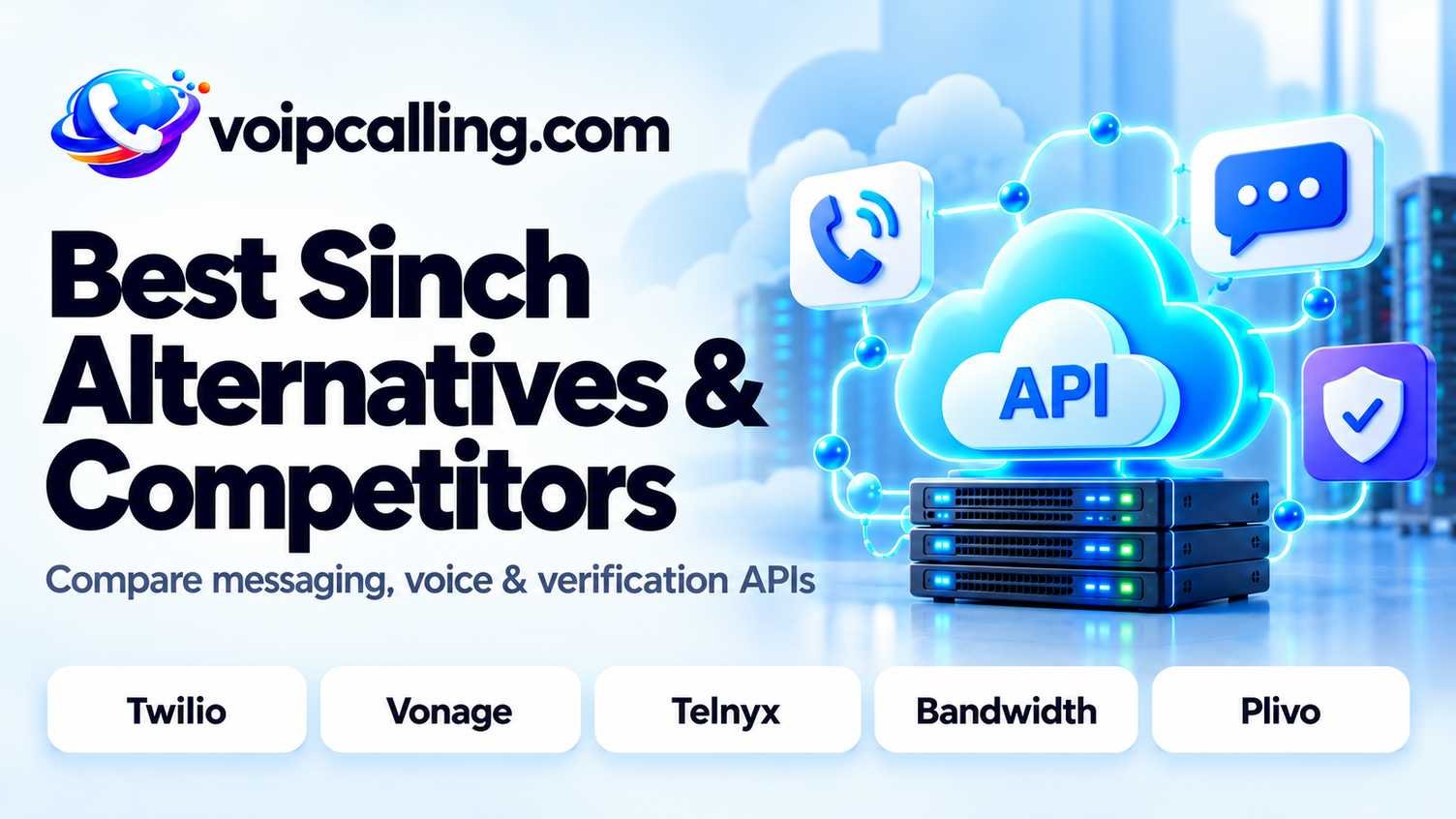
The best Sinch alternatives to evaluate for communications APIs are Twilio, Vonage Communications APIs, Telnyx, Bandwidth and Plivo. Start with Twilio or Vonage for a multichannel application, Telnyx or Bandwidth for a focused messaging-and-voice comparison, and Plivo when its current plan requirements fit your project.
These Sinch competitors are a shortlist for messaging, programmable voice and related verification workloads. A Sinch replacement for a finished messaging application, contact center or email-only product requires a separate feature evaluation. Decide which Sinch service you actually use before moving accounts or comparing prices.
Choose Sinch Alternatives For The Product You Actually Use
Match Sinch alternatives to the workload you need to replace. Sinch alternatives span different kinds of software and telecom service. Sinch’s product catalog distinguishes APIs from applications and lists messaging, email, voice, verification and numbers separately.
When evaluating Sinch alternatives, document the channels, destinations, sender identities and application behavior that must survive a move. A good comparison of Sinch competitors should identify what changes in your code and what remains a telecom onboarding task.
- Messaging APIs: compare Sinch alternatives against an inventory of SMS, MMS, WhatsApp, RCS and any other channels actually in use.
- Voice APIs or SIP: assess Sinch alternatives by mapping call control, numbers, call legs, recordings and media handling.
- Verification: compare Sinch alternatives by documenting challenge generation, expiry, retries, fallback and reporting.
- Applications: for Sinch alternatives, map inboxes, campaign tools, agent permissions and integrations separately from transport.
- Email: assess Sinch alternatives using sending domains, templates, reputation, suppression data and reporting as their own project.
A Sinch replacement need not replace everything at once. Testing Sinch alternatives with one channel first can reduce the initial scope, provided ownership, reporting and customer preferences stay consistent across the remaining systems.
Sinch Alternatives Compared: Messaging Prices, Ratings And Trials
G2 Customer Ratings: Twilio: 4.0/5 from 533 reviews; Vonage Communications APIs: 4.2/5 from 404; Telnyx CPaaS: 4.7/5 from 528; Bandwidth: 4.4/5 from 504; Plivo: 4.5/5 from 746. These platform scores are not separate ratings for individual channels or purchased plans.
Compare Sinch alternatives using the same sender, destination and billable unit. The USD figures below describe specific public pricing examples, not complete invoices. Sinch competitors may charge separately for carriers, registration, numbers, features and support.
| Provider | Best Fit | Plan Boundary | Pricing & Trial |
|---|---|---|---|
| Custom messaging applications that also need voice or verification APIs. | Programmable Messaging is not a finished campaign or agent application. Check sender registration and extra fees. | US SMS base: $0.0083/segmentInbound and outbound base reference; carrier fees, registration and numbers add cost.30-Day Free Trial — product-specific units, verified recipients and country limits.Start 30-Day Free Trial | |
| A multichannel API evaluation spanning messaging, voice and verification. | Evaluate Communications APIs rather than Business Communications or Contact Center. Channel approval is separate. | Country- and sender-specific pricingRequest destination, sender, channel, number and carrier charges. Numeric route rate not verified.Free Trial Available — confirm duration, credit allowance and SMS restrictions.Start Free Trial | |
| SMS and programmable calling evaluated with a carrier-oriented platform. | SMS is charged per message part plus carrier fees. Free account signup does not mean free usage. | SMS from $0.004/message partInbound/outbound reference plus carrier fees; numbers and registration priced separately.No Free Trial Credit Currently Advertised — signup guidance says no active free-credit promotion.Check Pricing | |
| US messaging workloads, number operations and communications development. | The published US 10DLC rate is not a universal global or toll-free rate. Confirm segment and carrier charges. | US 10DLC outbound SMS: $0.004/messagePublished API platform reference; confirm billable units, carrier fees and number charges.30-Day Messaging API Free Trial — Build: 3,000 credits and one US local number; verified mobile recipient; no card required.Start 30-Day Messaging Free Trial | |
| Voice/SIP projects or messaging buyers able to meet Enterprise terms. | US-region Professional excludes messaging; Enterprise starts at $1,000/month. The free trial is not proof of messaging access. | US-region Enterprise from $1,000/monthMessaging requires the appropriate Enterprise plan. Obtain channel-specific usage rates.3-Week Free Trial — $10 credits; region/product limits. Confirm messaging evaluation separately.Start 3-Week Free Trial |





A trial is limited evaluation access. A demo, refund policy or paid pilot is different. Where duration or channel access was not verified, it is explicitly left unconfirmed; a free account does not establish free production usage.
1. Twilio: For A Custom Multichannel Application
Twilio is one of the Sinch alternatives to examine when developers want communications APIs for messaging alongside voice or verification. Evaluate Sinch alternatives at the actual product level; a broad platform relationship does not make every feature part of one price.
Pricing boundary: its US SMS base rate is $0.0083 per segment for inbound and outbound long-code traffic. For Sinch competitors, carrier fees, numbers and onboarding add costs, and optional messaging features have separate prices. For Sinch competitors, that base rate is not the total cost of a campaign or verification workflow.
The verified 30-day trial provides product-specific free units. Geographic, recipient and content restrictions apply. Ask Sinch competitors to identify which of your tests can run before production approval and which require account upgrades.
A Twilio-based Sinch replacement should prove message submission, delivery events, replies, opt-outs and failure handling in your application. Our Twilio alternatives guide provides context for the reverse buying decision.
2. Vonage Communications APIs: For Messaging, Voice And Verification
Vonage Communications APIs belongs among Sinch alternatives when several communication channels are part of an application. Its API portfolio should be evaluated separately from Vonage Business Communications and Contact Center, whose plans and user interfaces address different requirements.
Pricing boundary: SMS prices depend on destination and sender type. For this comparison of Sinch alternatives, the page directs buyers to current dashboard prices and a global rate sheet; a dependable numerical route price was not established here. Ask Sinch competitors to quote both the chosen messaging product and optional reporting features.
This option among Sinch competitors advertises a free trial on its SMS page. Its duration, credit amount and exact account restrictions were not verified, so no specific allowance is promised. Confirm the available channel and permitted recipients before planning the pilot.
For this Sinch replacement, demonstrate the exact messaging API, voice flow and verification product separately. A successful SMS call does not prove that WhatsApp onboarding, voice routing or verification fallback is complete.
3. Telnyx: For An Explicit SMS And Telecom Cost Model
Telnyx is relevant among Sinch alternatives for buyers comparing SMS with programmable calling or SIP. Among Sinch competitors, its messaging pricing separates the API rate from carrier passthrough, which helps a team identify rather than overlook those cost components.
Pricing boundary: the published SMS reference starts at $0.004 per message part for sending or receiving, plus carrier fees. Numbers and registration are separate. Ask Sinch competitors to calculate the same message content and destination mix before comparing their base rates.
Telnyx’s current signup guidance says no free-trial credit promotion is active. Free signup with Sinch alternatives does not establish a free usage allowance. Confirm any individually offered evaluation in writing before presenting it as free.
A Telnyx-based Sinch replacement should test delivery events, two-way replies, number eligibility and any voice dependency. Compare actual support escalation and account operations rather than treating network ownership as a guaranteed performance advantage.
4. Bandwidth: For US Messaging And Number Operations
Bandwidth merits evaluation among Sinch alternatives when US application messaging, numbers and voice are central to the workload. Among Sinch competitors, its public table distinguishes 10DLC, short-code and toll-free pricing, so sender type belongs in the comparison from the start.
Pricing boundary: the published US 10DLC outbound SMS reference is $0.004 per message. Ask Sinch competitors to confirm segment accounting, carrier fees, registration and numbers in their quotes. Do not apply this figure to every sender type or international destination.
Bandwidth Build explicitly offers 30-day Messaging API trial access, 3,000 trial credits and one US local number without a credit card. Messaging tests use your verifiable mobile number; the published duration does not establish a matching Voice API period. Ask Sinch competitors to distinguish the products included in each offer.
For this Sinch replacement, test provisioning, registration, submission and delivery reporting together. If the project includes broader global number access or a multi-product enterprise configuration, scope that proposal separately from the self-service Build evaluation.
5. Plivo: For Buyers Whose Workload Fits Current Account Packaging
Plivo completes this list of Sinch alternatives, but its current account packaging materially affects the recommendation. In the US data region, Professional supports Voice and SIP while excluding SMS, MMS, RCS, WhatsApp and Verify. Enterprise starts at $1,000 per month in that region.
Pricing boundary: request Enterprise usage rates for your messaging workload instead of assuming the pay-as-you-go voice offer covers it. Sinch competitors should specify minimum spend, channel eligibility and the data region in the proposal.
Plivo advertises $10 free credits, and account documentation states that the evaluation credits last three weeks. That trial does not establish access to excluded messaging channels. Confirm any Enterprise messaging evaluation separately before scheduling a test.
A Plivo-based Sinch replacement can make sense to investigate for a suitable voice/SIP project or an Enterprise messaging purchase. It is a weaker shortlist choice when the requirement is explicitly low-volume US self-service messaging without that commitment.
Compare Sinch Alternatives By Segments And Complete Workflow Cost
Estimate the billable workload, not just the number of people contacted. Sinch alternatives can use different units and fee structures across SMS, rich messaging, voice and verification. A single campaign total can conceal those differences.
For an illustrative US outbound SMS workload, assume 10,000 messages each bill as two parts or segments. That creates 20,000 billable units. Twilio’s $0.0083 base reference produces $166, while Telnyx’s $0.004 reference produces $80 before their applicable additional charges. These are base-rate subtotals, not promised savings or all-in prices.
Ask Sinch competitors to calculate the same content, sender type and carrier distribution. Do not apply a generic character limit to every message: encoding and concatenation can change segment count. Validate real templates, including personalization and non-Latin characters.
- Transport: include inbound replies, outbound traffic, billable segments and carrier charges.
- Senders: include numbers, registration, setup and recurring sender costs.
- Features: include reporting, link handling, scheduling and any optional service used.
- Commercial terms: include minimum spend, prepaid balance, support and contract length.
- Operations: include integration work, troubleshooting and parallel-service overlap.
For a Sinch replacement supporting verification, model the complete challenge lifecycle, including retries and fallback attempts. A successful-verification fee and the price of a raw SMS are different units and should not be ranked as equivalent.
Compare Sinch competitors using a separate voice-cost model when evaluating Sinch alternatives. Price every required leg, number, recording and media feature rather than applying the messaging subtotal to the whole communications stack.
Channel Coverage And Sender Approval Are Separate Buying Gates
Sinch alternatives must support the actual channel in the actual country, with the sender identity you need. A general SMS coverage claim does not establish local number availability, two-way messaging or eligibility for a particular business use.
Give Sinch competitors a country-by-channel matrix. For each entry, record sender type, outbound destination, inbound reply support, expected throughput, onboarding steps and the party responsible for approval. For Sinch competitors, keep application user locations separate from telecom destination coverage.
For WhatsApp and RCS, ask what business verification, sender approval, templates and channel-specific setup are required. Do not assume those identities or configurations move automatically with an API account. Confirm ownership and migration eligibility for Sinch alternatives before ending the old arrangement.
A Sinch replacement also needs customer-preference continuity. Plan how opt-outs, suppression records and consent evidence will remain available to the application. Review applicable channel requirements with Sinch competitors rather than assuming a carrier change removes them.
Use Sinch alternatives pilots to verify the real workflow: submit, receive status, process a reply and apply the correct preference. A dashboard showing one delivered message proves only a small part of that sequence.
Sinch Alternatives Migration: Preserve Customer State And Application Behavior
A move to Sinch alternatives should preserve customer state as well as transport access. Give Sinch competitors an inventory of senders, numbers, templates, webhook endpoints, credentials, delivery records, opt-outs and channel approvals.
Ask Sinch competitors to map current event meanings to their own callbacks. Submission acceptance, downstream delivery and a customer response are different outcomes. Your application should not treat a renamed status as equivalent without testing it.
- Rebuild the integration: map authentication, requests, callbacks, error codes and reporting fields.
- Protect customer state: reconcile preferences, suppressions, templates and active conversations.
- Test recovery: simulate delayed events, duplicate callbacks, rate limits and unavailable destinations.
- Validate identities: confirm number and sender eligibility, ownership and channel migration steps.
- Preserve records: agree exports, retention and access before old-account closure.
- Control cutover: define routing, acceptance thresholds, rollback and escalation ownership.
Pilot the Sinch replacement with representative countries, content and failure cases. For multichannel applications, test fallback without sending duplicate customer messages. Ask Sinch competitors how support will investigate a disputed delivery using identifiers from both systems.
Compare Sinch alternatives using the finished result: integration effort, delivered business transactions, investigation time and complete cost. A quick signup or successful API response alone is not a production acceptance test.
When An API Shortlist Is Not Enough
If you need Sinch alternatives for a campaign, inbox or contact-center application, these Sinch alternatives replace only part of the possible stack. Document agent workflow, assignment, history, templates, permissions, reporting and integrations before evaluating a new application.
For email-only workloads, compare the relevant email product rather than these Sinch competitors as a broad brand list. For Sinch competitors, domain configuration, reputation, suppressions and template behavior need their own migration plan.
Keep Sinch when its current products, negotiated terms and operational knowledge meet the requirement and a Sinch replacement cannot demonstrate a worthwhile improvement. A narrower Sinch replacement or configuration review may solve the problem with less disruption.
How We Evaluated These Sinch Alternatives
We reviewed current official pricing, product, signup and trial documentation, along with exact G2 product listings. Sinch alternatives were assessed for communications API relevance, messaging cost transparency, product boundaries and realistic evaluation access.
This is a documented buying comparison, not a standardized hands-on deliverability benchmark. Test Sinch competitors with your account eligibility, destinations and application. Missing numeric prices and unverified trial durations are identified rather than invented.
Frequently Asked Questions
What Are The Best Sinch Alternatives?
Twilio, Vonage Communications APIs, Telnyx, Bandwidth and Plivo are relevant Sinch alternatives for communications APIs. Choose by channel, country, sender eligibility and production workload. Finished campaign software, contact centers and email-only services require a separate product comparison.
Which Sinch Competitors Are Cheapest For SMS?
There is no universal cheapest provider. The verified US examples include Twilio at $0.0083 per segment and Telnyx from $0.004 per message part before carrier and other charges. Compare Sinch alternatives using the same content, sender and destination mix.
Which Providers Offer Free Trials?
Twilio has a verified 30-day trial; Bandwidth offers 30-day Messaging API access; Plivo’s credits last three weeks with product limits. Vonage advertises a trial with duration unverified. Among these Sinch alternatives, Telnyx currently advertises no active free-credit promotion in its signup guidance.
Can I Keep My Numbers And Messaging Senders?
Possibly, subject to ownership, country, sender type and receiving-provider rules. Ask Sinch competitors to confirm each identity and channel separately. Porting a number does not automatically transfer registrations, templates, preferences or application configuration.
Is A Messaging API The Same As A Verification Service?
No. A messaging API transports messages, while a verification product adds its own challenge workflow and pricing. A Sinch replacement must reproduce the verification behavior your application needs, including expiry, retries and fallback.
Do These Providers Replace Sinch’s Finished Applications?
Not automatically. Sinch alternatives in this table are API-platform evaluations. If agents or marketers depend on an inbox, campaigns or contact-center tools, compare those application workflows and licenses separately from the underlying messaging or voice transport.
Customer Feedback On Sinch Alternatives: Onboarding And Account Work
A Twilio G2 review dated June 1, 2026, rated 5/5, praises number setup, webhook connections and SMS logs while criticizing the time required for A2P approval. When evaluating Sinch alternatives, measure sender onboarding alongside the first successful message.
A Telnyx CPaaS G2 review dated September 10, 2026, rated 5/5, praises SIP trunk setup and failover while saying account management could be smoother. Ask Sinch competitors to demonstrate routine account changes as well as technical integration.
These individual experiences identify useful evaluation questions; they do not guarantee another customer’s outcome. Use them to assess the proposed Sinch replacement against your own acceptance criteria.
Affiliate Disclosure: VoIPCalling.com may earn a commission if you purchase through affiliate links, at no extra cost to you. Recommendations reflect our editorial assessment of provider information, costs and suitability.