

The best OITVOIP alternatives for MSPs and telecom resellers are Viirtue for integrated quoting and billing with several partner models, SkySwitch for a white-label platform with a managed billing option, Intermedia for resellers that want voice alongside other cloud services, and 2600Hz for custom provisioning and carrier arrangements.
Start by identifying what OITVOIP does for you today. If you sell through its Channel program, your customers may depend on provider-led onboarding, billing and support. If you use White Label, you may have your own customer agreements, service desk, and a billing workflow built around OneBill or Datagate. The right OITVOIP competitors can replace those responsibilities along with the phones.
Which OITVOIP Workflows Do You Need To Replace?
OITVOIP serves MSPs and resellers through Channel and White Label arrangements. Its partner material describes a path from the provider-assisted Channel model to a more reseller-operated White Label service. Document the roles in your own agreement before comparing OITVOIP alternatives. The OIT partner program overview is a starting point.
Channel For Provider-Assisted Service
OITVOIP describes Channel as a way to get more help with onboarding, billing and related back-office tasks. If you currently use this model, identify who sends the customer’s agreement, collects payment, approves changes and receives the first support request. Ask the OITVOIP competitors to show what the end customer sees and who remains responsible when an account renews or changes its service.
White Label For Reseller-Run Service
Under White Label, OITVOIP describes the partner taking on customer onboarding and first-line support. Check which parts of that work your team does, what it escalates, and whether your plan includes any separate billing or compliance services. If you sell phones together with managed IT, ask how a prospective provider will support both the voice account and the billing format your customer expects.
OneBill, Datagate, And Managed Compliance
OITVOIP’s documentation describes OneBill and Datagate for white-label billing and documents a Managed Compliance service. The OneBill guide describes creating quotes, and the Datagate guide directs quoting to OneBill. The guides also describe specific cases where changing a user in the voice portal requires a separate billing update. Verify your own configuration, and ask the OITVOIP alternatives to demonstrate changes and corrections on the proposed plan.
Separate the billing tool from the work covered by the agreement. In your current setup, identify the party that calculates charges, sends invoices, handles applicable filing and remittance, and receives payments. If a customer calls about a credit after migration, support should know which party owns the old transaction.
OITVOIP Alternatives Comparison
The table compares reseller programs and service-provider platforms. Request a written quote for the exact program and services you intend to sell. Use the ratings to select what to test in a pilot or ask a partner reference.
| Provider | Best Fit | Buying Consideration | Pricing And Evaluation |
|---|---|---|---|
| Reseller Quoting And Billing | Verify how seat changes reach the invoice and who owns corrections. | Request Partner PricingQuote White Label or Channel+ and the proposed features and usage.Explore Viirtue Partner Programs | |
| Wholesale Or Managed Billing | Verify the program, who handles the back office and the AI features available. | Request Partner PricingInclude the Wholesale or Foundations terms and add-ons.Explore SkySwitch Partner Programs | |
| Advisor Or Branded Cloud Bundles | Confirm billing, brand and customer support in the exact model. | Request Partner PricingQuote Advisor or CORE and the proposed products.Explore Intermedia Partner Programs | |
| Programmable Multi-Tenant Voice | Confirm carrier arrangements and who maintains provisioning and billing integrations. | Request A Hosted Platform QuoteInclude usage, onboarding and integration costs.Explore The 2600Hz Hosted Platform |




G2’s ViiBE rating covers Viirtue’s reseller platform. Intermedia’s G2 score covers Unite, the communications application. Use the relevant partner agreement to assess CORE or Advisor terms. The 2600Hz score covers its platform, and the SkySwitch score comes from Capterra.
Best OITVOIP Competitors For MSPs And Resellers
1. Viirtue For Quoting, Billing, And Partner Model Choice
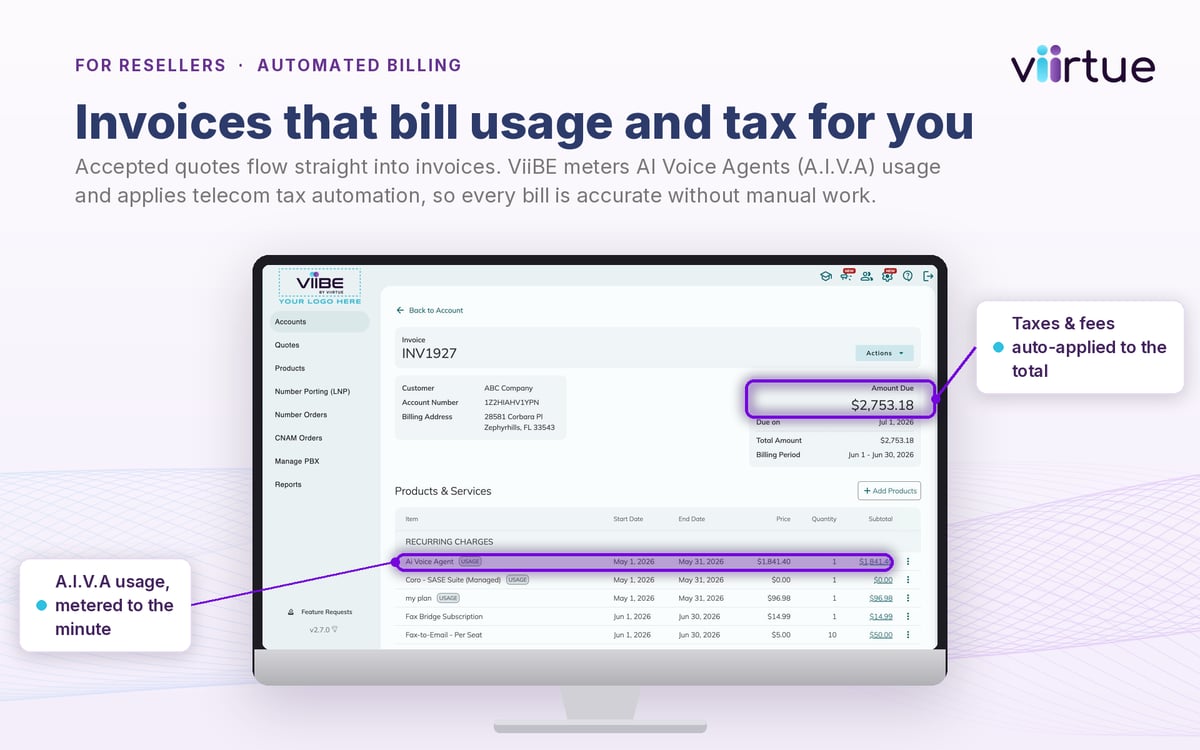
Viirtue is one of the closest OITVOIP alternatives if you want to review assisted and self-managed arrangements with the same provider. Its White Label model gives resellers access to ViiBE for quoting, contracts, billing and payments, with wholesale pricing subject to its stated minimum revenue requirements. Viirtue describes Channel+ as including billing and tax work while the partner retains pricing control. Its Channel model places more of the operational work with Viirtue.
Best fit: An MSP using OneBill for quotes today or a partner that wants to choose how much billing work it takes on. Have the finance and provisioning leads perform the demonstration together. A small team should test how quickly one person can trace a change. A larger reseller should confirm that sales, service delivery and finance can work with separate permissions.
What to test: Create a branded quote with standard users, a shared phone, and an included IT service. Make a mid-cycle change, issue a credit, and export the customer invoice. Ask which changes require manual billing updates. Apply the same sequence to the other OITVOIP competitors you shortlist and check who owns the process under each partner agreement.
Buying consideration: Confirm the actual wholesale minimum, the timing of any commitment, and the difference in billing, support and deployment responsibilities among the quoted programs. If you use OITVOIP’s Managed Compliance service, identify the party that performs equivalent work and what the new agreement covers.
2. SkySwitch For White-Label Voice And Managed Billing
SkySwitch sells white-label cloud communications through reseller partners. It describes Wholesale for partners running more of the operation and Foundations for managed customer billing, taxation and regulatory work under the partner’s brand. That makes it one of the OITVOIP alternatives to evaluate when your decision depends on keeping customer-facing control and changing who runs billing.
Best fit: An MSP that wants a branded voice service and wants to compare two levels of back-office involvement. An existing Channel partner should verify which onboarding and support responsibilities it would take over. A White Label partner should ask how the customer invoice, wholesale records and payment workflow would change.
What to test: Ask SkySwitch to create a customer under the proposed plan, update the customer’s seats and show the corresponding billing and support records. Test an invoice correction and identify who receives the customer’s payment. Ask the OITVOIP competitors offering managed billing to show the same workflow for a second customer that purchases several products together.
Buying consideration: Compare the partner agreement, branding and actual list of covered back-office tasks. Confirm whether a billing integration you need is supported on the proposed program. For context on the corporate parent’s broader services, see the BCM One alternatives guide.
3. Intermedia For Advisor Or Branded Cloud Bundles
Intermedia describes several partner models. Under Customer Ownership Reseller (CORE), the partner owns the customer relationship, sets prices and handles first-level support, with Intermedia describing wholesale billing and telecom tax handling. Its Advisor arrangement gives Intermedia a greater role in support and places the relationship under different terms. Ask the sales team to name the model it is proposing and explain the billing party, branding and support path.
Best fit: An MSP that wants to sell phone service, collaboration, contact center or other cloud services together. An OITVOIP Channel partner may find Advisor worth comparing. CORE is relevant when the objective is to sell a branded offer and maintain day-to-day customer control. Ask for the scope and price of the exact products in each option.
What to test: Move a sample customer from a simple phone bundle to a plan with a second product. Assign a customer administrator and open a first-line case. Confirm where the new product, support responsibility and invoice appear. Compare the same actions with other OITVOIP alternatives if you need to keep customer administration within your MSP.
Buying consideration: The public Unite rating can inform your assessment of calling and collaboration. Check reseller branding, commercial terms, and your access to customer information in the specific partner agreement.
4. 2600Hz For Custom Provisioning And Carrier Control
2600Hz, an Ooma company, offers white-label communications built on KAZOO. Its hosted platform advertises APIs and the option to bring your own carriers. It is one of the OITVOIP competitors to evaluate if your team wants to tie its own portal or billing system to provisioning and has the resources to run the resulting workflow.
Best fit: A service provider with technical staff or a qualified implementation partner. Prepare a list of the operations you need, such as creating a tenant, provisioning a handset, assigning a number and exporting rated or raw usage. Have the provider confirm which operations and carrier arrangements the proposed deployment supports.
What to test: Create a small tenant and follow one service change from the phone portal to your billing system. Simulate an incomplete order in a test environment and ask how staff see its status and correct it. Have the OITVOIP alternatives with more integrated workflows show the same order, so you can compare implementation and maintenance requirements.
Buying consideration: Custom control requires staffing and a clear support boundary. Ask who maintains API workflows, carrier connections and integrations. If your business currently relies on provider-operated billing, include an agreement or separate tool to replace it in the project scope.
Compare The Channel And White Label Responsibilities
For each customer group, write down who owns the agreement, sets the price, controls branding, provisions phones, issues invoices, collects payment and handles first-line support. Use the same list with every OITVOIP competitor you interview. Have the provider identify the party responsible for each task and the person your team contacts when it cannot complete the work itself.
Check What Happens When A Channel Customer Changes Programs
If you plan to move an existing Channel book to a branded reseller program, choose a representative customer with an open service request and an upcoming renewal. Ask what has to happen to its agreement, price, billing contact and access before the transition. Tell the OITVOIP alternatives whether your business needs to keep a commission-based model for some customers and invoice others directly. Ask if both arrangements can be supported and how the vendor identifies them in its portal.
Request sample notices and account records for the program you intend to move to. Clarify who sends the invitation, who owns the renewal, and who explains a change to the billing company. If an approval, authorization or new agreement is required, identify the point at which service delivery can proceed. That gives staff a checklist for changing the agreement.
Verify The Brand Across Customer Touchpoints
Use a new employee as the example. Ask the OITVOIP competitors to show the invitation, login page, mobile app listing, password reset and support link. Check whether the brand is yours, the platform’s, or shared under the proposed program. Confirm who controls the domain, email sender and notice template. For a reseller with multiple brands, repeat the test with a second customer and ask how the provider keeps the two identities separate.
Then ask the OITVOIP alternatives to send an example notice about an outage or a scheduled change. Check who reviews the notice and which contact gets replies. This matters if the provider currently speaks to customers on your behalf. Note which emails, onboarding material and customer instructions your team would need to update before any services move.
Map The Escalation Path For Branded Service
Give shortlisted OITVOIP competitors two support cases: one phone that stopped working after a move and one customer whose main number no longer rings the front desk. Ask which checks a first-line reseller technician performs, how they escalate the issue, and where they see updates. Have the provider identify how support differs for ordinary requests and service-affecting faults outside business hours.
If multiple locations have local administrators, show how one can change a holiday greeting without seeing another location’s billing or records. Confirm how a reseller administrator can see both locations and manage the relevant technician permissions. Ask how a new employee receives portal access and how the partner removes it when the employee leaves.
Replace OneBill And Datagate Workflows
Find the jobs your billing system performs before considering a move. These may include quoting, generating invoices, applying telecom charges, exporting invoice records and collecting payments through a processor. Have the OITVOIP alternatives show each job with a test customer. A demonstration should include a new order and routine exceptions, since an initial quote can work even when adjustments take extra effort.
Follow A User Change From The Phone Portal To The Invoice
Set up a sample customer billed for 20 regular seats and two shared devices. Add a new user halfway through the month and retire a shared device while keeping its number. Ask the OITVOIP competitors to show which portal controls each field, how the change reaches the invoice, and how finance sees the effective service date. Verify whether updating the voice portal is enough or whether billing staff need an approval or a manual adjustment.
Have finance compare the wholesale and customer invoices. Compare the billed service identifier, customer name, number, quantity and period. Have the vendor make a correction that affects the customer’s invoice while leaving the original order visible. If you use accounting or professional services automation software, test whether that correction reaches the corresponding agreement, payment or ledger entry.
Check Quoting, Payment, And The Status Of Open Balances
Use an existing OITVOIP scenario as a baseline. If OneBill creates the quote, ask the replacement to show its price, estimated charges and acceptance. If your team uses Datagate to handle recurring invoices, show how a wholesale usage record enters the billing tool and how finance matches it to an account. Give the OITVOIP alternatives the same sample records with customer details removed.
Ask who can see an open balance after the move, who can issue a late credit and which customer-facing portal shows the old invoice. If the proposed system changes how customers pay, verify whether another authorization is needed and who sends it. Test what the customer sees on a receipt and which company answers a question about a payment statement. A billing migration affects customers that pay by card and those that send payment after their own approval process.
Test The Data Feed You Would Keep
If you want to retain OneBill, Datagate or your own billing system, ask shortlisted OITVOIP competitors to supply an example service and usage export. Match one metered call and one recurring seat to the tenant, account and invoice. Then replay a corrected record after closing the period in a test environment. Check who sees the correction, whether your billing tool can apply it in the next period, and how a staff member avoids processing it twice.
Document which fields your team will maintain when someone changes a service address, transfers a number to a different office or retires a device. Ask the OITVOIP alternatives what happens if a file or synchronization job arrives late. Set a clear owner for reviewing differences ahead of billing and test what the owner sees when an account has missing or conflicting records.
Define The Managed Compliance Handoff
For accounts that use OITVOIP Managed Compliance, record the current scope and identify what service, filing or reporting work needs a replacement. Ask shortlisted OITVOIP competitors to put the billing entity, covered services, and role for tax calculation, filing and remittance in writing. When voice and managed IT share an invoice, verify the scope for each line. Coordinate the handoff and any open items with the people who handle those responsibilities for your business.
Ask how the providers will make records available while both services run and after the old account closes. Include invoices, adjustments, usage, payment detail and agreed reporting documents. Have your finance owner reconcile a final recurring bill and a later credit. A program with a different name can be workable if the affected accounts, duties and delivery dates are clear.
Compare Pricing By Seat, Usage, And Billed Revenue
Request wholesale prices for the same mix of regular seats, shared devices, numbers, SIP capacity, usage and add-ons. Include any recurring fee for billing services, minimum commitment, onboarding and first-line support. When the OITVOIP competitors quote different units, have them convert the figures into an ordinary month for the actual portfolio. Show the charge for each category so finance can see what is driving the change.
Work Through A Revenue-Based Billing Fee
OITVOIP’s white-label billing documentation describes a percentage calculation for certain billing services, based on the prior month’s billed revenue as defined in the agreement. Use the contract’s actual fee base when comparing the proposal. Ask whether taxes, credits, refunds, write-offs or non-voice services affect the base you will be charged on. Check any tiers and minimum fee separately.
For example, suppose an illustrative billing service charges 2.5% of its fee base. If the portfolio has US$20,000 of customer charges and US$1,200 of taxes that the proposed agreement includes in the base, the billing fee would be US$530. If the agreement applies the same percentage to a base of US$20,000, the fee would be US$500. These figures demonstrate the calculation. Use the OITVOIP alternatives’ written terms to model your actual invoice and ask for a reconciliation when a charge is credited later.
Price Each Partner Model At The Same Customer Count
For a Channel offer, include the actual commission or program payment, the work your business performs and any fee tied to activation. For White Label, include recurring wholesale charges, billing and staff time. Compare what happens if a customer buys more services, pays late or drops an add-on. Ask each of the OITVOIP competitors to quote at the expected live customer count and at a lower count during the move. If the new provider offers credits, check when each can be applied.
Plan for at least one period with source and destination accounts running together if the migration needs it. List port fees, hardware replacements and the staff hours needed to stage equipment and reconcile bills. Use the same spreadsheet for every provider. Make sure the selected option is workable before the largest or most profitable account moves, when recurring income may still depend on the source platform.
Price Both Bundled And Metered Customer Profiles
OITVOIP’s white-label billing guide describes both per-minute and bundled service structures. Build one profile with short, ordinary calls and one with substantial toll-free or outbound usage. Ask the OITVOIP competitors to identify included minutes or eligible routes and list features that carry their own fees. For a shared device, verify whether the charge follows the device, the user, or the account in the proposed agreement.
Request pricing for the same features as they appear on the customer’s bill. Ask whether a line is a recurring subscription, a fixed service charge or measured usage. Compare the result with how your finance team handles that charge today. This exposes differences that may affect customer pricing even when the quoted cost of a standard seat looks similar.
Ask How The Proposed Commitment Works In Practice
Have the OITVOIP alternatives specify where a minimum applies: per monthly portfolio, per account, per feature or another unit. Confirm how pilot seats, usage and separately sold products factor in. Ask whether a missed activation date changes which charges count. Use one scenario in which a major customer delays its move so you can judge whether the commitment is manageable.
Check how prices can change, what notice the partner agreement requires and whether a customer can retain one part of a bundle after cancelling another. Ask OITVOIP competitors for a sample invoice from a month that includes a plan change. That helps you see ongoing billing work and gives you a reference point for troubleshooting discrepancies after go-live.
Plan An OITVOIP Migration By Customer And Program
Build an inventory of partner model, tenant, agreement, numbers, devices, routes, messaging, portal users and billing system. Choose a typical customer and a second customer with a billing or routing dependency. Share the same information with the OITVOIP alternatives you pilot. Plan to test at least one customer-facing workflow and one financial change before moving more accounts.
Verify Numbers, Locations, And Dependencies
For each number, record the appropriate customer account, business purpose, location and target route. Group local and toll-free numbers separately where the receiving provider requires it. Include texting, fax, call forwarding and other services that depend on the number. Ask the receiving provider what authorization, account details and documentation it needs. Assign someone to monitor the port and identify numbers that require manual follow-up.
Ask OITVOIP competitors to verify coverage for your actual sites, number types and destinations. A customer can have office phones in one location and remote employees in another. Confirm local availability, port eligibility, outbound calling and softphone access separately. Ask how the provider validates service addresses and emergency calling setup through its approved procedure. If a number supports a separate device or service, coordinate a full test with its provider.
Run A Hosted Voice Or SIP Pilot With Real Use Cases
For hosted voice, record the intended daytime and after-hours routes. Verify inbound and outbound calling, caller ID, shared devices, transfers, voicemail and the ability to manage a greeting. Ask the OITVOIP alternatives to demonstrate the desk phone, app and any adapter the customer actually uses. If a device has to be reset or released from its existing provisioning setup, identify who can handle that work.
For a SIP customer that retains its own PBX, verify the handoff, quoted capacity, number presentation and responsibilities for support. Test how an inbound call reaches its destination and who takes over when the local connection fails. Ask the OITVOIP competitors to describe temporary fallback routing for a delayed port. Test messaging and any registration requirements separately before relying on a text-enabled number.
Move Records And Check The Customer Handoff
Decide which greetings, voicemail, recordings, messages, invoices and ticket records you need to retain. Ask what is available to export and how staff can locate it after the service is closed. Identify who can change a customer’s route or correct a bill during the overlap. If the team updates both systems, give it one place to record the change and mark which records have been updated.
Send sample notices using the identity the customer will see in the new program. Have the OITVOIP alternatives show what happens when a customer asks a billing question or opens a support request during the transition. Include the temporary support route and any action required on the customer’s devices or payment account. Ask staff to rehearse the handoff with the people who will actually answer questions.
Give Technicians A Shared Support Record
Ask the OITVOIP competitors to demonstrate how they transfer an open case from the implementation team to regular partner support. Use an after-hours forwarding issue that is still awaiting a customer response. Verify who can see the previous updates, identify the affected number, and approve a change. Keep the support contact and temporary route with the porting record so a second technician can act if the owner is unavailable.
For the OITVOIP alternatives you pilot, ask what the same support request looks like from the customer portal. Check whether the customer can see its case status and how the vendor works with the reseller if the issue affects several tenants. Include that communication path when deciding whether to move a customer with early-morning or after-hours staffing.
Use The First Invoice As A Migration Checkpoint
Compare live seats, billing quantities and usage after initial activation. Ask the OITVOIP competitors you pilot to show a correction for a mismatch and demonstrate how the adjustment appears on the next bill. Require the operational owner to approve the test routes and the finance owner to approve the invoice before moving more customers. Keep contact details for porting and billing support with the cutover record.
Agree on who can pause the next batch if a number has not moved, an important route fails or the bill cannot be reconciled. Follow the agreed process for cancelling old services once dependent lines and records have been checked. Record how a customer can ask for a service change and how the partner can reach the provider after the migration team hands over the account.
Frequently Asked Questions About OITVOIP Alternatives
What Is The Best Alternative To OITVOIP For An MSP?
Viirtue is a close fit for MSPs that want integrated quoting and billing with multiple partner models. SkySwitch is worth assessing for branded voice with managed billing. Intermedia fits broader cloud bundles, and 2600Hz fits service providers that need programmable provisioning or carrier choice.
Which OITVOIP Competitors Fit An Assisted Channel Model?
Compare Viirtue’s Channel or Channel+ programs with Intermedia’s Advisor arrangement, depending on who should set prices, supply first-line support and own billing. SkySwitch Foundations is relevant when the primary need is managed billing and back-office support under a partner brand.
Can You Keep Your Existing Billing Tool When Leaving OITVOIP?
Ask your shortlisted OITVOIP competitors and billing vendor to confirm the supported data feeds and integrations. Test a seat change, usage export and credit using a sample customer. Verify exactly which records the integration updates and which still need staff input.
How Much Do OITVOIP Alternatives Cost?
Get wholesale quotes for your exact program and customer mix. Include seat or usage charges, numbers, equipment, optional billing services, support and minimum commitments. Ask what the proposed fee is based on and what it costs to move customers in stages.
Can You Keep Your Phone Numbers When Switching?
Ask shortlisted OITVOIP competitors to verify which numbers they can port and what authorization and account records they require. Confirm separately how messaging, fax and emergency calling setup will be handled. Verify the affected services before closing the old account.
Should An End Customer Buy A White-Label Platform?
White-label platforms are intended for providers that resell or operate communications for multiple customers. A business replacing its own phones should evaluate the provider or reseller that will contract with it, issue its bills, and support its users. Ask who controls the numbers and admin access before planning the move.
Use Customer Ratings To Refine The Pilot
G2’s ViiBE listing is relevant to tasks such as quoting and billing. The Unite score covers the end-user application, and the 2600Hz score covers the platform. SkySwitch’s Capterra rating comes from a comparatively small review sample. Use the scope of each listing to pick the questions worth investigating.
Ask the OITVOIP competitors on your final shortlist for references that match your customer mix and partner model. Ask about the first billing cycle, a support escalation and the move from an assisted model to operating more of the service, if relevant. For providers that will connect to your billing tools, ask how often the reseller has to reconcile seat changes by hand.
Compare the OITVOIP alternatives against the same signed quote, live phone setup, support case and reconciled invoice. The option that completes those tasks under the agreement your team can operate is the one that best fits your move.
Affiliate Disclosure VoIPCalling may earn commissions from qualifying affiliate links on the site.