

The best White Label Communications alternatives for a managed service provider (MSP) or telecom reseller are SkySwitch for a comparable reseller platform and a managed billing option, Viirtue for partner-run quoting and billing, Intermedia CORE for bundling voice with other cloud services, 2600Hz for programmable multi-tenant communications, and Sinch Private Label Voice for a carrier-led hosted PBX and SIP portfolio.
White Label Communications (WLC) is the provider behind Atlas OS. Before comparing White Label Communications competitors, identify what Atlas currently does for your business. Provisioning phones is one part of the job. You may also depend on a ConnectWise integration, branded applications, wholesale invoices, or WLC’s Telecom Tax Compliance service. Those dependencies determine which provider can replace the work your team needs done.
What Do Atlas OS And WLC Do For Your Business?
WLC offers private-label hosted PBX and SIP trunking to partners. Atlas OS is its partner platform for provisioning services and making customer changes. WLC also advertises a branded communications client, and its developer center documents API access. A company selling WLC voice under its own name may therefore be replacing both a customer-facing product and the tools the reseller uses to operate it.
Atlas OS And ConnectWise PSA
ConnectWise Marketplace describes an Atlas integration for ConnectWise PSA, also called ConnectWise Manage. The listing describes work such as quoting and invoicing for hosted PBX and SIP services, with access to Atlas tax tools. If you use it, inspect a current agreement, invoice, product catalog entry, and service change. Determine which fields Atlas supplies, which fields your staff fills in, and what happens when a record changes. Ask White Label Communications alternatives to demonstrate the same operations inside your version of the PSA. The Atlas listing in ConnectWise Marketplace provides a starting point.
Telecom Tax Compliance And Billing
WLC markets Telecom Tax Compliance (TTC) as a billing and back-office option. It describes acting as carrier of record for the service covered by that arrangement and handling work that includes filing and remittance. Confirm whether your own agreement includes TTC and what it covers. When comparing White Label Communications competitors, request a written split of responsibility for generating invoices, collecting payments, handling disputed charges and completing applicable tax work.
Branded Calling And SIP Trunks
Identify the customers who use WLC’s hosted phone system and the customers who buy SIP trunks for a PBX they already operate. Some portfolios contain both. A reseller replacing the hosted service needs to check how end users sign in, how teams receive calls and how equipment is managed. A reseller replacing a trunk must also confirm the PBX handoff, call capacity, number availability and support boundary. White Label Communications alternatives can handle those needs in different ways, so quote each group separately.
White Label Communications Alternatives Comparison
The table compares reseller and wholesale offers. Ask the provider to quote the exact program, services, territory and implementation you need. The rating labels identify the product or platform reviewed. A broader platform rating can help you decide what to investigate in a demonstration.
| Provider | Best Fit | Buying Consideration | Pricing And Evaluation |
|---|---|---|---|
| ConnectWise And Managed Billing | Verify which ConnectWise functions and back-office tasks come with your program. | Request Partner PricingQuote Wholesale or Foundations and the billing scope.Explore SkySwitch Partner Programs | |
| Partner-Run Quoting And Billing | Check the wholesale minimum and who handles billing, tax work and first-line support. | Request White-Label PricingInclude the billing workflow, seats, numbers and usage.Explore Viirtue White Label | |
| A Branded Cloud Services Portfolio | Check the CORE agreement and who owns support and billing for each product. | Request CORE Wholesale PricingInclude the proposed products, entitlements and partner terms.Explore Intermedia CORE | |
| Programmable Multi-Tenant Voice | Confirm API scope, hosted deployment, carrier arrangements and engineering ownership. | Request A Hosted Platform QuoteInclude integration, platform and implementation costs.Explore The 2600Hz Hosted Platform | |
| Carrier-Led Hosted PBX And SIP | Confirm the usage record format, billing scope, inventory and support handoff. | Request Private Label Voice PricingQuote seats, trunking, numbers, equipment and migration.Explore Sinch Private Label Voice |





Intermedia’s G2 rating applies to Unite, the communications application. Use the CORE agreement to assess reseller terms. Sinch’s G2 rating covers the broader Sinch platform. Ask Private Label Voice for references from partners with a comparable mix of hosted seats and SIP trunks. Capterra’s SkySwitch score also comes from a smaller review sample than Intermedia Unite’s G2 score.
Best White Label Communications Competitors For Resellers
1. SkySwitch For ConnectWise And Managed Billing Options
SkySwitch is one of the closest White Label Communications alternatives for resellers that want a managed white-label phone platform and a choice of partner programs. Its Foundations program describes back-office support for billing, taxation and regulatory work under the partner’s brand. It also offers a Wholesale program. ConnectWise Marketplace lists a SkySwitch integration. Verify which actions the connector supports on the program you are considering.
Best fit: An MSP using ConnectWise PSA with a small service desk, or a reseller evaluating an alternative to WLC TTC. Ask for an example where a service change updates the intended agreement and appears on the customer invoice. Confirm the roles of the SkySwitch portal, ConnectWise and any separate billing service. For an MSP that sells other services on the same invoice, ask how the arrangement handles lines outside the voice package.
Buying consideration: A marketplace listing establishes that an integration is offered. Your test should establish what it does with the fields your business uses, including sites, agreements, recurring quantities and adjustments. Confirm whether Foundations can take on the responsibilities you currently expect from TTC, and ask the White Label Communications competitors you shortlist to provide the same sample records. For a wider look at the parent company’s services, see the BCM One alternatives guide.
2. Viirtue For Partner-Run Quotes And Billing
Viirtue gives White Label partners access to ViiBE, which brings quoting, contracts, recurring billing and payments into the same workflow. Viirtue describes minimum monthly revenue targets for white-label wholesale pricing. It is one of the White Label Communications alternatives worth testing if your team wants to change its tools while retaining control over sales, provisioning and billing.
Best fit: An MSP with a named finance or operations owner and a first-line support team. Have finance send a quote, change the number of seats, add a separate usage charge and issue a credit. Ask how a finalized quote becomes a service order and what the customer sees in the payment portal. If you keep ConnectWise as the source of customer and agreement data, verify the connector and fields in the proposed package.
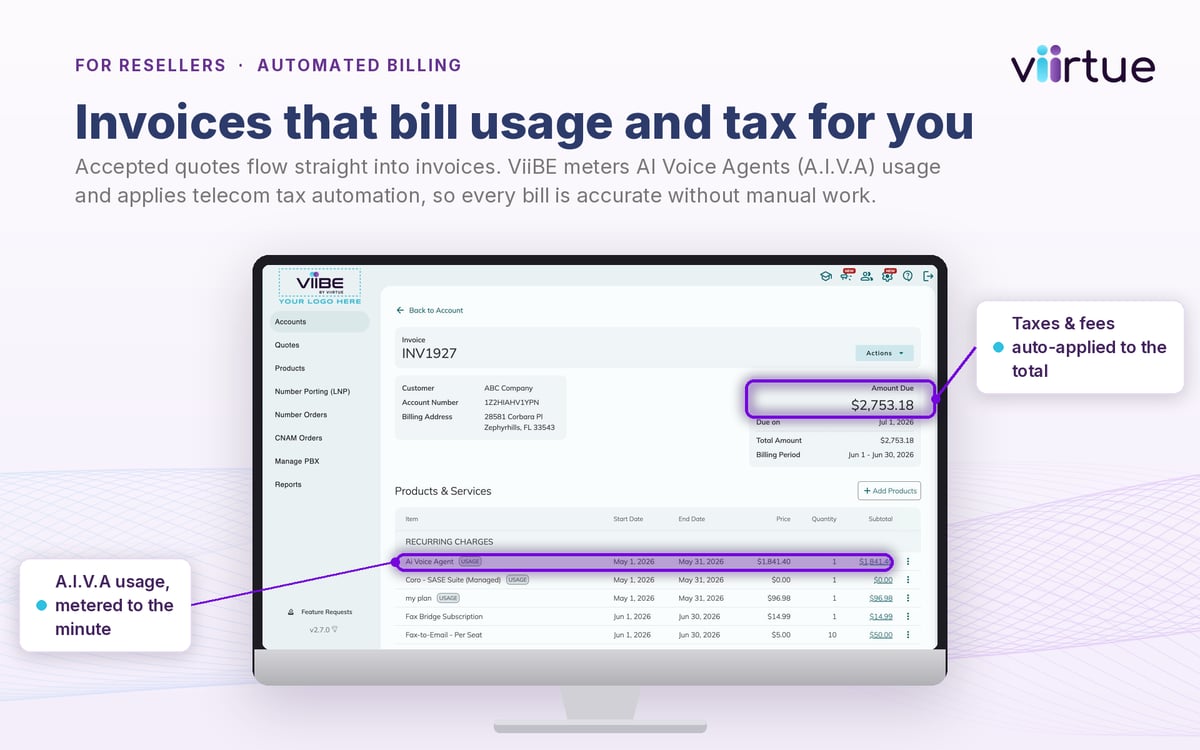
Buying consideration: ViiBE’s tax calculation tools can form part of the billing process. Get the agreement to identify who handles filing, remittance, corrections and notices. If reducing workload is why you are evaluating White Label Communications competitors, assign the test to the employee who will run billing and record how much work happens outside the portal.
3. Intermedia CORE For A Broader Branded Portfolio
Intermedia’s Customer Ownership Reseller program (CORE) is an option for MSPs selling voice alongside other cloud services under their brand. Intermedia says CORE resellers own the customer relationship, set prices and provide first-level support. Its program comparison describes telecom tax handling and escalation support. Ask for a proposal that explicitly names CORE, since Intermedia also offers partner models with different commercial responsibilities.
Best fit: An MSP with an established support practice that wants to bundle phone service, collaboration or contact center products with other services. For a small office, show how a receptionist and office manager use the new system. For a larger account, verify whether you can delegate routine administration, provision multiple locations and support each product through your existing service desk.
Buying consideration: Ask which applications and notifications display your brand and which partner tools are included. If your Atlas setup currently performs moves, adds and changes inside your PSA, test how the new workflow handles the same jobs. When comparing White Label Communications alternatives, distinguish the user experience of hosted calling from the partner terms governing billing and support.
4. 2600Hz For Programmable Multi-Tenant Communications
2600Hz, an Ooma company, offers a hosted white-label platform built on KAZOO. It advertises APIs and support for partner carrier arrangements. That makes it one of the White Label Communications competitors to consider if you use WLC’s APIs or if Atlas is only one component in a larger ordering, provisioning or billing workflow.
Best fit: A communications service provider with an engineer or implementation partner responsible for the integration. Provide a list of operations you need, such as creating a tenant, assigning a number, updating an endpoint and retrieving usage for billing. Ask which API or portal owns each operation. Test how both your existing tools and the new platform report a failed request or an incomplete order.
Buying consideration: Identify which functions your engineering team would own after launch. Confirm any custom domain work, app branding, carrier onboarding, integration maintenance and the support process used when a problem crosses platform and carrier teams. Compare these costs with the managed White Label Communications alternatives before choosing a design.
5. Sinch Private Label Voice For Hosted PBX And SIP
Sinch Private Label Voice combines hosted PBX, SIP trunking and softphone clients with a lifecycle management portal. Sinch also describes provisioned equipment and rated call detail records. It is one of the White Label Communications competitors to evaluate if you sell hosted phones to some customers and trunking to others, and want to assess those services together on a carrier-led platform.
Best fit: A provider or reseller with a mixed voice portfolio and staff responsible for number management and provisioning. Run a test that creates a hosted account, assigns a public number and provisions a device. For the trunking account, test an inbound route, outbound caller ID and the agreed behavior during a PBX or connection outage. Ask to see both transactions in the partner portal and the resulting billable records.
Buying consideration: Ask how rated usage records reach your billing system and which team handles discrepancies. Get a separate description of any invoicing and tax services in the quote. If you use WLC TTC or the Atlas integration to produce a complete customer bill, add those tasks to the evaluation of Sinch and the other White Label Communications alternatives.
Test The Atlas And ConnectWise Workflows That Matter
Make a list of the transactions your team performs weekly and at the end of a billing cycle. Take a sample customer record with sensitive details removed, along with a product code, service agreement, device order, and invoice. Use the same sample with the White Label Communications alternatives in your evaluation. It should include a change to an existing account, since an initial order can succeed even when the update process is cumbersome.
Choose The System That Owns Each Record
Identify where customer names, site addresses, product codes, seat counts, billed quantities and ticket records should live. Many MSPs use their professional services automation platform (PSA) for customer and agreement data while the phone portal handles inventory, numbers and technical configuration. Have each of the White Label Communications competitors explain how those records travel between the systems and which system wins when staff change a field in both.
Check whether multiple customer sites appear as one agreement, separate agreements, or line items on a single invoice. Compare that structure to your finance and support needs. A customer may bill centrally even though local administrators manage their own office phones. Ask who can edit each field and whether the system keeps a record of the change. It should be easy for a technician to identify the site without giving them access to charges or customer payment information.
Demonstrate One New Order And One Change
Begin with an agreed order for 32 hosted phone seats and a main number. Add three seats after activation, and retire one handset while keeping that user’s seat. Ask the White Label Communications alternatives to show the agreement quantities, equipment inventory and invoice after each step. Check whether the extra seats are assigned to the right site and whether the hardware removal changes the recurring charge only when it should.
Repeat an input or start with a wrong agreement code. A useful integration should make it clear whether an entry was accepted, rejected or waiting for attention. Confirm who can correct the record and how they know the correction reached the other system. Ask shortlisted White Label Communications competitors to show whether an accidental duplicate would create extra seats, new charges or a duplicate device order.
Trace A Usage Record To The Customer Invoice
Ask for one export of wholesale usage and one customer-facing invoice. Use a representative charged call or messaging event and verify the tenant, number, timestamp, units, rate and invoice line. If the provider rates the usage before export, ask what adjustments your system needs for your own price book. If your own platform rates the record, verify the behavior at billing-period boundaries, minimum durations and rounding using the terms on the quote.
Include a separate credit for a disputed charge. Ask how a correction appears in provisioning, on the wholesale bill and on the customer invoice. Compare White Label Communications competitors on who can make the correction and what data finance receives. Make sure the customer-facing explanation and your accounting records describe the same event. Assign someone to follow up if the two views disagree.
Test The Support Ticket And Provisioning Handoff
Use a common order that your sales, provisioning and service-desk teams all touch. Ask one person to approve the quote, another to install the line and a third to investigate a missing phone. In the PSA, check whether the account, site, service and equipment identifiers let a technician find the correct tenant without searching across similar customer names. Ask the White Label Communications competitors to show where a user request becomes a carrier or provisioning escalation.
Include an update from the wholesale provider in the test. Decide who should see it, which information can appear on the customer’s ticket and which team can close the incident. If you must manually copy an update, give the technician a well-defined place to record it. Check that the partner workflow keeps a history when a ticket changes owners. This is particularly useful for smaller MSPs where one person may work on billing and technical support in the same shift.
Check Whether The Integration Supports Your Routine Exceptions
Test a customer that moves a site, an agreement that has a nonstandard discount and a device that changes hands. Ask the White Label Communications alternatives to demonstrate what happens when the connector is temporarily unavailable. Note when staff use a manual process, then test how the systems reconcile after service returns. This reveals whether a missing update creates work for support or finance and how quickly they can identify it.
Compare Wholesale Pricing And Back-Office Work
Get comparable quotes for hosted seats, common-area phones, SIP capacity, numbers, usage, equipment and separately packaged features. Add partner minimums, billing-service costs and any staff time the move will create. When White Label Communications competitors quote different units, ask them to price the actual customer mix. SIP channels or other capacity measures, standard users and contact center seats belong on separate lines.
Use A Mixed Hosted PBX And SIP Cost Example
Suppose a reseller serves 60 hosted users and a separate PBX account that needs eight quoted SIP channels. In an illustrative quote, the 60 seats at US$13.50 total US$810 and eight channels at US$18 total US$144. If numbers and usage add US$35, a billing service adds US$110 and the reseller allocates US$160 in staff time, the direct monthly total is US$1,259. This is a sample calculation. Replace the figures with the units, rates and responsibilities in each actual proposal.
Price a second version if the reseller plans to keep using WLC for any of the services. It should show ongoing charges for retained customers or features as well as the overlap while ports and equipment are staged. Ask the White Label Communications alternatives how minimum commitments work when only part of the portfolio moves. Verify which recurring spend counts toward the minimum and what happens if the move takes longer than expected.
Distinguish Billing Software From The Agreed Service Scope
Build a checklist for who issues customer invoices, owns the payment relationship, calculates taxes, handles filing and remittance where applicable, manages credits, and provides records after termination. Ask each of the White Label Communications competitors to show how the proposed responsibilities appear in the actual agreement. If you depend on WLC acting as carrier of record under TTC, request the name and role of the entity whose offer you are reviewing, for the relevant services and locations.
Ask White Label Communications competitors to model accounts that already buy internet, managed IT and voice on one invoice. If the replacement bills voice through another system, record how the customer sees the split and who reconciles the total. If some business stays on WLC, document who will send the notices, authorize payments, explain credits and keep the sales team informed. This matters when the staff who sell the service also answer first-line billing questions.
Plan The Billing Handoff Around A Real Cycle
Pick a customer with an open invoice, a future renewal and a service change due near the cutover. Ask the White Label Communications alternatives to explain which invoice includes that change and what the customer sees if a prior charge is credited later. Check who can review the old invoice after the current portal closes, who issues the credit and how finance matches the adjustment to the customer’s payment.
Give the finance owner a list of records required for the handoff, including agreements, invoices, usage detail and outstanding balances. If customers pay automatically, ask which payment arrangements can continue and which require a fresh authorization. Decide how those notices reach customers and give staff a script for explaining a changed sender or statement descriptor. Test both a customer who pays by card and one who pays by invoice if your portfolio uses both.
Compare The Partner Terms At Three Portfolio Sizes
Have shortlisted White Label Communications alternatives model the first pilot, steady-state portfolio, and a larger volume you could realistically reach. Check how the quoted commitments and support responsibilities change, and what the price represents when you first go live. Ask how newly ordered devices and activated services appear on the first wholesale bill, and how charges change if you add a site near the end of a billing period.
Confirm the term, price-change process, support coverage and export rights before the team starts moving accounts. Ask White Label Communications competitors to account for carrier and equipment charges, if relevant, and for costs associated with a port that needs to be rescheduled. Have the prospective provider identify which activities are included in onboarding and which the partner is expected to perform.
Plan A White Label Communications Migration
Start with one hosted phone customer and one trunking or integration-heavy customer. Build a roster of numbers, routes, phone types, billing agreements and add-ons. Retrieve the current records from Atlas, ConnectWise or other billing and provisioning tools where you have access, then reconcile them with the customer and your invoices. Share the final inventory with the White Label Communications alternatives you want to pilot.
Inventory Numbers, Sites, And Dependencies
Record each number’s service address, current account, business purpose and destination after the move. Include toll-free, text-enabled, fax and other special-purpose numbers. Ask the White Label Communications competitors you shortlist what account records and approvals they need for each group. Assign someone to monitor port status and verify the numbers after transfer. If the initial cutover affects a published main number, agree on fallback routing with the receiving provider and the customer before scheduling the work.
Have the White Label Communications competitors explain where coverage, number inventory and product rules affect your plan. A reseller supporting remote staff or multiple countries should separately check where it can order and port numbers, where users can access the intended applications, and which destinations they can call. Verify availability with the exact service addresses, number types and partner program in the proposal.
Build Separate Test Plans For Hosted And SIP Customers
For hosted customers, test the customer’s main greeting, a staffed transfer, an unanswered call, voicemail and after-hours routing. Ask the White Label Communications competitors you pilot to show the branded sign-in, a delegated admin account, and the registration of one device from each important model. Confirm how emergency calling setup and service addresses are validated using the provider’s approved procedure. Coordinate any special equipment test with the company that supports the connected system.
For trunking customers, document the PBX, the carrier handoff and any backup route before the move. Have the parties confirm the quoted call capacity, numbering format, caller ID behavior and support responsibilities. Ask the White Label Communications alternatives to show where their responsibility starts and ends, especially if the PBX or access circuit belongs to the customer. Verify incoming and outgoing calling in the actual setup before releasing the rest of the numbers.
Rebuild Messaging, Records, And Partner Permissions
Ask how each of the White Label Communications competitors handles business texting and message routing for a moved number. Confirm any registration work and when two-way messaging can be tested. Set handling for shared inboxes, old histories, automated replies and integrations. Separately review voicemail, recordings, greeting files and reports. Identify what must be exported before the account closes and give authorized employees a way to retrieve it.
Test that a partner technician can see the tenants they support and that a customer administrator only has permissions for their account. Ask how the White Label Communications alternatives record changes to routes, billing fields and user permissions. Check where brand names appear during account creation and in support notices. Keep the existing and replacement roles documented until the last batch is accepted.
Test The Brand On Apps, Invoices, And Service Notices
Open the app installation page, reset a password, view the service portal and send a support message as a pilot customer. Ask the White Label Communications competitors to identify who controls the application identity, domain and email sender. Verify how mobile users on the old system are invited to the new one. Make a note of any work needed to update shortcuts, knowledge-base articles and customer training material.
If your MSP resells more than one branded offering, check whether the provider can keep the names and portals distinct. Ask how an outage notice is sent for one affected tenant and whether the reseller reviews it before delivery. With the White Label Communications alternatives that reach the pilot, send a sample notice and invoice to a test account. That lets sales and support agree on the identity the customer will see after the move.
Close The Pilot With A Reconciled Bill
Agree on acceptance criteria before you schedule a full migration. Verify the calling flow and check whether the right quantities appear in the partner and customer systems after the first service changes. Have finance reconcile the invoice for the pilot, including numbers, seat counts, prorated charges and adjustments. Ask the White Label Communications competitors that reach a finalist stage to document which issues they will resolve during the cutover and how they will respond if you need to pause.
Close the old service according to the confirmed porting and cancellation instructions once you have verified dependent services. Preserve the records your business still needs and document the finalized provider contacts. For customer support, keep one reference that explains how to report a phone problem, dispute a charge and request a service change. An account can be live and still need follow-up if finance or service-desk staff cannot complete routine tasks.
Frequently Asked Questions About White Label Communications Alternatives
What Is The Best White Label Communications Alternative For An MSP?
SkySwitch is a close fit for an MSP that wants a white-label reseller platform and a managed billing option. Viirtue fits teams that want integrated quoting and billing under their own control. Intermedia CORE fits MSPs that need a broader branded cloud portfolio.
Which White Label Communications Competitors Work With ConnectWise?
SkySwitch has a ConnectWise Marketplace listing, and Viirtue lists ConnectWise among ViiBE integrations. Ask the provider to confirm the exact supported actions and package. Demonstrate your own agreement, a change in seat count, and a sample invoice to verify the workflow you use today.
Which Alternatives Are Best For Hosted PBX And SIP Trunks?
Sinch Private Label Voice is worth evaluating when you sell both hosted PBX and SIP trunks. 2600Hz is a technical option if the replacement includes custom integrations or carrier arrangements. Compare the exact hosted and SIP services, territory, number features, billing records and support handoff.
How Much Do White Label Communications Alternatives Cost?
Request wholesale quotes for the exact program and customer mix. Compare the seat or capacity price, numbers, usage, add-ons, onboarding and monthly commitments. Include back-office fees and your own staff time if switching changes who produces invoices or handles service requests.
Can Another Provider Replace WLC Telecom Tax Compliance?
SkySwitch Foundations is a relevant program to evaluate for managed billing and back-office support. Ask every candidate for its written scope, including the billing entity, role as carrier where applicable, responsibilities for tax work and the process for disputed charges. Verify how the proposed agreement applies to your portfolio.
Can You Keep Your Numbers When Leaving WLC?
Ask the receiving provider to confirm which local and toll-free numbers it can port and what documentation it requires. Verify text-enabled, fax and other special-purpose lines separately. Confirm new routing and your responsibilities before cancelling related service.
Use Customer Ratings To Choose What To Test
G2 scores cover ViiBE, Intermedia Unite, 2600Hz and the broader Sinch platform. SkySwitch’s rating comes from Capterra. These listings describe different products and audiences. Use the scope and sample size to decide how much weight a score deserves. A public rating can help identify questions about usability or support that are worth taking into a demonstration.
Ask the White Label Communications competitors on your final shortlist for a reference with a comparable portfolio. If you depend on ConnectWise, ask the reference how it reconciles seat changes and fees. If trunks are part of the move, ask how the partner and carrier coordinate during an incident. Use the conversations to decide which configuration or support process to test in your own pilot.
Compare the White Label Communications alternatives against the same order, customer call flow, invoice and export. Keep the quote, responsibilities and pilot outcomes together. The best choice is the program that can take over the customer service you sell and the partner work that supports it.
Affiliate Disclosure VoIPCalling may earn commissions from qualifying affiliate links on the site.