

The best CoreDial alternatives for managed service providers (MSPs) depend on who should own the customer relationship, run the phone platform, and handle billing. Choose Viirtue if your team wants to manage quotes and invoices in the same system, Intermedia CORE if you want to add communications and other cloud services under your brand, or 2600Hz if your engineers need more control over integrations and carrier arrangements. Ask SkySwitch for a separate proposal if you are comfortable staying within BCM One.
CoreDial and SkySwitch are both part of BCM One. That matters if your search is driven by corporate ownership, supplier concentration, or contract terms. A SkySwitch proposal can give you a different offer, portal, and operating model. If your objective is to move outside BCM One, start with the three CoreDial competitors in this guide that belong to other companies. For the parent company’s broader voice and network services, see the BCM One alternatives guide.
What Are You Replacing In CoreDial?
CoreDial has served the wholesale and private-label cloud communications market. An MSP can use it to deliver phone service to multiple customers under its own business. CoreDial’s documentation also describes how partners use CoreNexa Automation Manager (CAM) to work with porting cases, order numbers, and manage account tasks. That makes the reseller operation part of the replacement decision. See CoreDial’s knowledge base to identify the tools behind your account.
Separate the services customers see from the work your business does in the background. Customers see a phone system, an app, a support contact, and a bill. Your team has to set up each customer, route calls, keep phones registered, reconcile usage, and escalate faults. A CoreDial competitor can match the first list and still leave you rebuilding the second. Write down which activities your current agreement or tools cover before asking anyone for a quote.
Decide Which Part Of The Service Needs To Change
- Partner tools: If quote revisions, billing corrections, or account provisioning occupy most of your time, compare how the CoreDial alternatives handle those tasks from beginning to end.
- Underlying supplier: If corporate independence is part of the decision, request the legal entity named on the proposed contract and identify the carriers used for the customers you plan to move.
- Technical control: If the platform needs to integrate with your own portal, bulk provisioning, or a carrier arrangement, ask for test access and an engineering review.
- One customer’s phones: If you are a business that buys service from a CoreDial reseller, start with your own contract and telephone numbers. Your reseller can explain which admin tasks, equipment, and number records it controls.
A white-label platform typically puts your brand in front of the customer. How far that branding extends varies. The main portal might use your domain while a mobile app, verification message, password reset, or outage notice still displays another company’s name. Ask shortlisted CoreDial competitors to show what a new customer receives at signup, when they request support, and when service is interrupted.
CoreDial Alternatives At A Glance
These four CoreDial alternatives cover different replacement paths. Viirtue and Intermedia CORE are suited to MSPs that want a packaged private-label service, while 2600Hz is worth evaluating when the engineering team needs platform-level control. SkySwitch is the same-owner option. The listed partner offers use quotes, so compare bids against the same portfolio and support assumptions.
| Provider | Best Fit | Buying Consideration | Pricing And Evaluation |
|---|---|---|---|
| Partner-Managed Quoting And Billing | Check the wholesale minimum, billing responsibilities and escalation coverage. | Request White-Label PricingQuote migration, seats, numbers, usage and the monthly minimum.Explore Viirtue White Label | |
| A Branded Cloud Services Portfolio | Confirm the CORE agreement, first-line support and branding by product. | Request CORE Wholesale PricingPrice the chosen products, feature entitlements and partner terms.Explore Intermedia CORE | |
| Platform APIs And Carrier Control | Verify how the hosted deployment handles your carriers, integrations and support. | Request A Hosted Platform QuoteInclude usage, implementation and custom integration costs.Explore The 2600Hz Hosted Platform | |
| A BCM One White-Label Option | Confirm Foundations billing scope and the process for moving CoreDial accounts. | Request Partner PricingConfirm the program, billing fees, service rates and transition costs.Explore SkySwitch Foundations |




The G2 score for Intermedia covers the Unite application. Use the program agreement to compare CORE commercial terms. G2’s Viirtue score is from the ViiBE product page. SkySwitch’s Capterra score has a smaller sample than Unite’s G2 score. Review the product name and the sample size before comparing the scores.
Best CoreDial Competitors For Resellers And MSPs
1. Viirtue For Quoting, Billing, And Customer Self-Service
Viirtue is one of the closest CoreDial alternatives for MSPs that want to run a branded service and update how they quote, provision, and bill it. ViiBE is Viirtue’s partner system for quoting, invoicing, payments, and reporting. Its white-label program gives the partner control over packaging, deployment, and support. Viirtue describes higher-tier escalation and onboarding for white-label partners and lists minimum monthly revenue requirements for access to wholesale pricing.
Who should shortlist it: An MSP with its own first-line support and a growing set of customers whose voice bills are hard to reconcile. A smaller reseller should ask for the minimum that applies to its proposed agreement and whether the commitment begins at signing or after the first customer goes live. An established reseller should ask how a staggered move affects the minimum during the transition.
What to test: Quote a customer with 30 standard users, five common-area phones, a new toll-free number, and an existing service package. Then add three users halfway through the first billing period and remove an add-on at renewal. Produce the first and second invoices, export the charges, and make a credit. This lets your team compare the billing work across CoreDial competitors using the same account.
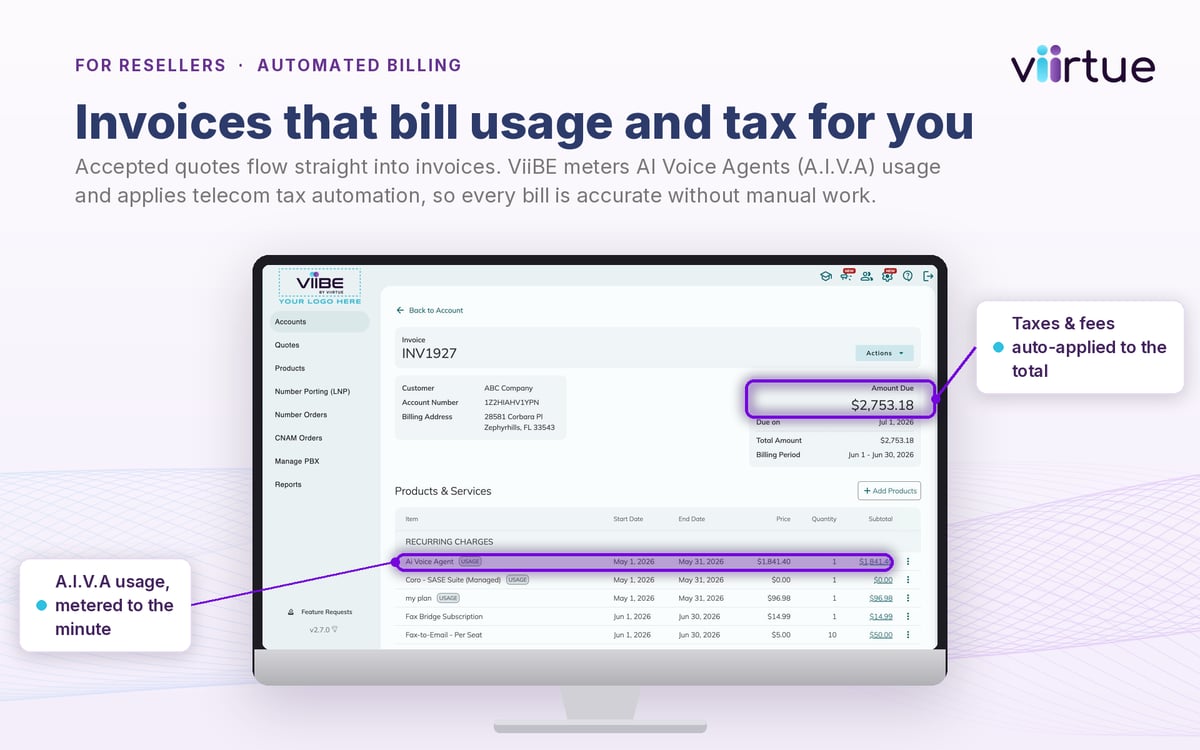
Where the fit changes: ViiBE may help consolidate billing work, but moving from an existing invoicing system can affect payments, tax handling, finance reports, and renewal terms. Ask how tax calculation, filing, and remittance are handled under the agreement you receive. If you already bill internet, help desk, and cloud services together, have staff reconcile the resulting invoice before committing to a wider move.
2. Intermedia CORE For A Branded Cloud Services Portfolio
Intermedia’s Customer Ownership Reseller program, called CORE, fits MSPs that want to own the customer relationship and include a wider portfolio in their offer. Intermedia describes CORE as a wholesale reseller model in which the partner sets end-customer prices and provides first-level support. Intermedia describes behind-the-scenes support and telecom tax handling in its program comparison. The company also advertises Co-Op, Advisor, and Service Provider arrangements with different billing, branding, and support roles.
Who should shortlist it: An MSP selling a recurring package of communications, support, and other cloud services. Intermedia is a useful CoreDial alternative when one service desk already handles user onboarding and can take first-line responsibility for a new phone application. A reseller with accounts on several different support packages should ask whether the program’s escalation model works across those customers.
What to test: Set up a sample customer with an office manager, a receptionist, a remote employee, and an MSP technician. Walk through first-time sign-in, delegate an admin task to the office manager, route a holiday closure, and raise an escalation. Capture what appears under your brand in the app, emails, and admin portal. Ask for the program name and service schedule in the quote so you can compare like for like against other CoreDial competitors.
Where the fit changes: Public reviews of Intermedia Unite can help you assess the day-to-day calling experience. The reseller agreement governs wholesale pricing, support, branding, and exit terms. When you compare CoreDial competitors for a customer with a custom carrier handoff or integration, ask for a written compatibility answer from the program team and have your engineers test the handoff with a representative account.
3. 2600Hz For API And Carrier Control
2600Hz, an Ooma company, offers a white-label communications platform built around KAZOO. Its hosted platform lists APIs, private-label options, and the ability to bring your own carriers. This makes 2600Hz one of the CoreDial alternatives to evaluate when the migration includes a custom portal, automated tenant onboarding, or a specific carrier relationship. Ask how those capabilities are packaged in the proposed deployment and which functions the vendor supports when an integration fails.
Who should shortlist it: A service provider with people who can own API credentials, monitor automation, and investigate call routing, or an MSP that has a qualified implementation partner. In a smaller team, estimate who will maintain workflows after the person who built them goes on leave. In a larger team, request documented responsibilities for platform, application, and carrier operations.
What to test: Create a tenant through the proposed deployment, apply the correct brand, provision a user and number, and retrieve usage in a form finance can read. Repeat the workflow with an invalid request, then retry it. You want to see whether the automation reports the error and avoids producing duplicate users or orders. This distinguishes technical CoreDial competitors when the feature lists look similar.
Where the fit changes: More control comes with more decisions. Confirm how the contract handles platform operations, carrier onboarding, the support of custom components, and upgrades to the interface your tools use. If a reseller relies on an external developer, ask who owns the code and credentials and make sure the team can still provision a customer when the integration is temporarily unavailable.
4. SkySwitch For A BCM One White-Label Option
SkySwitch sells white-label UCaaS to reseller partners. Its Foundations Partner Program describes managed end-customer billing, tax, and compliance services under the reseller’s brand. That program can be a fit for an MSP that wants to keep the first-line customer relationship and hand off some back-office work. Ask which program is on offer and whether your current CoreDial account is eligible for any transition process.
Who should shortlist it: A lean reseller that wants support with the billing workload or an established partner looking for a different BCM One program. If the purpose of comparing CoreDial alternatives is to diversify suppliers, first consider the three options outside BCM One. If the goal is to reduce manual billing work, compare the same tasks under SkySwitch Foundations and the other reseller agreements in the guide.
What to test: Ask SkySwitch to show the branded invoice, the flow for a disputed charge, how refunds and adjustments reach the partner’s records, and the support escalation path. Request a pilot plan for two actual customers with different routing and device setups. Confirm which activities SkySwitch will coordinate and which activities stay with your team.
Where the fit changes: Common ownership doesn’t establish automatic transfer of tenants, phone numbers, invoices, or commercial terms. Ask for a written list of what can carry over and what your engineers must recreate. If your preference is to keep your current invoicing system, check how a different SkySwitch partner arrangement handles that requirement.
Compare The Reseller Agreements Before The Features
Request the same documents from the CoreDial alternatives you shortlist. Ask for the partner agreement, the relevant service schedule, a sample wholesale bill, a sample customer invoice, and a written breakdown of onboarding and ongoing support. Ask whether the sales proposal includes the specific reseller program and region discussed on your call. A quote prepared for an agency arrangement answers different questions from one built for a white-label reseller.
Identify Who Owns The Customer Relationship
For each proposal from CoreDial competitors, record the party that signs the end-customer agreement, receives payment, controls customer pricing, and makes account changes. Check whether the vendor can contact your customer directly and under what circumstances. Ask what happens when an end customer adds a site, needs more phones, or buys a new service directly through an app. If services are bundled into an existing MSP agreement, find out which terms have to appear in that agreement or on the invoice.
Ownership also matters when an account leaves. Ask CoreDial competitors what information your team can export during ordinary operations and after notice of termination. Request a sample tenant export, a numbered inventory, and the instructions used to approve a port out. Have the prospective provider explain who keeps access to the customer’s administration, messages, and call recordings between notice and the final service date.
Follow A Transaction From Quote To Cash
Open a sample quote for a tenant with a standard seat package, equipment, two phone numbers, and a one-time installation. Include a discount that expires after a defined initial period. Change the start date and move one phone to another office. Then have the vendor recreate the monthly invoice and show how it ties back to consumption and inventory. Your finance person should reconcile the invoice using the proposed exports, with an explanation for every line that differs from the quote.
When comparing CoreDial alternatives, ask who handles a failed payment, refund, tax-related question, pricing correction, or account suspension. If the provider handles an item, ask how the customer hears about it and how you can see the resolution. If your business handles it, identify the staff role and permissions required. Record the workflow for reconciling the wholesale invoice as well as the one your customer receives.
Check Where You Can Sell And Support Service
CoreDial competitors may support different service addresses, local number pools, porting routes, or countries where employees use the app. Give each one the real addresses of a prospective customer with locations in several states and ask for coverage and costs by site. If that customer also has staff abroad, ask which features and calling destinations are available from their location. Separate answers about establishing a local number from answers about dialing a country or signing in from there.
When CoreDial competitors quote numbers in a specialized market, ask for examples of a new number order and a port on the actual product. Have the operator identify the address information or authorization it would need and the type of number it can supply. A carrier footprint map can help guide the discussion. A site-level response and a workable escalation path give your team the information it needs to schedule the cutover.
Verify Branding And Escalation With The Intended Roles
Log in as a partner administrator, a customer administrator, and a normal user. Open the web portal and mobile client, request a password reset, and send a support request. Check the app listing and what a customer sees while installing it. Compare the same surfaces against your brand requirements and identify restrictions on custom domains, email senders, handset branding, and status notices. An MSP serving accounts with different brands should repeat the exercise for a second tenant.
Ask how the CoreDial competitors handle a single failed desk phone, a customer-wide routing problem, and a platform incident. For each incident, write down who opens the case, where the reseller sees updates, who contacts affected customers, and who owns the next action. Ask whether ordinary and urgent requests use different routes and whether the program supplies written response objectives. A technical escalation preview is especially helpful when the vendor’s support team has limited visibility into your carrier or integrations.
How To Compare Wholesale Pricing And Margin
The relevant price is the actual cost of serving your whole portfolio. Ask each CoreDial alternative for separate figures for standard users, common-area devices, numbers, usage, and billable features. Add the partner minimum, recurring platform fees, implementation and the cost of keeping two systems active during the move. Mark which items can satisfy a minimum and which are added to it. Some expenses scale with seats while others apply to every tenant or invoice.
Run One Quote Through Three Customer Profiles
- Small single-site customer: Use ten desk or softphone users, one reception number, one spare device, and basic voicemail. Ask about minimum quantities per tenant and whether the configuration can use the least expensive quoted seat.
- Multi-site business: Use 45 seats, three locations, multiple local numbers, after-hours routing, and shared devices. Ask who handles port scheduling, address changes, device provisioning, and deployment that happens outside normal business hours.
- Messaging or queue-heavy account: Use an actual monthly volume and include peak calling periods, shared inboxes, toll-free activity, recording, and reporting. Verify what is separately billed and which features the base seat includes.
Have shortlisted CoreDial competitors price all three on the same spreadsheet. List local and toll-free numbers separately. Show which users need paid application entitlements, and classify any support or equipment cost by customer or site. Ask the vendor to model the first month, an ordinary month at steady state, and a renewal month. This shows how one-time incentives and early credits affect the first invoice and how the cost changes under ordinary conditions.
Work Through A Sample Margin Calculation
Suppose an MSP bills a customer US$1,200 per month. The hypothetical wholesale bill is US$610, numbers and usage cost US$85, and routine support takes two hours at an internal cost of US$45 per hour. The monthly direct cost is US$785, leaving US$415, or about 34.6% of revenue, before other expenses. If the MSP spreads US$600 of one-time deployment expense over the first 12 months for evaluation, the monthly equivalent falls to US$365, or about 30.4%. These figures illustrate the calculation. Use the prices, eligible charges, and support assumptions in your own quote.
Compare CoreDial alternatives with both pricing and service-desk effort visible. Give the person who handles support an opportunity to forecast time by tenant type. Password resets, device substitutions, porting questions, customer training, invoice disputes, and drop-offs in adoption all take staff time. If the provider performs a task that your team previously absorbed, document the expected change and any conditions attached to that service.
Test The Minimum During A Staged Move
Ask each of the CoreDial competitors to model a ramp of 50, then 125, then 250 active seats. Use your planned port batches and mark the same-month charges from CoreDial and the replacement provider. If the partner minimum already applies while few accounts have moved, calculate the gap between eligible spending and the commitment. Confirm the timing of credits and whether the minimum is measured by month or another billing period. Then check the effect of losing one of the largest customers during the move.
When two CoreDial competitors offer similar direct margin, compare the obligations that affect the next renewal. Find the notice window, any change process for prices or tier entitlements, the costs associated with changes in the customer base, and the process for exporting data. Ask whether hardware needs a new purchase or can move to the proposed service. That lets you compare CoreDial alternatives on operating cost after the introductory period.
How To Plan A CoreDial Migration
Start with one complete inventory and move customers in batches. For each tenant, record the customer owner, physical sites, numbers, extensions, devices, route schedules, mailboxes, queues, messaging, integrations, recorded greetings, recordings, and emergency calling settings. Use any available CoreNexa Automation Manager exports, then verify the records against bills and the customer’s actual desk phones and apps. One record per customer makes it easier to assign tasks to your staff and compare the work required by different CoreDial alternatives.
Prepare The Numbers And The Calling Routes
List public numbers with their exact purpose. A single business may have a main reception line, an after-hours route, individual numbers, fax, SMS, alerting, and a toll-free line. A number appearing on an invoice can also be published on signage or used to verify another application. Record the account information and how the receiving provider expects to verify authorization. Ask CoreDial competitors for their procedure for disputed, rejected, or partially completed ports and who is available during cutover.
Build the destination routes before scheduling the change. Use representative numbers to call the front desk during business hours, during a holiday schedule, from outside the company, and during an internet interruption at a site where a fallback is required. Verify outbound caller ID separately from inbound routing. Confirm the provider-approved emergency calling validation procedure and ensure each device and user profile has the correct service address. Keep coordination contacts available independently of the phones being moved.
Verify Messaging, Recordings, And Fax Separately
One public number can carry both calls and messages. Verify how each candidate handles the number, its messaging registration, and the user or queue that receives texts. Ask about message exports and how existing records will be retained during the change. CoreDial’s knowledge base includes separate SMS export and routing documentation. Ask shortlisted CoreDial alternatives to walk through an incoming and outgoing text on the pilot number and confirm the schedule for any messaging setup that applies.
Use a similar approach to compare how CoreDial competitors handle recordings and fax. Record which recordings, greetings, or voicemail messages need to be preserved, who can access them, and which file types the destination accepts. Provide finance, operations, or other authorized teams with a way to locate historical records after cutover. For fax, confirm which accounts still use the service, whether a physical device or email receives it, and whether the customer has another way to receive time-sensitive documents during the move.
Stage Devices And Administrator Permissions
Before you pilot any CoreDial alternatives, check the exact model and firmware of shared phones, reception consoles, cordless handsets, and adapters. Ask which devices can use the new platform’s provisioning process, which require a reset, and who can release any provisioning association on the existing account. Test one of every important type. For shared workspaces and public lines, show local staff how to sign in and report a problem before their port date.
Compare how the CoreDial competitors handle reseller-wide permissions and customer-level roles. Give each new administrator access only to the accounts and actions required for their job. Test an owner’s request to add a user, an MSP technician’s request to modify a queue, and a finance user’s invoice export. Check whether the system records changes and how your team can retrieve those records during an investigation. Decide who approves access changes when staff move between customers.
Use Two Pilot Customers Before Moving The Largest Accounts
Choose a typical account for the first pilot and a customer with one meaningful dependency for the second. That dependency might be a shared SMS number, a physical fax device, an appointment line, or an integration that changes routes. Give each pilot a named contact and agreement on how to report a problem. Ask the CoreDial alternatives that reach the pilot to participate in a live review of any failed test and to record the decision about whether to continue moving accounts.
Agree on migration checkpoints in advance. The first is an approved number inventory and configuration. The second is successful test calling, devices, and relevant messaging. The third is a clean pilot invoice. During cutover, assign an owner for each port batch and state who has authority to hold subsequent batches. Ask shortlisted CoreDial competitors what a fallback entails once a number has moved, including the routing options and expected response path. Keep the old service available for the agreed overlap period and follow the providers’ confirmed port and cancellation instructions.
Put The First New Invoice Through Acceptance
The first bill is where changes that look small in a demo can become recurring work. For each pilot tenant, compare the order, first invoice, and expected ongoing charges. Check active phones and numbers against billed quantities. Look at prorated changes, port dates, usage across billing periods, and who receives each notice. Give finance access to the same detail the vendor supplies its own support staff, where available.
Ask CoreDial competitors to explain how corrections on a wholesale bill flow through to the customer bill. If the invoice uses a payment link, verify that the link goes to the intended destination and that the payment credits the right customer account. If a customer requests a change to how its invoice is delivered, have the partner administrator perform the change. Resolve differences in the pilot before standardizing the process across all accounts.
When a reseller moves many tenants, administration work continues after the last port. Run another invoice check at the start of the next ordinary cycle, when the temporary installation charges have dropped out. Give account managers a list of remaining exceptions and document when the old service can be closed. The team evaluating the CoreDial alternatives should use those notes to update the time and cost assumptions for the next batch.
Frequently Asked Questions About CoreDial Alternatives
What Is The Best Alternative To CoreDial For An MSP?
Viirtue is a close match for MSPs that prioritize branded communications and partner-controlled billing. Intermedia CORE serves MSPs that want to add cloud products under their brand. Among CoreDial alternatives, 2600Hz suits service providers that need more API and carrier control. The best fit depends on the work your team wants to own.
Are CoreDial And SkySwitch Owned By The Same Company?
Yes. BCM One acquired both CoreDial and SkySwitch. SkySwitch can be relevant if you want another white-label program under the same parent. Ask for the proposed contracting entity and the process for moving your CoreDial tenants, phone numbers, devices, and records.
Which CoreDial Competitors Are Outside BCM One?
Viirtue, Intermedia, and 2600Hz are the three CoreDial competitors in this guide outside BCM One. Compare Viirtue for partner quoting and billing, Intermedia CORE for a branded communications and cloud portfolio, and 2600Hz for flexible platform integrations and carrier arrangements. 2600Hz is an Ooma company.
How Much Do CoreDial Alternatives Cost?
Request wholesale quotes for the exact CoreDial alternatives you plan to use. Use the same customer mix, seats, numbers, expected usage, and support requirements for each quote. Add partner minimums, migration and equipment charges, and the cost of running two services while customers move.
Can You Keep Your Numbers When Leaving CoreDial?
Ask the receiving provider to confirm which local and toll-free numbers it can port, which account information is required, and how it schedules the transfer. Verify messaging, special-purpose lines, and fallback routes separately. Follow the agreed porting sequence before cancelling related service.
What Should You Ask For In A White-Label Demo?
Ask CoreDial competitors to show a branded signup, tenant and number provisioning, a change to a customer invoice, and a support escalation. Give each vendor the same scenario. A reseller administrator, a customer administrator, and an end user should each have a task to perform.
Should A Business Customer Use A Wholesale Alternative?
A business shopping for its own phone system should compare the provider or reseller that will contract with it, issue bills, and provide support. The CoreDial alternatives here are aimed at organizations selling or operating service for multiple customers. Confirm who controls your numbers and credentials before planning a change.
What Customer Ratings Tell Resellers
G2 reviews of ViiBE are relevant to tasks such as billing, quoting, and platform administration. The Intermedia Unite rating is most useful when assessing the product employees use. The 2600Hz listing covers its communications platform. SkySwitch is shown using Capterra reviews. The sources and sample sizes vary, so use each score to identify things to verify in the corresponding product.
Read reviews from businesses that resemble your own. A single-location customer may focus on placing calls and answering the main line. A reseller may care more about account isolation, invoice aggregation, provisioning, and the response to a porting problem. Separate those perspectives when reviewing CoreDial competitors. Ask the provider to perform the workflow described in a review if it is important to your business.
Complete the evaluation with a reference whose portfolio looks like yours. Ask how the partner handled its first bill, whether existing numbers and devices moved on schedule, and how the provider responded when a support issue crossed team boundaries. For CoreDial alternatives with a small review sample, the pilot and a relevant reference are particularly useful. Record what each partner confirms in writing before you select the platform.
Affiliate Disclosure VoIPCalling may earn commissions from qualifying affiliate links on the site.