

Dstny France and Sewan are the closest Phenix Telecom alternatives in this shortlist for a French reseller replacing a white-label telephony platform. Ringover is the more focused option for a business replacing its employees’ calling application. The right choice depends on whether you need to operate services under your own brand, retain an existing PBX with SIP trunks, or improve everyday customer conversations.
This guide covers Phenix Partner, at phenix-partner.fr: the white-label provider of business telephony, Centrex, SIP trunks and internet services. The article title uses “Phenix Telecom,” but the comparison is specifically about Phenix Partner’s French business communications proposition.
That distinction changes the buying decision. A hosted calling subscription can be useful for one customer’s sales department while leaving a reseller’s ordering, billing, access services and support responsibilities unresolved. The French providers below therefore have different roles. Start with the operating model, then compare the services, contract and migration work needed to reproduce your actual customer estate.
What Should A Phenix Partner Alternative Replace?
Phenix Partner alternatives should be evaluated against a combined service and administration requirement. Its published offer covers voice, Centrex, SIP trunks and connectivity, while its partner platform supports customer profiles, ordering, eligibility checks and incident follow-up. API access is also published. These are existing capabilities to compare, rather than improvements that every competing provider automatically adds.
For a reseller, the replacement question reaches beyond whether employees can answer calls. Consider who owns the customer relationship, which company invoices the customer, who changes a service, and how an unresolved incident moves between your team and the underlying supplier. A platform switch can change all of those responsibilities even when the telephone number stays the same.
Start With The Reason For Leaving
Write the problem as an observable requirement. “We need better administration” is difficult to assess. “Our sales team must see order progress without receiving permission to change another customer’s services” can be demonstrated. Similarly, a pricing concern should identify the affected service, usage pattern, support work or contractual commitment before you seek competing quotes.
Separate a supplier problem from an estate problem. An undocumented PBX, unclear customer ownership or an incomplete number inventory can make any migration harder. Correcting those records may be necessary whichever provider you choose. If the current arrangement meets the operational requirements and only one department needs a better calling interface, a targeted application change could be sufficient.
Define The Purchase Before Comparing Providers
- White-Label Platform Replacement: You sell and support services under your brand across multiple customer organisations.
- SIP Supplier Change: You keep a suitable PBX and replace its external voice service after confirming compatibility.
- Centrex Migration: You move users, numbers and routing to a hosted business phone service.
- Department Application Change: A particular team needs better call handling or CRM activity without replacing the wider operator relationship.
These purchases can overlap, but they need separate acceptance criteria. Do not approve a complete customer-estate migration on evidence from a five-person application trial. Equally, a large partner platform demonstration should not substitute for testing the receptionist’s transfer, a manager’s permissions or a salesperson’s completed CRM record.
Best Phenix Telecom Alternatives Compared
The shortlist prioritises the relevant approved partner, Ringover, and adds two French operator candidates because they address the white-label and SIP requirements. The row order is a reading order, not an assertion that a calling application replaces an operator platform. Match the “Best Fit” column to the purchase you defined above.
| Provider | Best Fit | Buying Consideration | Pricing & Trial |
|---|---|---|---|
| A French Customer Team Replacing Its Calling App | Business for integrations, routing and coaching. Retail terms do not establish a wholesale operating model. | €49/user/month HTFrench Business reference, 12-month commitment; minimum 3 users. Excludes VAT. Confirm billing frequency, destination conditions and any add-ons.7-Day Free Trial — 5 users, 5 numbers, 5 outbound hours and €5 credit. Mobile numbers, SMS and WhatsApp unavailable during trial.Start A 7-Day Ringover Free Trial | |
Dstny France  | French White-Label Operator And SIP Procurement | Compare Operator and Operator Eshop models and the actual SIP design. Company TrustScore is not a programme rating. | Request A Partner ProposalQuote platform model, services, numbers, traffic, commitments, onboarding and support; retail seat prices are not wholesale tariffs.Request A Scoped Partner Demonstration; No Wholesale Free Trial AssumedExplore Dstny’s Operator Programme |
Sewan  | French White-Label Voice And Multi-Service Operations | Qualify hosted telephony, retained SIP and Sophia workflow. Company TrustScore is based on a small sample, not a partner-platform score. | Request A French Partner ProposalPrice the chosen services, platform, usage, implementation, commitments, billing exports and support responsibilities.Request A Scoped Partner Demonstration — no timed wholesale free trial assumed.Explore Sewan’s Partner Programme |

Ringover’s price is a retail software reference. Dstny and Sewan require a scoped partner proposal for this comparison; a public seat price from another product would not establish their wholesale cost. Likewise, the Trustpilot figures describe company profiles with very small review samples. They are not ratings of the specific partner programmes or SIP products.
Ask the operator candidates to quote the same sample customers, traffic, number blocks and service responsibilities. For Ringover, price the employee group and required application features. Keeping these procurement exercises distinct makes the comparison useful without implying that the services are commercially interchangeable.
Dstny France: For A French White-Label Operator Model
Dstny France belongs on the direct shortlist when the purpose is to operate French business communications under your own customer relationship. Its operator programme distinguishes an Operator model from an Operator Eshop approach. MyDstny is part of the proposition, making the platform arrangement an explicit subject for evaluation rather than a secondary feature beside the voice service.
Choose The Commercial Model Before The Catalogue
The published distinction matters if you already have billing software. Dstny describes an Operator route using the partner’s billing tools, while Operator Eshop extends into a branded marketplace and customer journey. Ask which responsibilities remain in your own systems and which are handled through the proposed platform. A demonstration should use the model you would actually contract.
An established reseller with its own invoicing process may value a different arrangement from a newer business building its catalogue. Neither situation makes one model universally preferable. Compare the practical work required to create a customer, activate a service, change its package, bill it and reconcile its cancellation. Request a sample export or invoice corresponding to that complete sequence.
Qualify The SIP Service Independently
Dstny publishes SIP Trunk Touch and describes traffic and call-quality visibility through MyDstny. This makes it relevant when you want to retain an installed phone system. The product description does not establish that every PBX version, customer configuration or failover design is supported. Supply the proposed installation details and ask the provider to confirm the accepted configuration and escalation boundary.
For a pilot, choose an account whose call flows are understood. Verify inbound calls to the required numbers, outbound caller identity, transfers, voicemail and the agreed continuity behaviour. Ask how your support team obtains evidence when a customer reports a failed call. The useful outcome is a repeatable investigation process, with ownership assigned, rather than a dashboard screenshot alone.
Who Should Shortlist Dstny?
A practical evaluation could involve a reseller with several customer organisations and a small provisioning team, or a larger operator comparing how much administration to retain internally. These are buyer scenarios, not published minimums or capacity limits. Request a proposal for your actual estate, including connectivity where it is part of the replacement.
Strength: The operator programme addresses the own-brand relationship and offers a meaningful choice of operating model. Buying limitation: You still need the contracted services, platform scope, implementation work and commercial commitments priced together. No wholesale free trial or universal savings claim is assumed here.
For the next step, request a partner demonstration showing one new customer order and one change to an existing account. Include an order exception and its billing consequence. That provides more decision value than an unrestricted tour of features your team might never use.
Sewan: For White-Label Voice And Multi-Service Administration
Sewan is the second direct operator comparison for a reseller assessing Phenix Partner. Its French partner proposition explicitly uses a white-label model, with Sophia presented as an interface spanning ordering and billing. This is relevant when the same customer relationship includes hosted voice, SIP and other business services.
Evaluate Sophia Through A Customer Lifecycle
Ask the demonstration team to follow a customer from initial order through a later service change and invoice. Your interest is how consistently the commercial and technical records stay aligned. For example, a new site should have a clear customer owner, service location and billing reference. A change should show who authorised it and when its charging consequence begins.
A useful reseller scenario is a customer opening a second office while retaining its original numbers and changing its reception arrangements. Give Sewan the desired outcome before the demonstration. Record the steps your team must perform and the handoffs that require supplier involvement. This reveals the working process without assuming that every action is automated or included in the same commercial package.
Separate Hosted Telephony From Retained SIP
Sewan’s published voice ecosystem includes hosted telephony and SIP trunks administered through Sophia. Those routes address different customer estates. A company moving away from a PBX needs a user and call-flow migration. A company retaining its system needs a qualified external voice service and a clear responsibility boundary for the installation.
Do not select between them solely on the number of employees. A small company can have a complex reception flow or specialised equipment, while a larger office may use straightforward hosted calling. List the required behaviour, retained equipment and support arrangements first. Then request the appropriate service design and a demonstration of the relevant administration tasks.
Who Should Shortlist Sewan?
Sewan is worth evaluating for a telecom reseller or managed service provider wanting to compare a broader customer-service catalogue and its operational handling. An illustrative buyer might support ten customer organisations with different mixes of voice and connectivity. The question is how its own staff would manage that variety, rather than whether a headline user count appears large enough.
Strength: The white-label proposition and Sophia workflow directly address reseller operations. Buying limitation: A common platform does not by itself establish equivalent terms, service availability or restoration arrangements across every product. Request those details for each quoted service and identify the team responsible for a disputed invoice or failed order.
Request a scoped partner demonstration and commercial proposal. Include onboarding, any required training, service-change processes, billing outputs and an exit example. A proposal becomes easier to judge when your support and finance teams can recognise their own tasks in it.
Ringover: For A French Business Team Replacing Its Calling App
Ringover is the approved-list option here for a narrower employee calling requirement. Its French Business offer combines calling with integrations, routing and supervision features. Consider it when a business wants its sales, recruitment or customer-service team to work more effectively in a calling application.
Where Ringover Fits The Comparison
A ten-person recruitment team, for example, might want calls associated with candidate records and a manager able to review coaching information. That is a different brief from replacing a reseller’s customer catalogue, internet orders and wholesale invoicing. Ringover may address the department’s brief while the surrounding operator services stay with another arrangement.
The Business plan is the relevant public reference for the integrations and advanced routing discussed here. Start a pilot with the exact CRM or ATS, user roles and required call flows. Complete an incoming call, a transfer, a missed-call return and an outbound conversation. Check the resulting activity against the correct customer record instead of stopping when the integration connects successfully.
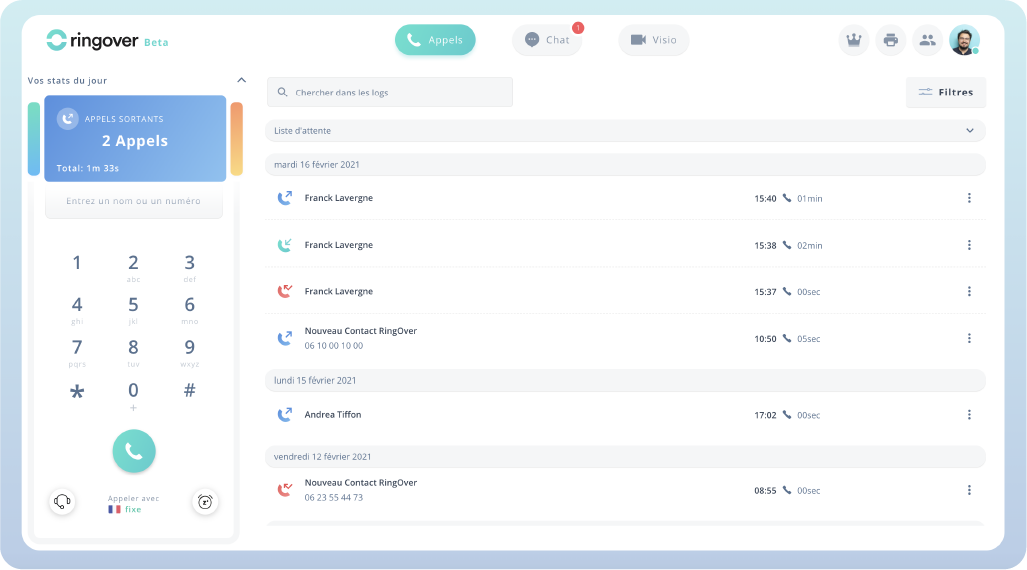
Our Ringover features and pricing review provides a broader application evaluation checklist. Use the French pricing reference in this comparison for the regional purchase discussed here.
Price The French Plan And Its Conditions
The French Business pricing reference is €49 per user per month HT, with a twelve-month commitment and a three-user minimum. For ten users, that is a €490 monthly software reference before VAT and additional charges. It is not a quote for a white-label operator business, and it should not be compared directly with an unqualified wholesale trunk price.
Confirm the billable user definition, selected numbers, destinations, forwarding charges and any separate products or add-ons. An international calling allowance does not mean every number type or destination is covered. Ask for the conditions that match the company’s actual traffic, especially if staff call overseas mobiles or forward calls outside the application.
Use The Trial For A Bounded Evaluation
The published seven-day trial allows up to five users, five numbers, five outbound hours and €5 credit. Mobile numbers, SMS and WhatsApp are unavailable during the trial. Those boundaries matter if messaging or a particular number type is central to the decision: obtain a separate demonstration or written confirmation for anything the trial cannot prove.
For a twenty-person department, choose a small representative pilot rather than treating five trial accounts as a full deployment. Include a manager and people doing different call-handling tasks. Write down which behaviours were tested and which still depend on the paid configuration. The trial can assess application fit; it does not establish wholesale resale rights or migrate the wider customer estate.
Choose Between Centrex, SIP Trunks And A Calling Application
The most useful Phenix Telecom competitors are the ones selling the service you need to replace. Centrex, a SIP trunk and a calling application can all appear in a business telephony discussion, but they leave different responsibilities with the customer and reseller.
Use Centrex When Moving The Phone System Is Part Of The Brief
A hosted telephony purchase should account for the users and their behaviour: extensions, reception, groups, working hours, voicemail and permitted devices. Document those requirements before discussing migration dates. Include people who rarely make calls but need to receive transfers or join a particular group; they are easy to miss when the inventory is based only on recent outbound activity.
For a business with reception and several departments, map where a caller goes during opening hours, lunch cover and closure. Decide who can edit that behaviour and who approves a temporary diversion. The operational benefit of a new hosted system depends on those arrangements being understandable to the people using and supporting it.
Use SIP When The Existing PBX Remains Suitable
A SIP proposal should describe the supported connection to the retained PBX, the numbers and the required simultaneous calls. Total employee count is only part of the sizing exercise. Ask the supplier to explain how the proposed service addresses the company’s busy periods and what happens when its agreed capacity is reached.
Obtain written qualification for the installed system and the proposed design. A compatible brand name on a website is a starting point for investigation, not acceptance of every version or customer configuration. Also identify who will update and support the retained system after the external voice supplier changes. Keeping hardware can preserve useful work, but its ongoing administration still needs an owner.
Use An Application Change For A Defined Department Problem
A focused calling app is appropriate when the improvement concerns daily user work: finding customer context, recording an outcome, returning a missed call or supervising a team. Describe the desired result before comparing features. “The next agent can see the previous conversation outcome” is a stronger acceptance criterion than “the product has a shared interface.”
If a business needs both an operator change and an application change, keep separate workstreams with a shared migration owner. This makes dependencies visible. It also prevents a successful application demonstration from concealing an unresolved number-porting, billing or connectivity requirement.
Compare The Partner Platform Beyond A Feature Checklist
A white-label telephony platform becomes part of your own service operation. When evaluating Phenix Partner alternatives, compare the work required to maintain accurate customer records across sales, provisioning, support and finance. A feature checklist can establish that a capability exists; a task-based demonstration shows whether it fits your organisation.
Customer Ownership And Staff Permissions
Prepare at least two separate sample customer organisations. Give the sales role the access it needs to prepare an order, a provisioning role the access to activate or change services, and finance the records required to reconcile charges. Ask what each role can see and change. Include how permissions are removed when someone changes jobs.
Check the same boundary from the customer’s perspective if customer access is part of the proposal. Which services can a customer inspect, which changes can it request, and which require approval? Decide whether a customer action can create a charge immediately. A clear authorisation process can be more valuable than allowing every possible self-service action.
Orders, Exceptions And API Access
Phenix Partner already publishes API access, so the alternative should be assessed for the workflow you intend to connect. Ask which required actions are available, what information returns to your systems, how failures are reported and what support is included. A label saying “API” cannot establish the scope of a particular integration.
Use a realistic interrupted order as a demonstration scenario. Suppose a service request is submitted but the receiving system does not confirm its status. Ask how staff check whether it was accepted before attempting it again. The aim is a process that avoids duplicate work or unintended duplicate services, with a visible record for resolving uncertainty.
Billing And Commercial Records
Follow one service through activation, a mid-period change and cancellation. Compare the service dates, customer references and charges appearing in the available outputs. Ask finance to reconcile the example against the customer’s intended invoice. Missing identifiers or unclear adjustment handling can create recurring manual work even when the headline tariff is competitive.
For an own-brand operation, establish who sets the customer price and how any supplier price change reaches your records. Ask whether historic commercial information remains available after a package changes. These are procurement questions to resolve in the chosen model, rather than assumptions that every white-label programme behaves the same way.
Incident Handling And Customer Communication
Walk through an incident affecting one customer and another affecting several. Identify the first contact, the information your team should collect, the supplier escalation route and the person updating customers. Ask for the applicable support hours and service commitments in writing. A general promise of assistance does not define responsibility for a particular incident.
The working record should help your support staff explain what has happened without making unsupported promises. Decide which supplier information can be passed to customers and how staff recognise a dependency on another service, such as access. This is especially useful when your brand remains the customer’s only contact.
Exit, Exports And Administrative Continuity
Ask how the business would leave before it signs. List the customer records, service references, number inventories, billing history and support information you would need to operate through an exit. Confirm what can be exported, in which form, at what cost and during which access period.
A credible exit plan does not require an assumption that the relationship will fail. It gives both parties a defined process for customer transfers, acquisitions and service changes. For a reseller, maintaining reliable operational records is also useful while staying with the provider, because staff should not depend on one person’s private spreadsheet to understand the estate.
Customer Data And Recording Access
Include customer information and recordings in the procurement discussion. Ask where relevant data is handled, which supplier documents describe that handling, what retention options apply and who can export or delete records. Bring your organisation’s privacy requirements to the review rather than assuming that a provider’s French market presence answers every data-handling question.
If recording or supervision is required, demonstrate access with the proposed staff roles. Check what happens when a user leaves and how a customer request for information would be handled. Agree the internal approval process for enabling those functions. These are practical requirements to resolve with the appropriate people in your organisation before deployment, not conclusions drawn from an aggregate review score.
Compare Wholesale Costs And Retail Prices Fairly
There is no defensible single “cheapest” choice across these different operating models. A software seat, a trunk service and a partner platform can charge for different things. Compare each proposal against the same desired outcome and show which responsibilities your own business must still fund.
Build A Comparable Request For Proposal
Give Dstny and Sewan the same customer scenarios. Include user requirements, retained PBXs, numbers, estimated traffic, peak simultaneous calls, site addresses and any connectivity dependency. Identify who provides onboarding, first-line support and customer billing. Request recurring charges and one-time work separately, with the commitment attached to each service.
Use recent invoices and service records to create a baseline, then correct known anomalies before projecting future cost. An unusual month of international calls or a temporary project site can distort the comparison. Ask providers to explain the treatment of those cases so the apparent savings are not simply the result of comparing different consumption assumptions.
Include Your Own Operational Work
Consider a purely illustrative example: a reseller has €500 of monthly service revenue, €300 of supplier charges and €80 of allocated support work. The remaining €120 is a contribution before other business expenses. If a new arrangement lowers supplier charges by €20 but adds €40 of recurring administrative work, the contribution falls to €100. These are invented planning figures, not provider tariffs.
This is why a lower wholesale line item may not improve the overall outcome. Estimate the time required for onboarding, order corrections, invoice reconciliation and incident escalation. Use your own staffing costs and measured workload where possible. Include temporary migration effort separately from work that continues every month.
Check Growth, Contraction And Contract Boundaries
Request three scenarios: the current estate, realistic growth and a smaller estate after customer losses. Ask how minimum commitments, service cancellation, unused capacity and support costs behave in each. A proposal that looks efficient at full utilisation may create an unattractive obligation when one larger customer leaves.
For Ringover, the three-user minimum and twelve-month Business commitment belong in the application calculation. For operator proposals, use the commitments actually offered in writing. Do not carry a retail trial, promotional price or plan minimum across to a wholesale arrangement. Finally, include overlap between old and new services and any agreed exit work in the migration budget.
How French SIP Providers Should Qualify Numbers And Access
French business-VoIP procurement has several distinct geographic questions. Can the service supply or accept the required French numbers? Can staff use it from their working locations? Can it reach the destinations customers actually call, at an acceptable price? A positive answer to one does not establish the others.
Build A Number Inventory Before Requesting Porting
Record the main number, direct numbers, number ranges and the legal account information for each service. Identify numbers associated with a site, a shared reception flow or retained equipment. Give French SIP providers the complete inventory and ask which supporting information is needed for that business arrangement.
ARCEP’s business porting guidance assigns the port and associated termination to the receiving operator. Do not independently cancel the number-bearing service when requesting portability. Treat remaining services separately: transferring a telephone number does not by itself establish that every other product on an old invoice has ended. Agree who checks closing charges and any services deliberately retained.
Quote Internet Services At The Actual Sites
If Phenix Partner supplies access as well as voice, compare the proposed replacement for each address. Ask which access service is available, what installation work is included, how the delivery date is established and which service commitment applies. A general fibre product description does not prove eligibility or an installation date at a particular building.
Decide whether voice and access should move together or in separate phases. If different suppliers are involved, assign responsibility for identifying which service needs attention during an incident. Obtain the proposed continuity arrangement in writing and test the agreed behaviour where practical. Do not assume that two products sold under one brand have the same support or restoration terms.
Check Mobile And Special Equipment Dependencies
Where the current estate includes mobile services or convergence, document what users expect to keep: identities, devices, calling behaviour and support contacts. Ask whether the proposed service covers those requirements or whether a separate mobile arrangement remains necessary. An employee calling app should not be treated as proof of an equivalent mobile operator service.
Also identify equipment outside everyday desk calling, such as an intercom, fax workflow or another device using an existing line. Give the supplier its details and obtain the appropriate qualification. A normal test call from a laptop does not prove that every retained device will work after migration. Resolve these dependencies before committing the affected number or site to a cutover.
Pilot The Replacement Before Moving The Customer Estate
A controlled migration should prove the service and the administration together. The first successful call is one milestone; the first correct customer bill is another. Define both before the pilot begins, with an owner who can resolve dependencies across the reseller, customer and supplier teams.
Stage One: Document The Current Service
Collect the customer and number inventory, contracts, known renewal dates, call flows and retained equipment details. Ask account owners to confirm what the customer actually uses. Record deliberate exceptions, including seasonal hours and temporary diversions. These details are easier to recover before a migration than after the old configuration is inaccessible.
Create an acceptance sheet for each pilot account. It should state the expected result for incoming calls, outbound identity, transfers, closure handling, authorised administration and billing. Avoid vague pass criteria such as “phones work.” Include the people who will approve each area and a clear way to record unresolved issues.
Stage Two: Choose Representative Pilot Accounts
A useful operator pilot could include a simple hosted customer, a customer retaining its PBX and an account with a service change during the billing period. These examples test different responsibilities. They are not a required minimum pilot size; adjust the selection to your estate and the supplier’s agreed evaluation process.
For a focused Ringover evaluation, use representatives of the actual calling roles instead. A supervisor, receptionist and outbound caller can expose different requirements. Keep the application pilot separate from claims about SIP compatibility or reseller administration, which need their own evidence.
Stage Three: Rehearse Support And Customer Communication
Agree the cutover contact list, decision owner and customer update process. Record what should happen if a prerequisite is incomplete or the proposed date changes. Ask the receiving provider to describe the available contingency actions for the particular migration. Do not assume that a port can always be reversed immediately.
Make sure customer-facing staff can explain the expected changes in plain language. Users need to know how to answer and transfer calls, where to find voicemail, and whom to contact if something fails. Finance needs to know how overlap and first-period charges will be checked. A rollout is easier to support when those teams receive relevant instructions before the change.
Stage Four: Validate Calls, Records And The First Invoice
After the agreed move, test each accepted call flow and compare the result with the sheet. Check that the right people can administer the service and that customer references remain consistent across the records your team uses. For application changes, inspect the resulting customer activity as well as the call itself.
Reconcile the first invoice against activation dates, agreed packages, number charges and any changes made during the period. Log discrepancies with an owner and a resolution date. A pilot that exposes a repeatable billing issue should be corrected before the same process is applied to many more customers.
Stage Five: Expand In Controlled Waves
Move the remaining estate in groups chosen by readiness and dependency, not simply alphabetically. Reuse the acceptance sheet and the support lessons from earlier moves. Hold the next wave if an unresolved issue could affect the same service design. This allows a reseller to learn from a small number of accounts before increasing operational load.
Close the migration only when operational ownership is clear, necessary records have been retained, and both continuing and terminated services are accounted for. Keep a short list of deferred improvements separate from defects. This helps the team finish the agreed replacement without confusing optional future work with a requirement for accepting the service.
Frequently Asked Questions
Which Company Does This Phenix Telecom Comparison Cover?
This comparison covers Phenix Partner at phenix-partner.fr, the white-label provider of French business telephony, Centrex, SIP trunks and internet services. The title remains “Best Phenix Telecom Alternatives & Competitors,” while the recommendations address Phenix Partner’s business and reseller requirements.
What Are The Closest White-Label Alternatives To Phenix Partner?
Dstny France and Sewan are the direct white-label operator candidates in this shortlist. Compare their proposed customer ownership, provisioning, billing, SIP services and support arrangements against your current estate. The best choice depends on the contracted operating model and a successful representative pilot.
Is Ringover A Complete Phenix Partner Replacement?
Ringover is a focused alternative for an employee calling application; its retail Business plan does not establish a complete white-label operator replacement. It can suit a team needing CRM-connected calling, routing and coaching. Wholesale services, access products and reseller administration require separate qualification.
Can I Keep My Existing PBX When Changing Providers?
You may be able to retain a suitable PBX and replace its SIP service after the receiving provider qualifies the installation. Obtain confirmation for the system, version, required numbers, call capacity and support boundary. Test the agreed call flows before moving the production service.
Which Phenix Telecom Alternative Is Cheapest?
No provider is demonstrably cheapest without a common service specification and current quotes. Compare recurring services, usage, numbers, implementation, support work and commitments together. Ringover’s public per-user price is an application reference, while the operator alternatives need proposals for the selected wholesale scope.
Can A Business Keep Its French Numbers?
A business should ask the receiving provider to qualify its French numbers and porting request before cancelling existing services. Supply accurate account and number records, agree the process and confirm related termination responsibilities. The acceptance of a specific number range and migration date requires provider confirmation.
What Should A White-Label Platform Demonstration Include?
Ask for a complete customer lifecycle: creation, ordering, permissions, a service change, incident handling, billing and export. Include an interrupted or rejected order. This reveals how the proposed platform handles operational work and exceptions, rather than only showing that individual features exist.
How Should A Reseller Start The Migration?
Start with a documented estate and a small, representative pilot covering calls, administration and the first invoice. Agree acceptance criteria, contacts and contingency actions before cutover. Expand in controlled waves after issues are resolved, with separate qualification for retained PBXs, number ports and internet services.
Customer Feedback And The Final Buying Decision
Review evidence can suggest questions for a pilot, but the sources here measure different experiences. Ringover has a G2 product rating of 4.6/5 from 500 reviews. Dstny’s Trustpilot company profile has a 3.2/5 TrustScore from one review, while Sewan’s has 2.5/5 from five. Those small company-profile samples cannot establish the performance of a particular wholesale programme.
Ringover, G2, October 6, 2026 — 5/5: A small-business reviewer praised the clear interface and centralised call history. Ringover, G2, September 30, 2026 — 4/5: Another reviewer found the dashboard useful but described a Salesforce integration that took additional time and support to complete. Test everyday usability and the exact integration separately.
Sewan, Trustpilot, March 9, 2026 — 1/5: A reviewer reported continued debits after transferring a business and its lines, alongside difficulty obtaining a response. This is an individual customer account, not an independently established outcome for every customer. It makes ownership changes, closing invoices and billing escalation worthwhile demonstration topics.
For a full Phenix Partner replacement, take Dstny France and Sewan into a proposal and pilot based on your actual customer estate. Choose Ringover when the requirement is specifically a French business team’s calling application. Keep the final decision tied to demonstrated workflows, qualified services and clear commercial responsibilities.
Affiliate Disclosure: VoIPCalling may earn a commission if you purchase through our affiliate links, at no additional cost to you. Recommendations reflect the provider’s suitability for the requirements discussed.