

The best QuestBlue alternatives depend on which part of the service you want to replace. For a managed team phone system, start with KrispCall and Calilio. For existing-PBX connectivity, evaluate Signal House, Nextiva, Telnyx, Twilio Elastic SIP Trunking, Plivo and Flowroute against your actual routing and usage.
QuestBlue combines SIP trunking, QuBe PBX, messaging, APIs and services for resellers. Choosing QuestBlue alternatives for one component does not automatically replace that whole relationship. This guide covers eight providers and explains where each belongs, what its published SIP trunking or managed-system price represents and which questions to settle before moving numbers.
Businesses researching QuestBlue alternatives should decide who will own the phone system after the change: your administrator, a managed provider or your own reseller operation. That decision makes the shortlist more useful than a ranking based on a single per-minute rate.
Which QuestBlue Service Are You Replacing?
QuestBlue’s pricing page lists domestic outbound and inbound calling at $0.009 per minute, US local DIDs at $0.70 monthly and Enterprise Cloud at $24.95 monthly plus usage. It also advertises SIP trunking “as low as” $0.006 per minute. Those figures have different scopes; the headline should not be assumed to apply to every call.
For QuestBlue alternatives buyers, the service boundary matters just as much. QuBe PBX is a hosted PBX offering, while the SIP trunking and MSP proposition includes white-label services and tools for selling, provisioning, invoicing and support. A retail calling application does not establish equivalent reseller capabilities.
If employees mainly need to answer calls and work together, evaluate QuestBlue alternatives on their hosted PBX experience. If your existing PBX works and a hosted PBX move is unnecessary, focus on SIP trunking. If you sell communications under your own brand, make account separation, billing and support responsibilities central to the evaluation.
This article evaluates QuestBlue alternatives through those distinct buying scenarios. It does not assume every provider replaces QuBe PBX, messaging APIs, fax and white-label operations in one package. Keep the existing service as the baseline until a candidate demonstrates the improvement you need.
Best QuestBlue Alternatives At A Glance
The following comparison separates managed calling from carrier connectivity. Prices are in USD, with annual billing stated where relevant. For SIP trunking, compare destination rates, incoming traffic, numbers, capacity and account terms. The G2 labels identify broader platform ratings where a dedicated trunk score is not used.
| Provider | Best Fit | Buying Consideration | Pricing & Trial |
|---|---|---|---|
| Managed Team Calling Instead Of QuBe PBX | Evaluate the hosted workspace and required plan; do not assume wholesale trunks or a white-label reseller platform. | $12/user/monthStarter, billed annually; $15 with monthly billing. Up to 5 users; check calling allowances and additional charges.7-Day Free Trial for VoIPCalling CustomersStart a 7-Day KrispCall Free Trial | |
| Shared Numbers And Hosted Call Handling | Standard supports up to 10 users. Premium adds IVR and supervision; this is a managed system, not a wholesale account. | $12/user/monthStandard, billed annually; $15 with monthly billing. Up to 10 users; number and usage charges can apply.Demo AvailableRequest a Calilio Demo | |
| SIP Connectivity And Programmable Voice | Direct PBX connectivity and voice APIs; answered calls round to whole minutes. Confirm reseller account and branding requirements separately. | $0.012/min outboundUS first 100,000-minute band; inbound $0.005/min. Voice-enabled local numbers require a sales quote.Demo AvailableRequest A Signal House Demo | |
| Retain A Business PBX With Line-Based SIP Plans | Quote the SIP product, not a hosted-user license. G2 score covers Nextiva overall; confirm line capacity and calling terms. | $14.95/line/monthMetered, plus $0.008/min with 100 minutes included. Unmetered is $24.95/line/month; confirm applicable destinations.Quote AvailableExplore Nextiva | |
| Configurable Carrier Connectivity | Direct SIP option; destination rates, numbers and CPS requirements need separate checks. G2 score covers Telnyx CPaaS. | From $0.005/min outboundLocal outbound starting rate; inbound from $0.0032/min. Numbers and additional services cost extra.Restricted Trial Credit AvailableStart A Telnyx Free Trial | |
| Developer-Managed Trunks | US Zone 1 rate differs from toll-free termination and high-cost routes; unlimited concurrency does not mean unlimited CPS. | $0.0100/min outboundUS 48 Zone 1; local inbound $0.0034/min. US local numbers $1.15/month.Free Trial With Usage LimitsStart A Twilio Free Trial | |
| BYO-PBX Trunks With Six-Second Billing | US/Canada 6/6 billing can matter for short answered calls; compare the actual destination rate. G2 score covers Plivo. | From $0.0046/min outboundUS starting rate; local inbound $0.0028/min. US local numbers $0.50/month.Trial Credits AvailableStart A Plivo Free Trial | |
| Specialist Business SIP Connectivity | Check the rate deck and destination prefixes; inbound and outbound are separate charges. | From $0.00833/min outboundUS lower 48 and Canada starting rate; domestic inbound from $0.005/min. Numbers cost extra.Check Paid Account TermsCheck Flowroute Pricing |






Read the buying boundary alongside each price. QuestBlue alternatives with employee licenses solve a different problem from a usage-based SIP trunking account. Likewise, a functional trunk or hosted PBX does not establish white-label billing, customer isolation or a particular reseller margin.
1. KrispCall: A Managed Workspace For Smaller Teams
KrispCall leads our QuestBlue alternatives for businesses seeking a straightforward managed calling workspace. It is most relevant when the intended hosted PBX change includes replacing the employee experience of a hosted PBX, rather than preserving every existing SIP trunking and reseller workflow. Start with the work staff need to complete each day.
Starter costs $12 per user monthly billed annually, or $15 with monthly billing, for teams of up to five users. For QuestBlue alternatives buyers, published allowances cover eligible numbers, calls and SMS; additional usage depends on destination and number type. When comparing QuestBlue alternatives, check the correct plan if you require recording, transfers or more advanced integrations.
Best Fit: a small customer-facing team wants calling, shared conversation context and simpler daily administration. Use our KrispCall review to explore the managed-system buying questions, then demonstrate incoming calls, missed-call follow-up and the relevant CRM workflow.
Buying Boundary: do not treat this as verified wholesale SIP trunking or a complete substitute for QuestBlue’s white-label platform. Among QuestBlue alternatives, KrispCall earns its place through the team workspace. Compare its license and usage total with the complete system you would retire.
VoIPCalling customers can access an exclusive seven-day free trial through our partner link. Test with real staff and representative calls before committing. Start a 7-Day KrispCall Free Trial.
2. Calilio: Shared Numbers And Hosted Call Handling
Calilio is our second managed option among QuestBlue alternatives. Standard is $12 per user monthly billed annually, or $15 with monthly billing, and supports up to ten users. Its listed features include number sharing, ring strategies and a call queue. This is a hosted workspace evaluation rather than a raw carrier-rate comparison.
Premium costs $28 per user monthly with annual billing, or $35 with monthly billing, and adds IVR, business hours, power dialing and live monitoring. For QuestBlue alternatives buyers who need menus or supervision, Premium is the relevant hosted PBX package; avoid assigning its capabilities to the Standard price.
Best Fit: a team needs several people to share responsibility for customer calls. In the demo, route an incoming call to available colleagues, miss a call deliberately and check how the next person follows up. Confirm the included allowances and the charges that apply once they are exhausted.
Buying Boundary: Calilio is not presented as a white-label reseller platform or a drop-in SIP trunking service. QuestBlue alternatives should be evaluated against the actual change you want. Request a demo and the relevant number-porting details; do not assume KrispCall’s exclusive trial also applies here.
3. Signal House: PBX Connectivity With Programmable Voice
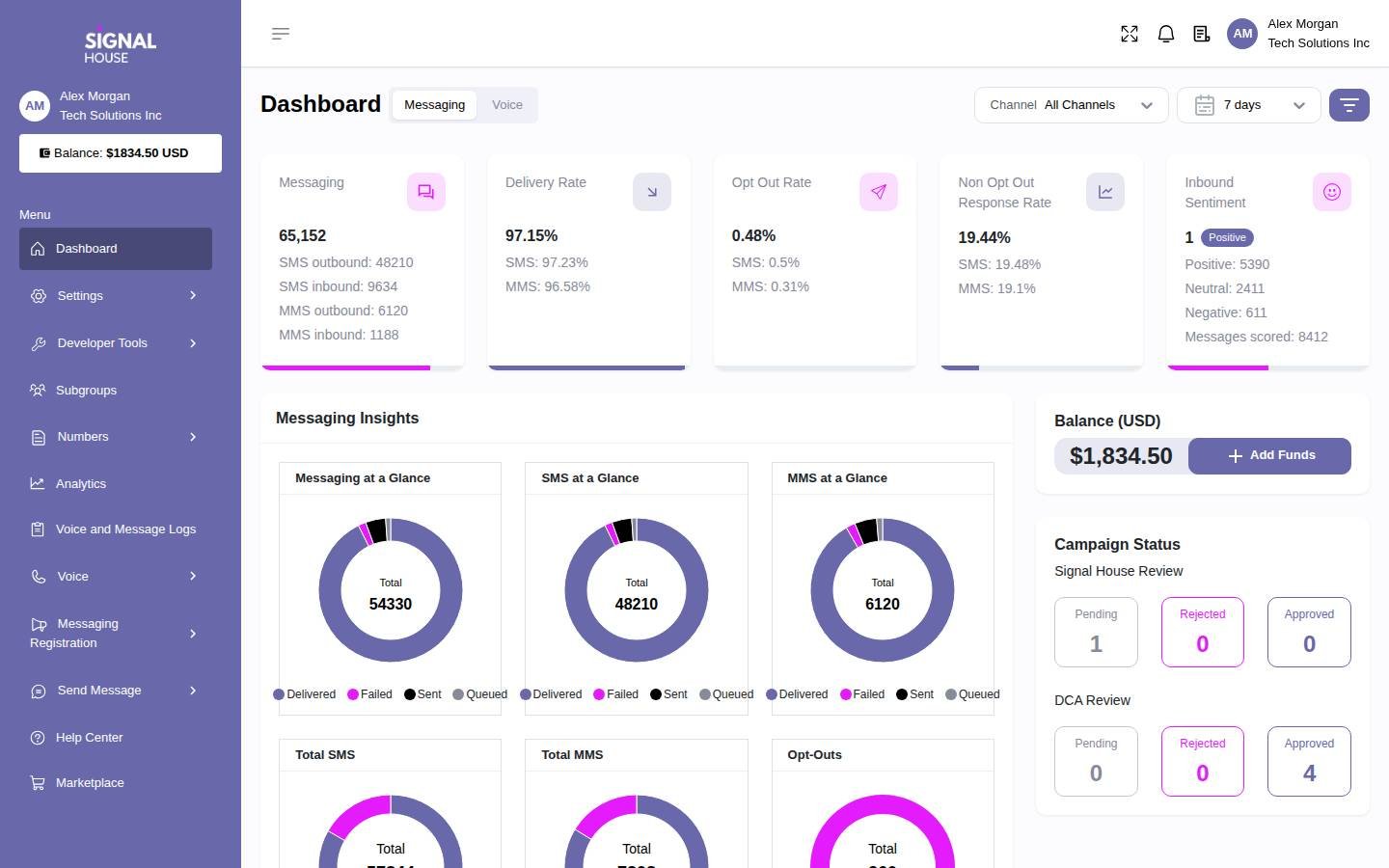
Signal House is a relevant affiliate among QuestBlue alternatives for businesses keeping a PBX while adding programmable voice workflows. Its voice product supports SIP trunking through a static-IP allowlist or registration credentials, with TLS/SRTP, UDP and TCP options described in its documentation.
Programmable voice profiles can route calls to trunks, endpoints or webhooks. For QuestBlue alternatives, that makes a demonstration with your existing SIP trunking and number routing more useful than a general messaging presentation. Begin with a working incoming and outgoing call, then test whatever application logic the migration requires.
Published US outbound pricing is $0.012 per minute for the first 100,000 monthly minutes, with graduated lower bands at higher volumes. Inbound is $0.005 per minute. Voice-enabled local-number pricing requires a quote; do not substitute a messaging-number price.
Buying Boundary: answered calls have a one-minute minimum and round up to the next minute; voicemail is answered traffic. For QuestBlue alternatives buyers with short calls, this matters. The G2 score is platform-wide, and reseller branding, customer accounts and invoicing need separate confirmation. Request a voice-specific demo.
4. Nextiva: Line-Based SIP Plans For An Existing PBX
Nextiva belongs among QuestBlue alternatives for a business that wants to keep its PBX and compare a line-based service. Its SIP trunking page lists Metered at $14.95 per line monthly, with 100 minutes included and $0.008 per minute specified. Unmetered is $24.95 per line monthly with nationwide calling.
When evaluating QuestBlue alternatives, these plans should be quoted as the SIP product, rather than inferred from a Nextiva employee-phone subscription. Ask how many lines your busy period requires, which destinations qualify and how additional numbers are priced. For QuestBlue alternatives, a predictable monthly charge still needs a clearly defined service scope.
Best Fit: an organization wants business connectivity with web-based administration for credentials and numbers. Compare the management approach with your current service. The useful demonstration is the actual PBX connection and call handling under load, not an unrelated hosted PBX sales presentation.
Buying Boundary: the 4.5/5 G2 rating covers Nextiva overall. It is not a separately measured SIP trunking score. For QuestBlue alternatives comparisons, request a product-specific SIP quote and written calling terms. This guide does not promise a free trunk trial.
5. Telnyx: Configurable Connectivity For Technical Teams
Telnyx is an infrastructure candidate among QuestBlue alternatives when your organization wants to retain technical control. Its SIP trunking pricing starts at $0.005 per minute for local outbound and $0.0032 for local inbound calls. Destination pricing, number rental and optional services remain separate checks.
When testing QuestBlue alternatives, compare how the proposed configuration handles your existing trunks and operational tools. Request the capacity needed for both active calls and bursts of new calls. Monthly usage is a cost input, but it does not describe the number of call attempts beginning during the busiest second.
Best Fit: an administrator or development team can own configuration and diagnostics. Use a small representative environment to test SIP trunking authentication, call identity and inbound routing. If you need customer-account separation, require a demonstration of that requirement rather than assuming a portal automatically supplies it.
Buying Boundary: the G2 score belongs to Telnyx CPaaS. For QuestBlue alternatives buyers, it provides broader platform feedback rather than a guarantee for a specific route. The trial includes restricted testing credit, verified-number requirements and calling limits; production porting and capacity need their own plan.
6. Twilio Elastic SIP Trunking: Developer-Oriented Carrier Control
Twilio Elastic SIP Trunking merits consideration among QuestBlue alternatives when the team can manage carrier configuration and related application work. The published US 48 Zone 1 outbound rate is $0.0100 per minute. Local inbound is $0.0034 per minute, and US local numbers are $1.15 monthly.
When pricing QuestBlue alternatives, those rates are more useful than the low toll-free termination headline when estimating ordinary US local calls. Separate recording, storage and other optional services from the base connection. A wider developer ecosystem can be useful, but engineering and ongoing maintenance remain part of the operating cost.
Best Fit: a technical organization wants SIP trunking alongside programmable communications tools. Demonstrate diagnostics and ownership of the account before relying on that flexibility. If replacing a hosted PBX, identify the separate application that will provide extensions, queues and the employee interface.
Buying Boundary: unlimited call concurrency is different from unlimited calls per second. QuestBlue alternatives should be sized for both. The G2 score here is specifically Elastic SIP Trunking, with a small review sample. Trial-account verification and usage restrictions must be considered when planning a test.
7. Plivo: Usage-Based Trunks With Granular US Billing
Plivo is worth evaluating among QuestBlue alternatives when your PBX remains in place and billing increments matter. Its US SIP trunking rates start at $0.0046 per outbound minute, with local inbound at $0.0028 and local numbers at $0.50 monthly. Different destination groups, including Alaska and Hawaii, have different rates.
US/Canada billing uses six-second minimums and increments. For QuestBlue alternatives, model that against the duration of actual answered calls, especially if many end quickly. A connected-minute total without per-call rounding can understate the amount that appears on an invoice.
Best Fit: a technical team needs inbound and outbound trunks with IP access-control or digest authentication. Test the documented fallback routing and security options against the exact equipment. Include any application layer that currently consumes QuestBlue events so it is part of the migration scope.
Buying Boundary: the 4.5/5 G2 score covers Plivo’s broader platform, not a standalone trunk-only sample. QuestBlue alternatives should still pass the workload test. Trial credits are advertised, but no fixed credit amount or duration is assumed. A hosted PBX interface is a separate requirement from the carrier connection.
8. Flowroute: Specialist Carrier Services And Multi-Account Management
Flowroute deserves a place among QuestBlue alternatives for organizations evaluating carrier connectivity and multi-account operations. Its pricing page explicitly describes creating and managing multiple accounts under one master account for MSPs and partners. That makes account administration a relevant demonstration topic rather than an assumed feature.
Published domestic inbound rates start at $0.005 per minute. Outbound rates for the US lower 48 and Canada start at $0.00833 per minute, with numbers additional. When quoting QuestBlue alternatives, ask for destination-level SIP trunking pricing and the account arrangement appropriate to your business.
Best Fit: an MSP or administrator wants SIP trunking while preserving control of its own calling environment. Demonstrate two customer accounts, their number ownership, access permissions and reporting. Multiple accounts are useful, but do not alone establish a full white-label storefront, automated retail invoicing or equivalent reseller terms.
Buying Boundary: the verified G2 score is 3.8/5 from a small sample. Investigate specific concerns rather than removing an inconvenient rating. For QuestBlue alternatives, test support and reconciliation alongside SIP trunking connectivity. Review the paid account terms; this comparison does not promise a timed free trial.
What MSPs Should Check Beyond The Calling Rate
For resellers, QuestBlue alternatives need to support a business relationship as well as a telephone call. List which services you currently sell, who receives the invoice and who answers support requests. If the replacement changes any of those responsibilities, include that change in the commercial evaluation.
Demonstrate Customer Separation
Ask providers on your QuestBlue alternatives shortlist to show two customer accounts with separate numbers, credentials, reports and access. For SIP trunking, establish whether one customer’s funding or traffic affects another. Where a hosted PBX is involved, confirm how administrators are restricted to the users and settings they should manage.
A generic partner program does not establish all of this. QuestBlue alternatives may offer referral relationships, developer subaccounts or wholesale services with very different obligations. Obtain the arrangement you intend to buy in writing, including what your customer sees and what your own staff must operate.
Reconcile Wholesale Costs With Customer Billing
When evaluating QuestBlue alternatives, export sample usage and trace it to the correct account, number and destination. Check whether your billing system can consume those fields. When a hosted PBX subscription is sold alongside usage, make sure the recurring license and carrier charges can be reconciled without manually reconstructing every invoice.
QuestBlue alternatives should also be evaluated for exception handling: a disputed call, an unexpected destination charge or a number that remains active after cancellation. Ask which reports and support channels resolve those cases. A lower nominal rate is less useful if reconciliation absorbs the apparent margin.
Include Messaging And Fax Dependencies
When scoping QuestBlue alternatives, inventory voice, messaging and fax separately if customers use them on related numbers. SIP trunking success does not establish messaging activation or fax compatibility. Demonstrate the specific sending, receiving and routing workflow before treating the customer account as fully migrated.
For QuestBlue alternatives, confirm who maintains messaging registrations, application callbacks and fax endpoints. Ask providers about the requirements applicable to the intended service and numbers. Avoid assuming that a voice port or a successful call transfers every associated capability automatically.
How To Compare Complete Costs
Model QuestBlue alternatives using one representative month and one busy period. Split the month into inbound minutes, outbound destinations, number rental, optional features and employee or line licenses. Add the tools and staff time needed to operate whichever service remains under your control.
Build A Consistent Baseline
For QuestBlue alternatives buyers, QuestBlue’s listed $0.009 domestic rates would produce $90 for 10,000 inbound minutes and $90 for 10,000 outbound minutes, if those rates apply. Fifty local DIDs at $0.70 monthly add $35. That limited subtotal is $215 before other services and charges.
Do not treat this calculation as a complete hosted PBX quote or a claim about a customer’s negotiated rate. QuestBlue alternatives must be compared on the same scope. Add cloud services, messaging, fax or other components where your deployment actually uses them.
Compare Line Plans With Metered Usage
Nextiva’s published SIP trunking plans create a useful SIP trunking question: how much traffic runs through each required line? Ignoring taxes and other differences, the $10 gap between $14.95 Metered and $24.95 Unmetered corresponds to 1,250 chargeable minutes at $0.008 each, beyond the stated included minutes.
This is an illustrative break-even calculation, not a purchase recommendation. For QuestBlue alternatives buyers, line count, included-minute treatment and eligible destinations need confirmation in the quote. A plan described as unmetered still requires defined calling terms and capacity.
Account For Rounding And Additional Services
Compare QuestBlue alternatives using billable durations call by call. Signal House rounds answered calls to whole minutes, whereas Plivo publishes 6/6 US/Canada billing. For SIP trunking, a sequence of short answered calls can therefore produce different billed-minute totals even when the actual connected time is identical.
Hosted PBX subscriptions require a parallel check: which users are billable, which allowances apply and which hosted PBX workflow requires an upgrade? QuestBlue alternatives should be priced for the configuration you need on launch day. Include porting work, number charges, relevant taxes and optional services in the final proposal.
How To Test A Replacement Before Moving Numbers
Begin evaluating QuestBlue alternatives with a temporary number and representative equipment. Write down what must happen on an incoming call, outgoing call and failed connection. A small test is more informative when its expected outcomes are agreed before somebody starts changing the production system.
Verify The Complete Call Path
Test SIP trunking authentication, caller identity, two-way audio, transfers, hold and menu input. Include several destinations your business actually calls. If encryption is required, verify the negotiated signaling and media path; a setting enabled in one portal does not establish protection across every component.
For hosted PBX candidates, repeat the staff workflow: incoming call, unanswered call, voicemail, follow-up and supervisor review where required. QuestBlue alternatives that simplify administration still need to support the way people work. Ask an ordinary user to complete the test instead of relying entirely on the administrator.
Test Failure And Recovery
During a controlled evaluation, interrupt the primary route and observe what happens. For SIP trunking, check which backup path receives traffic, whether calls reconnect correctly and how the system returns to normal. Record the account settings and contact responsible for that recovery.
QuestBlue alternatives should also be tested with support. Submit a reproducible example including a call identifier, timestamp and affected destination. The response helps establish what evidence the provider needs and which tasks remain yours. It does not prove future response times, but it makes responsibilities clearer.
Validate Usage And Application Events
Compare QuestBlue alternatives’ call records with your PBX or application logs. If SIP trunking callbacks drive customer notifications or billing, test duplicate events, failed delivery and delayed updates in your own integration. A completed call and a correctly processed application event are separate acceptance checks.
QuestBlue alternatives with a broader API environment may require new identifiers, authentication and event mappings. Keep credentials out of shared test notes and assign an owner for rotation. For a hosted PBX migration, also check which history and recordings can be retained or exported before retiring access.
Plan The Cutover Around Numbers And Customer Workflows
Move to QuestBlue alternatives only after confirming number portability, the receiving account and the required SIP trunking or managed-system features. Document every customer-facing number and its routing, messaging, fax and emergency-calling configuration where applicable. Ask the receiving provider to confirm the relevant setup requirements before the cutover.
Configure the new SIP trunking path or hosted PBX workspace before the main port. Use a small initial batch where practical and agree who validates incoming calls from external networks. Keep an escalation contact, the expected port window and a fallback plan available to the people managing the change.
QuestBlue alternatives can change more than the carrier name. Staff may need a new hosted PBX application, customers may need revised account access and billing tools may require new data mappings. Assign an owner to each of those changes so a successful number port does not conceal an unfinished operational migration.
When moving to QuestBlue alternatives, keep the previous service available for outstanding dependencies until they are resolved. Check the first complete invoice, remaining active numbers and access to historical records before closing unused services. Our VoIP questions and answers explain terms such as DIDs and connectivity when the purchasing team needs a shared vocabulary.
Frequently Asked Questions
Which QuestBlue Alternatives Are Closest For SIP Connectivity?
Signal House, Nextiva SIP, Telnyx, Twilio Elastic SIP Trunking, Plivo and Flowroute are relevant options when retaining an existing PBX. Compare authentication, routing, destination rates, number support and operational responsibilities. None of these QuestBlue alternatives should be assumed to reproduce every part of QuestBlue’s wider platform automatically.
Which Options Replace QuBe PBX For A Small Team?
KrispCall and Calilio are the first managed options in this guide. Compare the hosted PBX workflow and required plan rather than wholesale rates alone. KrispCall’s exclusive seven-day trial for VoIPCalling customers helps test the team experience; request a Calilio demo for its own current configuration.
Can A Reseller Use Any Of These Providers?
Reseller suitability needs a separate commercial and technical check. QuestBlue alternatives may differ in customer accounts, branding, invoicing, permitted service models and support ownership. Flowroute explicitly describes master-account management, but that feature alone does not prove a complete white-label replacement.
Are The Alternatives Always Cheaper?
No. SIP trunking cost depends on destinations, billable duration, number rental, capacity and optional features. A hosted PBX introduces user or platform charges and its own allowances. Compare the complete workload and the administration you must retain before claiming a saving.
Can I Test Without Porting My Main Number?
Start QuestBlue alternatives evaluations with a temporary SIP trunking number where the candidate’s account terms allow it. Verify inbound and outbound behavior before the main port. Trial accounts for QuestBlue alternatives can have restricted destinations, verification requirements and capacity, so confirm which acceptance checks require a paid configuration.
When Is Staying With QuestBlue Sensible?
Keep the existing service when it meets your needs and the proposed change does not demonstrate a worthwhile benefit. QuestBlue alternatives become more compelling when they solve a specific operational or economic problem and the migration effort is proportionate to that improvement.
Customer Feedback And Practical Buying Questions
Customer feedback can make QuestBlue alternatives evaluations more specific. In a G2 review relevant to QuestBlue alternatives, a Signal House reviewer using the name SMS N. rated it 5/5 on October 30, 2026, praising API integration and responsive support while noting unclear campaign-vetting steps and a mismatch between API and dashboard usage counters.
That review concerns messaging workflows, so it should prompt questions about onboarding and reporting rather than be presented as proof of SIP trunking quality. Test the voice configuration yourself and reconcile the records your business will actually use.
For Twilio Elastic SIP Trunking, Jayanth R.’s April 10, 2023, G2 review gave 3.5/5, described stability and useful customer communication, and raised low-volume cost and support concerns. This is an older individual experience, useful for framing questions rather than establishing current service performance.
Use the ratings to investigate QuestBlue alternatives, then choose on demonstrated fit. A hosted PBX workspace, a carrier connection and a reseller platform need different acceptance checks. The strongest decision combines a working call flow, understandable SIP trunking or managed-system costs and an operating model your team can sustain.
Affiliate Disclosure: VoIPCalling may earn a commission when you purchase through affiliate links in this article. Recommendations consider provider suitability, service limitations and pricing.