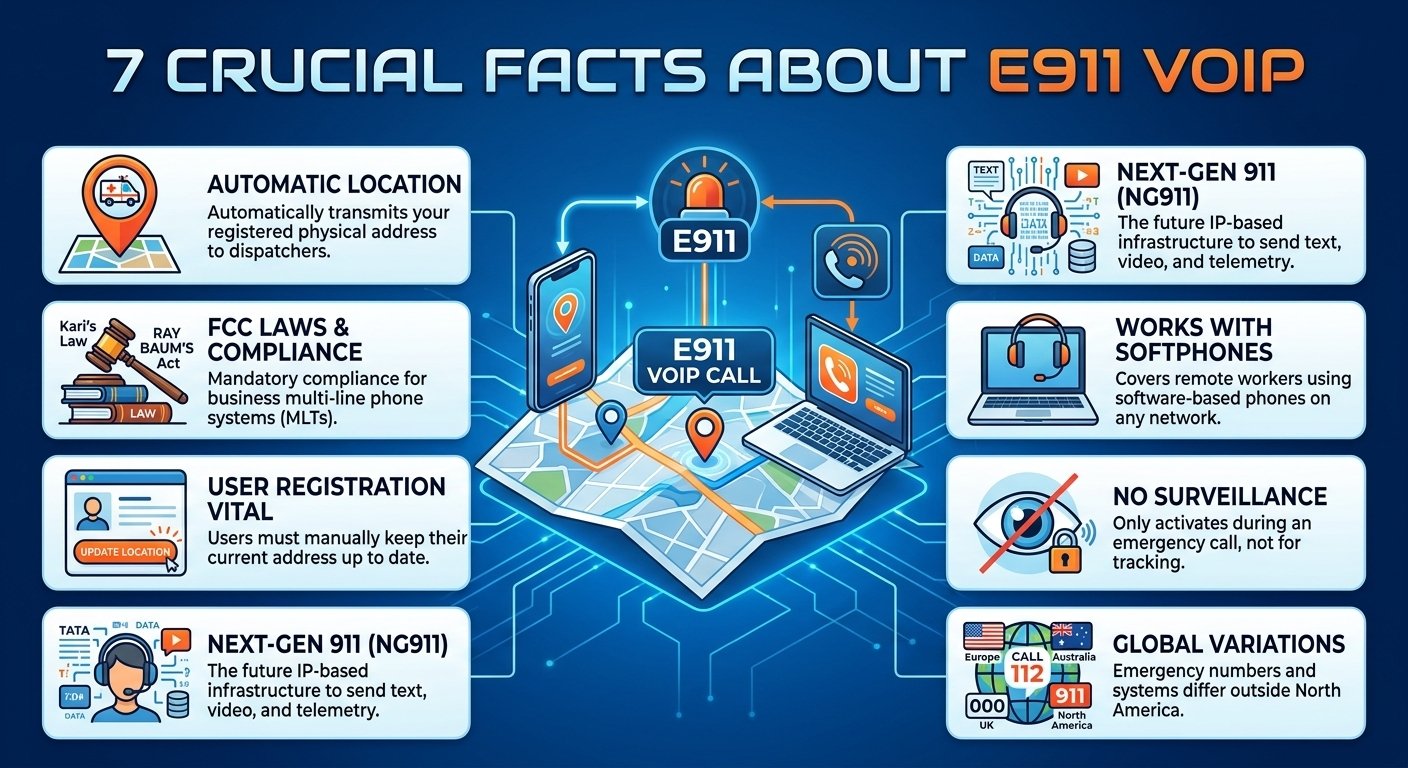
An e911 voip system is an extremely sophisticated emergency communication system, which automatically links your exact physical location to a dispatch center in the event of an emergency. The old telephone system is synonymous with a fixed building, while digital internet calling calls for a completely new way of thinking. Using an e911 voip system, users enter their physical location, so that first responders can send life-saving assistance to the right place.
This critical system is filling the critical gap between cloud-based communications and critical public safety systems. Knowing how e911 voip works ensures that people are still fully protected while enjoying the extensive flexibility of the internet telephony.
What Is Enhanced 911 (E911)?
The enhanced 911 is an important infrastructure improvement to the current dispatch system that is specifically engineered to send a caller’s precise location automatically to local officials. This technology connects a geographic location to your digital digits – it’s the basic building block of modern public safety access points. This information is sent to dispatchers in real-time, enabling them to direct police, fire or medical services without the need for verbal confirmation from panicking callers. Strong e911 for voip solutions ensures there are no tragic delays in times of emergency and ensures quick resolution.
Because of the lack of fixed geographic parameters in the internet telecommunications, e911 voip is a must for daily safety in today’s offices. For organizations that are moving 100% to cloud-based platforms, a compliant e911 voip setup is required for the safety of its people. This locator technology guarantees that mobile connectivity doesn’t impact quick response time. With proper management, voip e911 solutions can ensure absolute accuracy, no matter where employees decide to place their workstations.
How does E911 work—and why does it matter?
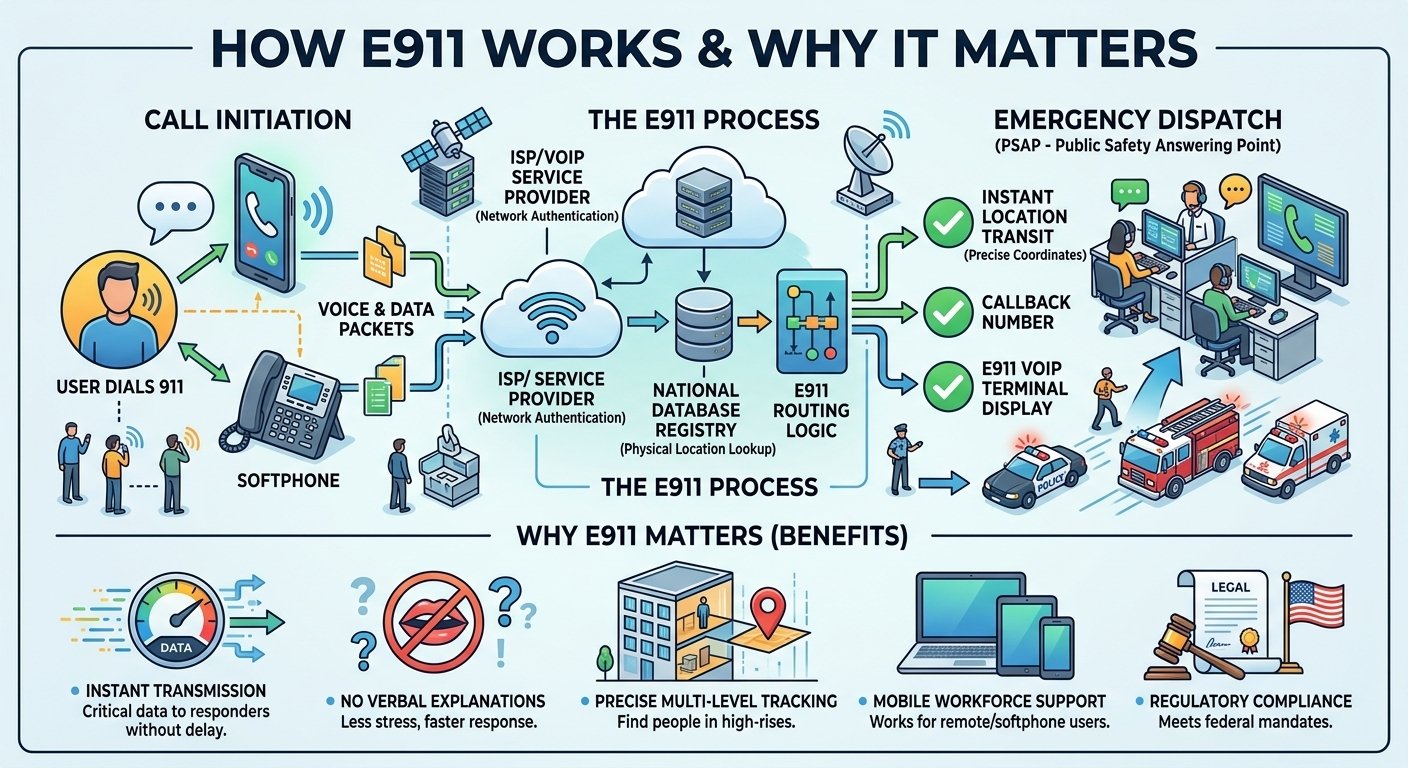
An improved dispatch system demands a perfect coordination between internet service providers, local emergency centres and national database registries. When a call is placed for assistance, the network validates the individual’s pre-registered physical location and only routes the call to the public safety answering point (PSAP) in the closest area. The callback number is instantly sent to dispatchers along with accurate geographic information via their e911 voip terminal. With trustworthy e911 voip technology, digital data is flawlessly converted into intelligence for first responders.
Establishing a strong voip e911 providers can be very useful for commercial businesses or residential owners for life saving reasons. The basic benefits of this routing process greatly improve overall public safety operations:
- Rapid and immediate transfer of critical locator information to emergency responders.
- Full verbal location explanations in very stressful situations.
- Accurate multi-level support: Floor and room tracking.
- Easy integration with mobile workforce devices and software-based softphones.
- Compliance with the Federal regulatory requirements for business telecom.
- Evolution of 911 & E911 Emergency Calls
The Evolution of 911 Emergency Calls and E911
Over the last decades, public safety infrastructure has undergone a complete revolution as has the telecommunication world. The architecture was originally designed for hardware used in fixed locations, but it’s continually evolving to accommodate nomadic devices and Internet-based telephony frameworks.
- Landlines: Traditional phones were wired to a specific address through copper wires. This permanent link gave emergency dispatchers immediate, very precise location information – the benchmark in reliability.
- Cell Phones: To determine a caller’s location, dispatchers are forced to use GPS triangulation and proximity to cell towers. Although technology has advanced, tracking is not as accurate as landlines and can be easily lost in buildings with lots of concrete.
- VoIP (Voice over IP) & E911: Cloud-based phone systems provide a lot of geographic flexibility, but have no physical location restrictions. For this, VoIP networks implement “E911” which involves users manually signing up and updating their physical address to their account settings. In case of an emergency, this information is self-reported and sent to dispatchers and the accuracy of the system depends entirely on the user maintaining accurate information.
Recent Laws Implemented by the FCC
Here is a detailed table summarizing the recent FCC laws and compliance guidelines for multi-line telephone systems (MLTS) and interconnected voice providers based on the information provided:
| Regulation / Mandate | Primary Objective | Key Requirements & Compliance Standards | Impact on Modern Enterprises & MLTS | Benefit to Public Safety |
| FCC General VoIP Guidelines | Mandatory Baseline Emergency Connectivity | Interconnected voice providers must seamlessly deliver emergency connectivity as a mandatory, non-negotiable feature. | Digital carriers and enterprises cannot allow users to “opt-out” of 911 access. Systems must actively prevent life-threatening routing delays. | Ensures all users on digital and modern telephony networks have guaranteed access to emergency responders. |
| Kari’s Law | Direct Dialing to Emergency Services | Systems must allow users to dial 9-1-1 directly without requiring an outbound prefix, post-fix, or trunk access code (e.g., dialing “9” to get an outside line). | Administrators must configure all Multi-Line Telephone Systems (MLTS) to recognize and instantly route 911 calls directly. | Eliminates fatal delays and confusion, ensuring anyone—including children or visitors—can easily reach help in a crisis. |
| RAY BAUM’S Act | Precise Location Transmission | A “dispatchable location” must automatically transmit to the receiving operator. This must include the exact street address plus granular details like the specific building, floor, suite, or room number. | Enterprises must maintain highly accurate, up-to-date internal location databases (like E911 registries) that map to specific extensions or devices. | Drastically reduces search time for first responders upon arrival, ensuring they are dispatched to the exact room rather than just a main lobby. |
VoIP E911 Solutions
Highly sophisticated telecom engineering is needed to provide functional interoperability between internet based platform and legacy dispatch infrastructure. Leading voip 911 service providers enable this connection by means of special third-party routing hubs that securely transfers encrypted information from cloud networks to local answering points. These complex digital pathways make sure that the modern packets are converted to the analog format that traditional dispatch staff are accustomed to.
Modern enterprises take full advantage of an advanced e911 voip integration to ensure complete regulatory compliance and effectively safeguard their decentralized remote workforce. Opting for top-notch e911 voip services ensures that every call to an emergency service is directed to the right geographic access point. These compliance attributes are essential for administrators to consider when choosing a long-term telecom provider for their corporate network.
Your E911 Address
A registered digital emergency location is a point that is used as the reference point for any emergency response associated with your communication account. To ensure absolute accuracy at a critical event, users will have to constantly check their actual physical location in their administrative portal. Using an old e911 voip profile can be a big risk as it may dispatch life-saving medical personnel to a facility that is completely abandoned and not your current location.
Not doing routine location verification almost assures that first responders will arrive at the wrong location. The most crucial personal accountability of any person actively using Internet-based telephony equipment is setting up perfectly accurate registry profiles. Accurate e911 voip records are your best bet to be your top coverage plan against any terrible logistical blunders during a crisis.
Next-Generation 911
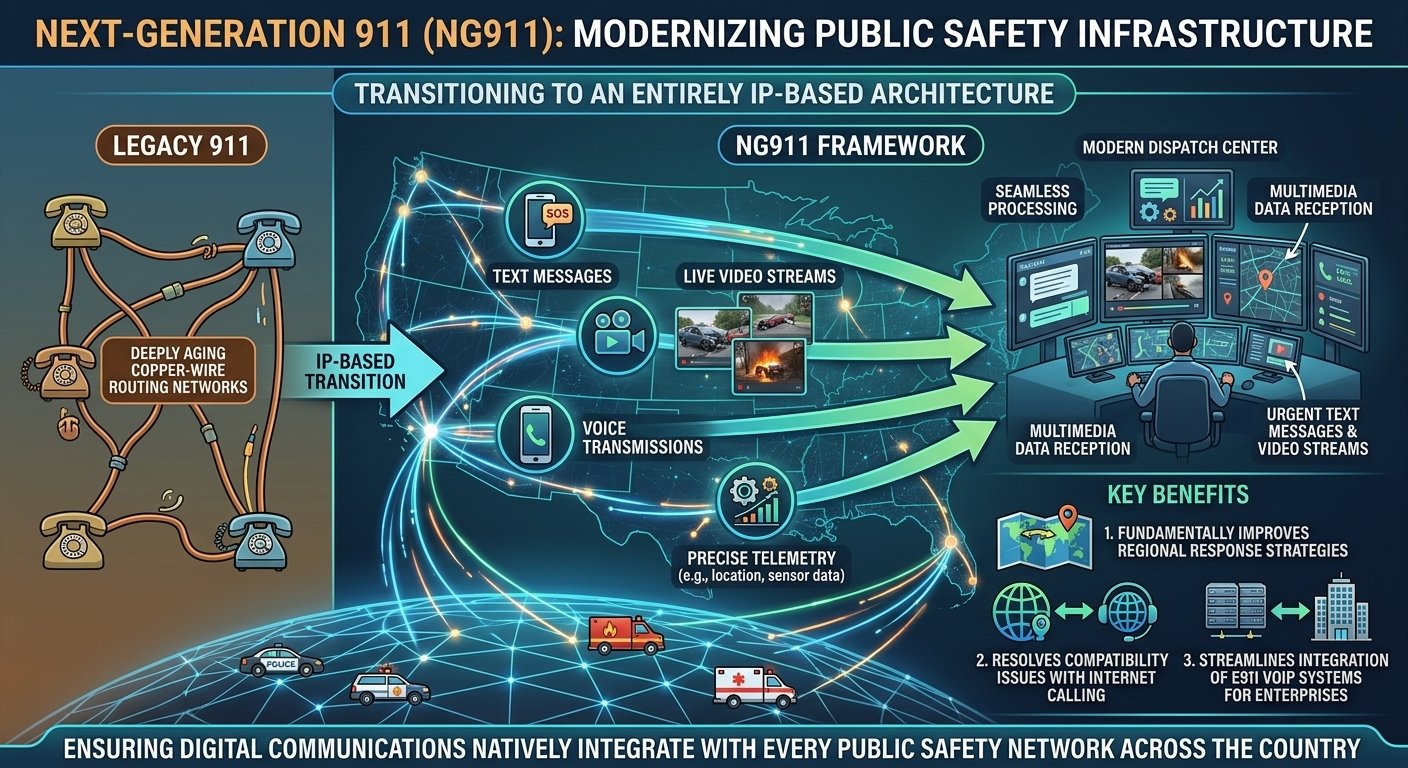
Modernizing the very antiquated public safety infrastructure is a major part of the transition to an all-IP national architecture, called NG911. This greatly enhanced digital system will eventually eliminate legacy copper-wire routing networks entirely, enabling modern dispatch centers to get multimedia information directly from concerned citizens. Rather than relying solely on voice communications, operators will be able to easily handle time-sensitive text communications, live video feeds and accurate telemetry data.
This is a huge technological shift that not only enhances regional response efforts, but also decisively addresses the strict compatibility constraints that have always been linked to internet calling. With the framework growing across the country, it will become much easier for enterprise administrators to integrate an e911 voip system. NG911 will eventually be adopted by all public safety networks nationwide, allowing digital communications to be natively integrated into all of them.
E911 and Cybersecurity: Common Misconceptions
Many wary consumers think that an embedded e911 chip is constantly tracking them around for invasive surveillance. This particular technology is not a hardware tracking device embedded in the person’s device, but instead a routing protocol that is only used during an active crisis. A thorough study of public safety communications by the National Emergency Number Association (NENA) found that emergency location transmission only turns on when a user dials the emergency digits on purpose.
Smart devices embedded with global positioning receivers are normally one-way passive listeners in the digital spectrum. The hardware silently works out the coordinates on earth but steadfastly refuses to broadcast them until an explicit emergency connection is made. By knowing these privacy limits, cautious users can feel very secure using an e911 voip system without worrying about an unwanted surveillance tracking system.
More E911 learnings: Other things you should know
Local city or town governments often collect their own compliance fees directly on the monthly internet calling bill in order to raise money for their own dispatch centers. These domestic surcharges are compulsory, and ensure that community answering points always have the funds to update routing software. In order to keep these localized e911 voip systems working, they need to be continually funded to keep their response time up to scratch.
Companies that are sending out large numbers of remote workers need to have a proactive corporate policy in place to ensure regular updates of their location registry. Ensuring that employees are trained on how to dial 911 on voip will ensure that everyone is aware of the basic mechanical differences between digital lines and legacy domestic connections. When a worker is using an e911 voip platform and has a sudden medical emergency, a well-trained company can stop a disastrous panic situation.
Read More: Best Call Recording Software for Call Center in 2026
Final Thought
Navigating the underlying complexities of modern public safety telecommunications genuinely requires a solid foundational understanding of how digital platforms communicate with local responders. Maintaining a flawlessly updated registry profile guarantees that life-saving personnel can pinpoint your exact whereabouts swiftly during any unforeseen crisis. Embracing these advanced e911 voip routing technologies ensures absolute legal compliance while securing unparalleled peace of mind for both residential homeowners and commercial users alike.
FAQs
-
What does E911 VoIP mean?
Enhanced 911 VoIP is an advanced public safety routing system that is specifically designed to automatically provide emergency dispatchers with an accurate internet location of the 911 caller. This enhanced infrastructure significantly cuts down on response time, giving operators immediate actionable co-ordinates without the need for verbal confirmation from them.
-
What does E911 mean on my phone?
Spotting this terminology within your smartphone settings simply indicates that your device actively supports the automatic transmission of location data during an emergency. The feature utilizes cellular triangulation and internal global positioning hardware to guarantee dispatchers can accurately locate you.
-
Can I call 911 in any country?
This is a numerical sequence that will usually only reach emergency services in North America and some allied territories. For international travelers, it is important to learn the emergency contact numbers for their destination country, which may be different from the numbers in the United States.
-
Is VoIP legal in the USA?
Internet-based telecommunications are still completely legal and under strict control of the federal telecommunications authorities throughout the United States. To be legally running, providers must comply with a number of legislative requirements in areas such as taxation, privacy and emergency dispatch connectivity.
-
How to test 911 on VoIP?
Users must never dial the emergency sequence directly for testing purposes without explicitly scheduling the test with their local dispatch center beforehand. Administrators must call their regional non-emergency administrative line to coordinate a designated testing window to verify their digital routing.
-
Can 911 see your location?
As long as your registered address is up-to-date in your dashboard, dispatchers have instant access to your exact physical location. Mobile devices can enable operators to see approximate coordinates based on satellite positioning systems and cell towers.
-
What is an E911 address?
This specific physical designation represents the exact street, building, and floor information formally registered to your digital communication account. First responders heavily rely on this manually submitted digital registry to navigate directly to your active location during a crisis.
-
How to dial 911 on VoIP?
Users simply enter the standard three-digit emergency sequence into their digital dialpad exactly as they would on a legacy domestic telephone. Modern legislative mandates strictly prohibit telecom platforms from demanding secondary access codes or outbound prefixes during an emergency.
-
What are VoIP 911 requirements?
Federal regulations strictly mandate that all internet voice providers deliver mandatory emergency connectivity seamlessly to every single registered subscriber. Carriers must securely route outbound emergency signals while simultaneously transmitting the user’s registered physical profile to the appropriate regional answering point.