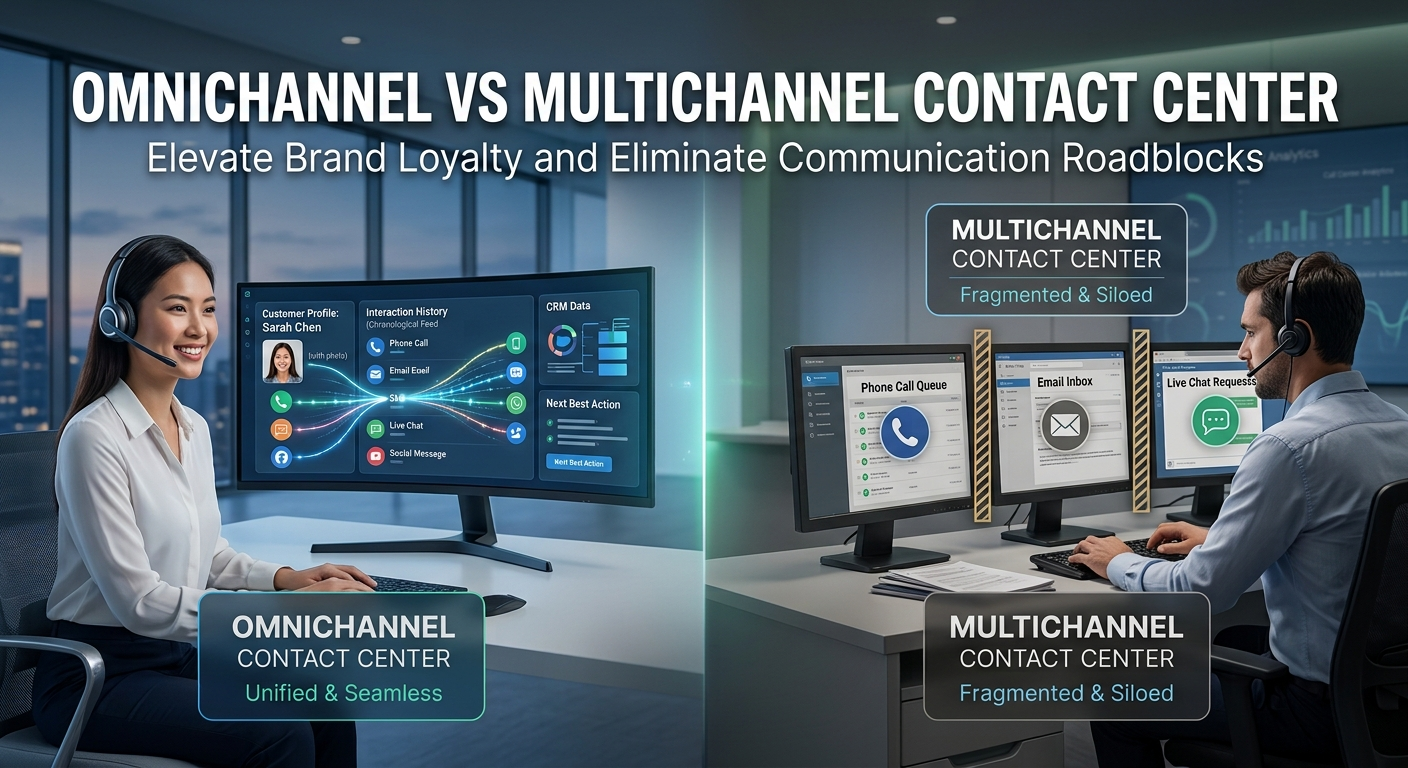
The decision between an omnichannel vs multichannel contact center hinges on your business objectives. A traditional setup offers different communication channels such as email and social media, but they are all in their own silos. On the other hand, an integrated strategy brings together all these touchpoints in a single system, which guarantees a seamless buyer journey. Today’s customers demand quick, seamless communication and don’t want to restate their problems. Hence, it is important to be aware of these architectural differences for long-term operational efficiency. This detailed guide covers the world of multi channel customer support, and how to choose the best system to boost brand loyalty and permanently remove communication barriers.
What Is an Omnichannel Contact Center?
An integrated platform is a modern customer engagement hub that brings together all communication touchpoints. This sophisticated architecture enables businesses to provide hyper-personalized experiences, no matter how buyers engage with the brand. Cloud-based technology allows support teams to have full visibility into past data and behavior. This single view significantly boosts agent productivity and strengthens an airtight omnichannel vs multichannel contact center approach.
The main advantage is the ability to make a seamless, connected experience where people feel seen as soon as they arrive. Agents can predict needs in advance, as they have a 360-degree view of past interactions. Another big plus is the capacity to quickly adjust to new communication trends such as in-app messaging and SMS. An omni channel contact center solution ensures your business is available wherever your audience is.
What Is a Multichannel Contact Center?
A traditional hub is a place where an organization can interact with the audience via various channels like phone, email, and live chat. But this model is a standalone one, where there is no cross-platform integration. Agents in this context handle inquiries effectively, but they don’t have access to the conversations that occur on other platforms. In fact, when you dig into the details of an omnichannel vs multichannel contact center, you’ll find that this legacy system is all about volume, not continuity.
This configuration is still very affordable and is a good choice for startups setting up their first support infrastructure. The first configuration is much quicker than complex, highly integrated cloud deployments. Moreover, platforms can be isolated so that teams can concentrate on particular metrics, such as email response time. This ease of use allows smaller teams to efficiently handle their multi channel customer service without the need for extensive technical training.
Differences Between Omnichannel & Multichannel Contact Center
The difference between an omnichannel vs multichannel contact center is all about the user experience and data integration. One is about the whole ecosystem, the other is about being on multiple platforms.
For a detailed comparison of these important differences, check out the detailed comparison table below. By knowing the difference between omni channel and multichannel architectures, you will be able to make future technological investments.
| Feature | Omnichannel | Multichannel |
| Integration | Fully integrated systems across all channels | Silos between different channels |
| Context | Complete customer history and journey data across channels | Limited cross-channel customer data |
| Experience | Consistent experience across channels | Can feel disjointed across channels |
| Customer Focus | Customer-obsessed, focused on service excellence | More operational focus on delivering service |
| Personalization | Hyper-personalized service based on customer data/journey | Less capacity for personalization |
| Channels | Phone, email, chat, SMS, social media, etc. | Typically focuses on traditional channels |
| Technology | Sophisticated, cloud-based, real-time omnichannel routing | Basic call routing, legacy on-premise systems |
| Cost | Higher investment but drives long-term value | Lower upfront costs but less futureproof |
| Metrics | 360-degree customer relationship metrics | Channel-specific metrics only |
| Best For | Customer-centric teams focused on superior CX | Budget-conscious teams with volume focus |
Advantages of an Omnichannel Call Center
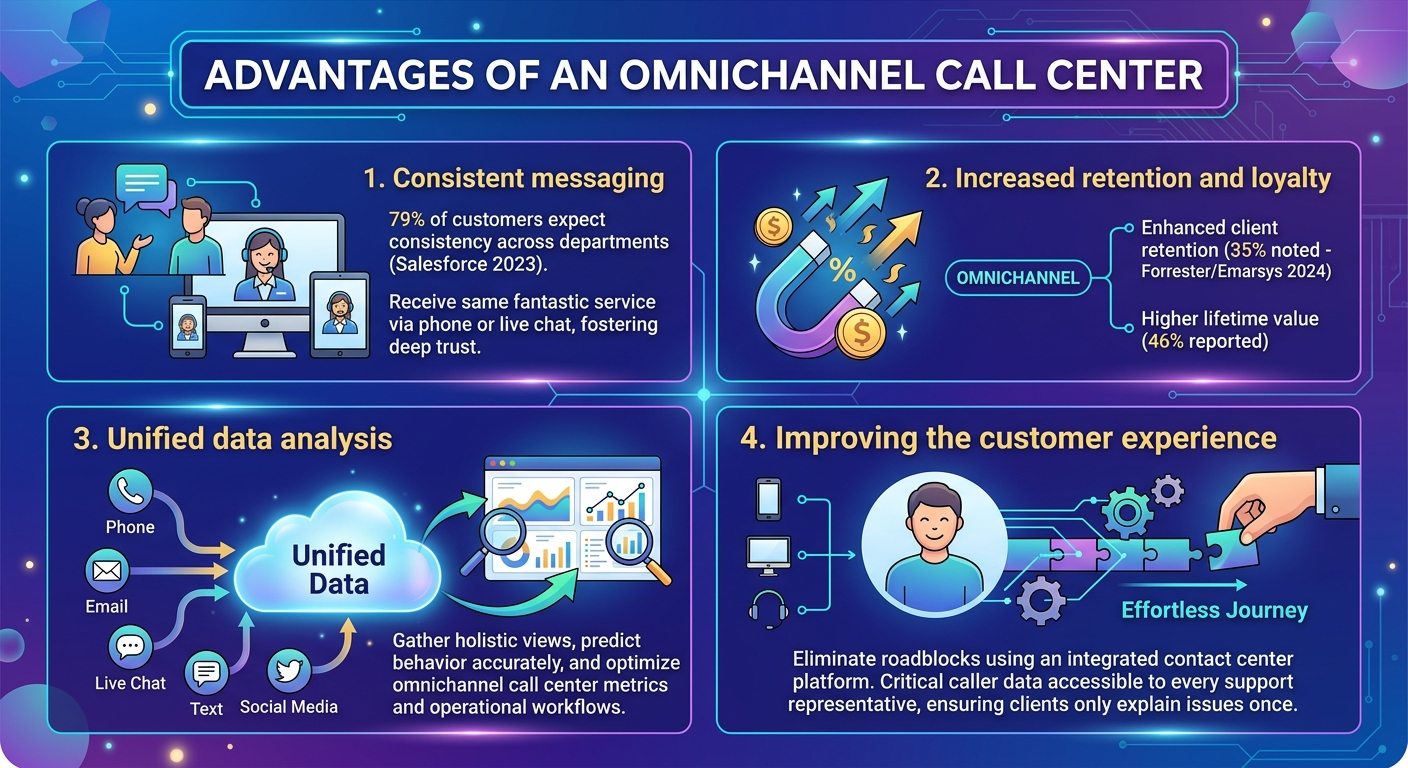
A fully-synchronized contact center changes the way that organizations deal with everyday consumer requests. The advantages below explain why modern businesses quickly embrace these advanced customer support solutions.
1. Consistent messaging
Salesforce’s 2023 State of the Connected Customer report reveals that 79% of customers expect consistency across departments. Customers are aware that they will get the same great service from a phone agent as they would from a live chat portal. This reliability in your omnichannel call center builds a strong level of trust and enhances your brand’s reputation in a very competitive market.
2. Increased retention and loyalty
The 2024 The Omnichannel Difference report by Forrester and Emarsys discovered that 35% of businesses noted enhanced client retention through integrated support systems. In total, 46% of organisations said they had seen an increase in lifetime value with a synchronised omnichannel contact centre compared to a multichannel contact centre. When buyers’ support experiences are connected and seamless across all channels, it becomes much easier to retain them.
3. Unified data analysis
Information is passed on smoothly as people move from one support person to another and supervisors can predict behaviour accurately. This comprehensive perspective enables businesses to optimize their live chat capabilities assessment efficiently, using omnichannel contact center metrics. The ability to see a caller’s journey allows leaders to identify unique trends and optimize the entire operational process for good.
4. Improving the customer experience
The ultimate goal is to remove friction from the buyer’s journey with an integrated contact center platform. With the addition of tools such as CRM software, all the important caller information is available to all individual support agents at once. When people reach out to the help desk, they only describe their problem once, and that’s how omnichannel software really works to break down sales channel silos.
Challenges of an Omnichannel Call Center
Although the advantages are many, there are organizational challenges to consider when moving to an interconnected call center. Before embarking on this technological transformation, leaders need to carefully assess their internal support capacity.
1. Cost and resources
A full-fledged omnichannel contact center vs multichannel contact center will cost a lot of money for communication software. Businesses need to invest in their current technology and acquire advanced cloud-based routing solutions for their agents. Furthermore, companies need to invest significant time in training their staff to use these sophisticated systems to avoid any short-term loss of productivity.
2. Managing omnichannel data
According to a 2024 Forrester report commissioned by Acoustic, 84% of respondents said tracking engagement was critical, but only 68% did. Call center supervisors are often overwhelmed with the sheer volume of behavioral data they collect, and don’t know how to use it to make meaningful decisions. To address this particular challenge, experts suggest using complete cleaning tools that can extract actionable intelligence from the huge support data stream.
Advantages of a Multichannel Call Center
Although it is not deeply integrated, this traditional contact center model has a lot of benefits for certain business models. Let’s find out why so many businesses are still using these stand-alone communication centres for their day-to-day needs.
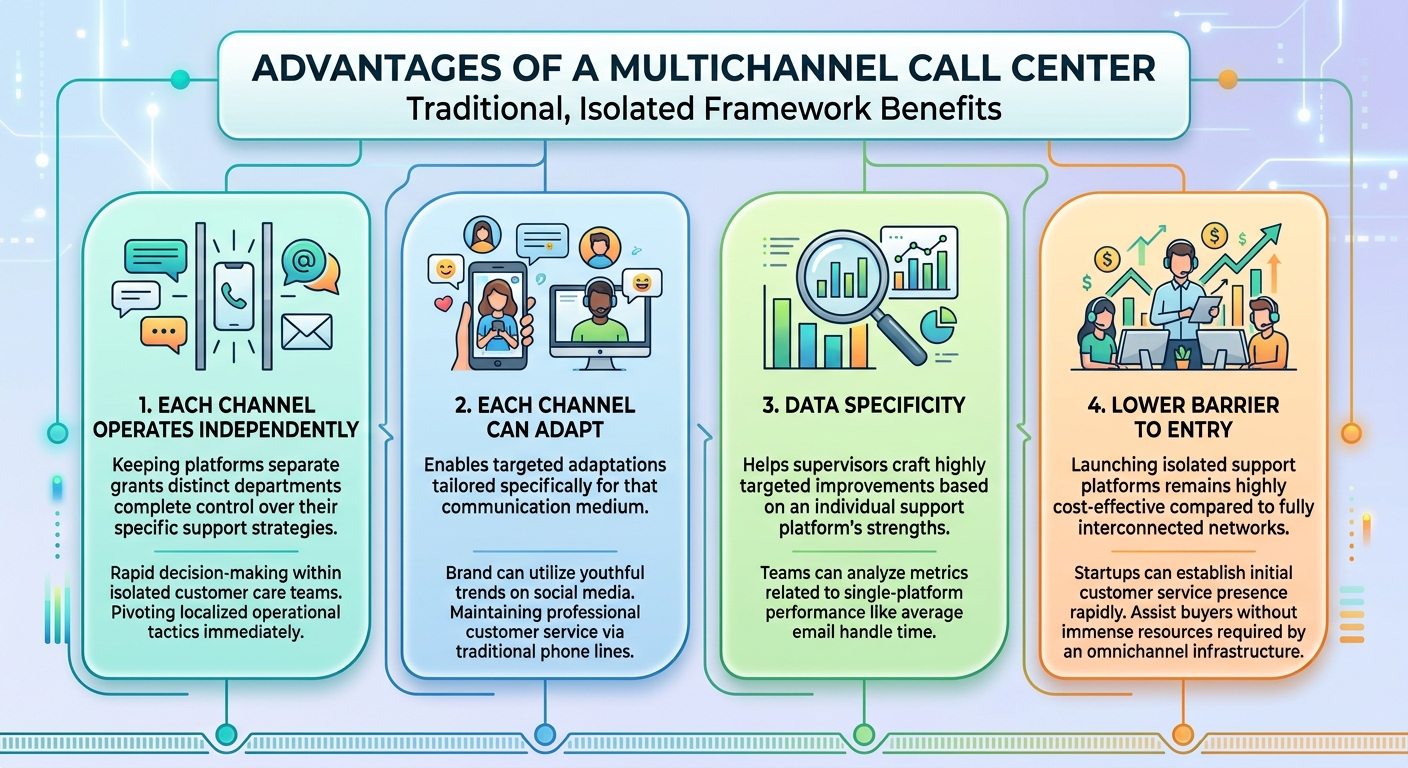
1. Each channel operates independently
Separate platforms provide full autonomy for different departments to have their own support strategies without the need for a lot of coordination. This multi channel contact center configuration enables quick decision making in separate customer care teams. Managers can adjust their local operational strategies on the fly without fear of affecting the entire corporate communications system.
2. Each channel can adapt
Some groups like to use certain platforms, which allows for specific adaptations that are unique to that communication medium. A brand can use the youthful trends on social media and still have professional multichannel customer service through traditional phone lines. By adjusting the tone, you can maximize engagement in that singular support setting, without the agent’s responses sounding too robotic.
3. Data specificity
Information isolation enables supervisors to make very specific improvements based on the strengths of an individual support platform. Multi channel call centre metrics such as average email handle time can be analysed by teams, and are only related to the performance of the single platform. This granular focus enables analysts to identify which particular network is providing the best resolution rate during quarterly reviews.
4. Lower barrier to entry
Stand-alone support platforms are still very cost-effective when compared to fully interconnected call center networks. This multichannel support approach is commonly used by startups to quickly get a customer service team up and running. You can help buyers without the huge resources of an omnichannel vs multichannel contact center infrastructure.
Challenges of a Multichannel Call Center
In general, the main disadvantages of this configuration are when considering the overall user experience versus an integrated support center. When customer service platforms don’t talk to each other, there are bound to be friction points.
1. Customer support roadblocks
Departments work in isolation, which means that consumers may have to re-enter account information when they switch from live chat to a phone agent. This multi-channel customer experience often causes high levels of frustration and reduced brand loyalty. When an agent receives an email inquiry, he has no idea what the buyer was talking about yesterday on the phone, and that’s a huge problem.
2. Inconsistent messaging
When independent call center queues are in operation, it can lead to conflicting information being passed on to the consumer base, which can erode trust over time. If agents are giving different answers to the same issues, then there is a risk of brand confusion with a fragmented multi channel customer support system. Consistency builds familiarity, and if you’re not consistent, buyers may doubt the reliability and competence of your entire support organization.
3. Data is not comprehensive
Evaluating isolated ticket statistics means call center leaders completely miss the holistic overview of buyer behavior. Without interconnected analytics, there is no way to gain a deep understanding of the effectiveness of the multichannel contact center solutions as a whole. In the absence of a single view, forecasting future support volume trends is extremely challenging and requires relying on disjointed operational insights.
Choosing Between Omnichannel and Multichannel Call Centers
Each organization has its own specific operational needs, budget, and audience. You need to thoroughly assess your internal capabilities before choosing between omnichannel and multichannel contact center software.
When deciding on your facility layout, take into account the following key considerations:
-
Assess your exact business model: Are you strictly an e-commerce brand or managing physical retail locations requiring synchronized digital support?
-
Evaluate your technical resources: Do you possess the massive budget required to deploy an omni channel contact center solution successfully?
-
Review your managerial capacity: Can your leadership team effectively synchronize multiple support departments into one cohesive unit?
For brands that are looking to just get tickets and are budget-conscious, a traditional call center is great. But for businesses that are committed to building high-quality, lasting customer relationships, an integrated facility is still a must.
Read More: Tree Phone: How to Design and Use One Effectively
Final words
Understanding your operational support capabilities is crucial when navigating the complexities of digital communication. The right omnichannel vs multichannel contact center architecture determines whether your agents will be able to keep your audience or not. Isolated call centers may provide low-cost access, but interconnected support facilities virtually ensure higher lifetime value and unparalleled satisfaction. In the end, a single technological ecosystem investment will help your support team stay competitive, resilient, and completely irreplaceable to your modern consumer base.
FAQs
-
What is the best choice for an omnichannel vs multichannel contact center?
The best choice strictly depends on your financial budget and customer experience goals. Integrated systems provide a flawless, personalized journey, while isolated networks offer a cheaper, faster setup for smaller support teams.
-
How do integrated platforms improve agent productivity?
Integrated systems consolidate all historical data and previous interactions into a single, unified dashboard. This eliminates the need for agents to toggle between multiple applications, allowing them to resolve issues much faster.
-
Is a traditional communication hub cheaper to implement?
Yes, legacy systems require significantly less upfront financial investment. Companies can launch isolated email and phone support quickly without purchasing expensive, fully synchronized cloud-routing software.
-
Can small businesses benefit from interconnected contact hubs?
Absolutely, small businesses can utilize scalable cloud software to synchronize their minimal platforms. Doing so early prevents future data silos and establishes a strong foundation for rapid, organized business expansion.
-
Why do consumers prefer integrated communication environments?
Consumers deeply despise repeating their account information to different representatives. Integrated environments ensure their previous interactions are instantly visible, making the resolution process completely frictionless and highly personalized.
-
Do isolated networks cause brand messaging inconsistencies?
Yes, because each department operates independently, they often push conflicting promotional materials. This lack of centralized coordination frequently confuses the target audience and degrades overall brand authority.
-
What specific metrics do integrated contact hubs track?
These advanced hubs track comprehensive relationship metrics, cross-platform behavioral trends, and overall lifetime value. This provides a holistic narrative rather than isolated, channel-specific statistics like basic response times.
-
How difficult is migrating from an isolated to a synchronized system?
Migration requires careful planning, significant financial investment, and extensive employee training. However, utilizing modern, adaptable software makes bridging the gap between an omnichannel vs multichannel contact center highly achievable.