
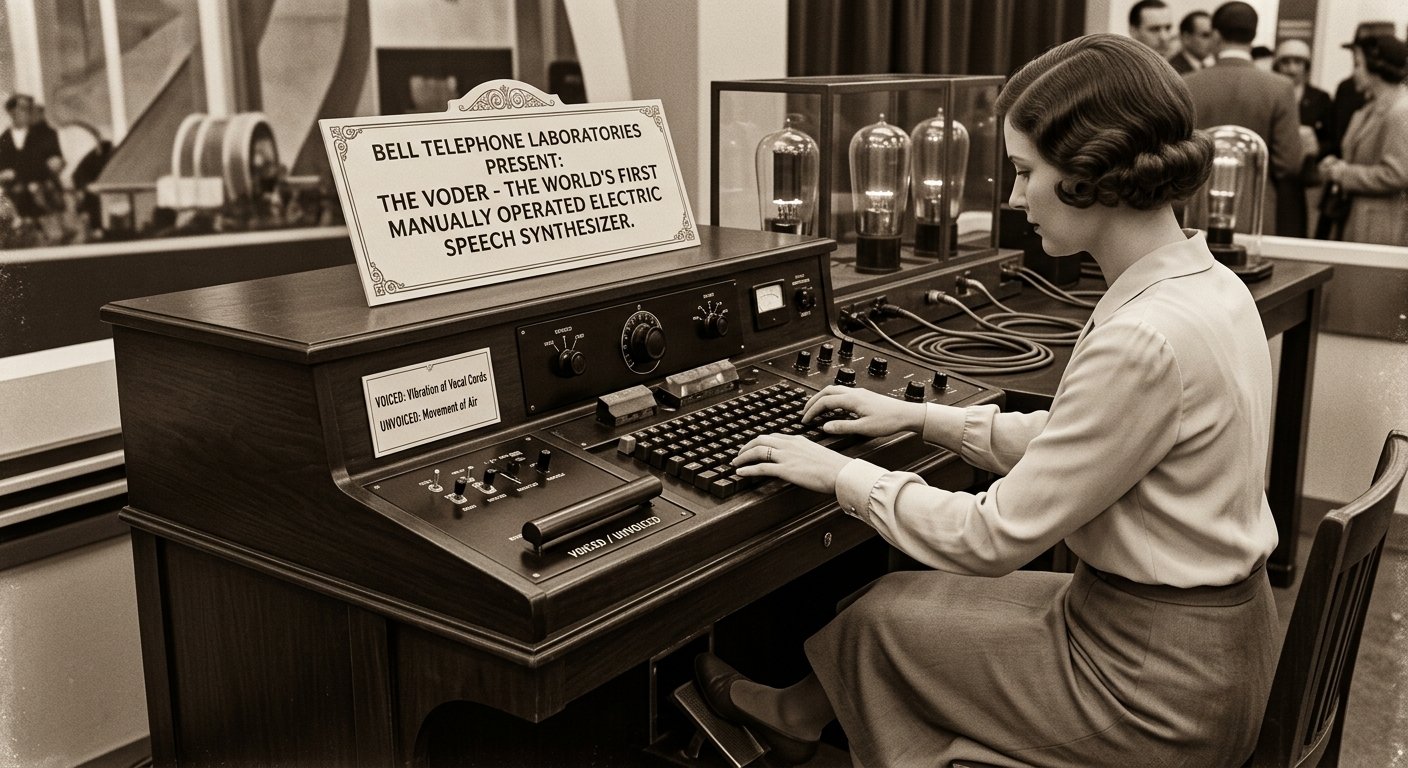
A Voder refers to the Voder (Voice Operation Demonstrator), an early electronic speech synthesizer developed by Bell Telephone Laboratories in the 1930s. Instead of playing recorded speech, the Voder electronically generated human-like sounds that a trained operator controlled using keys, pedals, and other controls. Demonstrated publicly in 1939, it was an important milestone in the development of electronic speech synthesis and modern voice technology.
Developed by Homer Dudley at Bell Labs in the late 1930s, voder device was officially known as the Voice Operation Demonstrator. Unlike modern digital text-to-speech systems, this invention required a human operator to physically manipulate keys and pedals to simulate the biological functions of the human vocal tract.
By breaking down speech into its fundamental acoustic components, it proved that human language could be recreated through purely electronic means, laying the groundwork for all future voice synthesis technology.
THE VODER: Overview
The Voder is a landmark achievement in early electrical engineering that fundamentally changed our understanding of the mechanics of human speech. An acronym for Voice Operation Demonstrator, this machine was never intended for home use but served as a proof of concept for Bell Labs engineers. It was a manually operated synthesizer that could mimic the nuances of human speech through complex circuitry.
This invention was vital because it demonstrated that the human voice could be synthesized without a human speaker being present. This discovery eventually found applications in numerous voice communication scenarios, from long-distance telephony to automated systems. The voder remains a foundational pillar for every voice-activated assistant we use in the modern world.
THE HISTORY OF THE VODER
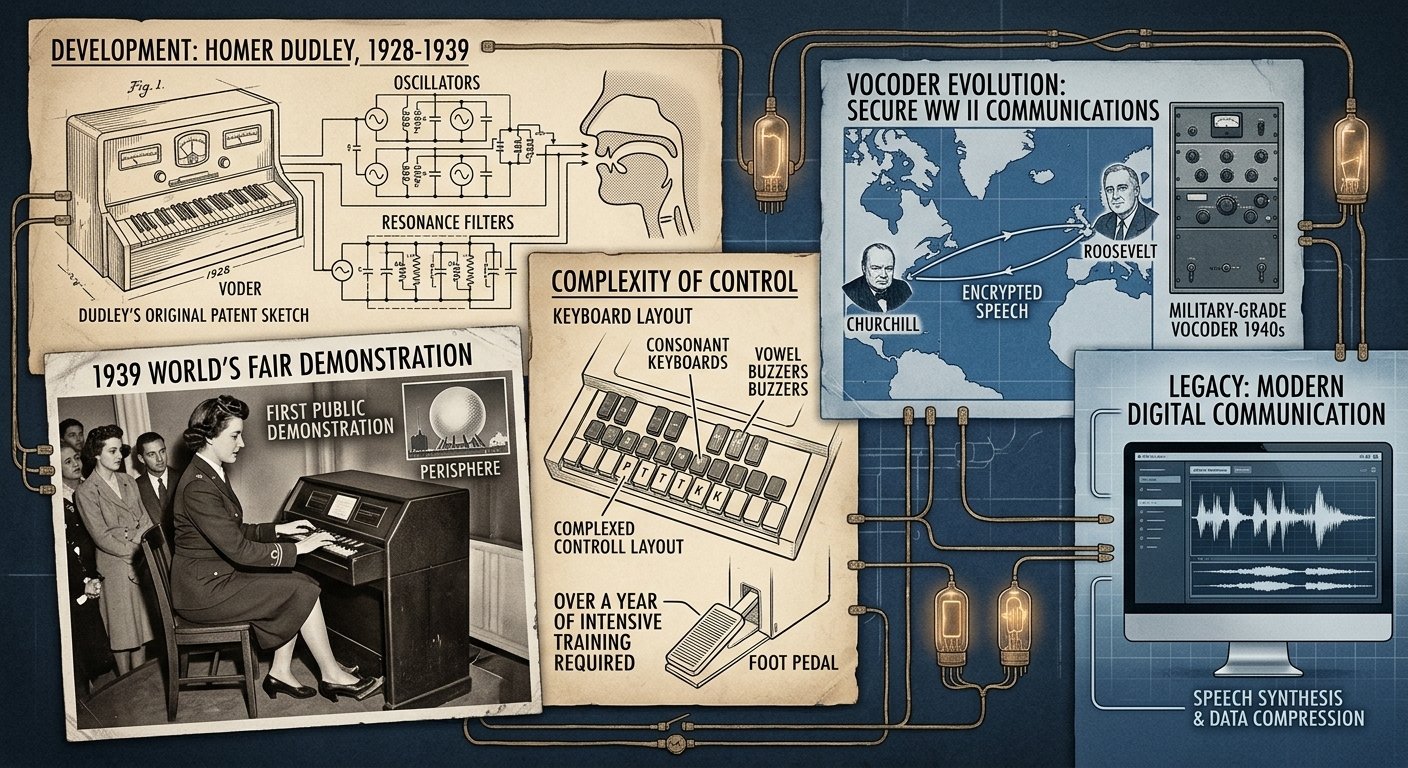
Developed by Homer Dudley starting in 1928, the Voder was the first electronic speech synthesizer, using oscillators and filters to mimic the human voice.[1] It gained international fame at the 1939 New York World’s Fair, where operator Helen Harper demonstrated the machine’s ability to converse, proving to a fascinated public that technology could eventually “talk” back to them. Since operating the device resembled playing a complex musical instrument, operators underwent over a year of intensive training to master the specific keyboard and foot pedal sequences necessary for fluid speech.
Dudley’s 1937 patent pioneered the concept of transmitting speech as simple electrical signals, laying the early groundwork for modern digital communication and data compression. Bell Labs continued to refine this technology for decades, evolving from basic robotic speech to complex acoustic research that continues to influence how we transmit and synthesize sound today. This specialized research also paved the way for the Vocoder, a system that became vital for secure, encrypted voice transmissions between Allied leaders during World War II.
How Did the Voder Work?
The voder operated as a spectrum-based voice synthesis device, utilizing a sophisticated array of vacuum tubes. It was the first successful attempt at recreating both voiced and unvoiced sounds, the two primary categories of human language. The system performed speech synthesis by carefully imitating the behavior of the human vocal tract, acting as an electronic surrogate for the lungs and mouth.
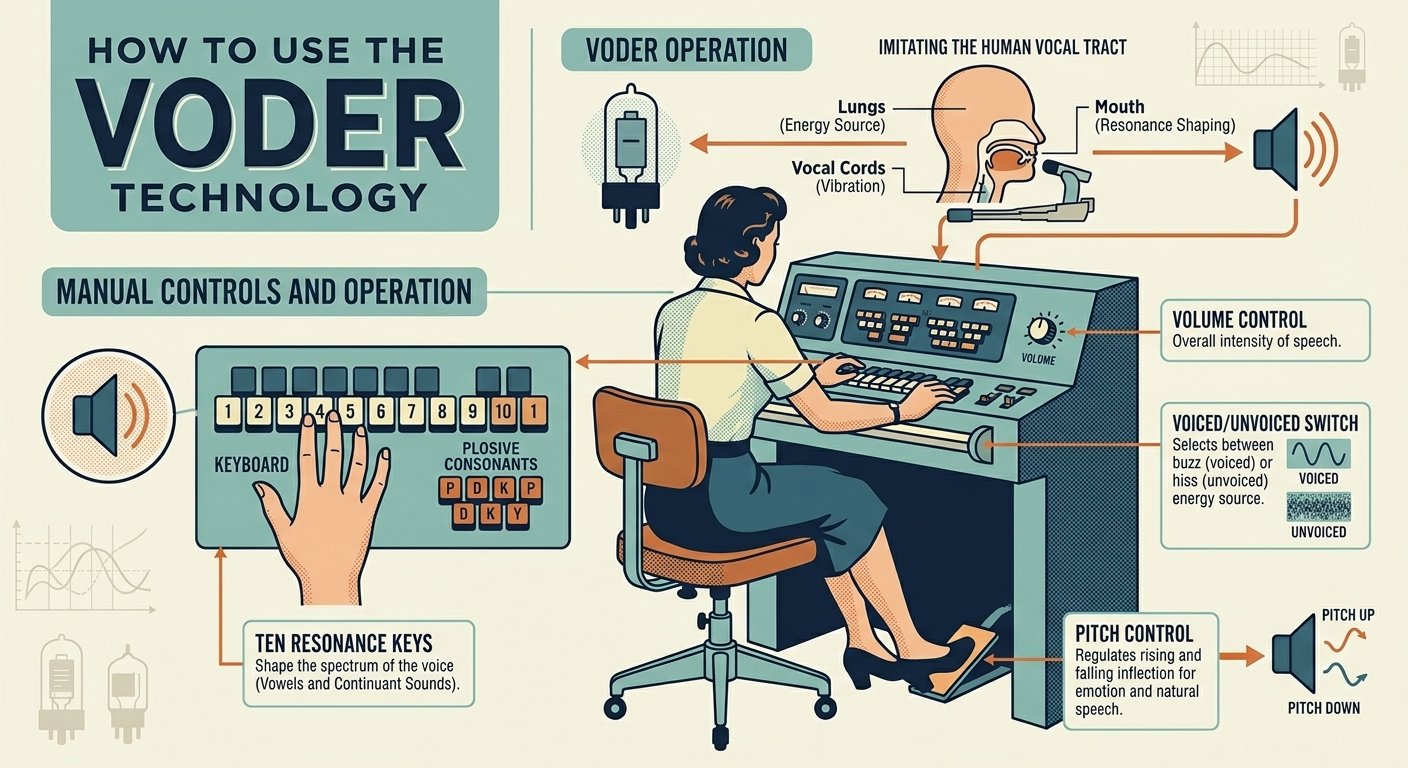
The machine reproduced speech by electronically reconstructing these core acoustic patterns. In order to produce recognizable speech, the internal energy source had to be converted into audible vibrations. This process resulted in various speech sounds that were distinct enough to be understood by a general audience.
-
Imitating the Human Vocal Tract
The device functioned by modeling the two main ways humans produce sound: through the vibration of vocal cords and the movement of air. By simulating these physical actions electronically, the voder could generate vowels and consonants. It essentially acted as a musical instrument where the “music” being played was the English language.
The operator had to understand the phonetic structure of words rather than just their spelling. Because the machine was entirely manual, the timing and pressure applied to the controls determined the clarity of the output. This made the device incredibly difficult to master, requiring a unique blend of musical and linguistic talent.
-
Manual Controls and Operation
Operators handled the machine like a piano, using a combination of hand and foot movements. The worker operated keys with their fingers to shape the mouth’s resonance, while a wrist bar controlled the vocal cords’ activity. Simultaneously, a foot pedal was controlled with the right foot to adjust the pitch, allowing for inflection and emotion.
-
-
-
The keyboard consisted of ten keys that controlled the spectral resonance of the voice.
-
The wrist bar allowed the operator to switch between voiced and unvoiced energy.
-
The foot pedal managed the rising and falling pitch of the synthesized output.
-
Additional keys were provided for specific consonants like “p” or “d.”
-
A set of controls managed the overall volume and intensity of the speech.
-
-
THE COMPONENTS OF THE VODER
The internal architecture of the Voder functions as an electronic analogue of the human vocal tract, simulating speech by generating and shaping raw acoustic energy. It utilizes a dual-source system to produce “breath” and “voice”: a noise generator creates unvoiced hissing, while a relaxation oscillator produces a saw-tooth wave to mimic the glottal pulse of the vocal cords.
These raw signals are modulated by the operator through a series of manual controls. A wrist bar toggles between energy sources, potentiometers adjust the pitch, and a specialized keyboard manipulates ten band-pass filters to simulate the resonant “formants” of a human mouth. This processed signal is then amplified to produce audible synthetic speech. The specific components and their functions are detailed in the table below:
| Category | Component | Function & Description |
| Sound Generation | Noise Generator | Produces random “hissing” noise to mimic air rushing through the lips (unvoiced sounds).[1] |
| Relaxation Oscillator | Acts as the primary energy source for the “buzz” tone, mimicking vocal cord vibration. | |
| Saw-tooth Wave | The specific wave shape produced by the oscillator to simulate a glottal pulse. | |
| Primary Controls | Wrist Bar | A master toggle used to switch between voiced (buzz) and unvoiced (hiss) energy sources.[2] |
| Potentiometers | A set of three dials used for pitch control and fine-tuning the frequency of the buzz tone. | |
| Keyboard | Functions like a human mouth; used to shape sounds and control resonance. | |
| Resonance & Filtering | Band-pass Filters | A bank of ten filters that divide the frequency range into specific sub-bands. |
| Formant Tuning | The filters are tuned to represent “formants” (spectral peaks) of human speech. | |
| Output & System | Amplifiers | Boosts the electronic signal to a level audible through a speaker. |
| Interconnected Wiring | Ensures that transitions between different sounds remain smooth and seamless. |
EVOLUTION OF SYNTHETIC SPEECH AND VERSATILE AUDIO CAPABILITIES
Engineers significantly improved the voder by addressing early limitations, such as the metallic quality of vowels, and introducing a volume-control system that mimicked natural human speech by decreasing loudness as pitch dropped. A major breakthrough included the integration of complex phonetic elements like the “zh” sound and additional keys for stop consonants, which allowed for crisper, more professional word endings. These improvements expanded the range of sounds operators could produce and made demonstrations more intelligible. Skilled operators could vary pitch, imitate different vocal characteristics and even produce singing or non-speech sounds.
Beyond standard speech, the voder demonstrated extraordinary flexibility by covering a pitch range from deep bass to high soprano, enabling operators to switch between genders or even perform melodic duets. Its capabilities extended to the imitation of animal noises, such as barking and mooing, as well as mechanical sounds like steam engines. Furthermore, skilled users could manipulate the device to sing, whisper using unvoiced noise sources, or simulate diverse regional accents by adjusting resonance filters, showcasing a level of acoustic range that often rivaled the complexities of the human voice.
SELECTING AND TRAINING A VODER OPERATOR
Finding the right person to operate the voder was a rigorous process that required identifying individuals with unique talents. Because the machine was so complex, operators needed sufficient skill and manual dexterity to master the instrument. Bell Labs initially screened hundreds of candidates, eventually selecting only twenty-four operators to undergo the full training program.
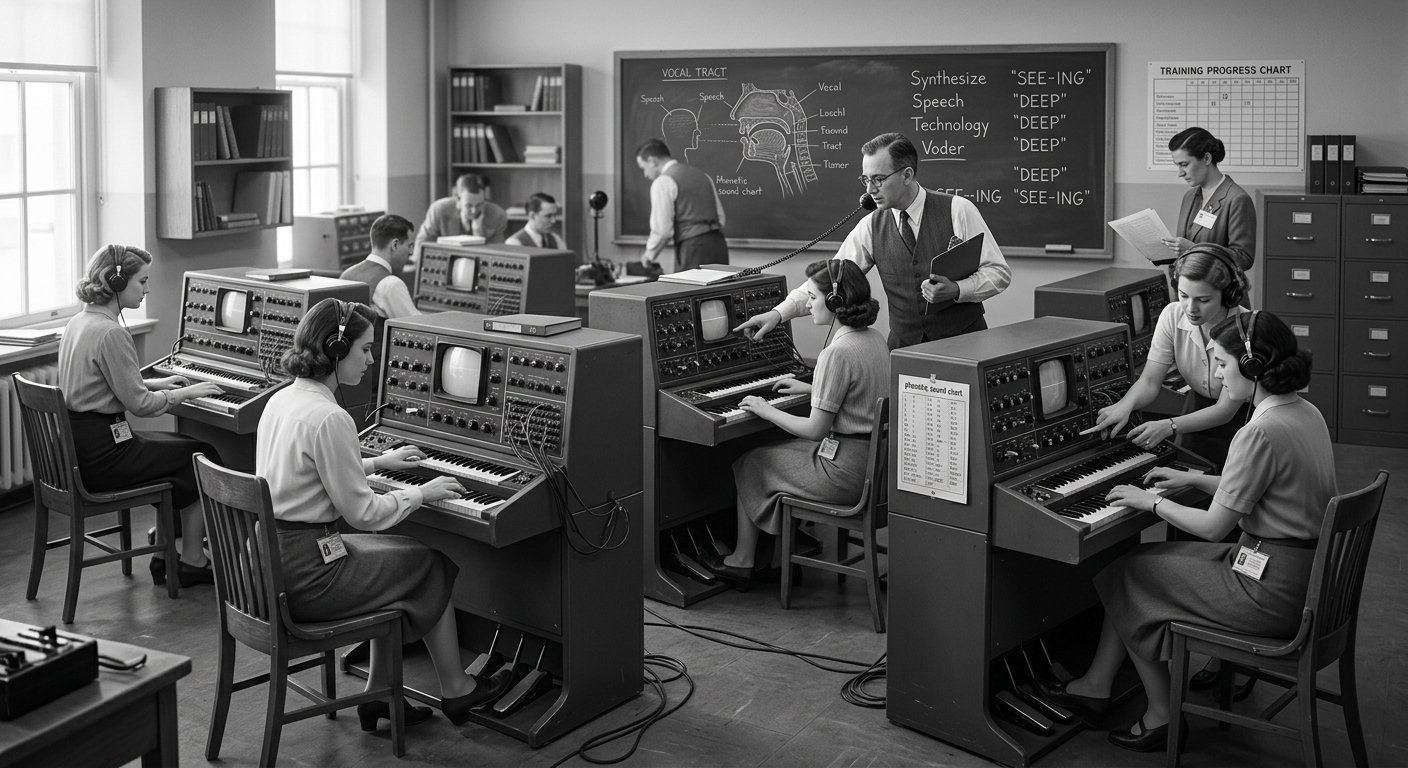
The selection process was based on a specific set of criteria designed to predict success with the machine. Candidates were evaluated on their ability to use a complex keyboard and their inherent phonetic sense. Quickness of comprehension was also vital, as the operator had to process and synthesize sounds in real-time during demonstrations.
-
The Intensive Training Program
To facilitate this massive training undertaking, twelve Voders were used to train the twenty-four selected operators in rotating shifts. After mastering the basics in the first six months, students spent the remainder of the year refining their technique and fluency. Bell Labs archives reveal that the training curriculum featured a core vocabulary of 2,500 words.
-
-
-
Operators practiced for hours a day to build necessary muscle memory.
-
Training included rhythmic exercises to ensure speech sounded natural.
-
Students had to learn to “play” the machine like a musical instrument.
-
Regular testing was conducted to ensure the synthesized speech was intelligible.
-
Only a small fraction of the original candidates reached professional proficiency.
-
-
VOCODER VS. VODER COMPARISON
While the names are similar, the Vocoder and the Voder were two different applications of the same speech synthesis technology. Both were electrical synthesizers, but they served very different functional purposes. The Vocoder was an automatic speech analysis and synthesis system designed to compress voice data for more efficient long-distance transmission.
In contrast, the voder was a pure synthesizer that could create speech from scratch without an incoming human voice signal. While the Vocoder required no special operator training, the Voder required a highly skilled person to manipulate its controls. These two inventions represent the twin pillars of modern communication: data compression and voice generation.
| Feature / Aspect | The Vocoder | The Voder |
| Primary Type | Speech analysis/synthesis | Pure speech synthesizer |
| Operation Mode | Automatic (No training) | Manual (Requires operator) |
| Speech Generation | Reproduces existing voice | Creates speech from scratch |
| Modern Usage | Digital voice compression | Text-to-speech technology |
| Control Method | Electronic signal analysis | Keyboard and foot pedals |
The Vocoder’s ability to compress speech was essential for secure communications during World War II, notably in the SIGSALY system used by Winston Churchill. The voder, however, remained primarily a research and demonstration tool. It was used to showcase the possibilities of synthesized sound rather than as a practical tool for daily communication.
Research published in historical journals indicates that the Vocoder technology eventually evolved into the voice-coding standards used in modern mobile phones. The Voder’s legacy is found in the software that allows our computers and cars to speak to us. Both machines prove that the human voice is not just a biological mystery, but a series of predictable acoustic patterns.
Read More: Call Center Shrinkage: Definition, Formula, Causes & How to Manage It
Final Thought
The Voder was an important milestone in the history of speech technology because it demonstrated publicly that intelligible speech could be generated electronically. Although the machine required a highly trained human operator and was never intended as an everyday telephone, the research surrounding it helped advance scientific understanding of speech synthesis and electronic voice communication.
FAQs
-
What is the voder used for today?
The original voder is no longer used for practical communication, as it has been replaced by digital software. However, its underlying principles of spectrum-based synthesis are used in modern text-to-speech (TTS) systems, accessibility tools for the visually impaired, and automated customer service voices.
-
Who invented the Voder and what does the name stand for?
The Voder was invented by Homer Dudley at Bell Labs in 1937. The name stands for “Voice Operation Demonstrator.” It was designed to show that human speech could be synthesized using electronic components like oscillators and filters.
-
How did an operator control the pitch of the Voder?
An operator used a foot pedal with their right foot to control the pitch of the voice. By moving the pedal up and down, they could make the synthesized voice sound higher or lower, allowing the machine to ask questions or express emotions.
-
Was the Voder a commercial success?
The Voder was never intended to be a commercial product for consumers. It was a research tool and a public relations masterpiece for Bell Labs that demonstrated their leadership in telecommunications and acoustic science.
-
How long did it take to learn to use the voder?
It typically took about one year of intensive training to become a professional operator. Candidates spent the first six months learning the basic phonetic controls and the remaining six months perfecting the natural rhythm and inflection of speech.
-
What is the difference between a Voder and a Vocoder?
The primary difference is that a Voder creates speech from scratch through a manual operator, while a Vocoder analyzes an existing human voice to compress and recreate it. The Vocoder is automatic, whereas the Voder is a manually played instrument.
-
Could the Voder speak multiple languages?
Theoretically, yes. Since the Voder was a phonetic synthesizer, an operator trained in the phonetics of different languages could produce speech in those languages. However, most public demonstrations and training were focused on English.
-
Why was Helen Harper famous in the history of the Voder?
Helen Harper was one of the most skilled operators of the Voder. She became the public face of the invention during the 1939 New York World’s Fair, where she demonstrated the machine’s ability to talk and sing to thousands of amazed visitors.
-
Are there any working Voders left?
Most original Voders are now museum pieces or part of historical archives at Bell Labs. Because they use fragile 1930s vacuum tube technology, very few are in full working order, though digital simulations of the device exist today for researchers.