
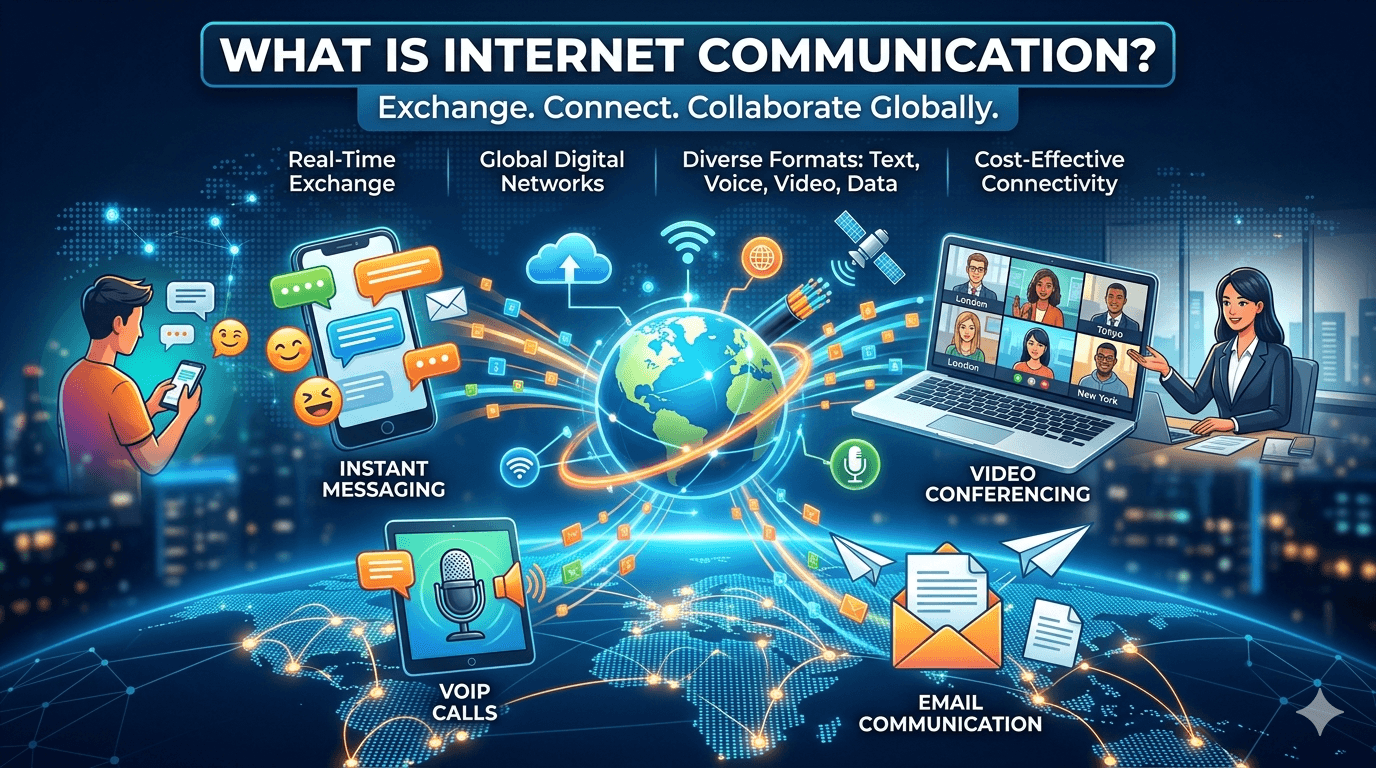
What is internet communication? It is the exchange of information, ideas, and data through digital networks and online protocols. This technology allows individuals and businesses to connect globally using various formats such as text, voice, video, and image sharing. By leveraging the internet, communication transcends geographical boundaries, enabling real-time interaction through platforms like email, instant messaging, and Voice over Internet Protocol (VoIP). Modern internet communication facilitates seamless collaboration, cost-effective global reach, and instant information dissemination, forming the backbone of digital society and contemporary business operations across the globe, ensuring that connectivity remains efficient and accessible to everyone.
Understanding Internet Communication
When exploring the core concept of what is internet communication, it is essential to recognize it as a vast ecosystem of interconnected devices and protocols. Unlike traditional analog systems that rely on physical wires or radio waves for direct point-to-point transmission, this digital approach breaks data into packets. These packets travel across various routers and servers before reassembling at the destination. This mechanism allows for a highly flexible and resilient way to share information, regardless of whether the users are in the same building or on opposite sides of the planet.
The concept of what is internet based communication encompasses every interaction that occurs over a network connection. From a simple text message sent via a mobile app to a complex multi-party video conference, the underlying technology remains focused on data transmission. This digital shift has fundamentally changed how we perceive distance and time. In the past, sending a letter across the ocean took weeks; today, an email arrives in milliseconds. This speed is a defining characteristic of our modern era, where information moves at the speed of light through fiber-optic cables and satellite links.
Furthermore, the online communication definition refers to the use of digital tools and platforms to facilitate dialogue. This includes synchronous methods, where parties interact in real-time, and asynchronous methods, where responses can happen at a later time. For businesses, understanding these distinctions is vital for maintaining productivity. By choosing the right medium for the right message, organizations can avoid communication fatigue and ensure that critical data is documented properly. The evolution of this field continues to push the boundaries of what is possible in human interaction.
Are Web-Based Communication and Internet Communication the Same?
While people often use these terms interchangeably, there is a technical distinction between the two. Internet communication is the broader category that includes any data transfer over the internet protocol suite. This includes things like file transfers via FTP, online gaming data, and even the background updates your computer downloads. Essentially, if a device uses an IP address to send data, it is engaging in some form of communication services on the internet. It is the infrastructure that supports the entire digital world.
Web-based communication, on the other hand, specifically refers to interactions that occur through a web browser using HTTP or HTTPS protocols. When you log into a webmail portal like Gmail or use a browser-based chat tool, you are using web-based communication. This is a subset of the larger internet communication world. Many modern applications now bridge this gap, using web technologies to deliver services that used to require dedicated software. This convergence has made digital interaction more accessible since users only need a browser to access a wide variety of communication web tools.
Understanding this difference helps in troubleshooting and selecting the right tools for specific tasks. For instance, a dedicated VoIP application might offer better audio quality and lower latency than a browser-based calling tool because it uses specialized internet communication protocols designed for real-time voice. However, web-based tools offer the advantage of not requiring installations, making them ideal for quick meetings with external clients. Both forms are integral to the modern internet business communication landscape, providing various layers of connectivity.
Why Internet Communication is Important
To understand what is the role of the internet in communication, one must look at the accessibility and democratization of information. Before the digital age, communication was often controlled by large gatekeepers like telecommunications monopolies or massive media conglomerates. Today, the internet has flattened this hierarchy. Anyone with a smartphone and a data connection can broadcast their message to a global audience. This shift has empowered individuals, revolutionized activism, and allowed small businesses to compete with global giants by reaching customers directly through internet based communication.
The role of the internet in communication also extends to the sheer volume of data we can now share. We are no longer limited to short text messages or voice calls. We can transmit high-definition video, massive datasets, and complex 3D models instantly. This capability is crucial for fields like telemedicine, where a specialist can examine a patient’s scans from thousands of miles away.
According to a research report by Market Research Future, the global VoIP market is projected to reach a significant valuation by 2030, growing at a steady CAGR as more organizations abandon traditional landlines in favor of communication services of internet providers.
Moreover, the internet fosters a sense of global community. It allows people with niche interests or specific professional needs to find each other and collaborate. This has led to the rise of open-source software, global research projects, and cross-cultural exchange that was previously unimaginable. The internet communication definition in a social context is about building bridges. It enables us to maintain relationships over long distances and stay informed about global events in real-time, making the world feel much smaller and more interconnected than ever before.
Types of Internet Communication
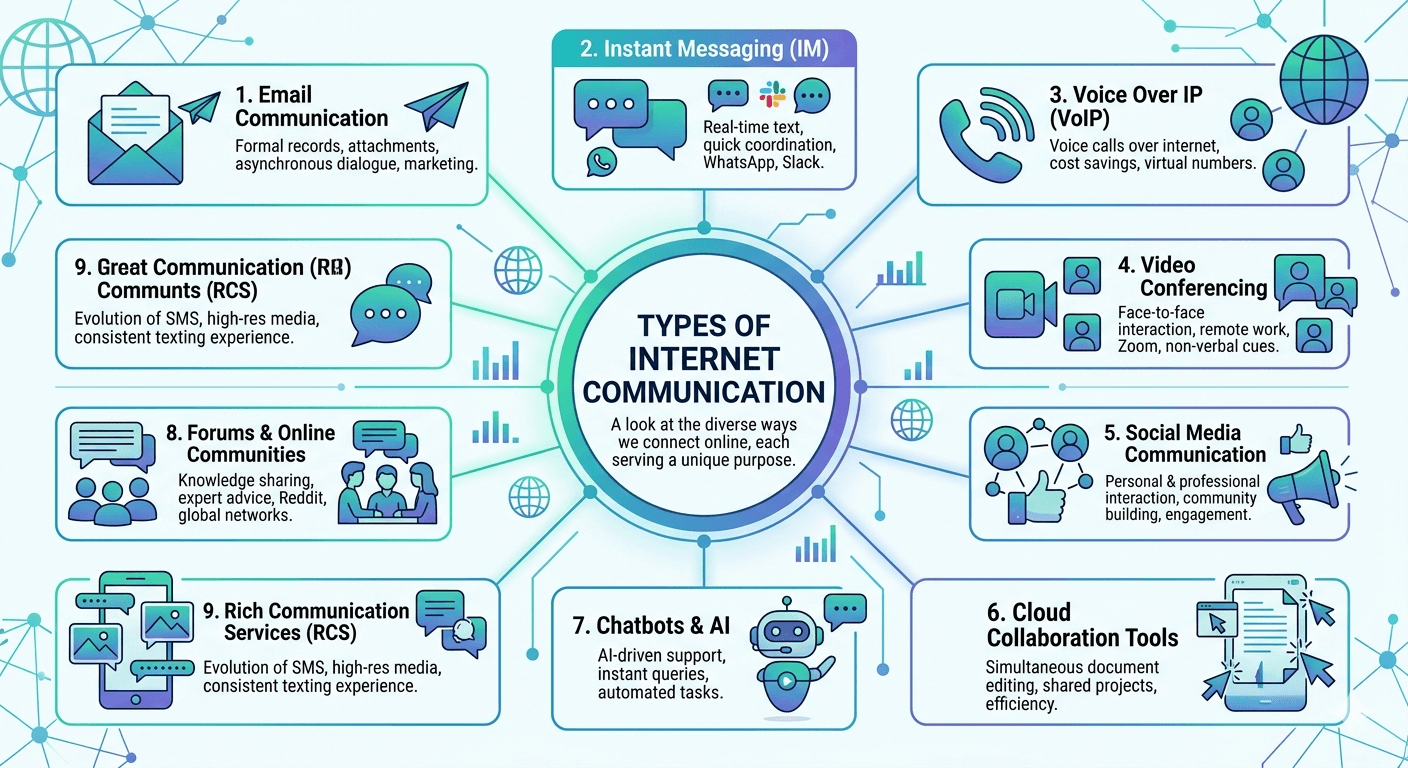
The variety of ways we connect online is staggering, with each method serving a unique purpose. As technology advances, these types often blend together, creating hybrid platforms that offer text, voice, and video in a single interface. However, identifying the distinct categories helps in understanding the full scope of internet communication.
1. Email Communication
Email remains the cornerstone of professional internet based communication. It serves as a formal record of dialogue and allows for the exchange of detailed information and attachments. Despite the rise of instant messaging, email is preferred for its asynchronous nature, allowing recipients to respond when it best fits their schedule. It is also a critical tool for marketing and newsletters, providing a direct line to a consumer’s inbox.
2. Instant Messaging (IM)
Instant messaging has transformed from a casual chat tool into a powerful business asset. Platforms like WhatsApp, Slack, and Microsoft Teams allow for rapid, real-time text exchanges. This type of communication on the internet is ideal for quick questions, team coordination, and reducing the clutter in one’s email inbox. Many IM services now include file sharing and status updates, making it easy to see when a colleague is available or busy.
3. Voice Over Internet Protocol (VoIP)
VoIP is a technology that allows you to make voice calls using a broadband internet connection instead of a regular phone line. This is a primary example of what is internet based communication in the modern office. VoIP offers significant cost savings, especially for international calls, and provides features like call forwarding, voicemail-to-email, and virtual numbers that can be used on any device.
4. Video Conferencing
Video conferencing has become an essential part of the modern workplace, especially with the rise of remote and hybrid work. Tools like Zoom and Google Meet allow for face-to-face interaction regardless of location. This form of online communications helps maintain the non-verbal cues that are often lost in text or voice-only interactions, such as facial expressions and body language, leading to better understanding and stronger team bonds.
5. Social Media Communication
Social media platforms like LinkedIn, X, and Facebook provide unique channels for both personal and professional interaction. They allow for the public or semi-public sharing of information and facilitate community building. In a business context, social media is used for customer engagement, brand building, and real-time crisis management. It is a dynamic form of internet communication where the audience can interact directly with the content creator.
6. Cloud Collaboration Tools
Cloud-based platforms like Google Workspace and Microsoft 365 have redefined how we work together. These tools allow multiple users to edit the same document, spreadsheet, or presentation simultaneously. This real-time collaboration is a sophisticated version of communication on the internet, where the “message” is the evolving document itself. It eliminates the need for back-and-forth file versions and ensures everyone is on the same page.
7. Chatbots and AI-Powered Communication
AI-driven chatbots are now a common feature on websites, providing instant customer support and lead generation. These bots use natural language processing to understand and respond to user queries. This represents a significant shift in what is internet communication, as humans are increasingly interacting with intelligent systems rather than other humans for routine tasks, freeing up human agents for more complex issues.
8. Forums and Online Communities
Forums like Reddit or specialized professional communities are vital for knowledge sharing. These platforms allow users to post questions and receive answers from a global pool of experts and peers. They serve as vast repositories of information and are a testament to the collaborative nature of internet based communication. Online communities often foster deep expertise and provide a sense of belonging to participants.
9. Rich Communication Services (RCS)
RCS is the evolution of traditional SMS, bringing many features of modern messaging apps to the default texting experience on mobile phones. This includes high-resolution image sharing, read receipts, and typing indicators. As carriers continue to adopt this standard, it simplifies the way we communicate over the internet by providing a consistent and feature-rich experience directly through the phone’s native messaging app.
Comparison Table: Types of Internet Communication
| Communication Type | Primary Use Case | Real-Time? | Best For |
| Formal correspondence | No | Documentation & official records | |
| Instant Messaging | Quick team updates | Yes | Rapid collaboration & informal chat |
| VoIP | Business phone calls | Yes | Cost-effective voice interaction |
| Video Conferencing | Virtual meetings | Yes | Face-to-face remote discussion |
| Social Media | Brand engagement | Semi | Community building & public updates |
| Cloud Tools | Document editing | Yes | Simultaneous project collaboration |
| Chatbots | Customer service | Yes | Automated support & FAQs |
| Forums | Knowledge sharing | No | Troubleshooting & peer advice |
Why Internet Communication Matters in 2026
As we look toward the mid-2020s, the importance of online communications has never been higher. The infrastructure of the global economy now rests almost entirely on digital pipes. A research study conducted by Stanford University highlighted that companies utilizing advanced internet communication tools reported a 20% increase in employee satisfaction compared to those relying on legacy systems. This is because modern tools reduce friction, making it easier for people to get their work done without unnecessary hurdles.
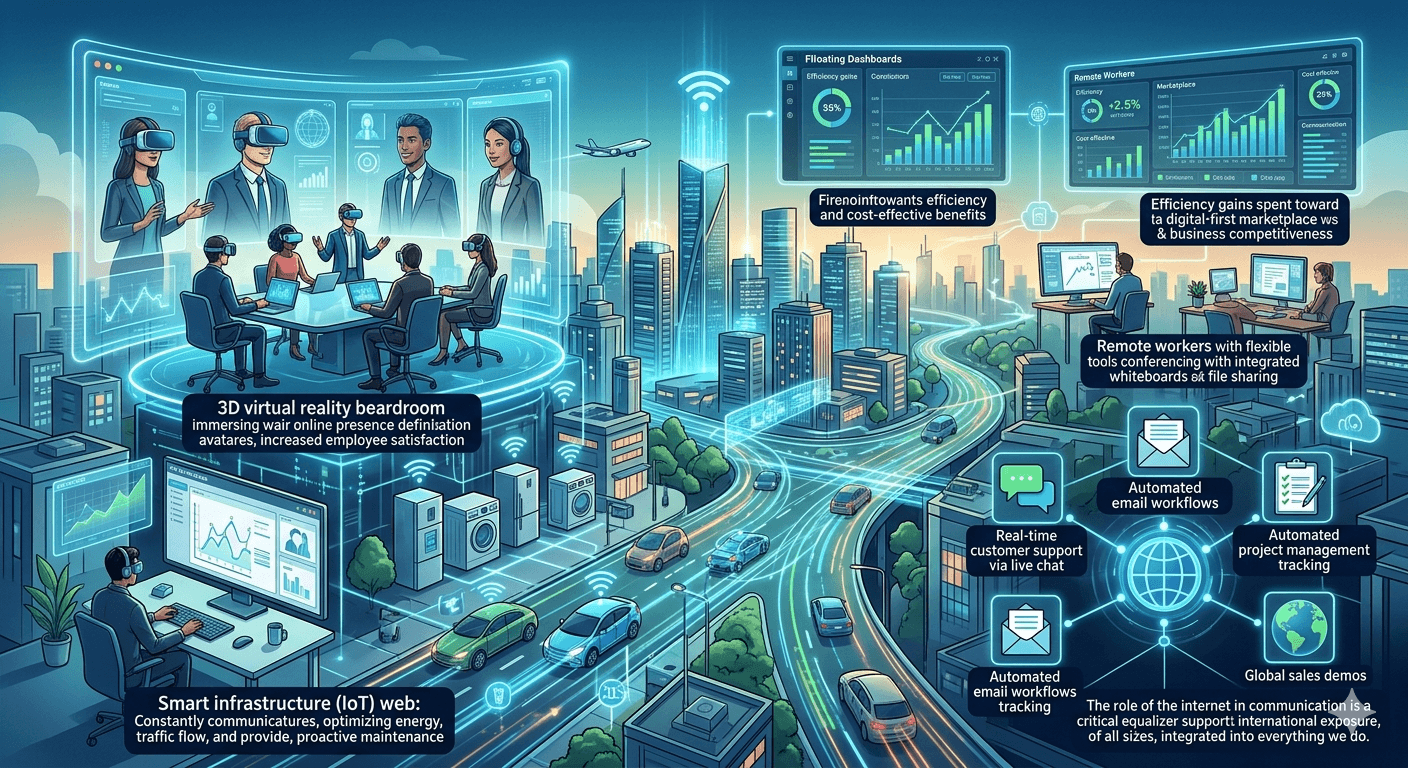
In 2026, the concept of “being online” is no longer a separate state of being; it is integrated into everything we do. The Internet of Things (IoT) means that our appliances, cars, and even city infrastructure are constantly communicating. This automated internet communication helps in managing energy consumption, optimizing traffic flow, and providing proactive maintenance for machinery. The role of the internet in communication has expanded from human-to-human interaction to a vast web of machine-to-machine dialogue that keeps our world running smoothly.
Furthermore, the rise of the metaverse and spatial computing is beginning to change our online communication definition once again. We are moving toward immersive environments where digital interaction feels more tactile and three-dimensional. Whether it’s a virtual boardroom or a digital social space, the way we project our presence online is becoming more sophisticated. Staying ahead of these trends is crucial for any business that wants to remain relevant in an increasingly digital-first marketplace.
Advantages of Internet Communication
The shift to digital interaction offers numerous benefits that have fundamentally improved our efficiency and connectivity. One of the most obvious advantages is the cost-effective nature of these tools. Traditional long-distance phone calls and physical mail are expensive and slow. In contrast, most forms of internet based communication cost a fraction of the price and provide instantaneous delivery. This allows businesses to reallocate funds toward innovation rather than just maintaining basic operations.
Another significant advantage is high flexibility. Internet communication allows people to work from anywhere, supporting the global trend toward remote work. This geographic independence means that companies can hire the best talent from around the world, regardless of where they live. It also gives employees a better work-life balance by reducing commute times and allowing for more flexible schedules. The ability to stay connected via mobile devices ensures that important information is never more than a few taps away, even when on the move.
Efficiency in group conversations is also a major plus. In the past, coordinating a meeting with ten people involved endless phone calls. Today, a single calendar invite or a group message can synchronize everyone instantly. Features like screen sharing and digital whiteboards during video calls make collaborative brainstorming much more productive than traditional speakerphone calls. These tools provide a central hub for information, ensuring that everyone has access to the latest updates and files, which significantly increases business competitiveness.
Business Use Cases of Internet Communication
In the corporate world, internet business communication is the lifeblood of daily activity. Customer support is one of the most prominent use cases. By using live chat and social media, companies can provide real-time assistance to customers, resolving issues quickly and improving brand loyalty. Automated email workflows also allow businesses to nurture leads and provide personalized content to their audience at scale, creating a more professional and responsive image.
Internal communication is equally transformed. Large enterprises use intranets and collaboration platforms to ensure that corporate strategy is communicated clearly across all departments. This helps in breaking down silos and fostering a culture of transparency. For project management, internet based communication tools allow managers to track progress, assign tasks, and provide feedback in real-time. This level of oversight ensures that projects remain on track and that potential bottlenecks are identified and addressed before they become major problems.
Marketing and sales teams rely heavily on digital communication to reach their targets. Through webinars, podcasts, and social media campaigns, businesses can establish themselves as thought leaders in their industry. Video conferencing is also used to conduct sales demos for clients around the world without the need for expensive travel. This broad reach allows even small startups to gain international exposure, proving that the role of the internet in communication is a powerful equalizer in the global economy.
Internet Communication vs Traditional Communication
When comparing digital methods to traditional communication, the differences are stark. Traditional communication, such as landline phones and physical mail, is often tied to a specific location. If you aren’t at your desk, you miss the call. Internet communication is tied to the user, not the device. Whether you are on your laptop, tablet, or smartphone, your digital identity travels with you. This mobility is a hallmark of modern online communications and is something that traditional systems simply cannot match.
Speed and capacity also favor the digital side. A traditional fax machine transmits one page at a time at a relatively slow speed. Digital file sharing can move gigabytes of data in seconds. While traditional face-to-face meetings have the advantage of physical presence, video conferencing offers a highly effective alternative that saves time and money. However, it is worth noting that traditional communication still holds value in building deep, personal rapport that can sometimes be harder to achieve through a screen.
The archiving and searchability of internet based communication are perhaps its greatest advantages over legacy systems. Every email, chat message, and shared document is indexed and searchable. In a traditional setting, finding a specific detail from a conversation six months ago might require digging through filing cabinets or relying on memory. In the digital world, a simple keyword search can bring up the exact information you need in seconds. This ability to capture and retrieve knowledge is vital for organizational intelligence and long-term success.
The Role of Cloud and CPaaS
The rise of cloud computing has been a major driver in the evolution of communication services on the internet. Instead of hosting expensive servers in-house, businesses now rent communication infrastructure from cloud providers. This “as-a-service” model allows for incredible scalability. If a business grows from ten employees to a thousand, the communication system can expand instantly without the need for new hardware. This flexibility is a key part of what is internet communication today.
Communication Platform as a Service (CPaaS) takes this a step further by providing developers with APIs (Application Programming Interfaces) to integrate communication features directly into their own software. For example, a ride-sharing app uses CPaaS to allow drivers and passengers to call or text each other within the app without revealing their personal phone numbers. This seamless integration of internet communication into other services is making our digital experiences more fluid and secure.
By leveraging the cloud, organizations can also ensure better reliability. Most major cloud communication providers operate out of multiple data centers globally. If one center goes down due to a natural disaster or power outage, the traffic is automatically rerouted to another. This level of redundancy is difficult and expensive for individual companies to achieve on their own. It ensures that business communication remains uninterrupted, which is critical for maintaining trust with clients and partners in a 24/7 global market.
Safety and Privacy in Internet Communication
As we become more dependent on digital interaction, the importance of safety and privacy in internet based communication cannot be overstated. Cybersecurity threats like phishing, malware, and data breaches are constant risks. To mitigate these, modern communication web tools employ end-to-end encryption, ensuring that only the intended sender and receiver can read the messages. This is especially important for sensitive industries like finance, healthcare, and law.
Users also need to be aware of their own digital footprint. Every interaction online leaves a trail of data that can be used by advertisers or, in worst-case scenarios, malicious actors. Understanding the online communication definition includes knowing how to manage privacy settings, use strong passwords, and enable multi-factor authentication. Businesses must also comply with data protection regulations like GDPR or CCPA, which dictate how they handle and store the communication data of their customers and employees.
Education and awareness are the best defenses against digital threats. Organizations should regularly train their staff on how to recognize suspicious emails and the importance of using secure networks for work communication. By fostering a culture of security, companies can enjoy the benefits of internet communication without exposing themselves to unnecessary risks. The goal is to create a digital environment where communication is not only fast and efficient but also safe and trustworthy for everyone involved.
Future Trends in Internet Communication
Looking ahead, the future of internet based communication will likely be shaped by the continued integration of Artificial Intelligence. We can expect real-time language translation in video calls to become a standard feature, breaking down the final barriers of global dialogue. Imagine a meeting where five participants speak five different languages, yet everyone understands each other perfectly through an AI-powered voice overlay. This is no longer science fiction; it is the next frontier of connectivity.
The integration of 5G and eventually 6G networks will provide the bandwidth and low latency required for more immersive experiences. This will likely lead to the widespread adoption of holographic communication, where a person can appear as a life-sized 3D projection in a remote location. This would combine the benefits of face-to-face interaction with the convenience of internet communication. As these technologies become more affordable, they will move from specialized industrial use cases into the mainstream consumer and business markets.
Finally, we will see a shift toward more decentralized communication protocols. Technologies like blockchain could be used to create messaging systems that are not owned by any single corporation, giving users total control over their data and identity. This move toward digital sovereignty will be a major topic of discussion as people look for ways to regain privacy in an increasingly monitored world. The journey of internet communication is far from over, and its next chapters promise to be even more transformative than the last.
Read More: Virtual Receptionist for Small Business: Efficiency, Cost-Savings, and Customer Retention.
Final Thoughts
The transformation brought about by digital connectivity is undeniable. When we ask what is internet communication, we are really asking about the future of human connection. From the early days of simple text-based emails to the immersive, AI-driven experiences of today, these tools have consistently worked to bring us closer together. They have redefined how we work, how we learn, and how we relate to one another on a global scale. By embracing these technologies while remaining mindful of privacy and security, we can continue to build a more collaborative and informed world.
FAQs Related to Internet Communication
What is internet communication?
Internet communication is the process of using digital networks and protocols to send and receive information in various formats like text, voice, video, and data. It allows for instant interaction across global distances using tools such as email, instant messaging, and VoIP.
What is the role of the internet in communication?
The internet acts as a global infrastructure that enables fast, cost-effective, and diverse ways to share information. It democratizes communication by allowing anyone to broadcast messages and facilitates real-time collaboration across different time zones and geographies.
What are the main types of Internet Communication?
The primary types include email for formal dialogue, instant messaging for quick updates, VoIP for voice calls, video conferencing for face-to-face meetings, and social media for community engagement and brand building.
Is internet communication secure?
While it can be vulnerable to cyber threats, most modern platforms use end-to-end encryption and multi-factor authentication to protect data. Users must remain vigilant against phishing and use secure networks to ensure their privacy.
What is the difference between Internet Communication and traditional communication?
Digital communication is faster, more cost-effective, and searchable, whereas traditional communication like physical mail is slower and often tied to a specific location. Internet methods also allow for much higher data capacity, such as high-definition video.
What is internet based communication in a business context?
In business, it refers to using digital tools for customer support, team collaboration, and marketing. This includes using VoIP for office phones, Slack for team chat, and Zoom for virtual client meetings, which increases overall operational efficiency.
How does VoIP improve internet communication?
VoIP allows for voice calls to be transmitted as data packets over the internet, significantly reducing costs for international calling. it also offers advanced digital features like virtual numbers and integration with other business software.
What are the 4 types of communication?
The four fundamental types of communication are verbal (speaking), non-verbal (body language), written (text/letters), and visual (images/charts). Internet communication utilizes all four of these types through various digital platforms.
How can I set up internet communication for my business?
Start by identifying your needs, such as a professional email service, a team chat app, and a reliable VoIP provider. Choose cloud-based platforms for easy scalability and ensure all tools are integrated to provide a seamless experience for your employees.